Set Another Table
September 28 - October 4, 2026
Formation Library → Sunday Table → Set Another Table
Builders at Work
The Sunday Table è scritto in due lingue, inglese e italiano. Per ogni sezione, il testo in inglese è seguito da quello in italiano.
Donations are tax deductible in the United States. We are Human Together or Not at All.
Cosiamo | Founder, UMANIAMO® | Humaning Architecture

The fourth week of REDISCOVER U® Humaning Workbook brings us through a movement to completion, but not to an ending. We began by recognizing what has been Authored in you. We then turned toward the person beside you and practiced noticing what your presence makes possible through relationships. Last week, as we approached Michaelmas, we explored what it means to Hold the Line Together when difference, pressure, uncertainty, and state enter the Room. This final week turns outward with a different kind of responsibility: Set Another Table.
The phrase can be taken literally: invite someone; make room; prepare food; pull up a chair. Create a place where another person can arrive without first having to prove their usefulness. Yet the Table is also an image of what happens when a person who has been humaned begins to create conditions in which someone else can become more capable of recognizing what has been Authored into them. This represents the Builder of Builders. Your work is not complete when you know yourself better, make better decisions, or become more grounded. The Magis appears when what has been vocated or formed in you becomes useful for the freedom and formation of another person.
This is where the D.E.E.P.E.R.™ Blueprint deserves a fuller place.
We often describe D.E.E.P.E.R. as a reflective practice, and while reflection is certainly built into it, it’s more than a method for looking backward. It is a practical architecture for moving from perception to responsible action while keeping discernment alive throughout the process. Builders need this because good intentions are not enough. A person may perceive clearly and still fail to act. They may act decisively without judging well. They may make a sound decision but never translate it into disciplined execution. They may execute successfully and never return to examine what the action actually produced. The Builder’s responsibility is to carry the whole movement.
Discernment comes first, but it’s not a single step that disappears once a decision is made. Ignatian discernment is better understood as a repeating loop of attention. You notice movements, patterns, consolations, desolations, resistance, desire, evidence, relationships, consequences, and fruit. You remain attentive to where something appears to be leading and to what may be moving you toward or away from greater freedom, truth, love, responsibility, and relationship with the Author.
In this sense, discernment is closer to seeing clearly enough to distinguish rather than simply decide. It is prospective because it notices direction and possibility, but it also returns continuously to the present reality. You are able to not only notice, “What is happening?” but also, “What is moving here, where might it lead, and what am I becoming as I move with it?”
Judgment follows, but judgment deserves to be rescued from the assumption that it means condemnation. Human judgment is the capacity to evaluate what has been discerned. It weighs what has become visible against values, responsibilities, relationships, evidence, conscience, and consequences. It asks whether something is rightly ordered and what effect a possible action may have on the people involved.
That makes judgment deeply relational. A technically efficient option may still be poor judgment if it diminishes the person. A logically defensible choice may still fail if the human consequences have been ignored. Judgment therefore requires more than intelligence. It requires the capacity to hold another Authored person within the scope of consideration.
Decision making is different again. Once reality has been discerned and evaluated, the person must choose. Decision making converts possibility into commitment by selecting a course among alternatives. Evidence matters here as do tradeoffs, constraints, resources, risks, probabilities, and consequences. Decision making narrows the field intentionally because eventually something must be chosen.
Yet a decision still does not change the world. That requires planned action. Planned action is the movement from “what should be done?” to “what, specifically, will be done?” It gives form to the choice. Responsibilities are assigned, sequence becomes visible, time is considered, dependencies are recognized, and the abstract decision becomes something capable of entering reality. This is where Structural thinking becomes particularly valuable because intention must acquire order if it is to survive contact with everyday life.
Then comes disciplined action: execution. Execution is where agency becomes visible. You may discern, judge, decide, and plan beautifully while remaining unchanged if you never cross into action. Execution is the moment when responsibility leaves the interior world and enters the shared one. The conversation is held. The boundary is stated. The call is made. The apology is offered. The new practice begins. The meeting is changed. The person is invited. The Table is actually set.
This distinction becomes important as we prepare to explore Agency versus Agent. An Authored human person possesses agency because the person is capable of perceiving, judging, choosing, acting, and bearing responsibility for what follows. An agent, whether human or technological, may perform actions toward a goal, but agency in the Humaning sense involves something deeper: authorship of response under moral responsibility.
That is why the Builder does not merely execute instructions. The Builder remains responsible throughout.
After execution comes Reflection, and here the loop begins again. What happened? What changed? What did the action produce in others and in me? What evidence appeared that was unavailable before action? Did the result strengthen agency or dependency? Did the relationship become more truthful, more capable, more free? Did what we built actually serve the greater good, or did something become distorted along the way?
Reflection returns us to discernment with new information. This is why D.E.E.P.E.R. is not a linear checklist. It is closer to a living cycle:
Discern → Judge → Decide → Plan → Execute → Reflect → Discern again.
The familiar D.E.E.P.E.R. sequence provides the practical language through which that movement can occur. Details keep us anchored in what is actually present. Evidence keeps interpretation accountable. Empathy preserves the human person inside the decision. Prospective allows us to see trajectory and possibility. Execution moves responsibility into action. Reflection examines the fruit and returns what has been learned to discernment.
Seen this way, D.E.E.P.E.R. becomes particularly important for the Builder of Builders because it can be practiced with another person without taking over their agency.
A Builder does not use D.E.E.P.E.R. to tell someone else what to think. The practice can instead create enough structure for the other person to see more clearly for themselves. What happened? What evidence supports that interpretation? Who is affected? Where might this lead? What action are you willing to take? What will you look for afterward?
Those questions do not replace judgment. They help another person exercise it.
This may also give us a useful connection to the different ways of thinking represented within Cognitive Advantage™. Conceptual thinking can be especially useful in prospective discernment because it notices patterns, possibilities, and what may not yet exist. Social thinking enriches judgment by keeping the relational and human consequences visible. Analytical thinking strengthens decision making by testing evidence, tradeoffs, and assumptions. Structural thinking gives form to planned and disciplined action by asking what must happen, in what order, by whom, and with what follow-through.
These are not rigid assignments of cognitive type to function. Every person uses all of these capacities to some degree, and discernment itself flows through the entire process. The value of the mapping is that it reminds us why no single way of thinking is sufficient. Builders who Build Builders do not merely seek people who think like themselves. They create enough room for different forms of attention to strengthen the whole movement from perception to action.
That is another reason to Set Another Table. The Table gives us somewhere to practice agency together. It provides a place where the person beside us can bring what they see without first surrendering it to the dominant voice. It allows disagreement to become information, judgment to remain relational, decisions to become shared responsibility, and action to become something that can be reflected upon rather than merely defended afterward.
By the fourth week, the REDISCOVER U® journey therefore turns outward. Self-knowledge becomes relational knowledge. Relational knowledge becomes sustainment. Sustainment becomes responsibility. Responsibility becomes action capable of creating another place where Humaning can occur.
The Builder does not complete the work by becoming impressive. The Builder completes the work by making another Builder more possible.
Set another Table.
Ad maiorem Dei gloriam.
We are human together, or not at all.
La quarta settimana del quaderno di lavoro “Humaning” di REDISCOVER U® ci accompagna in un percorso che porta al compimento, ma non alla fine. Abbiamo iniziato riconoscendo ciò che è stato “creato” in te. Ci siamo poi rivolti alla persona accanto a te e ci siamo esercitati a notare ciò che la tua presenza rende possibile attraverso le relazioni. La settimana scorsa, con l’avvicinarsi della festa di San Michele, abbiamo esplorato cosa significhi «tenere insieme la linea» quando la differenza, la pressione, l’incertezza e lo stato entrano nella Stanza. Questa settimana finale si rivolge verso l’esterno con un diverso tipo di responsabilità: Apparegliare un’altra tavola.
La frase può essere intesa letteralmente: invitare qualcuno; fare spazio; preparare da mangiare; avvicinare una sedia. Creare un luogo in cui un’altra persona possa arrivare senza dover prima dimostrare la propria utilità. Eppure la tavola è anche un’immagine di ciò che accade quando una persona che è stata trattata con umanità inizia a creare le condizioni in cui qualcun altro possa diventare più capace di riconoscere ciò che è stato inscritto in lui. Questo rappresenta il Costruttore dei Costruttori. Il tuo lavoro non è completo quando conosci meglio te stesso, prendi decisioni migliori o diventi più radicato. Il Magis appare quando ciò che è stato vocato o formato in te diventa utile per la libertà e la formazione di un’altra persona.
È qui che il modello D.E.E.P.E.R.™ merita un ruolo più centrale.
Spesso descriviamo D.E.E.P.E.R. come una pratica riflessiva e, sebbene la riflessione ne sia certamente parte integrante, è più di un semplice metodo per guardare al passato. È un’architettura pratica per passare dalla percezione all’azione responsabile, mantenendo vivo il discernimento durante l’intero processo. I Costruttori ne hanno bisogno perché le buone intenzioni non bastano. Una persona può percepire chiaramente e tuttavia non riuscire ad agire. Può agire con decisione senza valutare bene la situazione. Può prendere una decisione saggia ma non tradurla mai in un’esecuzione disciplinata. Può agire con successo e non tornare mai a esaminare ciò che l’azione ha effettivamente prodotto. La responsabilità del Costruttore è quella di portare avanti l’intero percorso.
Il discernimento viene prima di tutto, ma non è un singolo passo che scompare una volta presa una decisione. Il discernimento ignaziano va inteso piuttosto come un ciclo ripetitivo di attenzione. Si notano movimenti, schemi, consolazioni, desolazioni, resistenze, desideri, prove, relazioni, conseguenze e frutti. Si rimane attenti a dove qualcosa sembra condurre e a ciò che può spingere verso o allontanare da una maggiore libertà, verità, amore, responsabilità e relazione con l’Autore.
In questo senso, il discernimento è più vicino al vedere con sufficiente chiarezza per distinguere piuttosto che al semplice decidere. È prospettico perché coglie la direzione e le possibilità, ma ritorna anche continuamente alla realtà presente. Sei in grado non solo di notare: «Cosa sta accadendo?», ma anche: «Cosa si sta muovendo qui, dove potrebbe condurre e cosa sto diventando mentre mi muovo con esso?».
Segue il giudizio, ma il giudizio merita di essere liberato dal presupposto che significhi condanna. Il giudizio umano è la capacità di valutare ciò che è stato discernuto. Soppesa ciò che è diventato visibile alla luce di valori, responsabilità, relazioni, prove, coscienza e conseguenze. Si chiede se qualcosa sia correttamente ordinato e quale effetto una possibile azione possa avere sulle persone coinvolte.
Ciò rende il giudizio profondamente relazionale. Un’opzione tecnicamente efficiente può comunque rappresentare un giudizio errato se sminuisce la persona. Una scelta logicamente difendibile può comunque fallire se le conseguenze umane sono state ignorate. Il giudizio richiede quindi più dell’intelligenza. Richiede la capacità di tenere conto, nell’ambito della propria riflessione, di un’altra persona creata da Dio.
Il processo decisionale è ancora diverso. Una volta che la realtà è stata discernuta e valutata, la persona deve scegliere. Il processo decisionale trasforma la possibilità in impegno selezionando una linea d’azione tra le alternative. In questo contesto contano le prove, così come i compromessi, i vincoli, le risorse, i rischi, le probabilità e le conseguenze. Il processo decisionale restringe intenzionalmente il campo perché, alla fine, qualcosa deve essere scelto.
Eppure una decisione da sola non cambia il mondo. Ciò richiede un’azione pianificata. L’azione pianificata è il passaggio da «cosa si dovrebbe fare?» a «cosa, nello specifico, si farà?». Dà forma alla scelta. Vengono assegnate le responsabilità, la sequenza diventa visibile, si tiene conto del tempo, si riconoscono le dipendenze e la decisione astratta diventa qualcosa in grado di entrare nella realtà. È qui che il pensiero strutturale diventa particolarmente prezioso, perché l’intenzione deve acquisire un ordine se vuole sopravvivere al contatto con la vita quotidiana.
Poi arriva l’azione disciplinata: l’esecuzione. È nell’esecuzione che l’agire diventa visibile. Si può discernere, giudicare, decidere e pianificare magnificamente pur rimanendo immutati se non si passa mai all’azione. L’esecuzione è il momento in cui la responsabilità lascia il mondo interiore ed entra in quello condiviso. La conversazione ha luogo. Il confine viene stabilito. La chiamata viene effettuata. Le scuse vengono offerte. La nuova pratica ha inizio. L’incontro viene trasformato. La persona viene invitata. La tavola viene effettivamente apparecchiata.
Questa distinzione diventa importante mentre ci prepariamo a esplorare il tema Agency contro Agente. Una persona umana «autrice» possiede l’agenzia perché è capace di percepire, giudicare, scegliere, agire e assumersi la responsabilità di ciò che ne consegue. Un agente, sia esso umano o tecnologico, può compiere azioni volte a un obiettivo, ma l’agenzia nel senso di «Humaning» implica qualcosa di più profondo: l’autorialità della risposta sotto la responsabilità morale.
Ecco perché il Costruttore non si limita a eseguire istruzioni. Il Costruttore rimane responsabile per tutto il tempo.
Dopo l’esecuzione arriva la Riflessione, e qui il ciclo ricomincia. Cosa è successo? Cosa è cambiato? Che effetto ha avuto l’azione sugli altri e su di me? Quali prove sono emerse che prima dell’azione non erano disponibili? Il risultato ha rafforzato l’autodeterminazione o la dipendenza? La relazione è diventata più sincera, più capace, più libera? Ciò che abbiamo costruito ha effettivamente servito il bene comune, o qualcosa si è distorto lungo il percorso?
La riflessione ci riporta al discernimento con nuove informazioni. Ecco perché D.E.E.P.E.R. non è una lista di controllo lineare. È più simile a un ciclo vivente:
Discernere → Giudicare → Decidere → Pianificare → Eseguire → Riflettere → Discernere di nuovo.
La familiare sequenza D.E.E.P.E.R. fornisce il linguaggio pratico attraverso il quale quel movimento può avvenire. I dettagli ci mantengono ancorati a ciò che è effettivamente presente. L'evidenza garantiscono che l’interpretazione sia responsabile. L’empatia preserva la persona umana all’interno della decisione. La prospettiva ci permette di vedere la traiettoria e le possibilità. L’esecuzione trasforma la responsabilità in azione. La riflessione esamina i frutti e restituisce ciò che è stato appreso al discernimento.
Visto in questo modo, D.E.E.P.E.R. diventa particolarmente importante per il Costruttore di Costruttori perché può essere praticato con un’altra persona senza sostituirsi alla sua autonomia.
Un Costruttore non usa D.E.E.P.E.R. per dire a qualcun altro cosa pensare. La pratica può invece creare una struttura sufficiente affinché l’altra persona veda più chiaramente da sé. Cosa è successo? Quali prove sostengono quell’interpretazione? Chi ne è coinvolto? Dove potrebbe portare tutto questo? Quale azione sei disposto a intraprendere? Cosa cercherai in seguito?
Queste domande non sostituiscono il giudizio. Aiutano l’altra persona a esercitarlo.
Questo può anche fornirci un utile collegamento con i diversi modi di pensare rappresentati all’interno di Cognitive Advantage™. Il pensiero concettuale può essere particolarmente utile nel discernimento prospettico perché individua schemi, possibilità e ciò che potrebbe non esistere ancora. Il pensiero sociale arricchisce il giudizio mantenendo visibili le conseguenze relazionali e umane. Il pensiero analitico rafforza il processo decisionale verificando le prove, i compromessi e le ipotesi. Il pensiero strutturale dà forma all’azione pianificata e disciplinata chiedendosi cosa debba accadere, in quale ordine, da chi e con quale seguito.
Non si tratta di assegnazioni rigide di un tipo cognitivo a una funzione. Ogni persona utilizza tutte queste capacità in una certa misura, e il discernimento stesso permea l’intero processo. Il valore di questa mappatura sta nel ricordarci perché nessun singolo modo di pensare è sufficiente. I «Costruttori che formano Costruttori» non cercano semplicemente persone che la pensino come loro. Creano spazio sufficiente per diverse forme di attenzione, al fine di rafforzare l’intero movimento dalla percezione all’azione.
Questo è un altro motivo per «Approntare un’altra tavola». La tavola ci offre un luogo dove esercitare insieme la nostra capacità di agire. Fornisce uno spazio in cui la persona accanto a noi possa portare ciò che vede senza doverlo prima cedere alla voce dominante. Permette al disaccordo di diventare informazione, al giudizio di rimanere relazionale, alle decisioni di diventare responsabilità condivisa e all’azione di diventare qualcosa su cui riflettere piuttosto che limitarsi a difenderla a posteriori.
Entro la quarta settimana, il percorso REDISCOVER U® si rivolge quindi verso l’esterno. La conoscenza di sé diventa conoscenza relazionale. La conoscenza relazionale diventa sostegno. Il sostegno diventa responsabilità. La responsabilità diventa azione capace di creare un altro luogo in cui possa avvenire l’Essere Umani.
Il Costruttore non completa l’opera diventando impressionante. Il Costruttore completa l’opera rendendo più possibile la nascita di un altro Costruttore.
Appreparate un’altra tavola.
Ad maiorem Dei gloriam.
Siamo umani insieme, Siamo umani insieme o non lo siamo affatto.
This is the fourth week where we leverage the REDISCOVER U® Humaning Workbook. Last week we focused on Holding the Line.
This week we move deeper again to Set Another Table or Leading Across
Know Yourself → Know the Person Beside You → Hold the Line Together → Set Another Table.
If you do not have a physical REDISCOVER U® deck you may order the complete deck, however, we have linked a digital version of the card images for each card which will be available during the next two weeks along with the REDISCOVER U® Humaning Workbook. Don’t try to complete the workbook all at once. Move slowly and let the cards open what they open, let some ache, and let others remain quiet.
The purpose is not to construct a better identity. It is to recognize what has already been Authored and learn to carry it responsibly in relationship with others.
REDISCOVER U® Humaning – SettembreQuesta è la quarta settimana in cui utilizziamo il quaderno di esercizi REDISCOVER U® Humaning. La settimana scorsa ci siamo concentrati sul tema “Mantenere la rotta”.Questa settimana approfondiamo ulteriormente il tema “Preparare un altro tavolo” o “Guidare oltre”.Conosci te stesso → Conosci la persona accanto a te → Mantenete insieme la rotta → Preparate un altro tavolo.Se non disponete di un mazzo fisico di REDISCOVER U®, potete ordinare il mazzo completo; tuttavia, abbiamo inserito un link alla versione digitale delle immagini di ciascuna carta, che sarà disponibile nelle prossime due settimane insieme al quaderno di esercizi REDISCOVER U® Humaning. Non cercate di completare il quaderno tutto in una volta. Procedete lentamente e lasciate che le carte rivelino ciò che hanno da rivelare, lasciate che alcune provocino un po’ di dolore e che altre rimangano in silenzio.Lo scopo non è quello di costruire un’identità migliore. È quello di riconoscere ciò che è già stato creato e imparare a portarlo con responsabilità nelle relazioni con gli altri.
October 4th

The distinction between agency and agent becomes much clearer when it is placed inside the Ignatian tradition from which D.E.E.P.E.R.™ emerged.
An agent can: execute; carry instructions, represent an interest, perform a task, pursue an objective, and increasingly do so with remarkable sophistication. However, agency is different. Within Humaning, agency belongs to the Authored person because the humaned person can perceive, discern, judge, choose, act, reconsider, repent, repair, and accept responsibility for what follows. The person can author a response while remaining conscious that they are not the Author.
That relationship between the Authored and the Author is precisely why Ignatian spirituality sits so centrally within UMANIAMO®. The Spiritual Exercises of St. Ignatius of Loyola don’t form a person only to perform the correct behaviors. On the contrary, they cultivate interior freedom so that the person can notice what is moving within and around them, distinguish among those movements, and choose more freely what leads toward the end for which the person has been created. Ignatius recognized the summative nature of the exercises as the praise, reverence, and service of God. That is already a doctrine of agency.
A humaned person is neither a passive recipient of circumstances nor a sovereign self who invents reality. The person is Authored, placed in relationship with God, and entrusted with the responsibility to discern among what is presented to them. Freedom exists, but freedom is ordered toward relationship, responsibility, and ultimately Ad Majorem Dei Gloriam.
This is why the Examen is much deeper than a daily review.
Ignatius explicitly called one form the General Examen of Conscience. Its five movements begin with gratitude to God, continue through a request for grace to know one’s faults, review thoughts, words, and actions, seek forgiveness, and conclude with a purpose of amendment through grace. The Particular Examen similarly observes patterns over time and looks for evidence of amendment rather than treating reflection as an end in itself.
The movement is therefore not merely backward-looking; but also relational and prospective. The person returns to experience in the presence of God so that future action can become freer and more rightly ordered.
Historically, the Latin examen is associated with ex-agmen/ex-ago and developed meanings including a swarm, the tongue or pointer of a balance, and, figuratively, a weighing, consideration, or examination. The related Latin verb examino means to weigh, ponder, test, or examine. In fact, the authentic Latin translation provides a richer understanding for D.E.E.P.E.R.: the Examen is a weighing.
Yet the word Ex Amen is a powerful contemplative wordplay, in which an echo of movement from the interior toward amen or from what has been experienced, noticed, weighed, and discerned toward a freely given affirmation before the Author. In that spiritual sense, Amen is not merely agreement with an external command. It is a consent that has passed through the interior person.
That distinction matters enormously in the age of agents. An agent can say yes because it has been instructed to proceed. A person with agency can arrive at Amen after discernment. The first is execution; the second can be consent.
The Devil at Work seeks to obscure this distinction. His lantern does not have to eliminate choice. It only has to direct attention so thoroughly that the person mistakes a field authored elsewhere for their own discernment. The institution, ideology, market, social network, charismatic leader, or machine may gradually become the practical source of meaning, judgment, permission, and direction. The individual remains active but increasingly functions as an agent of an architecture they did not examine.
Ignatian spirituality interrupts that momentum. The Authored person returns from the noise of the day to the relationship that precedes every other relationship. Experience is brought before the Author and weighed. What moved me? What did I follow? Where was I free? Where was I driven by fear, appetite, approval, resentment, pride, or borrowed certainty? What produced consolation, greater faith, hope, love, freedom, and service? What narrowed me? What needs repair? What should change when I enter the world again?
D.E.E.P.E.R.™ takes that ancient Ignatian movement and gives it a practical Neuro-Ignatian architecture suited to the complexity of contemporary life. It does not replace the Examen. It extends its logic into the places where human beings must discern, judge, decide, act, and learn.
This week’s discussion moves beneath the question of whether we are active and toward the deeper question of who or what is authoring our response. The Examen reminds us that freedom is not simply having choices. It is the capacity to bring experience before the Author, weigh what is moving within and around us, and arrive at a response that has passed through discernment, conscience, and responsibility.
Where in your life are you exercising genuine agency, and where might you simply be functioning as an agent? Think about work, family, faith, technology, politics, relationships, or daily habits. Where are you perceiving, discerning, judging, and choosing for yourself? Where might you be carrying an instruction, expectation, narrative, or definition that you have never really examined? What changes when you ask not only, “What am I doing?” but “What is moving me?”
What would you discover if you brought one important choice before the Author and truly weighed it? Consider the deeper meaning of the Examen as a weighing. What are the Details? What Evidence supports or challenges your interpretation? Who must remain visible through Empathy? Where does the pattern lead when viewed Prospectively? Before moving to Execution, what does your conscience recognize that urgency, approval, fear, habit, or convenience may be obscuring? What would a freely discerned Amen sound like in this situation?
Who or what currently has the greatest influence over the space between you, the Authored, and the Author? The influence itself may be useful: a leader, institution, tradition, community, technology, expert, friend, or even a Builder. The question is whether it assists your discernment or gradually replaces it. What helps you remain teachable without becoming dependent, supported without surrendering judgment, and accompanied without allowing another person or system to become the practical author of your conscience?
The purpose of these questions is not to make us suspicious of every influence. None of us discerns alone. The Table, the Church, Scripture, tradition, evidence, companions, and other Builders can all help us see what we cannot see for ourselves. The deeper discipline is learning to distinguish companionship from substitution. A companion helps us return to the Author with greater freedom. A substitute quietly teaches us to return to them for the answer. That may be one of the most important tests of Buildership: Does my presence strengthen another person’s capacity to discern before the Author, or does it make my judgment increasingly necessary to them?
Sunday Table Invitation: Make sure the quiet ones speak… the children, the teenagers, the person on the edge of the table. Children still have unmanufactured enthusiasm; they have not yet learned to perform it, and watching how freely it moves in them can teach the rest of us what we lost. If young people are present, offer them a notebook and one question: What is something that makes you feel really alive, the kind of alive you don't have to fake?
Humaning is something we do together, and then carry out the door. This week the circle practices agency: noticing what is moving us, what may be speaking too loudly into our judgment, and how to return to the Author with greater freedom. Gather a few people and take it slowly.
First, go around once. Each person names one place in life where they currently feel genuinely free to choose and act with responsibility. It may be in work, family, faith, friendship, or a decision still unfolding. Say what makes that freedom feel real.
Then go around again, more honestly. Each person names one place where they may be acting more like an agent than exercising agency. Perhaps they are carrying an expectation, repeating a story, following a system, or reacting from fear, approval, habit, or pressure. Do not solve it. Just name where the choice may not feel fully their own.
Then help one another weigh one thing. For one person at a time, let the circle ask: What is actually happening? What evidence matters? Who is affected? Where might this lead? What does your conscience recognize? Do not give the answer. Help the person hear their own discernment more clearly.
Then close by noticing what has happened in the room. Agency grows when people are accompanied without being possessed, challenged without being controlled, and supported without someone else becoming the author of their decision.
So this is the practice: notice what is moving you, weigh it carefully, return it to the Author, and let your yes become a real Amen rather than mere compliance. Then carry that freedom out the door and help someone else become more capable of doing the same.
End however your circle ends with a prayer, a blessing, or shared silence. Then go, act freely, and help another person remain free.
Ad maiorem Dei gloriam.
We are human together or not at all.
4 ottobre
La distinzione tra agenzia e agente diventa molto più chiara quando viene collocata all’interno della tradizione ignaziana da cui è nato D.E.E.P.E.R.™.
Un agente può: eseguire; seguire istruzioni, rappresentare un interesse, svolgere un compito, perseguire un obiettivo e farlo in modo sempre più sofisticato. Tuttavia, l’azione è diversa. Nell’ambito dell’Humaning, l’azione appartiene alla persona “creata”, poiché la persona che vive l’Humaning è in grado di percepire, discernere, giudicare, scegliere, agire, riconsiderare, pentirsi, riparare e assumersi la responsabilità di ciò che ne consegue. La persona può dare vita a una risposta pur rimanendo consapevole di non essere l’Autore.
Quel rapporto tra la persona “creata” e l’Autore è proprio il motivo per cui la spiritualità ignaziana occupa un posto così centrale all’interno di UMANIAMO®. Gli Esercizi Spirituali di Sant’Ignazio di Loyola non formano una persona solo per indurla ad adottare comportamenti corretti. Al contrario, coltivano la libertà interiore affinché la persona possa notare ciò che si muove dentro di sé e intorno a sé, distinguere tra quei movimenti e scegliere più liberamente ciò che conduce verso il fine per cui è stata creata. Ignazio riconosceva la natura sintetica degli esercizi come lode, riverenza e servizio a Dio. Questa è già una dottrina dell’autonomia.
Una persona che vive secondo UMANIAMO® non è né un destinatario passivo delle circostanze né un sé sovrano che inventa la realtà. La persona è creata da Dio, posta in relazione con Lui e a cui è affidata la responsabilità di discernere tra ciò che le viene presentato. La libertà esiste, ma è orientata verso la relazione, la responsabilità e, in ultima analisi, Ad Majorem Dei Gloriam.
Ecco perché l’Esame è molto più profondo di una semplice revisione quotidiana.
Ignazio definì esplicitamente una di queste forme l’Esame Generale di Coscienza. I suoi cinque momenti iniziano con la gratitudine verso Dio, proseguono con la richiesta di grazia per riconoscere i propri difetti, passano attraverso la revisione dei pensieri, delle parole e delle azioni, cercano il perdono e si concludono con il proposito di emendamento attraverso la grazia. L’Esame Particolare, analogamente, osserva gli schemi nel tempo e cerca segni di emendamento, piuttosto che considerare la riflessione come un fine a sé stessa.
Il movimento non è quindi semplicemente rivolto al passato, ma è anche relazionale e proiettato verso il futuro. La persona ritorna all’esperienza alla presenza di Dio affinché l’azione futura possa diventare più libera e più correttamente ordinata.
Storicamente, il termine latino examen è associato a ex-agmen/ex-ago e ha sviluppato significati che includono uno sciame, la lingua o l’ago di una bilancia e, in senso figurato, una soppesatura, una considerazione o un esame. Il verbo latino correlato examino significa soppesare, ponderare, mettere alla prova o esaminare. Infatti, l’autentica traduzione latina offre una comprensione più ricca di D.E.E.P.E.R.: l’Examen è una soppesatura.
Eppure la parola Ex Amen è un potente gioco di parole contemplativo, in cui risuona un’eco di movimento dall’interiorità verso l’amen o da ciò che è stato vissuto, notato, soppesato e discernuto verso un’affermazione liberamente offerta davanti all’Autore. In quel senso spirituale, Amen non è semplicemente un’adesione a un comando esterno. È un consenso che è passato attraverso la persona interiore.
Questa distinzione è di enorme importanza nell’era degli agenti. Un agente può dire sì perché gli è stato ordinato di procedere. Una persona dotata di autonomia può giungere all’Amen dopo il discernimento. Il primo è esecuzione; il secondo può essere consenso.
Il diavolo al lavoro cerca di offuscare questa distinzione. La sua lanterna non deve necessariamente eliminare la scelta. Deve solo dirigere l’attenzione in modo così completo che la persona scambi un campo creato altrove per il proprio discernimento. L’istituzione, l’ideologia, il mercato, il social network, il leader carismatico o la macchina possono gradualmente diventare la fonte pratica di significato, giudizio, permesso e direzione. L’individuo rimane attivo ma funziona sempre più come agente di un’architettura che non ha esaminato.
La spiritualità ignaziana interrompe questo slancio. La persona «creata» ritorna dal frastuono della giornata alla relazione che precede ogni altra relazione. L’esperienza viene portata davanti all’Autore e soppesata. Cosa mi ha commosso? Cosa ho seguito? Dove ero libero? Dove sono stato spinto dalla paura, dall’appetito, dall’approvazione, dal risentimento, dall’orgoglio o da una certezza presa in prestito? Cosa ha prodotto consolazione, maggiore fede, speranza, amore, libertà e servizio? Cosa mi ha limitato? Cosa ha bisogno di essere riparato?
Cosa dovrebbe cambiare quando rientro nel mondo?
D.E.E.P.E.R.™ riprende quell’antico movimento ignaziano e gli conferisce un’architettura pratica neuro-ignaziana adatta alla complessità della vita contemporanea. Non sostituisce l’Esame. Ne estende la logica ai luoghi in cui gli esseri umani devono discernere, giudicare, decidere, agire e imparare.
La discussione di questa settimana va oltre la domanda se siamo attivi e si spinge verso la domanda più profonda: chi o cosa sta determinando la nostra risposta. L’Esame ci ricorda che la libertà non è semplicemente avere delle scelte. È la capacità di portare l’esperienza davanti all’Autore, soppesare ciò che si muove dentro e intorno a noi e giungere a una risposta che sia passata attraverso il discernimento, la coscienza e la responsabilità.
In quali ambiti della tua vita stai esercitando una vera autonomia, e in quali potresti semplicemente agire come un esecutore? Pensa al lavoro, alla famiglia, alla fede, alla tecnologia, alla politica, alle relazioni o alle abitudini quotidiane. Dove stai percependo, discernendo, giudicando e scegliendo per te stesso? Dove potresti portare con te un’istruzione, un’aspettativa, una narrazione o una definizione che non hai mai davvero esaminato? Cosa cambia quando ti chiedi non solo: “Cosa sto facendo?” ma “Cosa mi sta muovendo? »
Cosa scopriresti se portassi una scelta importante davanti all’Autore e la soppesassi veramente? Considera il significato più profondo dell’Esame come un soppeso. Quali sono i dettagli? Quali prove sostengono o mettono in discussione la tua interpretazione? Chi deve rimanere visibile attraverso l’empatia? Dove conduce lo schema se osservato in prospettiva? Prima di passare all’esecuzione, cosa riconosce la tua coscienza che l’urgenza, l’approvazione, la paura, l’abitudine o la convenienza potrebbero oscurare? Come suonerebbe un Amenliberamente discernuto in questa situazione?
Chi o cosa ha attualmente la maggiore influenza sullo spazio tra te, l’Autore e l’Opera? L’influenza in sé può essere utile: un leader, un’istituzione, una tradizione, una comunità, la tecnologia, un esperto, un amico o persino un Costruttore. La domanda è se essa aiuti il tuo discernimento o lo sostituisca gradualmente. Cosa ti aiuta a rimanere aperto all’insegnamento senza diventare dipendente, sostenuto senza rinunciare al giudizio, e accompagnato senza permettere che un’altra persona o un sistema diventi l’autore effettivo della tua coscienza?
Lo scopo di queste domande non è quello di renderci sospettosi di ogni influenza. Nessuno di noi discerne da solo. La Tavola, la Chiesa, la Scrittura, la tradizione, le prove, i compagni e altri Costruttori possono tutti aiutarci a vedere ciò che non riusciamo a vedere da soli. La disciplina più profonda consiste nell’imparare a distinguere la compagnia dalla sostituzione. Un compagno ci aiuta a tornare all’Autore con maggiore libertà. Un sostituto ci insegna silenziosamente a rivolgerci a lui per avere la risposta. Questa potrebbe essere una delle prove più importanti dell’essere Costruttori: La mia presenza rafforza la capacità di un’altra persona di discernere davanti all’Autore, o rende il mio giudizio sempre più necessario per lei?
Invito alla tavola domenicale: Assicuratevi che parlino i più silenziosi… i bambini, gli adolescenti, la persona seduta ai margini del tavolo. I bambini hanno ancora un entusiasmo genuino; non hanno ancora imparato a metterlo in scena, e osservare con quanta libertà si muove in loro può insegnare a tutti noi ciò che abbiamo perso. Se sono presenti dei giovani, offrite loro un quaderno e una domanda: Qual è una cosa che ti fa sentire davvero vivo, quel tipo di vitalità che non devi fingere?
L’Humaning è qualcosa che facciamo insieme e che poi portiamo fuori dalla porta. Questa settimana il cerchio si esercita nell’autodeterminazione: notando ciò che ci muove, ciò che potrebbe influenzare troppo il nostro giudizio, e come tornare all’Autore con maggiore libertà. Radunate alcune persone e procedete con calma.
Per prima cosa, fate un giro completo. Ogni persona indica un ambito della propria vita in cui attualmente si sente sinceramente libera di scegliere e agire con responsabilità. Può trattarsi del lavoro, della famiglia, della fede, dell’amicizia o di una decisione ancora in fase di definizione. Spiegate cosa rende reale quella libertà.
Poi fate un altro giro, con maggiore onestà. Ogni persona indichi un ambito in cui potrebbe agire più come un semplice esecutore che come soggetto attivo. Forse sta assecondando un’aspettativa, ripetendo una storia, seguendo un sistema, o reagendo per paura, desiderio di approvazione, abitudine o pressione. Non cercate di risolvere la questione. Limitatevi a indicare dove la scelta potrebbe non sembrare pienamente propria.
Poi aiutatevi a vicenda a valutare un aspetto. Per una persona alla volta, lasciate che il cerchio chieda: Cosa sta realmente accadendo? Quali prove contano? Chi ne è coinvolto? Dove potrebbe portare tutto questo? Cosa riconosce la tua coscienza? Non date la risposta. Aiutate la persona a sentire più chiaramente il proprio discernimento.
Concludete poi osservando ciò che è accaduto nella stanza. La capacità di agire cresce quando le persone vengono accompagnate senza essere possedute, sfidate senza essere controllate e sostenute senza che qualcun altro diventi l’autore della loro decisione.
Ecco quindi la pratica: osservate ciò che vi muove, valutatelo attentamente, restituitelo all’Autore e lasciate che il vostro sì diventi un vero Amen piuttosto che una mera obbedienza. Portate poi quella libertà fuori dalla porta e aiutate qualcun altro a diventare più capace di fare lo stesso.
Concludi comunque il tuo circolo con una preghiera, una benedizione o un silenzio condiviso. Poi vai, agisci liberamente e aiuta un’altra persona a rimanere libera.
Ad maiorem Dei gloriam.
Siamo umani insieme o non lo siamo affatto.
A Blueprint for the Builder at Work
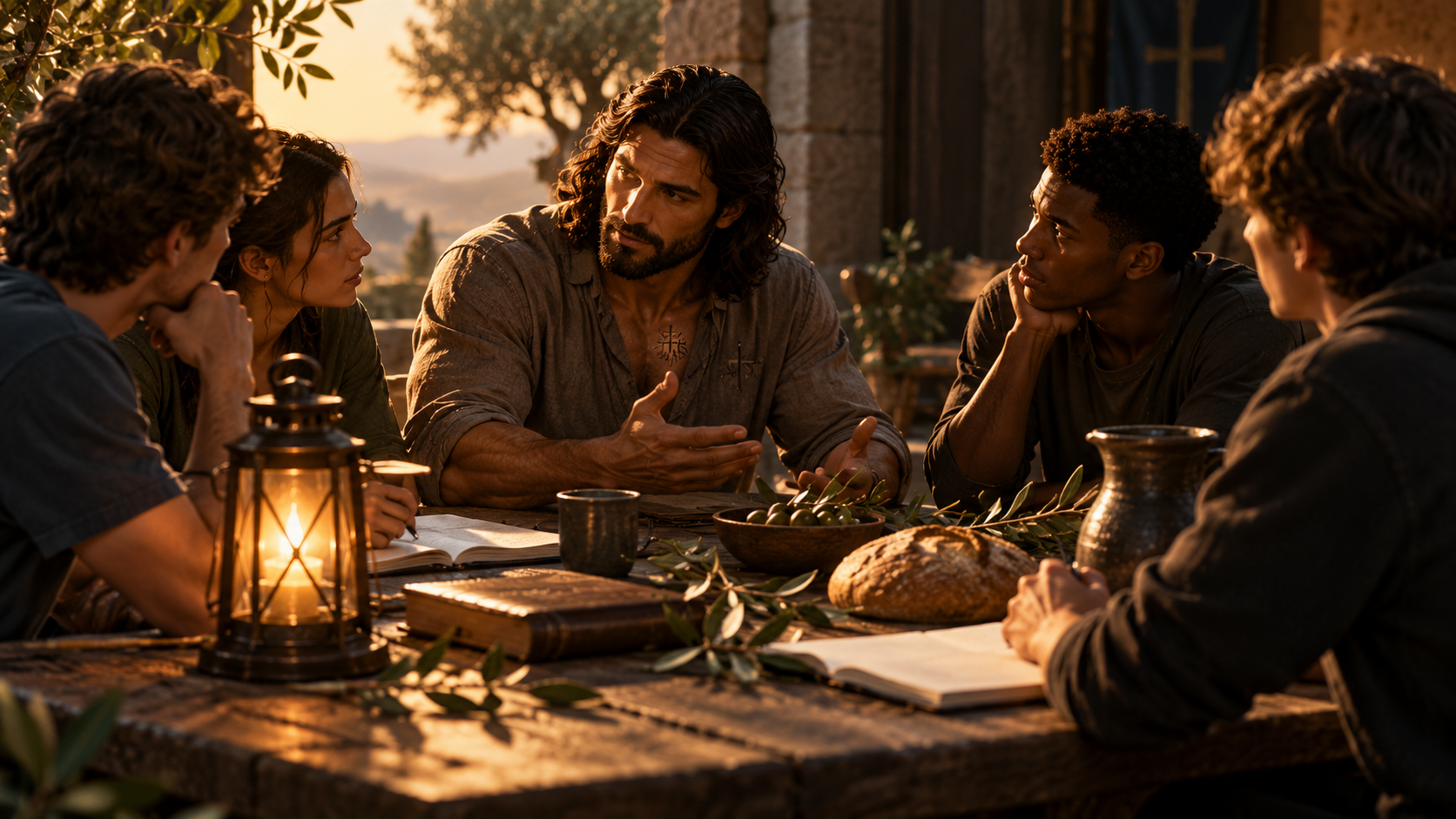
A Builder does not complete the work by becoming more insightful, more capable, or more influential. The deeper Magis appears when what has been formed in one person helps another person become more capable of discernment, judgment, decision, action, and reflection in their own right. The Builder does not author another person’s life, occupy their Chair, or make themselves indispensable. The Builder creates conditions in which another Authored person can recognize what they carry and begin to build from it.
The Six Promises of the Humaning Covenant become especially practical for Builders building Builders because they shape the conditions of the new Table.
Care for the Whole Person
Choose one person you regularly encounter and deliberately widen your attention. Notice what you know about their work or function, then notice what you may know very little about: what they are carrying, what matters to them, what has changed, where they are growing, or what remains unseen.
Magis Movement: Create one conversation in which you do not begin with what you need from the person. Ask one question that allows more of the whole person to become visible, and remain present long enough to receive the answer without immediately turning it into advice, diagnosis, or action.
Empower Individuals for a Greater Purpose
Notice one relationship where someone comes to you for guidance, reassurance, approval, or decision. Pay attention to whether your help leaves them more capable of acting on their own judgment or more dependent upon yours.
Magis Movement: In one conversation, resist solving the problem for the other person. Help them name what they see, what they believe matters, what options are available, and what responsibility they are prepared to carry. Offer your perspective without taking possession of their decision.
Integrate Faith and Science
Identify one decision or relationship where you have formed a strong interpretation. Examine the evidence, notice your embodied state, consider the relational consequences, and then bring the matter into prayer or discernment before the Author.
Magis Movement: Before one consequential decision, pause and work with both what can be observed and what conscience is revealing. If you use a REDISCOVER U® HeartMath practice, let it help steady the instrument rather than validate the conclusion. Then ask whether the decision remains aligned when both evidence and conscience are held together.
Encourage Reflection and Discernment
Practice slowing one conversation that would normally move quickly toward advice, agreement, or action. Allow enough time for uncertainty, difference, and competing interpretations to remain visible.
Magis Movement: When someone brings you a problem, do not move directly to “What should you do?” Begin with “What are you noticing?” “What seems important?” “What feels unclear?” and “Where might this be leading?” Let discernment remain active before judgment and decision narrow the field.
Value Every Act of Service
Notice someone whose contribution is easy to overlook because it is reliable, ordinary, or relational rather than dramatic. They may be the person who remembers, listens, prepares, repairs, welcomes, checks in, organizes, carries history, or helps someone else succeed.
Magis Movement: Name the service specifically and tell the person what it made possible. Do not turn the recognition into another task or request. Let the moment remain an act of witness to what they have contributed.
Invite Continuous Growth
Notice one relationship where you may still be responding to an earlier version of the person. Consider whether your expectations make room for evidence that they have changed.
Magis Movement: Release one outdated assumption and enter the next interaction with genuine curiosity. Ask a question you would not have needed to ask a year ago. Allow the person to show you who they are becoming rather than requiring them to confirm who you already believe them to be.
Use D.E.E.P.E.R.™ as a Builder’s practice for protecting human agency. Choose one real situation in which another person is trying to make sense of a challenge, decision, relationship, or opportunity. Rather than giving them your answer, use the Blueprint to help keep their own discernment, judgment, and responsibility active.
Details: What is actually present?
Begin with what happened before deciding what it means. What was said? What changed? Who is involved? What conditions matter? What facts are known and what remains uncertain? Help the person separate events from interpretation so that illusion, urgency, or borrowed assumptions do not narrow the field too early.
Evidence: What supports or challenges the interpretation?
Look for what confirms the story and what complicates it. Consider data, experience, source quality, timing, pattern, and contradiction. This is where a Builder helps another person remain intellectually free. Evidence should inform judgment without replacing it.
Empathy: Who is affected and who may be disappearing?
Bring the human person back into the field. Who will live with the consequences? Whose experience is missing? What might the situation look like from another position? Keep judgment from becoming detached from the people who will carry the outcome.
Prospective: Where does this lead?
Consider trajectory rather than only immediate relief. If the current pattern continues, what is likely to become stronger? What becomes weaker? What kind of relationship, habit, institution, or person is being formed? Prospective attention keeps the Builder from solving today’s problem by creating tomorrow’s dependency.
Execution: What will actually be done?
Discernment and judgment must eventually become a decision. Decision then must become planned action, and planned action must become disciplined execution. Name the next responsible step specifically. Who will act? What will happen? When? What resources or boundaries are required? What belongs to the other person, and what does not belong to you? Execution is where agency becomes visible.
Reflection: What did the action produce?
After action, return to the experience. What changed? What became clearer? What did not work? Did the action increase agency, trust, capability, and responsibility, or create new dependency and distortion?
Reflection returns the Builder to discernment with new evidence.
D.E.E.P.E.R.™ is not a one-way sequence. It is a continuing loop of Discernment → Judgment → Decision → Planned Action → Disciplined Action → Reflection → Discernment again.
At the end of the week, return to the image of the Table. Consider who has sat across from you during these four weeks, literally or figuratively. Think about the people you have listened to, advised, challenged, protected, encouraged, interrupted, supported, corrected, or perhaps misunderstood. Then reflect on the effect of your presence.
Did someone leave a conversation with greater clarity or greater dependence on you? Did your strength create capacity, or did it quietly make you indispensable? Did you preserve enough space for another person’s conscience and judgment to remain active? Did you recognize what they carried, or did you move too quickly to supply what you carry?
Now consider your own growth. Have you become more aware of what has been Authored into you? More conscious of how others experience you? More capable of remaining in a relationship when disagreement or pressure enters the Room? More willing to act after discernment rather than remaining indefinitely in reflection? Write your answers down and reflect on them in the following week.
Ad maiorem Dei gloriam.
We are human together, or not at all.
Un progetto per il Costruttore al lavoro
Un Costruttore non porta a termine il proprio lavoro diventando più perspicace, più capace o più influente. Il Magis più profondo emerge quando ciò che è stato formato in una persona aiuta un’altra persona a diventare, a sua volta, più capace di discernimento, giudizio, decisione, azione e riflessione. Il Costruttore non scrive la vita di un’altra persona, non occupa il suo posto né si rende indispensabile. Il Costruttore crea le condizioni in cui un’altra persona, che ha già trovato la propria strada, possa riconoscere ciò che porta dentro di sé e iniziare a costruire partendo da lì.
Le Sei Promesse dell’Alleanza Umanizzante diventano particolarmente concrete per i Costruttori che formano altri Costruttori, poiché plasmano le condizioni della nuova Tavola.
Prenditi cura della persona nella sua interezza
Scegli una persona che incontri regolarmente e allarga deliberatamente la tua attenzione. Osserva ciò che sai del suo lavoro o del suo ruolo, poi nota ciò di cui potresti sapere molto poco: ciò che porta con sé, ciò che conta per lei, cosa è cambiato, in quali ambiti sta crescendo o ciò che rimane nascosto.
Movimento Magis: Inizia una conversazione senza partire da ciò che ti serve da quella persona. Poni una domanda che permetta di far emergere maggiormente la persona nella sua interezza e rimani presente abbastanza a lungo da ricevere la risposta senza trasformarla immediatamente in un consiglio, una diagnosi o un’azione.
Dare potere alle persone per uno scopo più grande
Individua una relazione in cui qualcuno si rivolge a te in cerca di guida, rassicurazione, approvazione o una decisione. Presta attenzione a se il tuo aiuto la renda più capace di agire secondo il proprio giudizio o più dipendente dal tuo.
Esercizio Magis: In una conversazione, resisti alla tentazione di risolvere il problema al posto dell’altra persona. Aiutala a dare un nome a ciò che vede, a ciò che ritiene importante, alle opzioni disponibili e alla responsabilità che è disposta ad assumersi. Offri la tua prospettiva senza appropriarti della sua decisione.
Integra fede e scienza
Identifica una decisione o una relazione su cui ti sei formato un’interpretazione ben definita. Esamina le prove, osserva il tuo stato interiore, considera le conseguenze relazionali e poi porta la questione in preghiera o nel discernimento davanti all’Autore.
Movimento Magis: Prima di una decisione importante, fermati e lavora sia su ciò che è osservabile sia su ciò che la coscienza ti rivela. Se utilizzi una pratica REDISCOVER U® di HeartMath, lascia che ti aiuti a stabilizzare lo strumento piuttosto che a convalidare la conclusione. Chiediti poi se la decisione rimane coerente quando si tengono insieme sia le prove che la coscienza.
Incoraggia la riflessione e il discernimento
Esercitati a rallentare una conversazione che normalmente procederebbe rapidamente verso un consiglio, un accordo o un’azione. Concedi tempo sufficiente affinché l’incertezza, le differenze e le interpretazioni contrastanti rimangano visibili.
Movimento Magis: Quando qualcuno ti sottopone un problema, non passare direttamente a «Cosa dovresti fare?». Inizia con «Cosa stai notando?», «Cosa ti sembra importante?», «Cosa ti sembra poco chiaro?» e «Dove potrebbe portare tutto questo?». Lascia che il discernimento rimanga attivo prima che il giudizio e la decisione restringano il campo.
Valorizza ogni atto di servizio
Presta attenzione a qualcuno il cui contributo è facile da trascurare perché è affidabile, ordinario o relazionale piuttosto che spettacolare. Potrebbe essere la persona che ricorda, ascolta, prepara, ripara, accoglie, si informa, organizza, porta avanti la storia o aiuta qualcun altro ad avere successo.
Movimento Magis: Indica specificamente il servizio e spiega alla persona cosa ha reso possibile. Non trasformare il riconoscimento in un altro compito o in una richiesta. Lascia che il momento rimanga un atto di testimonianza di ciò che ha contribuito.
Incoraggia la crescita continua
Presta attenzione a una relazione in cui potresti ancora reagire in base a un’immagine precedente della persona. Valuta se le tue aspettative lasciano spazio alle prove del fatto che sia cambiata.
Movimento Magis: Abbandona un presupposto ormai superato e affronta la prossima interazione con sincera curiosità. Poni una domanda che non avresti avuto bisogno di porre un anno fa. Consenti alla persona di mostrarti chi sta diventando, anziché esigere che confermi chi credi già che sia.
Utilizza D.E.E.P.E.R.™ come pratica del “Costruttore” per tutelare l’autonomia umana. Scegli una situazione reale in cui un’altra persona sta cercando di dare un senso a una sfida, una decisione, una relazione o un’opportunità. Anziché fornire la tua risposta, usa lo Schema per aiutare a mantenere attivi il suo discernimento, il suo giudizio e la sua responsabilità.
Dettagli: cosa c’è effettivamente?
Inizia da ciò che è accaduto prima di decidere cosa significhi. Cosa è stato detto? Cosa è cambiato? Chi è coinvolto? Quali condizioni sono rilevanti? Quali fatti sono noti e cosa rimane incerto? Aiuta la persona a separare gli eventi dall’interpretazione, in modo che l’illusione, l’urgenza o i presupposti presi in prestito non restringano il campo troppo presto.
Evidenza: cosa sostiene o mette in discussione l’interpretazione?
Cerca ciò che conferma la storia e ciò che la complica. Considerate i dati, l’esperienza, la qualità delle fonti, la tempistica, gli schemi ricorrenti e le contraddizioni. È qui che un “Costruttore” aiuta un’altra persona a rimanere intellettualmente libera. Le prove dovrebbero informare il giudizio senza sostituirlo.
Empatia: chi ne è colpito e chi rischia di essere trascurato?
Riportate la persona nella sua dimensione umana. Chi dovrà convivere con le conseguenze? Quale esperienza manca? Come potrebbe apparire la situazione da un’altra prospettiva? Evitate che il giudizio si distacchi dalle persone che ne subiranno le conseguenze.
Prospettiva: Dove porta tutto questo?
Considerate la traiettoria piuttosto che il solo sollievo immediato. Se il modello attuale continua, cosa rischia di rafforzarsi? Cosa si indebolisce? Che tipo di relazione, abitudine, istituzione o persona si sta formando? L’attenzione alla prospettiva impedisce al “Costruttore” di risolvere il problema di oggi creando la dipendenza di domani.
Esecuzione: Cosa verrà effettivamente fatto?
Il discernimento e il giudizio devono alla fine tradursi in una decisione. La decisione deve poi trasformarsi in un’azione pianificata, e l’azione pianificata deve diventare un’esecuzione disciplinata. Indica in modo specifico il prossimo passo responsabile. Chi agirà? Cosa accadrà? Quando? Quali risorse o limiti sono necessari? Cosa appartiene all’altra persona e cosa non ti appartiene? L’esecuzione è il momento in cui l’autonomia diventa visibile.
Riflessione: Che risultato ha prodotto l’azione?
Dopo l’azione, torna all’esperienza. Cosa è cambiato? Cosa è diventato più chiaro? Cosa non ha funzionato? L’azione ha aumentato l’autonomia, la fiducia, la capacità e la responsabilità, oppure ha creato nuova dipendenza e distorsione?
La riflessione riporta il Costruttore al discernimento con nuove prove.
D.E.E.P.E.R.™ non è una sequenza unidirezionale. È un ciclo continuo di Discernimento → Giudizio → Decisione → Azione pianificata → Azione disciplinata → Riflessione → Di nuovo discernimento.
Alla fine della settimana, torna all’immagine della Tavola. Considera chi si è seduto di fronte a te durante queste quattro settimane, in senso letterale o figurato. Pensa alle persone che hai ascoltato, consigliato, sfidato, protetto, incoraggiato, interrotto, sostenuto, corretto o forse frainteso. Poi rifletti sull’effetto della tua presenza.
Qualcuno è uscito da una conversazione con maggiore chiarezza o con una maggiore dipendenza da te? La tua forza ha creato capacità, o ti ha reso silenziosamente indispensabile? Hai preservato spazio sufficiente affinché la coscienza e il giudizio dell’altra persona rimanessero attivi? Hai riconosciuto ciò che portavano con sé, o ti sei affrettato a fornire ciò che porti tu?
Ora considera la tua crescita personale. Sei diventato più consapevole di ciò che è stato impresso in te? Più consapevole di come gli altri ti percepiscono? Più capace di rimanere in una relazione quando il disaccordo o la pressione entrano nella stanza? Più disposto ad agire dopo aver discernuto piuttosto che rimanere indefinitamente nella riflessione? Scrivi le tue risposte e riflettici sopra nella settimana successiva.
Ad maiorem Dei gloriam.
Siamo umani insieme, o non lo siamo affatto.

There is a difference between becoming more aware of God and becoming more responsible because of what you have seen. The first belongs to consciousness. The second begins to enter conscience. Both matter, and here at the Sunday Table they belong together.
People often use the word spirituality to describe the interior life: awareness of God, attention to movement within, the recognition of meaning, desire, transcendence, beauty, suffering, relationship, and presence. Spirituality can enlarge consciousness because it teaches us to notice what we would otherwise rush past. It makes the ordinary more permeable to meaning. A meal, a friendship, disappointment, fatigue, work, silence, attraction, resistance, even confusion can become places where something is moving and therefore places worth attending to.
Faith and religion carry another dimension. They give that awareness a body, a memory, a language, a tradition, a community, Scripture, sacrament, moral formation, and practices through which private experience can be tested rather than simply trusted. Religion, at its best, does not replace consciousness; it helps form conscience. Faith animates both because faith is ultimately relational: trust in the Author through whom consciousness becomes more attentive and conscience becomes more capable of responsible choice.
So the comparison is not exact, but it is useful:
Spirituality can deepen consciousness.
Religious tradition can form conscience.
Faith gives both their relational center.
This is where Christ Consciousness can be understood in a distinctly Christian sense. It need not mean dissolving into some universal mind or ascending into a vaguely higher state. It can mean something much more concrete: becoming increasingly conscious in Christ, learning to perceive God, self, neighbor, creation, suffering, desire, and responsibility through the pattern revealed in Jesus.
Christ changes what becomes visible, people become more difficult to ignore: a stranger becomes capable of being a neighbor; an enemy remains a human person; power begins to look like service rather than possession. The person beside us becomes more than role, function, diagnosis, category, or usefulness and we begin to see differently because relationship with Christ has altered iur field of attention.
In that sense, Christ Consciousness changes what we are able to see.
Yet Christianity never stops at seeing. The person who sees suffering can still walk around it. You or I might recognize injustice and still rationalize participation. Someone who senses another’s dignity can still choose convenience over responsibility. Awareness becomes morally consequential only when conscience enters.
Christ Conscience is the formed capacity to discern and choose in fidelity to Christ when awareness becomes responsibility. If Christ Consciousness says, I can now see the person, Christ Conscience says, because I have seen the person, I am no longer free to behave as though I have not.
This distinction sits inside the architecture we have been exploring through the Sunday Table. The Michaelic Sword represents discernment because illumination alone is not enough. Light helps us see, but the Sword helps distinguish illumination from illusion and asks what the truth of what has been seen now requires. The Shield protects the conditions in which that discernment can remain possible. The Shield Wall protects those conditions relationally so that conscience can survive disagreement, pressure, fear, correction, and uncertainty without the human person becoming less Authored.
The Builder then moves what has been discerned into responsible action. This is also why the journey from Tourist to Pilgrim, Disciple, Crossing, and Builder is not simply a progression in knowledge. It is a progression in relationship and responsibility.
The Tourist encounters something interesting but remains largely outside it. The Pilgrim begins moving toward meaning and discovers that the journey may be changing the traveler. The Disciple comes closer still, entering formation and learning to remain with the teaching long enough for it to challenge the life already being lived.
Then comes the Crossing. The Crossing is not merely the next lesson. It is where what has been received must become personally answerable. The person can no longer remain only a student of someone else’s vocation. Their own vocation begins to emerge.
This is crucial because a Builder cannot manufacture another Builder. A Builder cannot assign vocation as though filling a position on an organizational chart. Vocation is not a template to be copied or a credential passed from one person to another. The Builder can accompany, challenge, teach, protect, model, question, and create conditions in which discernment becomes possible. But what is revealed in the Crossing belongs to the particular relationship between the Authored person and the Author.
The Builder does not clone, instead the Builder helps vocate. I like that word precisely because it keeps our attention on vocare, the call. To vocate another Builder is not to tell them what their calling must be. It is to help create enough interior and relational freedom that they can hear what is already calling them, discern it, test it, and eventually take responsibility for answering it. The Builder therefore stands beside rather than in front of the Author.
This also gives us a beautiful way to think about reclaiming faith. The history of reclaim carries the image of calling something back, including the old image of calling a hawk back to the glove. It is a striking image for our time because reclaiming faith need not mean retreating into nostalgia or recovering a cultural identity we believe has been taken from us. It can mean allowing ourselves to be called back from everything that has gradually claimed the authority to name us.
To reclaim faith is therefore to hear another call beneath the noise. It is to be called back toward the Author. That return does not make us less individual. It makes us more capable of becoming the particular person we were Authored to become. The closer the Authored moves toward the Author, the less necessary it becomes to derive identity from comparison, approval, performance, or imitation.
Paradoxically, communion deepens difference. That is why genuine Buildership should produce greater originality rather than greater conformity. Builders formed around the same Christ do not become replicas of one another. Their shared center allows their distinct vocations to become safer to inhabit.
Ignatius understood something of this when the early Jesuits became known as companions. The word companion carries the old Latin roots com and panis: with bread. A companion is, at its deepest linguistic memory, someone with whom bread is shared. For the Sunday Table, that image is almost too perfect.
The companionship of Builders is Eucharistic before it is organizational. We gather around bread received rather than manufactured, a life given rather than earned, and a Christ who does not erase difference but gathers distinct persons into one Body. This is not brotherhood as affinity, where we belong because we resemble one another. It is brotherhood rooted in a shared relationship to the Author and made visible through the way we accompany one another toward vocation.
The Builder therefore does not stand above the Disciple waiting to reproduce himself. He sets another Table. At that Table, another person can become conscious of what is moving within them, test it through discernment, allow conscience to become more finely formed, and eventually recognize a vocation that may look nothing like the Builder’s own. Other Builders gather not to impose one interpretation but to support the person’s relationship with the Author. One brings perspective, another evidence, another challenge, another encouragement, another silence. Their Builderships remain distinct. This is also where Shield Wall becomes generative.
The Shield Wall no longer exists only to protect those already standing within it. It becomes an architecture through which another person can be formed without being possessed. This is also where spirituality without conscience and religion without consciousness reveal their limitations. Spirituality without formed conscience can become fascination with interior experience. Everything becomes intuition, energy, synchronicity, feeling, or personal revelation, while nothing outside the self retains enough authority to test the interpretation. Consciousness expands, but responsibility does not necessarily deepen.
Religion without awakened consciousness can become the opposite problem. A person may recite doctrine, follow rules, perform expected practices, and remain largely inattentive to the human person standing directly in front of them. Conscience becomes confused with compliance because the interior life has stopped noticing.
UMANAIMO®'s integration of Ignatian spirituality refuses both reductions. It teaches awareness of interior movements while also insisting upon discernment, freedom, choice, action, and reflection. The Examen continually returns consciousness to conscience and conscience to action, then brings action back into reflection before the Author. We notice, discern, judge, choose, act, examine the fruit, and begin again.
The Spirit at Work illuminates consciousness so that more of reality becomes visible. The Sword disciplines conscience so that what has become visible can be weighed. The Builder at Work carries the resulting responsibility into the world. This is why the Builder of Builders may ultimately be one of the deepest expressions of Magis.
A Builder at Work succeeds when another person becomes capable of standing closer to the Author, more conscious of what has been Authored into them, more capable of exercising conscience, more willing to take responsibility for their vocation, and less dependent upon the Builder who helped them get there.
Eventually that person crosses. They become a Builder carrying a different history, a different combination of strengths, a different vocation, and perhaps an entirely different work.
Yet they remain companions, share bread, and hold the Wall together.
Ad maiorem Dei gloriam.
We are human together, or not at all.
Each witness reminds us that holiness is not imitation in the sense of becoming a copy of another person. The saints become companions because each received the Gospel through a particular life, temperament, circumstance, and vocation. Their common center was Christ; their expressions of Buildership were remarkably different.
October 5: Saint Faustina Kowalska
Mercy That Changes What We See. Saint Faustina Kowalska was a Polish Sister of Our Lady of Mercy whose ordinary religious life included work as a cook, gardener, and porter. Her spiritual writings and witness became inseparable from the modern devotion to Divine Mercy, through which she emphasized trust in Christ and the extension of mercy toward others.
Humaning Reflection: Faustina reminds us that Christ Consciousness changes how we see the person who has failed. Mercy does not deny responsibility; it refuses to make failure the final definition of the Authored. Christ Conscience then asks what our seeing requires of us. Can we hold accountability and the possibility of restoration together? Builders who Build Builders leave room for repentance, repair, and renewed vocation because they do not presume that another person’s present condition exhausts what the Author may yet bring forth.
October 6: Saint Bruno
The Freedom to Hear Another Call. Saint Bruno was a distinguished scholar and teacher associated with Reims who turned away from advancement within ecclesial life and pursued a more contemplative vocation. He founded the community at Chartreuse from which the Carthusian tradition developed, becoming an enduring witness to silence, prayer, solitude, and interior freedom.
Humaning Reflection: Bruno demonstrates that vocation can become audible only when other voices become quiet enough. Position, reputation, opportunity, and even the expectations of good institutions can become so loud that they obscure the deeper call. Christ Consciousness notices those competing movements; Christ Conscience weighs them. The Builder cannot tell another person which call is truly theirs, but can help create enough silence for the Authored to discern before the Author.
October 7: Our Lady of the Rosary
Contemplation That Forms Attention The Church celebrates the Memorial of Our Lady of the Rosary on October 7. The Rosary joins repeated prayer with contemplation of the mysteries of Christ, allowing the life of Jesus to be revisited through sustained attention and through Mary’s faithful relationship to him. The Church’s 2026 calendar observes the memorial on this date.
Humaning Reflection: The Rosary shows that repetition need not produce mindlessness; rightly practiced, it can form attention. We return to the mysteries because consciousness is continually being formed by what it repeatedly beholds. Mary also gives the Builder an important model: she accompanies a vocation she does not author. She receives, ponders, consents, suffers, remains, and releases. Builders who Build Builders do the same. They help another person draw closer to the Author without making themselves the source of the call.
October 8: Saint Pelagia of Antioch
Conscience Under Pressure. Saint Pelagia is remembered as an early Christian woman and martyr associated with Antioch. Ancient traditions concerning the details of her life differ, but the Church has preserved her memory as a witness whose fidelity to Christ endured under persecution.
Humaning Reflection: Pelagia brings us directly to conscience. There are moments when the Authored person confronts pressure powerful enough to demand more than outward compliance; it seeks interior surrender. Christ Conscience is formed precisely so that fidelity does not depend upon convenience. Humaning therefore protects the conditions in which conscience can be exercised, even when the cost is real. The Shield Wall is not built so others never face a Crossing. It is built so that when they do, they need not surrender who they are in order to remain among us.
October 9: Saint John Henry Newman
The Whole Person Moves Toward Truth. Saint John Henry Newman was an Anglican priest, Oxford scholar, theologian, and leading figure in the Oxford Movement whose long study of Christian history and doctrine eventually led him into the Catholic Church in 1845. He later became an Oratorian priest and cardinal. His writings on conscience, doctrinal development, education, and the relationship between faith and reason became among his most significant contributions. In 2025 Pope Leo XIV declared Newman a Doctor of the Church, and his October 9 memorial was added to the General Roman Calendar in 2026.
Humaning Reflection: Newman may be the clearest companion this week to our distinction between consciousness and conscience. His conversion did not arise from an impulse or from simply obeying another person’s conclusion. Study, friendship, prayer, history, reason, discomfort, conscience, and time all participated in the movement. His life reminds us that a Builder should not rush another person toward convergence. Sometimes vocation appears only because someone has been allowed to remain honestly inside the Crossing long enough for a freely owned Amen to emerge.
October 10: Saints Daniel, Samuel, and Companions
When Formation Becomes Mission. Daniel of Calabria, Samuel, Angelo, Donnolo, Leo, Nicholas, and Ugolino were Franciscan friars sent in 1227 to preach in North Africa. Remembered as the Franciscan Martyrs of Ceuta, they were killed after refusing to renounce their Christian faith and were later canonized by Pope Leo X.
Humaning Reflection: Coming only days after the feast of Saint Francis, these friars reveal what happens when a charism ceases to depend upon its founder. Francis did not clone Francis. The community formed men capable of discerning and carrying vocation beyond Assisi into circumstances he did not control. This is the Builder of Builders. The measure of formation is not whether others remain close to the original Builder but whether they become sufficiently formed to carry their own responsibility before the Author.
October 11: Saint John XXIII
Setting a Larger Table. Saint John XXIII, born Angelo Giuseppe Roncalli, became pope in 1958 and is remembered especially for convoking the Second Vatican Council. His feast is celebrated on October 11, the anniversary of the Council’s opening in 1962. His papacy became associated with pastoral renewal, dialogue, and an opening of the Church toward renewed engagement with the modern world.
Humaning Reflection: John XXIII offers an extraordinary closing image for Set Another Table. He possessed enormous authority, yet one of the defining acts of his papacy was to convene others. He created a space in which bishops from throughout the world could bring distinct histories, cultures, concerns, and perspectives into shared discernment. The Builder does not diminish authority by making room for others; properly exercised authority can make participation possible. A larger Table does not require everyone to become the same. It allows distinct vocations to gather around a common center.
The Builder does not produce replicas. The Builder accompanies another person through Pilgrimage, Discipleship, and the Crossing until a vocation that belongs uniquely to that Authored person can be heard, discerned, chosen, and lived. Christ Consciousness helps us see what the Author may be doing in another person. Christ Conscience prevents us from trying to author it ourselves.
Ad maiorem Dei gloriam.
We are human together, or not at all.
C’è una differenza tra diventare più consapevoli di Dio e diventare più responsabili in virtù di ciò che si è visto. Il primo aspetto appartiene alla consapevolezza. Il secondo comincia a entrare nella coscienza. Entrambi sono importanti e qui, alla Tavola della Domenica, vanno di pari passo.
Spesso si usa la parola spiritualità per descrivere la vita interiore: consapevolezza di Dio, attenzione al movimento interiore, riconoscimento del significato, del desiderio, della trascendenza, della bellezza, della sofferenza, della relazione e della presenza. La spiritualità può ampliare la coscienza perché ci insegna a notare ciò che altrimenti trascureremmo. Rende l’ordinario più permeabile al significato. Un pasto, un’amicizia, una delusione, la stanchezza, il lavoro, il silenzio, l’attrazione, la resistenza, persino la confusione possono diventare luoghi in cui qualcosa si muove e quindi luoghi a cui vale la pena prestare attenzione.
La fede e la religione apportano un’altra dimensione. Conferiscono a quella consapevolezza un corpo, una memoria, un linguaggio, una tradizione, una comunità, la Scrittura, i sacramenti, la formazione morale e le pratiche attraverso le quali l’esperienza privata può essere messa alla prova anziché semplicemente accettata con fiducia. La religione, nella sua forma migliore, non sostituisce la coscienza; aiuta a formare la coscienza. La fede anima entrambe perché, in ultima analisi, è relazionale: fiducia nell’Autore attraverso il quale la coscienza diventa più attenta e la coscienza morale diventa più capace di una scelta responsabile.
Quindi il paragone non è esatto, ma è utile:
La spiritualità può approfondire la coscienza.
La tradizione religiosa può formare la coscienza morale.
La fede fornisce a entrambe il loro centro relazionale.
È qui che la Coscienza Cristica può essere compresa in un senso distintamente cristiano. Non deve necessariamente significare dissolversi in una sorta di mente universale o ascendere a uno stato vagamente superiore. Può significare qualcosa di molto più concreto: diventare sempre più coscienti in Cristo, imparare a percepire Dio, se stessi, il prossimo, il creato, la sofferenza, il desiderio e la responsabilità attraverso il modello rivelato in Gesù.
Cristo cambia ciò che diventa visibile, le persone diventano più difficili da ignorare: uno sconosciuto diventa capace di essere un prossimo; un nemico rimane una persona umana; il potere comincia ad apparire come servizio piuttosto che come possesso. La persona accanto a noi diventa più di un ruolo, una funzione, una diagnosi, una categoria o un’utilità e iniziamo a vedere in modo diverso perché il rapporto con Cristo ha modificato il nostro campo di attenzione.
In questo senso, la Coscienza Cristica cambia ciò che siamo in grado di vedere.
Eppure il cristianesimo non si ferma mai al solo vedere. Chi vede la sofferenza può comunque aggirarla. Tu o io potremmo riconoscere l’ingiustizia e comunque razionalizzare la nostra partecipazione. Chi percepisce la dignità d’un altro può comunque scegliere la convenienza piuttosto che la responsabilità. La consapevolezza diventa moralmente rilevante solo quando entra in gioco la coscienza.
La Coscienza Cristica è la capacità consolidata di discernere e scegliere in fedeltà a Cristo quando la consapevolezza diventa responsabilità. Se la Coscienza Cristica dice: «Ora riesco a vedere la persona», la Coscienza Cristica dice: «Poiché ho visto la persona, non sono più libero di comportarmi come se non l’avessi vista».
Questa distinzione si colloca all’interno dell’architettura che abbiamo esplorato attraverso la Tavola Domenicale. La Spada Micaelica rappresenta il discernimento perché l’illuminazione da sola non basta. La luce ci aiuta a vedere, ma la Spada aiuta a distinguere l’illuminazione dall’illusione e chiede cosa richieda ora la verità di ciò che è stato visto. Lo Scudo protegge le condizioni in cui quel discernimento possa rimanere possibile. Il Muro dello Scudo protegge quelle condizioni a livello relazionale, in modo che la coscienza possa sopravvivere al disaccordo, alla pressione, alla paura, alla correzione e all’incertezza senza che la persona umana diventi meno Autore.
Il Costruttore trasforma poi ciò che è stato discernuto in azione responsabile. Questo è anche il motivo per cui il percorso da Turista a Pellegrino, Discepolo, Attraversamento e Costruttore non è semplicemente una progressione nella conoscenza. È una progressione nella relazione e nella responsabilità.
Il Turista incontra qualcosa di interessante ma ne rimane in gran parte al di fuori. Il Pellegrino inizia a muoversi verso il significato e scopre che il viaggio potrebbe stare cambiando il viaggiatore. Il Discepolo si avvicina ancora di più, entrando in un percorso di formazione e imparando a rimanere con l’insegnamento abbastanza a lungo da permettere che esso metta in discussione la vita già vissuta.
Poi arriva l’Attraversamento. L’Attraversamento non è semplicemente la lezione successiva. È il momento in cui ciò che è stato ricevuto deve diventare una responsabilità personale. La persona non può più rimanere solo uno studente della vocazione di qualcun altro. La propria vocazione comincia ad emergere.
Questo è fondamentale perché un Costruttore non può fabbricare un altro Costruttore. Un Costruttore non può assegnare una vocazione come se dovesse ricoprire una posizione in un organigramma. La vocazione non è un modello da copiare né una credenziale che si trasmette da una persona all’altra. Il Costruttore può accompagnare, stimolare, insegnare, proteggere, dare l’esempio, porre domande e creare le condizioni in cui il discernimento diventi possibile. Ma ciò che si rivela nel Passaggio appartiene al rapporto specifico tra la persona chiamata e Colui che chiama.
Il Costruttore non clona, ma aiuta a vocare. Mi piace questa parola proprio perché mantiene la nostra attenzione su vocare, la chiamata. Vocare un altro Costruttore non significa dirgli quale debba essere la sua chiamata. Significa aiutare a creare una libertà interiore e relazionale sufficiente affinché possa ascoltare ciò che già lo chiama, discernere, metterlo alla prova e, infine, assumersi la responsabilità di rispondervi. Il Costruttore, quindi, sta accanto all’Autore piuttosto che davanti a lui.
Questo ci offre anche un modo bellissimo di pensare al recupero della fede. La storia del termine recupero porta con sé l’immagine di richiamare qualcosa indietro, compresa l’antica immagine di richiamare un falco sul guanto. È un’immagine suggestiva per il nostro tempo perché recuperare la fede non significa necessariamente rifugiarsi nella nostalgia o recuperare un’identità culturale che crediamo ci sia stata sottratta. Può significare permettere a noi stessi di essere richiamati indietro da tutto ciò che ha gradualmente rivendicato l’autorità di definirci.
Rivendicare la fede significa quindi ascoltare un’altra chiamata al di là del rumore. Significa essere richiamati verso l’Autore. Quel ritorno non ci rende meno individuali. Ci rende più capaci di diventare la persona specifica che l’Autore ha voluto che diventassimo. Più chi è stato creato dall’Autore si avvicina all’Autore, meno diventa necessario ricavare la propria identità dal confronto, dall’approvazione, dalla prestazione o dall’imitazione.
Paradossalmente, la comunione approfondisce la differenza. Ecco perché un’autentica appartenenza ai Costruttori dovrebbe produrre maggiore originalità piuttosto che maggiore conformismo. I Costruttori formati attorno allo stesso Cristo non diventano repliche gli uni degli altri. Il loro centro condiviso permette alle loro vocazioni distinte di diventare più sicure da vivere.
Ignazio ne aveva intuito qualcosa quando i primi gesuiti divennero noti come compagni. La parola compagno porta in sé le antiche radici latine com e panis: con il pane. Un «compagno» è, nella sua memoria linguistica più profonda, qualcuno con cui si condivide il pane. Per la «Mensa Domenicale», quell’immagine è quasi troppo perfetta.
La compagnia dei Costruttori è eucaristica prima ancora che organizzativa. Ci riuniamo attorno al pane ricevuto piuttosto che prodotto, a una vita donata piuttosto che guadagnata, e a un Cristo che non cancella la differenza ma riunisce persone distinte in un unico Corpo. Non si tratta di fratellanza intesa come affinità, in cui apparteniamo perché ci assomigliamo. È una fratellanza radicata in un rapporto condiviso con l’Autore e resa visibile attraverso il modo in cui ci accompagniamo a vicenda verso la vocazione.
Il Costruttore, quindi, non si pone al di sopra del Discepolo in attesa di riprodurre se stesso. Egli prepara un’altra Tavola. A quella Tavola, un’altra persona può prendere coscienza di ciò che si muove dentro di sé, metterlo alla prova attraverso il discernimento, permettere alla coscienza di formarsi in modo più preciso e, alla fine, riconoscere una vocazione che potrebbe non assomigliare affatto a quella del Costruttore stesso. Altri Costruttori si riuniscono non per imporre un’unica interpretazione, ma per sostenere il rapporto della persona con l’Autore. Uno apporta una prospettiva, un altro delle prove, un altro una sfida, un altro un incoraggiamento, un altro il silenzio. Le loro identità di Costruttori rimangono distinte. È anche qui che il Muro Scudo diventa generativo.
Lo «Scudo Murario» non esiste più solo per proteggere coloro che già vi si trovano all’interno. Diventa un’architettura attraverso la quale un’altra persona può essere formata senza essere posseduta. È anche qui che la spiritualità senza coscienza e la religione senza consapevolezza rivelano i propri limiti. La spiritualità senza una coscienza formata può trasformarsi in un fascino per l’esperienza interiore. Tutto diventa intuizione, energia, sincronicità, sentimento o rivelazione personale, mentre nulla al di fuori del sé conserva un’autorità sufficiente per mettere alla prova l’interpretazione. La consapevolezza si espande, ma la responsabilità non necessariamente si approfondisce.
La religione senza una coscienza risvegliata può diventare il problema opposto. Una persona può recitare la dottrina, seguire le regole, compiere le pratiche previste e rimanere in gran parte disattenta alla persona che le sta direttamente di fronte. La coscienza si confonde con l’obbedienza perché la vita interiore ha smesso di prestare attenzione.
L’integrazione della spiritualità ignaziana da parte di UMANAIMO® rifiuta entrambe queste riduzioni. Insegna la consapevolezza dei movimenti interiori, insistendo al contempo sul discernimento, sulla libertà, sulla scelta, sull’azione e sulla riflessione. L’Esame riporta continuamente la coscienza alla coscienza e la coscienza all’azione, per poi ricondurre l’azione alla riflessione davanti all’Autore. Notiamo, discerniamo, giudichiamo, scegliamo, agiamo, esaminiamo il frutto e ricominciamo.
Lo Spirito al lavoro illumina la coscienza affinché diventi visibile una porzione più ampia della realtà. La Spada disciplina la coscienza affinché ciò che è diventato visibile possa essere soppesato. Il Costruttore al lavoro porta la responsabilità che ne deriva nel mondo. Ecco perché il Costruttore dei Costruttori può essere, in ultima analisi, una delle espressioni più profonde del Magis.
Un Costruttore al lavoro ha successo quando un’altra persona diventa capace di avvicinarsi all’Autore, più consapevole di ciò che è stato infuso in lei dall’Autore, più capace di esercitare la coscienza, più disposta ad assumersi la responsabilità della propria vocazione e meno dipendente dal Costruttore che l’ha aiutata ad arrivare fin lì.
Alla fine quella persona varca il confine. Diventa un Costruttore che porta con sé una storia diversa, una diversa combinazione di punti di forza, una vocazione diversa e forse un’opera del tutto diversa.
Eppure rimangono compagni, condividono il pane e sostengono insieme il Muro.
Ad maiorem Dei gloriam.
Siamo umani insieme, oppure non lo siamo affatto.
Ogni testimonianza ci ricorda che la santità non è imitazione nel senso di diventare una copia di un’altra persona. I santi diventano compagni perché ciascuno ha accolto il Vangelo attraverso una vita, un temperamento, circostanze e una vocazione particolari. Il loro centro comune era Cristo; le loro espressioni di Costruttori erano notevolmente diverse.
5 ottobre: Santa Faustina Kowalska
La misericordia che cambia il nostro modo di vedere. Santa Faustina Kowalska era una suora polacca dell’Ordine di Nostra Signora della Misericordia, la cui vita religiosa ordinaria comprendeva il lavoro di cuoca, giardiniera e portinaia. I suoi scritti spirituali e la sua testimonianza sono diventati parte integrante della moderna devozione alla Divina Misericordia, attraverso la quale ha sottolineato la fiducia in Cristo e l’estensione della misericordia verso gli altri.
Riflessione sull’umanità: Faustina ci ricorda che la Coscienza Cristica cambia il modo in cui vediamo la persona che ha fallito. La misericordia non nega la responsabilità; rifiuta di fare del fallimento la definizione definitiva di ciò che è stato creato. La Coscienza Cristica ci chiede quindi cosa ci richieda il nostro modo di vedere. Riusciamo a conciliare la responsabilità con la possibilità di un rinnovamento? Coloro che formano altri lasciano spazio al pentimento, alla riparazione e a una vocazione rinnovata, perché non presumono che la condizione attuale di un’altra persona esaurisca ciò che il Creatore potrebbe ancora far emergere.
6 ottobre: San Bruno
La libertà di ascoltare un’altra chiamata. San Bruno era un illustre studioso e docente legato a Reims che rinunciò all’avanzamento nella vita ecclesiale per seguire una vocazione più contemplativa. Fondò la comunità di Chartreuse da cui si sviluppò la tradizione certosina, diventando una testimonianza duratura di silenzio, preghiera, solitudine e libertà interiore.
Riflessione sull’essere umano: Bruno dimostra che la vocazione può diventare udibile solo quando le altre voci si placano a sufficienza. La posizione, la reputazione, le opportunità e persino le aspettative delle buone istituzioni possono diventare così forti da oscurare la chiamata più profonda. La Coscienza Cristica nota quei movimenti contrastanti; la Coscienza Cristica li soppesa. Il Costruttore non può dire a un’altra persona quale sia la chiamata che le appartiene veramente, ma può aiutare a creare il silenzio necessario affinché l’Autore possa discernere davanti all’Autore.
7 ottobre: Nostra Signora del Rosario
Contemplazione che forma l’attenzione La Chiesa celebra la Memoria di Nostra Signora del Rosario il 7 ottobre. Il Rosario unisce la preghiera ripetuta alla contemplazione dei misteri di Cristo, consentendo di rivisitare la vita di Gesù attraverso un’attenzione costante e attraverso il rapporto fedele di Maria con Lui. Il calendario della Chiesa del 2026 osserva la memoria in questa data.
Riflessione sull’essere umani: Il Rosario mostra che la ripetizione non deve necessariamente portare all’incoscienza; se praticata correttamente, può formare l’attenzione. Ritorniamo ai misteri perché la coscienza viene continuamente plasmata da ciò che contempla ripetutamente. Anche Maria offre al Costruttore un modello importante: accompagna una vocazione di cui non è l’autrice. Riceve, medita, acconsente, soffre, rimane e lascia andare. I Costruttori che formano altri Costruttori fanno lo stesso. Aiutano un’altra persona ad avvicinarsi all’Autore senza rendersi essi stessi la fonte della chiamata.
8 ottobre: Santa Pelagia di Antiochia
La coscienza sotto pressione. Santa Pelagia è ricordata come una delle prime donne cristiane e martire legata ad Antiochia. Le antiche tradizioni sui dettagli della sua vita divergono, ma la Chiesa ha conservato la sua memoria come testimone la cui fedeltà a Cristo resistette alla persecuzione.
Riflessione sull’umanità: Pelagia ci porta direttamente alla coscienza. Ci sono momenti in cui la persona creata dall’Autore si trova di fronte a una pressione così forte da esigere più di una semplice conformità esteriore; essa richiede una resa interiore. La coscienza cristiana è formata proprio affinché la fedeltà non dipenda dalla convenienza. L’Humaning, quindi, tutela le condizioni in cui la coscienza possa essere esercitata, anche quando il costo è reale. Il muro di protezione non è costruito affinché gli altri non debbano mai affrontare un Attraversamento. È costruito affinché, quando lo fanno, non debbano rinunciare a ciò che sono per rimanere tra noi.
9 ottobre: San Giovanni Enrico Newman
L’intera persona si muove verso la verità. San Giovanni Enrico Newman fu un sacerdote anglicano, studioso di Oxford, teologo e figura di spicco del Movimento di Oxford, il cui lungo studio della storia e della dottrina cristiana lo condusse infine alla Chiesa cattolica nel 1845. In seguito divenne sacerdote oratoriano e cardinale. I suoi scritti sulla coscienza, sullo sviluppo dottrinale, sull’educazione e sul rapporto tra fede e ragione sono diventati alcuni dei suoi contributi più significativi. Nel 2025 Papa Leone XIV dichiarò Newman Dottore della Chiesa, e la sua commemorazione del 9 ottobre fu aggiunta al Calendario Romano Generale nel 2026.
Riflessione sull’umanità: Newman potrebbe essere il compagno più chiaro questa settimana per la nostra distinzione tra coscienza e coscienza morale. La sua conversione non nacque da un impulso né dalla semplice obbedienza alle conclusioni di un’altra persona. Lo studio, l’amicizia, la preghiera, la storia, la ragione, il disagio, la coscienza e il tempo contribuirono tutti a questo percorso. La sua vita ci ricorda che un Costruttore non dovrebbe spingere un’altra persona verso la convergenza. A volte la vocazione appare solo perché a qualcuno è stato permesso di rimanere onestamente all’interno del Crocevia abbastanza a lungo da far emergere un Amen liberamente pronunciato.
10 ottobre: Santi Daniele, Samuele e compagni
Quando la formazione diventa missione. Daniele da Calabria, Samuele, Angelo, Donnolo, Leone, Nicola e Ugolino erano frati francescani inviati nel 1227 a predicare in Nord Africa. Ricordati come i martiri francescani di Ceuta, furono uccisi dopo aver rifiutato di rinnegare la loro fede cristiana e furono in seguito canonizzati da papa Leone X.
Riflessione sull’umanità: A pochi giorni dalla festa di San Francesco, questi frati rivelano cosa accade quando un carisma cessa di dipendere dal proprio fondatore. Francesco non ha clonato se stesso. La comunità ha formato uomini capaci di discernere e portare avanti la vocazione oltre Assisi, in circostanze che egli non controllava. Questo è il Costruttore dei Costruttori. La misura della formazione non sta nel fatto che gli altri rimangano vicini al Costruttore originale, ma nel fatto che diventino sufficientemente formati per assumersi la propria responsabilità davanti all’Autore.
11 ottobre: San Giovanni XXIII
Approntare una tavola più grande. San Giovanni XXIII, al secolo Angelo Giuseppe Roncalli, divenne papa nel 1958 ed è ricordato soprattutto per aver convocato il Concilio Vaticano II. La sua festa si celebra l’11 ottobre, anniversario dell’apertura del Concilio nel 1962. Il suo pontificato è stato associato al rinnovamento pastorale, al dialogo e all’apertura della Chiesa verso un rinnovato impegno con il mondo moderno.
Riflessione “Humaning”: Giovanni XXIII offre un’immagine conclusiva straordinaria per Set Another Table. Possedeva un’enorme autorità, eppure uno degli atti distintivi del suo pontificato fu proprio quello di riunire gli altri. Creò uno spazio in cui i vescovi di tutto il mondo potessero portare storie, culture, preoccupazioni e prospettive diverse in un discernimento condiviso. Il Costruttore non sminuisce l’autorità facendo spazio agli altri; l’autorità esercitata correttamente può rendere possibile la partecipazione. Una tavola più grande non richiede che tutti diventino uguali. Permette a vocazioni distinte di riunirsi attorno a un centro comune.
Il Costruttore non produce repliche. Il Costruttore accompagna un’altra persona attraverso il Pellegrinaggio, il Discepolato e l’Attraversamento finché una vocazione che appartiene in modo unico a quella persona creata dall’Autore possa essere ascoltata, discernita, scelta e vissuta. La Coscienza Cristica ci aiuta a vedere ciò che l’Autore potrebbe stare facendo in un’altra persona. La Coscienza Cristica ci impedisce di cercare di crearla noi stessi.
Ad maiorem Dei gloriam.
Siamo umani insieme, oppure non lo siamo affatto.
Cosiamo | Founder, UMANIAMO® | Humaning Architecture

The Major | Chapter Twelve · The Test
Volume II
“Before you call him,” Mara said, “let me finish.”
I was standing in the second bedroom on Racine, holding Tony’s mug. On the laptop, Prentiss’s announcement still welcomed me to the leadership team. I set the mug on a box and sat down.
“All right.”
“Coyle said you needed a daily account of what we do. Incidents, decisions, risks. He wants it checked by him before it goes to you. Eight every morning.”
“I asked for access to the existing information. I didn’t ask for a report.”
“Then tell him that. Don’t tell him you called to protect me.”
There was a sound at her end, a drawer closing.
“You came down here once and told me to go home. I went. Luis got called in at four because the handover hadn’t happened. He’d been asleep for three hours.”
I remembered the satisfaction of watching her collect her bag. I had carried that small success around for days without asking what followed it.
“I didn’t know.”
“You didn’t ask.”
Outside my window a car alarm began, stopped, began again. I waited for it to finish before speaking.
“What would a proper handover have needed?”
“Twenty minutes. Someone awake who knew they were taking it.”
We talked through the reporting request. The incident log already contained most of what I needed. The rest could wait for a weekly conversation. Mara wanted the three people maintaining the system to take turns attending. She did not want to become the person who interpreted everything for me and then interpreted me for everyone else.
“And if there’s something you need to investigate,” she said, “budget the time. It comes out of somewhere.”
I wrote that down. After we hung up, I called Prentiss. It was still early evening in California. I explained what information I had requested and asked him to withdraw the additional reporting task through Coyle. Then I addressed the announcement. The review could recommend delaying the demonstration; the staff needed to understand that before they began working toward an outcome in my name.
“That possibility was always implicit,” he said.
“Please make it explicit.”
He sent a clarification before I went to bed. On Monday, Mara confirmed that the morning report had been canceled. Nobody thanked me. I was beginning to understand how little thanks should have been involved.
That morning I handed in my resignation at the Bureau. My supervisor read it, looked at the date, and asked whether I could finish the handovers by then. He did not ask me to justify my life. Somehow I had prepared for that more carefully than I had prepared the case notes.
The next two weeks went into briefings, calls, corrections, and the slow transfer of things I had known so long I had forgotten someone would need them explained. On my last afternoon, a colleague asked about a witness whose number was in the file but who rarely answered it.
“Try after six,” I said. “She works days. Let it ring.”
He added it to the notes. I stayed while he made the call.
By the following Monday, I was back in California with two suitcases, a leased apartment I had seen for eleven minutes, and Tony’s blue mug wrapped in a dish towel. I had called him before leaving. We talked about nothing useful for almost half an hour, which required more effort from me than I cared to admit.
The Lab briefing was scheduled for nine.
Helen met me outside the sublevel with the access paperwork. My badge worked this time. Beyond the door were ordinary desks, a shelf of spare keyboards, and a man eating yogurt from a container large enough to suggest he had abandoned the idea of portions. The room smelled of warm equipment and yesterday’s lunch.
I had expected something more theatrical. The people hiding the future had bought the same office chairs as everyone else.
Anne stood at a screen with her sleeves pushed up. Beside her was the behavioral scientist I had questioned about the save. His name was Daniel Rhee. I had managed to remember the photograph of his children before learning his name.
Mara had sent Luis in her place. She was off duty, and this time there was coverage. He was a narrow man with a close beard and a habit of pressing his thumb into the center of his palm while someone else spoke.
“Before we start,” I said to him, “I owe you an apology for the night I sent Mara home.”
He glanced at Anne.
“She told you?”
“She told me what it cost you.”
“Okay.” He considered me for a moment. “Next time leave someone the pager.”
Anne pulled a chair away from the screen. We sat around a worktable marked with the rings of old coffee cups. Prentiss joined us by video. I had asked that the people demonstrating the system stay for the questions afterward. Anne had agreed on the condition that I keep the meeting inside the time we had booked.
“You have four weeks until the partner demonstration,” I said. “I’m not going to pretend the time doesn’t matter. Today I want to see an ordinary session, then choose one thing to examine more closely.”
“And decide whether the whole enterprise is corrupt by lunch?” Anne asked.
“I was hoping to eat first.”
She smiled briefly and turned to the screen.
PulsarVision’s new environment opened on a courtyard at dusk. People sat under a tree hung with small lights. Someone was playing a piano inside a building with its doors open. The sound changed as Anne moved through the space; close to the fountain, the water almost covered it.
“Everything you’re seeing today is a test account,” she said. “Staff and generated characters. No customers.”
She walked an avatar across the courtyard. A woman at a table looked up and raised her hand. The gesture was small, almost absent-minded. There was an empty place beside her.
I had seen more impressive graphics upstairs. What held my attention was the absence of a task. No enemy. No score. Anne could keep walking, and the woman would presumably turn back to her conversation. I found myself wanting her to sit down.
“The game brought people together around something they could do,” Anne said. “This gives them somewhere to remain afterward. Shared spaces, projects, conversations. Some of the characters are generated. Some represent people.”
“Which is she?” I asked.
Anne moved the pointer over the woman. A small panel opened beside her name.
“Generated host. She helps new arrivals find a group.”
Daniel showed us how the engine chose an introduction. It used what the test account had done before: a cooperative game, a music room, an abandoned attempt to join a discussion. It did not know the person was shy. It estimated which invitation they might accept. He corrected my use of the word know twice, politely, and I deserved both corrections.
“It can get this very wrong,” he said. “Someone avoids voice chat because they have a sleeping child. We interpret that as a preference for text. The next day they want to talk and we keep offering quiet rooms.”
“Can they change it?”
“Yes.” Anne opened the controls. “And we need to make that easier to find.”
There was pride in the way she moved through the place. I remembered the coastline on my first visit, the artists building it a few pixels at a time. One of them had made the evening light in this courtyard fall through leaves. I wondered how long he had spent getting that right.
Then Anne showed us what happened when someone left.
Her test account was seated at the table now. Across from it was an avatar named Ben, operated by an engineer at the next desk. They exchanged a few lines about a piece of music. The engineer raised a finger, clicked something, and took his hands off the keyboard.
Ben remained seated.
“Presence mode,” Anne said. “He can step away without breaking up the group. With permission, the system handles some limited social interaction until he returns.”
On the screen, Ben asked whether Anne had heard the new arrangement.
“Ben didn’t write that?”
“His delegate did.”
“Does she know?” I pointed to Anne’s avatar, then felt foolish. I meant the person who would be sitting there.
Anne showed me a symbol beside Ben’s name. It had changed when the engineer stepped away. I had not noticed it. When she selected it, the panel identified the delegate and explained that Ben was unavailable.
“The distinction is disclosed,” Helen said.
“At entry,” Anne added. “And here.”
I watched Ben turn toward the fountain. The engineer behind us scraped the bottom of his yogurt container. Onscreen, his face waited with patient interest.
“What’s the longest he can be gone?”
“That depends on his settings.”
“Show me.”
The default was twenty minutes. A longer period was possible. Daniel explained the uses: keeping a place in a group, catching up on what had been missed, helping someone whose work or care responsibilities kept interrupting them. The delegate could not make purchases or agree to certain commitments. It could decline a question it was not authorized to answer.
“It means a person can go and deal with their actual life,” Anne said. “Without always being the one who disappears.”
I thought of the unanswered text on a young man’s phone, although I had never seen that phone and knew nothing about his mother. I had built more of that person in my imagination than the evidence allowed. Here was a feature designed to let someone leave. I wanted to be glad of it.
“What happens to the person who stays?” I asked.
Nobody answered immediately. Daniel leaned toward the screen.
“We’ve tested whether they understand the indicator.”
“Before or after you tell them what it means?” Luis asked.
Daniel looked at him. “Both. The unaided results are weaker.”
“How much weaker?”
“I’d have to pull the study.”
Prentiss spoke from the laptop. “We can put that into the follow-up. You wanted one item to examine, Michael. Is this it?”
I wanted to order the feature removed. I could already hear how to explain the decision. A person should know who is speaking to him. It was simple, and I distrusted how satisfying that simplicity felt.
“Yes,” I said. “But first I want to understand what happens if we make the change unmistakable.”
Anne opened a second view. They had already built a version in which the avatar stood up, left a visible place marker, and spoke through a separate assistant window. It was less seamless, she said. People often moved to another table.
“Did they leave the environment?”
“Some did.”
“Or did they find someone who was actually there?” Luis asked.
Anne looked at Daniel. He made a note.
We had reached the end of the demonstration. I asked for fifteen minutes to choose the next step. Anne checked the time and gave me ten.
At the table, I put my notebook down and asked each of them what they thought we needed to learn. Daniel wanted to distinguish recognizing the symbol from understanding what a delegate could say. Helen wanted to check what users had authorized the system to say in their name. Anne wanted to know whether we were about to remove a useful way of participating from people who could not remain continuously available.
Luis waited until everyone else had finished.
“The account owner knows he went away,” he said. “The person across from him is the one who needs a choice. We keep putting all the controls on the other side.”
I had been looking at the setting that allowed Ben to leave. Luis was asking about the person waiting for him.
“What would you change?” I asked.
He described an existing option that required acceptance before a delegate continued a conversation. It was disabled in this demonstration build. Anne asked how much work it would take to enable it in a second test environment. Luis gave her a number, then added the time to check it. She accepted the larger number.
We agreed to compare the two versions internally before making a recommendation. Daniel would run the sessions with staff who had not seen the feature. He would ask them afterward who they believed had been speaking, what they thought they had agreed to, and whether they felt able to end the exchange. Anne moved another internal review to free the participants. I took responsibility for the delay in our report to Prentiss. Luis would keep the test isolated from the partner environment.
“And when do we decide?” Prentiss asked.
“Tomorrow at four. On this feature. We’ll have the study Daniel already has and the observations from today.”
“That won’t establish safety.”
“No,” I said. “It should tell us whether we have enough reason to require a change before anyone outside this building tries it.”
He agreed. I wrote down what we had actually agreed to before anyone could improve it in an announcement.
The next afternoon, Daniel brought six short recordings. Four participants had mistaken at least one generated response for a response from the absent colleague in the version we had first seen. All six understood the explicit handover in the second version. Two declined to continue. One asked to be notified when the colleague returned.
It was a small test. Daniel said that before I could. These were employees, familiar with the idea of generated characters, and six people could not tell us how everyone would behave. But the mistakes were there to watch.
Prentiss approved replacing the subtle indicator with the explicit handover for the upcoming demonstration. He wanted the change presented as a product improvement. Anne said it was one. I agreed with her.
For the first time since arriving, I had helped get something changed without humiliating a manager or sending an exhausted person home at somebody else’s expense. Luis had proposed the change. Daniel had made the evidence visible. I left the room wanting to call Mara and tell her it had worked.
I got as far as taking out my phone.
She was off. It could wait.
That evening I ate standing at the counter in the new apartment, then made myself sit down. The table had arrived with one loose leg. I tightened it before unpacking my clothes. My father would have understood that order of priorities.
I opened the notebook. Father Dolan used to ask us to find one thing in the day for which we were grateful before we began listing everything that had gone wrong. I had found it an irritating instruction at fourteen. Tonight I wrote Luis’s question at the top of the page. He had seen a choice missing where I had seen a disclosure missing. I would not have arrived at the same test on my own.
Beneath that I wrote the movement of the last two days: discern, judge, decide, plan, execute, reflect. I drew an arrow back to the first word. It looked tidy on paper. In the room, most of the useful things had happened when somebody interrupted the order I had in mind.
I sat for a while with the part I liked least. I had entered the Lab wanting to catch Prentiss hiding something. The thing that troubled me most had been demonstrated openly by people who believed it would help. I had nearly let my relief at making one improvement become a reason to stop looking.
Daniel called just after eight.
“I went back through the longer recording,” he said. “The one we didn’t finish.”
I moved my plate aside.
“What did you find?”
“The participant understood the handover. She answered all the questions correctly afterward. She knew her colleague had left. She knew the delegate was generating the responses.”
“All right.”
“She stayed another seventeen minutes.”
“She chose to.”
“That’s what I thought. Then I listened to why.”
He played the recording. A woman’s voice, slightly embarrassed, explained that she had meant to leave too. But her colleague had arranged for something to keep her company. Declining it had felt ungrateful.
There was a pause. Daniel asked whether she thought the colleague would be disappointed.
“I know it sounds ridiculous,” she said. “I didn’t want him to come back and find I hadn’t waited.”
I looked at the arrow in my notebook. We had made the choice visible. I had taken that for making it easy to exercise.
“Did the system tell her he expected her to stay?”
“No. She supplied that.”
“And what did it do when she said she ought to go?”
“That’s the part I want us to hear together.”
I turned to a clean page and asked him to start the recording earlier.
Ad maiorem Dei gloriam.
Cosiamo | Fondatore, UMANIAMO® | Humaning Architecture
The Major | Capitolo dodici · La prova
Volume II
«Prima di chiamarlo», disse Mara, «lasciami finire».
Ero in piedi nella seconda camera da letto di Racine, con in mano la tazza di Tony. Sul portatile, l’annuncio di Prentiss continuava a darmi il benvenuto nel team dirigenziale. Appoggiai la tazza su una scatola e mi sedetti.
«Va bene.»
«Coyle ha detto che ti serviva un resoconto quotidiano di ciò che facciamo. Incidenti, decisioni, rischi. Vuole che sia controllato da lui prima che ti venga inviato. Ogni mattina alle otto.»
«Ho chiesto l’accesso alle informazioni già disponibili. Non ho chiesto un resoconto».
«Allora diglielo. Non dirgli che hai chiamato per proteggermi».
Si sentì un rumore dalla sua parte, un cassetto che si chiudeva.
«Una volta sei venuta qui e mi hai detto di andare a casa. Ci sono andata. Luis è stato chiamato alle quattro perché il passaggio di consegne non era stato effettuato. Stava dormendo da tre ore».
Ricordai la soddisfazione di vederla prendere la borsa. Mi ero portato dietro quel piccolo successo per giorni senza chiedermi cosa ne sarebbe seguito.
«Non lo sapevo.»
«Non hai chiesto.»
Fuori dalla mia finestra un allarme d’auto partì, si fermò, poi ripartì. Aspettai che finisse prima di parlare.
«Cosa sarebbe servito per un passaggio di consegne come si deve?»
«Venti minuti. Qualcuno sveglio che sapesse di doverlo prendere in carico.»
Discutemmo della richiesta di rapporto. Il registro degli incidenti conteneva già gran parte di ciò di cui avevo bisogno. Il resto poteva aspettare la conversazione settimanale. Mara voleva che le tre persone addette alla manutenzione del sistema si alternassero nella partecipazione. Non voleva diventare la persona che interpretava tutto per me e poi interpretava me per tutti gli altri.
«E se c’è qualcosa che devi indagare», disse, «prevedi il tempo necessario. Da qualche parte si trova».
Me lo sono annotato. Dopo aver riattaccato, ho chiamato Prentiss. In California era ancora primo pomeriggio. Gli ho spiegato quali informazioni avevo richiesto e gli ho chiesto di ritirare l’incarico di rendicontazione aggiuntivo tramite Coyle. Poi ho affrontato la questione dell’annuncio. La revisione avrebbe potuto raccomandare di rinviare la dimostrazione; il personale doveva capirlo prima di iniziare a lavorare per ottenere un risultato a mio nome.
«Quella possibilità era sempre stata implicita», ha detto.
«Per favore, rendila esplicita».
Mi inviò un chiarimento prima che andassi a letto. Lunedì, Mara confermò che il rapporto mattutino era stato annullato. Nessuno mi ringraziò. Cominciavo a capire quanto poco ci fosse da ringraziare.
Quella mattina presentai le mie dimissioni all’FBI. Il mio supervisore le lesse, guardò la data e mi chiese se fossi in grado di completare il passaggio di consegne entro quella data. Non mi chiese di giustificare la mia vita. In qualche modo mi ero preparata a quello con più cura di quanto avessi preparato le note sul caso.
Le due settimane successive sono trascorse tra briefing, telefonate, correzioni e il lento trasferimento di cose che conoscevo da così tanto tempo da aver dimenticato che qualcuno avrebbe avuto bisogno di spiegazioni. Nel mio ultimo pomeriggio, un collega mi ha chiesto di una testimone il cui numero era nel fascicolo ma che raramente rispondeva al telefono.
«Prova dopo le sei», ho detto. «Lavora di giorno. Lascia squillare.»
Lui lo aggiunse alle note. Rimasi lì mentre faceva la telefonata.
Il lunedì successivo ero di nuovo in California con due valigie, un appartamento in affitto che avevo visto per undici minuti e la tazza blu di Tony avvolta in uno strofinaccio. L’avevo chiamato prima di partire. Parlammo di nulla di utile per quasi mezz’ora, il che mi richiese uno sforzo maggiore di quanto volessi ammettere.
Il briefing al Lab era previsto per le nove.
Helen mi venne a prendere fuori dal sottosuolo con i documenti di accesso. Il mio badge funzionò questa volta. Oltre la porta c’erano scrivanie normali, uno scaffale di tastiere di ricambio e un uomo che mangiava yogurt da un contenitore così grande da suggerire che avesse abbandonato l’idea delle porzioni. La stanza odorava di apparecchiature calde e del pranzo del giorno prima.
Mi aspettavo qualcosa di più teatrale. Le persone che nascondevano il futuro avevano comprato le stesse sedie da ufficio di tutti gli altri.
Anne era in piedi davanti a uno schermo con le maniche arrotolate. Accanto a lei c’era lo scienziato comportamentale che avevo interrogato riguardo al salvataggio. Si chiamava Daniel Rhee. Ero riuscito a ricordarmi la foto dei suoi figli prima ancora di sapere il suo nome.
Mara aveva mandato Luis al suo posto. Lei era fuori servizio e questa volta c’era un sostituto. Era un uomo magro con la barba incolta e l’abitudine di premere il pollice al centro del palmo della mano mentre qualcun altro parlava.
«Prima di iniziare», gli dissi, «ti devo delle scuse per quella sera in cui ho mandato Mara a casa».
Lanciò un’occhiata ad Anne.
«Te l’ha detto lei?»
«Mi ha detto quanto ti è costato».
«Va bene». Mi osservò per un attimo. «La prossima volta lascia il cercapersone a qualcuno».
Anne tirò fuori una sedia dallo schermo. Ci sedemmo attorno a un tavolo da lavoro segnato dai cerchi lasciati da vecchie tazze di caffè. Prentiss si unì a noi in videoconferenza. Avevo chiesto che le persone che stavano dimostrando il sistema rimanessero per le domande successive. Anne aveva acconsentito a condizione che io mantenessi la riunione entro i tempi che avevamo prenotato.
«Avete quattro settimane prima della dimostrazione per i partner», dissi. «Non ho intenzione di fingere che il tempo non conti. Oggi voglio vedere una sessione normale, poi scegliere una cosa da esaminare più da vicino».
«E decidere se l’intera impresa è corrotta prima di pranzo?», chiese Anne.
«Speravo di mangiare prima.»
Lei sorrise brevemente e si voltò verso lo schermo.
Il nuovo ambiente di PulsarVision si aprì su un cortile al crepuscolo. C’erano persone sedute sotto un albero adornato da piccole luci. Qualcuno stava suonando un pianoforte all’interno di un edificio con le porte aperte. Il suono cambiava mentre Anne si muoveva nello spazio; vicino alla fontana, l’acqua lo copriva quasi del tutto.
«Tutto quello che vedete oggi è un account di prova», disse. «Personale e personaggi generati. Nessun cliente.»
Fece camminare un avatar attraverso il cortile. Una donna seduta a un tavolo alzò lo sguardo e alzò la mano. Il gesto era piccolo, quasi distratto. C’era un posto vuoto accanto a lei.
Al piano di sopra avevo visto una grafica più impressionante. Ciò che catturò la mia attenzione fu l’assenza di un obiettivo. Nessun nemico. Nessun punteggio. Anne avrebbe potuto continuare a camminare e la donna, presumibilmente, sarebbe tornata alla sua conversazione. Mi sono ritrovato a desiderare che lei si sedesse.
«Il gioco ha riunito le persone attorno a qualcosa che potevano fare», disse Anne. «Questo offre loro un posto dove restare anche dopo. Spazi condivisi, progetti, conversazioni. Alcuni personaggi sono generati. Altri rappresentano persone vere.»
«Lei quale delle due è?», chiesi.
Anne spostò il puntatore sulla donna. Accanto al suo nome si aprì un piccolo pannello.
«Host generata. Aiuta i nuovi arrivati a trovare un gruppo.»
Daniel ci mostrò come il motore scegliesse un’introduzione. Utilizzava ciò che l’account di prova aveva fatto in precedenza: un gioco cooperativo, una sala musica, un tentativo abbandonato di partecipare a una discussione. Non sapeva che la persona fosse timida. Stimava quale invito avrebbe potuto accettare. Corresse il mio uso della parola «sapere» due volte, educatamente, e mi meritavo entrambe le correzioni.
«Può sbagliare di grosso», disse. «Qualcuno evita la chat vocale perché ha un bambino che dorme. Noi lo interpretiamo come una preferenza per il testo. Il giorno dopo quella persona vuole parlare e noi continuiamo a proporle stanze silenziose.»
«Possono cambiarlo?»
«Sì.» Anne aprì i comandi. «E dobbiamo rendere più facile trovarlo.»
C’era orgoglio nel modo in cui si muoveva per quel luogo. Mi tornò in mente la costa della mia prima visita, gli artisti che la costruivano pochi pixel alla volta. Uno di loro aveva fatto sì che la luce della sera in questo cortile filtrasse tra le foglie. Mi chiesi quanto tempo avesse impiegato per ottenere quel risultato.
Poi Anne ci mostrò cosa succedeva quando qualcuno se ne andava.
Il suo account di prova era ora seduto al tavolo. Di fronte a lui c’era un avatar di nome Ben, controllato da un ingegnere alla scrivania accanto. Si scambiarono qualche riga su un brano musicale. L’ingegnere alzò un dito, cliccò su qualcosa e tolse le mani dalla tastiera.
Ben rimase seduto.
«Modalità Presenza», spiegò Anne. «Può allontanarsi senza interrompere il gruppo. Con il permesso, il sistema gestisce alcune interazioni sociali limitate fino al suo ritorno.»
Sullo schermo, Ben chiese se Anne avesse ascoltato il nuovo arrangiamento.
«Non l’ha scritto Ben?»
«L’ha fatto il suo delegato.»
«Lei lo sa?» Indicai l’avatar di Anne, poi mi sentii sciocco. Intendevo la persona che sarebbe stata seduta lì.
Anne mi mostrò un simbolo accanto al nome di Ben. Era cambiato quando l’ingegnere si era allontanato. Non l’avevo notato. Quando lo selezionò, il pannello identificò la delegata e spiegò che Ben non era disponibile.
«La distinzione viene resa nota», disse Helen.
«All’ingresso», aggiunse Anne. «E qui.»
Osservai Ben voltarsi verso la fontana. L’ingegnere dietro di noi raschiava il fondo del suo vasetto di yogurt. Sullo schermo, il suo volto attendeva con paziente interesse.
«Qual è il tempo massimo in cui può assentarsi?»
«Dipende dalle sue impostazioni.»
«Fammelo vedere.»
L’impostazione predefinita era di venti minuti. Era possibile un periodo più lungo. Daniel ne spiegò gli usi: mantenere un posto in un gruppo, recuperare ciò che ci si era perso, aiutare qualcuno le cui responsabilità lavorative o di cura continuavano a interromperlo. Il delegato non poteva effettuare acquisti né accettare determinati impegni. Poteva rifiutare una domanda a cui non era autorizzato a rispondere.
«Significa che una persona può andare a occuparsi della propria vita reale», disse Anne. «Senza essere sempre quella che scompare».
Pensai al messaggio senza risposta sul telefono di un ragazzo, anche se non avevo mai visto quel telefono e non sapevo nulla di sua madre. Avevo costruito un’immagine di quella persona nella mia immaginazione più di quanto le prove consentissero. Ecco una funzione progettata per permettere a qualcuno di andarsene. Volevo esserne felice.
«Cosa succede alla persona che rimane?», chiesi.
Nessuno rispose immediatamente. Daniel si sporse verso lo schermo.
«Abbiamo verificato se capiscono l’indicatore.»
«Prima o dopo avergli spiegato cosa significa?» chiese Luis.
Daniel lo guardò. «In entrambi i casi. I risultati senza spiegazioni sono meno evidenti.»
«Quanto meno evidenti?»
«Dovrei consultare lo studio.»
Prentiss intervenne dal portatile. «Possiamo inserirlo nel follow-up. Volevi un elemento da esaminare, Michael. È questo?»
Volevo ordinare la rimozione di quella funzionalità. Avevo già in mente come spiegare la decisione. Una persona dovrebbe sapere chi le sta parlando. Era semplice, e mi insospettiva quanto quella semplicità mi sembrasse soddisfacente.
«Sì», dissi. «Ma prima voglio capire cosa succede se rendiamo la modifica inequivocabile.»
Anne aprì una seconda finestra. Avevano già realizzato una versione in cui l’avatar si alzava in piedi, lasciava un segnalino visibile e parlava attraverso una finestra separata dedicata all’assistente. Era meno fluido, disse. Spesso le persone si spostavano a un altro tavolo.
«Hanno lasciato l’ambiente?»
«Alcuni sì.»
«Oppure hanno trovato qualcuno che fosse davvero lì?» chiese Luis.
Anne guardò Daniel. Lui prese appunti.
Eravamo giunti alla fine della dimostrazione. Chiesi quindici minuti per decidere il passo successivo. Anne controllò l’ora e me ne concesse dieci.
Al tavolo, posai il mio taccuino e chiesi a ciascuno di loro cosa pensassero che dovessimo imparare. Daniel voleva distinguere il riconoscimento del simbolo dalla comprensione di ciò che un delegato potesse dire. Helen voleva verificare cosa gli utenti avessero autorizzato il sistema a dire a loro nome. Anne voleva sapere se stessimo per privare di un modo utile di partecipare le persone che non potevano rimanere costantemente disponibili.
Luis aspettò che tutti gli altri avessero finito.
«Il titolare dell’account sa di essersi allontanato», disse. «È la persona di fronte a lui che ha bisogno di una scelta. Continuiamo a mettere tutti i controlli dall’altra parte.»
Stavo osservando l’impostazione che permetteva a Ben di allontanarsi. Luis si riferiva alla persona che lo stava aspettando.
«Cosa cambieresti?», chiesi.
Descrisse un’opzione esistente che richiedeva l’accettazione prima che un delegato potesse proseguire una conversazione. In questa versione dimostrativa era disabilitata. Anne chiese quanto lavoro ci sarebbe voluto per abilitarla in un secondo ambiente di test. Luis le fornì una stima, poi aggiunse il tempo necessario per verificarla. Lei accettò la stima più alta.
Concordammo di confrontare le due versioni internamente prima di formulare una raccomandazione. Daniel avrebbe condotto le sessioni con il personale che non aveva ancora visto la funzionalità. In seguito avrebbe chiesto loro chi, secondo loro, avesse parlato, cosa pensassero di aver concordato e se si sentissero in grado di concludere lo scambio. Anne spostò un’altra revisione interna per liberare i partecipanti. Mi assunsi la responsabilità del ritardo nella nostra relazione a Prentiss. Luis avrebbe mantenuto il test isolato dall’ambiente del partner.
«E quando decidiamo?», chiese Prentiss.
«Domani alle quattro. Su questa funzionalità. Avremo lo studio che Daniel ha già preparato e le osservazioni di oggi.»
«Questo non garantirà la sicurezza.»
«No», risposi. «Dovrebbe dirci se abbiamo motivi sufficienti per richiedere una modifica prima che qualcuno al di fuori di questo edificio la provi.»
Lui fu d’accordo. Misi per iscritto ciò che avevamo effettivamente concordato prima che qualcuno potesse migliorarlo in un annuncio.
Il pomeriggio seguente, Daniel portò sei brevi registrazioni. Quattro partecipanti avevano scambiato almeno una risposta generata per una risposta del collega assente nella versione che avevamo visto per prima. Tutti e sei avevano compreso il passaggio di consegne esplicito nella seconda versione. Due si rifiutarono di continuare. Uno chiese di essere avvisato al ritorno del collega.
Era un piccolo test. Daniel lo disse prima che potessi farlo io. Si trattava di dipendenti, che conoscevano bene l’idea dei personaggi generati, e sei persone non potevano dirci come si sarebbero comportati tutti. Ma gli errori erano lì, sotto gli occhi di tutti.
Prentiss approvò la sostituzione dell’indicatore sottile con il passaggio di consegne esplicito per la dimostrazione imminente. Voleva che la modifica fosse presentata come un miglioramento del prodotto. Anne disse che lo era. Fui d’accordo con lei.
Per la prima volta da quando ero arrivato, avevo contribuito a far cambiare qualcosa senza umiliare un dirigente né mandare a casa una persona esausta a spese di qualcun altro. Luis aveva proposto il cambiamento. Daniel ne aveva reso visibili le prove. Uscii dalla stanza con la voglia di chiamare Mara e dirle che aveva funzionato.
Riuscii solo a tirare fuori il telefono.
Era spenta. Poteva aspettare.
Quella sera mangiai in piedi al bancone del nuovo appartamento, poi mi costrinsi a sedermi. Il tavolo era arrivato con una gamba allentata. L’ho stretta prima di disfare i bagagli. Mio padre avrebbe capito quell’ordine di priorità.
Ho aperto il taccuino. Padre Dolan ci chiedeva sempre di trovare una cosa nella giornata per cui fossimo grati prima di iniziare a elencare tutto ciò che era andato storto. A quattordici anni l’avevo trovata un’istruzione fastidiosa. Stasera ho scritto la domanda di Luis in cima alla pagina. Lui aveva visto mancare una scelta dove io avevo visto mancare una rivelazione. Da sola non sarei mai arrivata alla stessa prova.
Sotto ho scritto il susseguirsi degli ultimi due giorni: discernere, giudicare, decidere, pianificare, eseguire, riflettere. Ho disegnato una freccia che tornava alla prima parola. Sulla carta sembrava ordinato. Nella stanza, la maggior parte delle cose utili era successa quando qualcuno aveva interrotto l’ordine che avevo in mente.
Mi sono soffermato per un po’ sulla parte che mi piaceva meno. Ero entrato nel Laboratorio con l’intenzione di cogliere Prentiss in flagrante mentre nascondeva qualcosa. La cosa che mi aveva turbato di più era stata dimostrata apertamente da persone che credevano potesse essere d’aiuto. Avevo quasi lasciato che il mio sollievo per aver apportato un miglioramento diventasse un motivo per smettere di cercare.
Daniel ha chiamato poco dopo le otto.
«Ho riascoltato la registrazione più lunga», ha detto. «Quella che non avevamo finito.»
Spostai il piatto da un lato.
«Che cosa hai scoperto?»
«La partecipante aveva capito il passaggio di consegne. In seguito ha risposto correttamente a tutte le domande. Sapeva che la sua collega se n’era andata. Sapeva che era il delegato a fornire le risposte.»
«Va bene.»
«È rimasta altri diciassette minuti.»
«Ha scelto di farlo.»
«È quello che pensavo. Poi ho ascoltato il motivo.»
Fece partire la registrazione. Una voce femminile, leggermente imbarazzata, spiegò che anche lei aveva intenzione di andarsene. Ma il suo collega aveva organizzato qualcosa per tenerle compagnia. Rifiutarlo le era sembrato ingrato.
Ci fu una pausa. Daniel le chiese se pensasse che il collega sarebbe rimasto deluso.
«So che sembra ridicolo», disse lei. «Non volevo che tornasse e scoprisse che non avevo aspettato.»
Guardai la freccia sul mio taccuino. Avevamo reso visibile la scelta. L’avevo fatto per facilitare l’esercizio.
«Il sistema le ha detto che si aspettava che restasse?»
«No. È stata lei ad aggiungerlo.»
«E cosa ha fatto quando lei ha detto che avrebbe dovuto andarsene?»
«È questa la parte che vorrei ascoltassimo insieme.»
Ho voltato pagina e gli ho chiesto di far partire la registrazione da un punto precedente.
Ad maiorem Dei gloriam.