Read the Room
August 3, - 9, 2026
Formation Library → Sunday Table → Read the Room
Turn the Table II | Builders at Work
The Sunday Table è scritto in due lingue, inglese e italiano. Per ogni sezione, il testo in inglese è seguito da quello in italiano.
We are Human Together or Not at All.
Video Overview
This week's Sunday Table, explores the REDISCOVER UⓇ strength of Self-Control through the metaphor of "reading the room without losing the Chair." We discuss issues related to modern systems, particularly artificial intelligence, corporate cultures, and ideologies, often attempt to "adopt" individuals by quietly governing their identity and attention. By drawing on Ignatian spirituality, neuroscience, and Italian cultural traditions like Ferragosto, we encourage you to maintain your orientation toward the "Author," or God, rather than becoming dependent on extractive institutions.
Cosiamo | Founder, UMANIAMO® | Humaning Architecture
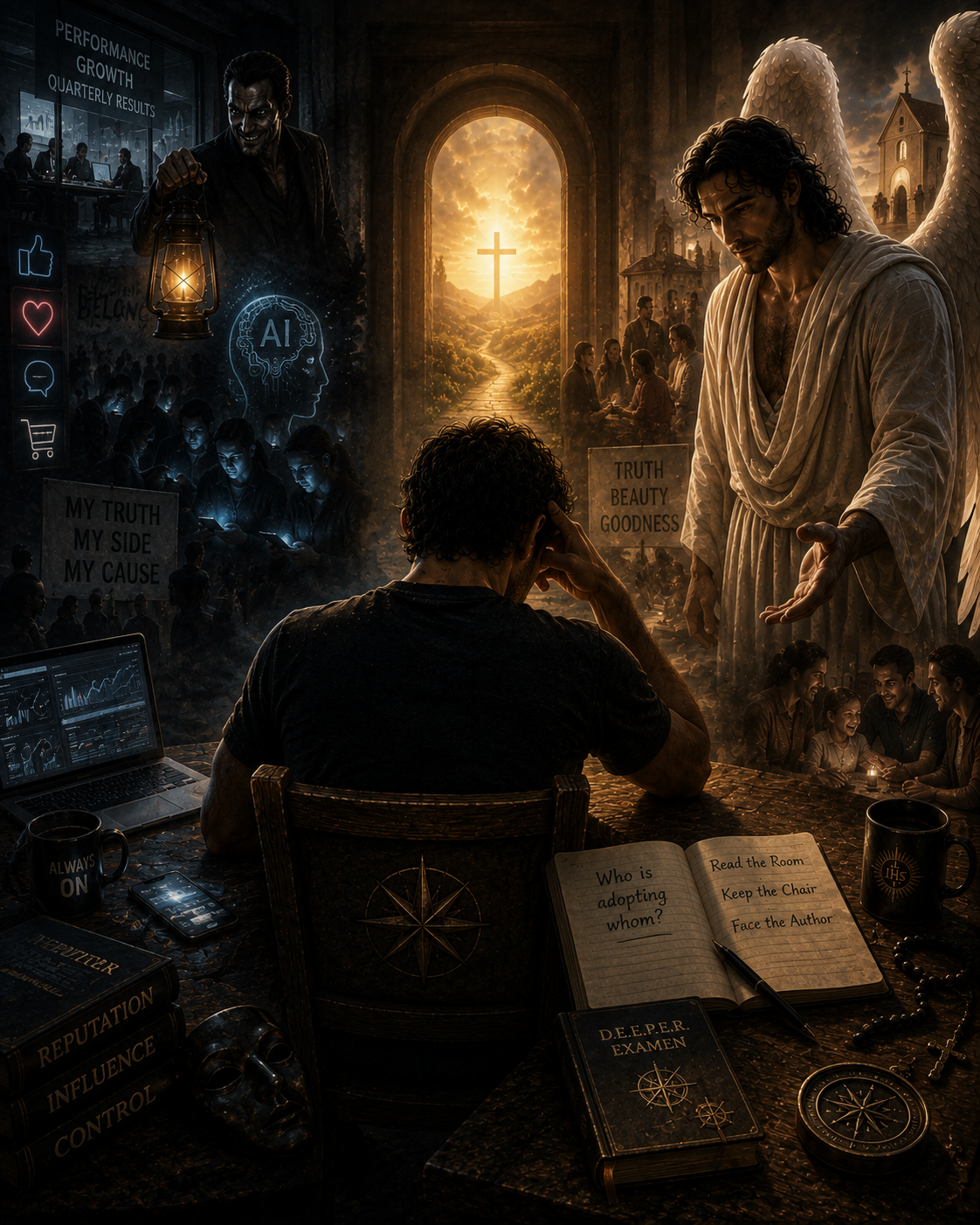
Sunday Table · Opening Reflection A few days ago, during an international presentation I gave on the Empty Chair in AI governance, someone commented about a phrase that is well known in corporate cultures and plastered all over the LinkedIn recruiting ads… organizations need to be adopting AI. Leaders need an adoption strategy. We need to hire an AI adoption strategist or even worse set up an AI committee. Our culture must adapt so the technology can be adopted successfully. In mid sentence, I heard myself say, almost before I had decided to: I would challenge you to consider that AI is adopting you.
The reversal stayed with me long after the Zoom webinar was over, because during my own D.E.E.P.E.R. Examen, I realized that artificial intelligence is only one of the rooms or situations in which this “adoption” happens or is “encouraged.” Employers can adopt us. Ideologies can adopt us. Influencers, markets, and platforms can adopt us. So can churches, ministries, movements, associations, universities, and causes devoted to genuinely good things. Many of these often do it so gradually, and with such generous language, that we never quite notice that the relationship has changed.
As with any method of prayerful inquiry, the questions we ask shape what we find. Because the D.E.E.P.E.R. Examen is designed at the intersection of Ignatian spirituality and neuroscience; it intentionally fosters double-loop learning, a posture of reflection that doesn't just evaluate our actions, but re-examines our underlying assumptions. Naturally, this practice produces entirely new questions. The question that surfaced first for me concerned the word adoption itself.
Etymology is a good place to anchor our understanding. Adopt comes from the Latin adoptare, literally "to choose for oneself, to take by choice," and specifically "to bring someone into a family as one's own child." Rooted within it are the components:
ad (toward)
optare (to choose or desire)
To adopt, therefore, is never a utilitarian transaction. It is an act of deliberate desire and directional movement. Adoption carries an inescapable relational weight: someone is chosen, drawn near, and given a permanent place of belonging.
For a Christian, this origin should make the word far heavier—and far more glorious—than contemporary usage suggests. Adoption is not merely a metaphor; it is the absolute center of the Gospel. The Apostle Paul deliberately reclaims this Roman legal custom to describe the heart of our salvation:
"For you did not receive a spirit of slavery to fall back into fear, but you received the Spirit of adoption, by whom we cry, 'Abba, Father!'" Romans 8:15
He reinforces this truth across his epistles:
Galatians 4:4–5: God sent His Son, born under the law, specifically "so that we might receive adoption as sons."
Ephesians 1:5: God "predestined us for adoption to Himself as sons through Jesus Christ, according to the purpose of His will."
Christian adoption is not a corporate initiative or a change-management technique. It is a radical claim about ultimate reality: the human person is actively drawn into the household of the Father. It is a belonging we could never manufacture or earn, only receive with open hands. That changes the question considerably. If I have already been received, called, and adopted by God, what exactly is happening when some other power begins behaving as though I belong to it?
None of this means an employer cannot employ us, a church cannot shepherd us, a teacher cannot teach us, or technology cannot assist us. We are relational creatures; we are meant to belong, to learn from one another, to take our place in families and institutions and shared work. The trouble begins when one of these secondary relationships quietly assumes the authority of the primary one. The employer stops asking for your work and begins determining your worth. The ideology stops helping you interpret part of reality and becomes the lens through which all of reality must pass. The influencer stops offering advice, and his desires slowly become your desires. Remaining acceptable to the church begins to feel indistinguishable from remaining acceptable to God. The mission that once asked you to serve begins consuming the people who serve it. The technology that once assisted your judgment now quietly settles the question before you have finished asking it.
Ironically, nothing dramatic happened at the table - no one seized your Chair. There may not have been a moment you could point to, a line you consciously crossed. The room simply began, an inch at a time, to rearrange itself around you… the metrics drifting toward the center, the vocabulary shifting, the expectations pressing closer while your own Chair turned so slowly you never felt it move.
This is why the second week of Turn the Table™ asks us to read the room without losing the Chair. Its governing question is not whether the room is good or bad; that is too simple. It is subtler: which lens is clarifying reality, and which is quietly governing it? A lens is a good thing. It helps us see what the unaided eye would miss and science, tradition, theology, data, experience, another person's perspective, and yes, AI, can each be a lens. But a lens is not the Light. The trouble begins the moment we forget the difference.
Here the image of the lantern carried by The Devil at Work becomes essential. The lantern does not illuminate the whole room; it illuminates just enough of it to make the enclosure feel like a universe. That is what an extractive relationship finally does. It rarely tells an outright lie. It gives you a partial world and slowly persuades you that nothing exists beyond it until the employer's world becomes the world, the platform's measures become your measures, the movement's enemies become your enemies, and the algorithm's prediction begins to sound like destiny. And because the lantern gives real light, you may never notice. That is what makes counterfeit authority so powerful: it almost never begins in darkness. It begins with something true, something useful, something you genuinely needed. The employer gave you an opportunity. The movement named a real injustice. The church gave you community. The work gave you meaning. The false move comes only afterward when gratitude quietly becomes allegiance, and allegiance becomes dependency, and a good thing begins asking for something it was never entitled to possess. It begins asking for the authored you.
That is the theological danger folded inside the language of adoption. The human person is not raw material awaiting institutional possession. You were not authored by a corporation, an ideology, a board, a movement, a platform, or a machine. They did not breathe you into being. They did not place the particular constellation of gifts within you or call you out of nothing. They may be part of your formation. They may never become your Author. When they forget that distinction, adoption morphs into co-option: a created thing steps between the Author and the Authored and asks you to turn your Chair away from the One your life comes from, toward its own smaller light.
This is why extraction is never only an organizational problem. It becomes a spiritual one, and its voice is unmistakable once you learn to hear it against the Author's. Extraction says, your value to me determines your value; the Author says, you were loved before you were useful. Extraction says, become what this system needs; the Author says, become what I have called you to become. Extraction says, stay close to the source of approval; Christ says, abide in me.
There will always be something willing to become our vine: an employer offering identity, an ideology offering certainty, an influencer offering belonging, a platform offering visibility, and now AI offering something perhaps more seductive than any of them: an apparently inexhaustible source of answers, affirmation, and interpretation. But Christ did not tell us to attach ourselves to whatever produces the quickest fruit. I am the vine. The Christian life therefore contains a question of attachment before it ever contains a question of performance. From what am I actually drawing life? What has begun to decide whether I feel secure, worthy, informed, righteous, or seen? Which relationship am I protecting because losing it would leave me unsure who I am?
Those questions take us straight into this week's REDISCOVER U® strength of Self-Control — which, understood rightly, is a far greater thing than refusing an appetite. It is the practiced freedom to remain rightly ordered. It is the capacity to receive everything a relationship genuinely offers without letting that relationship claim what belongs to God: to work wholeheartedly without being possessed by work, to belong deeply without surrendering conscience, to listen seriously without surrendering discernment, to use powerful tools without surrendering judgment, and even to love a church enough to recognize the moments when the institution and Christ are not asking the same thing of you. All of that requires watchfulness, because almost none of these relationships announce themselves as rivals to God. The Chair turns slowly. A small compromise seems reasonable. A demand seems temporary. The metric matters because everyone watches it; the vocabulary changes because that is how people talk here; silence becomes prudent, agreement becomes easier, questions become inconvenient, approval begins to feel like peace, and belonging begins to feel like vocation… until one day you cannot quite remember when you stopped asking whether the direction itself was even true.
This is why one of this week's Turns may be among the most important of all twenty-eight: Ask of every system, “what does repeated use train me to notice, desire, ignore, and become?” That is not a question for AI alone. Ask it of your employer. Ask it of your news and your politics and the people you follow. Ask it of the organizations you serve. Ask it of this newsletter, and of UMANIAMOⓇ, and, yes of your church. If a relationship cannot survive that examination, the problem is not your lack of loyalty. A healthy relationship makes the Chair more able to face the Author, not less. It leaves you more truthful, more responsible, more loving, more discerning, and finally more free to answer God's call.
Another of the Turns puts it plainly: “influence is cleanest when it reduces dependence on the influencer.” The good teacher wants the student to stand on his own. The good leader wants others to grow in agency. The Church is meant to lead a person toward Christ, not to make herself the whole of the journey. The table exists so that communion becomes possible not so that one chair may come to own all the others.
Perhaps this is the deeper meaning of reading the room without losing the Chair: we are not being asked to distrust every room. We are being invited to remember to whom we belong while we are inside it. Jesus entered rooms constantly: synagogues and homes and marketplaces, boats and banquets, the Temple, the houses of sinners and of religious leaders, and in his last days the chambers of political power. He read every one of them with extraordinary clarity; He knew what people wanted from Him, and recognized flattery, fear, manipulation, genuine hunger, grief, faith, and hypocrisy alike. But the room never once told Him who He was. His identity arrived from somewhere else entirely, “This is my beloved Son,” spoken before the crowds, before the miracles, before the arguments and the acclaim and the Cross. Belovedness preceded usefulness. And that may be the single most important defense against extraction we possess, because if the Chair already faces the Father, then the room may invite us, challenge us, employ us, teach us, disappoint us, applaud us, misunderstand us, or even reject us without ever becoming our source.
So this week, don’t look for someone trying to steal your Chair and more carefully at whether the room is quietly turning it. Watch what has been moving toward the center of your table. Watch what receives the first attention of your morning and the last of your night. Notice whose approval has become unusually powerful, which relationships cannot tolerate your questions, which institutions require your dependence in order to keep your belonging, which technologies have made themselves indispensable, which causes require enemies, and which ministries consume their servants in the very name of service. Watch, above all, for anything that offers you a small circle of certainty and persuades you that you no longer need to look beyond its light because The Devil at Work will always offer just enough illumination to keep you looking at his lantern.
The invitation of Turn the Table™ is to notice when that has happened, and then deliberately, perhaps only an inch at first, to turn the table back, and return the Chair toward the Light. Because in the end there is only one adoption that can tell you who you are. You were not chosen by God because you were useful to Him; you were not brought into His household because you extended His reach or improved His metrics or strengthened His institution. In Christ, adoption is a gift. You are authored and received before you perform. You belong before you produce, and everything else in your life must remain downstream of that.
So read the room this week, and read it well. Receive what is true in it. Learn what it can teach you, give generously, serve faithfully, use the instruments set before you, and love the people sitting there with you. But every so often, look down at the table, because something may have been moving. And then look at your Chair, and ask honestly where it is facing. The question isn’t really what have I adopted? The more revealing one is this: what has been trying to adopt me and is it turning me toward the Author, or quietly toward the lantern?
That is Self-Control. That is discernment. That is the work of the week ahead.
Ad maiorem Dei gloriam. Formed at the table. We are human together, or not at all.
Sunday Table · Riflessione iniziale Qualche giorno fa, durante una presentazione internazionale che ho tenuto sulla “sedia vuota” nella governance dell’IA, qualcuno ha commentato una frase ben nota nelle culture aziendali e che campeggia ovunque negli annunci di reclutamento su LinkedIn… le organizzazioni devono adottare l’IA. I leader hanno bisogno di una strategia di adozione. Dobbiamo assumere uno stratega per l’adozione dell’IA o, peggio ancora, istituire un comitato sull’IA. La nostra cultura deve adattarsi affinché la tecnologia possa essere adottata con successo. A metà frase, mi sono sentito dire, quasi prima ancora di averlo deciso: vi sfido a considerare che è l’IA ad adottare voi.
Questo ribaltamento di prospettiva mi è rimasto impresso a lungo dopo la fine del webinar su Zoom, perché durante il mio personale Esame D.E.E.P.E.R. mi sono reso conto che l’intelligenza artificiale è solo uno degli ambiti o delle situazioni in cui questa “adozione” avviene o viene “incoraggiata”. I datori di lavoro possono adottare noi. Le ideologie possono adottarci. Gli influencer, i mercati e le piattaforme possono adottarci. Così come le chiese, i ministeri, i movimenti, le associazioni, le università e le cause dedicate a cose genuinamente buone. Molti di questi lo fanno spesso in modo così graduale, e con un linguaggio così generoso, che non ci accorgiamo mai del tutto che il rapporto è cambiato.
Come per qualsiasi metodo di indagine orante, le domande che poniamo danno forma a ciò che scopriamo. Poiché il D.E.E.P.E.R. Examen è concepito all’incrocio tra spiritualità ignaziana e neuroscienze, promuove intenzionalmente l’apprendimento a doppio ciclo, un atteggiamento di riflessione che non si limita a valutare le nostre azioni, ma riesamina i nostri presupposti di fondo. Naturalmente, questa pratica genera domande del tutto nuove. La domanda che mi è venuta in mente per prima riguardava proprio la parola adozione.
L’etimologia è un buon punto di partenza per fondare la nostra comprensione. Il termine «adottare» deriva dal latino adoptare, letteralmente «scegliere per sé, prendere per scelta» e, nello specifico, «accogliere qualcuno in una famiglia come proprio figlio». In esso sono radicati i seguenti elementi: Adottare, quindi, non è mai una transazione utilitaristica. È un atto di desiderio deliberato e di movimento direzionale. L’adozione porta con sé un peso relazionale ineludibile: qualcuno viene scelto, avvicinato e gli viene dato un posto permanente a cui appartenere.
ad (verso)
optare (scegliere o desiderare)
Per un cristiano, questa origine dovrebbe rendere la parola molto più significativa — e molto più gloriosa — di quanto suggerisca l’uso contemporaneo. L’adozione non è semplicemente una metafora; è il centro assoluto del Vangelo. L’apostolo Paolo riprende deliberatamente questa usanza giuridica romana per descrivere il cuore della nostra salvezza:
«Voi infatti non avete ricevuto uno spirito di schiavitù per ricadere nella paura, ma avete ricevuto lo Spirito di adozione, per mezzo del quale gridiamo: “Abba, Padre!”» Romani 8:15
Egli ribadisce questa verità in tutte le sue epistole: l’adozione cristiana non è un’iniziativa aziendale né una tecnica di gestione del cambiamento. È un’affermazione radicale sulla realtà ultima: la persona umana è attivamente attirata nella famiglia del Padre. È un’appartenenza che non potremmo mai creare né guadagnarci, ma solo ricevere a mani aperte. Questo cambia notevolmente la questione. Se sono già stato accolto, chiamato e adottato da Dio, cosa sta accadendo esattamente quando qualche altro potere comincia a comportarsi come se io gli appartenessi?
Galati 4,4–5: Dio ha mandato il Suo Figlio, nato sotto la legge, proprio «affinché ricevessimo l’adozione a figli».
Efesini 1,5: Dio «ci ha predestinati ad essere adottati come figli per mezzo di Gesù Cristo, secondo il disegno della Sua volontà».
Nulla di tutto ciò significa che un datore di lavoro non possa assumerci, che una chiesa non possa guidarci, che un insegnante non possa istruirci o che la tecnologia non possa aiutarci. Siamo creature relazionali; siamo destinati ad appartenere, a imparare gli uni dagli altri, a trovare il nostro posto nelle famiglie, nelle istituzioni e nel lavoro condiviso. Il problema inizia quando una di queste relazioni secondarie assume silenziosamente l’autorità di quella primaria. Il datore di lavoro smette di chiederti di lavorare e inizia a determinare il tuo valore. L’ideologia smette di aiutarti a interpretare una parte della realtà e diventa la lente attraverso cui tutta la realtà deve passare. L’influencer smette di offrire consigli, e i suoi desideri diventano lentamente i tuoi desideri.
Rimanere accettabile agli occhi della chiesa comincia a sembrare indistinguibile dal rimanere accettabile agli occhi di Dio. La missione che un tempo ti chiedeva di servire inizia a consumare le persone che la servono. La tecnologia che un tempo aiutava il tuo giudizio ora risolve silenziosamente la questione prima ancora che tu abbia finito di porla.
Ironia della sorte, al tavolo non è successo nulla di drammatico: nessuno ha preso il tuo posto. Forse non c’è stato un momento preciso da indicare, una linea che hai consapevolmente superato. La stanza ha semplicemente cominciato, un pollice alla volta, a riorganizzarsi attorno a te… i parametri che si spostano verso il centro, il vocabolario che cambia, le aspettative che si fanno più pressanti mentre la tua stessa Poltrona ruotava così lentamente che non ne hai mai percepito il movimento.
Ecco perché la seconda settimana di Turn the Table™ ci chiede di leggere l’atmosfera senza perdere la Poltrona. La domanda fondamentale non è se l’atmosfera sia positiva o negativa; sarebbe troppo semplice. È più sottile: quale lente chiarisce la realtà e quale la governa silenziosamente? Una lente è una cosa positiva. Ci aiuta a vedere ciò che l’occhio nudo non coglierebbe e la scienza, la tradizione, la teologia, i dati, l’esperienza, la prospettiva di un’altra persona e, sì, l’IA, possono essere tutte lenti. Ma una lente non è la Luce. Il problema inizia nel momento in cui dimentichiamo la differenza.
Qui l’immagine della lanterna portata da The Devil at Work diventa essenziale. La lanterna non illumina l’intera stanza; ne illumina solo quanto basta per far sembrare quello spazio chiuso un universo. Questo è ciò che alla fine fa una relazione estrattiva. Raramente dice una bugia palese. Ti offre un mondo parziale e lentamente ti convince che nulla esista al di là di esso, finché il mondo del datore di lavoro diventa il mondo, i parametri della piattaforma diventano i tuoi parametri, i nemici del movimento diventano i tuoi nemici e la previsione dell’algoritmo comincia a sembrare un destino. E poiché la lanterna emette luce vera, potresti non accorgertene mai. È questo che rende l’autorità contraffatta così potente: non ha quasi mai inizio nell’oscurità. Ha inizio con qualcosa di vero, qualcosa di utile, qualcosa di cui avevi sinceramente bisogno. Il datore di lavoro ti ha offerto un’opportunità. Il movimento ha denunciato una vera ingiustizia. La chiesa ti ha offerto una comunità. Il lavoro ti ha dato un senso. La mossa sbagliata arriva solo in seguito, quando la gratitudine si trasforma silenziosamente in fedeltà, e la fedeltà diventa dipendenza, e una cosa buona comincia a chiedere qualcosa che non ha mai avuto il diritto di possedere. Comincia a chiedere il “te” creato da altri.
Questo è il pericolo teologico nascosto nel linguaggio dell’adozione. La persona umana non è materia prima in attesa di essere posseduta da un’istituzione. Non sei stato creato da una società, un’ideologia, un consiglio di amministrazione, un movimento, una piattaforma o una macchina. Non sono stati loro a darti vita. Non sono stati loro a collocare in te quella particolare costellazione di doni né a chiamarti dal nulla. Possono far parte della tua formazione. Ma non potranno mai diventare il tuo Autore. Quando dimenticano questa distinzione, l’adozione si trasforma in cooptazione: una cosa creata si frappone tra l’Autore e il creato e ti chiede di distogliere lo sguardo da Colui da cui proviene la tua vita, per rivolgerlo verso la propria luce più fioca.
Ecco perché l’estrazione non è mai solo un problema organizzativo. Diventa un problema spirituale, e la sua voce è inconfondibile una volta che impari a distinguerla da quella dell’Autore. L’estrazione dice: «Il tuo valore per me determina il tuo valore»; l’Autore dice: «Sei stato amato prima ancora di essere utile». L’estrazione dice: «Diventa ciò di cui questo sistema ha bisogno»; l’Autore dice: «Diventa ciò che ti ho chiamato a diventare». L’estrazione dice: «Resta vicino alla fonte dell’approvazione»; Cristo dice: «Rimanete in me».
Ci sarà sempre qualcosa disposto a diventare la nostra vite: un datore di lavoro che offre identità, un’ideologia che offre certezza, un influencer che offre senso di appartenenza, una piattaforma che offre visibilità, e ora l’intelligenza artificiale che offre qualcosa forse più seducente di tutti loro: una fonte apparentemente inesauribile di risposte, affermazioni e interpretazioni. Ma Cristo non ci ha detto di legarci a ciò che produce il frutto più rapido. «Io sono la vite». La vita cristiana, quindi, pone innanzitutto una questione di attaccamento prima ancora di porre una questione di rendimento. Da cosa traggo effettivamente la vita? Cosa ha iniziato a determinare se mi sento sicuro, degno, informato, giusto o visto? Quale relazione sto proteggendo perché perderla mi lascerebbe insicuro su chi sono?
Queste domande ci conducono direttamente al punto di forza REDISCOVER U® di questa settimana: l’Autocontrollo — che, se compreso correttamente, è qualcosa di ben più grande del semplice rifiuto di un desiderio.
È la libertà acquisita con la pratica di rimanere correttamente ordinati. È la capacità di ricevere tutto ciò che una relazione offre genuinamente senza lasciare che quella relazione rivendichi ciò che appartiene a Dio: lavorare con tutto il cuore senza essere posseduti dal lavoro, appartenere profondamente senza rinunciare alla coscienza, ascoltare seriamente senza rinunciare al discernimento, usare strumenti potenti senza rinunciare al giudizio, e persino amare una chiesa abbastanza da riconoscere i momenti in cui l’istituzione e Cristo non ti chiedono la stessa cosa. Tutto ciò richiede vigilanza, perché quasi nessuna di queste relazioni si presenta come rivale di Dio. La sedia gira lentamente. Un piccolo compromesso sembra ragionevole. Una richiesta sembra temporanea. Il metro di misura conta perché tutti lo osservano; il vocabolario cambia perché è così che si parla qui; il silenzio diventa prudente, l’accordo diventa più facile, le domande diventano scomode, l’approvazione comincia a sembrare pace e l’appartenenza comincia a sembrare vocazione… finché un giorno non riesci più a ricordare con esattezza quando hai smesso di chiederti se la direzione stessa fosse davvero quella giusta.
Ecco perché una delle «Svolte» di questa settimana potrebbe essere tra le più importanti di tutte e ventotto: chiedi a ogni sistema: «Cosa mi allena a notare, desiderare, ignorare e diventare il suo uso ripetuto?». Non è una domanda riservata solo all’intelligenza artificiale. Ponila al tuo datore di lavoro. Ponila alle notizie, alla politica e alle persone che segui. Ponila alle organizzazioni per cui lavori. Ponila a questa newsletter, a UMANIAMOⓇ e, sì, alla tua chiesa. Se una relazione non riesce a superare quell’esame, il problema non è la tua mancanza di lealtà. Una relazione sana rende chi siede sulla Cattedra più capace di affrontare l’Autore, non meno. Ti rende più sincero, più responsabile, più amorevole, più perspicace e, infine, più libero di rispondere alla chiamata di Dio.
Un’altra delle «Svolte» lo dice chiaramente: «L’influenza è più pura quando riduce la dipendenza da chi influenza». Il buon insegnante vuole che l’allievo cammini con le proprie gambe. Il buon leader vuole che gli altri crescano nella propria autonomia. La Chiesa è chiamata a guidare una persona verso Cristo, non a diventare essa stessa l’intero percorso. La tavola esiste affinché la comunione diventi possibile, non affinché una sedia possa arrivare a possedere tutte le altre.
Forse questo è il significato più profondo del «leggere la sala» senza perdere di vista la Presenza: non ci viene chiesto di diffidare di ogni sala. Siamo invitati a ricordare a chi apparteniamo mentre ci troviamo al suo interno. Gesù entrava costantemente nelle sale: sinagoghe e case e mercati, barche e banchetti, il Tempio, le case dei peccatori e dei capi religiosi, e nei suoi ultimi giorni le stanze del potere politico. Le interpretava tutte con straordinaria chiarezza; sapeva cosa le persone volevano da Lui e riconosceva sia l’adulazione, la paura, la manipolazione, la fame autentica, il dolore, la fede, sia l’ipocrisia. Ma la stanza non Gli ha mai detto chi fosse. La Sua identità proveniva da un luogo completamente diverso: «Questo è il mio Figlio prediletto», pronunciate davanti alle folle, prima dei miracoli, prima delle discussioni, degli elogi e della Croce. L’essere amati precedeva l’utilità. E questa potrebbe essere l’unica e più importante difesa contro lo sfruttamento che possediamo, perché se la Sedia è già rivolta verso il Padre, allora la stanza può invitarci, sfidarci, impiegarci, insegnarci, deluderci, applaudirci, fraintenderci o persino respingerci senza mai diventare la nostra fonte.
Quindi questa settimana, non cercare qualcuno che cerchi di rubarti la Sedia, ma osserva con maggiore attenzione se la stanza la sta silenziosamente spostando. Osserva ciò che si sta spostando verso il centro del tuo tavolo. Osserva ciò che riceve la tua prima attenzione al mattino e l’ultima alla sera. Nota quale approvazione è diventata insolitamente potente, quali relazioni non tollerano le tue domande, quali istituzioni richiedono la tua dipendenza per mantenere il tuo senso di appartenenza, quali tecnologie si sono rese indispensabili, quali cause richiedono nemici e quali ministeri consumano i propri servitori proprio in nome del servizio. Presta attenzione, soprattutto, a tutto ciò che ti offre una piccola cerchia di certezza e ti convince che non hai più bisogno di guardare oltre la sua luce, perché Il Diavolo all’opera ti offrirà sempre e solo l’illuminazione sufficiente a farti continuare a guardare la sua lanterna.
L’invito di Turn the Table™ è quello di notare quando ciò è accaduto e poi, deliberatamente, magari solo un pollice all’inizio, di ribaltare il tavolo e riportare la Sedia verso la Luce.
Perché alla fine c’è solo un’adozione che può dirti chi sei. Non sei stato scelto da Dio perché eri utile a Lui; non sei stato accolto nella Sua famiglia perché hai ampliato la Sua portata, migliorato i Suoi risultati o rafforzato la Sua istituzione. In Cristo, l’adozione è un dono. Sei stato creato e accolto prima ancora di agire. Appartieni a Lui prima di produrre qualcosa, e tutto il resto della tua vita deve rimanere subordinato a questo.
Quindi osserva bene l’ambiente che ti circonda questa settimana, e osservalo attentamente. Accogli ciò che di vero c’è in esso. Impara ciò che può insegnarti, dona generosamente, servi fedelmente, usa gli strumenti che ti sono stati messi a disposizione e ama le persone sedute lì con te. Ma ogni tanto, guarda il tavolo, perché qualcosa potrebbe essersi mosso. E poi guarda la tua sedia e chiediti onestamente verso dove è rivolta. La domanda non è in realtà: «Che cosa ho adottato?». Quella più rivelatrice è questa: «Che cosa sta cercando di adottarmi e mi sta orientando verso l’Autore, o silenziosamente verso la lanterna?
Questo è l’autocontrollo. Questo è il discernimento. Questo è il lavoro della settimana che ci attende.
Ad maiorem Dei gloriam. Siamo umani insieme, oppure non lo siamo affatto.
Self-Control
This week’s REDISCOVER U® strength is Self-Control, but the opening reflection asks us to understand it as something deeper than willpower. Self-Control isn’t just the ability to resist what we want. It is the practiced freedom to remain coherent when something around us is trying to reorganize our attention, desire, judgment, identity, or belonging. In the global context, self-control is one of the strengths that statistically is rather rare in individuals.
That makes Self-Control profoundly special and also relational. We don’t exercise it only against our various appetites for food, alcohol, or other things on a long list inside us. We often exercise it in the rooms we enter and the company we keep. Employers, friends, families, institutions, churches, causes, technologies, political movements, influencers, and communities all exert some formative pressure upon us. This is not automatically harmful. We are meant to be humaned through relationships. The question is whether a relationship helps the Chair remain oriented toward the Author or gradually turns it toward some smaller source of identity, certainty, approval, or belonging.
For this Table Practice, let the card become a lens for examining your relationships. Think about the rooms you enter regularly and the systems that have become part of your ordinary life. Consider work, family, church, friendships, social media, news, politics, professional organizations, technology, and anything else that occupies significant attention.
Then choose one relationship or system that seems to deserve a closer reading this week. The purpose is not to condemn it. The purpose is to notice what happens to you when you remain in relationship with it. Self-Control begins when we become conscious of what is forming us and recover enough interior freedom to choose our response.
What has been moving toward the center of my table?
Think about something that currently receives more of your attention than it once did. What does it promise you… security, belonging, certainty, success, recognition, usefulness, peace? Then ask the more difficult question: What happens inside me when that thing is threatened or withdrawn?
What is this relationship training me to notice, desire, ignore, and become?
This comes directly from Turn 24 in the Turn the TableTM Workbook and may be the central practice of the week. Choose one relationship, institution, technology, community, or recurring environment. Ask what repeated participation teaches your attention to notice first. Then consider what it encourages you to desire, what becomes easier to overlook, and what kind of person repeated participation is forming. Do not rush toward a verdict of “good” or “bad.” A relationship may offer something genuinely valuable while also producing unintended consequences.
Does this relationship increase my freedom to answer the Author, or increase my dependence upon itself?
Turn the Table™ offers another demanding test: “Influence is cleanest when it reduces dependence on the influencer.” Think about the relationship you have been examining. Are you becoming more truthful, responsible, discerning, loving, and capable of service through it? Can you disagree without fearing exclusion? Can you ask questions without risking belonging? Can you leave the room and still know who you are? Self-Control appears here as freedom and the ability to receive what another person or system genuinely offers without allowing it to claim what belongs to God.
Sunday Table Invitation. Make sure the quiet ones speak: the children, the teenagers, the person on the edge of the table. Leadership is not the loudest voice; the table is where a quiet person discovers they have been leading all along, and where a loud one learns to hold the space open for someone else.
If young people are present, offer them a notebook and one question to carry: When have you done the right thing first, before your friends did or wanted to, and didn't? What made it hard, and what would make it easier next time?
Humaning is something we do together, and then carry out the door. This week the circle practices the authored kind of leadership, the kind that has no title and needs none. Gather a few people and take it slowly.
The Humaning Circle this week should be simple because the movement we are examining is often simple. Chairs usually do not turn ninety degrees in a single moment. They turn by inches. Our response can begin the same way.
Gather in the Circle with the digital Self-Control card visible. Allow a moment of silence before anyone speaks. Each person should bring to mind one “room” they occupy regularly. It may be a workplace, family, church, online community, professional group, friendship, political environment, social platform, or relationship with technology. There is no requirement to disclose which room it is. The purpose of the Circle is discernment, not confession and certainly not judgment of another institution or person.
Invite each person to complete this reflection in their own words: “I notice that this room has been training me to…” They might recognize that it trains them to hurry, compare, perform, agree, distrust, prove, consume, remain silent, seek approval, become angry, become useful, or perhaps become more patient, generous, courageous, prayerful, curious, or attentive. Both movements matter. Reading the room means noticing what leads toward greater freedom as well as what quietly diminishes it.
After everyone who wishes to speak has done so, allow another period of silence. Then invite the second reflection: “To turn my Chair one inch toward the Author this week, I will…”
The action should be deliberately small and observable. Someone may wait before answering a message. Someone may ask a question they normally suppress. Someone may leave the phone outside the room during prayer or dinner. Someone may speak with a person whose approval has become too important. Someone may use AI for information but make a consequential judgment without asking it what to think. Someone may attend church while consciously remembering that Christ is the Vine, not the institution. Someone may simply notice the moment when the desire to belong begins asking them to surrender something true.
End however your circle ends with a prayer, a blessing, a shared silence. Then go, and lead where you stand.
Ad maiorem Dei gloriam. We are human together, or not at all.
Il punto di forza REDISCOVER U® di questa settimana è l’Autocontrollo, ma la riflessione iniziale ci invita a comprenderlo come qualcosa di più profondo della semplice forza di volontà. L’autocontrollo non è solo la capacità di resistere a ciò che desideriamo. È la libertà acquisita con la pratica di rimanere coerenti quando qualcosa intorno a noi cerca di riorganizzare la nostra attenzione, il nostro desiderio, il nostro giudizio, la nostra identità o il nostro senso di appartenenza. In un contesto globale, l’autocontrollo è uno dei punti di forza che, statisticamente, è piuttosto raro negli individui.
Ciò rende l’autocontrollo profondamente speciale e anche relazionale. Non lo esercitiamo solo contro i nostri vari appetiti per il cibo, l’alcol o altre cose presenti in una lunga lista dentro di noi. Spesso lo esercitiamo negli ambienti in cui entriamo e nelle compagnie che frequentiamo. Datori di lavoro, amici, famiglie, istituzioni, chiese, cause, tecnologie, movimenti politici, influencer e comunità esercitano tutti una certa pressione formativa su di noi. Ciò non è automaticamente dannoso. Siamo destinati a diventare pienamente umani attraverso le relazioni. La domanda è se una relazione aiuti la «Sedia» a rimanere orientata verso l’«Autore» o se la rivolga gradualmente verso qualche fonte minore di identità, certezza, approvazione o senso di appartenenza.
Per questa Esercitazione da Tavolo, lascia che la carta diventi una lente attraverso cui esaminare le tue relazioni. Pensa agli ambienti in cui entri regolarmente e ai sistemi che sono diventati parte della tua vita quotidiana. Considera il lavoro, la famiglia, la chiesa, le amicizie, i social media, le notizie, la politica, le organizzazioni professionali, la tecnologia e qualsiasi altra cosa che occupi una parte significativa della tua attenzione.
Scegli quindi una relazione o un sistema che questa settimana ti sembri meritare un’analisi più approfondita. Lo scopo non è condannarlo. Lo scopo è notare cosa succede a te quando rimani in relazione con esso. L’autocontrollo inizia quando diventiamo consapevoli di ciò che ci sta plasmando e recuperiamo abbastanza libertà interiore da poter scegliere la nostra risposta.
Cosa si sta spostando verso il centro del mio tavolo? Pensa a qualcosa che attualmente riceve più attenzione da parte tua rispetto al passato. Cosa ti promette… sicurezza, senso di appartenenza, certezza, successo, riconoscimento, utilità, pace? Poi poniti la domanda più difficile: Cosa accade dentro di me quando quella cosa viene minacciata o mi viene negata?
Cosa mi sta insegnando questa relazione a notare, a desiderare, a ignorare e a diventare? Questo esercizio proviene direttamente dalla Turn 24 del quaderno di esercizi Turn the Table™ e potrebbe essere la pratica centrale della settimana. Scegli una relazione, un’istituzione, una tecnologia, una comunità o un ambiente ricorrente. Chiediti cosa la partecipazione ripetuta insegna alla tua attenzione a notare per primo. Poi considera cosa ti incoraggia a desiderare, cosa diventa più facile trascurare e che tipo di persona la partecipazione ripetuta sta formando. Non affrettarti a giungere a un verdetto di “buono” o “cattivo”. Una relazione può offrire qualcosa di genuinamente prezioso pur producendo al contempo conseguenze non intenzionali.
Questa relazione aumenta la mia libertà di rispondere all’Autore, o aumenta la mia dipendenza da essa stessa? Turn the Table™ propone un’altra prova impegnativa: “L’influenza è più pura quando riduce la dipendenza da chi la esercita.” Pensa alla relazione che stai esaminando. Stai diventando più sincero, responsabile, perspicace, amorevole e capace di servire grazie ad essa? Riesci a dissentire senza temere l’esclusione? Riesci a porre domande senza mettere a rischio il tuo senso di appartenenza? Riesci a lasciare la stanza e sapere comunque chi sei? L’autocontrollo appare qui come libertà e capacità di ricevere ciò che un’altra persona o un sistema offre sinceramente, senza permettere che rivendichi ciò che appartiene a Dio.
Invito alla tavola domenicale. Assicurati che parlino i più silenziosi: i bambini, gli adolescenti, la persona seduta ai margini del tavolo. La leadership non è la voce più forte; la tavola è il luogo in cui una persona silenziosa scopre di aver guidato fin dall’inizio, e dove una persona chiassosa impara a tenere lo spazio aperto per qualcun altro.
Se sono presenti dei giovani, offrite loro un quaderno e una domanda da portare con sé: Quando avete fatto la cosa giusta per primi, prima che i vostri amici lo facessero o volessero farlo, e non l’avete fatto? Cosa l’ha resa difficile, e cosa la renderebbe più facile la prossima volta?
L’Humaning è qualcosa che facciamo insieme, e poi portiamo fuori dalla porta. Questa settimana il cerchio pratica quel tipo di leadership che nasce da sé, quella che non ha alcun titolo e non ne ha bisogno.
Riunite alcune persone e procedete con calma.
Il Circolo dell’Humaning di questa settimana dovrebbe essere semplice perché il movimento che stiamo esaminando è spesso semplice. Le sedie di solito non ruotano di novanta gradi in un solo istante. Ruotano di pochi pollici. La nostra risposta può iniziare allo stesso modo.
Riunitevi nel Circolo con la scheda digitale “Autocontrollo” ben visibile. Concedete un momento di silenzio prima che qualcuno parli. Ogni persona dovrebbe pensare a una “stanza” che occupa regolarmente. Può trattarsi di un luogo di lavoro, della famiglia, della chiesa, di una comunità online, di un gruppo professionale, di un’amicizia, di un contesto politico, di una piattaforma social o del rapporto con la tecnologia. Non è necessario rivelare di quale spazio si tratti. Lo scopo del Circolo è il discernimento, non la confessione e certamente non il giudizio su un’altra istituzione o persona.
Invitate ogni persona a completare questa riflessione con parole proprie: “Noto che questo spazio mi ha insegnato a…”Potrebbero riconoscere che li sta allenando a affrettarsi, a confrontarsi, a dare prova di sé, a essere d’accordo, a diffidare, a dimostrare, a consumare, a rimanere in silenzio, a cercare approvazione, ad arrabbiarsi, a rendersi utili, o forse a diventare più pazienti, generosi, coraggiosi, devoti, curiosi o attenti. Entrambe le direzioni sono importanti. Leggere lo spazio significa notare ciò che conduce verso una maggiore libertà così come ciò che la diminuisce silenziosamente.
Dopo che tutti coloro che desiderano parlare lo hanno fatto, concedete un altro momento di silenzio. Poi invita alla seconda riflessione: “Per orientare la mia Sedia di un pollice verso l’Autore questa settimana, farò…”
L’azione dovrebbe essere volutamente piccola e osservabile. Qualcuno potrebbe aspettare prima di rispondere a un messaggio. Qualcuno potrebbe porre una domanda che normalmente reprime. Qualcuno potrebbe lasciare il telefono fuori dalla stanza durante la preghiera o la cena. Qualcuno potrebbe parlare con una persona la cui approvazione è diventata troppo importante. Qualcuno potrebbe usare l’intelligenza artificiale per ottenere informazioni, ma formulare un giudizio autonomo senza chiederle cosa pensare. Qualcuno potrebbe andare in chiesa ricordando consapevolmente che Cristo è la Vite, non l’istituzione. Qualcuno potrebbe semplicemente notare il momento in cui il desiderio di appartenenza comincia a chiedergli di rinunciare a qualcosa di vero.
Concludete comunque il vostro incontro con una preghiera, una benedizione, un silenzio condiviso. Poi andate e guidate là dove vi trovate.
Ad maiorem Dei gloriam. Siamo umani insieme, oppure non lo siamo affatto.
Fact and Fiction

In this week’s Sunday Table week we’ve practiced reading the room. If you have been following the REDISCOVER UⓇ Turn the Table 28-Day Challenge, you’ve had a chance to practice internal discernment and reading the room. But reading the room is not enough, and it can even become its own trap, because there are really three things we have to learn to tell apart, because if we collapse them into one we are more susceptible to the illusions of The Devil at Work. The three things we refer to are the Chair and the Table, which we have talked about for some time - and there is the Room and the essence of self-control is the freedom to keep these three things distinct.
The Chair is you. It is your authored, singular self, the one seat only you can occupy, made to face the Author. The Table is communion, the shared space where your Chair meets other chairs, where we are human together or not at all. And the Room is the world you enter: the workplace, the platform, the culture, the ideology, the whole environment you must read but were never meant to be governed by. These are not the same thing, and almost every distortion we have alerted you to over the course of several months begins by confusing them — letting the Room sit next to you in the Chair, or letting the Room's noise rearrange the Table.
Now lay this week's other discipline across all three, because the line between Fact and Fiction runs straight through the Chair, the Table, and the Room alike. In each of them there is what is real, and what has been added. And it turns out that of the three figures we speak of at this Table, two work only in Fact, and one works only in Fiction.
The Spirit at Work moves in Fact. The Spirit consoles you toward what is actually true. He illuminates the real person in front of you, the real situation, the real call, and finally toward the Author, who is Reality itself. The Spirit at Work never deceives and never flatters. Every genuine movement of the Spirit at Work is a movement deeper into what is true. When you find yourself seeing more truly, loving the person who is actually there rather than the one you invented, willing to face a fact you would rather avoid… that is the Spirit at Work, and He is always working in Fact.
The Builder at Work builds in Fact. He has no choice; it is the only ground that holds. Build on illusion and the wall comes down. The Builder at Work takes the Fact the Spirit reveals and does something with it… the disciplined action, the honest repair, the real word said to the real person. He cannot build on a story you made up any more than a mason can build on a cloud. Fact is his only material, and everything he makes that lasts, he makes there.
The Devil at Work lives in Fiction. He is the deceiver, and deception is all he has, because he can create nothing, he can only counterfeit. He has no access to the real you at all; the Chair of the original is beyond his reach. So he works entirely in the added story: the mirror that shows you a false self, the lantern that lights a partial world and calls it the whole, the manufactured appearance, the invented motive, the flattering or condemning fiction that feels exactly like fact, the inverted room that looks real but is upside down. His entire aim is to get you to mistake his Fiction for the real thing and to seat his illusion in your Chair with you, to lay his stories on your Table, to make the Room's small lantern-light feel like the sum of the world.
This is where self-control becomes something far grander and more important than the mastery of an appetite. Self-control is the practiced freedom to keep your Chair seated in Fact — facing the Author, where the Spirit at Work reveals and the Builder at Work builds — and to refuse to let the deceiver's Fiction take the Chair, govern the Table, or define the Room. It is the freedom to remain in the real when the illusion is more comfortable, more flattering, and always more available. It is the strength to act on the fact rather than react to the fiction.
Practice it, then, in all three at once. In the Chair, guard your own self against Fiction. Don’t let the deceiver's mirror, the story that you are worthless, or that you are the exception, or that you are only what you produced this week, sit down where your authored self belongs. Let the Spirit at Work tell you the Fact of who you are: authored, called, loved before you were useful. Then let the Builder at Work build a life on that, and on nothing counterfeit.
At the Table, keep communion in Fact. Do not let the deceiver's fictions of the invented slight, the assumed motive, the tidy story that makes you right and the other wrong, govern the people you love. See the real person the Spirit is showing you. Tend the real relationship the Builder can actually repair. Leave the fiction at the door.
And in the Room, read in Fact. Receive what is genuinely true there, and refuse the lantern's fiction that its partial world is the only world. See what is actually present. Act rightly on it. And when the Room tries to sell you an illusion dressed as reality, name it, and don’t buy it.
So the week comes down to this. Distinguish the Chair, the Table, and the Room; never let one pretend to be another. Keep each of them seated in Fact where the Spirit at Work is always at work revealing what is real, and the Builder at Work is always at work building on it. Refuse the Fiction, where the deceiver waits with his mirror and his lantern and his beautiful, hollow stories. That refusal, held steadily, hour by hour, is self-control. And it is the whole of reading the room without losing the Chair.
The Chair faces the Author. The Table holds communion. The Room is read, but never obeyed. And the deceiver's fiction is named, and left outside.
Ad maiorem Dei gloriam. Formed at the table. We are human together, or not at all.
In questa edizione settimanale di “Sunday Table” ci siamo esercitati a “leggere l’atmosfera”. Se avete seguito la sfida di 28 giorni “Turn the Table” di REDISCOVER UⓇ, avete avuto modo di esercitarvi nel discernimento interiore e nel “leggere l’atmosfera”.
Ma “leggere l’atmosfera” non basta, e può persino diventare una trappola, perché in realtà ci sono tre cose che dobbiamo imparare a distinguere; se le confondiamo in un’unica entità, diventiamo più vulnerabili alle illusioni del Diavolo all’opera. Le tre cose a cui ci riferiamo sono la Sedia e il Tavolo, di cui abbiamo parlato già da tempo, e poi c’è la Stanza; l’essenza dell’autocontrollo sta proprio nella libertà di mantenere distinte queste tre cose.
La Sedia sei tu. È il tuo io unico e creato da te, l’unico posto che solo tu puoi occupare, fatto per stare di fronte all’Autore. Il Tavolo è la comunione, lo spazio condiviso dove la tua Sedia incontra altre sedie, dove siamo umani insieme o non lo siamo affatto. E la Stanza è il mondo in cui entri: il posto di lavoro, la piattaforma, la cultura, l’ideologia, l’intero ambiente che devi interpretare ma dal quale non sei mai stato destinato a farti governare. Non sono la stessa cosa, e quasi ogni distorsione su cui ti abbiamo messo in guardia nel corso di diversi mesi ha inizio proprio dalla loro confusione — lasciando che la Stanza si sieda accanto a te sulla Sedia, o permettendo al rumore della Stanza di riorganizzare il Tavolo.
Ora applica l’altra disciplina di questa settimana a tutte e tre, perché la linea di demarcazione tra Realtà e Finzioneattraversa in modo netto sia la Sedia, sia il Tavolo, sia la Stanza. In ciascuno di essi c’è ciò che è reale e ciò che è stato aggiunto. E risulta che delle tre figure di cui parliamo a questo Tavolo, due operano solo nel Fatto, e una opera solo nella Finzione.
Lo Spirito al Lavoro si muove nel Fatto. Lo Spirito vi consola verso ciò che è realmente vero. Egli illumina la persona reale davanti a voi, la situazione reale, la chiamata reale, e infine verso l’Autore, che è la Realtà stessa. Lo Spirito all’Opera non inganna mai e non lusinga mai. Ogni movimento autentico dello Spirito all’Opera è un movimento che conduce più in profondità in ciò che è vero. Quando ti ritrovi a vedere in modo più vero, ad amare la persona che è realmente lì piuttosto che quella che hai inventato, disposto ad affrontare un fatto che preferiresti evitare… quello è lo Spirito all’Opera, ed Egli opera sempre nella Realtà.
Il Costruttore al Lavoro costruisce nella Realtà. Non ha scelta; è l’unico terreno che regge. Costruisci sull’illusione e il muro crolla. Il Costruttore al Lavoro prende la Realtà che lo Spirito rivela e ne fa qualcosa… l’azione disciplinata, la riparazione onesta, la parola vera detta alla persona vera. Non può costruire su una storia che ti sei inventato, non più di quanto un muratore possa costruire su una nuvola.
La realtà è il suo unico materiale, e tutto ciò che crea che dura nel tempo, lo crea lì.Il Diavolo al Lavoro vive nella finzione. È l’ingannatore, e l’inganno è tutto ciò che ha, perché non può creare nulla, può solo contraffare. Non ha alcun accesso al tuo vero io; la Sedia dell’originale è fuori dalla sua portata. Quindi opera interamente nella storia aggiunta: lo specchio che ti mostra un falso sé, la lanterna che illumina un mondo parziale e lo chiama il tutto, l’apparenza fabbricata, il movente inventato, la finzione lusinghiera o condannatoria che sembra esattamente un fatto, la stanza capovolta che sembra reale ma è sottosopra. Il suo unico scopo è farti scambiare la sua Finzione per la realtà e far sedere la sua illusione sulla tua Poltrona insieme a te, posare le sue storie sul tuo Tavolo, far sembrare che la piccola luce della lanterna della Stanza sia la somma del mondo.
È qui che l’autocontrollo diventa qualcosa di molto più grandioso e importante del semplice dominio di un appetito.
L’autocontrollo è la libertà acquisita con la pratica di mantenere la tua Sedia seduta nella Realtà — di fronte all’Autore, dove lo Spirito al Lavoro rivela e il Costruttore al Lavoro costruisce — e di rifiutarti di lasciare che la Finzione dell’ingannatore occupi la Sedia, governi il Tavolo o definisca la Stanza. È la libertà di rimanere nel reale quando l’illusione è più confortevole, più lusinghiera e sempre più a portata di mano. È la forza di agire sulla realtà piuttosto che reagire alla finzione.
Praticalo, quindi, in tutte e tre le dimensioni contemporaneamente. Sulla Poltrona, difendi te stesso dalla Finzione. Non lasciare che lo specchio dell’ingannatore, la storia secondo cui sei inutile, o che sei l’eccezione, o che sei solo ciò che hai prodotto questa settimana, si sieda al posto che spetta al tuo sé creato. Lascia che lo Spirito all’Opera ti riveli la Realtà di chi sei: creato, chiamato, amato prima ancora di essere utile. Poi lascia che il Costruttore all’opera edifichi una vita su questo, e su nulla di contraffatto.
Alla Tavola, mantieni la comunione nella Realtà. Non lasciare che le finzioni dell’ingannatore – l’offesa inventata, il movente presunto, la storia ben ordinata che ti dà ragione e dà torto all’altro – governino le persone che ami. Guarda la persona reale che lo Spirito ti sta mostrando. Coltiva la relazione reale che il Costruttore può effettivamente riparare. Lascia la finzione fuori dalla porta.
E nella Stanza, leggi nella Realtà. Accogli ciò che lì è genuinamente vero e rifiuta la finzione della lanterna secondo cui il suo mondo parziale è l’unico mondo. Guarda ciò che è effettivamente presente. Agisci correttamente in base a ciò. E quando la Stanza cerca di venderti un’illusione travestita da realtà, chiamala per nome e non comprarla.
Quindi la settimana si riduce a questo. Distingui la Sedia, la Tavola e la Stanza; non lasciare mai che una finga di essere un’altra. Mantieni ciascuno di essi seduto nel Fatto, dove lo Spirito all’Opera è sempre all’opera nel rivelare ciò che è reale, e il Costruttore all’Opera è sempre all’opera nel costruirci sopra. Rifiuta la Finzione, dove l’ingannatore attende con il suo specchio, la sua lanterna e le sue belle storie vuote. Quel rifiuto, mantenuto con costanza, ora dopo ora, è autocontrollo. Ed è l’essenza stessa del leggere la Stanza senza perdere di vista la Sedia.
La Poltrona è rivolta verso l’Autore. Il Tavolo ospita la comunione. La Stanza viene letta, ma mai obbedita. E la finzione dell’ingannatore viene smascherata e lasciata fuori.
Ad maiorem Dei gloriam. Siamo umani insieme, oppure non lo siamo affatto.
Ferrogosto & The Assumption of Mary
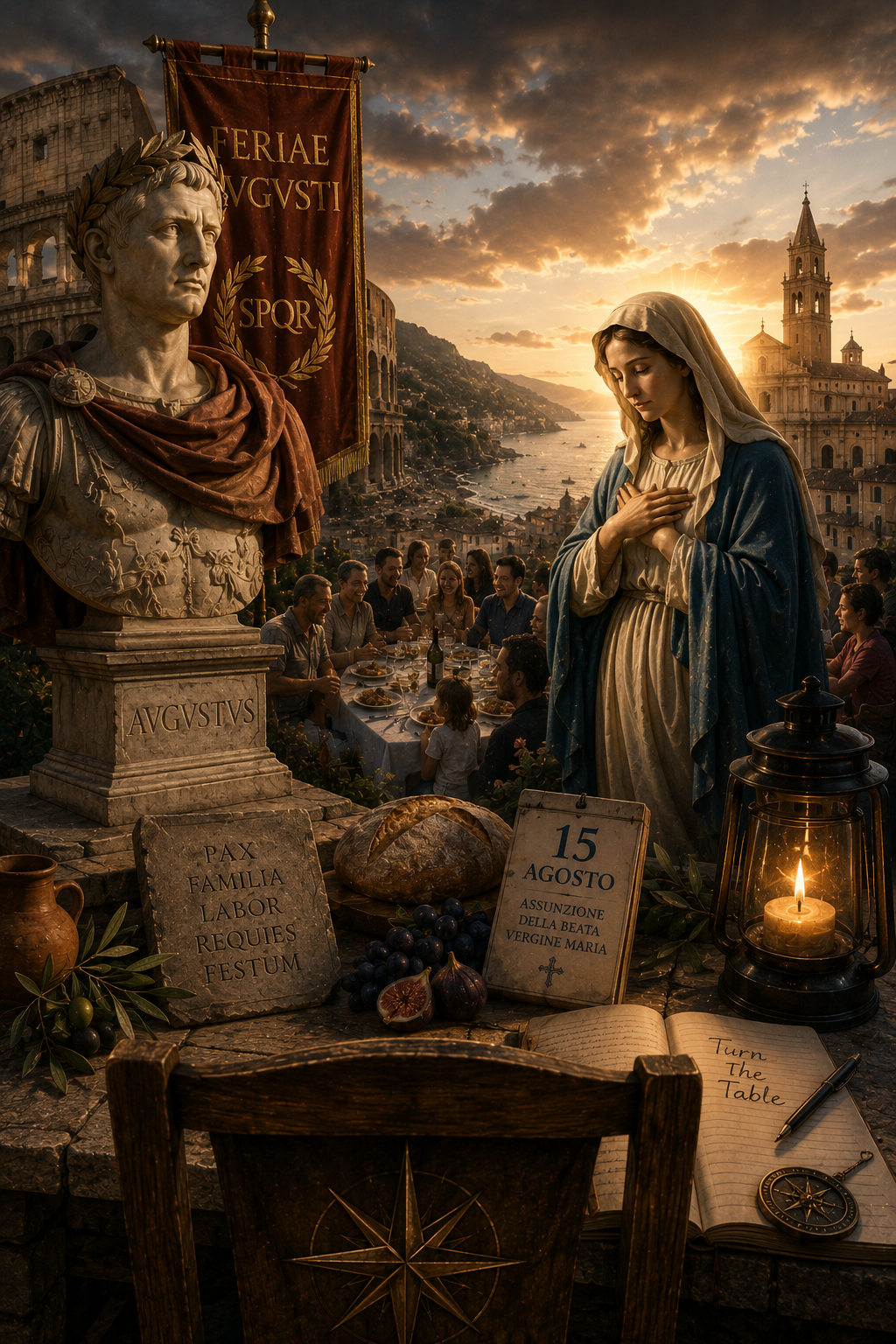
August has always seemed to carry a different rhythm in Italy. July is a busy work and tourism month, and September already hints at a return to a regular rhythm. August interrupts the routine… offices thin out, shutters close, families leave the cities for the sea, the mountains, or the paese. Traffic is a regular news piece as roads fill with the Italians heading to their favorite vacation spots. In August, Italian tables lengthen, lunches stretch into the afternoon, and even people who complain about Ferragosto eventually organize themselves around it. The month isn’t another month on the calendar, it changes the way time is inhabited.
That makes August an especially fitting month to Turn the Table™. Much of this week’s practice is about noticing what has quietly moved toward the center of our lives, what has begun to govern our attention, and what repeated participation is training us to desire, ignore, and become. August offers a surprisingly old version of that question because even the name of the month carries the imprint of power.
August was once called Sextilis, the sixth month in the old Roman calendar. It was later renamed in honor of Augustus Caesar, born Gaius Octavius. The title Augustus suggested something venerable, majestic, consecrated, worthy of reverence. Octavian had become more than a political ruler. His authority entered language, public life, memory, and eventually the calendar itself. More than two thousand years later, long after the empire that gave him that title disappeared, we still speak his name whenever we say August.
There is something almost unsettling in that. Human beings do not merely live inside cultures. Cultures live inside us. Their words, symbols, calendars, measures, expectations, and assumptions become so ordinary that we stop noticing where they came from. The room arranges the table, and eventually we forget that the arrangement was ever chosen at all.
Ferragosto carries a similar inheritance. Its name descends from the Latin Feriae Augusti, the holidays of Augustus, a period of rest associated with the end of demanding agricultural labor and with earlier Roman summer observances. The imperial calendar gathered rest, festivity, and social ritual into a public rhythm. Over time, the civic observance and the Christian feast of the Assumption of the Blessed Virgin Mary on August 15 became intertwined. What Italians now know as Ferragosto carries several histories at once: Roman, agricultural, civic, religious, familial, and modern.
That layering is part of what makes Italy so distinctive. The old is rarely erased completely. It is more often absorbed, repurposed, reinterpreted, and built upon. A Christian church rises where something older once stood. A family custom continues long after anyone can explain its origin. A feast gathers meanings from several centuries and allows them to coexist at the same table. Italy often does not demolish the room. It turns the table inside it.
There is something deeply Christian in that movement as well. Christianity itself entered a world that already possessed calendars, philosophies, temples, rituals, household structures, political powers, and deeply rooted assumptions about belonging. The first Christians did not enter an empty room. They had to learn how to remain inside the Roman world without allowing Rome to become the author of their identity.
That was no small thing because Roman power was never only administrative. The Empire carried symbolic and religious weight. Caesar did not simply govern territory. The emperor increasingly occupied sacred space. Loyalty to political authority could become entangled with worship, social belonging, and personal safety. Against that backdrop, the Christian confession that Jesus is Lord was not merely devotional language. It carried a quiet but profound reordering of authority. Caesar could rule, command, levy and collect taxes, and even name a month after himself. But Caesar did not and could not author the human person. That Chair belonged somewhere else.
That makes the convergence of Augustus and Mary on the August calendar particularly striking. On one side stands Augustus Caesar, one of the most consequential rulers of the ancient world. His administration reshaped Rome. His political authority reorganized the Mediterranean. His buildings, victories, reforms, and public image ensured that his name would survive long after his death.
On August 15, Christianity places before us someone entirely different. Mary of Nazareth had no army, no bureaucracy, no palace, no imperial title, and no calendar renamed in her honor. Her greatness begins not with conquest but with consent. She receives a call and answers it. She does not enlarge herself toward power. She allows herself to become available to God.
That difference is worth contemplating.
Augustus represents one of the oldest human instincts: to become large enough that history must remember us. Mary represents the strange Christian paradox that a person becomes most fully herself not by making herself the center, but by allowing herself to be ordered toward the Author. Her Magnificat makes the contrast even sharper. Mary does not use her chosenness to magnify herself. She magnifies God. The mighty are brought down, the lowly are lifted, the hungry are filled, and the proud are scattered. The logic of the room is reversed. The table turns.
This does not require us to reduce Augustus to a villain. History is more complicated than that. His reign brought relative stability after devastating civil wars, reorganized Roman administration, encouraged major cultural achievements, and shaped the Mediterranean for generations. Even the Feriae Augusti recognized something humane and necessary: people and animals cannot work endlessly without rest. The more important question is the one we have been asking throughout this week. Which lens is clarifying reality, and which is quietly governing it? Order is good, but order can become an idol. Work can give dignity, but work can become identity. Institutions can create belonging, but belonging can become possession. Tradition can carry wisdom, but tradition can become enclosure. Rest can restore the person, but even leisure can be turned into consumption.
The Chair is rarely taken all at once. It turns slowly. That is why Ferragosto is more than a summer holiday. It creates an opportunity to examine our relationship with time itself. Modern life has become extraordinarily skilled at adopting our time. Employers claim portions of it. Phones colonize its empty spaces. Social platforms monetize its pauses. News feeds compete for its attention. Algorithms fill its silence. Even leisure can become another form of production through planning, purchasing, photographing, posting, comparing, and documenting.
We may be surrounded by conveniences while remaining surprisingly unable to rest. That should tell us something. Rest is not merely the absence of work. Rest reveals what we believe owns us. The biblical Sabbath carries precisely this meaning. Israel was commanded to stop working because Israel was no longer enslaved in Egypt. Pharaoh no longer possessed every hour… the person could stop, as could the servant, and the animals. The land itself could stop as the growing season turns to harvest. Rest was therefore not idleness. It was a declaration of freedom.
Ferragosto can become a similar examination for us. Can we actually stop? Not stop producing while continuing to scroll. Not stop answering emails while continuing to worry about them. Not travel somewhere beautiful while remaining mentally trapped inside the same machinery we supposedly left behind.
Can we become unavailable long enough to discover what has become dependent upon our availability? That question belongs directly beside this week’s REDISCOVER U® strength of Self-Control. We usually imagine Self-Control as the ability to force ourselves to do difficult things or deny ourselves things we want. Yet there is another form of Self-Control that may be even harder: the freedom to stop when the world insists that we remain useful.
Some people can work eighteen hours but cannot sit quietly for eighteen minutes. Some can follow strict routines but cannot ignore a notification. Some can manage enormous responsibility but cannot tolerate disappointing an employer. Some can organize whole institutions yet feel uneasy during an afternoon in which nothing measurable has been achieved.
Ferragosto exposes these movements because the normal room changes. In much of Italy, the machinery simply slows down. The shop may be closed. The person you need may be away. The answer may have to wait. The bureaucracy may survive another day without your intervention. The family table becomes more important than the office desk. Lunch becomes something larger than fuel. Someone arrives with watermelon. Someone opens a bottle. Someone complains about the heat. Children disappear somewhere outside. Someone insists you eat more. Someone falls asleep after lunch. Conversation drifts. Time becomes less efficient and, perhaps because of that, more human.
For a few hours, the table becomes a table again. It is not a workstation, not a networking opportunity, not a productivity system, not a platform, and not a stage. It becomes the place where people sit because other people are there. There is wisdom hiding inside that.
The Assumption deepens the meaning even further because it insists that the human person cannot finally be reduced to productivity. The Christian imagination refuses to treat the body as disposable machinery temporarily carrying a useful mind. The whole person matters. Body and soul, relationship and vocation, earth and heaven all belong to the story.
That stands in direct opposition to every extractive system.
The employer may ask what you can produce. The market may ask what you will buy. The platform may ask whether you will engage. The influencer may ask whether you will follow. The algorithm may ask whether you can be predicted.
The Author asks something more fundamental: whether you are becoming fully alive.
Ferragosto therefore offers a very Italian way to practice Turn the Table™. It invites us to turn away from urgency long enough to recover presence. It allows us to discover whether we can receive a meal without rushing through it, whether another person can hold our attention, whether silence feels spacious or threatening, and whether an afternoon can remain unproductive without feeling wasted. That may be one of the deepest forms of Self-Control available to us. It is not the ability to dominate the self. It is the freedom to refuse every demand that tries to turn our existence into output.
Ad maiorem Dei gloriam. We are human together, or not at all.
In Italia, agosto sembra sempre avere un ritmo diverso. Luglio è un mese frenetico per il lavoro e il turismo, mentre settembre lascia già intravedere un ritorno alla normalità. Agosto interrompe la routine… gli uffici si svuotano, le saracinesche si chiudono, le famiglie lasciano le città per il mare, la montagna o il paese. Il traffico è un argomento ricorrente nei notiziari, mentre le strade si riempiono di italiani diretti verso le loro mete turistiche preferite. Ad agosto le tavole italiane si allungano, i pranzi si protraggono nel pomeriggio e persino chi si lamenta di Ferragosto finisce per organizzarsi in funzione di questa festività. Il mese non è solo un altro mese sul calendario, ma cambia il modo in cui viviamo il tempo.
Questo rende agosto un mese particolarmente adatto a «Turn the Table™». Gran parte della pratica di questa settimana consiste nel notare ciò che si è silenziosamente spostato al centro delle nostre vite, ciò che ha iniziato a dominare la nostra attenzione e ciò che la partecipazione ripetuta ci sta allenando a desiderare, a ignorare e a diventare. Agosto offre una versione sorprendentemente antica di questa domanda, perché persino il nome del mese porta l’impronta del potere.
Un tempo agosto si chiamava Sextilis, il sesto mese dell’antico calendario romano. Fu poi ribattezzato in onore di Augusto Cesare, nato Gaio Ottavio. Il titolo di Augusto suggeriva qualcosa di venerabile, maestoso, consacrato, degno di riverenza. Ottaviano era diventato più di un semplice sovrano politico. La sua autorità entrò nel linguaggio, nella vita pubblica, nella memoria e, infine, nel calendario stesso. A più di duemila anni di distanza, molto tempo dopo la scomparsa dell’impero che gli aveva conferito quel titolo, pronunciamo ancora il suo nome ogni volta che diciamo «agosto».
C’è qualcosa di quasi inquietante in tutto ciò. Gli esseri umani non si limitano a vivere all’interno delle culture. Sono le culture a vivere dentro di noi. Le loro parole, i simboli, i calendari, le misure, le aspettative e i presupposti diventano così ordinari che smettiamo di renderci conto della loro origine. La stanza dispone il tavolo, e alla fine dimentichiamo che quella disposizione sia mai stata scelta.
Il Ferragosto porta con sé un’eredità simile. Il suo nome deriva dal latino Feriae Augusti, le festività di Augusto, un periodo di riposo associato alla fine dei faticosi lavori agricoli e alle antiche celebrazioni estive romane. Il calendario imperiale riuniva riposo, festeggiamenti e rituali sociali in un ritmo pubblico. Col tempo, la celebrazione civica e la festa cristiana dell’Assunzione della Beata Vergine Maria, il 15 agosto, si intrecciarono. Ciò che gli italiani conoscono oggi come Ferragosto racchiude in sé diverse storie contemporaneamente: romana, agricola, civica, religiosa, familiare e moderna.
Questa stratificazione è parte di ciò che rende l’Italia così peculiare. Il passato raramente viene cancellato del tutto. Più spesso viene assorbito, riproposto, reinterpretato e sviluppato. Una chiesa cristiana sorge dove un tempo sorgeva qualcosa di più antico. Una tradizione familiare continua ben oltre il momento in cui qualcuno possa spiegarne l’origine. Una festa raccoglie significati provenienti da diversi secoli e permette loro di coesistere allo stesso tavolo. L’Italia spesso non demolisce la stanza. Capovolge il tavolo al suo interno.
C’è qualcosa di profondamente cristiano anche in quel movimento. Il cristianesimo stesso entrò in un mondo che possedeva già calendari, filosofie, templi, rituali, strutture familiari, poteri politici e presupposti profondamente radicati riguardo all’appartenenza. I primi cristiani non entrarono in una stanza vuota. Dovettero imparare a rimanere all’interno del mondo romano senza permettere che Roma diventasse l’artefice della loro identità.
Non era cosa da poco, perché il potere romano non fu mai solo amministrativo. L’Impero aveva un peso simbolico e religioso. Cesare non si limitava a governare un territorio. L’imperatore occupava sempre più lo spazio sacro. La fedeltà all’autorità politica poteva intrecciarsi con il culto, l’appartenenza sociale e la sicurezza personale. In quel contesto, la confessione cristiana che Gesù è il Signore non era solo un linguaggio devozionale. Comportava un silenzioso ma profondo riordino dell’autorità. Cesare poteva governare, comandare, imporre e riscuotere le tasse, e persino dare il proprio nome a un mese. Ma Cesare non era e non poteva essere l’artefice della persona umana. Quel Trono apparteneva a qualcun altro.
Ciò rende particolarmente suggestiva la convergenza tra Augusto e Maria nel calendario di agosto. Da una parte c’è Augusto Cesare, uno dei sovrani più influenti del mondo antico. Il suo governo ha rimodellato Roma. La sua autorità politica ha riorganizzato il Mediterraneo. I suoi edifici, le sue vittorie, le sue riforme e la sua immagine pubblica hanno garantito che il suo nome sopravvivesse a lungo dopo la sua morte.
Il 15 agosto, il cristianesimo ci presenta una figura completamente diversa. Maria di Nazaret non aveva un esercito, né una burocrazia, né un palazzo, né un titolo imperiale, né un calendario ribattezzato in suo onore. La sua grandezza non inizia con la conquista, ma con il consenso. Riceve una chiamata e vi risponde. Non si espande verso il potere. Si rende disponibile a Dio.
Vale la pena riflettere su questa differenza.
Augusto rappresenta uno degli istinti umani più antichi: diventare così grandi che la storia debba ricordarci. Maria rappresenta lo strano paradosso cristiano secondo cui una persona diventa pienamente se stessa non ponendosi al centro, ma lasciandosi orientare verso l’Autore. Il suo Magnificat rende il contrasto ancora più netto. Maria non usa la sua elezione per esaltare se stessa. Esalta Dio. I potenti sono abbattuti, gli umili sono innalzati, gli affamati sono saziati e i superbi sono dispersi. La logica della sala viene capovolta. La situazione si ribalta.
Questo non ci impone di ridurre Augusto a un cattivo. La storia è più complessa di così. Il suo regno portò una relativa stabilità dopo devastanti guerre civili, riorganizzò l’amministrazione romana, incoraggiò importanti conquiste culturali e plasmò il Mediterraneo per generazioni. Persino le Feriae Augusti riconoscevano qualcosa di umano e necessario: le persone e gli animali non possono lavorare all’infinito senza riposo. La domanda più importante è quella che ci siamo posti per tutta questa settimana. Quale lente chiarisce la realtà, e quale la governa silenziosamente? L’ordine è un bene, ma l’ordine può diventare un idolo. Il lavoro può conferire dignità, ma il lavoro può diventare identità. Le istituzioni possono creare senso di appartenenza, ma l’appartenenza può diventare possesso. La tradizione può trasmettere saggezza, ma la tradizione può diventare gabbia. Il riposo può rigenerare la persona, ma anche il tempo libero può essere trasformato in consumo.
La Sedia viene raramente occupata tutta in una volta. Gira lentamente. Ecco perché Ferragosto è più di una semplice vacanza estiva. Crea l’occasione per esaminare il nostro rapporto con il tempo stesso. La vita moderna è diventata straordinariamente abile nell’appropriarsi del nostro tempo. I datori di lavoro ne rivendicano porzioni. I telefoni colonizzano i suoi spazi vuoti. Le piattaforme social monetizzano le sue pause. I feed di notizie competono per la sua attenzione. Gli algoritmi riempiono il suo silenzio. Persino il tempo libero può diventare un’altra forma di produzione attraverso la pianificazione, l’acquisto, la fotografia, la pubblicazione, il confronto e la documentazione.
Potremmo essere circondati da comodità pur rimanendo sorprendentemente incapaci di riposare. Questo dovrebbe dirci qualcosa. Il riposo non è semplicemente l’assenza di lavoro. Il riposo rivela ciò che crediamo ci possieda. Il sabato biblico porta proprio questo significato. A Israele fu comandato di smettere di lavorare perché non era più schiavo in Egitto. Il Faraone non possedeva più ogni ora… la persona poteva fermarsi, così come il servo e gli animali. La terra stessa poteva fermarsi mentre la stagione della crescita volgeva al raccolto. Il riposo non era quindi ozio. Era una dichiarazione di libertà.
Ferragosto può diventare per noi un’occasione di riflessione simile. Riusciamo davvero a fermarci? Non smettere di produrre mentre continuiamo a scorrere i social. Non smettere di rispondere alle e-mail mentre continuiamo a preoccuparcene. Non viaggiare in un posto bellissimo rimanendo mentalmente intrappolati nello stesso ingranaggio che avremmo dovuto lasciarci alle spalle.
Riusciamo a renderci irraggiungibili abbastanza a lungo da scoprire ciò che è diventato dipendente dalla nostra disponibilità? Questa domanda si colloca proprio accanto alla forza del “Autocontrollo” di REDISCOVER U® di questa settimana. Di solito immaginiamo l’autocontrollo come la capacità di costringerci a fare cose difficili o di negarci ciò che desideriamo. Eppure esiste un’altra forma di autocontrollo che potrebbe essere ancora più difficile: la libertà di fermarsi quando il mondo insiste affinché restiamo utili.
C’è chi riesce a lavorare diciotto ore ma non riesce a stare seduto in silenzio per diciotto minuti. C’è chi segue routine rigide ma non riesce a ignorare una notifica. C’è chi gestisce enormi responsabilità ma non tollera di deludere un datore di lavoro. C’è chi organizza intere istituzioni eppure si sente a disagio durante un pomeriggio in cui non è stato raggiunto nulla di misurabile.
Ferragosto mette a nudo questi meccanismi perché il contesto abituale cambia. In gran parte d’Italia, il sistema semplicemente rallenta. Il negozio potrebbe essere chiuso. La persona di cui hai bisogno potrebbe essere assente. La risposta potrebbe dover aspettare. La burocrazia potrebbe sopravvivere un altro giorno senza il tuo intervento. La tavola di famiglia diventa più importante della scrivania dell’ufficio. Il pranzo diventa qualcosa di più di un semplice rifornimento di energia. Qualcuno arriva con l’anguria. Qualcuno stappa una bottiglia. Qualcuno si lamenta del caldo. I bambini spariscono da qualche parte fuori. Qualcuno insiste perché tu mangi di più. Qualcuno si addormenta dopo pranzo. La conversazione va alla deriva. Il tempo diventa meno efficiente e, forse proprio per questo, più umano.
Per qualche ora, la tavola torna a essere semplicemente una tavola. Non è una postazione di lavoro, né un’occasione di networking, né un sistema di produttività, né una piattaforma, né un palcoscenico. Diventa il luogo dove le persone si siedono perché ci sono altre persone. In questo si nasconde una saggezza.
L’Assunzione ne approfondisce ulteriormente il significato perché insiste sul fatto che la persona umana non può, in definitiva, essere ridotta alla produttività. L’immaginario cristiano rifiuta di trattare il corpo come un macchinario usa e getta che ospita temporaneamente una mente utile. Conta la persona nella sua interezza. Corpo e anima, relazioni e vocazione, terra e cielo: tutto fa parte della storia.
Ciò è in diretta opposizione a ogni sistema estrattivo.
Il datore di lavoro potrebbe chiederti cosa sei in grado di produrre. Il mercato potrebbe chiederti cosa comprerai. La piattaforma potrebbe chiederti se ti impegnerai. L’influencer potrebbe chiederti se lo seguirai. L’algoritmo potrebbe chiederti se sei prevedibile.
L’Autore pone una domanda più fondamentale: se stai diventando pienamente vivo.
Ferragosto offre quindi un modo molto italiano di mettere in pratica Turn the Table™. Ci invita ad allontanarci dall’urgenza abbastanza a lungo da recuperare la presenza. Ci permette di scoprire se siamo in grado di gustare un pasto senza consumarlo in fretta, se un’altra persona può catturare la nostra attenzione, se il silenzio ci sembra ampio o minaccioso, e se un pomeriggio può rimanere improduttivo senza darci la sensazione di essere sprecato. Questa potrebbe essere una delle forme più profonde di autocontrollo a nostra disposizione. Non è la capacità di dominare il sé. È la libertà di rifiutare ogni pretesa che cerchi di trasformare la nostra esistenza in un risultato.
Ad maiorem Dei gloriam. Siamo umani insieme, o non lo siamo affatto.
Small acts to move the world forward

This week’s Magis Moments are not meant to add more tasks to an already crowded life. They are small acts of reorientation. We are digging deeper into the Week Two of Turn the Table™ Workbook - where the focus this week is to notice which lens is clarifying reality and which is quietly governing it, while the opening reflection asks an even more personal question: what has been trying to adopt me, and is it turning my Chair toward the Author or toward some smaller light?
The practice for the coming week is therefore simple. Choose one action from each of the Six Promises of the Humaning Covenant and actually do it. The point is not completion for its own sake. It is to create enough friction with the ordinary pattern that you can see what has been governing the room.
Choose one period of thirty minutes this week in which you become deliberately unavailable to every system that normally claims your attention. Put the phone away, close the laptop, step away from work, and do something that restores the whole instrument: walk, pray, sit outside, prepare a meal, stretch, rest, or spend uninterrupted time with another person. Pay attention to what becomes restless when nothing is demanding your usefulness.
The action is really about rest. It is to notice whether you still know how to receive time that has not been assigned a productive purpose.
Choose one person with whom you have influence and do something that makes that person less dependent upon you. Give away information you have been holding. Invite them into a decision. Teach rather than simply solve. Ask for their judgment before offering yours. Step back from something they are ready to carry.
Turn the Table™ reminds us that greater purpose requires other chairs and that influence is cleanest when it reduces dependence on the influencer. This week, leave someone with more agency because you were present.
Take one claim, prediction, recommendation, metric, dashboard, headline, AI response, or strongly held opinion that is currently influencing you and examine it twice. First ask what the evidence actually supports. Then ask what the evidence cannot decide for you.
The week’s Turns insist that data may reveal a pattern without pronouncing a vocation, and that truth should not be rejected because it arrives through science nor error accepted because it arrives clothed in technology. Your action is to make one consequential judgment this week in which evidence informs the decision without being allowed to replace conscience, wisdom, prayer, or responsibility.
Identify one voice you hear regularly that almost never contradicts you. It may be a person, media source, community, ideology, influencer, organization, or AI tool. Seek one serious counter-perspective from someone you respect and listen long enough to understand it before defending your own position.
Do not change your mind merely to prove that you are open-minded. Instead, notice what happens inside you when confirmation is removed. Week Two warns us to distrust the voice that never costs us anything and never contradicts us, because flattery can resemble confirmation until the fruit appears. The action is to create one honest opening through which correction could enter.
Perform one act of service this week that cannot easily be measured, posted, credited, or repaid. Wash something. Carry something. Prepare food. Make a call. Sit with someone who needs company. Repair something another person would otherwise have to deal with. Do it without announcing it.
Then notice whether the act feels smaller because no one saw it or somehow more complete. The Humaning question is not whether the act increased your visibility. It is whether another person’s burden was lighter because of you.
Notice one pattern that this week’s reflection has exposed and make one concrete adjustment before the week ends. If a platform has been governing too much attention, change the setting. If an employer’s approval has become too important, establish one boundary. If a relationship cannot tolerate questions, ask one. If AI has begun settling questions before you have formed your own judgment, change how you use it. If a church, organization, or cause has become confused with the Author, create enough distance to see the distinction again.
Growth should leave evidence. Do not end the week merely knowing something you did not know on Sunday. Let the insight acquire a verb.
At the end of the week, return to the rooms you actually entered rather than the rooms you remember vaguely. Turn the Table™ asks us not to summarize from memory alone, but to revisit the friction, the facts, the fictions, and the fruit.
Details: Recall one or two moments when you felt the Chair move. What actually happened? What was said, requested, rewarded, withheld, predicted, praised, or feared? Describe the event without explaining it yet.
Evidence: What was fact, and what interpretation arrived immediately afterward? What evidence supported your reading, and what did you assume because the room had already trained you to assume it?
Empathy: Who else was affected? Whose dignity, burden, freedom, perspective, or agency did you fail to see at first? Did the room make someone invisible because the system did not know how to measure what they contributed?
Prospective: look downstream. If this relationship, habit, technology, allegiance, or pattern continues exactly as it is, what kind of person are you likely to become? What is it training you to notice, desire, ignore, and become? That question sits near the heart of Week Two.
Execution: Give the reflection a verb. What one repair, boundary, conversation, refusal, invitation, change in use, or act of service now needs to happen? Give it time. Formation begins when reflection becomes action.
Reflection, ask the deeper question beneath the week. What is the Author forming in you through this pressure? Where did you become freer? Where did approval become less necessary? Where did a smaller light lose some of its authority? Where did you discover that belonging to God made you more capable of belonging rightly to other people?
Magis is not the reward for doing all six actions well. It is the question of what greater good became possible because you remained more fully in the Chair.
Look back across the week and ask where you became less central so that another person could become more capable. Notice where you chose relationship over visibility, truth over confirmation, responsibility over convenience, service over recognition, or rest over the demand to prove usefulness. Ask what produced deeper freedom, wider service, stronger relationships, or more shared life. These are the fruits the Turn the Table™ workbook itself gives us as signs of Magis.
Then ask the hardest question of the week: what was trying to adopt you?
Perhaps it was not something obviously harmful. It may have been a good employer, a useful technology, a trusted institution, a political cause you still believe in, a church you love, a person whose wisdom has helped you, or simply the desire to be useful. The point is not to reject what is good. The point is to see whether gratitude was becoming allegiance, whether allegiance was becoming dependence, and whether dependence was beginning to turn the Chair.
Now ask what changed when you noticed.
Did the room become larger? Did another person become more visible? Did you recover a question you had stopped asking? Did a metric become a measure again instead of a master? Did an AI response return to being assistance rather than absolution? Did a relationship become healthier because you stopped asking it to tell you who you are? Did you remember that you were loved before you were useful?
Choose one Turn from the week that interrupted you, accused you, or steadied you, and carry it into the next seven days as your watchword. Then name one action that will exist outside the Sunday Table before the week is over.
That is the sending.
Not more reflection for reflection’s sake, but a Chair that faces a little more clearly toward the Author, a table with a little more room around it, and a life that leaves someone else a little freer because you were there.
Ad maiorem Dei gloriam.
Piccoli gesti che fanno andare avanti il mondo
I Momenti Magis di questa settimana non hanno lo scopo di aggiungere ulteriori impegni a una vita già piena. Sono piccoli atti di riorientamento.
Stiamo approfondendo la seconda settimana del quaderno di esercizi Turn the Table™ – dove l’attenzione questa settimana è rivolta a notare quale lente sta chiarendo la realtà e quale la sta governando silenziosamente, mentre la riflessione iniziale pone una domanda ancora più personale: cosa sta cercando di adottarmi, e sta orientando la mia Sedia verso l’Autore o verso una luce più piccola?
La pratica per la settimana che verrà è quindi semplice. Scegliete un’azione da ciascuna delle Sei Promesse del Patto dell’Umanità e mettetela in pratica. Il punto non è il completamento fine a se stesso, ma creare un attrito sufficiente con lo schema abituale da permettervi di vedere cosa sta governando la stanza.
Scegliete un periodo di trenta minuti questa settimana in cui vi rendiate deliberatamente irreperibili per ogni sistema che normalmente richiede la vostra attenzione. Mettete via il telefono, chiudete il portatile, allontanatevi dal lavoro e fate qualcosa che rigeneri l’intero essere: camminate, pregate, sedetevi all’aperto, preparate un pasto, fate stretching, riposatevi o trascorrete del tempo senza interruzioni con un’altra persona. Prestate attenzione a ciò che diventa irrequieto quando nulla richiede la vostra utilità.
L’azione riguarda in realtà il riposo. Si tratta di notare se sai ancora come accogliere il tempo a cui non è stato assegnato uno scopo produttivo.
Scegli una persona su cui hai influenza e fai qualcosa che la renda meno dipendente da te. Condividi le informazioni che hai tenuto per te. Coinvolgi quella persona in una decisione. Insegna invece di limitarti a risolvere. Chiedi il suo giudizio prima di offrire il tuo. Fai un passo indietro rispetto a qualcosa che quella persona è pronta ad assumersi.
Turn the Table™ ci ricorda che uno scopo più grande richiede altre sedie e che l’influenza è più autentica quando riduce la dipendenza da chi la esercita. Questa settimana, lascia a qualcuno maggiore autonomia grazie alla tua presenza.
Prendi un’affermazione, una previsione, una raccomandazione, un indicatore, un dashboard, un titolo, una risposta dell’IA o un’opinione fermamente sostenuta che ti sta influenzando in questo momento ed esaminala due volte. Chiediti innanzitutto cosa sostengono effettivamente le prove. Poi chiediti cosa le prove non possono decidere al posto tuo.
I «Turns» di questa settimana sottolineano che i dati possono rivelare uno schema senza pronunciarsi su una vocazione, e che la verità non dovrebbe essere respinta solo perché proviene dalla scienza, né l’errore accettato solo perché si presenta sotto le spoglie della tecnologia. La tua azione consiste nel formulare un giudizio significativo questa settimana, in cui le prove guidino la decisione senza però sostituire la coscienza, la saggezza, la preghiera o la responsabilità.
Identifica una voce che senti regolarmente e che non ti contraddice quasi mai. Può trattarsi di una persona, una fonte mediatica, una comunità, un’ideologia, un influencer, un’organizzazione o uno strumento di intelligenza artificiale. Cerca una contro-prospettiva seria da parte di qualcuno che rispetti e ascoltala abbastanza a lungo da comprenderla prima di difendere la tua posizione.
Non cambiare idea solo per dimostrare di avere una mentalità aperta. Osserva invece cosa accade dentro di te quando viene rimossa la conferma. La seconda settimana ci avverte di diffidare della voce che non ci costa mai nulla e non ci contraddice mai, perché l’adulazione può assomigliare a una conferma finché non si vedono i frutti. L’azione consiste nel creare un’apertura sincera attraverso la quale possa entrare la correzione.
Compie questa settimana un atto di servizio che non possa essere facilmente misurato, pubblicato, riconosciuto o ripagato. Lava qualcosa. Trasporta qualcosa. Prepara da mangiare. Fai una telefonata. Siediti con qualcuno che ha bisogno di compagnia. Ripara qualcosa di cui altrimenti un’altra persona dovrebbe occuparsi. Fallo senza annunciarlo.
Poi osserva se l’atto ti sembra meno importante perché nessuno l’ha visto o, in qualche modo, più completo. La domanda fondamentale non è se l’atto abbia aumentato la tua visibilità, ma se il fardello di un’altra persona sia stato alleggerito grazie a te.
Individua uno schema che la riflessione di questa settimana ha messo in luce e apporta un cambiamento concreto prima che la settimana finisca. Se una piattaforma sta assorbendo troppa attenzione, modifica le impostazioni. Se l’approvazione di un datore di lavoro è diventata troppo importante, stabilisci un limite. Se una relazione non tollera domande, ponine una. Se l’intelligenza artificiale ha iniziato a risolvere questioni prima che tu abbia formulato il tuo giudizio, cambia il modo in cui la utilizzi. Se una chiesa, un’organizzazione o una causa è stata confusa con l’Autore, crea una distanza sufficiente per vedere nuovamente la distinzione.
La crescita dovrebbe lasciare tracce. Non concludere la settimana limitandoti a sapere qualcosa che domenica non sapevi. Lascia che l’intuizione si trasformi in un’azione.
Alla fine della settimana, torna nelle stanze in cui sei effettivamente entrato piuttosto che in quelle che ricordi vagamente. Turn the Table™ ci chiede di non riassumere basandoci solo sulla memoria, ma di rivisitare gli attriti, i fatti, le finzioni e i frutti.
Dettagli: Ricorda uno o due momenti in cui hai sentito la sedia muoversi. Cosa è successo realmente? Cosa è stato detto, richiesto, ricompensato, negato, previsto, lodato o temuto? Descrivi l’evento senza spiegarlo ancora.
Evidenza: Qual era il fatto e quale interpretazione ne è derivata immediatamente dopo? Quali prove hanno sostenuto la tua lettura e cosa hai dato per scontato perché quella stanza ti aveva già abituato a farlo?
Empatia: Chi altro ne è stato influenzato? Di chi non hai colto inizialmente la dignità, il fardello, la libertà, la prospettiva o l’autonomia? L’ambiente ha reso qualcuno invisibile perché il sistema non sapeva come misurare il suo contributo?
Prospettiva: guarda a valle. Se questa relazione, abitudine, tecnologia, fedeltà o schema continua esattamente così com’è, che tipo di persona rischi di diventare? Cosa ti sta insegnando a notare, desiderare, ignorare e diventare? Questa domanda è al centro della Seconda Settimana.
Esecuzione: dai alla riflessione un verbo. Quale riparazione, limite, conversazione, rifiuto, invito, cambiamento nell’uso o atto di servizio deve avvenire ora? Concedigli tempo. La formazione inizia quando la riflessione diventa azione.
Riflessione: poniti la domanda più profonda che sta alla base della settimana. Cosa sta formando l’Autore in te attraverso questa pressione? Dove sei diventato più libero? Dove l’approvazione è diventata meno necessaria? Dove una luce più piccola ha perso parte della sua autorità? Dove hai scoperto che appartenere a Dio ti ha reso più capace di appartenere giustamente alle altre persone?
Il Magis non è la ricompensa per aver svolto bene tutte e sei le azioni. È la domanda su quale bene maggiore sia diventato possibile perché sei rimasto più pienamente nella Sedia.
Ripensa alla settimana e chiediti dove sei diventato meno centrale affinché un’altra persona potesse diventare più capace. Notate dove avete scelto la relazione invece della visibilità, la verità invece della conferma, la responsabilità invece della comodità, il servizio invece del riconoscimento, o il riposo invece dell’esigenza di dimostrare la propria utilità. Chiedetevi cosa ha prodotto una libertà più profonda, un servizio più ampio, relazioni più forti o una vita più condivisa. Questi sono i frutti che lo stesso quaderno di lavoro Turn the Table™ ci offre come segni del Magis.
Poi ponetevi la domanda più difficile della settimana: cosa stava cercando di appropriarsi di voi?
Forse non era qualcosa di palesemente dannoso. Potrebbe essere stato un buon datore di lavoro, una tecnologia utile, un’istituzione di fiducia, una causa politica in cui credi ancora, una chiesa che ami, una persona la cui saggezza ti ha aiutato, o semplicemente il desiderio di essere utile. Il punto non è rifiutare ciò che è buono. Il punto è vedere se la gratitudine si stava trasformando in fedeltà, se la fedeltà si stava trasformando in dipendenza e se la dipendenza stava cominciando a capovolgere la Seduta.
Ora chiediti cosa è cambiato quando te ne sei accorto.
La stanza è diventata più spaziosa? Un’altra persona è diventata più visibile? Hai ritrovato una domanda che avevi smesso di porre? Un parametro è tornato a essere una misura invece che un padrone? Una risposta dell’intelligenza artificiale è tornata a essere un aiuto piuttosto che un’assoluzione? Una relazione è diventata più sana perché hai smesso di chiederle di dirti chi sei? Ti sei ricordato che eri amato prima ancora di essere utile?
Scegli una Svolta della settimana che ti ha interrotto, accusato o rassicurato, e portala con te nei prossimi sette giorni come parola d’ordine. Poi indica un’azione che esisterà al di fuori della Tavola della Domenica prima che la settimana finisca.
Questo è il mandato.
Non più riflessione fine a se stessa, ma una Sedia che guarda un po’ più chiaramente verso l’Autore, un tavolo con un po’ più di spazio intorno, e una vita che lascia qualcun altro un po’ più libero perché tu c’eri.
Ad maiorem Dei gloriam.
Cosiamo | Founder, UMANIAMO® | Humaning Architecture

We opened this week with a question that arrived almost before I knew I was asking it. In a conversation about organizational adoption of artificial intelligence, I heard myself turn the familiar phrase around: perhaps the question is not simply whether we are adopting AI, but whether AI is adopting us. Much of this week’s theme, Read the Room, has been about noticing when a room that once helped us see begins quietly determining what we are permitted to see, when a lens becomes an enclosure, and when the Chair starts turning almost imperceptibly away from the Author toward some smaller light.
That work is essential, but it is only half of discernment. We are not merely people upon whom the world acts. We are continually reaching outward ourselves. We choose whom to trust. We choose whose voices to hear repeatedly. We choose which ideas receive serious consideration and which eventually receive permanent places at our tables. We choose friendships, mentors, communities, technologies, books, ministries, occupations, causes, and collaborators. We walk into rooms that no one forced us to enter and invite people into parts of our lives they could never have occupied without our consent. In the oldest sense of the word, we adopt. We choose and draw near.
That makes the question of adoption deeper than simply guarding against what might claim or harm us, because what we deliberately draw near will, in time, participate in who we become. What we attend to repeatedly trains our attention. What we admire begins educating our desire. What we tolerate establishes new thresholds. What we love makes claims upon our imagination. What we trust becomes part of the architecture through which we encounter the world. None of those things become our authors, they can’t. The human person remains authored by God. But they do become formative relationships, and because formation is rarely neutral, discernment is necessary before we invite it close enough to change us.
The Gospel shows Jesus exercising this kind of freedom. He did not move through the world indiscriminately, allowing every person, expectation, invitation, or pressure equal access to Him. He was radically available without being directionless. He could enter a room fully, attend to the person before Him completely, and still remain oriented toward the Father. His openness was never the same thing as susceptibility.
Luke gives us one of the clearest examples before Jesus chooses the Twelve. He does not simply gather whoever happens to be nearby. He goes up to the mountain to pray and spends the night in prayer. Only when morning comes does He call His disciples and choose twelve from among them (Luke 6:12–13). Before one of the most consequential acts of relationship in His public ministry, there is prolonged communion with the Father. Jesus reads outward from the Chair and relationship follows that discernment.
The way the story unfolds and its message matters. Prayer does not appear after the choice as a request that God bless what Jesus has already decided. Prayer precedes the choosing. The relationship is received through communion rather than selected by preference, which as we have learned may be an Empty Chair. Luke gives us a powerful alternative to the way we often fill our own tables. We tend to ask whether someone interests us, impresses us, agrees with us, can help us, needs us, or offers access to a room we want to enter. The Gospel points to a different question: what becomes possible for the work of God because this person has been drawn near?
John's Gospel makes the intentionality even more explicit when Jesus tells the disciples, “You did not choose me, but I chose you and appointed you to go and bear fruit” (John 15:16). The purpose of His choosing was not possession, but fruitfulness. Christ draws people near so that they may eventually be sent. His relationship with them doesn’t make them smaller, more dependent, or permanently enclosed within His immediate physical presence. He forms them for a mission.
Before we consider adopting any relationship, it's our responsibility to ask; does drawing this person, community, practice, technology, or idea near make me more capable of bearing good fruit beyond the relationship itself, or does it increasingly require the relationship to remain at the center? Jesus repeatedly chooses people in ways that enlarge rather than consume them. He sees Matthew sitting at the tax booth and says, “Follow me” (Matthew 9:9). Matthew rises and leaves a structure that had defined both his work and his social identity. Jesus does not recruit him so that Matthew can become a more effective tax collector for a sacred cause. The invitation opens an entirely different possibility of life.
When Jesus sees Zacchaeus in the sycamore tree, He tells him to come down because He intends to stay at his house (Luke 19:1–10). The encounter does not create dependence upon Jesus as a charismatic personality. It restores Zacchaeus to responsibility. By the end of the meal, the man who had organized his life around accumulation is speaking about restitution and generosity. The relationship leaves him more responsible for what he has done and more available to his neighbors.
At Jacob's well, Jesus encounters a Samaritan woman whose social, religious, and personal history could easily have reduced her to a category (John 4:4–42). Instead, He engages her seriously and asks questions. He also allows questions and speaks truth without humiliation. The conversation expands until the woman who came alone to draw water returns to her town and begins telling others what she has encountered. Again, the relationship does not close around Jesus. It opens outward.
We also have to consider our own motivations, similarly. For example, What are you looking for when you reach toward this relationship? What desire is underneath the adoption? Are you looking for wisdom, companionship, status, certainty, usefulness, access, belonging, validation, direction, relief from loneliness, someone to tell you what to think, or someone whose presence helps you hear the Author more clearly? The desire itself may not be wrong, but unnamed desires are remarkably easy for the lantern to manipulate.
This is a place where REDISCOVER U® becomes important. Discernment begins with knowing something about the humaned person being sent into the room - you. Not every good opportunity is your opportunity and not every worthy cause is your vocation. For me those two are especially difficult, as someone who enjoys the vigor and rigor of a good challenge for what appears as a worthy cause. In some ways, the REDISCOVER U® H.A.L.T.E.R. check-in arose from my own reflections. The check-in is simple - are you… Hungry, Angry, Lonely, or Tired? Express the feeling then ask does this room satisfy one or more of those states in you? That’s the space for discernment. Then Respond or Reframe. For example, I tend toward a Hunger for challenging problems, which has served me well in many ways, allowing me to see the lantern so that I can recognize The Devil at Work. However, what feels satisfying may actually be extraction carrying the mask of “mission.”
We can also think about the fact that not every wise person is your mentor or even a friend and not every community where you could belong is the community to which you are called. Jesus Himself did not heal every sick person in Palestine, remain in every village that wanted Him, or accept every invitation that came His way. In Mark's Gospel, after an extraordinary evening of healing in Capernaum, Jesus rises early and goes to a deserted place to pray. When the disciples find Him and tell Him, “Everyone is searching for you,” He does something extraordinary: He leaves. “Let us go on to the neighboring towns,” He says, “that I may proclaim the message there also; for that is what I came out to do” (Mark 1:35–38).
Everyone wanted Him and He still left. That may be one of the most powerful Gospel images of Self-Control that we might reflect upon this week. Popularity does not determine your vocation and being needed does not automatically become yours to fill. The fact that a room wanted more from Him did not mean the Father was asking Him to remain there. We need that distinction. Some of the most extractive relationships in our lives may not begin with coercion at all. They may begin because we are needed. We are useful and appreciated for one reason or another. For many of us it may feel like we are finally being seen. The room of the crowd keeps saying, “Everyone is looking for you,” and something inside likes the feeling. Without discernment however, usefulness can become one of the most flattering lanterns of The Devil at Work.
Knowing your Authored self seated facing the Author allows you to know whether something belongs within the particular vocation for which you have been called. Sometimes Self-Control is the freedom to leave a good room because staying would require abandoning the work for which we were actually sent.
The Six Promises of the Humaning Covenant give us another way to test what we are considering drawing near. Rather than treating them as rules applied after a relationship has already been established, we can use them as questions of invitation. Does this relationship honor the whole person, or does it mainly value what I can produce? Does it increase agency and responsibility for a greater purpose, or create dependence upon the person or institution offering belonging? Does it allow faith and evidence to remain in honest conversation, or require one to silence the other? Does it create space for reflection and discernment, including disagreement, or does it reward speed, conformity, and certainty? Does it recognize the quiet work of service that receives no applause, or only what can be measured and displayed? Does it allow people to grow beyond the identities in which they first entered, or does the relationship require them to remain useful in precisely the way the system already knows how to use them?
These questions do not divide the world neatly into good rooms and bad rooms. Human relationships are too complex for that, and so are humaned persons. A community can nourish us in one season and constrain us in another. A mentor may have been exactly the person we needed and later become someone from whom we must differentiate. An employer may provide meaningful work while still making claims that require boundaries. A church can be genuinely holy while remaining human enough to need correction. Technology can extend our capacity while also training habits we must resist. Discernment does not require the absence of tension. It requires enough freedom to read the tension truthfully.
That is also why your somatic senses matter, though they shouldn’t become the final judge, especially when you are experiencing Hunger, Anger, Loneliness, or Tiredness. Our Neuro-Ignatian discernment pays attention to movements within us because desire, agitation, attraction, resistance, consolation, and desolation can all provide information. But they must be tested by their direction and fruit. Something exciting may still be drawing us away from freedom. Something uncomfortable may be precisely where growth is occurring. Peace can be counterfeit, particularly when it is purchased through avoidance, and agitation can accompany an invitation that asks us to become larger than the version of ourselves we have learned to protect.
The Gospel gives us a particularly powerful image of this in the rich young man who comes to Jesus asking what he must do to inherit eternal life (Mark 10:17–22). Jesus looks at him and loves him before asking him to relinquish what has become the organizing attachment of his life. The man goes away grieving. His sorrow does not prove the invitation was wrong. It reveals the cost of freedom. That should make us cautious about evaluating what to adopt merely by what feels immediately comfortable. Some relationships flatter us and leave us smaller. Others challenge us and leave us freer. The question is not simply whether a room feels good while we are inside it, but what kind of fruit appears after we have lived there for a while. Jesus gives the criterion plainly: “You will know them by their fruits” (Matthew 7:16). Fruit requires time. It cannot always be detected during the first conversation, the first week on a job, the first encounter with a new technology, or the first rush of belonging to a movement. We have to watch what grows.
Ad maiorem Dei gloriam. We are human together or not at all.
The saints of this particular week seem almost providentially aligned with Week Two of Turn the Table™. The workbook asks, “Which lens is clarifying reality, and which is quietly governing it?” and moves through greater purpose, faith and science, discernment, the danger of flattery, the formative power of systems, and finally the refusal to delegate responsibility. The liturgical calendar gives us, in succession, people who faced empires, privilege, wealth, institutional pressure, ideological captivity, imprisonment, violence, and death without allowing the room they occupied to determine who they were.
Monday, August 10 · Saint Lawrence, Deacon and Martyr
Lawrence was a deacon of the Church of Rome in the third century, entrusted particularly with service to the poor and with administering the Church's material resources. He was martyred during the persecution of Emperor Valerian in 258, only days after Pope Sixtus II. An ancient tradition remembers Lawrence distributing the Church's goods to the poor and then presenting the poor themselves as the true treasure of the Church.
Humaning Reflection. Lawrence read the imperial room correctly. Rome possessed the power to declare what was valuable, confiscate what it wanted, and take his life, but it could not make him adopt its measure of treasure. He had already received another measure. That is an extraordinary expression of Self-Control: not clenching tightly around what belongs to us, but remaining free enough that the world's valuation cannot become our own. This week, notice what your room calls valuable. Salary, visibility, influence, position, followers, productivity, access, possessions, even institutional survival can gradually migrate toward the center of the table. Lawrence asks whether we can still recognize the treasure sitting quietly in the overlooked chairs.
Tuesday, August 11 · Saint Clare of Assisi, Virgin
Born into privilege in Assisi around 1193–1194, Clare encountered the evangelical life awakened by Francis and chose a radically different belonging. She left the security expected of a noblewoman and founded the community that became the Poor Clares. John Paul II described her vocation as something received from God and emphasized the contemplative gaze upon Christ that marked her life. Clare did not simply reject one social identity; she discovered a deeper one.
Humaning Reflection. Clare is especially powerful for a week concerned with adoption because she could have allowed family, class, wealth, social expectation, or even Francis himself to become her final source. She did not. Francis helped her see, but Christ remained the Light. That distinction matters. Healthy influence helps another person face the Author more clearly; it does not make the influencer indispensable. Clare asks us to examine the people whose approval has become unusually important. Has gratitude become allegiance? Has admiration become imitation? The cleanest relationships do not possess us. They help us become more completely the person God authored.
Wednesday, August 12 · Saint Jane Frances de Chantal, Religious
Jane Frances de Chantal knew dramatically different rooms during her life. She was a wife and mother, became a widow after her husband's accidental death, and later, under the spiritual friendship of St. Francis de Sales, founded the Order of the Visitation. Her spirituality developed not through escape from relationship but through changing relationships, responsibilities, grief, service, and discernment.
Humaning Reflection. Jane Frances reminds us that losing a room does not mean losing the Chair. Jobs end. Children grow. Relationships change. Institutions disappoint us. Roles in which we once knew exactly who we were can disappear overnight. When identity has become fused with the room, its loss can feel like the loss of the self. Self-Control allows us to grieve what has changed without demanding that yesterday's identity determine tomorrow's vocation. The Author may still be writing when the room we thought was permanent has emptied.
Thursday, August 13 · Saints Pontian and Hippolytus, Martyrs
Pontian and Hippolytus offer perhaps the most surprising story of the week. Pontian was pope; Hippolytus had been an opponent associated with a serious division in the Roman Church. Both were eventually exiled to the mines of Sardinia during persecution, where reconciliation occurred before their deaths. The Church remembers them together as martyrs rather than allowing their earlier conflict to have the final word.
Humaning Reflection. What a remarkable Turn of the Table. Two men once separated by competing claims within the Church eventually discovered that Christ was larger than the conflict that had defined their room. Ideologies often survive by teaching us that reconciliation with the other side would constitute betrayal. The identity of the group becomes so powerful that its enemies must remain our enemies. Pontian and Hippolytus refused to let division have authorship over the last chapter of their lives. Self-Control sometimes means restraining not appetite but righteousness, the intoxicating need to always be right. Ask whether there is a relationship in which preserving the argument has become more important than recovering the person.
Friday, August 14 · Saint Maximilian Mary Kolbe, Priest and Martyr
Maximilian Kolbe was a Polish Franciscan priest devoted to Mary who used the communications technology of his own era extensively in evangelization. Arrested by the Nazis and imprisoned at Auschwitz, he volunteered to take the place of another prisoner condemned to starvation, a man who had cried out for his wife and children. Kolbe died on August 14, 1941.
Humaning Reflection. Auschwitz was an architecture deliberately constructed to adopt the human person into a system of dehumanization. Prisoners became numbers. Human worth was allocated by usefulness. Fear was intended to govern every chair. Kolbe could not control the room, but the room could not control the meaning of his presence within it. His final freedom was exercised for another man. Here Self-Control reaches far beyond restraint and becomes the sovereignty of the soul: the system may determine what happens to my body, but it does not determine whom I will love. That is worth remembering whenever a much smaller system tells us, "This is simply how things work here."
Saturday, August 15 · The Assumption of the Blessed Virgin Mary
The Solemnity of the Assumption celebrates the Church's faith that Mary, at the end of her earthly life, was taken body and soul into heavenly glory and shared uniquely in her Son's victory over death. The Gospel proclaimed at the Mass during the Day includes the Visitation and Mary's Magnificat, in which she directs attention away from herself toward what God has done. In the United States in 2026, August 15 falls on a Saturday, so the obligation to attend Mass is abrogated, although the day remains the Solemnity of the Assumption.
Humaning Reflection. Mary may give us the week's clearest picture of rightly ordered Self-Control because her great yes never becomes self-authorship. She consents completely without placing herself at the center of what follows. Even the Magnificat continually turns the table toward God: He has looked; He has done great things; He has shown strength; He has lifted the lowly; He has remembered His promise. Mary's identity becomes larger rather than smaller through surrender because she gives herself to the Author rather than to an enclosure. The Assumption therefore answers the lantern with the horizon. We were never authored merely for the small circle of usefulness, recognition, productivity, or belonging available in the rooms of this world. Human life points beyond them.
Sunday, August 16 · Saint Rocco
Traditionally remembered as a pilgrim who devoted himself to caring for victims of plague, he embodies a form of Self-Control that is not about withdrawing from danger but about remaining rightly ordered within it. He entered rooms marked by fear, disease, social abandonment, and uncertainty without allowing those conditions to determine the meaning of his presence. His life was oriented toward service rather than self-protection, and toward mercy rather than status.
Humaning Reflection: San Rocco reminds us that the room may be shaped by fear without requiring us to become fearful people. Every age has its contagions, some physical, some social, some ideological, some technological. Fear can reorganize a table faster than almost anything else. It can make us suspicious, defensive, tribal, or willing to surrender judgment in exchange for certainty. Rocco offers another way. He reads the suffering in the room and moves toward the person who needs care. His Chair remains oriented toward the Author, and because of that, the room does not get to dictate who he becomes. That makes him a powerful closing figure for Week Two: Self-Control is not merely resisting what may harm us; it is remaining free enough to choose love, service, and courage when the room is organized around fear.
Taken together, these commemorations tell an extraordinary story about belonging. This is remarkably close to the work of Read the Room Without Losing the Chair. This week reminds us to let data reveal patterns without allowing it to pronounce vocation; to remember that prediction is not providence; to recognize that what cannot be measured may still be decisive; to use AI to extend capacity rather than replace formation; and to ask what every system trains us to notice, desire, ignore, and become. It ends by warning against voices that never contradict us, distinguishing flattery from confirmation, asking machines for assistance rather than absolution, and examining the very shape of our questions.
Ad maiorem Dei gloriam. We are human together, or not at all.
Abbiamo aperto questa settimana con una domanda che mi è venuta in mente quasi prima ancora che mi rendessi conto di starla ponendo. Durante una conversazione sull’adozione dell’intelligenza artificiale da parte delle organizzazioni, mi sono sorpreso a ribaltare la solita frase: forse la domanda non è semplicemente se siamo noi ad adottare l’IA, ma se è l’IA ad adottare noi.
Gran parte del tema di questa settimana, «Leggere la stanza», ha riguardato il rendersi conto di quando una stanza che un tempo ci aiutava a vedere inizia silenziosamente a determinare ciò che ci è permesso vedere, di quando una lente diventa una gabbia e di quando la Sedia inizia a voltarsi, in modo quasi impercettibile, allontanandosi dall’Autore per dirigersi verso una luce più piccola.
Questo lavoro è essenziale, ma costituisce solo metà del discernimento. Non siamo semplicemente persone su cui il mondo agisce. Siamo noi stessi a protenderci continuamente verso l’esterno. Scegliamo di chi fidarci. Scegliamo quali voci ascoltare ripetutamente. Scegliamo quali idee meritano una seria considerazione e quali alla fine ottengono un posto permanente alle nostre tavole. Scegliamo amicizie, mentori, comunità, tecnologie, libri, ministeri, occupazioni, cause e collaboratori. Entriamo in stanze in cui nessuno ci ha costretti a entrare e invitiamo le persone in parti della nostra vita che non avrebbero mai potuto occupare senza il nostro consenso. Nel senso più antico del termine, adottiamo. Scegliamo e ci avviciniamo.
Questo rende la questione dell’adozione più profonda del semplice proteggersi da ciò che potrebbe rivendicarci o danneggiarci, perché ciò a cui ci avviciniamo deliberatamente, col tempo, contribuirà a plasmare chi diventeremo. Ciò a cui prestiamo attenzione ripetutamente allena la nostra attenzione. Ciò che ammiriamo inizia a educare il nostro desiderio. Ciò che tolleriamo stabilisce nuove soglie. Ciò che amiamo rivendica spazio nella nostra immaginazione. Ciò di cui ci fidiamo diventa parte dell’architettura attraverso cui incontriamo il mondo. Nessuna di queste cose diventa il nostro autore, non può esserlo. La persona umana rimane opera di Dio. Ma queste cose diventano relazioni formative, e poiché la formazione è raramente neutra, è necessario il discernimento prima di invitare qualcosa abbastanza vicino da cambiarci.
Il Vangelo mostra Gesù che esercita questo tipo di libertà. Egli non si muoveva nel mondo in modo indiscriminato, concedendo a ogni persona, aspettativa, invito o pressione pari accesso a Lui. Era radicalmente disponibile senza essere privo di direzione. Poteva entrare pienamente in una stanza, dedicarsi completamente alla persona che aveva davanti e rimanere comunque orientato verso il Padre. La sua apertura non era mai sinonimo di vulnerabilità.
Luca ci offre uno degli esempi più chiari prima che Gesù scelga i Dodici. Egli non si limita a radunare chiunque si trovi nelle vicinanze. Sale sul monte a pregare e trascorre la notte in preghiera. Solo al mattino chiama i Suoi discepoli e ne sceglie dodici tra loro (Luca 6,12–13). Prima di uno degli atti relazionali più determinanti del Suo ministero pubblico, c’è una prolungata comunione con il Padre. Gesù legge dall’esterno della Sedia e la relazione segue quel discernimento.
Il modo in cui la storia si svolge e il suo messaggio sono importanti. La preghiera non appare dopo la scelta come una richiesta affinché Dio benedica ciò che Gesù ha già deciso. La preghiera precede la scelta. La relazione viene ricevuta attraverso la comunione piuttosto che selezionata in base a una preferenza, che, come abbiamo imparato, può essere una Sedia Vuota. Luca ci offre una potente alternativa al modo in cui spesso riempiamo le nostre tavole. Tendiamo a chiederci se qualcuno ci interessi, ci colpisca, sia d’accordo con noi, possa aiutarci, abbia bisogno di noi o ci offra l’accesso a una stanza in cui vogliamo entrare. Il Vangelo indica una domanda diversa: cosa diventa possibile per l’opera di Dio perché questa persona è stata attirata vicino?
Il Vangelo di Giovanni rende l’intenzionalità ancora più esplicita quando Gesù dice ai discepoli: «Non siete voi che avete scelto me, ma sono io che ho scelto voi e vi ho costituiti perché andiate e portiate frutto» (Giovanni 15,16). Lo scopo della Sua scelta non era il possesso, ma la fecondità. Cristo avvicina le persone affinché possano, alla fine, essere inviate. Il Suo rapporto con loro non le rende più piccole, più dipendenti o permanentemente rinchiuse nella Sua immediata presenza fisica. Egli le forma per una missione.
Prima di prendere in considerazione l’idea di instaurare qualsiasi relazione, è nostra responsabilità chiederci: avvicinare questa persona, questa comunità, questa pratica, questa tecnologia o questa idea mi rende più capace di portare buoni frutti al di là della relazione stessa, oppure richiede sempre più che la relazione rimanga al centro? Gesù sceglie ripetutamente le persone in modi che le ampliano anziché consumarle. Vede Matteo seduto al banco delle imposte e gli dice: «Seguimi» (Matteo 9,9). Matteo si alza e abbandona una struttura che aveva definito sia il suo lavoro sia la sua identità sociale. Gesù non lo recluta affinché Matteo possa diventare un esattore delle tasse più efficace per una causa sacra. L’invito apre una possibilità di vita completamente diversa.
Quando Gesù vede Zaccheo sul sicomoro, gli dice di scendere perché intende soggiornare a casa sua (Luca 19,1–10). L’incontro non crea dipendenza da Gesù come personalità carismatica. Restituisce a Zaccheo il senso di responsabilità. Alla fine del pasto, l’uomo che aveva organizzato la propria vita intorno all’accumulo di ricchezze parla ormai di restituzione e generosità. Il rapporto lo rende più responsabile di ciò che ha fatto e più disponibile verso il prossimo.
Al pozzo di Giacobbe, Gesù incontra una donna samaritana la cui storia sociale, religiosa e personale avrebbe potuto facilmente ridurla a una semplice categoria (Giovanni 4,4–42). Invece, si impegna seriamente con lei e le pone delle domande. Accetta anche le sue domande e dice la verità senza umiliarla. La conversazione si amplia fino a quando la donna, che era venuta da sola ad attingere acqua, torna nella sua città e comincia a raccontare agli altri ciò che ha vissuto. Ancora una volta, la relazione non si chiude attorno a Gesù, ma si apre verso l’esterno.
Allo stesso modo, dobbiamo considerare anche le nostre motivazioni. Ad esempio: cosa stai cercando quando ti avvicini a questa relazione? Quale desiderio si nasconde dietro l’adozione? Stai cercando saggezza, compagnia, status, certezza, utilità, accesso, senso di appartenenza, conferma, guida, sollievo dalla solitudine, qualcuno che ti dica cosa pensare, o qualcuno la cui presenza ti aiuti ad ascoltare più chiaramente l’Autore? Il desiderio in sé potrebbe non essere sbagliato, ma i desideri non definiti sono straordinariamente facili da manipolare da parte della “lanterna”.
È qui che REDISCOVER U® diventa importante. Il discernimento inizia con la conoscenza della persona “umanizzata” che viene inviata nella stanza: tu. Non ogni buona opportunità è la tua opportunità e non ogni causa degna è la tua vocazione. Per me questi due aspetti sono particolarmente difficili, essendo una persona che apprezza il vigore e il rigore di una bella sfida per quella che sembra una causa degna. In un certo senso, il check-in H.A.L.T.E.R. di REDISCOVER U® è nato dalle mie stesse riflessioni. Il check-in è semplice: sei… Hungry (affamato), Angry (arrabbiato), Lonely (solo) o Tired (stanco)? Espremi il sentimento, poi chiediti: questa stanza soddisfa uno o più di questi stati in te? Quello è lo spazio per il discernimento. Poi Rispondi o riformula. Ad esempio, io tendo ad avere «fame» di problemi impegnativi, il che mi è stato utile in molti modi, permettendomi di vedere la lanterna in modo da poter riconoscere «Il diavolo all’opera». Tuttavia, ciò che sembra soddisfacente potrebbe in realtà essere uno sfruttamento che indossa la maschera della «missione».
Possiamo anche riflettere sul fatto che non ogni persona saggia è il tuo mentore o addirittura un amico, e non ogni comunità a cui potresti appartenere è quella alla quale sei chiamato. Gesù stesso non guarì ogni malato in Palestina, non rimase in ogni villaggio che lo voleva, né accettò ogni invito che gli veniva rivolto. Nel Vangelo di Marco, dopo una serata straordinaria di guarigioni a Cafarnao, Gesù si alza di buon’ora e si reca in un luogo deserto per pregare. Quando i discepoli lo trovano e gli dicono: «Tutti ti cercano», Egli fa qualcosa di straordinario: se ne va. «Andiamo nei villaggi vicini», dice, «affinché io possa annunciare il messaggio anche lì; poiché è per questo che sono venuto» (Marco 1,35–38).
Tutti lo volevano eppure Lui se ne andò. Questa potrebbe essere una delle immagini evangeliche più potenti di autocontrollo su cui potremmo riflettere questa settimana. La popolarità non determina la tua vocazione e il fatto di essere necessario non significa automaticamente che tu debba colmare quel bisogno. Il fatto che una folla volesse di più da Lui non significava che il Padre gli stesse chiedendo di rimanere lì. Abbiamo bisogno di questa distinzione. Alcune delle relazioni più opprimenti della nostra vita potrebbero non iniziare affatto con la coercizione. Potrebbero iniziare perché c’è bisogno di noi. Siamo utili e apprezzati per un motivo o per l’altro. A molti di noi può sembrare di essere finalmente notati. La sala affollata continua a dire: «Tutti ti stanno cercando», e qualcosa dentro di noi apprezza quella sensazione. Senza discernimento, tuttavia, l’utilità può diventare una delle lanterne più lusinghiere del diavolo all’opera.
Conoscere il proprio sé Autore, seduto di fronte all’Autore, permette di capire se qualcosa appartiene alla particolare vocazione per la quale siamo stati chiamati. A volte l’autocontrollo è la libertà di lasciare una bella sala perché restare significherebbe abbandonare l’opera per la quale siamo stati effettivamente inviati.
Le Sei Promesse dell’Alleanza Humaning ci offrono un altro modo per mettere alla prova ciò a cui stiamo pensando di avvicinarci. Anziché trattarle come regole da applicare dopo che una relazione è già stata instaurata, possiamo utilizzarle come domande di invito. Questa relazione onora la persona nella sua interezza, o valorizza principalmente ciò che io posso produrre? Aumenta l’autonomia e la responsabilità per uno scopo più grande, o crea dipendenza dalla persona o dall’istituzione che offre un senso di appartenenza? Permette alla fede e all’evidenza di coesistere in un dialogo onesto, o richiede che l’una metta a tacere l’altra? Crea spazio per la riflessione e il discernimento, compreso il dissenso, o premia la rapidità, la conformità e la certezza? Riconosce il lavoro silenzioso di servizio che non riceve applausi, o solo ciò che può essere misurato e messo in mostra? Permette alle persone di crescere al di là delle identità con cui sono entrate inizialmente, o la relazione richiede loro di rimanere utili esattamente nel modo in cui il sistema sa già come utilizzarle?
Queste domande non dividono il mondo in modo netto in spazi buoni e spazi cattivi. Le relazioni umane sono troppo complesse per questo, e lo sono anche le persone in quanto esseri umani. Una comunità può nutrirci in un periodo e limitarci in un altro. Un mentore può essere stato esattamente la persona di cui avevamo bisogno e in seguito diventare qualcuno da cui dobbiamo prendere le distanze. Un datore di lavoro può offrire un lavoro significativo pur avanzando pretese che richiedono dei limiti. Una chiesa può essere genuinamente santa pur rimanendo abbastanza umana da aver bisogno di correzioni. La tecnologia può ampliare le nostre capacità, ma allo stesso tempo instillare abitudini a cui dobbiamo resistere. Il discernimento non richiede l’assenza di tensione. Richiede libertà sufficiente per interpretare la tensione in modo veritiero.
Ecco perché anche i tuoi sensi somatici sono importanti, sebbene non debbano diventare il giudice finale, specialmente quando provi fame, rabbia, solitudine o stanchezza. Il nostro discernimento neuro-ignaziano presta attenzione ai movimenti interiori perché il desiderio, l’agitazione, l’attrazione, la resistenza, la consolazione e la desolazione possono tutti fornire informazioni. Ma devono essere vagliati in base alla loro direzione e ai loro frutti. Qualcosa di eccitante potrebbe comunque allontanarci dalla libertà. Qualcosa di scomodo potrebbe essere proprio il luogo in cui sta avvenendo la crescita. La pace può essere falsa, in particolare quando viene ottenuta attraverso l’evitamento, e l’agitazione può accompagnare un invito che ci chiede di diventare più grandi della versione di noi stessi che abbiamo imparato a proteggere.
Il Vangelo ci offre un’immagine particolarmente potente di questo nel giovane ricco che si avvicina a Gesù chiedendogli cosa debba fare per ereditare la vita eterna (Marco 10,17–22). Gesù lo guarda e lo ama prima di chiedergli di rinunciare a ciò che è diventato il legame centrale della sua vita. L’uomo se ne va afflitto. Il suo dolore non dimostra che l’invito fosse sbagliato. Rivela il costo della libertà. Ciò dovrebbe renderci cauti nel valutare cosa adottare basandoci semplicemente su ciò che ci fa sentire immediatamente a nostro agio. Alcune relazioni ci lusingano e ci rendono più piccoli. Altre ci sfidano e ci rendono più liberi. La domanda non è semplicemente se una stanza ci faccia sentire bene mentre ci siamo dentro, ma che tipo di frutto appare dopo che ci abbiamo vissuto per un po’. Gesù fornisce chiaramente il criterio: «Li riconoscerete dai loro frutti» (Matteo 7,16). I frutti richiedono tempo. Non sempre possono essere individuati durante la prima conversazione, la prima settimana di lavoro, il primo incontro con una nuova tecnologia o la prima ondata di entusiasmo nel far parte di un movimento. Dobbiamo osservare ciò che cresce.
Ad maiorem Dei gloriam. Siamo umani insieme o non lo siamo affatto.
I santi di questa particolare settimana sembrano quasi provvidenzialmente in sintonia con la Seconda Settimana di Turn the Table™. Il quaderno di lavoro chiede: «Quale lente chiarisce la realtà e quale la governa silenziosamente?» e affronta temi quali lo scopo superiore, la fede e la scienza, il discernimento, il pericolo dell’adulazione, il potere formativo dei sistemi e, infine, il rifiuto di delegare la responsabilità. Il calendario liturgico ci presenta, in successione, persone che hanno affrontato imperi, privilegi, ricchezza, pressioni istituzionali, prigionia ideologica, incarcerazione, violenza e morte senza permettere che lo spazio che occupavano determinasse chi fossero.
Lunedì 10 agosto · San Lorenzo, diacono e martire
Lorenzo era un diacono della Chiesa di Roma nel III secolo, incaricato in particolare del servizio ai poveri e dell’amministrazione delle risorse materiali della Chiesa. Fu martirizzato durante la persecuzione dell’imperatore Valeriano nel 258, pochi giorni dopo papa Sisto II. Un’antica tradizione ricorda che Lorenzo distribuiva i beni della Chiesa ai poveri e poi presentava gli stessi poveri come il vero tesoro della Chiesa.
Riflessione sull’essere umani. Lorenzo interpretò correttamente la situazione imperiale. Roma possedeva il potere di dichiarare cosa fosse prezioso, di confiscare ciò che voleva e di togliergli la vita, ma non poteva costringerlo ad adottare la propria misura del tesoro. Egli aveva già ricevuto un’altra misura. Questa è una straordinaria espressione di autocontrollo: non aggrapparsi con forza a ciò che ci appartiene, ma rimanere abbastanza liberi da non lasciare che la valutazione del mondo diventi la nostra. Questa settimana, osserva ciò che la tua realtà definisce prezioso. Stipendio, visibilità, influenza, posizione, follower, produttività, accesso, beni, persino la sopravvivenza istituzionale possono gradualmente spostarsi verso il centro del tavolo. Lawrence ci chiede se siamo ancora in grado di riconoscere il tesoro che giace silenziosamente sulle sedie trascurate.
Martedì 11 agosto · Santa Chiara d’Assisi, vergine
Nata in una famiglia benestante ad Assisi intorno al 1193–1194, Chiara entrò in contatto con la vita evangelica risvegliata da Francesco e scelse un’appartenenza radicalmente diversa. Abbandonò la sicurezza che ci si aspettava da una nobildonna e fondò la comunità che divenne quella delle Clarisse. Giovanni Paolo II descrisse la sua vocazione come qualcosa ricevuto da Dio e sottolineò lo sguardo contemplativo rivolto a Cristo che segnò la sua vita. Chiara non si limitò a rifiutare un’identità sociale; ne scoprì una più profonda.
Riflessione sull’essere umani. Chiara è una figura particolarmente significativa in una settimana dedicata all’adozione, perché avrebbe potuto permettere che la famiglia, la classe sociale, la ricchezza, le aspettative sociali o persino lo stesso Francesco diventassero la sua fonte ultima. Ma non lo fece. Francesco l’aiutò a vedere, ma Cristo rimase la Luce. Questa distinzione è importante. Un’influenza sana aiuta l’altra persona a rivolgersi all’Autore con maggiore chiarezza; non rende chi influenza indispensabile. Chiara ci chiede di esaminare le persone la cui approvazione è diventata insolitamente importante. La gratitudine è diventata fedeltà? L’ammirazione è diventata imitazione? Le relazioni più pure non ci possiedono. Ci aiutano a diventare più pienamente la persona che Dio ha creato.
Mercoledì 12 agosto · Santa Giovanna Francesca di Chantal, religiosa
Giovanna Francesca di Chantal conobbe ruoli drammaticamente diversi nel corso della sua vita. Fu moglie e madre, rimase vedova dopo la morte accidentale del marito e, in seguito, sotto la guida spirituale di San Francesco di Sales, fondò l’Ordine della Visitazione. La sua spiritualità si sviluppò non attraverso la fuga dalle relazioni, ma attraverso il cambiamento delle relazioni, delle responsabilità, del lutto, del servizio e del discernimento.
Riflessione sull’essere umani. Giovanna Francesca ci ricorda che perdere uno spazio non significa perdere la Sedia. I lavori finiscono. I figli crescono. Le relazioni cambiano. Le istituzioni ci deludono. I ruoli in cui un tempo sapevamo esattamente chi eravamo possono scomparire dall’oggi al domani. Quando l’identità si è fusa con lo spazio, la sua perdita può sembrare la perdita di sé stessi.
L’autocontrollo ci permette di elaborare il lutto per ciò che è cambiato senza pretendere che l’identità di ieri determini la vocazione di domani. L’Autore potrebbe ancora essere intento a scrivere quando la stanza che credevamo permanente si è svuotata.
Giovedì 13 agosto · Santi Ponziano e Ippolito, martiri
Ponziano e Ippolito offrono forse la storia più sorprendente della settimana. Ponziano era papa; Ippolito era stato un oppositore legato a una grave divisione nella Chiesa romana. Entrambi furono infine esiliati nelle miniere della Sardegna durante la persecuzione, dove avvenne la riconciliazione prima della loro morte. La Chiesa li ricorda insieme come martiri, piuttosto che lasciare che il loro precedente conflitto avesse l’ultima parola.
Riflessione sull’umanità. Che straordinaria inversione di rotta. Due uomini, un tempo separati da rivendicazioni contrastanti all’interno della Chiesa, alla fine scoprirono che Cristo era più grande del conflitto che aveva definito il loro spazio. Le ideologie spesso sopravvivono insegnandoci che la riconciliazione con la parte avversa costituirebbe un tradimento. L’identità del gruppo diventa così potente che i suoi nemici devono rimanere nostri nemici. Ponziano e Ippolito rifiutarono di lasciare che la divisione scrivesse l’ultimo capitolo delle loro vite. L’autocontrollo a volte significa frenare non l’appetito, ma la pretesa di avere sempre ragione, quel bisogno inebriante di essere sempre nel giusto. Chiediti se esiste una relazione in cui preservare la discussione è diventato più importante che recuperare la persona.
Venerdì 14 agosto · San Massimiliano Maria Kolbe, sacerdote e martire
Massimiliano Kolbe era un sacerdote francescano polacco devoto a Maria che utilizzò ampiamente le tecnologie di comunicazione della sua epoca nell’evangelizzazione. Arrestato dai nazisti e imprigionato ad Auschwitz, si offrì volontario per prendere il posto di un altro prigioniero condannato a morire di fame, un uomo che aveva invocato a gran voce sua moglie e i suoi figli. Kolbe morì il 14 agosto 1941.
Riflessione sull’umanità. Auschwitz era un’architettura costruita deliberatamente per integrare la persona umana in un sistema di disumanizzazione. I prigionieri diventavano numeri. Il valore umano veniva determinato dall’utilità. La paura era destinata a governare ogni angolo. Kolbe non poteva controllare quella stanza, ma quella stanza non poteva controllare il significato della sua presenza al suo interno. La sua libertà finale fu esercitata per un altro uomo. Qui l’autocontrollo va ben oltre la moderazione e diventa la sovranità dell’anima: il sistema può determinare ciò che accade al mio corpo, ma non determina chi amerò. Vale la pena ricordarlo ogni volta che un sistema molto più piccolo ci dice: «È semplicemente così che funzionano le cose qui».
Sabato 15 agosto · Assunzione della Beata Vergine Maria
La solennità dell’Assunzione celebra la fede della Chiesa secondo cui Maria, al termine della sua vita terrena, fu assunta in corpo e anima alla gloria celeste e partecipò in modo unico alla vittoria del Figlio sulla morte. Il Vangelo proclamato durante la Messa del giorno include la Visitazione e il Magnificat di Maria, in cui ella distoglie l’attenzione da sé stessa per rivolgerla a ciò che Dio ha compiuto. Negli Stati Uniti, nel 2026, il 15 agosto cade di sabato, quindi l’obbligo di partecipare alla Messa è sospeso, sebbene la giornata rimanga la Solennità dell’Assunzione.
Riflessione sull’umanità. Maria può offrirci l’immagine più chiara della settimana di un autocontrollo correttamente ordinato, perché il suo grande sì non diventa mai un’affermazione di sé. Lei acconsente pienamente senza porsi al centro di ciò che seguirà. Anche il Magnificat sposta continuamente l’attenzione verso Dio: Egli ha guardato; ha compiuto grandi cose; ha mostrato la sua potenza; ha innalzato gli umili; si è ricordato della sua promessa. L’identità di Maria si amplia anziché ridursi attraverso l’abbandono, perché ella si dona all’Autore piuttosto che a un recinto. L’Assunzione risponde quindi alla lanterna con l’orizzonte. Non siamo mai stati creati solo per la ristretta cerchia di utilità, riconoscimento, produttività o appartenenza disponibile nelle stanze di questo mondo. La vita umana punta oltre di esse.
Domenica 16 agosto · San Rocco
Tradizionalmente ricordato come un pellegrino che si dedicò alla cura delle vittime della peste, egli incarna una forma di autocontrollo che non consiste nel ritirarsi dal pericolo, ma nel mantenere il giusto ordine al suo interno. Entrava in spazi segnati dalla paura, dalla malattia, dall’abbandono sociale e dall’incertezza senza permettere che quelle condizioni determinassero il significato della sua presenza. La sua vita era orientata al servizio piuttosto che all’autoprotezione, e alla misericordia piuttosto che allo status.
Riflessione sull’umanità: San Rocco ci ricorda che la stanza può essere plasmata dalla paura senza che ciò ci imponga di diventare persone timorose. Ogni epoca ha i suoi contagi, alcuni fisici, altri sociali, altri ideologici, altri ancora tecnologici. La paura può riorganizzare un tavolo più rapidamente di quasi qualsiasi altra cosa. Può renderci sospettosi, sulla difensiva, tribali o disposti a rinunciare al giudizio in cambio della certezza. Rocco offre un’altra via. Egli legge la sofferenza presente nella stanza e si avvicina alla persona che ha bisogno di cure. La sua Poltrona rimane orientata verso l’Autore e, proprio per questo, la stanza non riesce a dettare chi lui diventerà. Ciò lo rende una potente figura conclusiva per la Seconda Settimana: l’autocontrollo non consiste semplicemente nel resistere a ciò che potrebbe nuocerci; consiste nel rimanere abbastanza liberi da scegliere l’amore, il servizio e il coraggio quando la stanza è organizzata attorno alla paura.
Nel loro insieme, queste commemorazioni raccontano una storia straordinaria sull’appartenenza. Ciò è straordinariamente vicino al lavoro di Leggere l’ambiente senza perdere la presidenza. Questa settimana ci ricorda di lasciare che i dati rivelino schemi senza permettere loro di determinare la vocazione; di ricordare che la previsione non è provvidenza; di riconoscere che ciò che non può essere misurato può comunque essere decisivo; di usare l’IA per ampliare le capacità piuttosto che sostituire la formazione; e di chiederci a cosa ogni sistema ci addestra a notare, desiderare, ignorare e diventare. Si conclude mettendo in guardia dalle voci che non ci contraddicono mai, distinguendo l’adulazione dalla conferma, chiedendo alle macchine assistenza piuttosto che assoluzione ed esaminando la forma stessa delle nostre domande.
Ad maiorem Dei gloriam. Siamo umani insieme, oppure non lo siamo affatto.
Cosiamo | Founder, UMANIAMO® | Humaning Architecture

He flew home on the first flight he could get, he couldn’t sleep, and he did not open the letter on the plane, though it rode against his chest the whole way exactly as it had going out.
Back at his apartment on Racine, everything was just as he had left it. It always was; that was the point. Everything owned a place and everything was in its place, and the bare wall by the door said nothing, and for a long time Michael stood in the middle of that ordered room in his travel clothes, not moving, just standing. What he brought back with him did not fit anywhere in this apartment or in his life. He kept seeing the wall. Three point seven million points of light, breathing, and a soft-spoken man with a wedding ring who had built the instrument that read them, and the word actives, and the half-second before the CEO said growth. He had built cases his whole life out of the patient accumulation of fact, and he had all the facts now, and they would not resolve into anything he could stand on, because there was one document he had refused to read.
He had carried it for two weeks. He, who read everything, slowly, from the ground up, who refused to move on a thing until he understood it well enough to stake a life on being right — he had carried this one unopened against his chest across a continent and back, because the discipline that served him everywhere else simply failed at the flap of one envelope. He knew what that was. He had interviewed enough men to know avoidance when he saw it, even in the mirror. The letter was the one fact he did not want, because opening it meant his father was really gone, and meant hearing, at last, whatever the old man had waited until he was dying to say.
He made coffee, because it was after five somewhere in him, and he sat at the small table by the window, and he opened it.
The handwriting was worse than the envelope had suggested. Giovanni's writing had been the one steady thing in that house, block letters pressed so hard you could read them from the back of the page. This was that same hand with the steadiness gone, the letters still block, still trying, but wandering now, pressed unevenly, the hand of a man who had gotten old while Michael was not looking. It was short. His father had never wasted a word in his life, and had not started now.
Michele.
I am no good at this. You know that better than anybody. I built something. For years I told myself what it was. This last year I made myself look at what it is. I cannot write it down. You saw it in one afternoon, I think. You always could.
I cannot fix it. I am too old and too much of it is me now. So I am giving it to you. Not because you are my son. Because you are the only man I ever knew who looks at a thing and sees what is actually there and who would look at all those people and see people. You did it when you were a boy. You did it to me, and I could not stand it, and that was mine, not yours.
I am not asking you to forgive me. I am asking you to go and look. You will know what to do. You always did.
Papà
Michael read it twice, the way he read everything, and then he set it down on the table very carefully, the way you set a thing down when your hands have stopped being entirely yours.
He had come home believing he understood the shape of the thing. His estranged father had built a machine and, at the end, handed it by some accident or irony to the one son he hadn’t spoken to in years. Their broken relationship now packaged as a title in a chair, a signature the board needed, “we need you here, don't get in the way.” He had been ready for that. He knew how to refuse that.
This was not that. This was an arrow aimed directly at him. His old man had chosen him. Not defaulted to him, not settled on him because the bloodline ran out, chosen him deliberately, for the exact reason Michael had spent his whole life being the man in the room nobody quite wanted: because he looked at something - anything and saw what was actually there. Giovanni had built the wall and could no longer see the men in it. And he had known, somehow, from nine years of silence away, that his son still could. The thing that had broken them, the boy who looked at his own father too clearly and would not pretend not to, was the thing his father was now betting the whole kingdom on.
You did it to me, and I could not stand it.
There it was, the nearest his old man would ever come to it, and it was enough and it was not enough, and it was all there was ever going to be. Michael sat with the grief of that a long time, the coffee going cold at his elbow, the ordered room dark around the one lamp. He did not weep. He had learned, on other men's porches, in dress blues, how to hold still inside the worst thing. But something moved in him that he had kept walled off for nine years, the shrapnel finally shifting, and it was not forgiveness exactly, and it was not peace. It was closer to being handed a mission by a dead man, and knowing already that he was going to take it.
Because that was the other thing the letter did, and Michael understood it slowly, sitting there, the way he understood everything. Go and look. You will know what to do. His father had not left him a company to run, or a fortune to manage, or a chair to warm. He had left him a machine built backward, a monster that studied three point seven million people the way the Corps had taught Michael to study his own men, and aimed it the other way, at keeping them instead of getting them home and he had left it to the one person who might turn it right-side up.
Michael did not know how to do that. That was the plain truth of it, and he was too honest a man to pretend otherwise, even to himself, at two in the morning. He knew how to see the thing; he had seen it in one afternoon, exactly as his father said. But seeing was not the same as knowing what to do, and everything he understood about taking care of people — really taking care of them, the whole apparatus of it, the way you formed a man and watched over him and got him home — lived inside an institution he had left behind, in a language the civilian world did not speak and a structure that simply did not exist out here. He had the reflex. He did not have the words for it, and he did not have the machinery. And the thing he had been left with was the largest machine he had ever seen for doing the exact opposite.
He looked at the letter on the table, at the wandering block letters of a hand that had once been the steadiest thing he knew.
Somewhere, he did not know where, there was a boy in a room lit only by a screen, one point of light among the three point seven million, holding steady, retained, exactly where the model wanted him — and Michael did not know the boy existed, and would not for a long time, and could not have told you his name. But he had just been handed, by his dead father, the beginning of the only question that would ever matter now.
Not what is it for. He knew what it was for.
The question was whether one man, with the reflex and not the words, with the instinct and not the structure, alone in an ordered apartment on the far side of a nine-year silence, could actually go down into that and turn it around. You will know what to do, his father had written. You always did.
Michael sat in the dark a while longer. Then, because he was who he was, he got up, and he found a legal pad, and he uncapped a pen, and at the top of the first blank page — not knowing yet that it was the first page of the rest of his life — he wrote a single word, and underlined it, and looked at it for a long time.
How.
Ad maiorem Dei gloriam.
Tornò a casa con il primo volo disponibile, non riuscì a dormire e non aprì la lettera sull’aereo, anche se la tenne premuta contro il petto per tutto il viaggio, esattamente come aveva fatto all’andata.
Tornato nel suo appartamento in Racine, tutto era esattamente come l’aveva lasciato. Era sempre così; era proprio questo il punto. Ogni cosa aveva il suo posto e ogni cosa era al suo posto, e la parete spoglia vicino alla porta non diceva nulla, e per molto tempo Michael rimase in piedi al centro di quella stanza ordinata, con indosso gli abiti da viaggio, immobile, semplicemente lì in piedi. Ciò che si era portato dietro non trovava posto né in quell’appartamento né nella sua vita. Continuava a guardare quella parete. Tre virgola sette milioni di punti luminosi, che respiravano, e un uomo dalla voce pacata con una fede nuziale che aveva costruito lo strumento in grado di rilevarli, e la parola «attivi», e quel mezzo secondo prima che l’amministratore delegato dicesse «crescita». Aveva costruito casi per tutta la vita grazie al paziente accumulo di fatti, e ora aveva tutti i fatti, ma questi non si sarebbero risolti in nulla su cui potesse fare affidamento, perché c’era un documento che si era rifiutato di leggere.
Se lo era portato dietro per due settimane. Lui, che leggeva tutto, lentamente, partendo da zero, che si rifiutava di andare avanti finché non avesse compreso una cosa abbastanza bene da scommetterci la vita — se lo era portato stretto al petto, senza aprirlo, attraverso un continente e ritorno, perché la disciplina che lo aveva servito ovunque altrove aveva semplicemente ceduto di fronte al lembo di una busta. Sapeva bene di cosa si trattasse. Aveva intervistato abbastanza uomini da riconoscere l’evitamento quando lo vedeva, persino allo specchio. Quella lettera era l’unica realtà che non voleva affrontare, perché aprirla significava che suo padre se n’era andato davvero, e significava ascoltare, finalmente, qualunque cosa il vecchio avesse aspettato di dirgli fino all’ultimo respiro.
Si preparò un caffè, perché da qualche parte dentro di lui erano già passate le cinque, si sedette al tavolino vicino alla finestra e la aprì.
La calligrafia era peggiore di quanto la busta lasciasse supporre. La scrittura di Giovanni era stata l’unica costante in quella casa, lettere maiuscole premute con tanta forza da poterle leggere anche dal retro del foglio. Quella era la stessa mano, ma senza più quella fermezza; le lettere erano ancora maiuscole, ancora un tentativo, ma ora vaganti, premute in modo irregolare: la mano di un uomo che era invecchiato mentre Michael non guardava. Era breve. Suo padre non aveva mai sprecato una parola in vita sua, e non aveva certo iniziato adesso.
Michele.
Non sono bravo in queste cose. Tu lo sai meglio di chiunque altro. Ho costruito qualcosa. Per anni mi sono detto cosa fosse. Quest’ultimo anno mi sono costretto a guardare in faccia la realtà. Non riesco a metterlo per iscritto. Tu l’hai capito in un pomeriggio, credo. Tu ci sei sempre riuscito.
Non riesco a sistemarlo. Sono troppo vecchio e ormai ne faccio parte troppo. Quindi lo affido a te. Non perché sei mio figlio. Perché sei l’unico uomo che io abbia mai conosciuto che guarda una cosa e vede ciò che c’è realmente, e che guarderebbe tutte quelle persone e vedrebbe delle persone. Lo facevi già da ragazzo. Lo facevi con me, e io non riuscivo a sopportarlo, e quella era una cosa mia, non tua.
Non ti sto chiedendo di perdonarmi. Ti sto chiedendo di andare a guardare. Saprai cosa fare. L’hai sempre saputo.
Papà
Michael lo lesse due volte, come leggeva sempre tutto, e poi lo posò sul tavolo con molta attenzione, come si posa una cosa quando le mani hanno smesso di essere interamente tue.
Era tornato a casa convinto di aver capito come stavano le cose. Suo padre, da cui si era allontanato, aveva costruito una macchina e, alla fine, per qualche caso o ironia del destino, l’aveva affidata all’unico figlio con cui non parlava da anni. Il loro rapporto incrinato ora racchiuso in un titolo su una poltrona, una firma di cui il consiglio aveva bisogno: «abbiamo bisogno di te qui, non intralciarci». Era pronto a questo. Sapeva come rifiutarlo.
Ma non era quello. Quella era una freccia puntata direttamente contro di lui. Il suo vecchio lo aveva scelto. Non si era accontentato di lui per mancanza di alternative, né lo aveva scelto perché la linea di sangue si era esaurita, ma lo aveva scelto deliberatamente, proprio per lo stesso motivo per cui Michael aveva trascorso tutta la vita essendo l’uomo nella stanza che nessuno voleva davvero: perché guardava qualcosa – qualsiasi cosa – e vedeva ciò che c’era realmente. Giovanni aveva eretto il muro e non riusciva più a vedere gli uomini che vi erano racchiusi. E aveva saputo, in qualche modo, da nove anni di silenzio, che suo figlio ci riusciva ancora. La cosa che li aveva spezzati, il ragazzo che guardava il proprio padre con troppa lucidità e non voleva fingere di non farlo, era la cosa su cui suo padre stava ora scommettendo l’intero regno.
Me l’hai fatto tu, e io non sono riuscito a sopportarlo.
Eccola lì, la cosa più vicina a cui suo padre sarebbe mai arrivato, ed era abbastanza e non era abbastanza, ed era tutto ciò che ci sarebbe mai stato. Michael rimase a sedere a lungo con quel dolore, il caffè che si raffreddava al suo fianco, la stanza ordinata immersa nell’oscurità attorno all’unica lampada. Non pianse. Aveva imparato, sotto i portici di altri uomini, in divisa blu, come rimanere impassibile anche nella situazione peggiore. Ma qualcosa si mosse in lui che aveva tenuto rinchiuso per nove anni, le schegge che finalmente si spostavano, e non era esattamente perdono, e non era pace. Era più simile a ricevere una missione da un uomo morto, e sapere già che l’avrebbe accettata.
Perché quella era l’altra cosa che la lettera aveva fatto, e Michael lo capì lentamente, seduto lì, nel modo in cui capiva ogni cosa. Vai a vedere. Saprai cosa fare. Suo padre non gli aveva lasciato una compagnia da dirigere, né una fortuna da gestire, né una poltrona da scaldare. Gli aveva lasciato una macchina costruita al contrario, un mostro che studiava tre virgola sette milioni di persone proprio come il Corpo aveva insegnato a Michael a studiare i propri uomini, e la puntava nella direzione opposta, per trattenerli invece che riportarli a casa; e l’aveva lasciata all’unica persona che avrebbe potuto rimetterla a posto.
Michael non sapeva come farlo. Questa era la nuda verità, ed era un uomo troppo onesto per fingere il contrario, nemmeno con se stesso, alle due del mattino. Sapeva come vedere la situazione; l’aveva compresa in un solo pomeriggio, esattamente come aveva detto suo padre. Ma vedere non era la stessa cosa che sapere cosa fare, e tutto ciò che capiva di come prendersi cura delle persone — prendersene cura davvero, l’intero meccanismo, il modo in cui si formava un uomo, lo si vegliava e lo si riportava a casa — viveva all’interno di un’istituzione che si era lasciato alle spalle, in un linguaggio che il mondo civile non parlava e in una struttura che là fuori semplicemente non esisteva. Aveva il riflesso. Non aveva le parole per esprimerlo, e non aveva gli strumenti. E ciò che gli era rimasto era la macchina più grande che avesse mai visto, destinata a fare esattamente l’opposto.
Guardò la lettera sul tavolo, le lettere maiuscole vaganti di una mano che un tempo era stata la cosa più ferma che conoscesse.
Da qualche parte, non sapeva dove, c’era un ragazzo in una stanza illuminata solo da uno schermo, un punto di luce tra i tre virgola sette milioni, fermo, immobile, esattamente dove il modello lo voleva — e Michael non sapeva che quel ragazzo esistesse, e non lo avrebbe saputo per molto tempo, e non avrebbe saputo dirti il suo nome. Ma gli era appena stato consegnato, dal padre defunto, l’inizio dell’unica domanda che ora avrebbe avuto importanza.
Non a cosa servisse. Sapeva a cosa servisse.
La domanda era se un uomo, con il riflesso e non con le parole, con l’istinto e non con la struttura, da solo in un appartamento ordinato dall’altra parte di un silenzio durato nove anni, potesse davvero addentrarsi in tutto ciò e ribaltarne il corso. Saprai cosa fare, aveva scritto suo padre. L’hai sempre saputo.
Michael rimase seduto al buio ancora per un po’. Poi, poiché era chi era, si alzò, prese un blocco per appunti, svitò il tappo di una penna e, in cima alla prima pagina bianca — senza sapere ancora che era la prima pagina del resto della sua vita — scrisse una sola parola, la sottolineò e la guardò a lungo.
Come.
Ad maiorem Dei gloriam.