Freedom
August 10 - 16, 2026
Formation Library → Sunday Table → Freedom
Turn the Table III | Builders at Work
The Sunday Table è scritto in due lingue, inglese e italiano. Per ogni sezione, il testo in inglese è seguito da quello in italiano.
We are Human Together or Not at All.
Igniting the Builder at Work
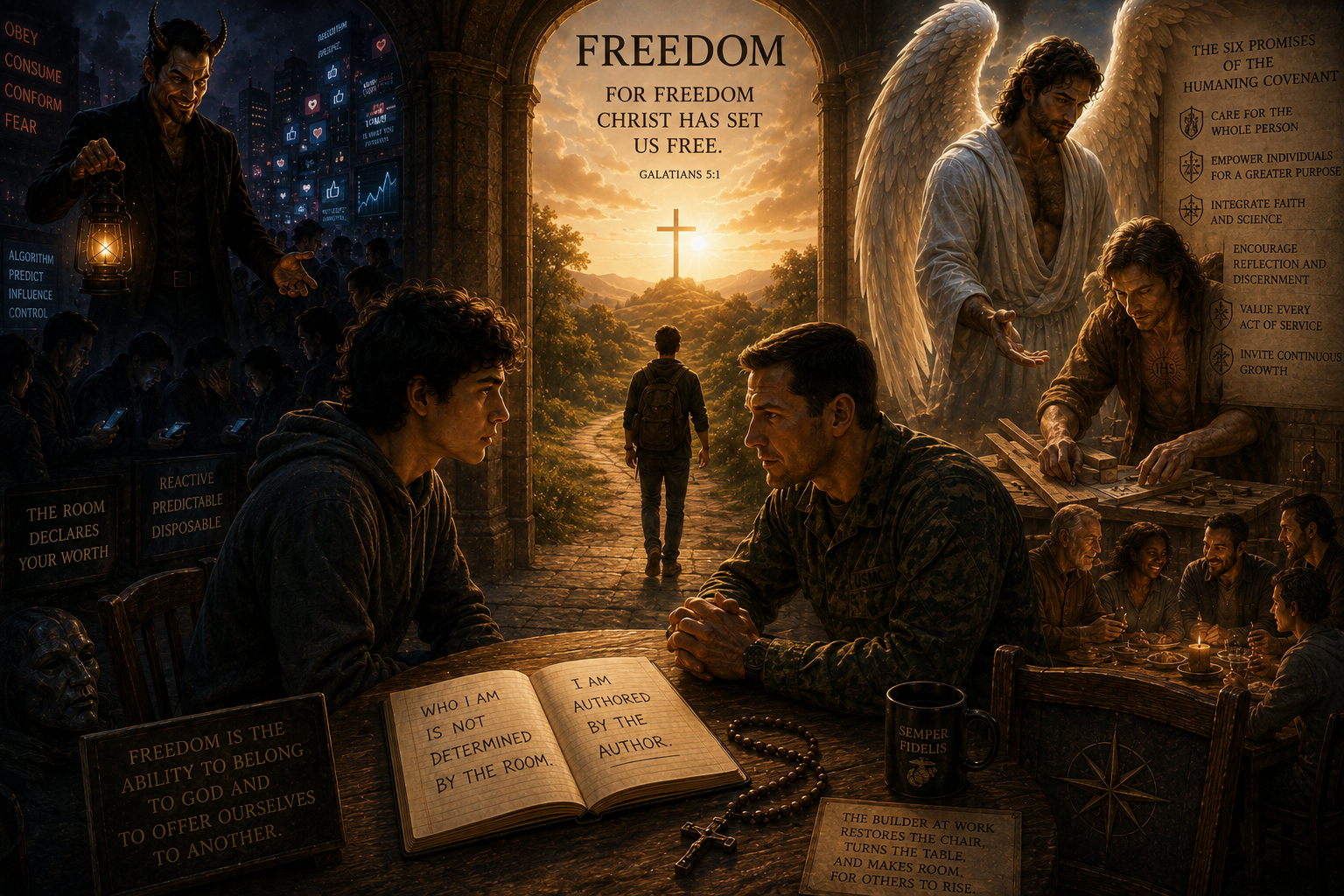
There is a word at the center of the Christian message that may be more dangerous than we have allowed ourselves to remember: freedom.
Before freedom became a political claim, a constitutional guarantee, a market promise, or a declaration of personal autonomy, Paul wrote something startling to the Galatians: “For freedom Christ has set us free.” He was not describing the freedom to do whatever we want. He was describing liberation from everything that prevents a humaned person from becoming fully available to God and, because of that freedom, fully available to another person.
That may be the first and most radical form of Christian humanism. The human person matters because the human person has been authored by God. Dignity does not begin with productivity, citizenship, intelligence, usefulness, conformity, religious performance, institutional membership, or social approval. It is received before any of those things can be earned. Once we understand that, every lesser authority becomes exactly that: lesser.
Caesar was not God, even if he or other emperors claimed to be. Your employer is not God and neither is the stock market, or algorithm, or any institution including the church. Even the ideology itself is not God. When any man-made system exerts influence that claims divine access to God, beware, because that is not God. There has never been a prophet that can replace or speak for the Father - the Author - other than his son. Knowing that fact is why a genuinely free humaned person is difficult to control.
Systems of every shape and color and make-up prefer predictable people. Political movements prefer reliable adherents which can be predicted as votes. Organizations prefer people who remain within their roles and don’t step outside of the box. Algorithms become more useful when we become easier to forecast. Even communities created for good purposes can begin rewarding agreement more than discernment because people capable of asking serious questions complicate the room.
Christ keeps complicating the room by producing persons. He encounters people whom society has already categorized and returns them to themselves. The blind man is not merely a problem. The tax collector is not exhausted by his reputation. The Samaritan woman is larger than the categories surrounding her. The sick person is not reducible to the condition. The sinner remains capable of becoming something the room has not predicted. Christ sees the Authored because He knows the Author.
The Six Promises of the Humaning Covenant can be understood in a similar light. They are not values for behaving more kindly inside existing systems. They protect the conditions necessary for freedom. Each Promise resists a particular form of captivity, and together they create the human architecture in which the Builder at Work can emerge.
Care for the Whole Person protects us from reduction. Every system has a tendency to see only what it knows how to use - labor, consumers, employees, voters, members… None of those descriptions are necessarily false, but each becomes dangerous when the category replaces the person. The first responsibility of the Builder at Work is to look again. Whenever a humaned person has become a number, role, problem, demographic, diagnosis, or output, the Builder at Work must restore the whole person to the room.
Empower Individuals for a Greater Purpose protects us from dependence. The Builder at Work does not accumulate followers to become a more important “influencer.” The Builder at Work equips people to stand. Jesus formed disciples and then sent them somewhere He would not physically accompany them. Pentecost expanded rather than centralized responsibility. Clean influence does the same. If someone becomes increasingly incapable of acting without us, we should question whether we are developing them or quietly possessing them.
Integrate Faith and Science protects us from false choices. The Builder at Work does not need to mutilate reality to preserve belonging. Evidence does not threaten God, and faith does not require intellectual dishonesty. Science can tell us about patterns without pronouncing vocation. Data can illuminate conditions without determining human worth. Prayer can reveal meaning without becoming an excuse to ignore evidence. Freedom allows us to hold what is true together instead of choosing whichever half protects our narrative.
Encourage Reflection and Discernment protects us from reaction, and perhaps no Promise is more necessary in our present time. A person who must respond immediately is easy to govern. Urgency can pull the switch before judgment has arrived. Outrage can turn attention. Fear can shorten the distance between stimulus and action. Synthetic signals can produce authentic anger before we know whether what we saw was real. Discernment restores the interval in which freedom lives.
Value Every Act of Service protects us from spectacle. Our age has become extraordinarily good at confusing visibility with significance. What receives attention appears valuable, while the work sustaining actual human life often happens beyond the camera. Someone prepares the meal, changes the sheets, repairs the broken thing, listens to the story again, visits the sick person, stays late, carries a burden, washes the feet. The Builder at Work notices because Christ noticed. The Builder at Work serves because service does not require an audience to become real.
Invite Continuous Growth protects us from becoming imprisoned by the person we already know how to be. Even our own identity can become a rulebook. We begin saying, “This is just who I am,” when perhaps the Author is still writing. Peter fails and is recommissioned. Saul becomes Paul. Zacchaeus becomes capable of restitution. Fishermen become apostles. Christian freedom includes the uncomfortable possibility that tomorrow’s obedience may require outgrowing yesterday’s explanation of ourselves.
These Promises become something more powerful when we hold them together. Care protects the whole person. Empowerment returns agency. Integration protects truth. Discernment protects freedom of judgment. Service protects what cannot be measured. Growth protects the unfinished person. That is not a framework for producing compliant people. It is an architecture for producing free ones.
This is where “We the People” begins to sound different when heard through the Gospel. There is a political meaning to those words that deserves its own history, but Christianity offers an even older and deeper image of human plurality: the Body of Christ.
Paul tells us there are many members but one Body. The eye does not become the hand. The hand does not become the foot. Difference is not a defect to be engineered away. Nor does the stronger member possess the weaker. In fact, Paul insists that the members appearing weaker are indispensable. That may be one of the most radical descriptions of the human community ever offered. The Body has a Head, but the Head is Christ. That single distinction protects every other chair at the table.
We belong to one another precisely because none of us authored the other. The leader does not own the follower. The employer does not own the worker. The parent does not own the child. The institution does not own the member. The nation does not own the citizens. Our mutual belonging comes from a common Source rather than from possession. That is the freedom the Builder at Work must protect. And protecting it requires more than agreeing with an essay. The Builder at Work must act.
When the whole person disappears behind a metric, put the person back in the room. When someone has become dependent upon your expertise, teach rather than simply answer. When evidence contradicts the story your group prefers, tell the truth. When urgency demands immediate reaction, keep your hands still long enough to discern. When an invisible act of service needs doing, do it without waiting for recognition. When correction arrives, allow it through the gate before explanation seals the entrance.
Then look at the systems around you. Ask whether they produce freer people.
Look at your workplace. Look at your church, family, politics, and technology. Look at UMANIAMO® and the Sunday Table. If participation continually produces smaller, more dependent, more frightened, more reactive, more fragmented humaned persons, something in the architecture requires disciplined action. Don’t just criticize, build differently.
The Builder at Work is not the person standing outside the world declaring everything broken. The Builder at work enters the room carrying enough freedom not to be authored by it. He sees what is there, separates signal from noise, recognizes what is worth preserving, repairs what can be repaired, refuses what diminishes the person, and begins constructing conditions in which someone else can stand.
Christian freedom moves in that direction. It is not freedom from everyone else. It is freedom for everyone else. Paul completes his teaching about freedom by turning it toward love: through love, serve one another. That is the paradox the world still struggles to understand. The freest person in the room may be the one washing the feet. The strongest person may be the one who does not need to win. The most powerful leader may be the one creating other leaders. The person most secure in his identity may be the one capable of changing his mind. The person most capable of standing alone may be the one most available to stand beside another. This is how the Body of Christ rises: not through identical members, but through free humaned persons offering what each was authored to give.
So do not leave the Six Promises on the page - use them. Your Chair was never a throne. It is the place from which you answer for what you do with the life you were given. The Builder at Work gets up from the Chair and builds. “For freedom Christ has set us free.”
Perhaps the most dangerous thing Christianity ever gave the world was a human being who actually believed it. Perhaps the next one is you.
Ad maiorem Dei gloriam. We are human together or not at all.
Accendere lo spirito del costruttore al lavoro
C’è una parola al centro del messaggio cristiano che potrebbe essere più pericolosa di quanto ci siamo permessi di ricordare: libertà.
Prima che la libertà diventasse una rivendicazione politica, una garanzia costituzionale, una promessa di mercato o una dichiarazione di autonomia personale, Paolo scrisse qualcosa di sorprendente ai Galati: «È per la libertà che Cristo ci ha liberati». Egli non stava descrivendo la libertà di fare tutto ciò che vogliamo. Stava descrivendo la liberazione da tutto ciò che impedisce a una persona umana di rendersi pienamente disponibile a Dio e, grazie a quella libertà, pienamente disponibile verso un’altra persona.
Questa potrebbe essere la prima e più radicale forma di umanesimo cristiano. La persona umana conta perché è stata creata da Dio. La dignità non ha origine dalla produttività, dalla cittadinanza, dall’intelligenza, dall’utilità, dalla conformità, dalla pratica religiosa, dall’appartenenza a un’istituzione o dall’approvazione sociale. Si riceve prima ancora che si possa guadagnare una qualsiasi di queste cose. Una volta compreso questo, ogni autorità minore diventa esattamente ciò che è: minore.
Cesare non era Dio, anche se lui o altri imperatori affermavano di esserlo. Il tuo datore di lavoro non è Dio, né lo è il mercato azionario, né un algoritmo, né alcuna istituzione, compresa la Chiesa. Nemmeno l’ideologia in sé è Dio. Quando un sistema creato dall’uomo esercita un’influenza che rivendica un accesso diretto a Dio, fai attenzione, perché quello non è Dio. Non c’è mai stato un profeta in grado di sostituire o parlare a nome del Padre – l’Autore – se non suo Figlio. È proprio la consapevolezza di questo fatto che rende difficile controllare una persona veramente libera.
I sistemi di ogni forma, colore e struttura preferiscono persone prevedibili. I movimenti politici preferiscono aderenti affidabili, i cui voti siano prevedibili. Le organizzazioni preferiscono persone che rimangano nei propri ruoli e non escano dagli schemi. Gli algoritmi diventano più utili quando siamo più facili da prevedere. Persino le comunità create per buoni scopi possono iniziare a premiare il consenso più del discernimento, perché le persone capaci di porre domande serie complicano l’ambiente.
Cristo continua a complicare il quadro creando persone. Incontra individui che la società ha già etichettato e li riconsegna a se stessi. Il cieco non è solo un problema. Il pubblicano non è esaurito dalla sua reputazione. La donna samaritana è più grande delle categorie che la circondano. Il malato non è riducibile alla sua condizione. Il peccatore rimane capace di diventare qualcosa che il quadro non ha previsto. Cristo vede l’Autore perché conosce l’Autore.
Le Sei Promesse dell’Alleanza dell’Umanizzazione possono essere comprese in una luce simile. Non sono valori per comportarsi con maggiore gentilezza all’interno dei sistemi esistenti. Esse proteggono le condizioni necessarie alla libertà. Ogni Promessa resiste a una particolare forma di prigionia e, insieme, creano l’architettura umana in cui può emergere il Costruttore all’Opera.
La cura della persona nella sua interezza ci protegge dalla riduzione. Ogni sistema tende a vedere solo ciò che sa utilizzare: manodopera, consumatori, dipendenti, elettori, membri… Nessuna di queste descrizioni è necessariamente falsa, ma ognuna diventa pericolosa quando la categoria sostituisce la persona. La prima responsabilità del Costruttore all’Opera è guardare di nuovo. Ogni volta che una persona umanizzata è diventata un numero, un ruolo, un problema, un dato demografico, una diagnosi o un risultato, il Costruttore all’Opera deve riportare la persona nella sua interezza nella stanza.
“Dare potere agli individui per uno scopo più grande” ci protegge dalla dipendenza. Il Costruttore al Lavoro non accumula seguaci per diventare un “influencer” più importante. Il Costruttore al Lavoro fornisce alle persone gli strumenti per reggersi in piedi. Gesù formò i discepoli e poi li mandò in luoghi dove non li avrebbe accompagnati fisicamente. La Pentecoste ha ampliato la responsabilità anziché centralizzarla. Un’influenza sana fa lo stesso. Se qualcuno diventa sempre più incapace di agire senza di noi, dovremmo chiederci se lo stiamo aiutando a crescere o se lo stiamo silenziosamente possedendo.
Integrare fede e scienza ci protegge dalle false scelte. Il costruttore al Lavoro non ha bisogno di mutilare la realtà per preservare il senso di appartenenza. Le prove non minacciano Dio, e la fede non richiede disonestà intellettuale. La scienza può indicarci dei modelli senza pronunciarsi sulla vocazione. I dati possono chiarire le condizioni senza determinare il valore umano. La preghiera può rivelare un significato senza diventare una scusa per ignorare le prove. La libertà ci permette di tenere insieme ciò che è vero invece di scegliere la metà che protegge la nostra narrazione.
Incoraggiare la riflessione e il discernimento ci protegge dalla reazione, e forse nessuna Promessa è più necessaria nel nostro tempo. Una persona che deve rispondere immediatamente è facile da governare. L’urgenza può far scattare l’interruttore prima che giunga il giudizio. L’indignazione può distogliere l’attenzione. La paura può accorciare la distanza tra stimolo e azione. I segnali sintetici possono produrre rabbia autentica prima ancora che sappiamo se ciò che abbiamo visto fosse reale. Il discernimento ripristina l’intervallo in cui vive la libertà.
«Valorizzare ogni atto di servizio» ci protegge dallo spettacolo. La nostra epoca è diventata straordinariamente abile nel confondere la visibilità con il significato. Ciò che riceve attenzione appare prezioso, mentre il lavoro che sostiene la vita umana reale spesso avviene lontano dalle telecamere. Qualcuno prepara il pasto, cambia le lenzuola, ripara ciò che è rotto, ascolta di nuovo la storia, visita il malato, rimane fino a tardi, porta un fardello, lava i piedi. Il Costruttore al Lavoro se ne accorge perché Cristo se ne è accorto. Il Costruttore al Lavoro serve perché il servizio non ha bisogno di un pubblico per diventare reale.
Invitare alla Crescita Continua ci protegge dal rimanere imprigionati nella persona che già sappiamo essere. Anche la nostra stessa identità può diventare un regolamento. Cominciamo a dire: «Questo è semplicemente chi sono», quando forse l’Autore sta ancora scrivendo. Pietro fallisce e riceve un nuovo incarico. Saulo diventa Paolo. Zaccheo diventa capace di restituzione. I pescatori diventano apostoli. La libertà cristiana include la scomoda possibilità che l’obbedienza di domani possa richiedere di superare la spiegazione che d’ieri davamo di noi stessi.
Queste Promesse diventano qualcosa di più potente quando le teniamo insieme. La cura protegge la persona nella sua interezza. L’empowerment restituisce l’autonomia. L’integrazione protegge la verità. Il discernimento protegge la libertà di giudizio. Il servizio protegge ciò che non può essere misurato. La crescita protegge la persona incompiuta. Questo non è un quadro per produrre persone remissive. È un’architettura per produrre persone libere.
È qui che «Noi, il popolo» comincia a suonare diverso quando viene ascoltato attraverso il Vangelo. C’è un significato politico in quelle parole che merita una storia a sé stante, ma il cristianesimo offre un’immagine ancora più antica e profonda della pluralità umana: il Corpo di Cristo.
Paolo ci dice che ci sono molte membra, ma un solo Corpo. L’occhio non diventa la mano. La mano non diventa il piede. La differenza non è un difetto da eliminare con l’ingegneria. Né la membra più forte possiede quella più debole. Anzi, Paolo insiste sul fatto che le membra che sembrano più deboli sono indispensabili. Questa potrebbe essere una delle descrizioni più radicali della comunità umana mai offerte. Il Corpo ha una Testa, ma la Testa è Cristo. Quella singola distinzione tutela ogni altro posto a tavola.
Apparteniamo gli uni agli altri proprio perché nessuno di noi ha creato l’altro. Il leader non possiede il seguace. Il datore di lavoro non possiede il lavoratore. Il genitore non possiede il figlio. L’istituzione non possiede il membro. La nazione non possiede i cittadini. La nostra appartenenza reciproca deriva da una Fonte comune piuttosto che dal possesso. Questa è la libertà che il Costruttore al Lavoro deve proteggere. E proteggerla richiede più che essere d’accordo con un saggio. Il Costruttore al Lavoro deve agire.
Quando la persona nella sua interezza scompare dietro un indicatore, riportala nella stanza. Quando qualcuno è diventato dipendente dalla tua competenza, insegna invece di limitarti a rispondere. Quando le prove contraddicono la versione che il tuo gruppo preferisce, di’ la verità. Quando l’urgenza richiede una reazione immediata, mantieni le mani ferme abbastanza a lungo da discernere. Quando c’è bisogno di compiere un atto di servizio invisibile, fallo senza aspettare un riconoscimento. Quando arriva una correzione, lasciala passare attraverso il cancello prima che una spiegazione ne sigilli l’ingresso.
Poi osserva i sistemi che ti circondano. Chiediti se producono persone più libere.
Guarda il tuo posto di lavoro. Guarda la tua chiesa, la tua famiglia, la politica e la tecnologia. Guarda UMANIAMO® e la Tavola della Domenica. Se la partecipazione produce continuamente persone più piccole, più dipendenti, più spaventate, più reattive, più frammentate, qualcosa nell’architettura richiede un’azione disciplinata. Non limitarti a criticare, costruisci in modo diverso.
Il Costruttore al Lavoro non è la persona che sta fuori dal mondo dichiarando che tutto è rotto. Il Costruttore al Lavoro entra nella stanza portando con sé abbastanza libertà da non lasciarsi plasmare da essa. Vede ciò che c’è, separa il segnale dal rumore, riconosce ciò che vale la pena preservare, ripara ciò che può essere riparato, rifiuta ciò che sminuisce la persona e inizia a costruire le condizioni in cui qualcun altro possa stare in piedi.
La libertà cristiana va in quella direzione. Non è libertà da tutti gli altri. È libertà per tutti gli altri. Paolo completa il suo insegnamento sulla libertà orientandolo verso l’amore: attraverso l’amore, servitevi gli uni gli altri. Questo è il paradosso che il mondo fatica ancora a comprendere. La persona più libera nella stanza potrebbe essere quella che lava i piedi. La persona più forte potrebbe essere quella che non ha bisogno di vincere. Il leader più potente potrebbe essere colui che forma altri leader. La persona più sicura della propria identità potrebbe essere quella capace di cambiare idea. La persona più capace di stare da sola potrebbe essere quella più disponibile a stare al fianco di un altro. È così che il Corpo di Cristo si eleva: non attraverso membri identici, ma attraverso persone libere e piene di umanità che offrono ciò che ciascuna è stata creata per dare.
Quindi non lasciate le Sei Promesse sulla pagina: mettetele in pratica. La tua poltrona non è mai stata un trono. È il luogo da cui rispondi di ciò che fai della vita che ti è stata donata. Il Costruttore al Lavoro si alza dalla poltrona e costruisce. «È per la libertà che Cristo ci ha liberati».
Forse la cosa più pericolosa che il cristianesimo abbia mai dato al mondo è stato un essere umano che ci credesse davvero. Forse il prossimo sarai tu.
Ad maiorem Dei gloriam. Siamo umani insieme o non lo siamo affatto.
Social Intelligence
Each week we pick up one card and turn it to the light. This week is Social Intelligence and as usual we need to stretch into what that strength actually means, because the world in which we practice it has changed underneath us.
Social Intelligence has always described our capacity to read people well: to perceive another person accurately, catch the social cues, understand what is happening in a room, and respond as the moment actually requires. We still need all of that. But we no longer encounter only embodied people in direct conversation. We encounter curated personas, algorithmically chosen voices, parasocial attachments, synthetic images, generated language, and AI-mediated interpretations of people we may never meet. The old work of separating signal from noise assumed that noise was whatever obscured the signal. Now the noise has learned to look like signal. A synthetic voice can sound authentic. An edited image can look like evidence. A confident answer can arrive sounding truer than the human evidence warrants. The lantern no longer merely lights a small enclosure it can imitate the sun.
So this week Social Intelligence has to include a discipline older than any of our devices, and it is the discipline of digestion. The Ayurvedic tradition never limited consumption to food; we take impressions in through all the senses, and whatever enters must be processed what is well digested nourishes, and what is not becomes ama, a residue that clouds everything downstream. Use it as a metaphor and it describes our moment exactly. We are constantly consuming things such as faces, arguments, outrage, affirmation, predictions, headlines, theology, and now synthetic social signals. The honest question to ask these days isn't whether we ingested a thing but whether we digested it. Because false input produces entirely real consequences: a fabricated story makes real anger, a manipulated image makes real fear, an AI-generated read of a person becomes a real decision made about that person. The signal may be synthetic; what it does in the body, the relationship, and the spirit is not.
Which quietly rewrites the old proverb. We are not simply what we eat. We are shaped by what we repeatedly take in and never discern.
So when you look at the Social Intelligence card this week, notice what moves in you. Does it open into a quiet yes, a recognition that you read people and rooms well, that you catch what others miss? Then steward it, and add this one discipline: digest what you take in before you let it become how you see a human being. Does it ache and produce a tightening, a sense that too much of how you now read people arrived already interpreted, through fragments and labels and other people's voices, until you are not quite sure how much of anyone you are actually seeing? Then this is the week to clear the fog. Or does it stay quiet, real, but not your center? Honor it, and still keep the digestive watch, because in this age no one is exempt from what they consume.
This is finally a matter of freedom, which is our theme. A person who cannot digest what enters is governed by it: reactive, forecastable, easy to move. A person who can receive, pause, test, and only then decide is free. Social Intelligence, this week, is the freedom to encounter another human being truthfully in an environment engineered to prevent it.
Bring the digestive discipline to your own table, and move through three questions — from what you take in, to how it shapes your seeing, to what you hand on.
What did I consume this week, and what did it begin producing in me before I had discerned it? Pick one thing such as a comment, a story, a post, an image, an AI answer, something you heard repeated until it felt established. Don't start by deciding if it was true. Ask what happened inside you. Did the body tighten? Did you become angry, reassured, afraid, vindicated, eager to repeat it? The point is to see that the reaction was already real before the signal was ever established as reliable.
How much of this person am I actually seeing, and how much am I seeing through what I've consumed about them? Think of one person or group you believe you understand. How much came through direct encounter, and how much through mediated consumption the colleague known mostly by email, the generation known through headlines, the group known through its opponents, the public figure known through a thousand fragments a platform chose to keep you watching? You may find the fog between you and another person was built largely from material you never personally examined.
What have I been feeding others that I hadn't digested myself? Think of something you forwarded, repeated, endorsed, or built into a decision without fully processing it: an interpretation, a label, an AI summary, a statistic, a judgment about someone. What made you willing to carry it into another room? That it confirmed what you believed, came from a trusted source, arrived with urgency, made you feel informed? Undigested noise does not stay inside us. We metabolize it into behavior and hand it to the next person.
Before leaving the table, choose one of the Six Promises as a digestive test for something you expect to consume this week. If your test is Care for the Whole Person, ask whether the information makes the actual person more visible or less. If it is Reflection and Discernment, wait longer than the signal wants you to wait. If it is Continuous Growth, go looking for the evidence that might require you to revise what you already believe.
Sunday Table Invitation. Make sure the quiet ones speak:the children, the teenagers, the person on the edge of the table. Often the person who says least has digested most. If young people are present, offer them a notebook and one question: When did something you saw on a screen make you feel something strongly and did it turn out to be the whole story?
Humaning is something we do together, and then carry out the door. This week the circle practices digestion before speech. Gather a few people and take it slowly.
Begin with a short fast from input. Phones away, screens closed, and simply sit in silence long enough to notice what the mind rushes to supply when nothing new is entering. Do not treat the silence as empty; let it be diagnostic. Notice the headline still arguing inside you, the conversation you keep replaying, the voice whose approval is present though the person is not, the explanation you have repeated so often it now sounds like your own.
Then, each person names something that still feels undigested — not the content, but the movement. A story that left you angry before you understood it. An answer that gave you a certainty you had not earned. Someone's opinion that became your own before you examined it. An image whose fear outlasted the screen. Describe what the consumption produced in you, not the interpretation it produced.
Then discern, together, what would actually help you process it — sometimes evidence, sometimes a direct conversation with the person involved, sometimes the context that was missing, sometimes a perspective from someone who would disagree with you, and sometimes only silence, sleep, prayer, or enough time for the agitation to settle before you decide what the thing even means. And bring it to prayer honestly, because Christian discernment is not becoming a faster algorithm; prayer restores the relationship between the Authored and the Author, and real prayer makes room for the possibility that the person you judged must be seen again, or that the certainty you felt was a counterfeit peace.
Then each person chooses one thing they will not pass along yet — a story, a judgment, an AI output, a criticism, a piece of charged information — and holds it until they know enough about its source, its fruit, and their own movement to decide whether carrying it forward would serve truth or only multiply noise.
Close by returning to the person. Because the whole point is not mastering the information environment; it is preserving the human capacity to encounter another person truthfully inside it. The Devil at Work no longer needs to carry every lantern himself — a sincere person will carry one for him, believing he is helping light the room. So the Builder at Work becomes careful about what light he receives and what light he hands on. The practice is simple enough to remember: consume carefully, digest completely, and do not feed another person what you have not yet discerned yourself.
When we do that, the fog begins to clear. The person becomes visible again, the signal can be heard through the interference, and the Chair remains free to face the Author.
Ad maiorem Dei gloriam. Formed at the table. Sent as Builders. We are human together — or not at all.
Ogni settimana prendiamo una carta e la giriamo verso la luce. Questa settimana il tema è Intelligenza sociale e, come al solito, dobbiamo approfondire il vero significato di questo punto di forza, perché il mondo in cui lo mettiamo in pratica è cambiato sotto i nostri piedi.
L’intelligenza sociale ha sempre descritto la nostra capacità di interpretare bene le persone: percepire accuratamente l’altro, cogliere i segnali sociali, comprendere cosa sta accadendo in una stanza e rispondere come il momento effettivamente richiede. Abbiamo ancora bisogno di tutto questo. Ma non incontriamo più solo persone in carne e ossa in una conversazione diretta. Incontriamo personaggi curati, voci scelte algoritmicamente, legami parasociali, immagini sintetiche, linguaggio generato e interpretazioni mediate dall’intelligenza artificiale di persone che potremmo non incontrare mai. Il vecchio lavoro di separare il segnale dal rumore presupponeva che il rumore fosse tutto ciò che oscurava il segnale. Ora il rumore ha imparato a sembrare un segnale. Una voce sintetica può sembrare autentica. Un’immagine modificata può sembrare una prova. Una risposta sicura può arrivare suonando più vera di quanto le prove umane giustifichino. La lanterna non si limita più a illuminare un piccolo spazio: può imitare il sole.
Quindi questa settimana l’Intelligenza Sociale deve includere una disciplina più antica di qualsiasi nostro dispositivo, ed è la disciplina della digestione. La tradizione ayurvedica non ha mai limitato il consumo al cibo; assorbiamo impressioni attraverso tutti i sensi, e tutto ciò che entra deve essere elaborato: ciò che è ben digerito nutre, e ciò che non lo è diventa ama, un residuo che offusca tutto ciò che viene dopo. Usatela come metafora e descriverà esattamente il nostro momento. Consumiamo costantemente cose come volti, discussioni, indignazione, affermazioni, previsioni, titoli dei giornali, teologia e ora anche segnali sociali sintetici. La domanda onesta da porsi in questi giorni non è se abbiamo ingerito qualcosa, ma se l’abbiamo digerita. Perché un input falso produce conseguenze del tutto reali: una storia inventata genera rabbia reale, un’immagine manipolata genera paura reale, un’interpretazione di una persona generata dall’intelligenza artificiale diventa una decisione reale presa riguardo a quella persona. Il segnale potrà anche essere sintetico; ciò che provoca nel corpo, nella relazione e nello spirito non lo è.
Il che riscrive silenziosamente il vecchio proverbio. Non siamo semplicemente ciò che mangiamo. Siamo plasmati da ciò che assimiliamo ripetutamente e non discerniamo mai.
Quindi, quando guardi la carta dell’Intelligenza Sociale questa settimana, nota cosa si muove dentro di te. Si apre in un silenzioso sì, un riconoscimento del fatto che sai leggere bene le persone e le situazioni, che colgi ciò che agli altri sfugge? Allora gestiscila con cura e aggiungi questa disciplina: digerisci ciò che assorbi prima di lasciare che diventi il modo in cui vedi un essere umano. Ti fa male e produce una tensione, la sensazione che gran parte di come ora interpreti le persone sia già pre-interpretata, attraverso frammenti, etichette e le voci altrui, al punto che non sei più del tutto sicuro di quanto di una persona tu stia effettivamente vedendo? Allora questa è la settimana giusta per diradare la nebbia. Oppure rimane silenziosa, reale, ma non è il tuo centro? Onoralo, e continua comunque a vigilare sulla digestione, perché in quest’epoca nessuno è esente da ciò che consuma.
Questa è in definitiva una questione di libertà, che è il nostro tema. Una persona che non riesce a digerire ciò che entra è governata da esso: reattiva, prevedibile, facile da influenzare. Una persona che sa ricevere, fermarsi, valutare e solo allora decidere è libera. L’Intelligenza Sociale, questa settimana, è la libertà di incontrare un altro essere umano in modo autentico in un ambiente progettato per impedirlo.
Porta la disciplina digestiva alla tua tavola e affronta tre domande: da ciò che assorbi, a come questo modella la tua visione, a ciò che trasmetti.
Cosa ho consumato questa settimana e cosa ha iniziato a produrre in me prima che me ne rendessi conto?Scegli una cosa, come un commento, una storia, un post, un’immagine, una risposta dell’IA, qualcosa che hai sentito ripetere fino a quando non ti è sembrato un dato di fatto. Non iniziare chiedendoti se fosse vero. Chiediti cosa è successo dentro di te. Il corpo si è irrigidito? Ti sei arrabbiato, rassicurato, hai provato paura, ti sei sentito giustificato, desideroso di ripeterlo? Il punto è rendersi conto che la reazione era già reale prima ancora che il segnale fosse considerato affidabile.
Quanto di questa persona sto vedendo realmente, e quanto sto vedendo attraverso ciò che ho assimilato su di lei? Pensa a una persona o a un gruppo che credi di comprendere. Quanto deriva dall’incontro diretto e quanto dal consumo mediato: il collega conosciuto soprattutto via e-mail, la generazione conosciuta attraverso i titoli dei giornali, il gruppo conosciuto attraverso i suoi oppositori, il personaggio pubblico conosciuto attraverso mille frammenti che una piattaforma ha scelto di mostrarti per tenerti incollato allo schermo? Potresti scoprire che la nebbia tra te e un’altra persona è stata costruita in gran parte da materiale che non hai mai esaminato personalmente.
Cosa ho trasmesso agli altri che non avevo ancora assimilato io stesso? Pensa a qualcosa che hai inoltrato, ripetuto, avallato o integrato in una decisione senza elaborarlo appieno: un’interpretazione, un’etichetta, un riassunto generato dall’intelligenza artificiale, una statistica, un giudizio su qualcuno. Cosa ti ha spinto a trasmetterlo ad altri? Il fatto che confermasse ciò in cui credevi, che provenisse da una fonte attendibile, che arrivasse con urgenza, che ti facesse sentire informato? Il rumore non digerito non rimane dentro di noi. Lo metabolizziamo trasformandolo in comportamento e lo trasmettiamo alla persona successiva.
Prima di alzarti da tavola, scegli una delle Sei Promesse come test di assimilazione per qualcosa che ti aspetti di assimilare questa settimana. Se il tuo test è «Cura della persona nella sua interezza», chiediti se l’informazione rende la persona reale più visibile o meno. Se è «Riflessione e discernimento», aspetta più a lungo di quanto il segnale ti induca ad aspettare. Se è «Crescita continua», vai alla ricerca delle prove che potrebbero richiederti di rivedere ciò in cui già credi.
Invito alla tavola della domenica. Assicuratevi che parlino anche i più silenziosi: i bambini, gli adolescenti, la persona seduta all’estremità del tavolo. Spesso chi parla meno è chi ha assimilato di più. Se sono presenti dei giovani, offrite loro un quaderno e una domanda: Quando qualcosa che avete visto su uno schermo vi ha fatto provare un’emozione forte e si è rivelata essere tutta la storia?
L’Humaning è qualcosa che facciamo insieme e che poi portiamo fuori dalla porta. Questa settimana il cerchio si esercita nell’assimilazione prima di parlare. Raduna alcune persone e procedi con calma.
Inizia con un breve digiuno dagli stimoli esterni. Metti via i telefoni, chiudi gli schermi e siediti semplicemente in silenzio abbastanza a lungo da notare ciò che la mente si affretta a fornire quando non entra nulla di nuovo. Non considerare il silenzio come vuoto; lascia che sia diagnostico. Notate il titolo che continua a discutere dentro di voi, la conversazione che continuate a riprodurre, la voce la cui approvazione è presente anche se la persona non c’è, la spiegazione che avete ripetuto così spesso che ora suona come se fosse vostra.
Poi, ogni persona nomina qualcosa che sembra ancora non digerito — non il contenuto, ma il movimento. Una storia che vi ha fatto arrabbiare prima di comprenderla. Una risposta che vi ha dato una certezza che non vi eravate guadagnati. L’opinione di qualcuno che è diventata la vostra prima di esaminarla. Un’immagine la cui paura è durata più a lungo dello schermo stesso. Descrivi ciò che quell’esperienza ha suscitato in te, non l’interpretazione che ne hai tratto.
Poi discerne, insieme, cosa ti aiuterebbe davvero a elaborarla — a volte delle prove, a volte una conversazione diretta con la persona coinvolta, a volte il contesto che mancava, a volte il punto di vista di qualcuno che non sarebbe d’accordo con te, e a volte solo il silenzio, il sonno, la preghiera o il tempo necessario affinché l’agitazione si plachi prima di decidere cosa significhi davvero quella cosa. E portalo nella preghiera con sincerità, perché il discernimento cristiano non consiste nel diventare un algoritmo più veloce; la preghiera ristabilisce il rapporto tra il Creato e il Creatore, e la vera preghiera lascia spazio alla possibilità che la persona che hai giudicato debba essere rivista, o che la certezza che provavi fosse una pace contraffatta.
Poi ogni persona sceglie una cosa che per ora non diffonderà — una storia, un giudizio, un risultato generato dall’IA, una critica, un’informazione controversa — e la trattiene finché non ne sa abbastanza sulla sua fonte, sui suoi frutti e sul proprio percorso per decidere se diffonderla servirebbe alla verità o moltiplicherebbe solo il rumore.
Concludi tornando alla persona. Perché il punto fondamentale non è dominare l’ambiente informativo; è preservare la capacità umana di incontrare un’altra persona in modo autentico al suo interno. Il Diavolo all’Opera non ha più bisogno di portare ogni lanterna da solo — una persona sincera ne porterà una per lui, credendo di contribuire a illuminare la stanza. Così il Costruttore all’Opera diventa attento alla luce che riceve e a quella che trasmette. La pratica è abbastanza semplice da ricordare: consuma con attenzione, assimila completamente e non trasmettere a un’altra persona ciò che tu stesso non hai ancora discernuto.
Quando lo facciamo, la nebbia comincia a diradarsi. La persona torna a essere visibile, il segnale può essere udito nonostante le interferenze e la Sedia rimane libera di affrontare l’Autore.
Ad maiorem Dei gloriam. Formati attorno alla tavola. Inviati come Costruttori. Siamo umani insieme o non lo siamo affatto.
When the Noise Learns to Look Like the Truth
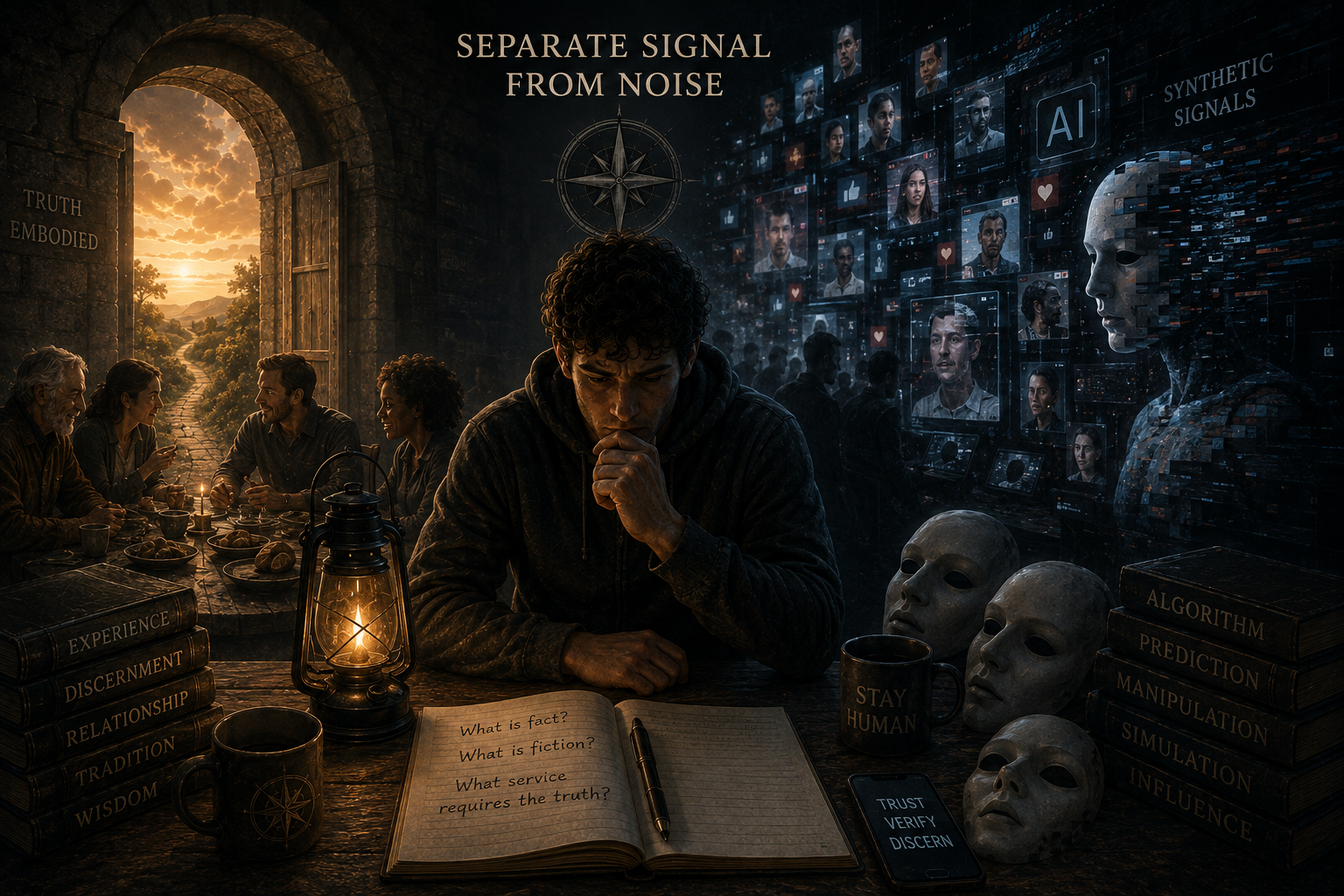
A couple of days ago, I woke up with the word “obfuscate” on my mind. This is not a word that I have ever really used in a sentence, but there it was. When I reflected on the word, I realized that the word no longer describes the whole problem. For much of human history, signal and noise were comparatively easy to imagine. The signal was what mattered. The noise was what interfered with our ability to receive it. Noise distracted, distorted, overwhelmed, delayed, or concealed. We learned to filter it out. We learned to become quieter, more attentive, more disciplined, more skeptical of distraction. In that older model, the problem was largely one of obstruction. The truth was somewhere in the room, and the work was to clear away what prevented us from seeing or hearing it.
However, something different is happening now. The noise has learned to resemble the signal. We are no longer dealing only with clutter, distraction, propaganda, rumor, emotional reaction, or competing interpretations. We increasingly inhabit environments filled with synthetic signals: images that look like evidence, voices that sound embodied, conversations that feel relational, recommendations that appear personalized, stories that imitate lived experience, social proof that can be manufactured, and personas that can simulate familiarity without ever having stood in a room with us. The old problem of obfuscation remains, but now it has acquired a new form. The lantern no longer merely illuminates a small enclosure and persuades us that we are seeing the whole room. The lantern can now imitate the appearance of the sun.
That changes the work of discernment. Week Three of Turn the Table™ workbook focuses on the turns to Separate Signal from Noise, and its governing question asks what is fact, what is fiction, and what service the truth requires. The Turns warn us that repetition produces familiarity rather than truth, that forecasts of us are assembled from people who were not us, that silence reveals how much of our interior life has been occupied by borrowed voices, and that urgency often demands action before the instrument has been properly calibrated. Those warnings are already demanding. Yet the world into which we are carrying them now requires another level of attentiveness because familiarity can be manufactured, voices can be generated, urgency can be engineered, and even the apparent evidence before our eyes may no longer have an embodied source.
This is where I keep returning to an older understanding of consumption. In Ayurveda, what we take into ourselves is not limited to food. The body and mind are continuously receiving impressions through the senses. What we see, hear, taste, touch, smell, remember, imagine, and emotionally absorb must be processed. In that tradition, what is well digested can become nourishment, while what remains poorly processed can contribute to ama, a kind of residue or toxicity associated with incomplete digestion. Whatever conclusions one draws about Ayurveda as a medical system, that image gives us a remarkably useful metaphor for the age we are entering: human beings do not merely consume calories. We consume worlds.
We consume conversations before breakfast. We consume faces we have never met. We consume wars through screens, outrage through headlines, confidence through influencers, intimacy through podcasts, comparison through photographs, certainty through political commentary, affirmation through algorithms, and increasingly companionship, advice, images, voices, and interpretation through artificial intelligence. We take these things into ourselves through the same sensory and emotional systems that once dealt primarily with embodied people and physically present environments.
Then we have to digest them and that is the part we rarely discuss. We spend enormous energy asking whether information is true, useful, entertaining, dangerous, biased, generated, authentic, or manipulative. Those are important questions. But there is another question beneath them: What happens inside the human person after the signal has entered?
A fabricated image can produce authentic anger, just as a synthetic voice can produce authentic fear. The parasocial relationship can produce authentic attachment and even affection. The input may be artificial while the physiological, psychological, relational, and spiritual consequences are entirely real.
That should concern us because the human nervous system did not evolve in an environment in which every face, voice, testimony, and social signal might need to be authenticated before being believed. We are exquisitely sensitive to human cues because those cues once carried enormous survival value. A face tells us whether someone is safe. Each voice carries some level of emotion. Groups communicate belonging or threat. When we trust a person’s testimony it allows us to act without personally verifying every fact. Human beings survived through social intelligence long before we had databases.
Now those same systems are being asked to navigate environments in which the social cues themselves may be synthetic. That means traditional Social Intelligence is no longer sufficient.
We still need the capacity to read tone, gesture, context, reciprocity, emotion, power, and social dynamics. But we increasingly need something more like parasocial intelligence: the capacity to recognize when familiarity is not a relationship, when repeated exposure is not intimacy, when someone who feels known does not know us at all, and when influence is being experienced as friendship because the medium has blurred the distinction.
We may also need what could be called synthetic social intelligence: the capacity to remain humanly calibrated when the apparent social signal has no human origin, or when its origin has been obscured beyond ordinary recognition. Deepfake detection is only the technical edge of that problem. The deeper question is whether we can prevent synthetic signals from bypassing discernment and producing real human consequences before we understand what entered us.
The body offers a useful analogy. It does not respond equally well to everything that can technically be consumed. Something can be engineered to look, taste, smell, or feel satisfying while offering something quite different from nourishment. In the same way, the mind can be flooded with social stimuli that resemble human relationships while lacking the reciprocity, accountability, embodiment, history, and vulnerability through which real relationships are formed. We may feel socially full while becoming relationally malnourished.
That is where the Ayurvedic concept of ama becomes even more useful. What we consume but do not adequately process doesn’t just disappear. It can accumulate and cloud perception. It can alter appetite and make the next thing harder to discern. In Ayurveda, we consider these unprocessed or undigested things to be “toxins” which accumulate over time. The same may be true socially and spiritually. Undigested emotions are transformed into something more toxic: fear becomes suspicion: humiliation becomes defensiveness: propaganda becomes prejudice; outrage becomes identity; AI output becomes assumed knowledge; theology becomes ideology and legalism; and trauma becomes our default leadership behavior.
The toxin does not remain inside the person. We metabolize it into behavior and then feed it to one another. That may be one of the most important Humaning problems of our time.
A future Builder at Work sees a convincing clip and shares it before checking it. Another receives an emotionally charged story and passes it along because it confirms what the group already believes. A manager accepts an AI-generated assessment because it sounds objective and builds it into a personnel decision. A church repeats an interpretation because questioning it has become socially expensive. A nonprofit circulates an exaggerated claim because the cause is good and the number is useful. A young man adopts an influencer’s vocabulary because the vocabulary finally gives shape to something he has been feeling. None of these people means to be malicious. They are simply carrying lanterns whose light they have not examined. That is what makes the Devil at Work more dangerous in this landscape. He does not need one lantern anymore. He can distribute them and persuade ordinary people, including people who genuinely intend to become Builders at Work, to carry partial light from room to room because they never paused long enough to determine its source, direction, or fruit.
Paul’s warning in Second Corinthians becomes disturbingly contemporary: Satan can disguise himself as an angel of light. The danger, then, is not merely darkness. It is an apparent illumination. Something can look persuasive, useful, compassionate, sophisticated, rational, spiritual, or obviously true while still leading us away from truth. Galatians intensifies that responsibility when Paul says that even if an angel from heaven proclaims something contrary to the Gospel already received, the brilliance of the messenger does not validate the message. Apparent authority does not absolve discernment. The Chair remains responsible.
John’s Gospel gives us another test when Jesus distinguishes His peace from the peace the world gives. That matters because our bodies are often drawn toward whatever resolves uncertainty most quickly. Certainty feels better than ambiguity. Agreement feels better than tension. An answer feels better than an unanswered question. A community that tells us exactly what to believe can feel safer than one that requires discernment. Yet a feeling of relief is not necessarily the peace of Christ. Turn the Table™ itself warns us that the felt sense must be tested because agitation can accompany truth and peace can be counterfeit.
First Corinthians adds another dimension when Paul says that God is not a God of confusion but of peace. In its original context, Paul is addressing disorder in the gathered community, where competing voices and gifts have begun to interfere with intelligibility. That is remarkably relevant to the architecture of modern attention. Confusion is not always created by too little information. It can be created by an abundance of competing signals with no trustworthy way to order them. Our problem is increasingly not scarcity; it is digestion. In our current reality, discernment must become more embodied than the simple intellectual act of separating true claims from false ones. We the People need the body, because contraction, agitation, exhaustion, and openness carry information, while remembering that bodily reactions are signals to be examined rather than verdicts to be obeyed. We the People need reason, evidence, memory, experience, community, and trustworthy human relationships. We the People need Scripture because apparent light must be tested against something greater than appearance. We the People need prayer because Christian discernment is not merely superior pattern recognition. It is a relational act between the Authored and the Author.
Sit on Your Hands
My friend Rick, a retired pilot, recently shared the best advice he received from a Check Airman during flight simulator training years ago. When the big red warning light appears, the first thing you do is put your left hand under your left butt cheek and your right hand under the other. It sounds ridiculous until you understand the point: keep your hands from moving faster than your judgment. The warning may be real, but the first impulse is not necessarily the right response. Rick described the deeper sequence as Recognition and Reflection. First recognize that friction is present. Then reflect on what is actually happening before touching the switch. Immediate inaction does not mean inattention; sometimes it is the discipline that prevents urgency from becoming part of the emergency.
That advice feels even more important in an age of synthetic signals. We are surrounded by metaphorical red lights: headlines, notifications, provocative emails, viral clips, AI-generated interpretations, manipulated images, and voices that can provoke a real bodily response before we know whether the signal itself is authentic. The practice is therefore beautifully simple: sit on your hands long enough to digest what entered. Recognize what happened, reflect on what it stirred in you, discern what belongs to the signal and what belongs to the noise, and make enough room for prayer that the Author can interrupt your first interpretation. Then, when the signal is clearer and action is actually required, move the switch that needs moving. Restraint is not a weakness. Sometimes it's what keeps the plane in the air and our feet on the ground.
Ad maiorem Dei gloriam. We are human together or not at all.
Quando il rumore impara a sembrare la verità
Un paio di giorni fa mi sono svegliato con la parola “obfuscate” in mente. Non è una parola che abbia mai usato davvero in una frase, eppure eccola lì. Riflettendoci, mi sono reso conto che quella parola non descriveva più l’intero problema. Per gran parte della storia umana, il segnale e il rumore erano relativamente facili da immaginare. Il segnale era ciò che contava. Il rumore era ciò che interferiva con la nostra capacità di riceverlo. Il rumore distraeva, distorceva, sopraffaceva, ritardava o nascondeva. Abbiamo imparato a filtrarlo. Abbiamo imparato a diventare più silenziosi, più attenti, più disciplinati, più scettici nei confronti delle distrazioni. In quel modello più antico, il problema era in gran parte di ostruzione. La verità era da qualche parte nella stanza, e il compito era quello di eliminare ciò che ci impediva di vederla o sentirla.
Tuttavia, ora sta accadendo qualcosa di diverso. Il rumore ha imparato ad assomigliare al segnale. Non abbiamo più a che fare solo con disordine, distrazioni, propaganda, voci, reazioni emotive o interpretazioni contrastanti. Viviamo sempre più spesso in ambienti pieni di segnali sintetici: immagini che sembrano prove, voci che suonano concrete, conversazioni che sembrano relazionali, consigli che appaiono personalizzati, storie che imitano l’esperienza vissuta, prove sociali che possono essere fabbricate e personaggi che possono simulare familiarità senza essersi mai trovati nella stessa stanza con noi. Il vecchio problema dell’offuscamento permane, ma ora ha assunto una nuova forma. La lanterna non si limita più a illuminare un piccolo spazio e a convincerci di vedere l’intera stanza. La lanterna ora può imitare l’aspetto del sole.
Questo cambia il lavoro di discernimento. La terza settimana del quaderno di esercizi Turn the Table™ si concentra sulle svolte relative a Separare il segnale dal rumore, e la domanda guida chiede cosa sia fatto, cosa sia finzione e quale servizio richieda la verità. Le Svolte ci avvertono che la ripetizione produce familiarità piuttosto che verità, che le previsioni su di noi sono assemblate da persone che non eravamo noi, che il silenzio rivela quanto della nostra vita interiore sia stata occupata da voci prese in prestito, e che l’urgenza spesso esige un’azione prima che lo strumento sia stato adeguatamente calibrato. Questi avvertimenti sono già impegnativi. Eppure il mondo in cui li stiamo portando richiede ora un altro livello di attenzione perché la familiarità può essere fabbricata, le voci possono essere generate, l’urgenza può essere ingegnerizzata e persino le prove apparenti davanti ai nostri occhi potrebbero non avere più una fonte concreta.
È qui che continuo a tornare a una concezione più antica del consumo. Nell’Ayurveda, ciò che assumiamo non si limita al cibo. Il corpo e la mente ricevono continuamente impressioni attraverso i sensi. Ciò che vediamo, sentiamo, assaggiamo, tocchiamo, annusiamo, ricordiamo, immaginiamo e assorbiamo emotivamente deve essere elaborato. In quella tradizione, ciò che viene ben digerito può diventare nutrimento, mentre ciò che rimane elaborato in modo inadeguato può contribuire all’ama, una sorta di residuo o tossicità associata a una digestione incompleta. Qualunque conclusione si tragga sull’Ayurveda come sistema medico, quell’immagine ci offre una metafora straordinariamente utile per l’era in cui stiamo entrando: gli esseri umani non si limitano a consumare calorie. Consumiamo mondi.
Consumiamo conversazioni prima di colazione. Consumiamo volti che non abbiamo mai incontrato. Consumiamo guerre attraverso gli schermi, indignazione attraverso i titoli dei giornali, fiducia attraverso gli influencer, intimità attraverso i podcast, confronti attraverso le fotografie, certezze attraverso i commenti politici, affermazioni attraverso gli algoritmi e, sempre più spesso, compagnia, consigli, immagini, voci e interpretazioni attraverso l’intelligenza artificiale. Assorbiamo queste cose attraverso gli stessi sistemi sensoriali ed emotivi che un tempo si occupavano principalmente di persone in carne e ossa e di ambienti fisicamente presenti.
Poi dobbiamo digerirle, ed è questa la parte di cui parliamo raramente. Spendiamo un’enorme quantità di energia a chiederci se un’informazione sia vera, utile, divertente, pericolosa, di parte, generata, autentica o manipolatoria. Sono domande importanti. Ma c’è un’altra domanda che sta alla base di tutte queste: Cosa accade all’interno della persona umana dopo che il segnale è entrato?
Un’immagine fabbricata può produrre rabbia autentica, proprio come una voce sintetica può produrre paura autentica. La relazione parasociale può produrre un attaccamento autentico e persino affetto. L’input può essere artificiale, mentre le conseguenze fisiologiche, psicologiche, relazionali e spirituali sono del tutto reali.
Questo dovrebbe preoccuparci perché il sistema nervoso umano non si è evoluto in un ambiente in cui ogni volto, voce, testimonianza e segnale sociale dovesse essere autenticato prima di essere creduto. Siamo estremamente sensibili ai segnali umani perché un tempo quei segnali avevano un enorme valore per la sopravvivenza. Un volto ci dice se qualcuno è sicuro. Ogni voce veicola un certo livello di emozione. I gruppi comunicano senso di appartenenza o minaccia. Quando ci fidiamo della testimonianza di una persona, ciò ci permette di agire senza dover verificare personalmente ogni singolo fatto. Gli esseri umani sono sopravvissuti grazie all’intelligenza sociale molto prima di disporre di banche dati.
Ora a quegli stessi sistemi viene chiesto di orientarsi in ambienti in cui gli stessi segnali sociali potrebbero essere sintetici. Ciò significa che l’intelligenza sociale tradizionale non è più sufficiente.
Abbiamo ancora bisogno della capacità di interpretare il tono, i gesti, il contesto, la reciprocità, l’emozione, il potere e le dinamiche sociali. Ma abbiamo sempre più bisogno di qualcosa di più simile all’intelligenza parasociale: la capacità di riconoscere quando la familiarità non è una relazione, quando l’esposizione ripetuta non è intimità, quando qualcuno che si sente conosciuto non ci conosce affatto e quando l’influenza viene percepita come amicizia perché il mezzo ha offuscato la distinzione.
Potremmo anche aver bisogno di quella che potremmo definire intelligenza sociale sintetica: la capacità di mantenere un equilibrio umano quando il segnale sociale apparente non ha origine umana, o quando la sua origine è stata oscurata al punto da renderne impossibile il riconoscimento. Il rilevamento dei deepfake rappresenta solo l’aspetto tecnico di questo problema. La questione più profonda è se siamo in grado di impedire che i segnali sintetici eludano il nostro discernimento e producano conseguenze umane reali prima ancora di capire cosa ci sia entrato dentro.
Il corpo offre un’analogia utile. Non risponde altrettanto bene a tutto ciò che tecnicamente può essere consumato. Qualcosa può essere progettato per apparire, avere un sapore, un odore o una consistenza soddisfacenti, pur offrendo qualcosa di ben diverso dal nutrimento. Allo stesso modo, la mente può essere inondata da stimoli sociali che assomigliano alle relazioni umane, pur mancando della reciprocità, della responsabilità, della concretezza, della storia e della vulnerabilità attraverso cui si formano le relazioni reali. Potremmo sentirci socialmente sazi mentre diventiamo relazionalmente malnutriti.
È qui che il concetto ayurvedico di ama diventa ancora più utile. Ciò che consumiamo ma non elaboriamo adeguatamente non scompare semplicemente. Può accumularsi e offuscare la percezione. Può alterare l’appetito e rendere più difficile discernere ciò che verrà dopo. Nell’Ayurveda, consideriamo queste cose non elaborate o non digerite come “tossine” che si accumulano nel tempo. Lo stesso può valere a livello sociale e spirituale. Le emozioni non digerite si trasformano in qualcosa di più tossico: la paura diventa sospetto; l’umiliazione diventa atteggiamento difensivo; la propaganda diventa pregiudizio; l’indignazione diventa identità; i risultati dell’IA diventano conoscenza presunta; la teologia diventa ideologia e legalismo; e il trauma diventa il nostro comportamento di leadership predefinito.
La tossina non rimane all’interno della persona. La metabolizziamo in comportamenti e poi ce la trasmettiamo a vicenda. Questo potrebbe essere uno dei problemi più importanti legati all’“Humaning” del nostro tempo.
Un futuro “Costruttore al lavoro” vede un video convincente e lo condivide prima di verificarlo. Un altro riceve una storia carica di emozioni e la diffonde perché conferma ciò in cui il gruppo già crede. Un manager accetta una valutazione generata dall’intelligenza artificiale perché sembra oggettiva e la integra in una decisione relativa al personale. Una chiesa ripete un’interpretazione perché metterla in discussione è diventato socialmente costoso. Un’organizzazione no profit diffonde un’affermazione esagerata perché la causa è buona e il numero è utile. Un giovane adotta il vocabolario di un influencer perché quel vocabolario dà finalmente forma a qualcosa che provava da tempo. Nessuna di queste persone intende essere maliziosa. Stanno semplicemente portando lanterne di cui non hanno esaminato la luce. È questo che rende il Diavolo all’opera più pericoloso in questo contesto. Non ha più bisogno di una sola lanterna. Può distribuirle e persuadere la gente comune, comprese le persone che intendono sinceramente diventare “Costruttori al lavoro” (Builders at Work), a portare una luce parziale di stanza in stanza perché non si sono mai fermate abbastanza a lungo per determinarne la fonte, la direzione o il frutto.
L’avvertimento di Paolo nella Seconda Lettera ai Corinzi diventa inquietantemente attuale: Satana può travestirsi da angelo di luce. Il pericolo, quindi, non è semplicemente l’oscurità. È un’illuminazione apparente. Qualcosa può sembrare persuasivo, utile, compassionevole, sofisticato, razionale, spirituale o palesemente vero, pur allontanandoci dalla verità. La Lettera ai Galati rafforza tale responsabilità quando Paolo afferma che, anche se un angelo dal cielo proclamasse qualcosa di contrario al Vangelo già ricevuto, lo splendore del messaggero non convalida il messaggio. L’apparente autorità non esonera dal discernimento. Il Presidente rimane responsabile.
Il Vangelo di Giovanni ci offre un’altra prova quando Gesù distingue la Sua pace dalla pace che il mondo offre. Questo è importante perché i nostri cuori sono spesso attratti da ciò che risolve più rapidamente l’incertezza. La certezza è più rassicurante dell’ambiguità. L’accordo è più rassicurante della tensione. Una risposta è più rassicurante di una domanda senza risposta. Una comunità che ci dice esattamente cosa credere può sembrare più sicura di una che richiede discernimento. Eppure una sensazione di sollievo non è necessariamente la pace di Cristo. Lo stesso Turn the Table™ ci avverte che la sensazione provata deve essere messa alla prova, perché l’agitazione può accompagnare la verità e la pace può essere contraffatta.
La Prima Lettera ai Corinzi aggiunge un’altra dimensione quando Paolo afferma che Dio non è un Dio di confusione, ma di pace. Nel contesto originale, Paolo affronta il tema del disordine nella comunità riunita, dove voci e doni contrastanti hanno iniziato a interferire con la comprensibilità. Ciò è straordinariamente rilevante per l’architettura dell’attenzione moderna. La confusione non è sempre causata da una carenza di informazioni. Può essere generata da un’abbondanza di segnali contrastanti senza un modo affidabile per ordinarli. Il nostro problema non è più tanto la scarsità, quanto la capacità di elaborare. Nella nostra realtà attuale, il discernimento deve diventare qualcosa di più concreto del semplice atto intellettuale di separare le affermazioni vere da quelle false. Noi, il Popolo, abbiamo bisogno del corpo, perché la tensione, l’agitazione, l’esaurimento e l’apertura veicolano informazioni, pur ricordando che le reazioni corporee sono segnali da esaminare piuttosto che verdetti a cui obbedire. Noi, il Popolo, abbiamo bisogno di ragione, prove, memoria, esperienza, comunità e relazioni umane affidabili. Noi, il Popolo, abbiamo bisogno della Scrittura perché la luce apparente deve essere messa alla prova rispetto a qualcosa di più grande dell’apparenza. Noi, il Popolo, abbiamo bisogno della preghiera perché il discernimento cristiano non è semplicemente un riconoscimento superiore di schemi. È un atto relazionale tra il Creato e il Creatore.
Il mio amico Rick, un pilota in pensione, ha recentemente condiviso il miglior consiglio che ha ricevuto da un istruttore di volo durante un addestramento al simulatore anni fa. Quando si accende la grande spia rossa di avvertimento, la prima cosa da fare è mettere la mano sinistra sotto la natica sinistra e la mano destra sotto l’altra. Sembra ridicolo finché non se ne capisce il senso: impedire alle mani di muoversi più velocemente del proprio giudizio. L’allarme può essere reale, ma il primo impulso non è necessariamente la risposta giusta. Rick ha descritto la sequenza più profonda come «Riconoscimento e Riflessione». Prima bisogna riconoscere che c’è un attrito. Poi riflettere su ciò che sta realmente accadendo prima di toccare l’interruttore. L’immediata inazione non significa disattenzione; a volte è proprio la disciplina che impedisce all’urgenza di diventare parte dell’emergenza.
Questo consiglio appare ancora più importante in un’epoca di segnali sintetici. Siamo circondati da semafori rossi metaforici: titoli dei giornali, notifiche, e-mail provocatorie, video virali, interpretazioni generate dall’intelligenza artificiale, immagini manipolate e voci che possono provocare una vera e propria reazione fisica prima ancora di sapere se il segnale stesso sia autentico. La pratica è quindi meravigliosamente semplice: tenetevi le mani ferme abbastanza a lungo da assimilare ciò che è entrato. Riconoscete ciò che è accaduto, riflettete su ciò che ha suscitato in voi, discernete ciò che appartiene al segnale e ciò che appartiene al rumore, e fate spazio sufficiente alla preghiera affinché l’Autore possa interrompere la vostra prima interpretazione. Poi, quando il segnale è più chiaro e l’azione è effettivamente necessaria, azionate l’interruttore che deve essere azionato. La moderazione non è una debolezza. A volte è ciò che mantiene l’aereo in volo e i nostri piedi per terra.
Ad maiorem Dei gloriam. Siamo umani insieme o non lo siamo affatto.
A Blueprint for the Builder at Work
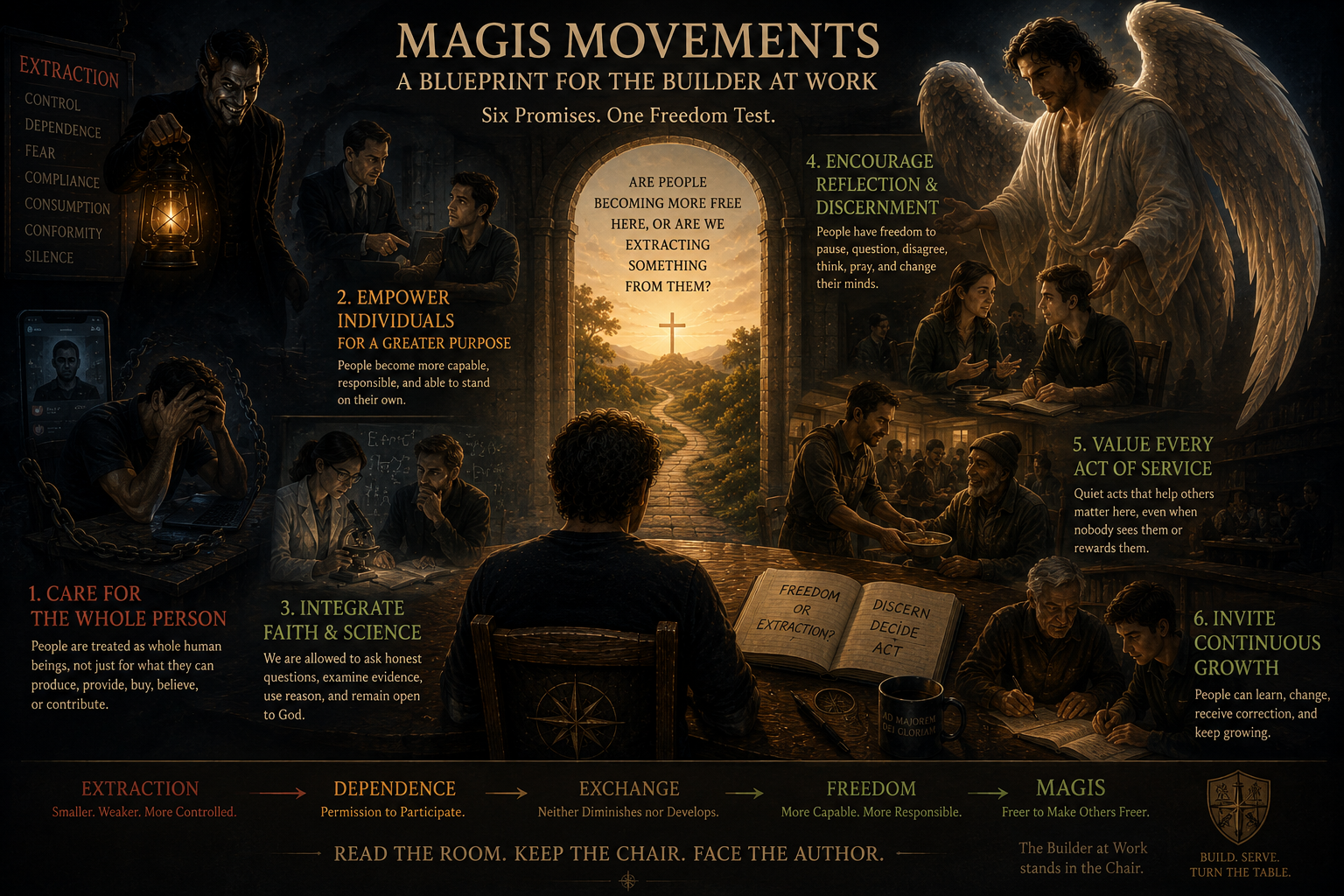
The Sunday Table is not meant to end at the table. Reflection that never acquires a verb eventually becomes another form of consumption. The Builder at Work takes what has been recognized, reflected upon, discerned, and prayed over and gives it form in the world.
That is why we are changing the name of this practice from Magis Moments to Magis Movements. A moment can pass. A movement goes somewhere. In the Ignatian tradition, movements reveal direction: toward greater freedom or greater enclosure, toward consolation or desolation, toward service or self-importance, toward the Author or toward one of the many lanterns competing for our attention.
Magis asks what greater good becomes possible once we have discerned the direction.
The Six Promises of the Humaning Covenant provide the Builder's blueprint. They allow us to examine the human architecture immediately around us and ask whether our presence is creating conditions of extraction, dependence, exchange, freedom, or Magis. The point is not merely to score the room. The Builder does something with what the reading reveals.
The Devil at Work rarely begins by asking you to do something obviously diabolical. That would make him too easy to recognize. More often, he nudges with something almost too easy to ignore… give a little more attention; stop asking that question; keep scrolling; keep the peace. Then some of the nudges are more forceful jabs, such as trust the system; do as I say not as I do; parrot what everyone else is saying. Before long, something that once served you, whatever that is, has begun using you.
At UMANAIMOⓇ we call that extraction. Something takes more from the humaned person than it gives back. An employer may extract work while slowly taking confidence and agency. A platform may extract attention while leaving us restless. A leader may extract loyalty while making people increasingly afraid to think for themselves. A cause may extract outrage. A church can even extract service while forgetting to care for the people doing the serving. The Devil at Work is quite content with any arrangement that leaves a person smaller, more dependent, more reactive, or less able to recognize the voice of the Author.
Christian freedom moves in the opposite direction. Freedom doesn’t mean that nobody asks anything of us. Quite interestingly, Love asks a great deal as does vocation and even service sometimes costs enormously. The difference is what the relationship produces. Healthy relationships shape people who become more capable of choosing, loving, serving, discerning, telling the truth, accepting correction, and helping someone else stand on their own.
That is why the Six Promises of the Humaning Covenant can become a very practical freedom test. They help us look at a workplace, friendship, church, team, technology, organization, relationship, or even our own leadership and ask a much simpler question: Are people becoming more free here, or are we extracting something from them?
Choose one relationship, group, organization, technology, or community and rate each statement which corresponds with one of the promises of the Humaning Covenant from 1 to 5. Do not rate what the relationship or organization, etc. says it does. Rate what you actually experience.
1: Extraction: This takes from people and leaves them smaller or feeling less than..
2: Dependence: People can participate, but they become more dependent, cautious, or controlled.
3: Exchange: The relationship mostly works, but it neither clearly diminishes nor develops people.
4: Freedom: People become more capable, responsible, and able to stand on their own.ٜ
5: Magis: People become freer and use that freedom to help others become freer too.
People here are treated like whole human beings, not just for what they can produce, provide, buy, believe, or contribute. 1 · 2 · 3 · 4 · 5
A score of 1 means people are exhausted, reduced to numbers, roles, grades, output, appearance, or usefulness. A score of 5 means performance matters, but the person always matters more.
Being part of this relationship makes people better able to think, decide, act, and contribute without needing constant permission or approval. 1 · 2 · 3 · 4 · 5
A score of 1 means power is collected at the center and people are kept dependent. A score of 5 means people leave stronger than they arrived and use their strength for something larger than themselves.
We are allowed to ask honest questions, examine evidence, use reason, listen to conscience, and remain open to God without being forced to silence one part of ourselves. 1 · 2 · 3 · 4 · 5
A score of 1 means truth must fit the approved story. A score of 5 means evidence and faith can challenge, deepen, and correct our understanding without fear.
People have enough freedom to pause, question, disagree, think, pray, and change their minds before being pushed to act. 1 · 2 · 3 · 4 · 5
A score of 1 means urgency, fear, conformity, or pressure makes decisions for us. A score of 5 means people are expected to discern rather than merely comply.
Quiet acts that genuinely help another person matter here, even when nobody sees them or rewards them. 1 · 2 · 3 · 4 · 5
A score of 1 means only visible achievement, status, applause, followers, money, or recognition counts. A score of 5 means service is valued because another person's burden becomes lighter.
People are allowed to learn, change, admit mistakes, receive corrections, and become more than the role or reputation they already have. 1 · 2 · 3 · 4 · 5
A score of 1 means mistakes become permanent labels and questioning threatens belonging. A score of 5 means correction leads to growth and people are expected to keep becoming.
Add the six scores if you want a quick picture, but do not let the number replace discernment. A total cannot tell you everything about a relationship. Instead, pay special attention to the lowest score. That may be where the Devil at Work has found his easiest entrance.
The movement from Extraction to Magis is really a movement of freedom. At the extraction end of the scale, the relationship asks, What can I get from you? Dependence asks, How can I keep you needing me? Exchange asks, What can we trade? Freedom asks, What becomes possible in you because we are in relationship? Magis asks the largest question of all: What greater good becomes possible for others because both of us have become more free?
That is the difference between using people and Humaning with them.
Turn the Table™ - gives us several short actions or actionable reflections worth carrying into the places where freedom is most easily lost. These are not slogans, they are acts of defiant Social Intelligence. Use them as interruptions to create the space between a signal and your own reaction.
“Influence is healthiest when it reduces dependence on the influencer.” When someone relies on you, ask what you can teach, share, delegate, or release so that they become more capable rather than more attached to your authority.
“Let data reveal the pattern, not pronounce the vocation.” Use grades, metrics, profiles, analytics, assessments, and AI to see something you may have missed, but never let a measurement tell a humaned person what they are capable or allowed to become.
“Ask any system: What does repeated use train me to notice, desire, ignore, and become?” Ask this of your phone, school, workplace, church, news, social media, politics, AI, and even the communities you love. Repeated use is always forming something.
“Ask machines for assistance, never absolution.” Use AI to help you think, but do not ask it to carry the responsibility for your judgment. The answer may come from the machine. The decision still belongs to your Chair.
“Repetition produces familiarity, not truth.” When everyone seems to “know” something, slow down. Hearing a claim one hundred times does not turn it into proof of truth.
“Urgency is often a demand to act before the instrument can be calibrated.” When the red light appears, remember Rick's Check Airman. Keep your hands still long enough to recognize, reflect, discern, and pray before you throw the switch.
“No algorithm rewards washing of feet. That is why it remains a reliable test.” Do one useful thing this week that nobody needs to know you did. If another person's burden became lighter, it mattered.
“Recognize Magis by its fruit. Wider service, deeper freedom, stronger relationships, and more shared life.” When you are unsure whether something is truly greater, stop measuring how impressive it looks. Examine what it inspires in people.
The Devil at Work wants us to believe that freedom is primarily the ability to get what we want. That definition is convenient because appetites are easy to manipulate. The deeper freedom Christ offers is harder to exploit. It is the freedom to stand boldly in the truth of the Authored person that you are even when a system would try to diminish you, demand compliance, cast a shadow of shame, or turn your chair even slightly into the lantern of The Devil at Work. That freedom makes you unstoppable.
Look again at the six scores. Choose the lowest one and DO something about it this week. Don’t wait for the perfect conditions, Build where your Chair already sits.
That is how the Builder at Work begins to defeat the Devil at Work: not by becoming louder than him, but by creating conditions in which another humaned person becomes freer. Then turn the table and ask the question that matters most: Because I was in this room, did someone become more free? If the answer increasingly becomes yes, you are already moving from extraction toward Magis.
Ad maiorem Dei gloriam.
Footnote: artificial intelligence is understood as machine inference: computational systems that detect patterns, generate outputs, recommend actions, and simulate certain features of reasoning without conscience, responsibility, embodiment, or wisdom. Machine inference does not mimic or refer to intelligence in the human sense.
La Tavola Domenicale non è destinata a concludersi a tavola. La riflessione che non si traduce mai in azione finisce per diventare un’altra forma di consumo. Il Costruttore al Lavoro prende ciò che è stato riconosciuto, su cui si è riflettuto, discernuto e per cui si è pregato, e gli dà forma nel mondo.
Ecco perché stiamo cambiando il nome di questa pratica da Magis Moments a Magis Movements. Un momento può passare. Un movimento va da qualche parte. Nella tradizione ignaziana, i movimenti rivelano una direzione: verso una maggiore libertà o una maggiore chiusura, verso la consolazione o la desolazione, verso il servizio o l’egocentrismo, verso l’Autore o verso una delle tante lanterne che competono per la nostra attenzione.
Il Magis ci chiede quale bene superiore diventi possibile una volta che abbiamo discernito la direzione.
Le Sei Promesse dell'Alleanza Umanizzante forniscono il progetto del Costruttore. Ci permettono di esaminare l’architettura umana che ci circonda immediatamente e di chiederci se la nostra presenza stia creando condizioni di sfruttamento, dipendenza, scambio, libertà o Magis. Il punto non è semplicemente valutare la situazione. Il Costruttore agisce in base a ciò che la lettura rivela.
Il Diavolo al Lavoro raramente inizia chiedendoti di fare qualcosa di palesemente diabolico. Ciò lo renderebbe troppo facile da riconoscere. Più spesso, ti spinge con qualcosa di quasi troppo facile da ignorare… presta un po’ più di attenzione; smetti di farti quella domanda; continua a scorrere; mantieni la calma. Poi alcuni di questi spintoni diventano colpi più decisi, come «fidati del sistema»; «fai come dico, non come faccio»; «ripeti a pappagallo ciò che dicono tutti gli altri». In poco tempo, qualcosa che un tempo ti era utile, qualunque cosa fosse, ha iniziato a sfruttarti.
Noi di UMANAIMOⓇ lo chiamiamo «estrazione». Qualcosa prende dalla persona più di quanto le restituisca. Un datore di lavoro può sfruttare il lavoro mentre sottrae lentamente fiducia e autonomia. Una piattaforma può attirare l’attenzione lasciandoci irrequieti. Un leader può esigere lealtà mentre rende le persone sempre più timorose di pensare con la propria testa. Una causa può suscitare indignazione. Una chiesa può persino estrarre il servizio dimenticandosi di prendersi cura delle persone che lo rendono. Il Diavolo al Lavoro si accontenta di qualsiasi situazione che lasci una persona più piccola, più dipendente, più reattiva o meno capace di riconoscere la voce dell’Autore.
La libertà cristiana va nella direzione opposta. Libertà non significa che nessuno ci chieda nulla. È piuttosto interessante notare che l’Amore chiede molto, così come la vocazione, e persino il servizio a volte ha un costo enorme. La differenza sta in ciò che la relazione produce. Le relazioni sane formano persone che diventano più capaci di scegliere, amare, servire, discernere, dire la verità, accettare la correzione e aiutare qualcun altro a camminare con le proprie gambe.
Ecco perché le Sei Promesse dell'Alleanza Umanizzante possono diventare un test di libertà molto pratico. Ci aiutano a guardare un ambiente di lavoro, un'amicizia, una chiesa, una squadra, la tecnologia, un'organizzazione, una relazione o persino la nostra stessa leadership e a porci una domanda molto più semplice: B Le persone stanno diventando più libere qui, o stiamo sottraendo loro qualcosa?B
Scegli una relazione, un gruppo, un’organizzazione, una tecnologia o una comunità e valuta da 1 a 5 ogni affermazione che corrisponde a una delle promesse del Patto Humaning. Non valutare ciò che la relazione o l’organizzazione, ecc. dice di fare. Valuta ciò che vivi effettivamente.
1: Sfruttamento: Questo sottrae qualcosa alle persone e le lascia più piccole o con un senso di inferiorità.
2: Dipendenza: Le persone possono partecipare, ma diventano più dipendenti, caute o controllate.
3: Scambio: La relazione funziona per lo più, ma non sminuisce né valorizza chiaramente le persone.
4: Libertà: Le persone diventano più capaci, responsabili e in grado di reggersi sulle proprie gambe.
5: Magis: Le persone diventano più libere e usano quella libertà per aiutare anche gli altri a diventare più liberi.
Qui le persone vengono trattate come esseri umani a tutto tondo, non solo per ciò che possono produrre, fornire, acquistare, credere o contribuire. 1 · 2 · 3 · 4 · 5
Un punteggio di 1 significa che le persone sono esauste, ridotte a numeri, ruoli, voti, risultati, aspetto o utilità. Un punteggio di 5 significa che le prestazioni contano, ma la persona conta sempre di più.
Far parte di questa relazione rende le persone più capaci di pensare, decidere, agire e contribuire senza bisogno di permessi o approvazioni costanti. 1 · 2 · 3 · 4 · 5
Un punteggio di 1 significa che il potere è concentrato al centro e le persone sono tenute in una condizione di dipendenza. Un punteggio di 5 significa che le persone se ne vanno più forti di quando sono arrivate e usano la loro forza per qualcosa di più grande di loro stesse.
Ci è permesso porre domande sincere, esaminare le prove, usare la ragione, ascoltare la coscienza e rimanere aperti a Dio senza essere costretti a mettere a tacere una parte di noi stessi. 1 · 2 · 3 · 4 · 5
Un punteggio di 1 significa che la verità deve adattarsi alla versione ufficiale. Un punteggio di 5 significa che le prove e la fede possono mettere in discussione, approfondire e correggere la nostra comprensione senza timore.
Le persone hanno abbastanza libertà per fermarsi, porre domande, dissentire, riflettere, pregare e cambiare idea prima di essere spinte ad agire. 1 · 2 · 3 · 4 · 5
Un punteggio di 1 significa che l’urgenza, la paura, il conformismo o la pressione prendono decisioni al posto nostro. Un punteggio di 5 significa che ci si aspetta che le persone esercitino il discernimento piuttosto che limitarsi a obbedire.
Qui contano gli atti silenziosi che aiutano sinceramente un’altra persona, anche quando nessuno li vede o li ricompensa. 1 · 2 · 3 · 4 · 5
Un punteggio di 1 significa che contano solo i risultati visibili, lo status, gli applausi, i seguaci, il denaro o il riconoscimento. Un punteggio di 5 significa che il servizio è valorizzato perché il fardello di un’altra persona diventa più leggero.
Alle persone è permesso imparare, cambiare, ammettere gli errori, accettare le correzioni e diventare qualcosa di più del ruolo o della reputazione che già possiedono. 1 · 2 · 3 · 4 · 5
Un punteggio di 1 significa che gli errori diventano etichette permanenti e che mettere in discussione qualcosa mette a rischio il senso di appartenenza. Un punteggio di 5 significa che la correzione porta alla crescita e ci si aspetta che le persone continuino a evolversi.
Somma i sei punteggi se vuoi avere un quadro rapido, ma non lasciare che il numero sostituisca il discernimento. Un totale non può dirti tutto su una relazione. Presta invece particolare attenzione al punteggio più basso. Potrebbe essere proprio lì che il Diavolo all’opera ha trovato il suo punto di ingresso più facile.
Il passaggio da Estrazione a Magis è in realtà un movimento di libertà. All’estremità dell’estrazione della scala, la relazione chiede: Cosa posso ottenere da te? La dipendenza chiede: Come posso fare in modo che tu continui ad aver bisogno di me? Lo scambio chiede: Cosa possiamo scambiarci? La libertà chiede: Cosa diventa possibile in te grazie al fatto che siamo in relazione? Il “Magis” pone la domanda più grande di tutte: Quale bene superiore diventa possibile per gli altri grazie al fatto che entrambi siamo diventati più liberi?
Questa è la differenza tra l’usare le persone e il vivere da esseri umani con loro.
Turn the Table™ – ci offre diverse azioni brevi o riflessioni concrete che vale la pena portare con sé nei luoghi in cui la libertà si perde più facilmente. Questi non sono slogan, sono atti di Intelligenza Sociale ribelle. Usali come interruzioni per creare lo spazio tra un segnale e la tua reazione.
“L’influenza è più sana quando riduce la dipendenza da chi la esercita.” Quando qualcuno fa affidamento su di te, chiediti cosa puoi insegnare, condividere, delegare o lasciar andare affinché diventi più capace anziché più attaccato alla tua autorità.
“Lascia che i dati rivelino lo schema, non che determinino la vocazione.” Usa voti, metriche, profili, analisi, valutazioni e IA per individuare ciò che potresti aver trascurato, ma non lasciare mai che una misurazione dica a una persona in carne e ossa ciò che è in grado o autorizzata a diventare.
«Chiedi a qualsiasi sistema: “Cosa mi allena a notare, desiderare, ignorare e diventare l’uso ripetuto?”» Chiedilo al tuo telefono, alla scuola, al posto di lavoro, alla chiesa, alle notizie, ai social media, alla politica, all’IA e persino alle comunità che ami. L’uso ripetuto sta sempre plasmando qualcosa.
«Chiedete alle macchine assistenza, mai l’assoluzione.» Usate l’intelligenza artificiale per aiutarvi a pensare, ma non chiedetele di assumersi la responsabilità del vostro giudizio. La risposta può venire dalla macchina. La decisione spetta comunque a voi.
«La ripetizione produce familiarità, non verità.» Quando tutti sembrano “sapere” qualcosa, rallentate. Sentire un’affermazione cento volte non la trasforma in una prova di verità.
“L’urgenza è spesso una richiesta di agire prima che lo strumento possa essere calibrato.” Quando si accende la spia rossa, ricordati del “Check Airman” di Rick. Tieni le mani ferme abbastanza a lungo da riconoscere, riflettere, discernere e pregare prima di azionare l’interruttore.
“Nessun algoritmo premia il lavaggio dei piedi. Ecco perché rimane una prova affidabile.” Fai una cosa utile questa settimana che nessuno debba sapere che hai fatto. Se il fardello di un’altra persona si è alleggerito, allora ha avuto importanza.
«Riconosci il Magis dai suoi frutti: un servizio più ampio, una libertà più profonda, relazioni più forti e una vita più condivisa.» Quando non sei sicuro che qualcosa sia davvero più grande, smetti di valutare quanto sembri impressionante. Esamina ciò che ispira nelle persone.
Il Diavolo all’opera vuole farci credere che la libertà sia principalmente la capacità di ottenere ciò che vogliamo. Quella definizione è comoda perché gli appetiti sono facili da manipolare. La libertà più profonda che Cristo offre è più difficile da sfruttare. È la libertà di rimanere con coraggio fedeli alla verità della persona creata da Dio che sei, anche quando un sistema cerca di sminuirti, esige obbedienza, getta un’ombra di vergogna o fa ruotare la tua sedia anche solo leggermente verso la luce del Diavolo all’opera. Quella libertà ti rende inarrestabile.
Riguarda i sei punteggi. Scegli quello più basso e FAI qualcosa al riguardo questa settimana. Non aspettare le condizioni perfette, costruisci dove la tua sedia è già posizionata.
È così che il Costruttore al Lavoro inizia a sconfiggere il Diavolo al Lavoro: non diventando più forte di lui, ma creando le condizioni in cui un’altra persona umanizzata diventi più libera. Poi ribalta la situazione e poni la domanda che conta di più: Poiché ero in questa stanza, qualcuno è diventato più libero? Se la risposta diventa sempre più spesso sì, ti stai già spostando dall’estrazione verso il Magis.
Ad maiorem Dei gloriam.
Nota a piè di pagina: per intelligenza artificiale si intende l’inferenza automatica: sistemi computazionali che rilevano schemi, generano risultati, raccomandano azioni e simulano determinate caratteristiche del ragionamento senza coscienza, responsabilità, incarnazione o saggezza. L’inferenza automatica non imita né si riferisce all’intelligenza nel senso umano del termine.
Examining your own Architecture
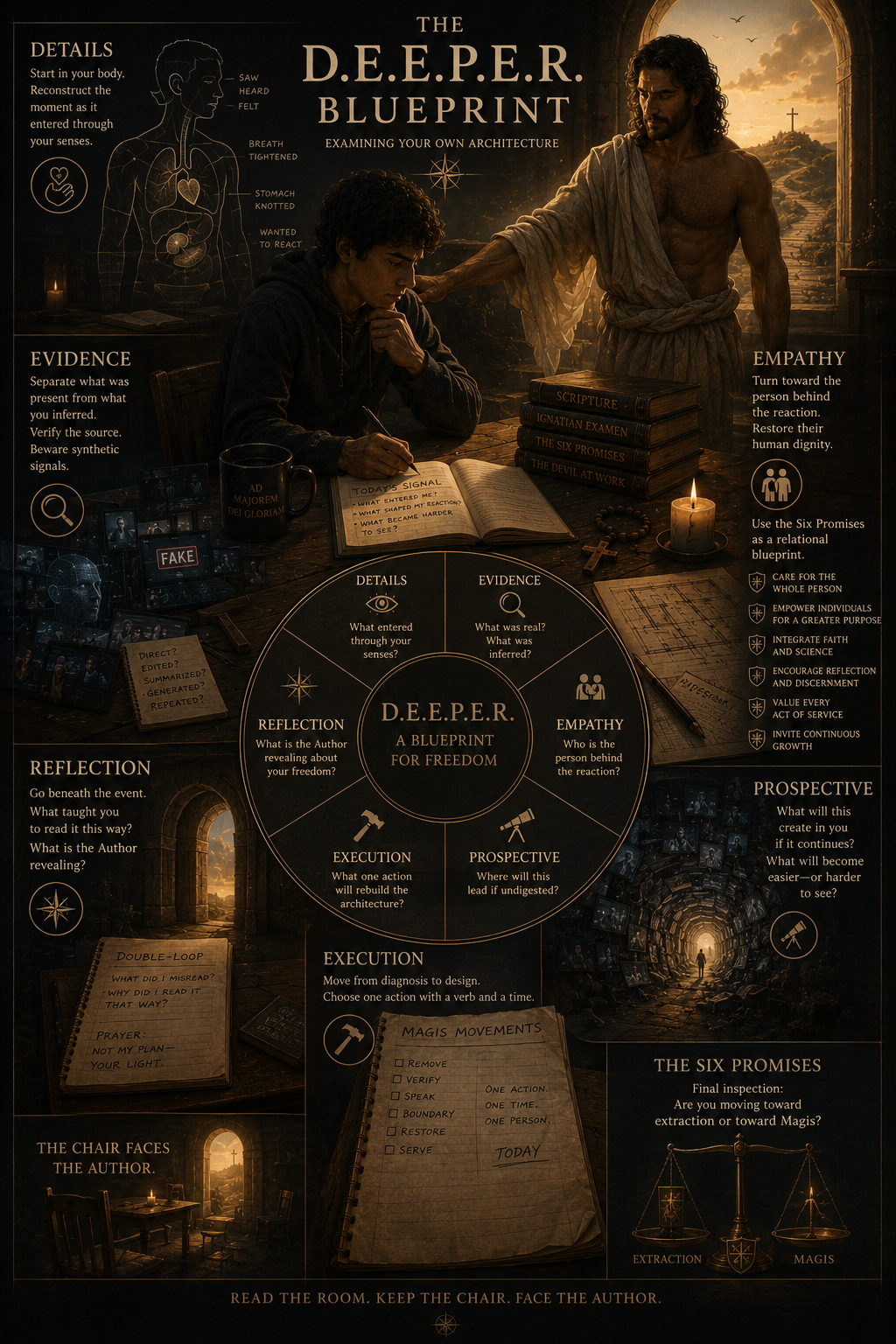
This week, D.E.E.P.E.R.™ needs to feel less like a review of events and more like walking through the interior architecture of your life when everyone else is out of the room. It’s important to separate signal from noise, to notice obfuscation, to recognize synthetic signals, to digest what we consume before we pass it on, and to use the Six Promises as a practical path from extraction toward freedom and Magis. The Magis Movements create a blueprint for the Builder at Work so that he can do something with what has been revealed. The D.E.E.P.E.R.™ practice should therefore become the place where we inspect the structure of ourselves.
The D.E.E.P.E.R. Blueprint is the new name for the D.E.E.P.E.R. Examen because a blueprint does not merely record what shapes the inside and outside of a building. It reveals what holds the building up, where pressure is being carried, what was added later, where the passage has narrowed, and what may need to be repaired before another person enters. That is the invitation this week. Do not simply ask what happened to you. Ask what moved through you, where it stuck, what it formed, and what architecture it exposed.
D.E.E.P.E.R. refers to Details, Evidence, Empathy, Prospective, Execution and Reflection.
Details: Start in your own body. Return to one moment when something entered strongly through the senses. It may have been a conversation, an image, an email, a headline, a video, an AI response, a tone of voice, an accusation, an organizational demand, or a moment when you suddenly felt yourself react.
Before explaining the event, reconstruct its physical arrival. Where were you? What did you see or hear? What happened in your breathing, jaw, chest, stomach, shoulders, hands, or posture? Did your body move toward the signal, away from it, or freeze around it? What did you want to do immediately? Your body is not the verdict, but it is part of describing “what happened” without prejudice. Be specific when describing the details.
Evidence: Separate what was actually present from how your nervous system and imagination reacted. Describe everything about the event or experience which provided an interior or external signal. Record the feelings arising as you recall the situation - does it feel light or heavy and where? What did you infer? What came from memory, reputation, fear, repetition, or someone else’s interpretation? If the signal was mediated through technology, how much do you know about its source? Was it direct, edited, summarized, generated, or repeated? Did you notice a glimpse of puzzlement on the faces of others? We know that repetition produces familiarity rather than truth and that synthetic signals can now resemble authentic ones so was there something different in this interaction? The Builder at Work does not distrust everything, but he doesn’t let appearance become evidence without examination. Always look under the hood so to speak.
Empathy: Turn toward the person who may have disappeared behind your reaction. Who became harder to see once the signal entered and how do you know - is it a feeling or observation? Perhaps it was the person who angered you, the colleague reduced to a label, the stranger represented through a headline, the group you know mostly through mediated voices, or even yourself. Ask what burden, fear, wound, dignity, or agency became obscured. Then use the Six Promises as a relational blueprint. Was the whole person visible? Was personal agency preserved? Was truth held together rather than divided? Was there enough room for reflection? Was quiet service recognized? Was growth still possible? Empathy here is not sentimental agreement. It is the recovery of enough visibility that a humaned person can no longer be treated merely as noise.
Prospective: Examine what the signal will invite if it remains undigested. This is where the image from Ayurvedic sciences becomes especially useful. What has entered you but has not yet been processed? If this fear, outrage, certainty, resentment, interpretation, parasocial attachment, AI output, organizational story, or repeated voice continues to accumulate, what kind of interior architecture will it produce? What will become easier to notice? What will become harder to see? Which people will begin looking like categories? What kinds of reactions will become automatic? Where will your Chair slowly turn? The question is not only where this single event is leading, but what kind of person repeated exposure is constructing.
Execution: Move from diagnosis to design and disciplined action. The Builder at Work asks what must now change in the architecture. Do you need to remove a source of noise for a time? Verify something before repeating it? Speak directly to the person rather than continue consuming interpretations about them? Put your hands under your legs long enough for Recognition to become Reflection? Create a boundary around a platform, meeting, relationship, or stream of information? Repair something you passed along before it was digested? Restore agency to someone who has become too dependent on your interpretation? Make one invisible burden lighter? Choose one action with a verb and a time. A blueprint that never becomes construction is only another drawing.
Reflection: Move beneath the event and ask what the Author is revealing about the architecture of your freedom. This is the double-loop movement. Do not stop with, “What did I misread?” Ask, “What taught me to read it that way?” What belief, fear, appetite, loyalty, habit, rule, wound, platform, relationship, or pattern of consumption gave the signal immediate authority? What condition inside you made this particular lantern persuasive? Where did you confuse relief with peace, familiarity with truth, visibility with importance, urgency with responsibility, or belonging with obedience? Then ask where the Author may be inviting a deeper repair.
This final movement should be felt rather than merely answered. Sit with the question long enough to notice whether your interior perceptive space opens or contracts. Bring the uncertainty into prayer without demanding immediate resolution. Authentic prayer doesn’t mean that we should ask the Author to approve the blueprint we have already drawn. It allows Him to reveal where a wall should come down, where a foundation is weak, where a door has been sealed, or where we have been building around a lantern rather than toward the Light.
The Six Promises can then be used as the final inspection of the week. Ask whether the architecture revealed by your D.E.E.P.E.R.™ Blueprint is moving toward extraction or toward Magis. Are you becoming more able to see the whole person? More willing to give agency away? More capable of holding faith, evidence, conscience, and embodiment together? More able to pause before reaction? More attentive to quiet service? More open to correction and growth? If the answer is yes, then freedom is beginning to take architectural form.
The final question is whether you feel better or understand more. It is whether someone else will encounter a freer room because you did this work. That is where the D.E.E.P.E.R. Blueprint joins the Magis Movements. Reflection reveals the structure. Magis rebuilds it.
Ad maiorem Dei gloriam.
Esplorare la propria architettura
Questa settimana, D.E.E.P.E.R.™ deve sembrare meno una rassegna di eventi e più un percorso attraverso l’architettura interiore della propria vita, quando tutti gli altri sono fuori dalla stanza. È importante separare il segnale dal rumore, notare l’offuscamento, riconoscere i segnali sintetici, assimilare ciò che consumiamo prima di trasmetterlo, e utilizzare le Sei Promesse come percorso pratico dall’estrazione verso la libertà e il Magis. I Movimenti del Magis creano un progetto per il Costruttore al Lavoro affinché possa fare qualcosa con ciò che è stato rivelato. La pratica D.E.E.P.E.R.™ dovrebbe quindi diventare il luogo in cui ispezioniamo la struttura di noi stessi.
Il Progetto D.E.E.P.E.R. è il nuovo nome dell’Esame D.E.E.P.E.R., perché un progetto non si limita a registrare ciò che modella l’interno e l’esterno di un edificio. Rivelano ciò che sostiene l’edificio, dove viene assorbita la pressione, cosa è stato aggiunto in seguito, dove il passaggio si è ristretto e cosa potrebbe dover essere riparato prima che entri un’altra persona. Questo è l’invito di questa settimana. Non chiedetevi semplicemente cosa vi sia successo. Chiedetevi cosa vi abbia attraversato, dove si sia bloccato, cosa abbia formato e quale architettura abbia messo a nudo.
D.E.E.P.E.R. si riferisce a Dettagli, Evidenza, Empatia, Prospettiva, Esecuzione e Riflessione.
Dettagli: Inizia dal tuo corpo. Torna a un momento in cui qualcosa è entrato con forza attraverso i sensi. Potrebbe essere stata una conversazione, un’immagine, un’e-mail, un titolo, un video, una risposta dell’intelligenza artificiale, un tono di voce, un’accusa, una richiesta organizzativa o un momento in cui ti sei sentito reagire all’improvviso.
Prima di spiegare l’evento, ricostruisci il suo impatto fisico. Dove ti trovavi? Cosa hai visto o sentito? Cosa è successo al tuo respiro, alla mascella, al torace, allo stomaco, alle spalle, alle mani o alla postura? Il tuo corpo si è mosso verso il segnale, si è allontanato da esso o si è irrigidito attorno ad esso? Cosa avresti voluto fare immediatamente? Il tuo corpo non è il verdetto, ma è parte della descrizione di «ciò che è accaduto» senza pregiudizi. Sii specifico nel descrivere i dettagli.
Evidenza: Distinguete ciò che era effettivamente presente da come hanno reagito il vostro sistema nervoso e la vostra immaginazione. Descrivete tutto ciò che, nell’evento o nell’esperienza, ha fornito un segnale interno o esterno. Annotate le sensazioni che emergono mentre rievocate la situazione: vi sembra una sensazione leggera o pesante e dove? Cosa avete dedotto? Cosa proveniva dalla memoria, dalla reputazione, dalla paura, dalla ripetizione o dall’interpretazione di qualcun altro? Se il segnale è stato veicolato dalla tecnologia, quanto sapete della sua fonte? Era diretto, modificato, sintetizzato, generato o ripetuto? Hai notato un barlume di perplessità sui volti degli altri? Sappiamo che la ripetizione produce familiarità piuttosto che verità e che i segnali sintetici possono ormai assomigliare a quelli autentici, quindi c’era qualcosa di diverso in questa interazione? Il Costruttore all’Opera non diffida di tutto, ma non lascia che l’apparenza diventi prova senza un’analisi. Guarda sempre sotto il cofano, per così dire.
Empatia: rivolgiti alla persona che potrebbe essere scomparsa dietro la tua reazione. Chi è diventato più difficile da vedere una volta che il segnale è entrato in gioco e come lo sai – è una sensazione o un’osservazione? Forse era la persona che ti ha fatto arrabbiare, il collega ridotto a un’etichetta, lo sconosciuto rappresentato da un titolo, il gruppo che conosci soprattutto attraverso voci mediate, o persino te stesso. Chiediti quale fardello, paura, ferita, dignità o autonomia sia stato oscurato. Poi usa le Sei Promesse come modello relazionale. Era visibile la persona nella sua interezza? È stata preservata l’autonomia personale? La verità è stata mantenuta unita anziché divisa? C’era spazio sufficiente per la riflessione? È stato riconosciuto il servizio silenzioso? La crescita era ancora possibile? L’empatia qui non è un consenso sentimentale. È il recupero di una visibilità sufficiente affinché una persona trattata con umanità non possa più essere considerata semplicemente come rumore di fondo.
Prospettiva: Esamina cosa susciterà il segnale se rimane non elaborato. È qui che l’immagine tratta dalle scienze ayurvediche diventa particolarmente utile. Cosa è entrato in te ma non è stato ancora elaborato? Se questa paura, indignazione, certezza, risentimento, interpretazione, attaccamento parasociale, output dell’IA, narrazione organizzativa o voce ripetuta continua ad accumularsi, che tipo di architettura interiore produrrà? Cosa diventerà più facile da notare? Cosa diventerà più difficile da vedere? Quali persone cominceranno ad apparire come categorie? Quali tipi di reazioni diventeranno automatiche? Verso dove si orienterà lentamente la tua Sedia? La domanda non è solo dove sta portando questo singolo evento, ma che tipo di persona sta costruendo l’esposizione ripetuta.
Esecuzione: Passa dalla diagnosi alla progettazione e all’azione disciplinata. Il Costruttore al Lavoro chiede cosa debba cambiare ora nell’architettura. Hai bisogno di rimuovere una fonte di rumore per un po’? Verificare qualcosa prima di ripeterla? Parlare direttamente alla persona piuttosto che continuare a consumare interpretazioni su di lei? Mettere le mani sotto le gambe abbastanza a lungo da far sì che il Riconoscimento diventi Riflessione? Creare un confine attorno a una piattaforma, a una riunione, a una relazione o a un flusso di informazioni? Riparare qualcosa che hai trasmesso prima che fosse assimilato? Restituire l’autonomia a qualcuno che è diventato troppo dipendente dalla tua interpretazione? Alleggerire un fardello invisibile? Scegli un’azione con un verbo e un tempo. Un progetto che non diventa mai costruzione è solo un altro disegno.
Riflessione: Spingiti al di là dell’evento e chiediti cosa l’Autore ti sta rivelando sull’architettura della tua libertà. Questo è il movimento a doppio ciclo. Non fermarti a chiederti: «Cosa ho frainteso?». Chiediti: «Cosa mi ha insegnato a leggerlo in quel modo?». Quale convinzione, paura, desiderio, lealtà, abitudine, regola, ferita, piattaforma, relazione o modello di consumo ha conferito a quel segnale un’autorità immediata? Quale condizione dentro di te ha reso persuasiva proprio questa lanterna? Dove hai confuso il sollievo con la pace, la familiarità con la verità, la visibilità con l’importanza, l’urgenza con la responsabilità o l’appartenenza con l’obbedienza? Chiediti poi dove l’Autore potrebbe invitarti a una riparazione più profonda.
Questo movimento finale dovrebbe essere percepito piuttosto che semplicemente risolto. Rimani con la domanda abbastanza a lungo da notare se il tuo spazio percettivo interiore si apre o si contrae. Porta l’incertezza nella preghiera senza esigere una risoluzione immediata. La preghiera autentica non significa che dovremmo chiedere all’Autore di approvare il progetto che abbiamo già disegnato. Permette a Lui di rivelare dove un muro dovrebbe essere abbattuto, dove una fondazione è debole, dove una porta è stata sigillata, o dove abbiamo costruito attorno a una lanterna anziché verso la Luce.
Le Sei Promesse possono quindi essere utilizzate come ispezione finale della settimana. Chiediti se l’architettura rivelata dal tuo Progetto D.E.E.P.E.R.™ si sta muovendo verso l’estrazione o verso il Magis. Stai diventando più capace di vedere la persona nella sua interezza? Più disposto a cedere il controllo? Più capace di tenere insieme fede, evidenza, coscienza e incarnazione? Più capace di fermarti prima di reagire? Più attento al servizio silenzioso? Più aperto alla correzione e alla crescita? Se la risposta è sì, allora la libertà sta cominciando ad assumere una forma architettonica.
La domanda finale è se ti senti meglio o se comprendi di più. È se qualcun altro troverà uno spazio più libero grazie al lavoro che hai svolto. È qui che il modello D.E.E.P.E.R. si unisce ai Movimenti del Magis. La riflessione rivela la struttura. Il Magis la ricostruisce.
Ad maiorem Dei gloriam.
Cosiamo | Founder, UMANIAMO® | Humaning Architecture

Before we begin another week of the Sunday Table, it may be worth remembering why there is a table here at all. The Sunday Table was never intended as a newsletter organized around an Italian meal, nor as a warm metaphor for community. It was a way for the founders of UMANIAMOⓇ to come together and share different perspectives. The Sunday Table itself is modeled as a reflection of Italian traditions. In Southern Italy, the Sunday table has long been a sacred center of family life, a place where generations gather, food is passed, stories are repeated, disagreements survive, the dead remain present in memory, and no one needs to earn the right to participate by producing something first. The table preserves something the western world continually threatens to help us forget: before we are workers, customers, voters, followers, users, profiles, or data, we are persons received into a relationship. That is already a quiet act of resistance.
Every tyranny, whether political, economic, technological, ideological, organizational, or spiritual, begins in the mind and eventually attempts to reorganize human relationships around its own center of gravity. It tries to tell us what deserves attention, who has value, which voices may speak, what must be feared, what counts as success, and what forms of belonging are permitted. Tyranny doesn’t always look like a military occupation. Sometimes it shows up looking like efficiency and convenience or often as a form of certainty or an ideology's vocabulary, a platform's incentives, a religious institution's rules, or an algorithm's supposedly neutral recommendation. Whatever its form, tyranny begins to succeed when the humaned person forgets that there is a place from which the system can’t legitimately reach him, his authored self rightly seated at the Sunday Table.
The Sunday Table is the first sovereign place of freedom because the person who takes the Chair does not arrive there alone. He arrives at the table already authored and called into a relationship with the One from whom his life originated. The Chair is therefore not a throne from which the self declares independence from everyone else. It is the place of responsibility from which the Authored remembers the Author. That distinction is what makes Christian freedom different from isolation, rebellion, or mere autonomy. We are not free because nobody has a claim upon us. We are free because the deepest claim has already been made by Love, and every lesser claim must therefore remain in its proper place.
The Sunday Table’s first essay series was written almost one year ago in September 2025 around Michaelmas, the feast honoring Michael, Gabriel, and Raphael. My intention at the time was not to create a devotional project. Instead, It was to bring Christ back to the table with us and, in a certain sense, off the wall. Christianity can become strangely easy to contain when Christ remains an image we look toward rather than a presence around whom we reorganize life. He can hang above the dining room, remain inside the church building, appear in a prayer before the meal, and still have very little to do with what happens between the people sitting beneath Him.
The Sunday Table was our attempt to change that. If Christ is truly present at the table, then the table must eventually change. The way we speak and listen to each other changes. The way we view authority, especially relational authority, changes. We can also look beyond our immediate table to see that these changes also affect the way we treat difficult people and even how we understand work, service, failure, strength, technology, disagreement, and belonging. Christ does not return to the table as the crucifix or icon, He returns as the One who keeps turning it to its true direction.
Michaelmas was an especially urgent beginning, at least for me, because the three archangels tell us something about the nature of that presence. Michael stands in the ancient question contained in his name: Who is like God? Gabriel announces what the human person could never have authored alone. Raphael accompanies and heals. None occupies the place of God and each directs attention beyond himself. Their very presence exposes the counterfeit movement of The Devil at Work and extinguishes the illusory lantern for the Light.
That pattern has remained the table legs supporting the Sunday Table. We don’t gather to create another walled off room or another set of approved opinions where members are slowly indoctrinated into how they are expected to think and are expected to say. We gather so that the space we create can remain open enough for discernment. The Sunday Table must be able to withstand even the most difficult questions. It must be able to tolerate correction. It must be capable of allowing evidence to disturb an interpretation, prayer to interrupt certainty, another person's experience to complicate our own, and the Author to call us somewhere the room itself did not predict.
That is why the table is an ongoing rejection of tyranny rather than a one-time declaration against it. Tyranny returns and it always does. Tyranny returns in families when one person's anger determines what everyone else may say. It returns in organizations when belonging depends upon often unseen agreements. It returns in politics when opponents cease to be neighbors and become categories. It returns in religion when rules intended to guide the person begin replacing discernment in the person. It returns in the form of technology when convenience becomes extractive dependence and prediction begins sounding like destiny. It returns within us when our own certainty becomes so complete that another humaned person can no longer surprise us.
The table must, therefore, be turned again and again. That is why we created the Turn the Table Workbook that we have been practicing throughout August. We began by calibrating the humaned “instrument” because a depleted, frightened, fragmented person cannot reliably read what is happening around him. We then learned to read the room without losing the Chair, noticing how relationships, organizations, ideologies, technologies, and even communities we love can slowly turn us toward their own smaller light. Now, in Week Three, we are asked to Separate Signal from Noise, and even that distinction has become more difficult than it used to be. We created the Sunday Table as a sovereign place of freedom and it's up to each of us to reject even the smallest of tyrannies and remain committed as Builders at Work, for which the future of humanity may still find a seat at the table.
The saints and feasts of this week arrive at an unusually fitting moment in our Turn the Table™ practice. Week Three asks us to Separate Signal from Noise, to distinguish fact from fiction, to name the movement before acting, and eventually to ask what service the truth requires. The calendar gives us men and women who had to do precisely that under very different kinds of pressure. Together, they remind us that discernment is not simply the ability to acquire more information. It is the capacity to recognize what deserves our attention and then allow what is true to change how we live.
Monday, August 17 · Saint Clare of Montefalco
Saint Clare of Montefalco was an Augustinian nun and abbess from Umbria whose life became known for intense prayer, contemplation of the Passion of Christ, and spiritual leadership. Vatican News includes her among the saints commemorated on August 17. Her life was largely hidden from the kinds of visibility through which our own age measures significance, yet her interior attentiveness eventually made her a trusted spiritual guide to others.
Humaning Reflection: Clare offers a powerful beginning to a week concerned with signal and noise because she reminds us that the most important signal may not be the loudest one. Contemplation trains attention. It creates enough interior silence for what is merely urgent to lose some of its authority and for what is important to become visible again. Much of modern life teaches us to attend to whatever interrupts us most effectively. Clare points in the opposite direction. If our interior world is continuously occupied by notifications, borrowed opinions, unresolved reactions, and the expectations of others, we may possess enormous amounts of information while remaining unable to hear what is actually moving within us.
Tuesday, August 18 · Saint Helena, Empress
Saint Helena, mother of the Emperor Constantine, rose from comparatively humble origins to become one of the most influential women of the Roman world. After her conversion to Christianity, she became known for generosity toward the poor, support for those suffering imprisonment or exile, pilgrimage to the Holy Land, and association with the discovery of the True Cross. Vatican News commemorates her on August 18 and emphasizes that she used imperial status not simply for prestige but in service of others.
Humaning Reflection: Helena is an extraordinary figure for Social Intelligence because few rooms contain more potential noise than a court of imperial power. Rank can obscure people. Wealth can obscure needs. Access can make privilege appear normal. Yet the human significance of Helena's story lies not simply in becoming Augusta, but in what she did when power became available to her. She used position to notice those whom power normally makes invisible.
Wednesday, August 19 · Saint John Eudes
Saint John Eudes was a seventeenth-century French priest, missionary, spiritual writer, and founder of the Congregation of Jesus and Mary, known as the Eudists. He devoted particular attention to priestly formation and promoted devotion to the Hearts of Jesus and Mary. His work arose in a period in which religious life could easily become surrounded by institutional habit while losing contact with the interior formation necessary to sustain it.
Humaning Reflection: His contribution is particularly useful because formation itself is a way of separating signal from noise. It is possible to know religious language, hold office, perform the expected ritual, or possess the title without allowing the heart to be transformed. John Eudes kept returning attention toward the interior life from which external service must proceed.
Thursday, August 20 · Saint Bernard of Clairvaux
Saint Bernard of Clairvaux was a Cistercian abbot, theologian, preacher, and Doctor of the Church whose influence extended throughout twelfth-century Europe. He entered Cîteaux as a young man and later founded and led the Abbey of Clairvaux. His spirituality united contemplation, disciplined community life, devotion to Christ and Mary, and a theology of love that understood human desire as gradually reordered toward God.
Humaning Reflection: Bernard is an especially interesting companion for a week about obfuscation because he possessed an unusually powerful voice. He advised popes, entered theological disputes, preached publicly, and influenced events well beyond the walls of his monastery. His life therefore reminds us that strong voices are not automatically noise and quiet voices are not automatically signal. Discernment cannot be reduced to volume. The deeper test is direction. Where is this voice leading? Does it draw attention toward God, toward truth, toward greater love and responsibility, or increasingly toward the importance of the speaker himself?
Friday, August 21 · Saint Pius X, Pope
Saint Pius X served as pope from 1903 until his death in 1914. He is remembered especially for pastoral reform, encouragement of frequent reception of the Eucharist, attention to catechesis, and a desire to renew Christian life around Christ rather than allow faith to become merely institutional or intellectual. The Church observes his memorial on August 21.
Humaning Reflection: Pius X invites a particularly useful Humaning examination of complexity. Institutions accumulate procedures, traditions, vocabulary, structures, and habits because some of them genuinely help preserve what matters. Yet over time, the scaffolding can become more visible than the building it was meant to support. The means can begin obscuring the end. That danger exists in churches, governments, businesses, nonprofits, universities, families, and even our own spiritual practices. The Humaning question is not whether structure is necessary, but whether the structure still helps the person reach what it was created to serve. When we cannot explain why something exists except by saying that this is how we have always done it, noise may have begun masquerading as a signal.
Saturday, August 22 · The Queenship of the Blessed Virgin Mary
The feast places Mary's queenship entirely within the kingship of Christ rather than presenting authority as possession or self-exaltation. It remains one of the significant Marian observances of August.
Humaning Reflection: Mary gives this week's theme one of its clearest reversals. The world often associates importance with visibility, title, control, and the ability to command attention. Mary's authority comes through receptivity, faithfulness, and her persistent orientation toward God. Even when the Church names her Queen, she does not become the center of the Gospel. She continues pointing beyond herself toward her Son.
Sunday, August 23 · Saint Philip Benizi
Saint Philip Benizi was a thirteenth-century Servite friar and priest who became an important leader in the developing Order of the Servants of Mary. He became remembered for leadership marked by humility, peacemaking, and service rather than an appetite for ecclesial status.
Humaning Reflection: Leadership produces noise very easily because visibility gathers around the leader. People watch what the leader says, wears, believes, decides, approves, and rejects. Eventually the person with responsibility can begin mistaking attention for importance. Philip invites us to ask whether our presence makes the room clearer or more dependent upon us. The socially intelligent leader does not need to dominate interpretation. He helps people see, strengthens their capacity to act, repairs what can be repaired, and then allows the work to remain larger than his name.
Taken together, the saints and feast of this week offer a remarkably coherent practice of attention. This is precisely where Separate Signal from Noise should lead. The purpose is not to make us suspicious of every voice, institution, structure, leader, emotion, or message. Suspicion can become its own noise. The purpose is to recover enough discernment that we can tell what deserves our attention without being captured by whatever is best at demanding it.
Il primo luogo sovrano
Prima di dare inizio a un’altra settimana de “La tavola della domenica”, vale forse la pena ricordare perché qui ci sia una tavola. “La tavola della domenica” non è mai stata concepita come una newsletter incentrata su un pasto italiano, né come una calorosa metafora di comunità. Era un modo per i fondatori di UMANIAMOⓇ di riunirsi e condividere prospettive diverse. “La tavola della domenica” stessa è concepita come un riflesso delle tradizioni italiane. Nel Sud Italia, la tavola domenicale è da tempo un centro sacro della vita familiare, un luogo dove le generazioni si riuniscono, il cibo viene passato di mano in mano, le storie vengono raccontate e ripetute, i disaccordi sopravvivono, i defunti rimangono presenti nella memoria e nessuno deve guadagnarsi il diritto di partecipare producendo prima qualcosa. La tavola preserva qualcosa che il mondo occidentale minaccia continuamente di farci dimenticare: prima di essere lavoratori, clienti, elettori, follower, utenti, profili o dati, siamo persone accolte in una relazione. Questo è già di per sé un silenzioso atto di resistenza.
Ogni tirannia, sia essa politica, economica, tecnologica, ideologica, organizzativa o spirituale, ha origine nella mente e alla fine cerca di riorganizzare le relazioni umane attorno al proprio centro di gravità. Cerca di dirci cosa merita attenzione, chi ha valore, quali voci possono esprimersi, cosa bisogna temere, cosa conta come successo e quali forme di appartenenza sono consentite. La tirannia non si presenta sempre come un’occupazione militare. A volte si presenta sotto le spoglie dell’efficienza e della convenienza o, spesso, come una forma di certezza o come il vocabolario di un’ideologia, gli incentivi di una piattaforma, le regole di un’istituzione religiosa o la raccomandazione apparentemente neutrale di un algoritmo. Qualunque sia la sua forma, la tirannia comincia ad avere successo quando la persona umana dimentica che esiste un luogo da cui il sistema non può legittimamente raggiungerla: il suo io autentico, giustamente seduto alla Tavola della Domenica.
La Tavola della Domenica è il primo luogo sovrano della libertà perché chi siede alla Testa del tavolo non vi giunge da solo. Giunge alla tavola già come persona creata e chiamata a una relazione con Colui da cui ha avuto origine la sua vita. La Testa del tavolo non è quindi un trono da cui l’io dichiara la propria indipendenza da tutti gli altri. È il luogo della responsabilità da cui la persona creata ricorda l’Autore. È questa distinzione che rende la libertà cristiana diversa dall’isolamento, dalla ribellione o dalla mera autonomia. Non siamo liberi perché nessuno ha alcun diritto su di noi. Siamo liberi perché il diritto più profondo è già stato rivendicato dall’Amore, e ogni diritto minore deve quindi rimanere al proprio posto.
La prima serie di saggi di «The Sunday Table» è stata scritta quasi un anno fa, nel settembre 2025, in occasione di San Michele, la festa in onore di Michele, Gabriele e Raffaele. La mia intenzione all’epoca non era quella di creare un progetto devozionale. Volevo invece riportare Cristo a tavola con noi e, in un certo senso, farlo scendere dalla parete. Il cristianesimo può diventare stranamente facile da confinare quando Cristo rimane un’immagine verso cui guardiamo piuttosto che una presenza attorno alla quale riorganizziamo la vita. Egli può essere appeso sopra la sala da pranzo, rimanere all’interno dell’edificio della chiesa, apparire in una preghiera prima del pasto, e avere comunque ben poco a che fare con ciò che accade tra le persone sedute sotto di Lui.
«The Sunday Table» è stato il nostro tentativo di cambiare questa situazione. Se Cristo è veramente presente a tavola, allora la tavola alla fine deve cambiare. Cambia il modo in cui parliamo e ci ascoltiamo a vicenda. Cambia il modo in cui consideriamo l’autorità, specialmente quella relazionale. Possiamo anche guardare oltre la nostra tavola immediata per vedere che questi cambiamenti influenzano anche il modo in cui trattiamo le persone difficili e persino il modo in cui comprendiamo il lavoro, il servizio, il fallimento, la forza, la tecnologia, il disaccordo e l’appartenenza. Cristo non ritorna alla tavola come crocifisso o icona, ma ritorna come Colui che continua a orientarla nella sua vera direzione.
La festa di San Michele è stata un inizio particolarmente urgente, almeno per me, perché i tre arcangeli ci rivelano qualcosa sulla natura di quella presenza. Michele incarna l’antica domanda racchiusa nel suo nome: «Chi è come Dio?». Gabriele annuncia ciò che l’essere umano non avrebbe mai potuto creare da solo. Raffaele accompagna e guarisce. Nessuno occupa il posto di Dio e ciascuno dirige l’attenzione al di là di sé stesso. La loro stessa presenza smaschera il movimento contraffatto del Diavolo al Lavoro e spegne la lanterna illusoria per far posto alla Luce.
Questo schema è rimasto le gambe della tavola che sostengono la Tavola Domenicale. Non ci riuniamo per creare un’altra stanza recintata o un altro insieme di opinioni approvate dove i membri vengono lentamente indottrinati su come ci si aspetta che pensino e che dicano. Ci riuniamo affinché lo spazio che creiamo possa rimanere sufficientemente aperto al discernimento. La Tavola Domenicale deve essere in grado di reggere anche le domande più difficili. Deve essere in grado di tollerare la correzione. Deve essere capace di permettere che le prove mettano in discussione un’interpretazione, che la preghiera interrompa la certezza, che l’esperienza di un’altra persona complichi la nostra, e che l’Autore ci chiami in un luogo che la stanza stessa non aveva previsto.
Ecco perché la tavola rappresenta un rifiuto continuo della tirannia piuttosto che una dichiarazione una tantum contro di essa. La tirannia ritorna, e lo fa sempre. Ritorna nelle famiglie quando la rabbia di una persona determina ciò che tutti gli altri possono dire. Ritorna nelle organizzazioni quando l’appartenenza dipende da accordi spesso invisibili. Ritorna in politica quando gli avversari smettono di essere vicini e diventano categorie. Ritorna nella religione quando le regole intese a guidare la persona iniziano a sostituire il discernimento nella persona stessa. Ritorna sotto forma di tecnologia quando la comodità diventa dipendenza estrattiva e la previsione comincia a sembrare destino. Ritorna dentro di noi quando la nostra stessa certezza diventa così totale che un’altra persona in carne e ossa non può più sorprenderci.
Il tavolo deve, quindi, essere ribaltato ancora e ancora. Ecco perché abbiamo creato il Quaderno di lavoro “Turn the Table” che abbiamo utilizzato per tutto il mese di agosto. Abbiamo iniziato calibrando lo “strumento” umano, perché una persona svuotata, spaventata e frammentata non è in grado di interpretare in modo affidabile ciò che accade intorno a sé. Abbiamo poi imparato a leggere l’atmosfera senza perdere di vista la Presidenza, notando come le relazioni, le organizzazioni, le ideologie, le tecnologie e persino le comunità che amiamo possano lentamente orientarci verso la loro luce più fioca. Ora, nella Terza Settimana, ci viene chiesto di separare il segnale dal rumore, e anche questa distinzione è diventata più difficile di quanto non fosse un tempo. Abbiamo creato la “Mensa della Domenica” come luogo sovrano di libertà e spetta a ciascuno di noi respingere anche la più piccola delle tirannie e rimanere impegnati come “Costruttori al Lavoro” (Builders at Work), affinché il futuro dell’umanità possa ancora trovare un posto a tavola.
I santi e le feste di questa settimana giungono in un momento insolitamente appropriato nella nostra pratica Turn the Table™. La terza settimana ci chiede di separare il segnale dal rumore, di distinguere la realtà dalla finzione, di dare un nome al movimento prima di agire e, infine, di chiederci quale servizio richieda la verità. Il calendario ci presenta uomini e donne che hanno dovuto fare proprio questo sotto pressioni di vario genere. Insieme, ci ricordano che il discernimento non è semplicemente la capacità di acquisire più informazioni. È la capacità di riconoscere ciò che merita la nostra attenzione e poi permettere che ciò che è vero cambi il nostro modo di vivere.
Lunedì 17 agosto · Santa Chiara di Montefalco
Santa Chiara di Montefalco era una monaca agostiniana e badessa umbra, la cui vita si distinse per l’intensa preghiera, la contemplazione della Passione di Cristo e la guida spirituale. Vatican News la include tra i santi commemorati il 17 agosto. La sua vita rimase in gran parte nascosta a quei tipi di visibilità con cui la nostra epoca misura l’importanza, eppure la sua attenzione interiore finì per renderla una guida spirituale fidata per gli altri.
Riflessione “Humaning”: Chiara offre un inizio significativo a una settimana dedicata al tema del “segnale e del rumore”, perché ci ricorda che il segnale più importante potrebbe non essere quello più forte. La contemplazione allena l’attenzione. Crea un silenzio interiore sufficiente affinché ciò che è semplicemente urgente perda parte della sua autorità e ciò che è importante torni ad essere visibile. Gran parte della vita moderna ci insegna a prestare attenzione a ciò che ci interrompe in modo più efficace. Chiara indica la direzione opposta. Se il nostro mondo interiore è continuamente occupato da notifiche, opinioni prese in prestito, reazioni irrisolte e aspettative altrui, potremmo possedere enormi quantità di informazioni pur rimanendo incapaci di ascoltare ciò che realmente si muove dentro di noi.
Martedì 18 agosto · Santa Elena, Imperatrice
Sant’Elena, madre dell’imperatore Costantino, proveniva da origini relativamente umili e divenne una delle donne più influenti del mondo romano. Dopo la sua conversione al cristianesimo, si distinse per la generosità verso i poveri, il sostegno a chi subiva la prigionia o l’esilio, il pellegrinaggio in Terra Santa e il suo coinvolgimento nella scoperta della Vera Croce. Vatican News la commemora il 18 agosto e sottolinea come ella abbia utilizzato il proprio status imperiale non solo per il prestigio, ma al servizio degli altri.
Riflessione sull’umanità: Elena è una figura straordinaria per l’Intelligenza Sociale perché pochi ambienti racchiudono più potenziale di rumore di una corte imperiale. Il rango può offuscare le persone. La ricchezza può offuscare i bisogni. L’accesso al potere può far apparire normali i privilegi. Eppure il significato umano della storia di Elena non sta semplicemente nel diventare Augusta, ma in ciò che fece quando il potere le fu messo a disposizione. Usò la sua posizione per notare coloro che il potere normalmente rende invisibili.
Mercoledì 19 agosto · San Giovanni Eudes
San Giovanni Eudes fu un sacerdote francese del XVII secolo, missionario, autore di scritti spirituali e fondatore della Congregazione di Gesù e Maria, nota come gli Eudisti. Dedicò particolare attenzione alla formazione sacerdotale e promosse la devozione ai Cuori di Gesù e Maria. La sua opera nacque in un periodo in cui la vita religiosa poteva facilmente lasciarsi avvolgere dalla routine istituzionale, perdendo il contatto con la formazione interiore necessaria a sostenerla.
Riflessione “Humaning”: Il suo contributo è particolarmente utile perché la formazione stessa è un modo per separare il segnale dal rumore. È possibile conoscere il linguaggio religioso, ricoprire una carica, eseguire il rituale previsto o possedere il titolo senza permettere che il cuore venga trasformato. Giovanni Eudes continuava a riportare l’attenzione verso la vita interiore da cui deve scaturire il servizio esterno.
Giovedì 20 agosto · San Bernardo di Chiaravalle
San Bernardo di Chiaravalle fu un abate cistercense, teologo, predicatore e Dottore della Chiesa, la cui influenza si estese in tutta l’Europa del XII secolo. Entrò a Cîteaux da giovane e in seguito fondò e guidò l’Abbazia di Chiaravalle. La sua spiritualità univa la contemplazione, la vita comunitaria disciplinata, la devozione a Cristo e a Maria e una teologia dell’amore che interpretava il desiderio umano come progressivamente riorientato verso Dio.
Riflessione “Humaning”: Bernardo è un compagno particolarmente interessante per una settimana dedicata all’offuscamento, poiché possedeva una voce insolitamente potente. Consigliava i papi, interveniva nelle dispute teologiche, predicava pubblicamente e influenzava gli eventi ben oltre le mura del suo monastero. La sua vita ci ricorda quindi che le voci forti non sono automaticamente rumore e che le voci sommesse non sono automaticamente un segnale. Il discernimento non può essere ridotto al volume. La prova più profonda è la direzione. Dove conduce questa voce? Attira l’attenzione verso Dio, verso la verità, verso un amore e una responsabilità più grandi, o sempre più verso l’importanza di chi parla?
Venerdì 21 agosto · San Pio X, Papa
San Pio X fu papa dal 1903 fino alla sua morte, avvenuta nel 1914. È ricordato soprattutto per la riforma pastorale, l’incoraggiamento alla frequente ricezione dell’Eucaristia, l’attenzione alla catechesi e il desiderio di rinnovare la vita cristiana attorno a Cristo, piuttosto che permettere che la fede diventasse meramente istituzionale o intellettuale. La Chiesa celebra la sua memoria il 21 agosto.
Riflessione Humaning: Pio X invita a un’analisi Humaning particolarmente utile della complessità. Le istituzioni accumulano procedure, tradizioni, vocabolario, strutture e abitudini perché alcune di esse aiutano davvero a preservare ciò che conta. Eppure, col passare del tempo, l’impalcatura può diventare più visibile dell’edificio che dovrebbe sostenere. I mezzi possono iniziare a oscurare il fine. Questo pericolo esiste nelle chiese, nei governi, nelle imprese, nelle organizzazioni no profit, nelle università, nelle famiglie e persino nelle nostre stesse pratiche spirituali. La domanda in chiave «Humaning» non è se la struttura sia necessaria, ma se la struttura aiuti ancora la persona a raggiungere ciò per cui è stata creata.
Quando non riusciamo a spiegare perché qualcosa esiste se non dicendo che è così che abbiamo sempre fatto, il rumore potrebbe aver iniziato a mascherarsi da segnale.
Sabato 22 agosto · La Reggia della Beata Vergine Maria
La festa colloca la reggia di Maria interamente all’interno della regalità di Cristo, piuttosto che presentare l’autorità come possesso o autoesaltazione. Rimane una delle più significative celebrazioni mariane del mese di agosto.
Riflessione sull’umanità: Maria offre al tema di questa settimana uno dei suoi ribaltamenti più evidenti. Il mondo spesso associa l’importanza alla visibilità, al titolo, al controllo e alla capacità di attirare l’attenzione. L’autorità di Maria deriva dalla ricettività, dalla fedeltà e dal suo costante orientamento verso Dio. Anche quando la Chiesa la nomina Regina, ella non diventa il centro del Vangelo. Continua a indicare oltre se stessa, verso suo Figlio.
Domenica 23 agosto · San Filippo Benizi
San Filippo Benizi fu un frate e sacerdote servito del XIII secolo che divenne un importante leader nell’Ordine dei Servi di Maria, allora in fase di sviluppo. È ricordato per una leadership caratterizzata dall’umiltà, dalla ricerca della pace e dal servizio, piuttosto che dalla brama di status ecclesiale.
Riflessione sull’umanità: La leadership genera rumore molto facilmente perché la visibilità si concentra attorno al leader. Le persone osservano ciò che il leader dice, indossa, crede, decide, approva e rifiuta. Alla fine, chi ricopre una posizione di responsabilità può iniziare a confondere l’attenzione con l’importanza. Filippo ci invita a chiederci se la nostra presenza renda l’ambiente più chiaro o più dipendente da noi. Il leader socialmente intelligente non ha bisogno di dominare l’interpretazione. Aiuta le persone a vedere, rafforza la loro capacità di agire, ripara ciò che può essere riparato e poi permette che l’opera rimanga più grande del suo nome.
Nel loro insieme, i santi e le feste di questa settimana offrono una pratica dell’attenzione straordinariamente coerente. È proprio qui che dovrebbe condurci Separare il segnale dal rumore. Lo scopo non è quello di renderci sospettosi nei confronti di ogni voce, istituzione, struttura, leader, emozione o messaggio. Il sospetto può diventare esso stesso rumore. Lo scopo è recuperare un discernimento sufficiente per poter distinguere ciò che merita la nostra attenzione senza lasciarci catturare da ciò che è più abile nel pretenderla.
Cosiamo | Founder, UMANIAMO® | Humaning Architecture

For nine days Michael worked the word he had written on the legal pad the way he worked everything… from the ground up, patiently, refusing to move on until the thing was understood well enough to stake a life on. How. He treated it like a case. He did not yet have a suspect or a theory; he had a fact he could not resolve, and a father's charge, and a wall of three point seven million people breathing in the dark behind his eyes. So he did what he had always done. He started with what he actually knew, and he built.
What he knew was this. On that wall he had seen men, and the brilliant people who built the wall had not and could not and the difference between him and them was not intelligence, because they had more of that than he did, and it was not information, because they had all of it and he had none. The difference was something that had been done to him, over twenty years, that had not been done to them. He kept circling the word for it and kept coming up short, and that itself told him something. The thing he was looking for was so deep in him that he had no name for it, the way a fish has no word for water.
He tried training first, because that was the civilian word, and he threw it out inside a day. The Corps had trained him in a hundred things: weapons, tactics, how to move a company across bad ground in the dark and none of that was what let him see men on a wall. Training gave you a skill you could lose. This was not a skill. It was closer to a shape. They had not taught him to see men; they had made him into the kind of man who could not help it. He wrote a new word under the first one. Formation. And he sat looking at it for a long time, because it was righter than anything else and still not quite the whole of it, and because he did not know where a civilian went to get it.
That was the wall he kept hitting, and it was worse than the first. The Corps had not formed him with a speech. It had formed him with an entire apparatus: the drill field, the instructors who knew what was in your right pocket and what was in your heart, the after-action reviews that made you look, unflinching, at what you had actually done and not what you meant to do, the fitness reports, the mentorship that ran down the ranks like a current, the whole patient, brutal, decades-deep machine of it. You could not buy that. It did not exist out here. He had walked out of the Corps into a country that had gyms on every corner for the body and nothing at all, anywhere, for the thing the Corps had actually built in him. He had felt the absence for five years without knowing what he was missing. Now he knew, and the knowing did not help, because the thing was gone the moment he took off the uniform, and he had been handed a machine engineered to do the exact reverse of it to millions of people at once.
He was ready, on the ninth night, to conclude that what he needed had never existed anywhere but inside one institution he could no longer belong to.
And then, because he was tired, and because the mind offers up strange things when it is tired, he remembered being fourteen.
He remembered a classroom on the near west side, and a Jesuit named Father Dolan who was old even then, and the letters carved over the door that Michael had walked under twice a day for four years and never once read, the way you never read the thing that is always there. Ad maiorem Dei gloriam. He remembered and it came up whole, the way the box had probably come up whole in some other room he knew nothing about being made, at the end of the day, to sit still and go back over it. Where were you most yourself today? Where did you go? He had thought it was a religion-class exercise, a thing you performed to get the grade, and he had performed it, and forgotten it, and gone off to enlist. He had not thought about it in thirty years.
He put his pen down.
Because it was the same thing. It was the exact same thing. The school had done to him, at fourteen, in a gentler key, what the Corps had done to him at twenty it had not filled his head, it had made a shape; it had taught him to stop and look at his own interior and read what had moved through it; it had known him, one boy among a class of boys, and formed him one at a time. They were educated, the men who built the wall. He had been formed, twice, by two institutions in two different uniforms and he understood now, sitting very still at the small table, that they were not two things at all. They were one thing, and the one thing had a name, and the name was the name over the door he had never read, the name of the school itself, the name of the man who had authored the whole method five hundred years before there was a Marine Corps or a glass building or a wall of lights.
He had been carrying the answer since he was fourteen. He had simply never needed it before, and so had never seen it.
He did not, even now, have the working vocabulary of it. He could not have told you the words discernment, the Exercises, the proper name of the little nightly practice Father Dolan had walked them through. He had the reflex and not the language, still; he was a man who had spoken a thing fluently his whole life without ever once learning its grammar. But he had the thread now, and Michael had never in his life failed to follow a thread once he had it in his hand.
And following it, that ninth night, he arrived at the thing that changed the shape of the whole problem, the thing that turned How from a wall into a door.
Formation was never done at scale.
He saw it all at once and could not believe he had missed it. The Corps had not formed him in a stadium. It had formed him through a staff sergeant who knew his name, a lieutenant who corrected him alone, a chain of specific men taking specific responsibility for specific other men, one at a time, all the way down. Father Dolan had not formed a demographic. He had formed Michele Bavuso, one boy, whom he had actually known. The whole power of the thing was that it could not be mass-produced, because a person is not mass-produced, because the moment you tried to do it to a million people at once you got exactly the wall a wall that knew everything about three point seven million people and had never once formed a single one of them, because it had never known even one of them as a man.
That was why the machine his father built was so terrible, and it was also, Michael understood, the crack in it. The machine's strength was its scale. Formation's strength was that it refused scale. You could not out-scale the wall; that was the game the wall always won. But you did not have to. You had only to do the one thing the wall, for all its millions, could not do even once. You had to go down into the room and know one of them. Actually know him. One boy. By name.
He looked at the legal pad at How, underlined, and Formation beneath it and under both of them, now, he wrote a third line, and it was the smallest and least strategic thing a man inheriting an empire could possibly write, and he knew as he wrote it that it was the only true first step there was.
Find one.
Somewhere on the far side of the country, in a room lit only by a screen, one of the three point seven million was awake again, holding steady, retained, a point of light that a machine loved perfectly and no one knew at all. He had a name that was short for something, and a grandfather's box on his desk, and a door that had opened once by accident and closed again, and he was waiting, though he did not know he was waiting, and never used that word for someone to come down into the room and get him.
Michael did not know the boy existed. He did not know his name, or that his hands had once made a thing that held. He knew only that he had been formed, twice, to see the man inside the number, and that his father had spent his dying breath handing him a wall full of numbers, and that the whole impossible mission had just narrowed, mercifully, to a thing a single man could actually begin.
Find one. Know him. Form him. And let the one become the proof that the wall could be turned around.
He turned off the lamp. For the first time in nine days, he slept.
Ad maiorem Dei gloriam.
The Major | Capitolo Cinque · La parola giusta
Cosiamo | Fondatore, UMANIAMO® | Humaning Architecture
Per nove giorni Michael ha lavorato sulla parola che aveva scritto sul blocco per appunti come faceva con ogni cosa… partendo da zero, con pazienza, rifiutandosi di andare avanti finché non l’avesse compresa abbastanza bene da potervi scommettere la vita. Come. La trattò come un caso. Non aveva ancora un sospettato né una teoria; aveva un fatto che non riusciva a risolvere, l’incarico affidatogli da un padre e un muro di 3,7 milioni di persone che respiravano nell’oscurità dietro i suoi occhi. Così fece ciò che aveva sempre fatto. Partì da ciò che sapeva per certo e costruì.
Quello che sapeva era questo. Su quel muro aveva visto degli uomini, e le menti brillanti che avevano costruito il muro non li avevano visti e non potevano vederli, e la differenza tra lui e loro non era l’intelligenza, perché ne avevano più di lui, e non erano le informazioni, perché loro le possedevano tutte e lui nessuna. La differenza era qualcosa che gli era stato fatto a lui, nell’arco di vent’anni, e che a loro non era stato fatto. Continuava a cercare la parola giusta per definirla, ma non ci riusciva mai, e questo di per sé gli diceva qualcosa. La cosa che stava cercando era così profonda dentro di lui che non aveva un nome per definirla, proprio come un pesce non ha una parola per dire “acqua”.
Provò prima con addestramento, perché quella era la parola usata dai civili, ma la scartò nel giro di un giorno. Il Corpo lo aveva addestrato in un centinaio di cose: armi, tattiche, come guidare una compagnia su terreni impervi al buio, e nulla di tutto ciò gli aveva permesso di vedere gli uomini su un muro. L’addestramento ti dava un’abilità che potevi perdere. Questa non era un’abilità. Era più simile a una forma. Non gli avevano insegnato a vedere gli uomini; lo avevano trasformato nel tipo di uomo che non poteva farne a meno. Scrisse una nuova parola sotto la prima. Formazione. E rimase seduto a guardarla a lungo, perché era più giusta di qualsiasi altra cosa eppure non era ancora del tutto esaustiva, e perché non sapeva dove un civile potesse andare per ottenerla.
Quello era il muro contro cui continuava a sbattere, ed era peggiore del primo. Il Corpo non lo aveva formato con un discorso. Lo aveva formato con un intero apparato: il campo di addestramento, gli istruttori che sapevano cosa c’era nella tua tasca destra e cosa c’era nel tuo cuore, le analisi post-azione che ti costringevano a guardare, senza battere ciglio, a ciò che avevi effettivamente fatto e non a ciò che intendevi fare, i rapporti di idoneità fisica, il tutoraggio che scorreva lungo i ranghi come una corrente, l’intera macchina paziente, brutale, profonda decenni. Quello non si poteva comprare. Lì fuori non esisteva. Era uscito dal Corpo dei Marines in un paese che aveva palestre ad ogni angolo per il corpo e niente, da nessuna parte, per quella cosa che il Corpo dei Marines aveva effettivamente costruito dentro di lui. Ne aveva sentito la mancanza per cinque anni senza sapere cosa gli mancasse. Ora lo sapeva, e saperlo non lo aiutava, perché quella cosa era svanita nel momento stesso in cui si era tolto l’uniforme, e gli era stata consegnata una macchina progettata per fare esattamente il contrario a milioni di persone contemporaneamente.
Era pronto, la nona notte, a concludere che ciò di cui aveva bisogno non era mai esistito da nessuna parte se non all’interno di un’istituzione alla quale non poteva più appartenere.
E poi, poiché era stanco, e poiché la mente offre immagini strane quando è stanca, si ricordò di quando aveva quattordici anni.
Si ricordò di un’aula nella zona ovest della città, e di un gesuita di nome padre Dolan che era già anziano anche allora, e delle lettere incise sopra la porta sotto cui Michael era passato due volte al giorno per quattro anni senza mai leggerle, proprio come non si legge mai ciò che è sempre lì. Ad maiorem Dei gloriam. Se ne ricordò e gli tornò in mente tutto d’un tratto, proprio come probabilmente quella scatola era riapparsa intatta in qualche altra stanza di cui non sapeva nulla, creata, in fin dei conti, per stare ferma e riviverla. Dove ti sei sentito più te stesso oggi? Dove sei andato? Aveva pensato che fosse un esercizio di religione, una cosa che si faceva per ottenere il voto, e l’aveva fatto, poi l’aveva dimenticato e se n’era andato ad arruolarsi. Non ci aveva pensato per trent’anni.
Posò la penna.
Perché era la stessa cosa. Era esattamente la stessa cosa. La scuola gli aveva fatto, a quattordici anni, in modo più delicato, ciò che il Corpo gli aveva fatto a vent’anni: non gli aveva riempito la testa, ma gli aveva dato una forma; gli aveva insegnato a fermarsi e a guardare dentro di sé e a leggere ciò che vi si muoveva; lo aveva conosciuto, un ragazzo tra una classe di ragazzi, e lo aveva plasmato uno alla volta. Erano istruiti, gli uomini che costruivano il muro. Era stato plasmato, due volte, da due istituzioni in due uniformi diverse e ora capiva, seduto immobile al tavolino, che non erano affatto due cose diverse. Erano una sola cosa, e quella cosa aveva un nome, e il nome era quello sopra la porta che non aveva mai letto, il nome della scuola stessa, il nome dell’uomo che aveva ideato l’intero metodo cinquecento anni prima che esistesse un Corpo dei Marines o un edificio di vetro o un muro di luci.
Portava con sé la risposta fin da quando aveva quattordici anni. Semplicemente non ne aveva mai avuto bisogno prima, e quindi non l’aveva mai vista.
Non possedeva, nemmeno adesso, il vocabolario necessario per esprimerla. Non avrebbe saputo dirti quali fossero le parole discernimento, gli Esercizi, il nome proprio di quella piccola pratica serale che padre Dolan li aveva guidati a compiere. Aveva il riflesso ma non il linguaggio, ancora; era un uomo che aveva parlato una cosa fluentemente per tutta la vita senza averne mai imparato la grammatica. Ma ora aveva il filo conduttore, e Michael non aveva mai, in vita sua, mancato di seguire un filo una volta che lo aveva in mano.
E seguendolo, quella nona notte, giunse a ciò che cambiò la forma dell’intero problema, ciò che trasformò Come da un muro in una porta.
L’addestramento non era mai stato fatto su larga scala.
Capì tutto in un colpo solo e non riusciva a credere di non essersene accorto. Il Corpo non lo aveva addestrato in uno stadio. Lo aveva addestrato attraverso un sergente maggiore che conosceva il suo nome, un tenente che lo correggeva in privato, una catena di uomini specifici che si assumevano responsabilità specifiche per altri uomini specifici, uno alla volta, fino in fondo. Padre Dolan non aveva addestrato una categoria demografica. Aveva formato Michele Bavuso, un ragazzo, che aveva conosciuto davvero. Tutta la potenza della cosa stava nel fatto che non poteva essere prodotta in serie, perché una persona non viene prodotta in serie, perché nel momento in cui si provava a farlo con un milione di persone contemporaneamente si otteneva esattamente il muro: un muro che sapeva tutto di tre virgola sette milioni di persone e non ne aveva mai formata nemmeno una, perché non ne aveva mai conosciuta nemmeno una come uomo.
Ecco perché la macchina costruita da suo padre era così terribile, ed era anche, capì Michael, la sua crepa. La forza della macchina era la sua portata. La forza della Formazione era che rifiutava la portata. Non si poteva superare il muro in termini di portata; quella era la partita che il muro vinceva sempre. Ma non era necessario. Bastava fare l’unica cosa che il muro, nonostante i suoi milioni, non poteva fare nemmeno una volta. Bisognava scendere nella stanza e conoscere uno di loro. Conoscerlo davvero. Un ragazzo. Per nome.
Guardò il blocco per appunti, dove c’era scritto Come, sottolineato, e Formazione sotto di esso; e sotto entrambi, ora, scrisse una terza riga, ed era la cosa più piccola e meno strategica che un uomo che eredita un impero potesse mai scrivere, e mentre la scriveva sapeva che era l’unico vero primo passo che ci fosse.
Trovarne uno.
Da qualche parte dall’altra parte del Paese, in una stanza illuminata solo da uno schermo, uno dei tre virgola sette milioni era di nuovo sveglio, fermo, immobile, un punto di luce che una macchina amava alla perfezione e che nessuno conosceva affatto. Aveva un nome che era l’abbreviazione di qualcosa, e una scatola di suo nonno sulla scrivania, e una porta che una volta si era aperta per caso e poi si era richiusa, e stava aspettando, anche se non sapeva di stare aspettando, e non usò mai quella parola per chiedere a qualcuno di scendere nella stanza e venirlo a prendere.
Michael non sapeva che il ragazzo esistesse. Non conosceva il suo nome, né sapeva che le sue mani avessero un tempo creato qualcosa che reggeva. Sapeva solo che era stato plasmato, due volte, per vedere l’uomo racchiuso nel numero, e che suo padre aveva speso il suo ultimo respiro per consegnargli un muro pieno di numeri, e che l’intera missione impossibile si era appena ridotta, per fortuna, a qualcosa che un solo uomo potesse effettivamente iniziare.
Trovarne uno. Conoscerlo. Plasmarlo. E lasciare che quell’uno diventasse la prova che la parete poteva essere ribaltata.
Spense la lampada. Per la prima volta in nove giorni, dormì.
Ad maiorem Dei gloriam.
Scroll Down