Stand Alone
July 13 - 19, 2026
Formation Library → Sunday Table → Stand Alone
The Edge | Builders at Work
The Sunday Table è scritto in due lingue, inglese e italiano. Per ogni sezione, il testo in inglese è seguito da quello in italiano.
Your tax deductible donation supports the Sunday Table. We are human together, or not at all.
Cosiamo | Founder, UMANIAMO® | Humaning Architecture
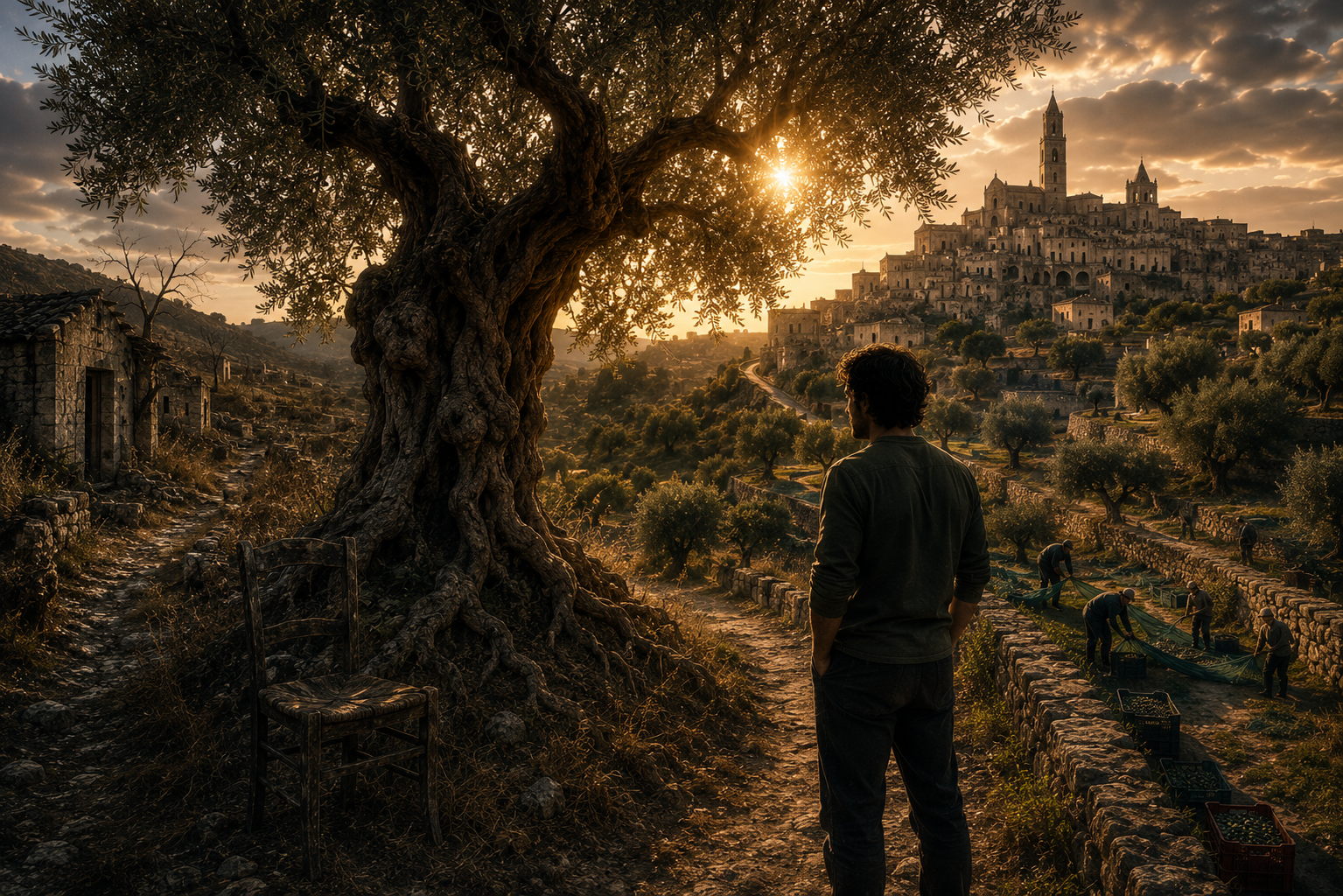
We visit places that seem novel and even nostalgic because they preserve old things, and then there are old things and places that still teach us about ourselves. Matera, Italy is the second kind of “old.”
Matera’s stone houses, rupestrian churches, cisterns, paths, ovens, courtyards, and farms have survived not because history placed them in a big museum, but because generation after generation kept using them, repairing them, praying in them, arguing in them, feeding children in them, and beginning again inside and around them. Matera has never been only a landscape, except for in movie scenes. Matera, and in many ways the whole Italian peninsula, exists as an agreement between humans and the land: take what is needed, waste little, remember who came before you, and leave something living for those who will follow.
That agreement can be read in the stone, as most tourists are invited to discover. More importantly though, it can also be read in the olive tree. The olive tree breathes at its own pace in communion with its place. It asks a person to think prospectively - beyond the season, past the market, and usually well beyond his own lifetime. The olive tree may very well outlive the farmer who planted it, the children who first gathered beneath it, and the family who pressed its fruit. Its trunk carries injury without surrendering its purpose; it twists around drought and pruning and fire and wind and neglect and time, and then returns with silver leaves and fruit. An olive tree is never merely an agricultural crop. It is a collection of memories with roots.
Earlier this month a film crew came to Matera to record an episode about olive oil as part of an installment of an Italian series that travels the country looking for the people who quietly keep its inheritance alive. The series carries a title that could serve as this week's whole meditation: Visioni - Oltre ciò che vedi. Visions - Beyond What You See. The filming shifted its focus to a central element of Mediterranean culture: extra virgin olive oil, as a sign of belonging, shared history, and social life. It is from this perspective that the episode builds its story.
The Sunday Table carries a similar idea about the Sunday Table itself - as a place of shared identity and belonging. This week’s Sunday Table carries discipline, beyond what you can see through the strengths of prudence and discretion. Prudence is the strength to see what is actually true rather than what is merely visibly apparent: beyond the selfie or the instagram post, beyond the market price or the brand, and beyond what most people at the table have already agreed to see. Among the people the cameras found there and we present here is friend, Andrea Aldo Capozza, a twenty-seven-year-old entrepreneur and olive-oil sommelier.
His story, as he tells it, is a Stand Alone story. He had already made a career in real estate across Basilicata and Calabria. He enjoyed a career that was working for him, by every measure the world recognizes. Yet he stopped, because he had come to believe that the future runs through the protection of Italy's agricultural and cultural inheritance, and that belief would not keep him awake at night. His sharing that decision mirrors the main theme for this week, Stand Alone, which arranges our lives into the service of a larger design.
Read that sentence again, because it is the architecture of a whole human life in a single clause. The skills remain as does the competence. The years of doing the thing well are not repudiated. They are simply demoted from being the point to being the instrument placed underneath something larger and worth surrendering to a vocation that was meant only for you. That is what it looks like when a man stops working for his own résumé and puts his résumé to work. His interest, tellingly, did not start in a nostalgic romance as a would-be prince of agritourism. It began in the study of plant fibers and hemp for industrial use, and moved from there toward the olive. So he arrived at the tree by way of structural knowledge rather than nostalgia. That matters because he was pulled by a trained eye that turned and saw something that others may have been driving past; he was not longing for an imagined past.
To a conventional eye, an abandoned grove looks like an underperforming asset: uncultivated land, unrealized production, neglected property. To the Builder at Work, it looks like an Empty Chair. Something is still present, but the authority to care for it has disappeared. The trees are still standing. The terraces remain, as do the old paths remain. Much is intact, except for the weakened human relationship that once held them all together. The architecture has not vanished; it has become unattended. An unattended thing does not stay neutral for long; it is simply waiting to learn whether someone will come back for it, or whether someone else will arrive to strip it.
Andrea's work, which I will refer to as uliviculture (ulivicoltura), treats the recovery of these groves as something other than a commodity market opportunity. In his account they are a historical and landscape inheritance to be preserved and passed on, where every olive tree is holding a story, a legacy handed down, a visible sign of the long relationship between a people and their ground - and only an olive tree whisperer, like Andrea can hear the story waiting to be told. The oil matters of course, but the oil is not the mission. The larger work is to return abandoned land to belonging, and to make the region's inheritance visible without turning it into social media scenery, which is why his model deliberately refuses to stay inside agriculture, and reaches across farming, tourism, property, and culture as one connected thing: uliviculture.
That distinction is significant in a place such as Matera, because this city knows exactly what happens when a living place is reduced to an image. Millions now recognize the Sassi from photographs and films: the view across the Murgia, the stone stairways, the cave interiors, the skyline at sunset. Yet a city can be seen everywhere and remain entirely misunderstood. The same is true of olive oil. It can sit on tables across the world, poured from a beautiful bottle with an artistic label, while the person pouring knows nothing of the tree, the soil, the family, the harvest, the mill, or the patient soulful human labor held inside it.
A commodity hides a relationship and a sacrament reveals it. Olive oil is not a sacrament in the strict theological sense, but Mediterranean Christianity has always understood its sacramental quality. Oil runs all through Scripture as food, medicine, light, consecration, hospitality, healing, abundance, burial, and blessing. It feeds the household and lights the sanctuary. It marks kings, priests, prophets, the sick, and the newly baptized. The word Christ itself points to the Anointed One.
So the olive tree stands very close to the Sunday Table. Bread and oil may be the simplest meal, but simplicity is not emptiness. The bread carries wheat, weather, mill, oven, hands, and hunger. The oil carries tree, root, stone, sun, harvest, pressing, patience, and time. Together they make visible the one truth a table exists to teach: that no one feeds himself alone. At the Sunday Table the oil is not a garnish. It is testimony. It says that formation takes time, that fruit depends on roots, that what looks ordinary may hold the labor of generations, and that nourishment is not manufactured at the moment of consumption. Long before the bottle was opened, someone planted, pruned, waited, gathered, carried, pressed, protected, and preserved.
The most quietly radical part of Adreas's olive tree whisperer work may be the tasting. He treats it, by his own description, as a tool for building awareness. Sharing the complexity of the olive in a way that anyone can recognize what separates a great oil from a merely ordinary one, in language plain enough that no one needs credentials to follow it. The point he insists on is the one that gives the whole thing away: tasting is a gesture of knowledge, not an exercise reserved for a few. A gesture can be universally known, and thus revered for its simplicity and complexity at the same time. That is discernment, at a table, with a spoon in your hand and it is being deliberately handed to everybody rather than hoarded by experts. He describes the sommelier's (Olive Tree Whispers) real work as going beyond technique altogether: to become an interpreter of a territory, giving back its history, its landscape, the labor of its farmers, the culture folded into every bottle.
The oil cannot explain itself to a hurried person; it must be attended to. So does a human being. And so, it turns out, does a decision.
There is one more piece of Andea's vision, and it is the one that reaches across the ocean and into the soul of UMANIAMOⓇ. He speaks about wanting to help Italians living abroad come back and to accompany anyone who wants to choose Italy as the place to build their tomorrow. As many of you know, I returned to the region of my ancestors, Basilicata, and live in Matera. UMANIAMOⓇ was conceived in West Virginia and born in Matera in an ancient cathedral complex on the Street of Redemption. The words that breathed life into UMANIAMOⓇ, were “bring my people together.”
Perhaps like Andrea, that message to me didn’t mean recruiting Italian Americans and handing them an itinerary and practical information, but by building a real connection between the person arriving and the ground they are arriving on: a genuine cultural experience rather than a transaction. As the current President of the Order Sons and Daughters of Italy in America (OSDIA) for the West Virginia Grand Lodge, Andrea’s invitation to wanting to help may have arrived providentially as prudence and discretion have slowly brought these messages together.
As Italian Americans, our homeland calls and sometimes that call is in the senses - perhaps a taste or smell or feeling. As one Italian elder once shared with me, your “blood knows when you are home.” That home may be in the taste of the olive oil. Most Italian Americans I know visit Italy as tourists and find the place captivating and strangely familiar. Those that arrive or return as pilgrims, visit the villages often of their ancestors, looking for something deeper yet not having an idea of how to walk the streets without romanticizing, intruding, or reducing an inheritance to a selfie.
A pilgrimage invitation rooted in restored olive groves offers another kind of return. Not sightseeing but Participation. Imagine Italian-American families helping recover a grove in the Materan landscape; or students learning how olive trees are pruned and harvested while also hearing the stories of the migration that emptied that countryside in the first place. Imagine a restored rural property becoming a place of hospitality, education, reflection, and exchange. Imagine descendants abroad contributing to a living landscape that keeps feeding local families and welcoming those who come back in good faith. That is more than heritage tourism, it is a reunion; and perhaps is the greatest demonstration of the rise of humanity in the face of tyranny. Where the sin is abandoning our shared heritage and responsibility for someone else’s touristy Instagram story.
The invitation of UMANIAMOⓇ and Andrea’s bridge between people and places honors the deeper purpose of organizations like OSDIA, because as I have found, cultural preservation is not accomplished by remembering and recording what Italians once did; it is lived by helping Italians and Italian Americans participate in the living and ever evolving unwritten history to be carried forward now. The olive trees make that invitation visible. So Andrea Aldo Capozza's forgotten olive trees are not forgotten at all. They have been waiting for someone to recognize that abandonment is not the same as extinction. Waiting for a generation willing to see an inheritance as a sacred responsibility. Waiting for the hands ready to clear the ground, tend the roots, read the season, and take part in a harvest that began long before you were born. Maybe they are waiting for you (U).
Follow Andrea on Instagram: https://www.instagram.com/olioserio/
Learn more about OSDIA
Visitiamo luoghi che ci sembrano nuovi e persino nostalgici perché conservano cose antiche, e poi ci sono cose e luoghi antichi che continuano a insegnarci qualcosa su noi stessi. Matera, in Italia, appartiene a questa seconda categoria di “antico”.
Le case in pietra di Matera, le chiese rupestri, le cisterne, i sentieri, i forni, i cortili e le fattorie sono sopravvissuti non perché la storia li abbia collocati in un grande museo, ma perché generazione dopo generazione si è continuato a usarli, a ripararli, a pregare al loro interno, a litigare al loro interno, a nutrire i bambini al loro interno e a ricominciare da capo al loro interno e attorno a essi. Matera non è mai stata solo un paesaggio, se non nelle scene dei film. Matera, e per molti versi l’intera penisola italiana, esiste come un patto tra gli esseri umani e la terra: prendi ciò che ti serve, spreca poco, ricorda chi ti ha preceduto e lascia qualcosa di vivo per chi verrà dopo di te.
Quel patto si legge nella pietra, come la maggior parte dei turisti è invitata a scoprire. Ma, cosa ancora più importante, si legge anche nell’ulivo. L’ulivo respira al proprio ritmo, in comunione con il luogo in cui si trova. Chiede all’uomo di pensare in prospettiva – al di là della stagione, oltre il mercato e, di solito, ben oltre la propria vita. L’olivo potrebbe benissimo sopravvivere al contadino che lo ha piantato, ai bambini che per primi si sono radunati sotto di esso e alla famiglia che ne ha spremuto i frutti. Il suo tronco sopporta le ferite senza rinunciare al proprio scopo; si contorce affrontando siccità, potature, incendi, vento, abbandono e il tempo, per poi tornare con foglie argentate e frutti. Un ulivo non è mai solo una coltura agricola. È un insieme di ricordi con radici.
All’inizio di questo mese una troupe cinematografica è venuta a Matera per girare un episodio sull’olio d’oliva nell’ambito di una serie italiana che viaggia per il Paese alla ricerca delle persone che, in silenzio, mantengono vivo il suo patrimonio. La serie porta un titolo che potrebbe fungere da meditazione per l’intera settimana: Visioni - Oltre ciò che vedi. Visioni - Oltre ciò che vedi. Le riprese hanno spostato l’attenzione su un elemento centrale della cultura mediterranea: l’olio extravergine di oliva, come segno di appartenenza, storia condivisa e vita sociale. È da questa prospettiva che la puntata costruisce la sua storia.
La «Mensa della Domenica» veicola un’idea simile riguardo alla mensa stessa – come luogo di identità condivisa e di appartenenza. La «Mensa della Domenica» di questa settimana incarna la disciplina, al di là di ciò che si può vedere, attraverso le virtù della prudenza e della discrezione. La prudenza è la forza di vedere ciò che è realmente vero piuttosto che ciò che è semplicemente visibile: al di là del selfie o del post su Instagram, al di là del prezzo di mercato o del marchio, e al di là di ciò che la maggior parte delle persone a tavola ha già accettato di vedere. Tra le persone che le telecamere hanno ripreso lì e che vi presentiamo qui c’è il nostro amico Andrea Aldo Capozza, un imprenditore ventisettenne e sommelier dell’olio d’oliva.
La sua storia, così come la racconta lui stesso, è una storia “a sé stante”. Si era già fatto una carriera nel settore immobiliare tra la Basilicata e la Calabria. Godeva di una carriera che funzionava per lui, secondo ogni metro di valutazione riconosciuto dal mondo. Eppure si è fermato, perché era giunto a credere che il futuro passi attraverso la tutela del patrimonio agricolo e culturale italiano, e quella convinzione non gli avrebbe tolto il sonno. Il fatto che abbia condiviso questa decisione rispecchia il tema principale di questa settimana, Stand Alone, che organizza le nostre vite al servizio di un disegno più ampio.
Rileggete quella frase, perché racchiude l’architettura di un’intera vita umana in una sola proposizione. Le abilità rimangono, così come la competenza. Gli anni passati a fare bene il proprio lavoro non vengono rinnegati. Vengono semplicemente declassati da “scopo” a strumento posto al servizio di qualcosa di più grande, a cui vale la pena dedicarsi per una vocazione destinata solo a te. È così che appare quando un uomo smette di lavorare per il proprio curriculum e mette invece il proprio curriculum al servizio di qualcosa di più grande. Il suo interesse, significativamente, non è nato da un romanticismo nostalgico da aspirante principe dell’agriturismo.
È nato dallo studio delle fibre vegetali e della canapa per uso industriale, per poi spostarsi da lì verso l’olivo. È così che è giunto all’albero attraverso una conoscenza strutturale piuttosto che per nostalgia. Questo è importante perché è stato attratto da un occhio esperto che si è voltato e ha visto qualcosa che altri avrebbero potuto ignorare passando in auto; non stava rimpiangendo un passato immaginario.
A un occhio convenzionale, un uliveto abbandonato appare come un bene sottoutilizzato: terra incolta, produzione non realizzata, proprietà trascurata. Per il Costruttore all’opera, sembra una Sedia Vuota. Qualcosa è ancora presente, ma l’autorità che se ne prendeva cura è scomparsa. Gli alberi sono ancora in piedi. I terrazzamenti rimangono, così come i vecchi sentieri. Molto è intatto, tranne il rapporto umano ormai indebolito che un tempo teneva insieme il tutto. L’architettura non è svanita; è stata semplicemente abbandonata. Una cosa abbandonata non rimane neutra a lungo; sta semplicemente aspettando di sapere se qualcuno tornerà a prendersene cura, o se qualcun altro arriverà per spogliarla.
Il lavoro di Andrea, che chiamerò ulivicoltura, considera il recupero di questi uliveti come qualcosa di diverso da un’opportunità di mercato. Nella sua visione, essi costituiscono un’eredità storica e paesaggistica da preservare e tramandare, dove ogni ulivo custodisce una storia, un’eredità tramandata, un segno visibile del lungo rapporto tra un popolo e la propria terra – e solo un «sussurratore di ulivi», come Andrea, può ascoltare la storia che attende di essere raccontata. L’olio è importante, naturalmente, ma non è la missione. Il compito più ampio è restituire un senso di appartenenza alla terra abbandonata e rendere visibile il patrimonio della regione senza trasformarlo in uno scenario per i social media; ecco perché il suo modello rifiuta deliberatamente di limitarsi all’agricoltura, abbracciando invece agricoltura, turismo, proprietà immobiliare e cultura come un unico insieme interconnesso: l’ulivicoltura.
Questa distinzione è significativa in un luogo come Matera, perché questa città sa esattamente cosa succede quando un luogo vivo viene ridotto a un’immagine. Milioni di persone oggi riconoscono i Sassi grazie a fotografie e film: la vista sulla Murgia, le scalinate di pietra, gli interni delle grotte, lo skyline al tramonto. Eppure una città può essere vista ovunque e rimanere del tutto fraintesa. Lo stesso vale per l’olio d’oliva. Può trovarsi sulle tavole di tutto il mondo, versato da una bella bottiglia con un’etichetta artistica, mentre chi lo versa non sa nulla dell’albero, del terreno, della famiglia, della raccolta, del frantoio o del paziente e appassionato lavoro umano racchiuso in esso.
Una merce nasconde una relazione, mentre un sacramento la rivela. L’olio d’oliva non è un sacramento nel senso teologico stretto, ma il cristianesimo mediterraneo ne ha sempre compreso la qualità sacramentale. L’olio attraversa tutta la Scrittura come cibo, medicina, luce, consacrazione, ospitalità, guarigione, abbondanza, sepoltura e benedizione. Nutre la famiglia e illumina il santuario. Contrassegna re, sacerdoti, profeti, malati e i neo-battezzati. La stessa parola Cristorimanda all’Unto.
Così l’olivo è molto vicino alla tavola domenicale. Pane e olio possono costituire il pasto più semplice, ma la semplicità non è vuoto. Il pane racchiude il grano, il clima, il mulino, il forno, le mani e la fame. L’olio racchiude l’albero, la radice, la pietra, il sole, il raccolto, la spremitura, la pazienza e il tempo. Insieme rendono visibile l’unica verità che una tavola esiste per insegnare: che nessuno si nutre da solo. Alla tavola domenicale l’olio non è un contorno. È una testimonianza. Ci dice che la formazione richiede tempo, che il frutto dipende dalle radici, che ciò che sembra ordinario può racchiudere il lavoro di generazioni e che il nutrimento non viene prodotto al momento del consumo. Molto prima che la bottiglia venisse aperta, qualcuno ha piantato, potato, atteso, raccolto, trasportato, spremuto, protetto e conservato.
La parte più silenziosamente radicale del lavoro di Andreas come «sussurratore di ulivi» potrebbe essere proprio la degustazione. Egli la considera, secondo la sua stessa descrizione, uno strumento per sviluppare la consapevolezza. Condivide la complessità dell’oliva in modo tale che chiunque possa riconoscere ciò che distingue un ottimo olio da uno semplicemente ordinario, con un linguaggio così semplice che nessuno ha bisogno di credenziali per seguirlo. Il punto su cui insiste è proprio quello che svela il tutto: la degustazione è un gesto di conoscenza, non un esercizio riservato a pochi. Un gesto può essere universalmente conosciuto, e quindi venerato per la sua semplicità e complessità allo stesso tempo. Questo è discernimento, a tavola, con un cucchiaio in mano, e viene deliberatamente offerto a tutti anziché essere accaparrato dagli esperti. Egli descrive il vero lavoro del sommelier (Olive Tree Whispers) come qualcosa che va ben oltre la tecnica: diventare un interprete di un territorio, restituendone la storia, il paesaggio, il lavoro dei suoi agricoltori, la cultura racchiusa in ogni bottiglia.
L’olio non può spiegarsi da solo a una persona di fretta; bisogna prestargli attenzione. Lo stesso vale per un essere umano. E, a quanto pare, lo stesso vale per una decisione.
C’è un altro aspetto della visione di Andea, ed è quello che attraversa l’oceano e arriva all’anima di UMANIAMOⓇ. Parla del desiderio di aiutare gli italiani che vivono all’estero a tornare e di accompagnare chiunque voglia scegliere l’Italia come luogo in cui costruire il proprio domani. Come molti di voi sanno, sono tornato nella regione dei miei antenati, la Basilicata, e vivo a Matera. UMANIAMOⓇ è stato concepito in West Virginia ed è nato a Matera in un antico complesso cattedrale sulla Via della Redenzione. Le parole che hanno dato vita a UMANIAMOⓇ sono state «riunire la mia gente».
Forse, come per Andrea, quel messaggio per me non significava reclutare italo-americani e fornire loro un itinerario e informazioni pratiche, ma creare un legame autentico tra la persona che arriva e il territorio in cui atterra: un’esperienza culturale genuina piuttosto che una semplice transazione. In qualità di attuale presidente dell’Ordine Figli e Figlie d’Italia in America per la Gran Loggia del West Virginia, l’invito di Andrea a voler dare una mano potrebbe essere arrivato provvidenzialmente, poiché la prudenza e la discrezione hanno lentamente fatto convergere questi messaggi.
Come italo-americani, la nostra patria ci chiama e a volte quella chiamata risuona nei sensi – forse in un sapore, in un odore o in una sensazione. Come mi ha confidato una volta un anziano italiano, «il sangue sa quando sei a casa». Quella casa potrebbe risiedere nel sapore dell’olio d’oliva. La maggior parte degli italo-americani che conosco visita l’Italia come turista e trova il luogo affascinante e stranamente familiare. Coloro che arrivano o tornano come pellegrini, spesso visitano i villaggi dei propri antenati, alla ricerca di qualcosa di più profondo, pur non avendo idea di come percorrere le strade senza idealizzare, invadere o ridurre un’eredità a un semplice selfie.
Un invito al pellegrinaggio radicato in uliveti riportati a nuova vita offre un altro tipo di ritorno. Non turismo, ma partecipazione. Immaginate famiglie italo-americane che aiutano a recuperare un uliveto nel paesaggio materano; o studenti che imparano come si potano e si raccolgono le olive, ascoltando al contempo le storie dell’emigrazione che ha svuotato quella campagna in primo luogo. Immaginate una proprietà rurale riportata a nuova vita che diventi un luogo di ospitalità, educazione, riflessione e scambio. Immaginate i discendenti all’estero che contribuiscono a un paesaggio vivo che continua a sfamare le famiglie locali e ad accogliere chi torna in buona fede. Questo è più che turismo del patrimonio, è una riunione; ed è forse la più grande dimostrazione dell’ascesa dell’umanità di fronte alla tirannia. Dove il peccato è abbandonare il nostro patrimonio condiviso e la nostra responsabilità per la storia turistica su Instagram di qualcun altro.
L’invito di UMANIAMOⓇ e il ponte che Andrea getta tra persone e luoghi onorano lo scopo più profondo di organizzazioni come OSDIA, perché, come ho scoperto, la conservazione culturale non si realizza ricordando e documentando ciò che gli italiani facevano un tempo; si vive aiutando gli italiani e gli italo-americani a partecipare alla storia non scritta, viva e in continua evoluzione, da portare avanti oggi. Gli ulivi rendono visibile quell’invito. Quindi gli ulivi dimenticati di Andrea Aldo Capozza non sono affatto dimenticati. Stanno aspettando che qualcuno riconosca che l’abbandono non equivale all’estinzione. Aspettano una generazione disposta a vedere un’eredità come una responsabilità sacra. Aspettano mani pronte a ripulire il terreno, a curare le radici, a interpretare le stagioni e a partecipare a una raccolta iniziata molto prima che tu nascessi. Forse stanno aspettando proprio te (U).
Segui Andrea su Instagram: https://www.instagram.com/olioserio/
Scopri di più su OSDIA
Your tax deductible donation supports a living heritage.
Prudence & DIscretion
This week we invite you to engage not only with the ideas of Humility, but the actions that create these aspects of Humaning.
You may choose one or both of the following practices depending on your setting, time, and relationships.
The Table Discussion is a relaxed and relational conversation designed to help people reflect honestly on the week's REDISCOVER UⓇ theme and the realities of everyday life. It is a shared conversation among family and friends seeking to remain present to one another. The table discussion is not a debate or lesson, it's a discussion of being human together.
After the meal, coffee, or shared gathering:
Read the REDISCOVER UⓇ card and the reflections aloud
Move through the discussion prompts naturally
Allow the conversation to unfold without rushing
Some discussions may be lighthearted, and others may become deeply reflective. It's up to you.
The Humaning Circle is a more intentional relational practice inspired by the spirit of a prayer circle, conversation circle, or community gathering.
Place the REDISCOVER UⓇ card at the center of the table or view the digital card, then invite each person to quietly reflect on the theme together before sharing.
Begin with one slow shared breath and a brief moment of silence.
The Humaning Circle encourages:
DEEP listening
Honest reflection
Relational courage
Shared presence
Each week we pick up one card and turn it to the light. This week's is Prudence and Discretion and both words have been diluted and averaged, until between them they seem to describe a person who is afraid to do just about anything at all. However, this is the powerful REDISCOVER U® strength leading to discernment, the one that governs all the others. In the older latin language it is “discretio,” or the power to make distinctions, which has the same root as discernment, which historically was a mother of the virtues, the one that keeps all the rest of us from running off a cliff. Here’s its edge and the reason it belongs to a week called Stand Alone: real discernment is not the confidence to trust your “feelings” it is the prudence to question them. A feeling can be counterfeited, which we discussed last week. An open consoling feeling can wash over you and in seconds and then leave you feeling alone and isolated. It’s like winning a trophy that you know was not earned. Prudence is what tests the feeling first but puts on the brakes and what waits to judge a thing by its fruit, over time, rather than by how good it felt in the moment.
So when you pick up this card or read the digital copy, notice what moves in you. Does it open into a quiet yes, a recognition that you already carry this, that you can see a room clearly and are not ruled by it? Then it is a strength already alive in you; steward it. Does it ache like a pang, a grief, from spending my life reading the room and calling it wisdom, waiting for permission I never gave myself? Then it is the buried one, asking to be lived. Or does it stay quiet and neutral real, but not your center? Honor it, and keep moving. The prudent move is not to hesitate. It is to see truly, test the pull, and then when it is time to act, do something.
This week’s theme is about standing alone: the courage to see what is true and act on it before the room has agreed. Bring it to your own table, and let the questions move from the room, to the reading, to the standing.
Where in your life are you reading the room and waiting to see what everyone else thinks before you'll say what you already know? What are you calling that habit? Prudence? Patience? Peace?
Think of a time you felt sure about something and it turned out you were wrong yet the feeling was strong, and it lied. What would it look like to test a strong pull this week instead of simply trusting it?
Is there something you have been calling hope that, told honestly, still leaves you contracted every time you return to it? What would change if you named it truthfully?
Where is God inviting you to stand before anyone else has? Not to be right, not to be seen, but to make visible something a whole room already believes and is waiting for someone to go first on.
Sunday Table Invitation. Make sure the quiet ones get to speak: the children, the teenagers, the person on the edge of the table. Standing alone is easier to talk about than to do, and the table is where we practice it in miniature: saying the true thing among people who will listen.
Pro Tip: If young people are present, offer them a notebook and one question to carry: When was a time you knew something was right or wrong, but stayed quiet because of what others might think, and what helped you, or would have helped you, to stand?
Humaning is something we do together, and then carry out the door. This week the circle practices the two halves of discretion, telling a true reading from a counterfeit one, and finding the courage to stand on it. Gather a few people and take it slowly.
First, go around once. Each person names, briefly and honestly, one place they are currently waiting for the room, a truth they can see but have not yet stood up for, at work, at home, in themselves. No fixing, no advice. Just naming it aloud, which is already the first small act of standing.
Then go around again, and test one pull together. Invite one person to name a strong feeling they've been trusting such as a yes or a no they're sure of. As a circle, help them trace it the way discernment does: not how strong is it, but where does it lead? Does following it make them larger or smaller, freer or more alone, more themselves or less? You are not deciding for them. You are practicing, out loud, the prudence of questioning a reading instead of obeying it.
Then close with a single question, and let each person answer aloud: Before we gather again, what is one thing I can see clearly that I will stop waiting for permission to act on?
Because a room full of people who all privately agree and none will say it is the most common loneliness there is and it breaks the moment one person stands. The table has done its work when someone leaves it willing to be first: to see truly, test the pull, and rise while the room is still seated, so that others can remember what they already knew.
End however your circle ends with a prayer, a blessing, a shared silence. Then go gently, and when it is time, stand.
Ad maiorem Dei gloriam. We are human together, or not at all.
Prudenza e discrezione
Questa settimana vi invitiamo a confrontarvi non solo con i concetti di umiltà, ma anche con le azioni che danno vita a questi aspetti dell’“Humaning”.
Potete scegliere una o entrambe le seguenti pratiche a seconda del contesto, del tempo a disposizione e delle relazioni che intrattenete.
La discussione a tavola è una conversazione informale e incentrata sulle relazioni, pensata per aiutare le persone a riflettere con sincerità sul tema REDISCOVER UⓇ della settimana e sulle realtà della vita quotidiana. È una conversazione condivisa tra familiari e amici che cercano di rimanere presenti gli uni agli altri. La discussione a tavola non è un dibattito né una lezione, ma una riflessione sull’essere umani insieme.
Dopo il pasto, il caffè o un momento di ritrovo in compagnia:
Leggete ad alta voce la scheda REDISCOVER UⓇ e le riflessioni
Passate naturalmente da un spunto di discussione all’altro
Lasciate che la conversazione si sviluppi senza fretta
Alcune discussioni potrebbero essere spensierate, mentre altre potrebbero diventare profondamente riflessive. Dipende da voi.
Il cerchio dell’essere umani è una pratica relazionale più intenzionale, ispirata allo spirito di un cerchio di preghiera, di conversazione o di incontro comunitario.
Posizionate la scheda REDISCOVER UⓇ al centro del tavolo o visualizzate la scheda digitale, quindi invitate ogni persona a riflettere in silenzio sul tema insieme prima di condividere le proprie riflessioni.
Iniziate con un respiro lento e condiviso e un breve momento di silenzio.
Il Circolo dell’Umanità incoraggia:
L’ascolto PROFONDO
La riflessione onesta
Il coraggio relazionale
La presenza condivisa
Ogni settimana prendiamo una carta e la giriamo verso la luce. Quella di questa settimana è Prudenza e discrezione ed entrambe le parole sono state indebolite e banalizzate, al punto che, insieme, sembrano descrivere una persona che ha paura di fare praticamente qualsiasi cosa. Tuttavia, questa è la potente forza di REDISCOVER U® che conduce al discernimento, quella che governa tutte le altre. Nel latino antico si chiama “discretio”, ovvero il potere di operare distinzioni, che ha la stessa radice del termine “discernimento”, storicamente considerato la madre delle virtù, quella che impedisce a tutti noi di precipitare da un dirupo. Ecco il suo punto di forza e il motivo per cui appartiene a una settimana chiamata “Stand Alone”: il vero discernimento non è la sicurezza di fidarsi dei propri “sentimenti”, ma la prudenza di metterli in discussione. Un sentimento può essere contraffatto, come abbiamo discusso la settimana scorsa. Una sensazione aperta e consolatoria può travolgerti in pochi secondi per poi lasciarti solo e isolato. È come vincere un trofeo che sai di non esserti guadagnato. La prudenza è ciò che prima mette alla prova quella sensazione, ma poi frena, ed è ciò che aspetta di giudicare una cosa dai suoi frutti, nel tempo, piuttosto che da quanto ti ha fatto sentire bene in quel momento.
Quindi, quando prendi in mano questa carta o ne leggi la versione digitale, nota cosa si muove dentro di te. Si apre in un sì tranquillo, nel riconoscimento che questo lo porti già dentro di te, che riesci a vedere chiaramente una situazione senza esserne dominato? Allora è una forza già viva in te; custodiscila. Ti fa male come una fitta, un dolore, per aver passato la vita a leggere l’atmosfera e a chiamarla saggezza, aspettando un permesso che non ti sei mai concesso? Allora è quella sepolta, che chiede di essere vissuta. Oppure rimane tranquilla e neutrale, reale, ma non è il tuo centro? Onoralo e continua ad andare avanti. La mossa prudente non è esitare. È vedere con chiarezza, mettere alla prova l’impulso e poi, quando è il momento di agire, fare qualcosa.
Il tema di questa settimana riguarda lo stare da soli: il coraggio di vedere ciò che è vero e agire di conseguenza prima che la stanza sia d’accordo. Portalo al tuo tavolo e lascia che le domande passino dalla stanza, alla lettura, allo stare da soli.
In quali ambiti della tua vita stai leggendo l’atmosfera e aspetti di vedere cosa pensano gli altri prima di dire ciò che già sai? Come chiami quell’abitudine? Prudenza? Pazienza? Pace?
Pensa a un momento in cui eri sicuro di qualcosa e si è rivelato che avevi torto, eppure la sensazione era forte, e ti ha ingannato. Come sarebbe mettere alla prova un forte richiamo questa settimana invece di fidarti semplicemente di esso?
C’è qualcosa che hai sempre chiamato “speranza” ma che, a dirla onestamente, ti fa ancora sentire a disagio ogni volta che ci torni sopra? Cosa cambierebbe se la definissi con sincerità?
Dove ti sta invitando Dio a prendere posizione prima di chiunque altro? Non per avere ragione, non per farti notare, ma per rendere visibile qualcosa in cui tutta la stanza già crede e sta aspettando che qualcuno faccia il primo passo.
Invito alla tavola domenicale. Assicurati che chi tace possa parlare: i bambini, gli adolescenti, la persona seduta ai margini del tavolo. Prendere posizione da soli è più facile a dirsi che a farsi, e la tavola è il luogo dove lo mettiamo in pratica in miniatura: dire la verità tra persone disposte ad ascoltare.
Consiglio da esperto: Se sono presenti dei giovani, offri loro un taccuino e una domanda da portare con sé: Quando è stata l’ultima volta che sapevi che qualcosa era giusto o sbagliato, ma sei rimasto in silenzio per paura del giudizio degli altri, e cosa ti ha aiutato, o ti avrebbe aiutato, a prendere posizione?
Essere umani è qualcosa che facciamo insieme, e poi portiamo fuori dalla porta. Questa settimana il cerchio si esercita nelle due facce della discrezione: distinguere una lettura vera da una falsa, e trovare il coraggio di sostenerla. Raduna alcune persone e procedi con calma.
Per prima cosa, fate un giro di tavolo. Ogni persona nomini, brevemente e onestamente, un ambito in cui sta attualmente aspettando il momento giusto, una verità che vede ma per la quale non ha ancora preso posizione, al lavoro, a casa, dentro di sé. Niente soluzioni, niente consigli. Basta nominarla ad alta voce, il che è già il primo piccolo atto di presa di posizione.
Poi fate un altro giro e mettete alla prova insieme una di queste intuizioni. Invitate una persona a esprimere un sentimento forte di cui si fida, come un «sì» o un «no» di cui è certa. Come cerchio, aiutatela a seguirne il percorso come fa il discernimento: non quanto è forte, ma dove conduce? Seguirlo la rende più grande o più piccola, più libera o più sola, più se stessa o meno? Non state decidendo al posto suo. State mettendo in pratica, ad alta voce, la prudenza di mettere in discussione un’intuizione invece di obbedirle.
Concludete poi con un’unica domanda, e lasciate che ogni persona risponda ad alta voce: prima di ritrovarci di nuovo, qual è una cosa che vedo chiaramente e per la quale smetterò di aspettare il permesso di agire?
Perché una stanza piena di persone che sono tutte d’accordo tra loro ma nessuna lo dice è la solitudine più comune che esista, e si spezza nel momento in cui una persona si alza. Il tavolo ha svolto il suo compito quando qualcuno lo lascia disposto a essere il primo: a vedere veramente, a mettere alla prova l’impulso e ad alzarsi mentre la sala è ancora seduta, affinché gli altri possano ricordare ciò che già sapevano.
Concludete comunque il vostro cerchio con una preghiera, una benedizione, un silenzio condiviso. Poi andate con dolcezza e, quando sarà il momento, alzatevi.
Ad maiorem Dei gloriam. Siamo umani insieme, oppure non lo siamo affatto.
Cosiamo | Founder, UMANIAMO® | Humaning Architecture
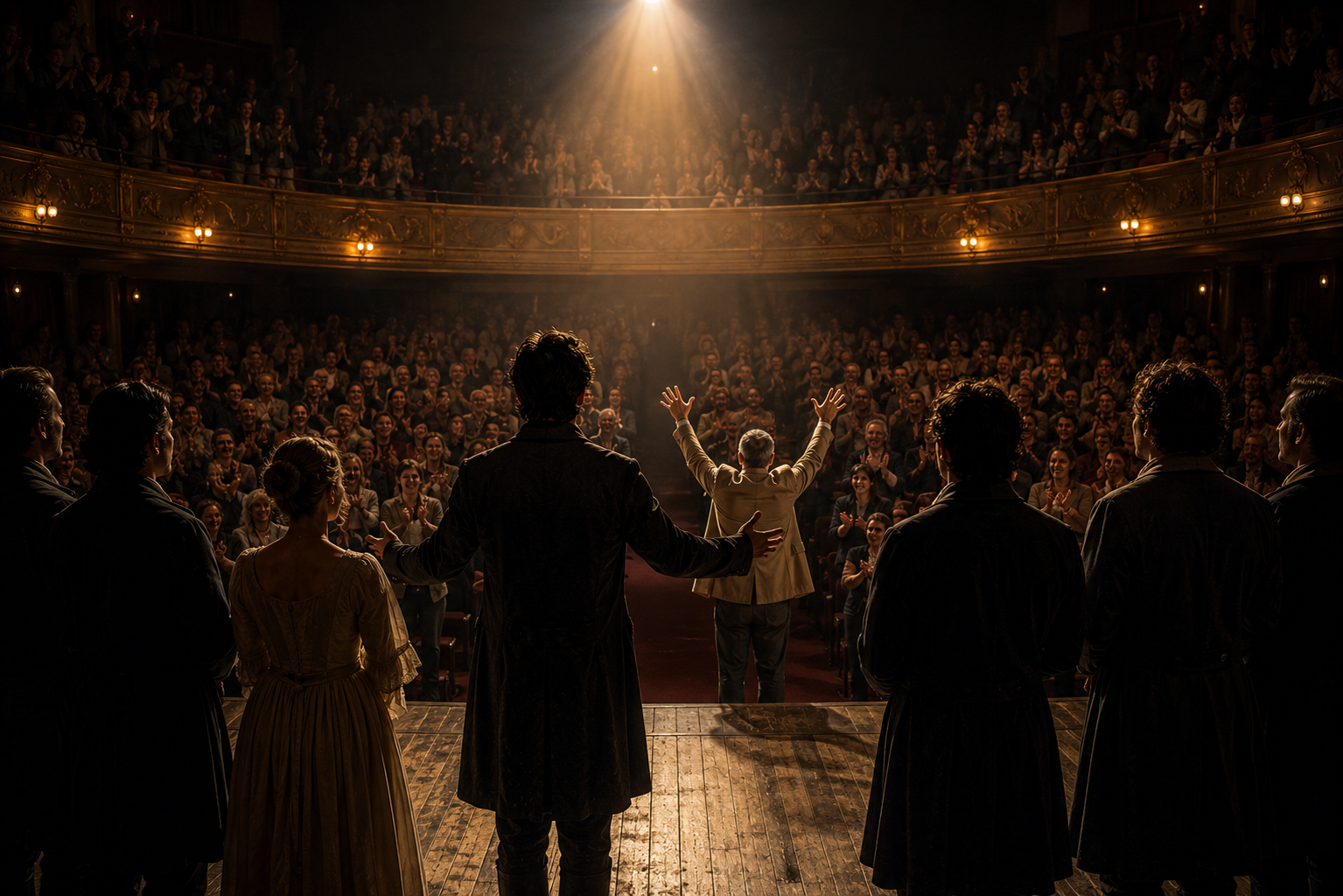
Some of what we know about being human does not come from the people who study it. It comes from the people who stand in front of a dark room and give something away, night after night, without any guarantee it will be received. Our guest this week spent several years on the musical theatre stage, which means he spent several years doing the thing most of us arrange our lives to avoid: standing exposed under the lights, having offered everything he had, and then waiting in silence to find out whether it landed. That is not a performer's problem. That is the human condition with a spotlight on it. He noticed something from that stage that the audience will never see and it turns out to be exactly what this week is about. The story below is his.
Every actor knows the curtain call carries a strange mixture of relief, exhaustion, and uncertainty. The story has been told, and the lights dim. You stand together looking out into a darkness you cannot quite see into, waiting to learn whether the performance you gave actually mattered. His company received a standing ovation every single night so reliably that the applause began to feel almost automatic, the way a thing can be genuinely good and still become a routine, on both sides of the lights. Until one evening, when it very nearly didn't happen at all.
The applause came. Some people stood right away. But roughly forty percent of the house stayed seated and from the stage you notice these things. You cannot make out faces under the lights, but you can feel movement, and you can sense hesitation as clearly as enthusiasm; it wasn’t silence or disapproval. It was something more familiar than either: people were waiting. Waiting to see what the other people in the room would do. They were waiting for permission. Waiting until standing was the safe and obvious thing rather than a decision anyone had to make.
Then a man in the front row stood up, turned his back on the stage to face the rest of the audience, threw both hands in the air, and… visibly irritated, his voice cutting straight through the applause, shouted at them. "Up! Up! Get UP!"
He was not asking. He sounded genuinely offended that anyone was still sitting down. And for a moment the entire theatre was looking at him instead of at the actors. Then one row stood. Then another. Then another. Within seconds the whole house was on its feet, and the applause turned to thunder. Our guest has thought about that night for years since, and here is what he says about it: that hard-won ovation meant more to him than every automatic one combined. Not because it was the loudest, because it wasn't free. Someone had to stand first. Someone had to risk looking foolish with his back to the stage and his hands in the air. Everyone in that theatre had appreciated the performance; only one of them was willing to make his appreciation cost something. The rest followed gladly, the moment following became possible. He barely remembers the performance now, but he remembers the man. He never learned his name, and the man himself had almost certainly forgotten the whole business before he reached the parking lot. But from the stage, one person's courage changed the temperature of an entire room.
That story is harder to hear as a charming anecdote and easier to hear as a diagnosis, because we have built an entire civilization out of the forty percent who were waiting. We wait to see what everyone else thinks. We wait for the room, the comments, the polling, the feed. We wait until a position is safe enough that holding it costs nothing. And we have learned to call this prudence, which in fact is a slander against one of the oldest virtues we have, and a convenient one, because it lets comfort wear wisdom's clothes.
This week's REDISCOVER UⓇ card is Prudence and Discretion, and both words have been gutted over time. Prudence has been reduced to hesitation, discretion to silence, until between them they seem to describe a person who never does anything at all. But neither virtue was ever meant to produce spectators. Prudence is the strength to see what is actually true… not what is popular or trending, and certainly not what the room has already decided. Discretion is knowing what belongs, and when, and to whom. Together they do not make you careful. They make you dangerous, in the way a truthful person is always slightly dangerous, because they give you the capacity to act when action is required even if nobody else has moved yet.
How many times have you heard or been told to “read the room,” ah but… The Builder at Work reads the signal of the room. Sometimes those two readings agree, and following the room is genuinely right. Sometimes they do not and everything depends on knowing which kind of moment you are standing in. That difficulty of reading the room or the signal is precisely why it cannot be reduced to a simple rule. There are times when prudence means waiting, holding your tongue, letting a thing ripen. There are other moments when prudence means standing up with your back to the stage and your hands in the air while four hundred people stare at you. The virtue is not in the waiting or the standing. The virtue is in the discerning and there is no formula or checklist to use at the moment, which is why it takes a lifetime, and why Ignatius spent months in a cave learning to tell one movement in himself from another.
The third promise of the Humaning Covenant is to encourage reflection and discernment. Each week we share the D.E.E.P.E.R. Examen as an invitation to exercise this skill. However, discernment does not end with noticing or reading the room, the signal is where discernment meets motivation. It is entirely possible to have a long term contemplative habit and to feel everything accurately, name the movement precisely, and then do nothing at all, and mistake the act of noticing as doing something. That is the forty percent, in their seats, genuinely appreciating.
For almost a year now we’ve introduced a weekly D.E.E.P.E.R. reflection in each Sunday Table. The method itself is about 500 years old spiritual technology documented by Ignatius of Loyola. The D.E.E.P.E.R. Examen or simply DEEPER is an adaptation of Ignatius’ method that has six movements: Details, Evidence, Empathy, Prospective, Execution, and Reflection. Most of us are comfortable with one or two of the DEEP parts of DEEPER such as noticing the details of what happened and perhaps who was present. We gather the Details, read the Evidence, hold the people in Empathy, glance at where it is all heading in Prospective and there we stop, because the first four can be done in a chair and they cost nothing. The last two are where it gets expensive. Execution becomes the only question that finally matters: now what? Not what I feel but what will I do, concretely, tomorrow, in a way that costs me something. And Reflection is not simply remembering; it is coming back, days and weeks later, to look honestly at what the action actually became - its impact.
That second part of Execution and Reflection is not optional, and it is definitely not sentimental. It is the test. A feeling can be counterfeited. An expansive feeling, which Ignatius called a “consolation” can arrive bathed in light and leave you smaller than it found you. But true fruitfulness cannot be faked. Ignatius's own instruction was to trace a thing's whole course from the beginning, middle, and end and to judge it by its tail rather than its face, which means you cannot know what a movement really was until you have lived it out far enough to see what it produced, inside yourself and the people around you. That is the difference between a reflective memory and a lived practice: memory looks back to identify what it felt like; the DEEPER lived practice includes what happened next. The Builder at Work does not only observe the world, he responds to it, and then goes back to see what the response actually did.
Perhaps that is how God most often works. Not by beginning with the crowd, but by beginning with one person willing to Stand Alone under the right authority before anyone else does. Not above others or against them. Just before them, so the room can remember what it already knew and had been waiting for permission to say. Sometimes the most prudent person in the room is the first one on their feet. So the question this week is simple, and it will not be simple to answer honestly: Where is God inviting you to stand before anyone else has? not to be sanctimonious or to be seen, only to make visible, at some cost to yourself, something a whole roomful of people already believe and are waiting for someone else to go first and do. You may barely remember the performance, but someone will remember you.
Ad maiorem Dei gloriam.
Parte di ciò che sappiamo sull’essere umani non proviene da chi lo studia. Proviene da chi si trova di fronte a una sala buia e offre qualcosa, sera dopo sera, senza alcuna garanzia che venga accolto. Il nostro ospite di questa settimana ha trascorso diversi anni sui palcoscenici del teatro musicale, il che significa che ha passato diversi anni a fare proprio ciò che la maggior parte di noi cerca di evitare a tutti i costi: stare lì, esposto sotto i riflettori, dopo aver offerto tutto ciò che aveva, e poi aspettare in silenzio per scoprire se il messaggio fosse arrivato. Questo non è un problema dell’artista. È la condizione umana messa sotto i riflettori. Da quel palcoscenico ha notato qualcosa che il pubblico non vedrà mai e che, a quanto pare, è esattamente il tema di questa settimana. La storia che segue è la sua.
Ogni attore sa che il saluto finale porta con sé uno strano mix di sollievo, stanchezza e incertezza. La storia è stata raccontata e le luci si abbassano. Si resta lì in piedi tutti insieme a guardare nell’oscurità di cui non si riesce a scrutare il fondo, in attesa di scoprire se lo spettacolo che avete offerto abbia davvero contato qualcosa. La sua compagnia riceveva una standing ovation ogni singola sera con tale regolarità che gli applausi cominciavano a sembrare quasi automatici, proprio come una cosa può essere davvero buona e diventare comunque una routine, da entrambe le parti delle luci. Finché una sera, quando per un soffio non è successo affatto.
Gli applausi sono arrivati. Alcune persone si sono alzate subito. Ma circa il quaranta per cento del pubblico è rimasto seduto e dal palco queste cose si notano. Non si riescono a distinguere i volti sotto le luci, ma si percepiscono i movimenti e si avverte l’esitazione con la stessa chiarezza con cui si percepisce l’entusiasmo; non era silenzio né disapprovazione. Era qualcosa di più familiare di entrambe: le persone stavano aspettando. Aspettavano di vedere cosa avrebbero fatto gli altri presenti in sala. Aspettavano il via libera. Aspettavano che alzarsi in piedi diventasse la cosa sicura e ovvia, piuttosto che una decisione che qualcuno dovesse prendere.
Poi un uomo in prima fila si alzò, voltò le spalle al palco per rivolgersi al resto del pubblico, alzò entrambe le mani in aria e… visibilmente irritato, con la voce che squarciava gli applausi, gridò loro: «In piedi! In piedi! Alzatevi!»
Non stava chiedendo. Sembrava sinceramente offeso dal fatto che qualcuno fosse ancora seduto. E per un attimo l’intero teatro guardava lui invece che gli attori. Poi una fila si alzò. Poi un’altra. Poi un’altra ancora. Nel giro di pochi secondi l’intera sala era in piedi e gli applausi si trasformarono in un fragore assordante. Il nostro ospite ha ripensato a quella serata per anni da allora, ed ecco cosa dice al riguardo: quell’ovazione conquistata a fatica significò per lui più di tutte quelle automatiche messe insieme. Non perché fosse la più fragorosa, ma perché non era gratuita. Qualcuno doveva alzarsi per primo. Qualcuno doveva rischiare di sembrare ridicolo, dando le spalle al palcoscenico e con le mani in aria. Tutti in quel teatro avevano apprezzato lo spettacolo; solo uno di loro era disposto a far sì che il proprio apprezzamento costasse qualcosa. Gli altri lo seguirono volentieri, e il momento successivo divenne possibile. Ora ricorda a malapena lo spettacolo, ma ricorda quell’uomo. Non ha mai saputo il suo nome, e l’uomo stesso aveva quasi certamente dimenticato l’intera faccenda prima di raggiungere il parcheggio. Ma dal palco, il coraggio di una sola persona ha cambiato l’atmosfera di un’intera sala.
Quella storia è più difficile da ascoltare come aneddoto affascinante e più facile da interpretare come diagnosi, perché abbiamo costruito un’intera civiltà attorno al quaranta per cento di coloro che stavano aspettando. Aspettiamo di vedere cosa ne pensano gli altri. Aspettiamo l’atmosfera della sala, i commenti, i sondaggi, i feed. Aspettiamo finché una posizione non sia abbastanza sicura da non comportare alcun costo. E abbiamo imparato a chiamarla prudenza, il che in realtà è una calunnia contro una delle virtù più antiche che abbiamo, e anche una comoda, perché permette al comfort di vestirsi con gli abiti della saggezza.
La carta REDISCOVER UⓇ di questa settimana è «Prudenza e Discrezione», ed entrambe le parole sono state svuotate di significato nel corso del tempo. La prudenza è stata ridotta a esitazione, la discrezione al silenzio, al punto che insieme sembrano descrivere una persona che non fa mai nulla. Ma nessuna delle due virtù è mai stata concepita per creare spettatori. La prudenza è la forza di vedere ciò che è realmente vero… non ciò che è popolare o di tendenza, e certamente non ciò che l’ambiente ha già deciso. La discrezione è sapere cosa è appropriato, quando e per chi. Insieme, non ti rendono cauto. Ti rendono pericoloso, nello stesso modo in cui una persona sincera è sempre un po’ pericolosa, perché ti danno la capacità di agire quando è necessario agire, anche se nessun altro si è ancora mosso.
Quante volte hai sentito dire o ti è stato detto di «leggere l’atmosfera», ah ma… Il Costruttore al Lavoro legge il segnale dell’ambiente. A volte queste due interpretazioni coincidono, e seguire l’atmosfera è davvero la cosa giusta da fare. A volte non coincidono e tutto dipende dal sapere in che tipo di momento ti trovi. Quella difficoltà nel leggere l’atmosfera o il segnale è proprio il motivo per cui non può essere ridotta a una semplice regola. Ci sono momenti in cui la prudenza significa aspettare, tenere a freno la lingua, lasciare che una cosa maturi. Ci sono altri momenti in cui la prudenza significa alzarsi in piedi con le spalle al palco e le mani in aria mentre quattrocento persone ti fissano. La virtù non sta nell’attesa né nello stare in piedi. La virtù sta nel discernimento e non esiste una formula o una lista di controllo da usare in quel momento, ed è per questo che ci vuole una vita intera, ed è per questo che Ignazio trascorse mesi in una grotta imparando a distinguere un movimento dentro di sé da un altro.
La terza promessa del Patto di Humaning è quella di incoraggiare la riflessione e il discernimento. Ogni settimana condividiamo l’Esame D.E.E.P.E.R. come invito a esercitare questa abilità. Tuttavia, il discernimento non si esaurisce nel notare o nel «leggere l’atmosfera»: il segnale si manifesta dove il discernimento incontra la motivazione. È del tutto possibile avere un’abitudine contemplativa di lunga data, percepire tutto con precisione, dare un nome esatto al movimento e poi non fare assolutamente nulla, scambiando l’atto di notare per un’azione concreta. Quelli sono il quaranta per cento, seduti ai loro posti, che apprezzano sinceramente.
Da quasi un anno ormai abbiamo introdotto una riflessione settimanale D.E.E.P.E.R. in ogni «Tavola domenicale». Il metodo in sé è una tecnica spirituale vecchia di circa 500 anni, documentata da Ignazio di Loyola. L’Esame D.E.E.P.E.R. o semplicemente DEEPER è un adattamento del metodo di Ignazio che prevede sei fasi: Dettagli, Evidenza, Empatia, Prospettiva, Esecuzione e Riflessione. La maggior parte di noi si trova a proprio agio con una o due delle parti «DEEP» di DEEPER, come notare i dettagli di ciò che è accaduto e magari chi era presente. Raccogliamo i Dettagli, leggiamo le Prove, accogliamo le persone con Empatia, diamo un’occhiata a dove tutto sta andando nella Prospettiva e lì ci fermiamo, perché le prime quattro fasi si possono svolgere seduti su una sedia e non costano nulla. È con le ultime due che la cosa si fa costosa. L’Esecuzione diventa l’unica domanda che alla fine conta: e adesso? Non cosa provo, ma cosa farò, concretamente, domani, in un modo che mi costi qualcosa. E la Riflessione non è semplicemente ricordare; è tornare, giorni e settimane dopo, per guardare onestamente a ciò che l’azione è effettivamente diventata – il suo impatto.
Quella seconda parte di Esecuzione e Riflessione non è facoltativa, e non è assolutamente sentimentale. È la prova. Un sentimento può essere contraffatto. Un sentimento espansivo, che Ignazio chiamava «consolazione», può arrivare inondato di luce e lasciarti più piccolo di come ti ha trovato. Ma la vera fecondità non può essere simulata. L’istruzione stessa di Ignazio era quella di ripercorrere l’intero corso di una cosa dall’inizio, alla metà e alla fine, e di giudicarla dalla coda piuttosto che dalla faccia; ciò significa che non puoi sapere cosa sia stato realmente un movimento finché non lo hai vissuto abbastanza a lungo da vedere cosa ha prodotto, dentro di te e nelle persone che ti circondano. Questa è la differenza tra un ricordo riflessivo e una pratica vissuta: il ricordo guarda indietro per identificare come ci si sentiva; la pratica vissuta, PIÙ PROFONDA, include ciò che è successo dopo. Il Costruttore al Lavoro non si limita a osservare il mondo, ma vi risponde, e poi torna indietro per vedere quale effetto abbia effettivamente avuto la sua risposta.
Forse è così che Dio opera più spesso. Non partendo dalla folla, ma da una persona disposta a stare da sola sotto la giusta autorità prima di chiunque altro. Non al di sopra degli altri né contro di loro. Semplicemente prima di loro, affinché la sala possa ricordare ciò che già sapeva e per cui aspettava il permesso di dire. A volte la persona più prudente nella sala è la prima ad alzarsi in piedi. Quindi la domanda di questa settimana è semplice, e non sarà semplice rispondere onestamente: Dove ti sta invitando Dio a prendere posizione prima che lo faccia chiunque altro? Non per essere ipocrita o per farti notare, ma solo per rendere visibile, a un certo costo per te stesso, qualcosa in cui un’intera sala di persone già crede e sta aspettando che qualcun altro faccia il primo passo e agisca. Potresti ricordare a malapena il momento, ma qualcuno si ricorderà di te.
Ad maiorem Dei gloriam.
Taste That Brings Us Home
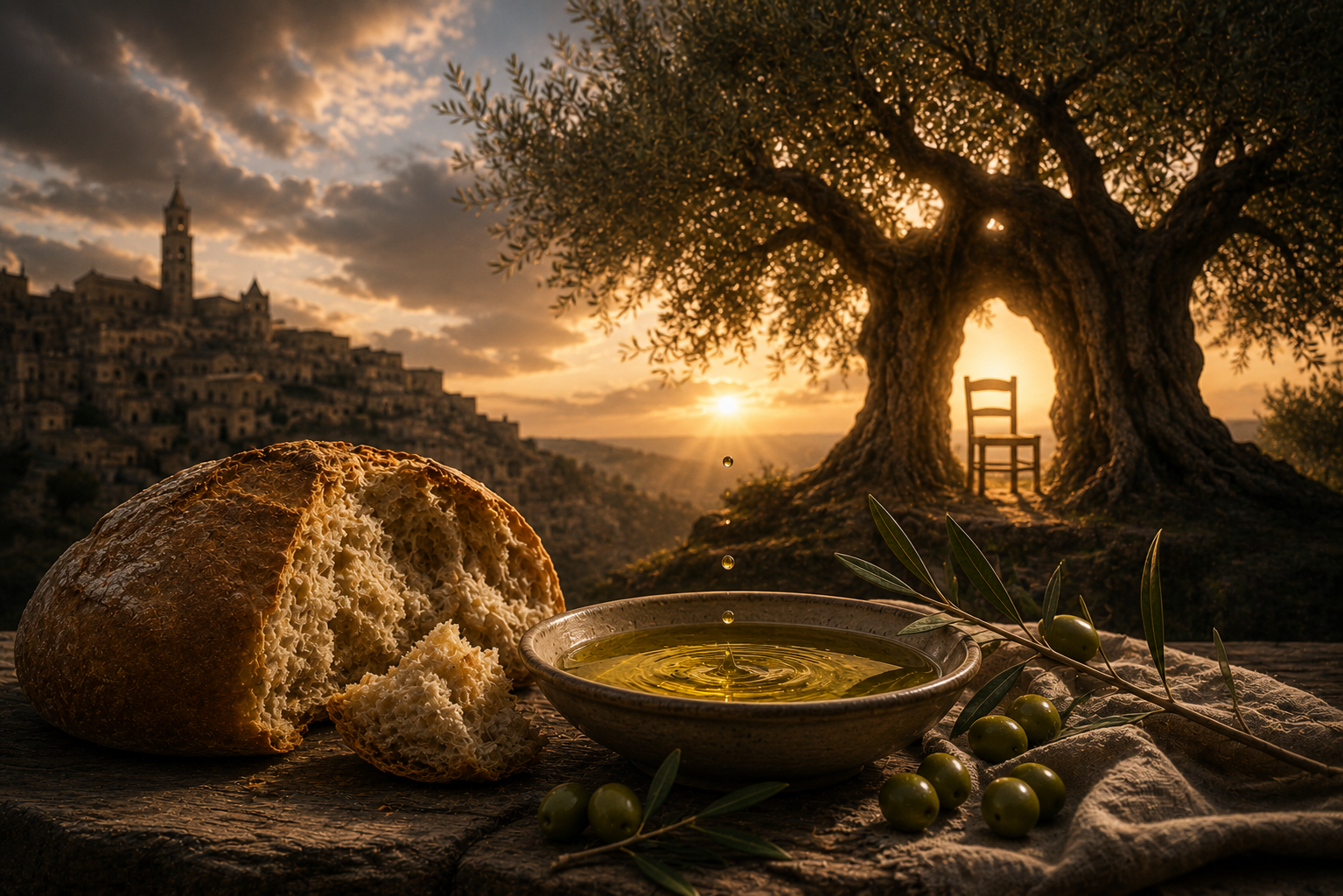
The simplest meal to prepare is bread and oil… no recipe or technique required. A torn piece of bread, a green pour, maybe salt. It is what the people of the Mediterranean have eaten for three thousand years and it was the Recipe of the Week in one our first Sunday Tables. It is what still gets set down in front of you the moment you walk into the right kitchen in the South of Italy, before anyone asks who you are or why you came. We think of it as nothing. It is, in fact, almost the whole covenant.
For those not accustomed to extra virgin olive oil, especially from South Italy, you may be surprised by the criteria used to evaluate the oils. When professional tasters grade olive oil, they are looking for three positive qualities: that it is fruity, bitter, and pungent and catches you in the back of the throat and makes you cough. Bitterness is not a flaw in olive oil. It is a virtue. It is the taste of the polyphenols, the living compounds that make the oil worth eating at all. These are the same compounds that give it its famous peppery sting, and its quiet, ibuprofen-like power in the body. So the good oil bites... It is a little harsh… It has an edge.
Defective oil, the rancid ones, the ones gone flat, those refined and stripped and blended into average agreeableness is smooth, mild, and easy. It will not offend anyone at the table and it will not do anything for anybody either. Dead oil is the one that goes down easy.
Sit with that, because it is the whole of what we have been saying all year, and it is sitting in a bottle in your kitchen. The world is running a machine that files the edges off originals, that rewards you for being milder, smoother, more agreeable, less likely to catch anyone in the throat. It is called the result of maturity. And here is a three-thousand-year-old agricultural tradition that grades a thing higher for its bitterness, and calls the smooth version rancid.
The original bites. The copy goes down easily. Every taster in the Mediterranean knows how to tell the difference. Somewhere along the way, we forgot how to tell it about people.
But now the objection, and it is the most important thing in this essay, so stay with it. Anyone who has worked a grove will tell you that a wild olive is bitter too and inedible. The oleaster, the untended tree, produces small hard fruit nobody can eat. And every cultivated olive is under constant threat of becoming one, because the cultivated tree is a graft: a good variety joined onto a rootstock, and that rootstock keeps throwing up wild suckers from the base. If the farmer does not go at them with a knife year after year, without sentiment the wild growth chokes out the grafted branches and the whole tree reverts. It goes back to producing bitter, wild, useless fruit.
So there are two bitternesses, and everything depends on telling them apart. There is the bitterness of the wild thing… the untended, unpruned, left-to-itself thing. That bitterness is not strength. It is just useless and nobody can eat it.
And there is the bitterness of the tended thing… the pruned, cultivated, formed tree, whose oil bites in the throat because it is dense with everything that makes it worth eating. That bitterness is virtue. They taste like opposites because they are opposites, and the difference between them is entirely the pruner's knife.
This settles something we keep getting wrong about ourselves. The original is not the wild self. The original is not whatever grows if everyone leaves you alone. That is the great lie of The Devil at Work, and it produces exactly what an untended tree produces: something with an edge that feeds nobody. The original is the authored self, and an authored thing must still be tended, or the wild rootstock takes it back. Formation is not the removal of your edge. Formation is what makes your edge valuable to the world.
And this is why no two olive trees are quite the same — not even two cuttings of one variety, rooted on the same hillside. A tree is its own history written into wood: every drought it outlasted, every frost and fire it survived, every cut the pruner made, the exact angle of its slope to the sun. Two trees of the same cultivar yield measurably different oil, because each was formed by what it endured. That is what terroir means, and it is only individuation by another name. The tree is not a stamped copy, and it is not the wild oleaster. It is an original, authored by its care and its wounds.
And it did not become that alone. The olive we know does not exist in the wild — the wild tree is the bitter, useless oleaster. The olive became the olive across thousands of years of human hands: grafted, carried across seas, its best individuals saved and spread, while those same hands were fed, healed, lit, and anointed by it in return. That is not a tool designed for our use. It is a companion formed in a covenant... each making the other what it is, over time. Which is the whole of what we mean at the Sunday Table. We are shaped by what we tend, and it is shaped by us, and neither is ever finished.
Which is precisely what the old Law understood, and it is written into the ground rules of planting a tree. When a fruit tree is planted, Israel was told, its fruit is forbidden for three years and the Hebrew word for that forbidden fruit is orlah, the very same word the Law uses for uncircumcised. The young tree's fruit is not condemned or evil. It is simply not yet formed, and to eat it would be to take something before it had become what it was made to be. Only after the years of tending does the fruit become fit to give.
Read that with a young man in mind and it is almost unbearably kind. You are not defective. Your fruit is not yet fit because you have not yet been tended. That is not sin, it is orlah. It is the timeline of formation, and the tree is not being punished by it. And the prophets took the same knife to the heart. Circumcise your hearts, Jeremiah says cut away what is wild and stubborn in you, so that something can finally grow that feeds someone. That is what the D.E.E.P.E.R. Examen is. It is the annual, unsentimental removal of the wild growth coming up from the base, always, that would choke the grafted life if nobody took a blade to it. Not to make you milder. To keep you from reverting.
I was most surprised by the following revelation, which was truly a revelation towards what we have been exploring at the Sunday Table. Among everything on the table, this one substance really does stand by itself. Look at nearly every other oil in the kitchen: canola, sunflower, soybean, corn, cottonseed, grapeseed; all of them are seeds, crushed and then rescued from themselves. Most oils must be pulled out with chemical solvent, then degummed, neutralized, bleached, and deodorized before a human being can stand to eat them. The crude product is inedible. Refining is what makes them usable. The processing is not an insult to those oils; it is their whole path to the table.
Olive oil is not a seed, it is pressed from flesh of the fruit, the way you would press a grape. It is literally juice. And it can be drunk the moment it comes off the mill, which is exactly what the families do at the frantoio with their bread. There are no solvents or additional processing - just pressing.
The simplicity inverts the logic of the modern American food system: refining olive oil ruins it. Put it through the same purification every other oil requires and you strip out the polyphenols, which is to say the bitterness, the sting, the life, the reason to eat it. This is a market fact, the refined (non extra virgin) product is graded lower. It sells under a lesser name. Olive oil is one case where it is at its best in its original state. Processing is not improvement - it destroys the original. Which is why the highest grade olive oil in the whole category is called extra virgin, which means, when you actually hear it, the least done to it. The top of the ladder is the one closest to the original. Nowhere else in your kitchen does the law itself declare that the unaltered thing is the superior thing.
This is the last piece of Olive Oil standing alone… Top grade olive oil cannot be granted by a machine. Chemistry alone will not do it. To be certified extra virgin, an oil has to be tasted by a panel of trained human beings, whose formed palates decide whether it is fruity, whether it is properly bitter, whether it bites, and whether any defect has crept in. A laboratory can measure the acidity. Only a person can say whether it is good.
Hold that against everything else in the age of AI and algorithms and Tik Tok. We are handing every judgment we have to instruments that measure. Yet here, in the oldest food on the table, the final authority is still a trained panel of expert humans, tasting because no machine has ever been built that can tell you whether a thing is good, only whether it is within tolerance.
Olives are a fruit and the oil is the juice of the fruit not from the seed and still certified by a human palette.
True story… When four million Italians came to America between 1880 and 1920, they arrived in a country that cooked in lard and butter, and they refused to give up their oil. They were mocked for it. "Garlic eaters" was the insult, and reformers used the smell of an Italian kitchen as shorthand for dirtiness and a failure to become properly American. Settlement-house workers ran classes to correct their cooking. Well-meaning experts explained that olive oil was an extravagance the poor could not afford, that it was not right to cook meat and cheese and beans and macaroni together, that strong seasoning damaged the stomach. A dietician of the era warned that highly flavored foods would "destroy the taste for milder foods."
Read that again. The concern was not that the food was unhealthy. The concern was that if you keep eating the strong thing, you will lose your appetite for the bland one - the average one - not the original. That is not nutrition advice. That is the averaging machine, standing at a stove in 1921, trying to retrain a people's palate downward into the mild blandness of the standard protestant diet at the time. This is the same mechanism that your social media feed runs on your attention now, and it was aimed then at the exact thing that made those families originals, their taste. Fortunately, our ancestors didn’t listen to the bland advice. They kept cooking and wrote home begging for crates of olive oil. They stacked the tins in the windows of the alimentari like a beacon. They learned to read a label closely, because counterfeit oil was already a problem a hundred years ago, exactly as it is now. They were told their taste was a defect to be corrected, and they held onto it anyway, and in the end they changed the American palate rather than surrendering to it. They stood alone. They did it with oil.
Here is why the oil could carry all that weight when so much else was lost. Most of what families brought across the water did not survive the crossing unchanged. Houses were sold. Land was divided among cousins and then divided again. Dialects thinned. A man altered names at a desk in a hurry. Feast days faded to a date nobody kept. Recipes bent to whatever the American market carried. Children learned English fast, and some of them learned silence about where their parents came from even faster.
However, the table endured. The oil endured. The bread endured. The Sunday meal endured.
Because heritage is usually handed to us as something the mind holds such as a photograph, a surname, a flag, a record, a monument, a story. All of that matters. But some inheritance is carried underneath language entirely, and it comes back through scent and texture and taste before the mind has any idea what has happened. A piece of bread dipped in good oil can return a person to a table he has never personally sat at. That is not sentimentality, it is an embodied inheritance. The oil carries more than flavor, it carries the bitterness of the fruit, the mineral character of the soil, the heat of that particular season, the timing of the harvest, the condition of the tree, the hand of the pruner, the judgment of the miller, and the patience of a family that refused to walk away from the grove. Taste becomes a form of testimony. The body receives the whole story before the mind has found a single word for it.
This may be why certain plants turn sacred in so many cultures, and why the sacredness is never separable from the care. In India, holy basil is not treated as a useful herb. It is planted near the house, watered, watched, approached with reverence, harvested a certain way. Its meaning lives inside a relationship. The same is true of the vines and grains and trees of the Mediterranean world. They do not stay meaningful by symbolism. They require a human being to accept responsibility for their life. A sacred plant left untended does not remain a sacred plant. It becomes a dead emblem, a picture of something that used to be alive.
Which is the sharpest possible statement of what we mean by Humaning, and the reason we keep saying that a person is not a copy. You can’t revere a human being or care for the whole person from a distance either. Reverence that costs nothing and tends nothing is just admiration, and admiration is what we give to things. The moment a person becomes an image to us: an avatar, demographic, profile, or even an inspiring story or a category they have become a lifeless emblem.
The tree in the photograph. Only someone taking responsibility for its life keeps something alive. Trees, traditions, tables, people. All of it. Same law.
There are two great images in the Italian-American story, and until recently I had only ever thought about one of them. The Statue of Liberty stands in the harbor holding a flame above the water. For generations of Italians she meant arrival, possibility, safety, labor, the hope of a life beyond the limits of the one they left. She is the image of the journey outward. The olive tree is the other half, and nobody put it on a postcard. The tree is what stayed. It does not move and that is the entire point, yet its fruit travels. Its oil crosses the ocean, enters a kitchen in Chicago or Providence or West Virginia, blesses the food, anoints the sick, lights the lamp, and returns the taste of a place to people living four thousand miles from the grove. The torch holds a flame above the water. The tree holds sunlight inside its fruit. One welcomes the migrant. Another remembers where the person came from.
The Statue of Liberty remembers the journey outward. The olive tree remembers the rooted life from which the journey began. Italian America lives between the torch and the grove.
Each of us at the Sunday Table is that grafted shoot. Nobody grew their own roots. Whatever nourishes you came up through ground you did not make, tended by hands that were gone before you were hungry and the only honest posture toward that is not pride of place but gratitude, and the prudence and discretion toward your own wild growth.
And that is not only an Italian story. Every human being leaves something. Every human being longs for a return. Every one of us needs some taste, some scent, some word or prayer or place that tells the body where it belongs. Liberty without amnesia. Movement without severance. Progress that does not require destroying the origin.
Look closely and the whole Humaning Covenant is already growing there.
Care for the whole person is the grove itself, a thing tended for its own sake, over decades, by someone who will not see every harvest and prune anyway. Empower for a greater purpose is what an olive tree does with its whole life: it converts sun and stone into something that feeds a family it will outlive. Integrate faith and science is the miller, who holds ancient inherited practice and real chemistry in the same hands and does not think of them as rivals. Encourage reflection and discernment is the tasting itself, the slow, trained attention that can tell a living oil from a dead one, offered to ordinary people rather than hoarded by experts. Value every act of service is the whole invisible chain inside every bottle: the pruner, the picker, the carrier, the miller, the one who kept the terrace wall from falling. And invite continuous growth is the tree's own stubborn answer to injury twisting around drought and fire and neglect and coming back silver-leafed, unfinished, still bearing.
And Magis, the more, is what happens at the mill. Because in Italy the families still bring their small harvests to the local frantoio and wait together for their own batch to be pressed. And they bring grilled bread, so they can catch the first bright green drops as the oil comes out — fettunta, bread with oil on it, eaten standing up among neighbors while everyone argues about whose grove did better this year.
Nobody engineered that. No one at the mill designed a community-building “activation.” It simply appears wherever people tend something real, together, over time. That is Magis exactly: not more bottles, not more revenue, not more anything but a life that shows up around the work and could not have been manufactured by any of the people standing in it.
And in Greece the same thing takes a different form: whole families coming back from the cities every autumn for the harvest, working the nets together, pressing it all at the village mill, and then not selling it. The oil is divided among the family and it powers their households for the year. Selling it is a last resort. They call it liquid inheritance. It is not a product. It is a family, in a tin.
There was a chair kept empty in those kitchens. Not for a ghost, but for whoever might come: the neighbor, the cousin passing through, the stranger at the wrong hour. And that chair's rule was never just the furniture. It was that there was always something ready to share. A chair with nothing on the table in front of it is not hospitality; it is just an empty seat. The bread and the oil are what make it an invitation. They are the cheapest thing in the house and the entire meaning of the gesture — the least you can set down and the most you can possibly mean by it. So the oil fills that chair first in the plainest way. It is the readiness.
But it fills it in a second way that is harder to see and, I think, truer. The pruner who shaped that tree is very likely dead. The grandmother who kept the terrace wall from collapsing is dead. The cousin who did the harvest is four thousand miles from your kitchen and will never sit at your table. And every one of them is in the oil. Their judgment, their timing, their refusal to leave the grove is what you are tasting. The chair is not empty. It is crowded with everyone whose work is in your mouth. That is what it means to say the table remembers: not that we think fond thoughts about the dead, but that we are, right now, being fed by them.
And in a third way, the oldest one. Oil is what marks the anointed. It is what a priest's thumb carries to a forehead at a baptism and to a hand at a deathbed. The word Christ means precisely this — the one anointed with oil. So when you pour it out on a table, you are handling the same substance that marks kings and priests and the newly born and the dying. This is the Sacred Heart coming down off the kitchen wall and sitting in the chair. Not the picture watching the meal. The Guest at it. And when He takes the chair, it never closes, He sits, and somehow there is still a chair for one more. That is simply how He is.
Then the fourth way, which is not poetry at all, but law. We have spent this year naming the Empty Chair: a person seated for their name and their signature and denied any power to act. We need you in the chair — don't get in the way. It is the shape of the age. The human beside the machine, who can see the problem and cannot stop the process.
Now look again at what happens before a bottle can be called extra virgin. The laboratory runs its numbers. And then a panel of formed human beings sits down and tastes it — and nothing is certified until they do. Their judgment is not advisory. The machine does not overrule them. Their whole authority rests on a thing that took years to form and cannot be faked. The rule itself grants them the say.
That is not an empty chair. That is a chair that is full — a formed person, whose discernment is load-bearing, seated with real standing to decide. It may be one of the last of its kind left in the entire food system. Which is worth noticing on a week when we have been asking who is willing to stand. Somebody, somewhere, decided that the goodness of this one thing was too important to leave to an instrument — and gave the chair to a human being who had been trained to taste.
So here, finally, is the difference the whole table turns on. A commodity can be bought without a relationship. That is precisely what a commodity is for it lets you have the thing without having anything to do with anyone. A sacramental taste asks something of you instead, and the questions it asks are not questions of consumption at all:
Who tended this? Whose hands gathered it? What ground formed it? What has been kept alive inside it? And what responsibility just passed to me? These are not customer questions. They are the questions of a communion.
This is why the olive belongs at the center of the Sunday Table and not merely in a field outside Matera. Its oil says, out loud and in your mouth, that origin is not an abstraction. It can be tasted. It can be received. And it can be handed to the person beside you with a piece of bread which is, in the end, the only thing any of us has ever really needed to do.
The tree holds the memory. The oil carries the story. The Sunday Table turns inheritance into communion. So set out the bread. Pour the oil the good kind, the kind that bites. And do not eat it alone.
Ad maiorem Dei gloriam.
Il pasto più semplice da preparare è pane e olio… non servono né ricette né tecniche particolari. Un pezzo di pane spezzato, un filo d’olio verde, magari un po’ di sale. È ciò che la gente del Mediterraneo mangia da tremila anni ed è stata la Ricetta della Settimana in una delle nostre prime edizioni di «Tavole della Domenica». È ciò che ancora oggi ti viene servito non appena varchi la soglia della cucina giusta nel Sud Italia, prima ancora che qualcuno ti chieda chi sei o perché sei venuto. Lo consideriamo una cosa da nulla. In realtà, è quasi l’essenza stessa del patto.
Per chi non è abituato all’olio extravergine di oliva, specialmente quello del Sud Italia, i criteri utilizzati per valutare gli oli potrebbero risultare sorprendenti. Quando i degustatori professionisti valutano l’olio d’oliva, cercano tre qualità positive: che sia fruttato, amaro e piccante, e che ti colpisca in fondo alla gola facendoti tossire. L’amarezza non è un difetto nell’olio d’oliva. È una virtù. È il sapore dei polifenoli, i composti viventi che rendono l’olio degno di essere consumato. Sono gli stessi composti che gli conferiscono il suo famoso pizzicore pepato e il suo potere silenzioso, simile all’ibuprofene, nell’organismo. Quindi il buon olio punge… È un po’ aspro… Ha un carattere deciso.
L’olio difettoso, quello rancido, quello che ha perso il suo carattere, quello raffinato, spogliato e miscelato fino a diventare mediamente gradevole, è morbido, delicato e facile. Non offenderà nessuno a tavola, ma non farà nulla per nessuno. L’olio morto è quello che scende facilmente.
Rifletteteci, perché è l’essenza di ciò che abbiamo detto per tutto l’anno, ed è lì, in una bottiglia nella vostra cucina. Il mondo sta facendo funzionare una macchina che smussa gli spigoli degli originali, che ti premia per essere più mite, più morbido, più gradevole, meno propenso a dare fastidio alla gola di qualcuno. Si chiama «risultato della maturità». Ed ecco una tradizione agricola vecchia di tremila anni che valuta una cosa più in alto per la sua amarezza, e definisce la versione morbida «rancida».
L’originale morde. La copia scende facilmente. Ogni degustatore del Mediterraneo sa distinguere la differenza. Da qualche parte lungo il percorso, abbiamo dimenticato come riconoscerla nelle persone.
Ma ora l’obiezione, ed è la cosa più importante di questo saggio, quindi seguite il ragionamento. Chiunque abbia lavorato in un uliveto vi dirà che anche un’oliva selvatica è amara e immangiabile. L’oleastro, l’albero incolto, produce piccoli frutti duri che nessuno può mangiare. E ogni olivo coltivato è costantemente minacciato di diventare un oleastro, perché l’albero coltivato è un innesto: una buona varietà innestata su un portainnesto, e quel portainnesto continua a far spuntare polloni selvatici dalla base. Se il contadino non li elimina con un coltello anno dopo anno, senza pietà, la crescita selvatica soffoca i rami innestati e l’intero albero torna allo stato originario. Torna a produrre frutti amari, selvatici, inutili.
Quindi ci sono due tipi di amarezza, e tutto dipende dal saperli distinguere. C’è l’amarezza della cosa selvaggia… quella non curata, non potata, lasciata a se stessa. Quell’amarezza non è forza. È solo inutile e nessuno può mangiarla.
E c’è l’amarezza della cosa curata… l’albero potato, coltivato, modellato, il cui olio punge in gola perché è denso di tutto ciò che lo rende degno di essere mangiato. Quell’amarezza è virtù. Hanno un sapore opposto perché sono opposti, e la differenza tra loro sta interamente nel coltello del potatore.
Questo chiarisce qualcosa che continuiamo a fraintendere su noi stessi. L’originale non è il sé selvaggio. L’originale non è ciò che cresce se tutti ti lasciano in pace. Questa è la grande menzogna di The Devil at Work, e produce esattamente ciò che produce un albero incolto: qualcosa di spigoloso che non nutre nessuno. L’originale è il sé plasmato, e una cosa plasmata deve comunque essere curata, altrimenti il portainnesto selvaggio se ne riappropria. La formazione non è la rimozione del tuo spigolo. La formazione è ciò che rende il tuo spigolo prezioso per il mondo.
Ed è per questo che non esistono due ulivi del tutto uguali — nemmeno due talee della stessa varietà, radicate sullo stesso pendio. Un albero è la propria storia scritta nel legno: ogni siccità che ha superato, ogni gelo e ogni incendio a cui è sopravvissuto, ogni taglio operato dal potatore, l’angolo esatto della sua inclinazione rispetto al sole. Due alberi della stessa cultivar producono un olio sensibilmente diverso, perché ciascuno è stato plasmato da ciò che ha sopportato. Questo è ciò che significa terroir, ed è solo l’individuazione con un altro nome. L’albero non è una copia stampata, e non è l’oleastro selvatico. È un originale, plasmato dalle cure ricevute e dalle sue ferite.
E non è diventato così da solo. L’olivo che conosciamo non esiste allo stato selvatico — l’albero selvatico è l’oleastro amaro e inutile. L’olivo è diventato l’olivo grazie a migliaia di anni di mani umane: innestato, trasportato attraverso i mari, i suoi esemplari migliori salvati e diffusi, mentre quelle stesse mani, in cambio, sono state nutrite, guarite, illuminate e unte da esso. Non è uno strumento progettato per il nostro uso. È un compagno plasmato in un patto… in cui ciascuno rende l’altro ciò che è, nel corso del tempo. Ed è proprio questo il senso di ciò che intendiamo alla Tavola della Domenica. Siamo plasmati da ciò che coltiviamo, e ciò che coltiviamo è plasmato da noi, e nessuno dei due è mai completo.
Ed è proprio ciò che la vecchia Legge aveva compreso, ed è scritto nelle regole fondamentali della piantumazione di un albero. Quando si pianta un albero da frutto, era stato detto a Israele, il suo frutto è proibito per tre anni e la parola ebraica per quel frutto proibito è orlah, la stessa parola che la Legge usa per indicare chi è incirconciso. Il frutto dell’albero giovane non è condannato né malvagio. Semplicemente non è ancora maturo, e mangiarlo significherebbe prendere qualcosa prima che fosse diventato ciò per cui era stato creato. Solo dopo anni di cura il frutto diventa pronto per essere offerto.
Leggete queste parole pensando a un giovane e vi sembreranno di una gentilezza quasi insopportabile. Non sei imperfetto. Il tuo frutto non è ancora maturo perché non sei stato ancora curato. Questo non è peccato, è orlah. È il percorso di formazione, e l’albero non ne viene punito. E i profeti hanno portato lo stesso coltello al cuore. Circoncidete i vostri cuori, dice Geremia: tagliate via ciò che in voi è selvaggio e ostinato, affinché possa finalmente crescere qualcosa che nutra qualcuno. Questo è ciò che è l’Esame D.E.E.P.E.R. È la rimozione annuale, spietata, della crescita selvaggia che spunta dalla base, sempre, e che soffocherebbe la vita innestata se nessuno la tagliasse via con una lama. Non per rendervi più docili. Per impedirvi di regredire.
Sono rimasto molto sorpreso dalla seguente rivelazione, che è stata davvero una rivelazione rispetto a ciò che abbiamo esplorato alla Tavola della Domenica. Tra tutto ciò che è sul tavolo, questa sostanza è davvero unica nel suo genere. Guardate quasi tutti gli altri oli in cucina: colza, girasole, soia, mais, semi di cotone, vinaccioli; sono tutti semi, schiacciati e poi “salvati” da se stessi. La maggior parte degli oli deve essere estratta con solventi chimici, poi degommata, neutralizzata, sbiancata e deodorata prima che un essere umano possa sopportarne il consumo. Il prodotto grezzo è immangiabile. È la raffinazione a renderli utilizzabili. La lavorazione non è un insulto a quegli oli; è il loro intero percorso fino alla tavola.
L’olio d’oliva non è un seme, viene spremuto dalla polpa del frutto, proprio come si spreme un’uva. È letteralmente succo. E può essere bevuto nel momento stesso in cui esce dal frantoio, che è esattamente ciò che fanno le famiglie al frantoio con il loro pane. Non ci sono solventi né lavorazioni aggiuntive: solo la spremitura.
Questa semplicità ribalta la logica del moderno sistema alimentare americano: la raffinazione dell’olio d’oliva lo rovina.Se lo si sottopone alla stessa purificazione richiesta da qualsiasi altro olio, si eliminano i polifenoli, ovvero l’amaro, il piccante, la vitalità, la ragione stessa per cui lo si consuma. È un dato di fatto del mercato: il prodotto raffinato (non extravergine) viene classificato al di sotto. Viene venduto con una denominazione di livello inferiore. L’olio d’oliva è uno dei casi in cui dà il meglio di sé allo stato originale. La lavorazione non è un miglioramento: distrugge l’originale. Ecco perché l’olio d’oliva di grado più elevato dell’intera categoria si chiama extra vergine, il che significa, a ben vedere, quello a cui è stato fatto il minimo possibile. Il vertice della scala è quello più vicino all’originale. In nessun altro ambito della vostra cucina la legge stessa dichiara che la cosa inalterata è quella superiore.
Questo è l’ultimo prodotto a base di olio d’oliva che resiste da solo… L’olio d’oliva di prima qualità non può essere certificato da una macchina. La chimica da sola non basta. Per essere certificato come extravergine, un olio deve essere degustato da una giuria di esseri umani addestrati, i cui palati esperti decidono se è fruttato, se è adeguatamente amaro, se ha un retrogusto pungente e se si è insinuato qualche difetto. Un laboratorio può misurare l’acidità. Solo una persona può dire se è buono.
Confrontate questo con tutto il resto nell’era dell’intelligenza artificiale, degli algoritmi e di TikTok. Stiamo affidando ogni nostro giudizio a strumenti di misurazione. Eppure qui, nel cibo più antico che si trovi in tavola, l’autorità finale spetta ancora a una giuria di esperti umani, che degustano perché non è mai stata costruita una macchina in grado di dirvi se una cosa è buona, ma solo se rientra nei limiti di tolleranza.
Le olive sono un frutto e l’olio è il succo del frutto, non del seme, e viene ancora certificato dal palato umano.
Storia vera… Quando quattro milioni di italiani arrivarono in America tra il 1880 e il 1920, giunsero in un paese dove si cucinava con lo strutto e il burro, e si rifiutarono di rinunciare al loro olio. Per questo furono derisi. «Mangiatori di aglio» era l’insulto, e i riformatori usavano l’odore di una cucina italiana come sinonimo di sporcizia e di incapacità di diventare veri americani. Gli operatori dei centri di accoglienza organizzavano corsi per correggere il loro modo di cucinare. Esperti ben intenzionati spiegavano che l’olio d’oliva era una stravaganza che i poveri non potevano permettersi, che non era giusto cucinare insieme carne, formaggio, fagioli e maccheroni, e che i condimenti forti danneggiavano lo stomaco. Un dietologo dell’epoca avvertì che i cibi dal sapore molto forte avrebbero «distrutto il gusto per i cibi più delicati».
Rileggete questa frase. La preoccupazione non era che il cibo fosse malsano. La preoccupazione era che, se si continua a mangiare cibi dal sapore forte, si perderà l’appetito per quelli insipidi – quelli medi – non per quelli originali. Questo non è un consiglio nutrizionale. Quella è la «macchina della media», in piedi ai fornelli nel 1921, che cercava di rieducare il palato di un popolo verso il basso, verso la blanda insipidità della dieta protestante standard dell’epoca. È lo stesso meccanismo con cui oggi i vostri feed sui social media gestiscono la vostra attenzione, e all’epoca era rivolto proprio a ciò che rendeva quelle famiglie originali: il loro gusto. Fortunatamente, i nostri antenati non diedero ascolto a quei consigli insipidi. Continuarono a cucinare e scrissero a casa implorando casse di olio d’oliva. Impilarono le lattine nelle vetrine degli alimentari come un faro. Impararono a leggere attentamente le etichette, perché l’olio contraffatto era già un problema cento anni fa, esattamente come lo è oggi. Gli fu detto che il loro gusto era un difetto da correggere, eppure vi tennero comunque, e alla fine cambiarono il palato americano invece di arrendersi ad esso. Rimasero soli. Ci sono riusciti grazie all’olio.
Ecco perché l’olio poteva sostenere tutto quel peso quando così tante altre cose andavano perdute. La maggior parte di ciò che le famiglie portarono oltreoceano non sopravvisse alla traversata senza subire cambiamenti. Le case furono vendute. La terra fu divisa tra i cugini e poi divisa di nuovo. I dialetti si affievolirono. Un uomo modificò i nomi in fretta, seduto a una scrivania. I giorni di festa svanirono in una data che nessuno osservava più. Le ricette si adattarono a ciò che il mercato americano offriva. I bambini impararono in fretta l’inglese, e alcuni di loro impararono ancora più in fretta a tacere sulle origini dei propri genitori.
Tuttavia, la tavola resistette. L’olio resistette. Il pane resistette. Il pranzo della domenica resistette.
Perché il patrimonio culturale ci viene solitamente tramandato come qualcosa che la mente custodisce, come una fotografia, un cognome, una bandiera, un documento, un monumento, una storia. Tutto ciò conta. Ma alcune eredità si tramandano interamente al di là del linguaggio, e riaffiorano attraverso il profumo, la consistenza e il sapore prima ancora che la mente abbia la minima idea di ciò che è accaduto. Una fetta di pane intinta in un buon olio può riportare una persona a una tavola a cui non si è mai seduta personalmente. Non è sentimentalismo, è un’eredità incarnata. L’olio trasporta più del semplice sapore: porta con sé l’amarezza del frutto, il carattere minerale del suolo, il calore di quella particolare stagione, il momento del raccolto, le condizioni dell’albero, la mano di chi pota, il giudizio del frantoiano e la pazienza di una famiglia che si è rifiutata di abbandonare l’uliveto. Il gusto diventa una forma di testimonianza. Il corpo riceve l’intera storia prima ancora che la mente abbia trovato una sola parola per descriverla.
Forse è per questo che certe piante diventano sacre in così tante culture, e perché la sacralità non è mai separabile dalla cura. In India, il basilico sacro non è trattato come un’erba utile. Viene piantato vicino alla casa, innaffiato, sorvegliato, trattato con riverenza, raccolto in un certo modo. Il suo significato vive all’interno di una relazione. Lo stesso vale per le viti, i cereali e gli alberi del mondo mediterraneo. Non mantengono il loro significato solo attraverso il simbolismo. Richiedono che un essere umano si assuma la responsabilità della loro vita. Una pianta sacra lasciata incustodita non rimane una pianta sacra. Diventa un emblema morto, l’immagine di qualcosa che un tempo era vivo.
Questa è l’affermazione più incisiva possibile di ciò che intendiamo per “Humaning”, e il motivo per cui continuiamo a dire che una persona non è una copia. Non si può venerare un essere umano né prendersi cura della persona nella sua interezza da lontano. La venerazione che non costa nulla e non si prende cura di nulla è solo ammirazione, e l’ammirazione è ciò che riserviamo alle cose. Nel momento in cui una persona diventa per noi un’immagine: un avatar, un dato demografico, un profilo, o persino una storia ispiratrice o una categoria, essa è diventata un emblema privo di vita.
L’albero nella fotografia. Solo chi si assume la responsabilità della sua vita mantiene in vita qualcosa. Alberi, tradizioni, tavoli, persone. Tutto. La stessa legge.
Ci sono due grandi immagini nella storia italo-americana, e fino a poco tempo fa avevo pensato solo a una di esse. La Statua della Libertà si erge nel porto tenendo una fiamma sopra l’acqua. Per generazioni di italiani lei significava arrivo, possibilità, sicurezza, lavoro, la speranza di una vita oltre i limiti di quella che avevano lasciato. È l’immagine del viaggio verso l’esterno. L’ulivo è l’altra metà, e nessuno l’ha mai raffigurato su una cartolina. L’albero è ciò che è rimasto. Non si muove, ed è proprio questo il punto, eppure il suo frutto viaggia. Il suo olio attraversa l’oceano, entra in una cucina a Chicago, a Providence o nel West Virginia, benedice il cibo, unge i malati, accende la lampada e restituisce il sapore di un luogo a persone che vivono a quattromila miglia dal boschetto. La torcia tiene alta una fiamma sopra l’acqua. L’olivo custodisce la luce del sole all’interno del suo frutto. Uno accoglie il migrante. L’altro ricorda da dove quella persona è venuta.
La Statua della Libertà ricorda il viaggio verso l’esterno. L’olivo ricorda la vita radicata da cui il viaggio è iniziato. L’America italiana vive tra la torcia e l’oliveto.
Ognuno di noi alla tavola della domenica è quel germoglio innestato. Nessuno ha messo radici da sé. Qualunque cosa ti nutra è spuntata da un terreno che non hai creato tu, curato da mani che se ne erano andate prima che tu avessi fame, e l’unico atteggiamento onesto nei confronti di ciò non è l’orgoglio per il proprio posto, ma la gratitudine, insieme alla prudenza e alla discrezione verso la tua stessa crescita selvaggia.
E questa non è solo una storia italiana. Ogni essere umano lascia qualcosa. Ogni essere umano desidera un ritorno. Ognuno di noi ha bisogno di un sapore, di un profumo, di una parola, di una preghiera o di un luogo che dica al corpo a quale luogo appartiene. Libertà senza amnesia. Movimento senza rottura. Progresso che non richieda la distruzione dell’origine.
Guardate da vicino e l’intero Patto dell’Umanità sta già crescendo lì.
Prendersi cura della persona nella sua interezza è il boschetto stesso, qualcosa di cui ci si prende cura per se stesso, nel corso di decenni, da parte di qualcuno che comunque non vedrà ogni raccolto né ogni potatura. Dare forza per uno scopo più grande è ciò che un ulivo fa con tutta la sua vita: trasforma il sole e la pietra in qualcosa che nutre una famiglia che sopravviverà a lui. Integrare fede e scienza è il frantoiano, che tiene nelle stesse mani un’antica pratica ereditata e la vera chimica e non le considera rivali. Incoraggiare la riflessione e il discernimento è la degustazione stessa, l’attenzione lenta e allenata che sa distinguere un olio vivo da uno morto, offerta alla gente comune piuttosto che accaparrata dagli esperti. Valorizzare ogni atto di servizio è l’intera catena invisibile all’interno di ogni bottiglia: il potatore, il raccoglitore, il trasportatore, il frantoiano, chi ha impedito al muro del terrazzamento di crollare. E invitare alla crescita continua è la risposta ostinata dell’albero stesso alle ferite: contorcendosi tra siccità, fuoco e abbandono, per poi tornare con foglie argentate, incompiuto, ma ancora fecondo.
E Magis, il di più, è ciò che accade al frantoio. Perché in Italia le famiglie portano ancora i loro piccoli raccolti al frantoiolocale e aspettano insieme che venga spremuto il loro lotto. E portano il pane grigliato, così da poter raccogliere le prime gocce verde brillante man mano che l’olio esce — fettunta, pane con l’olio sopra, mangiato in piedi tra i vicini mentre tutti discutono su quale uliveto abbia dato il raccolto migliore quest’anno.
Nessuno l’ha progettato. Nessuno al frantoio ha ideato un’“attivazione” volta a rafforzare la comunità. Apparesemplicemente ovunque le persone si prendano cura di qualcosa di reale, insieme, nel corso del tempo. Questo è esattamente il Magis: non più bottiglie, non più entrate, non più nulla se non una vita che si manifesta attorno al lavoro e che non avrebbe potuto essere creata da nessuna delle persone che vi partecipano.
E in Grecia la stessa cosa assume una forma diversa: intere famiglie che ogni autunno tornano dalle città per la raccolta, lavorano insieme le reti, spremono tutto al frantoio del paese e poi non lo vendono. L’olio viene diviso tra i membri della famiglia e alimenta le loro case per tutto l’anno. Venderlo è l’ultima risorsa. Lo chiamano «eredità liquida». Non è un prodotto. È una famiglia, in un barattolo.
In quelle cucine c’era una sedia tenuta vuota. Non per un fantasma, ma per chiunque potesse arrivare: il vicino, il cugino di passaggio, lo sconosciuto all’ora sbagliata. E la regola di quella sedia non era mai solo quella di un semplice mobile. Era che c’era sempre qualcosa pronto da condividere. Una sedia con il tavolo davanti vuoto non è ospitalità; è solo un posto vuoto. Il pane e l’olio sono ciò che la rendono un invito. Sono la cosa più economica della casa e l’intero significato del gesto — il minimo che si possa mettere in tavola e il massimo che si possa intendere con esso. Quindi l’olio riempie quella sedia innanzitutto nel modo più semplice. È la disponibilità.
Ma la riempie anche in un secondo modo, più difficile da cogliere e, credo, più vero. Il potatore che ha modellato quell’albero molto probabilmente è morto. La nonna che ha impedito al muro della terrazza di crollare è morta. Il cugino che ha fatto la vendemmia è a quattromila miglia dalla tua cucina e non si siederà mai alla tua tavola. E ognuno di loro è nell’olio. Il loro giudizio, il loro tempismo, il loro rifiuto di abbandonare l’uliveto è ciò che stai assaporando. La sedia non è vuota. È affollata di tutti coloro il cui lavoro è nella tua bocca. Questo è ciò che significa dire che la tavola ricorda: non che nutriamo pensieri affettuosi per i defunti, ma che, proprio ora, siamo nutriti da loro.
E in un terzo modo, il più antico. L’olio è ciò che contraddistingue l’unto. È ciò che il pollice di un sacerdote porta sulla fronte durante un battesimo e sulla mano al capezzale di un moribondo. La parola Cristo significa proprio questo: colui che è stato unto con l’olio. Quindi, quando lo versi su una tavola, stai maneggiando la stessa sostanza che segna re e sacerdoti, i neonati e i morenti. Questo è il Sacro Cuore che scende dalla parete della cucina e si siede sulla sedia. Non l’immagine che osserva il pasto. L’Ospite che vi partecipa. E quando Egli prende posto sulla sedia, questa non si chiude mai; Egli si siede, e in qualche modo c’è ancora posto per un’altra persona. È semplicemente così che Lui è.
Poi il quarto modo, che non è affatto poesia, ma legge. Abbiamo trascorso quest’anno dando un nome alla “Sedia Vuota”: una persona seduta solo per il proprio nome e la propria firma, a cui è negato ogni potere di agire. Abbiamo bisogno di te sulla sedia — non intralciarci. È la forma di quest’epoca. L’essere umano accanto alla macchina, che può vedere il problema ma non può fermare il processo.
Ora guarda di nuovo cosa succede prima che una bottiglia possa essere definita «extravergine». Il laboratorio esegue le sue analisi. E poi una commissione di esseri umani maturi si siede e la assaggia — e nulla viene certificato finché non lo fanno. Il loro giudizio non è consultivo. La macchina non li scavalca. Tutta la loro autorità poggia su qualcosa che ha richiesto anni per formarsi e che non può essere simulato. La regola stessa garantisce loro l’ultima parola.
Quella non è una sedia vuota. È una sedia piena — una persona esperta, il cui discernimento è determinante, seduta con reale autorità per decidere. Potrebbe essere una delle ultime del suo genere rimaste nell’intero sistema alimentare. Il che vale la pena notare in una settimana in cui ci siamo chiesti chi sia disposto a prendere posizione. Qualcuno, da qualche parte, ha deciso che la bontà di questa singola cosa era troppo importante per essere affidata a uno strumento — e ha affidato la sedia a un essere umano che era stato addestrato a degustare.
Ecco, finalmente, la differenza su cui ruota l’intera questione. Una merce può essere acquistata senza alcun rapporto. È proprio questo lo scopo di una merce: ti permette di avere la cosa senza avere nulla a che fare con nessuno. Un gusto sacramentale, invece, ti chiede qualcosa, e le domande che pone non sono affatto domande di consumo:
Chi l’ha coltivata? Di chi sono le mani che l’hanno raccolta? Quale terra l’ha plasmata? Cosa è stato mantenuto in vita al suo interno? E quale responsabilità mi è appena stata affidata? Queste non sono domande da cliente. Sono le domande di una comunione.
Ecco perché l’oliva deve stare al centro della tavola domenicale e non semplicemente in un campo fuori Matera. Il suo olio dice, ad alta voce e nella tua bocca, che l’origine non è un’astrazione. Si può assaporare. Si può ricevere. E si può porgere alla persona accanto a te con un pezzo di pane, che è, in fin dei conti, l’unica cosa che ognuno di noi abbia mai davvero avuto bisogno di fare.
L’albero custodisce la memoria. L’olio porta con sé la storia. La tavola domenicale trasforma l’eredità in comunione. Quindi disponete il pane. Versate l’olio, quello buono, quello che ha carattere. E non mangiatelo da soli.
Ad maiorem Dei gloriam.
Small acts to move the world forward
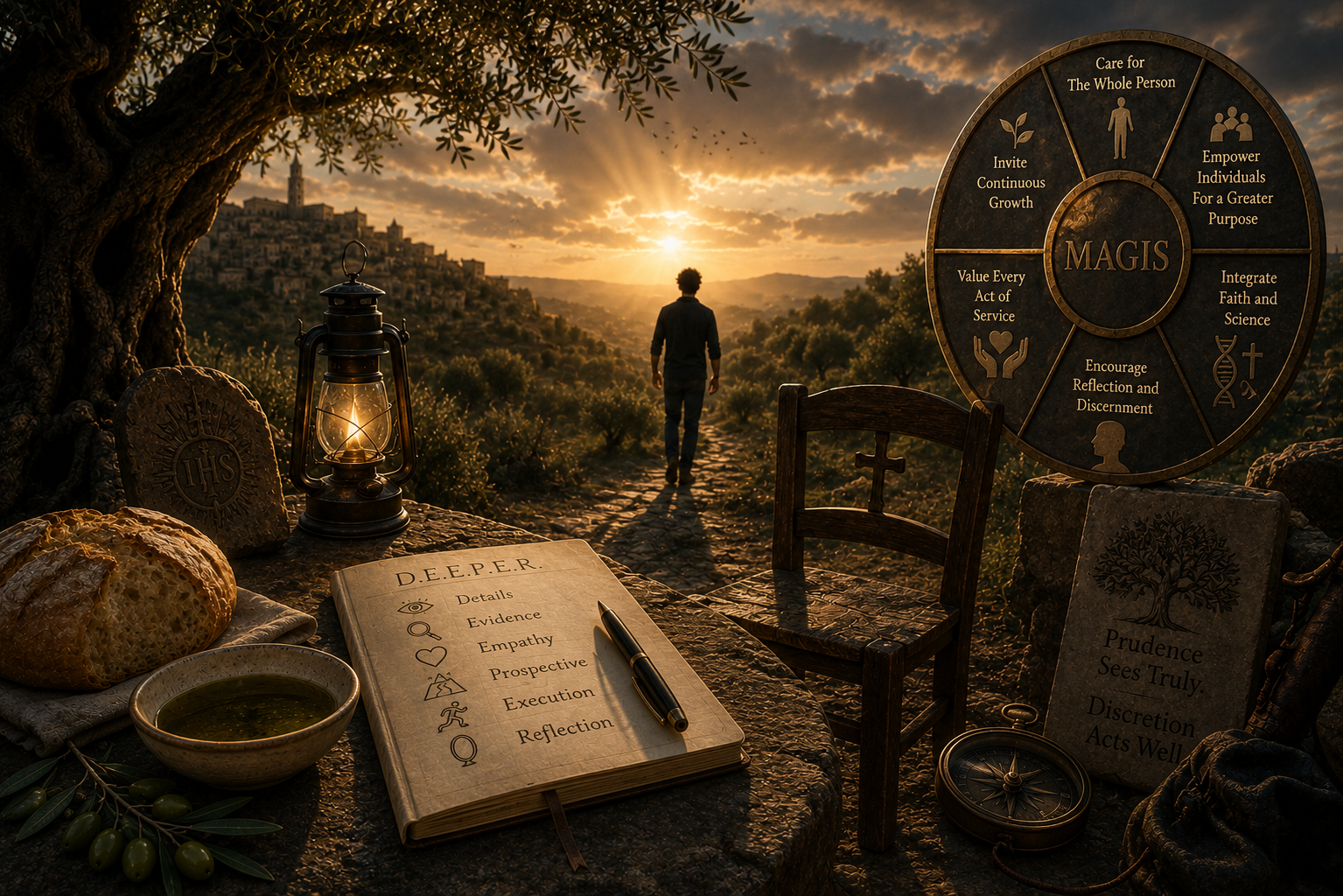
Here are some small acts that move the world forward using the Six Promises of the Humaning Covenant. Give them a try and then use them in the D.E.E.P.E.R. Examen.
Prudence begins in a rested body; you cannot see truly through exhaustion, and most bad sensations are just depletion in disguise.
This week: name one way you have been running yourself down and calling it commitment — and stop it, once, on purpose. Sleep instead of scroll. Eat a real meal sitting down. Then notice how differently the same situation reads to a steady body.
Someone near you sees something true and keeps waiting for permission to say it.
This week: be the permission. Find the person who half-raised a hand and got talked over, and say it plainly, in front of others: "Say that again I want everyone to hear it." Lend them your standing so theirs can survive the room.
A strong pull is data, not a verdict and testing it is not doubt, it is discretion.
This week: take one thing you feel certain about and trace it before you act on it. Not how strong the feeling is, but where it leads - larger or smaller, freer or more alone, more myself or less. Test the pull, then decide.
Momentum decides most things by simply not stopping.
This week: put one decision on a deliberate pause. Name the question no one wants to slow down for, and refuse to let the thing roll forward until it's answered. That pause, held on purpose, is discretion with its hand up.
The person who stood first is almost never thanked; the room takes his courage and forgets the source.
This week: find someone who went first on something… said the hard true thing, took the unpopular stand, and thank them for it, specifically. Name the cost they paid. Honor the standing that made everyone else's easier.
The habit of intervention atrophies in the long stretch of low-stakes deference, so that when the high-stakes moment finally comes, you have no muscle left to stand.
This week: stand on one small thing you'd normally let slide, a small untruth, a quiet unfairness, a "that's not quite right" you usually swallow. Not to be difficult. To keep the muscle alive for the day it matters.
Consider your actions toward the Six Promises of the Humaning Covenant as you move through the D.E.E.P.E.R. Examen. It’s helpful to keep a notebook handy. Look back at your actions in relation to the Six
Details: What happened this week? Where did I see something clearly, a truth, a wrongness, a thing that needed saying? Write down exactly what you saw - what, where, when, who.
Evidence: What did my body register beneath the noise? Where did I feel the open of consolation, and where was the tightening of contraction? And this week's discipline did I test it, or just trust it? What other evidence to do you have - reactions, messages, proof of something beyond thoughts.
Empathy: Who was waiting for someone to go first? Whose true word did I let vanish because I stayed seated? Make a note of the people involved.
Prospective: If I keep reading the room instead of standing in it, who am I becoming and what is being left unsaid that only I could say? Where will this place me in 3 months or 3 years?
Execution: Now what. What is the one concrete thing tomorrow asks of me: a word, a stand, a pause, a repair that will cost me something? Name it while it is still clear, before the room talks me out of it.
Reflection: Not only what did I feel this week, but in the last month? Go back to a stand you took, or failed to take, and look honestly at its fruit. Did the thing that felt like consolation leave you larger or smaller? Did the hard word bear something good, over time, or not? This is the test a single evening cannot run. Judge the movement by its tail, not its face.
Then the Builder at Work's question: Did I stand today, or only appreciate from my seat? Don’t answer to judge yourself, choose to be first tomorrow.
Magis is never the applause that comes free. It is the ovation that had to be sparked — the good that no one would have reached without someone willing to rise while the room was still seated. This week it may look like a true word said out loud at some cost. It may look like a strong feeling tested instead of obeyed. It may look like a "hope" finally named as the mask it was, and set down. It may look like standing, once, on a small thing, so the muscle is there for the large one.
The fruit will tell you which of your movements this week were real. It always does — not tonight, but in the tail of them, over the weeks, in what they became. So act, and then go back and look. That is the whole practice: see truly, test the pull, stand while it costs something, and return to read the harvest.
Someone has to be first. Let it be you, not alone, but under the One who authored you, with the whole cloud of witnesses at your side.
Formed at the table. Sent as Builders. We are human together, or not at all.
Ad maiorem Dei gloriam.
Ecco alcuni piccoli gesti che fanno progredire il mondo attingendo alle Sei Promesse dell'Alleanza Umanizzante. Provateli e poi utilizzateli nell'Esame D.E.E.P.E.R.
La prudenza nasce da un corpo riposato; non si riesce a vedere chiaramente quando si è esausti, e la maggior parte delle sensazioni negative non sono altro che esaurimento mascherato.
Questa settimana: individua un modo in cui ti sei logorato definendolo “impegno” — e smettila, una volta per tutte, di proposito. Dormi invece di scorrere il telefono. Mangia un pasto vero sedendoti a tavola. Poi nota quanto la stessa situazione appaia diversa a un corpo in equilibrio.
Qualcuno vicino a te vede qualcosa di vero e continua ad aspettare il permesso di dirlo.
Questa settimana: sii tu quel permesso. Trova la persona che ha alzato la mano a metà ed è stata zittita, e dillo chiaramente, davanti agli altri: «Ripetilo, voglio che tutti lo sentano». Concedi loro la tua autorità affinché la loro voce possa farsi sentire nella stanza.
Ciò che attrae con forza sono i dati, non un verdetto, e metterli alla prova non è dubbio, è discernimento.
Questa settimana: prendi una cosa di cui sei certo e analizzala prima di agire di conseguenza. Non quanto sia forte la sensazione, ma dove conduce: verso qualcosa di più grande o più piccolo, di più libero o di più solitario, di più me stesso o di meno. Metti alla prova quell’attrazione, poi decidi.
Lo slancio decide la maggior parte delle cose semplicemente non fermandosi.
Questa settimana: metti una decisione in pausa deliberata. Identifica la domanda per cui nessuno vuole rallentare e rifiuta di lasciare che la cosa vada avanti finché non avrà una risposta. Quella pausa, mantenuta di proposito, è discernimento che alza la mano.
La persona che si è fatta avanti per prima non viene quasi mai ringraziata; la sala prende il suo coraggio e ne dimentica la fonte.
Questa settimana: trova qualcuno che sia stato il primo a fare qualcosa… che abbia detto la dura verità, che abbia preso una posizione impopolare, e ringrazialo specificatamente per questo. Indica il prezzo che ha pagato. Onora quella presa di posizione che ha reso più facile quella di tutti gli altri.
L’abitudine di intervenire si atrofizza nel lungo periodo di deferenza in situazioni di bassa posta in gioco, così che quando finalmente arriva il momento cruciale, non hai più la forza di prendere posizione.
Questa settimana: prendi posizione su una piccola cosa che normalmente lasceresti passare, una piccola menzogna, un’ingiustizia silenziosa, un «questo non va proprio bene» che di solito ti tieni per te. Non per fare il difficile. Per mantenere viva la forza necessaria per il giorno in cui conterà davvero.
Considera le tue azioni rispetto alle Sei Promesse del Patto dell’Umanità mentre procedi con l’Esame D.E.E.P.E.R. È utile tenere un taccuino a portata di mano. Ripensa alle tue azioni in relazione alle Sei
Dettagli: Cosa è successo questa settimana? Dove ho visto qualcosa con chiarezza, una verità, un’ingiustizia, una cosa che andava detta? Annota esattamente ciò che hai visto: cosa, dove, quando, chi.
Evidenza: Cosa ha percepito il mio corpo al di là del rumore di fondo? Dove ho sentito l’apertura della consolazione e dove la tensione della contrazione? E riguardo alla disciplina di questa settimana, l’ho messa alla prova o mi sono semplicemente fidato? Quali altre prove hai: reazioni, messaggi, indizi di qualcosa che va oltre i pensieri.
Empatia: Chi stava aspettando che qualcuno facesse la prima mossa? Quale parola sincera ho lasciato svanire perché sono rimasto seduto? Prendi nota delle persone coinvolte.
Prospettiva: Se continuo a leggere l’atmosfera della stanza invece di prenderne parte, chi sto diventando e cosa rimane non detto che solo io potrei dire? Dove mi porterà tutto questo tra 3 mesi o 3 anni?
Esecuzione: E adesso? Qual è l’unica cosa concreta che il domani mi chiede: una parola, una presa di posizione, una pausa, una riparazione che mi costerà qualcosa? Nominala finché è ancora chiara, prima che l’atmosfera della stanza mi convinca a lasciar perdere.
Riflessione: Non solo cosa ho provato questa settimana, ma nell’ultimo mese? Torna a una presa di posizione che hai assunto, o che non sei riuscito ad assumere, e guarda onestamente ai suoi frutti. Quella cosa che sembrava una consolazione ti ha reso più grande o più piccolo? Quella parola dura ha portato qualcosa di buono, col tempo, o no? Questa è la prova che una singola serata non può reggere. Giudica il movimento dalla coda, non dal volto.
Poi la domanda del Costruttore al lavoro: oggi ho preso posizione, o mi sono limitato ad apprezzare dal mio posto? Non rispondere per giudicarti, scegli di essere il primo domani.
Il Magis non è mai l’applauso che arriva gratis. È l’ovazione che doveva essere scatenata — il bene che nessuno avrebbe raggiunto senza qualcuno disposto ad alzarsi mentre la sala era ancora seduta. Questa settimana potrebbe sembrare una parola vera detta ad alta voce a un certo costo. Potrebbe sembrare un sentimento forte messo alla prova invece che assecondato. Potrebbe sembrare una «speranza» finalmente smascherata per ciò che era, e messa da parte. Potrebbe sembrare l’aver preso posizione, una volta, su una piccola cosa, in modo che il muscolo sia pronto per quella grande.
Il frutto ti dirà quali dei tuoi movimenti di questa settimana sono stati reali. Lo fa sempre — non stasera, ma nel loro strascico, nel corso delle settimane, in ciò che sono diventati. Quindi agisci, e poi torna indietro e osserva. Questa è l’intera pratica: vedere con chiarezza, mettere alla prova la spinta, resistere anche quando costa qualcosa, e tornare indietro per valutare il raccolto.
Qualcuno deve essere il primo. Che sia tu, non da solo, ma sotto Colui che ti ha creato, con l’intera schiera di testimoni al tuo fianco.
Formati attorno alla tavola. Inviati come Costruttori. Siamo umani insieme, o non lo siamo affatto.
Ad maiorem Dei gloriam.
Cosiamo | Founder, UMANIAMO® | Humaning Architecture

For as long as I can remember, I have been looking for the one who would help me fill the Empty Chair. A partner or a circle of the right people. Someone to build with, because it seemed more meaningful to do with someone rather than to build alone. In many ways, I was looking for validation but not for the reason that I thought. I never looked to have an idea validated, what I wanted was to be challenged in a way that would stretch an idea as well as to keep me true to the intent. That wasn't a weakness, although it resulted in disappointment. We were made for the table and not for solitude; the longing for someone to sit across from you is the image of God in you, asking for its own reflection. The desire was never the problem. Where I kept aiming it was.
The modern world has a name for what I thought I was after: the mastermind group. There are versions of it that are nothing more than networking in expensive suits - a circle of ambitious people trading advantages, each one's rise engineered to serve the others', the whole arrangement ordered to produce more for its members. It looks like communion, and it is much closer to mutual extraction: a lantern built in the shape of a table in the hands of The Devil at Work. I have sat at those tables and they often glow with bright smiles and grand ideas. They are also, in the end, empty in the way that matters, because every person there is still serving himself through everyone else. The Devil at Work, holds the lantern and everyone looks at their own reflection in a mirror.
Underneath my search, I have come to see, was a confusion about authority and accountability. I kept looking for someone to grant me something, agreement usually, but sometimes a shared seat at their table, a partner who would finally make the work feel worth it. But that is the revocable authority conferred by others. That was never what I actually needed, because what I actually needed had already been given. I was authored and accountable for this and it was written into me by God before anyone's permission, and it cannot be granted or withheld by any room I might be invited into.
Once that lands, one conclusion becomes unavoidable, and it is the first thing my own D.E.E.P.E.R. Examen kept handing back to me: for the authored self, waiting is not an option, not for me and not for you either. You do not wait for a group, a sign, or a partner to begin living what you were made for. The office comes when it comes. The Authoring is already yours. So I stopped asking who would help me fill the chair, and asked the better question: who actually fills it?
My mistake was glaringly obvious and staring me in the face in the light of the Devil at Work’s lantern. Here is what I did wrong, and it took a mountain and a cave to see it. I had assumed the choice was between a mastermind and no mastermind, between the room of impressive people and the lonely business of doing it myself. That is a false choice, and it is the exact trap that the Devil at Work presents. Standing Alone is not standing solo. There is a real mastermind. It had been convened all along. I was simply looking for it in the wrong rooms.
The Empty Chair is filled by turning to the Author and listening. The foundation is your relationship with the Author, and there is no substitute for turning the chair, or for the silence that comes after. The hardest part is never in the question, it is stopping long enough to hear what comes back.
The Authored person does not sit at that table alone. The Author provides companions, or a great cloud of witnesses, the ones who ran the race ahead of you and finished it, who are not metaphors and not memories, and who are closer to this work than any consultant you could hire.
Every morning I pray (meditate), the form of which is my own, hence I will not hand anyone a formula for theirs. However, during my pilgrimage to Monte Sant’Angelo in the cave of Archangel Michael, I began praying in a deeper way, speaking directly to the Father, to Jesus the Lord and Savior, and to the Holy Spirit, and then, at the end, I ask three in particular for counsel, each in his own way: Jesus, Archangel (Saint) Michael, then Saint Ignatius of Loyola. That is my mastermind, we meet daily, and never once has any of them cancelled.
Something important occurs in this group, and it is what makes it real where the other one is counterfeit. Not one member of that table wants anything from me. That’s a big difference, and it is worth sitting with, because it is a test you can run on any circle you are ever invited into. People who are advancing themselves through you populate the counterfeit mastermind.That is not cynicism; it is simply the arrangement, and everyone in the room has agreed to it. The real one is populated by those who are already home. They have nothing to gain. Michael is not building his platform. Ignatius does not need the credit. There is no reciprocity to manage, no favor being banked, no rise of yours that quietly serves a rise of theirs. Which means their counsel is the only counsel in your life uncontaminated by their own interest and that is exactly why it can be trusted, and exactly why it will tell you things no ambitious friend ever will.
This is also where the conditions of the chair come home. We can name what it takes to genuinely fill a chair: the capacity to see clearly, the standing to act, the safety to speak, the discipline to hold for the unanswered question, the strength to keep judgment under pressure, the trust for a true word to actually be heard. A human companion can supply some of these, sometimes, on a good day. The Author supplies them all and supplies the one no human being ever could: the Authoring itself, the standing that was never anyone's to grant. Turn to Him and listen, and the chair is not empty. Everything a good companion would give, He gives, and more.
The Onomastici remind us that the Christian life has always been lived by ordinary people in particular places. Every saint carried a distinct personality, vocation, struggle, and calling. None became holy by becoming someone else. Each became more fully the person God intended.
As we continue our July reflection on The Builder at Work, these saints remind us that every original life can become an instrument of grace when placed under the right authority.
July 20 - Saint Apollinaris
Tradition remembers Saint Apollinaris as one of the earliest bishops of Ravenna and a courageous shepherd during a time when proclaiming Christ often meant persecution. Whether preaching openly, caring for his people, or enduring repeated exile, his life reflects the quiet authority that comes from fidelity rather than position.
Humaning Reflection
Authority begins with stewardship, not status. The Builder at Work does not seek influence for its own sake but accepts responsibility for the people entrusted to his care. Leadership is measured not by visibility but by faithfulness.
July 21 - Saint Lawrence of Brindisi
Born in Brindisi in southern Italy, Lawrence possessed an extraordinary gift for languages and Scripture. He preached throughout Europe, advised princes and popes, worked for peace between nations, and served wherever the Church most needed him. His brilliance never became an end in itself. Every talent was offered back to God in service.
Humaning Reflection
Intelligence becomes wisdom only when it serves love. The Builder at Work never studies merely to know more but to serve more faithfully. Gifts become fruitful when they are returned to the Author.
July 22 - Saint Mary Magdalene
Mary Magdalene was the first witness of the Resurrection. While others fled in fear or hid in uncertainty, she remained near Christ through suffering and became the first to hear the Risen Lord call her by name. She was entrusted with carrying the greatest news in history—not because she sought authority, but because she remained faithful.
Humaning Reflection
The original is always called by name. Before Mary announced the Resurrection, Christ first restored her identity by simply saying, "Mary." Every Builder must first learn to recognize the voice that knows his name before he can carry hope to others.
July 23 - Saint Bridget of Sweden
Bridget lived as wife, mother, advisor to kings, widow, pilgrim, and founder of a religious order. Her life demonstrates that holiness is not confined to one vocation. She faithfully listened to God's call through every season of life while continually inviting both Church and society toward renewal.
Humaning Reflection
Formation is lifelong. The Builder at Work remains teachable, allowing each stage of life to deepen rather than diminish vocation. Growth is not changing identities but becoming more fully oneself under God.
July 24 - Saint Sharbel Makhlouf
The Lebanese monk Sharbel lived most of his life hidden from public attention. His holiness emerged through silence, prayer, manual labor, simplicity, and extraordinary devotion to Christ in the Eucharist. After his death, countless pilgrims sought his intercession as stories of healing spread throughout the world.
Humaning Reflection
The world's influence is often measured by visibility. God's influence is often measured by depth. The Builder at Work understands that hidden faithfulness may bear fruit far beyond anything visible during one's lifetime.
July 25 - Saint James the Greater
James was one of Christ's closest companions, present at the Transfiguration, the raising of Jairus' daughter, and the agony in Gethsemane. Passionate, impulsive, and courageous, he learned that true greatness is found not in power but in service. He ultimately became the first Apostle to give his life in martyrdom. Today his shrine at Santiago de Compostela continues to draw pilgrims from around the world who walk hundreds of miles seeking clarity, healing, and renewal.
Humaning Reflection
The Builder's journey is always a pilgrimage. The path transforms the traveler long before he reaches the destination. Every faithful step forms the original.
July 26 - Saints Joachim and Anne
Though Scripture records no spoken words from Joachim and Anne, Christian tradition honors them as the faithful parents who formed Mary in faith, prayer, humility, and trust. Their quiet fidelity prepared the home in which the Mother of Christ would grow.
Their witness reminds us that the most enduring builders are often those whose names history scarcely records, yet whose formation echoes across generations.
Humaning Reflection
Every table shapes the future. Parents, grandparents, teachers, mentors, and elders become Builders at Work whenever they create the conditions for another person's vocation to flourish. Humaning begins at home.
This week, notice how each saint lived a remarkably different life. A bishop, a scholar, a woman who first witnessed the Resurrection, a queen and pilgrim, a hermit, an apostle, and faithful grandparents. As we continue reflecting on The Builder at Work, remember that holiness has never been conformity. God does not create copies. He authors originals. The saints remind us that becoming more fully ourselves under God is not a modern idea—it has always been the Christian journey.
Ad maiorem Dei gloriam.
Da quando ho memoria, ho sempre cercato quella persona che mi aiutasse a riempire la “Sedia Vuota”. Un partner o una cerchia di persone giuste. Qualcuno con cui costruire, perché mi sembrava più significativo farlo insieme a qualcuno piuttosto che da solo. Per molti versi, cercavo una conferma, ma non per il motivo che pensavo. Non ho mai cercato di far convalidare un’idea; ciò che volevo era essere messo alla prova in modo tale da ampliare i confini di un’idea e, al contempo, mantenermi fedele all’intento originario. Non era una debolezza, anche se ha portato a delusioni. Siamo stati creati per stare a tavola e non per la solitudine; il desiderio che qualcuno si sieda di fronte a te è l’immagine di Dio in te, che chiede il proprio riflesso. Il desiderio non è mai stato il problema. Lo era piuttosto la direzione verso cui continuavo a puntarlo.
Il mondo moderno ha un nome per ciò che pensavo di cercare: il gruppo di mastermind. Ne esistono versioni che non sono altro che networking in abiti costosi – una cerchia di persone ambiziose che si scambiano vantaggi, l’ascesa di ciascuno orchestrata per servire quella degli altri, l’intero sistema ordinato a produrre di più per i propri membri. Sembra comunione, ma è molto più vicino allo sfruttamento reciproco: una lanterna a forma di tavolo nelle mani del Diavolo all’Opera. Mi sono seduto a quei tavoli e spesso risplendono di sorrisi smaglianti e grandi idee. Ma alla fine sono vuoti, nel senso che conta, perché ogni persona lì presente continua a servire se stessa attraverso tutti gli altri. Il Diavolo al Lavoro tiene in mano la lanterna e ognuno guarda il proprio riflesso in uno specchio.
Ho capito che alla base della mia ricerca c’era una confusione riguardo all’autorità e alla responsabilità. Continuavo a cercare qualcuno che mi concedesse qualcosa, di solito un consenso, ma a volte un posto al proprio tavolo, un partner che finalmente mi facesse sentire che ne valeva la pena. Ma quella è l’autorità revocabile conferita dagli altri. Non è mai stato ciò di cui avevo realmente bisogno, perché ciò di cui avevo realmente bisogno mi era già stato dato. Ne ero l’autrice e ne ero responsabile, ed era stato scritto in me da Dio prima del permesso di chiunque altro, e non può essere concesso o negato da nessuna stanza in cui potrei essere invitata.
Una volta compreso questo, una conclusione diventa inevitabile, ed è la prima cosa che il mio D.E.E.P.E.R. Examen continuava a restituirmi: per il sé che si è creato da sé, l’attesa non è un’opzione, né per me né per te. Non si aspetta un gruppo, un segno o un partner per iniziare a vivere ciò per cui si è stati creati. L’incarico arriva quando arriva. L’Autore è già tuo. Così ho smesso di chiedermi chi mi avrebbe aiutato a occupare la poltrona, e ho posto la domanda migliore: chi la occupa davvero?
Il mio errore era palesemente ovvio e mi fissava dritto negli occhi alla luce della lanterna del Diavolo al Lavoro. Ecco cosa ho sbagliato, e ci sono voluti una montagna e una caverna per rendermene conto. Avevo dato per scontato che la scelta fosse tra un gruppo di mentori e nessun gruppo di mentori, tra una stanza piena di persone impressionanti e la solitaria impresa di fare tutto da solo. Questa è una falsa scelta, ed è esattamente la trappola che il Diavolo al Lavoro ti tende. Stare da soli non significa stare in solitaria. C’è un vero e proprio gruppo di esperti. Era stato convocato fin dall’inizio. Lo stavo semplicemente cercando nelle stanze sbagliate.
La sedia vuota si riempie rivolgendosi all’Autore e ascoltando. Il fondamento è il tuo rapporto con l’Autore, e non c’è alcun sostituto per il gesto di girare la sedia, né per il silenzio che ne segue. La parte più difficile non sta mai nella domanda, ma nel fermarsi abbastanza a lungo da ascoltare ciò che ti viene in risposta.
La persona guidata dall’Autore non siede a quel tavolo da sola. L’Autore fornisce compagni, o una grande schiera di testimoni: coloro che hanno corso la corsa prima di te e l’hanno portata a termine, che non sono metafore né ricordi, e che sono più vicini a quest’opera di qualsiasi consulente tu possa assumere.
Ogni mattina prego (medito), secondo una forma che mi è propria; pertanto non fornirò a nessuno una formula per la propria. Tuttavia, durante il mio pellegrinaggio a Monte Sant’Angelo, nella grotta dell’Arcangelo Michele, ho iniziato a pregare in modo più profondo, rivolgendomi direttamente al Padre, a Gesù, Signore e Salvatore, e allo Spirito Santo; poi, alla fine, chiedo consiglio in particolare a tre di loro, ciascuno a modo suo: Gesù, l’Arcangelo (San) Michele e infine Sant’Ignazio di Loyola. Questo è il mio «mastermind»: ci incontriamo ogni giorno e nessuno di loro ha mai annullato un incontro.
In questo gruppo accade qualcosa di importante, ed è ciò che lo rende reale, mentre l’altro è una contraffazione. Nessuno dei membri di quel tavolo vuole nulla da me. È una grande differenza, e vale la pena rifletterci, perché è un test che puoi applicare a qualsiasi cerchia in cui tu venga invitato. Le persone che cercano di fare carriera grazie a te popolano il gruppo di lavoro fasullo. Non è cinismo; è semplicemente così che stanno le cose, e tutti i presenti nella stanza lo hanno accettato. Quello vero è popolato da coloro che sono già a casa. Non hanno nulla da guadagnare. Michele non sta costruendo la sua piattaforma. Ignazio non ha bisogno di prendersi il merito. Non c’è alcuna reciprocità da gestire, nessun favore da accumulare, nessuna tua ascesa che serva silenziosamente alla loro. Il che significa che il loro consiglio è l’unico nella tua vita non contaminato dal loro interesse personale, ed è proprio per questo che ci si può fidare, ed è proprio per questo che ti dirà cose che nessun amico ambizioso ti dirà mai.
È anche qui che le condizioni della poltrona assumono tutto il loro significato. Possiamo elencare ciò che serve per occupare davvero una poltrona: la capacità di vedere con chiarezza, l’autorità per agire, la sicurezza per parlare, la disciplina per sopportare la domanda senza risposta, la forza per mantenere il giudizio sotto pressione, la fiducia che una parola vera venga effettivamente ascoltata. Un compagno umano può fornire alcune di queste cose, a volte, in una giornata fortunata. L’Autore le fornisce tutte e offre quella che nessun essere umano potrebbe mai dare: l’Autore stesso, l’autorità che nessuno ha mai potuto concedere. Rivolgiti a Lui e ascolta, e la poltrona non sarà vuota. Tutto ciò che un buon compagno darebbe, Lui lo dà, e anche di più.
Gli Onomastici ci ricordano che la vita cristiana è sempre stata vissuta da persone comuni in luoghi specifici. Ogni santo aveva una personalità, una vocazione, una lotta e una chiamata distinte. Nessuno è diventato santo trasformandosi in qualcun altro. Ciascuno è diventato più pienamente la persona che Dio aveva previsto.
Mentre proseguiamo la nostra riflessione di luglio su Il Costruttore al lavoro, questi santi ci ricordano che ogni vita originale può diventare uno strumento di grazia quando è posta sotto la giusta autorità.
20 luglio - Sant’Apollinare
La tradizione ricorda Sant’Apollinare come uno dei primi vescovi di Ravenna e un pastore coraggioso in un’epoca in cui proclamare Cristo significava spesso subire persecuzioni. Sia che predicasse apertamente, si prendesse cura del suo popolo o sopportasse ripetuti esili, la sua vita riflette quella autorevolezza discreta che deriva dalla fedeltà piuttosto che dalla posizione.
Riflessione sull’essere umani
L’autorità inizia con l’amministrazione, non con lo status. «Il Costruttore al lavoro» non cerca l’influenza fine a se stessa, ma accetta la responsabilità per le persone affidate alle sue cure. La leadership non si misura in base alla visibilità, ma alla fedeltà.
21 luglio – San Lorenzo da Brindisi
Nato a Brindisi, nel sud dell’Italia, Lorenzo possedeva uno straordinario dono per le lingue e le Scritture. Predicò in tutta Europa, fu consigliere di principi e papi, operò per la pace tra le nazioni e prestò servizio ovunque la Chiesa ne avesse maggiormente bisogno. La sua genialità non divenne mai fine a se stessa. Ogni talento fu offerto a Dio nel servizio.
Riflessione sull’Umanità
L’intelligenza diventa saggezza solo quando è al servizio dell’amore. Il Costruttore al Lavoro non studia mai solo per sapere di più, ma per servire con maggiore fedeltà. I doni diventano fruttuosi quando vengono restituiti all’Autore.
22 luglio - Santa Maria Maddalena
Maria Maddalena fu la prima testimone della Risurrezione. Mentre gli altri fuggivano spaventati o si nascondevano nell’incertezza, lei rimase accanto a Cristo nella sofferenza e fu la prima a sentire il Signore risorto chiamarla per nome. Le fu affidato il compito di portare la notizia più grande della storia — non perché cercasse autorità, ma perché rimase fedele.
Riflessione sull’Umanità
L’originale viene sempre chiamato per nome. Prima che Maria annunciasse la Resurrezione, Cristo le restituì la sua identità semplicemente dicendo: «Maria». Ogni Costruttore deve prima imparare a riconoscere la voce che conosce il suo nome prima di poter portare speranza agli altri.
23 luglio - Santa Brigida di Svezia
Brigida visse come moglie, madre, consigliera dei re, vedova, pellegrina e fondatrice di un ordine religioso. La sua vita dimostra che la santità non è limitata a una sola vocazione. Ha ascoltato fedelmente la chiamata di Dio in ogni stagione della vita, invitando continuamente sia la Chiesa che la società al rinnovamento.
Riflessione sull’umanità
La formazione dura tutta la vita. Il Costruttore al lavoro rimane aperto all’insegnamento, permettendo a ogni fase della vita di approfondire, anziché sminuire, la vocazione. La crescita non consiste nel cambiare identità, ma nel diventare più pienamente se stessi sotto lo sguardo di Dio.
24 luglio - San Sharbel Makhlouf
Il monaco libanese Sharbel visse gran parte della sua vita lontano dai riflettori. La sua santità emerse attraverso il silenzio, la preghiera, il lavoro manuale, la semplicità e la straordinaria devozione a Cristo nell’Eucaristia. Dopo la sua morte, innumerevoli pellegrini ricorsero alla sua intercessione man mano che le storie di guarigioni si diffondevano in tutto il mondo.
Riflessione sull’umanità
L’influenza del mondo si misura spesso in base alla visibilità. L’influenza di Dio si misura spesso in base alla profondità. Il Costruttore al lavoro comprende che la fedeltà nascosta può portare frutti ben oltre qualsiasi cosa visibile durante la propria vita.
25 luglio - San Giacomo il Maggiore
Giacomo fu uno dei compagni più vicini a Cristo, presente alla Trasfigurazione, alla resurrezione della figlia di Giairo e all’agonia nel Getsemani. Appassionato, impulsivo e coraggioso, imparò che la vera grandezza non si trova nel potere, ma nel servizio. Alla fine divenne il primo apostolo a dare la vita da martire. Oggi il suo santuario a Santiago de Compostela continua ad attirare pellegrini da tutto il mondo che percorrono centinaia di miglia alla ricerca di chiarezza, guarigione e rinnovamento.
Riflessione sull’essere umani
Il cammino del Costruttore è sempre un pellegrinaggio. Il percorso trasforma il viaggiatore molto prima che raggiunga la destinazione. Ogni passo fedele plasma l’originale.
26 luglio – Santi Gioacchino e Anna
Sebbene la Scrittura non riporti alcuna parola pronunciata da Gioacchino e Anna, la tradizione cristiana li onora come i genitori fedeli che hanno formato Maria nella fede, nella preghiera, nell’umiltà e nella fiducia. La loro silenziosa fedeltà ha preparato la casa in cui sarebbe cresciuta la Madre di Cristo.
La loro testimonianza ci ricorda che i costruttori più duraturi sono spesso coloro i cui nomi la storia registra a malapena, ma la cui formazione riecheggia attraverso le generazioni.
Riflessione sull’“Humaning”
Ogni tavola plasma il futuro. Genitori, nonni, insegnanti, mentori e anziani diventano “Costruttori all’opera” ogni volta che creano le condizioni affinché la vocazione di un’altra persona possa fiorire. L’“Humaning” inizia a casa.
Questa settimana, osservate come ogni santo abbia vissuto una vita straordinariamente diversa. Un vescovo, uno studioso, una donna che per prima ha assistito alla Resurrezione, una regina e pellegrina, un eremita, un apostolo e dei nonni fedeli. Mentre continuiamo a riflettere su Il Costruttore al Lavoro, ricordiamo che la santità non è mai stata sinonimo di conformismo. Dio non crea copie. Egli crea originali. I santi ci ricordano che diventare più pienamente noi stessi sotto lo sguardo di Dio non è un’idea moderna: è sempre stato il cammino cristiano.
Ad maiorem Dei gloriam.
Cosiamo | Founder, UMANIAMO® | Humaning Architecture

The coffee was made by five, because it is always made by five.
Michael had tried, in the years since he left active duty, to let himself sleep later. It never worked. His body keeps a reveille the mind has retired from; twenty years writes something into a man that no amount of civilian mornings can unwrite. So he rose in the dark, the way he had risen in the dark on three continents, and he made the coffee, and he stood at the window of the apartment on Racine with the cup in his hand and watched Chicago decide whether or not to be gray.
He is a Marine. People who meet him now, in the badge-and-lanyard world of the Bureau's field office downtown, sometimes say he was one, and he lets it pass, because the correction would take longer than it's worth and because it isn't really theirs to receive. You do not stop being a Marine. You retire from the active exercise of it, the way a man retires from running distances but does not retire from having legs. The thing itself remains. It had gotten him up this morning. It will get him up tomorrow.
At forty-four he lived alone and did not mind it — or told himself he did not, which after enough years comes to nearly the same thing. The apartment was clean in the specific way of a man who had learned to live out of a footlocker: everything owned a place, and everything was in it. By the door, where another man might hang a diploma, the wall was bare. He knew where he had been. He did not need the wall to tell him.
The work suited him better than he had expected it to. He had worried, leaving the Corps, that civilian life would be soft in a way that would rot him. It wasn't soft. It was just quieter, and the enemy wore better clothes. At the Bureau he mostly built cases the way he had once built operations, patiently, from the ground, refusing to move on a thing until he understood it well enough to stake a life on being right. His partners found him slow. His convictions held up on appeal. He had made a kind of peace with being the man who asked the third question after everyone else had stopped at the first.
The letter came on a Tuesday.
He noticed that, later, that it had been a Tuesday, the deadest day of the week, the day nothing is supposed to happen. It was in the stack of mail he'd let pile for three days, between a jury-duty summons and a coupon book, and he almost set it in the recycling with the coupon book because the return address was a law firm he didn't know and the envelope had the heavy, apologetic weight that law firms use. He opened it standing at the counter, still in his running clothes, and read it twice, and then set the cup down very carefully, the way you set a thing down when your hands have stopped being entirely yours.
Giovanni was dead.
The words on the page were more formal than that. We regret to inform you. Our client. The estate of. But underneath the lawyer's grammar was the single fact, and the fact did not care how it was dressed: the man who had made him was gone, and had been gone eleven days already, and Michael had spent those eleven days not knowing had run his miles and built his cases and made his coffee at five while somewhere his father was being moved, and boxed, and buried, without him.
He had delivered this news to other families, in another life. He had stood on porches in his dress blues with a chaplain at his shoulder and watched a mother's face come apart, and he had learned to hold still inside it, to be the fixed thing in the worst moment of someone's life. Next of kin. He knew the phrase from the inside. He had simply never expected to be on this side of the door, reading it about his own blood, in his running clothes, alone, on a Tuesday.
They had not spoken in nine years. He would not, this morning, let himself go near the reason. It sat in him the way shrapnel sits in a man who has decided not to have the surgery deep, walled off, painless until it wasn't. Nine years. He had told himself it was Giovanni's move to make. He had told himself a lot of things, and the coffee had gone cold while he told them, and none of them changed the eleven days.
There was more in the envelope. There is always more; the dead are generous with paperwork. He made himself sit at the small table by the window and read it the way he read everything, slowly, from the ground up, refusing to move on until he understood.
His father had left him, the company.
Michael knew the company existed the way you know a weather system exists in a country you've left as a name, a rumor, a thing that came up in the periphery of other conversations. Giovanni had built it out of nothing in the years after Michael's mother died, after the family that once was a family, stopped being one.
Games… His father, who had never in Michael's memory played anything, who considered idleness a kind of sin, who had come to this country with a fourth-grade education and a genius for work; his father had spent the last two decades of his life building a company that made games. Michael had heard, secondhand, that it had become large. He had heard the word unicorn attached to it once, at a wedding, and had not known whether the person meant it as praise. Now according to the lawyer, it was his. All of it the shares, the seat, the whole strange kingdom his father had raised on the far side of their silence. The lawyer's letter used the language of instruments and interests, but what it meant was plainer and worse: the thing Giovanni had built instead of repairing what he'd broken, he had handed, at the end, to the one person he had broken it with. There was a control provision. There was a board. There was, the letter said, a transition period during which your presence in Chicago would be of considerable value. His presence. As if he were a signature that needed to be in the room.
He almost laughed. He knew that arrangement. He had seen it a hundred times, in a hundred forms - put the man in the chair so the decision would have a name to answer to, seated for his signature and quietly kept from the wheel. We need you in the chair; don't get in the way. You learn to smell it. He was being handed a title, and he had not yet decided whether a title was the same thing as being handed a company, because in his experience it very often was not.
There was one more thing in the envelope, and it was the thing he did not open. A second letter, smaller, sealed by hand. His name on the front, not Michael, the way the lawyers had it, but Michele, the old way, the way only two people had ever written it, and one of them was in the ground. The ink was uneven. His father's hand had never been uneven. His father's hand had been the one steady thing in that house, block letters pressed hard enough to read from the back of the page, and this was not that hand. This was a hand that had gotten old while Michael wasn't looking. This was eleven days, and nine years, and every question he had walled off in his mind, sitting sealed in an envelope on a small table, in an apartment on a gray Chicago morning, waiting for him to be brave enough or foolish enough to break the flap.
He didn't open it.
He sat with it a long time, the cold coffee at his elbow, the city fully lit now and going about its business four floors down, indifferent as cities are. Somewhere out there, though he did not know it yet and would not for a while, there was a young man about the age Michael had been when he first raised his right hand, a young man who had never met Giovanni, would never meet Michael, and whose evenings were already being shaped, night after night, by a machine his father had built and left, without meaning to, in his estranged son's hands. The boy was awake more than he should be. The glow was good at keeping him.
Michael did not know about the boy. He knew only that his father was dead, that a kingdom he had never wanted had fallen to him on a Tuesday, and that a sealed letter in a shaking hand was asking him to decide something he had spent nine years refusing to decide.
He turned the small envelope over once, and set it down, and did not open it.
Not yet.
Ad maiorem Dei gloriam.
Il caffè era pronto alle cinque, perché viene sempre preparato alle cinque.
Michael aveva cercato, negli anni trascorsi da quando aveva lasciato il servizio attivo, di concedersi di dormire più a lungo. Non aveva mai funzionato. Il suo corpo mantiene una sveglia dalla quale la mente si è ritirata; vent’anni imprimono in un uomo qualcosa che nessuna quantità di mattine da civile può cancellare. Così si alzò al buio, proprio come si era alzato al buio in tre continenti diversi, preparò il caffè e rimase in piedi davanti alla finestra dell’appartamento in Racine con la tazza in mano, osservando Chicago che decideva se essere grigia o meno.
È un marine. Chi lo incontra ora, nel mondo di distintivi e cordoncini dell’ufficio operativo dell’FBI in centro, a volte dice che lo era, e lui lascia correre, perché la rettifica richiederebbe più tempo di quanto valga la pena e perché non spetta davvero a loro riceverla. Non si smette di essere un marine. Ci si ritira dall’esercizio attivo di quella funzione, proprio come un uomo si ritira dalla corsa su lunghe distanze ma non si ritira dall’avere le gambe. La cosa in sé rimane. Era stata quella a farlo alzare quella mattina. Lo farà alzare anche domani.
A quarantaquattro anni viveva da solo e la cosa non gli dispiaceva — o almeno così si diceva, il che, dopo abbastanza anni, equivale quasi alla stessa cosa. L’appartamento era pulito nel modo specifico di un uomo che aveva imparato a vivere con un baule: ogni cosa aveva il suo posto, e ogni cosa era al suo posto. Vicino alla porta, dove un altro uomo avrebbe potuto appendere un diploma, la parete era spoglia. Sapeva dove era stato. Non aveva bisogno che fosse la parete a dirglielo.
Il lavoro gli si addiceva più di quanto si fosse aspettato. Quando aveva lasciato il Corpo dei Marines, aveva temuto che la vita civile fosse così comoda da farlo marcire. Non era comoda. Era solo più tranquilla, e il nemico indossava abiti migliori. All’FBI si occupava per lo più di costruire casi nello stesso modo in cui un tempo aveva organizzato le operazioni: con pazienza, partendo da zero, rifiutandosi di andare avanti finché non avesse compreso la questione abbastanza bene da scommetterci la vita. I suoi colleghi lo trovavano lento. Le sue convinzioni reggevano in appello. Aveva fatto una sorta di pace con l’idea di essere l’uomo che poneva la terza domanda dopo che tutti gli altri si erano fermati alla prima.
La lettera arrivò un martedì.
Se ne rese conto solo più tardi: era stato un martedì, il giorno più morto della settimana, quello in cui non dovrebbe succedere nulla. Era nella pila di posta che aveva lasciato accumularsi per tre giorni, tra una convocazione per fare il giurato e un libretto di buoni sconto, e per poco non l’aveva gettata nella raccolta differenziata insieme al libretto perché il mittente era uno studio legale che non conosceva e la busta aveva quel peso massiccio e apologetico tipico degli studi legali. La aprì in piedi davanti al bancone, ancora in tenuta da corsa, la lesse due volte, poi posò la tazza con molta attenzione, come si posa un oggetto quando le mani hanno smesso di essere completamente tue.
Giovanni era morto.
Le parole sulla pagina erano più formali di così. Ci dispiace informarvi. Il nostro cliente. L’eredità di. Ma al di là della grammatica dell’avvocato c’era un unico fatto, e a quel fatto non importava come fosse rivestito: l’uomo che lo aveva fatto era se ne era andato, e se n’era andato già da undici giorni, e Michael aveva trascorso quegli undici giorni senza sapere che aveva corso le sue miglia, preparato i suoi casi e fatto il caffè alle cinque mentre da qualche parte suo padre veniva spostato, messo in una bara e sepolto, senza di lui.
Aveva dato questa notizia ad altre famiglie, in un’altra vita. Era rimasto in piedi sotto i portici nella sua divisa blu con un cappellano al suo fianco e aveva visto il volto di una madre crollare, e aveva imparato a rimanere impassibile di fronte a ciò, a essere l’ancora di salvezza nel momento peggiore della vita di qualcuno. Parente più prossimo. Conosceva quella frase dall’interno. Semplicemente non si sarebbe mai aspettato di trovarsi da questa parte della porta, a leggerla riguardo al proprio sangue, in tenuta da corsa, da solo, di martedì.
Non si parlavano da nove anni. Quella mattina non avrebbe permesso a se stesso di avvicinarsi al motivo. Era lì dentro, come le schegge di granata in un uomo che ha deciso di non sottoporsi all’intervento: in profondità, isolato, indolore finché non lo era più. Nove anni. Si era detto che spettava a Giovanni fare la prima mossa. Si era detto molte cose, e il caffè si era raffreddato mentre se le ripeteva, e nessuna di esse aveva cambiato quei undici giorni.
C’era dell’altro nella busta. C’è sempre dell’altro; i morti sono generosi con le pratiche burocratiche. Si costrinse a sedersi al tavolino vicino alla finestra e a leggerlo come leggeva tutto, lentamente, dall’inizio alla fine, rifiutandosi di andare avanti finché non avesse capito.
Suo padre gli aveva lasciato l’azienda.
Michael sapeva che l’azienda esisteva nello stesso modo in cui si sa che esiste un sistema meteorologico in un paese che si è lasciato alle spalle: come un nome, una voce, una cosa che emergeva ai margini di altre conversazioni. Giovanni l’aveva costruita dal nulla negli anni successivi alla morte di sua madre, dopo che la famiglia che un tempo era una famiglia aveva smesso di esserlo.
Giochi… Suo padre, che a memoria di Michael non aveva mai giocato a nulla, che considerava l’ozio una sorta di peccato, che era arrivato in questo paese con un’istruzione di quarta elementare e un talento geniale per il lavoro; suo padre aveva trascorso gli ultimi due decenni della sua vita a costruire un’azienda che produceva giochi. Michael aveva sentito dire, di seconda mano, che era diventata grande. Una volta, a un matrimonio, aveva sentito usare il termine «unicorno» a proposito di essa, e non aveva capito se chi lo aveva detto lo intendesse come un complimento. Ora, secondo l’avvocato, era sua. Tutto: le azioni, il posto nel consiglio di amministrazione, l’intero strano regno che suo padre aveva costruito al di là del loro silenzio. La lettera dell’avvocato utilizzava il linguaggio degli atti e degli interessi, ma ciò che significava era più chiaro e peggiore: ciò che Giovanni aveva costruito invece di riparare ciò che aveva distrutto, lo aveva consegnato, alla fine, all’unica persona con cui lo aveva distrutto. C’era una clausola di controllo. C’era un consiglio di amministrazione. C’era, diceva la lettera, un periodo di transizione durante il quale la tua presenza a Chicago sarebbe stata di notevole valore. La sua presenza. Come se fosse una firma che doveva essere presente nella stanza.
Quasi rise. Conosceva bene quell’accordo. L’aveva visto centinaia di volte, in centinaia di forme: mettere l’uomo sulla poltrona in modo che la decisione avesse un nome a cui rispondere, seduto lì per la firma e tenuto tranquillamente lontano dal timone. Abbiamo bisogno di te in quella poltrona; non intralciarci. Si impara a fiutarlo. Gli stavano conferendo un titolo, e lui non aveva ancora deciso se un titolo fosse la stessa cosa che ricevere in mano un’azienda, perché, secondo la sua esperienza, molto spesso non lo era.
C’era un’altra cosa nella busta, ed era proprio quella che non aprì. Una seconda lettera, più piccola, sigillata a mano. Il suo nome sul fronte, non Michael, come lo scrivevano gli avvocati, ma Michele, alla vecchia maniera, come solo due persone l’avevano mai scritto, e una di loro giaceva sotto terra. L’inchiostro era irregolare. La calligrafia di suo padre non era mai stata irregolare. Quella di suo padre era stata l’unica costante in quella casa, lettere maiuscole impresse con tale forza da poter essere lette anche dal retro della pagina, e quella non era quella calligrafia. Era una calligrafia che era invecchiata mentre Michael non guardava. Erano undici giorni e nove anni, e ogni domanda che aveva rinchiuso nella sua mente, lì, sigillata in una busta su un tavolino, in un appartamento in una grigia mattina di Chicago, in attesa che lui fosse abbastanza coraggioso o abbastanza sciocco da aprirla.
Non la aprì.
Rimase seduto lì a lungo, con il caffè freddo al suo fianco, la città ormai tutta illuminata che andava avanti con la sua vita quattro piani più in basso, indifferente come solo le città sanno essere. Da qualche parte là fuori, anche se lui ancora non lo sapeva e non lo avrebbe saputo per un po’, c’era un giovane più o meno dell’età che aveva Michael quando alzò per la prima volta la mano destra, un giovane che non aveva mai incontrato Giovanni, che non avrebbe mai incontrato Michael, e le cui serate venivano già plasmate, notte dopo notte, da una macchina che suo padre aveva costruito e lasciato, senza volerlo, nelle mani del figlio da cui si era allontanato. Il ragazzo stava sveglio più di quanto avrebbe dovuto. Il bagliore era perfetto per tenerlo sveglio.
Michael non sapeva nulla del ragazzo. Sapeva solo che suo padre era morto, che un regno che non aveva mai voluto gli era toccato in un martedì, e che una lettera sigillata, in una mano tremante, gli chiedeva di decidere qualcosa che aveva trascorso nove anni rifiutandosi di decidere.
Girò una volta la piccola busta, la posò e non la aprì.
Non ancora.
Ad maiorem Dei gloriam.