Relational Usury
September 14-20, 2026
Formation Library → Sunday Table → Relational Usury
Builders at Work
The Sunday Table è scritto in due lingue, inglese e italiano. Per ogni sezione, il testo in inglese è seguito da quello in italiano.
Donations are tax deductible in the United States. We are Human Together or Not at All.
Cosiamo | Founder, UMANIAMO® | Humaning Architecture

The S.M.A.R.T.E.R. Castle™ elevates relationships as part of the architecture of a human life. OUTbound Relationships are the people, communities, institutions, sources of wisdom, and support toward whom we move toward for help, challenge, guidance, belonging, protection, opportunity, or companionship. Properly defined, they strengthen the person at the center - you. They widen your perspective, increase capacity, restore courage, challenge illusion, and help make you more capable of disciplined and responsible action. Yet every strength in an architecture can become distorted, and an OUTbound Relationship is no exception.
The distortion is difficult to recognize because it almost never starts off as feeling extractive. It may still resemble something that has hints of friendship, opportunity, mentorship, patriotism, investment, community, or care. Something real may even be offered at the beginning. A person may receive access, encouragement, money, belonging, influence, confidence, protection, or guidance at exactly the moment they need it most. The relationship feels generous because, at first, it may be. Over time, however, the exchange begins to change. What was offered freely acquires an invisible price, and the person discovers that the relationship is charging interest. This is what I mean by relational usury.
Traditional usury exploits need by extracting an excessive return often in the form of interest from someone who requires access to capital. Relational usury operates through a similar pattern, but the currency may be trust, dependency, fear, loyalty, identity, vulnerability, access, reputation, silence, or hope. The relationship appears to give something outward while quietly requiring greater surrender inward. Rarely is that bargain stated explicitly. Instead, it is implied through expectations that accumulate over time: I helped you, so you owe me. I protected you, so you must remain loyal. I gave you access, so you should not question me. I invited you “inside,” so you must protect what happens here.
Human relationships are naturally reciprocal, so reciprocity itself is not the problem. Families help one another, friends carry burdens, colleagues exchange expertise, political coalitions work toward shared purposes, and communities survive because people contribute what they have and receive what they need. Reciprocity can be generous, healthy, and even sacrificial. The distortion begins when mutuality becomes asymmetrical dependency while continuing to present itself as a relationship. The person no longer becomes more capable because of the connection. Instead, the relationship slowly teaches them that their security, identity, opportunity, or belonging depends upon remaining inside the arrangement.
That distinction is particularly important within the S.M.A.R.T.E.R. Castle™ because the OUTbound tower is not just a catalogue of useful contacts, it’s more of a living inventory of who helps us think more clearly, remain honest, recognize our best selves, receive wisdom, and withstand the pressure to disappear into roles or expectations. A person whose foundations of Accountability, Trust, and Meaning are strong can reach outward without being absorbed by what they encounter. When those foundations are fragile, however, OUTbound Relationships can assume an authority they were never meant to possess. A person searching for trust may accept control as safety. Someone longing for meaning may accept ideology as purpose. Someone exhausted by responsibility may hand accountability to a leader, group, or institution willing to carry the uncertainty for them.
This is where illusion enters… The Devil at Work never presents extraction as extraction. The illusion works better when extraction is renamed protection. A political movement proclaims that conformity is necessary because the enemy is too dangerous for internal disagreement. An institution persuades employees that silence protects the mission. A financial scheme convinces participants that skepticism signals weakness while loyalty proves intelligence. A manipulative relationship rebrands jealousy as care, surveillance as concern, obedience as trust, and isolation as protection. A religious environment may suggest that questioning leadership threatens unity, while a professional network may quietly communicate that access depends upon favors that can never be named openly.
What makes these relationships dangerous isn’t that there’s an expectation of something in return. Almost every meaningful relationship does. The deeper discernment demands that you ask whether what the relationship requires preserves or diminishes your capacity for independent judgment, conscience, and responsible action. Can you reasonably disagree without losing belonging? Does the relationship strengthen discernment, or does it gradually teach the person to outsource it?
As dependency grows, the cost of the relationship often becomes harder to see because payment is no longer made in obvious currency. The interest may be paid in silence, self-censorship, favors that can never quite be repaid, repeated defense of behavior one would condemn in someone else, or the gradual abandonment of relationships outside the group. Sometimes the price is simply the habit of accepting contradiction because belonging has become more precious than truth. The person may continue to describe the relationship as supportive long after they have begun reorganizing themselves around what the relationship requires.
One of the clearest signs of relational usury appears when the person who entered the relationship seeking protection becomes responsible for protecting the protector. The political organization that promised representation now requires defense against criticism. The institution that promised security demands silence about what threatens its reputation. The leader who once provided guidance becomes someone whose image must be protected. The family system that once promised belonging requires everyone to preserve the family story regardless of what actually happened. The shield has changed hands. The person who came seeking safety is now holding the perimeter for the arrangement.
At this point, relational safety itself can become performative. An environment may use all the outward language of openness, belonging, psychological safety, family, care, inclusion, community, and mutual support while quietly making honesty more expensive. The true test of relational safety is not whether people feel welcomed while they agree. It is what happens when someone says no, raises a concern, asks for evidence, sets a boundary, or admits that something no longer feels right. A relationship that can tolerate only affirmation may be comfortable, but it is not safe in the Humaning sense. Safety requires enough strength in the relationship for truth to enter without automatically threatening the dignity or membership of the person who speaks it.
Loyalty can also be distorted in much the same way. True loyalty is not the suppression of truth in order to preserve belonging. It is fidelity strong enough to survive truth. A loyal friend may challenge you precisely because the friendship matters. A loyal employee may surface a concern because the mission deserves better than silence. A loyal citizen may criticize an institution because public service matters more than protecting the image of those currently holding office. When loyalty becomes coercive, correction is seen as betrayal and conscience becomes subordinate to allegiance.
Families can make this mistake. Institutions can make it. Political movements, religious communities, friendship circles, investment networks, and professional associations can all fall into the same pattern because the underlying mechanism is human rather than ideological. Belonging becomes conditional upon protecting the arrangement from scrutiny, and over time the group’s survival becomes more important than the truth it originally claimed to serve.
This is where the distinction between a genuine Shield Wall and a Phantom Wall becomes essential. A true Shield Wall protects the conditions under which the people within it can remain fully human. It protects conscience, dignity, truthful speech, difference, correction, responsibility, and the freedom to act without surrendering the Authored person. It does not require sameness, nor does it exist primarily to preserve itself. Its strength is revealed when the people within it can remain in righteous relationships even when agreement becomes difficult.
A Phantom Wall protects something else. It may protect the arrangement, the faction, the leader, the flow of advantage, the ideology, the institution, or the network. Its members may genuinely feel protected because they are inside the perimeter, but the protection is conditional. They remain safe so long as they continue to serve the architecture that encloses them. From a distance, this can look remarkably like loyalty. Up close, it is closer to debt.
The analogy to a Ponzi scheme is useful because such schemes often survive through appearances that are temporarily convincing. Early participants may receive real returns. Confidence grows because the system appears to work. New trust enters and sustains promises already made. The apparent success becomes evidence used to silence skepticism even though the underlying architecture cannot sustain itself indefinitely. Relational usury can follow a similar pattern. A network may produce real benefits for years, but if its stability depends upon continued deference, recruitment, concealment, or loyalty rather than transparent value and accountable relationship, its strength is more fragile than it appears.
Political life offers another clear example because politics naturally requires coalition, compromise, negotiation, and mutual support. Those things are not inherently corrupt. The distortion begins when public service becomes a closed circuit of reciprocal protection in which relationships exist primarily because each participant controls something the others need. Access is traded for loyalty, silence for protection, favors for future favors, and the citizen gradually disappears from the architecture. The wall begins protecting the people inside it rather than the people it was built to serve.
Institutions can become similarly enclosed. Leaders surround themselves with people whose careers, status, or reputations depend upon the same arrangement. Everyone knows enough about everyone else that movement becomes dangerous. Loyalty becomes insurance, favors become debt, and silence becomes currency. The organization may appear highly relational because everyone is connected, but connection alone is not relational health. A tightly connected network can be extraordinarily unsafe when truth threatens the conditions holding the network together.
This is why the OUTbound Relationships of the S.M.A.R.T.E.R. Castle™ should not be evaluated primarily by size, prestige, influence, or usefulness. The deeper diagnostic question is what those relationships are making us more capable of becoming. Do they leave us freer, more truthful, more responsible, more willing to examine our assumptions, and more capable of serving people who can offer nothing in return? Do they strengthen our ability to stand before the Author without needing the relationship to tell us who we are? Or do they make us increasingly performative, indebted, cautious, tribal, dependent, and afraid of what might happen if the arrangement ended?
The Six Promises of the Humaning Covenant provide a useful way of testing that architecture. Care for the Whole Person: does this relationship recognize the Authored humaned person or primarily the resource they represent. Empower Individuals for a Greater Purpose: does this relationship increase agency or manufacture dependency. Integrate Faith and Science: does evidence and conscience remain available when they complicate the preferred narrative. Encourage Reflection and Discernment: is there enough freedom to examine the relationship itself. Value Every Act of Service: is continued service genuinely oriented toward another or leverage over another stored for later use. Invite Continuous Growth: are permitted to change, mature, disagree, leave, return, or outgrow the arrangement without being frozen into the identity of a traitor. Seen this way, relational usury is not only something that happens to us. We also have to examine whether we impose it on others.
In a world increasingly skilled at converting relationships into influence, engagement, access, data, affiliation, loyalty, and exchange, this distinction becomes part of the First Line of Defense. We need enough self-knowledge to recognize when our needs make us vulnerable to enclosure, enough discernment to notice when protection begins to demand surrender, and enough relational courage to build connections that do not require possession in order to endure. A true Shield Wall is built through discernment, trust, meaning, and accountability, because the person beside us remains a person rather than an investment whose return must eventually be collected.
Ad maiorem Dei gloriam. We are human together or not at all.
Cosiamo | Fondatore, UMANIAMO® | Architettura dell’Umanità
Il S.M.A.R.T.E.R. Castle™ eleva le relazioni a parte integrante dell’architettura di una vita umana. Le relazioni OUTbound sono le persone, le comunità, le istituzioni, le fonti di saggezza e di sostegno verso cui ci rivolgiamo in cerca di aiuto, sfide, guida, senso di appartenenza, protezione, opportunità o compagnia. Se definite correttamente, rafforzano la persona al centro: te stesso. Ampliano la tua prospettiva, aumentano le tue capacità, ridanno coraggio, mettono in discussione le illusioni e ti aiutano a diventare più capace di agire in modo disciplinato e responsabile. Tuttavia, ogni elemento di forza in un’architettura può subire distorsioni, e una relazione OUTbound non fa eccezione.
La distorsione è difficile da riconoscere perché quasi mai all’inizio sembra avere un carattere di sfruttamento. Può ancora assomigliare a qualcosa che presenta accenni di amicizia, opportunità, guida, patriottismo, investimento, comunità o cura. All’inizio potrebbe persino essere offerto qualcosa di reale. Una persona può ricevere accesso, incoraggiamento, denaro, senso di appartenenza, influenza, fiducia, protezione o guida proprio nel momento in cui ne ha più bisogno. La relazione sembra generosa perché, all’inizio, potrebbe esserlo davvero. Col passare del tempo, tuttavia, lo scambio comincia a mutare. Ciò che era stato offerto gratuitamente acquista un prezzo invisibile, e la persona scopre che la relazione sta applicando degli interessi. Questo è ciò che intendo per usura relazionale.
L’usura tradizionale sfrutta il bisogno estraendo un rendimento eccessivo, spesso sotto forma di interessi, da chi ha bisogno di accedere al capitale. L’usura relazionale opera secondo uno schema simile, ma la valuta può essere la fiducia, la dipendenza, la paura, la lealtà, l’identità, la vulnerabilità, l’accesso, la reputazione, il silenzio o la speranza. La relazione sembra dare qualcosa all’esterno mentre, silenziosamente, richiede una maggiore resa interiore. Raramente tale patto viene dichiarato esplicitamente. È invece sottinteso attraverso aspettative che si accumulano nel tempo: ti ho aiutato, quindi mi sei debitore. Ti ho protetto, quindi devi rimanere leale. Ti ho concesso l’accesso, quindi non dovresti mettermi in discussione. Ti ho invitato “all’interno”, quindi devi proteggere ciò che accade qui.
Le relazioni umane sono per natura reciproche, quindi la reciprocità di per sé non è il problema. Le famiglie si aiutano a vicenda, gli amici si sostengono a vicenda, i colleghi si scambiano competenze, le coalizioni politiche lavorano per obiettivi condivisi e le comunità sopravvivono perché le persone contribuiscono con ciò che hanno e ricevono ciò di cui hanno bisogno. La reciprocità può essere generosa, sana e persino sacrificale. La distorsione inizia quando la mutualità diventa dipendenza asimmetrica pur continuando a presentarsi come una relazione. La persona non diventa più capace grazie al legame. Al contrario, la relazione le insegna lentamente che la sua sicurezza, identità, opportunità o senso di appartenenza dipendono dal rimanere all’interno dell’accordo.
Questa distinzione è particolarmente importante all’interno dello S.M.A.R.T.E.R. Castle™ perché la torre OUTbound non è solo un elenco di contatti utili, ma piuttosto un inventario vivente di chi ci aiuta a pensare con maggiore chiarezza, a rimanere onesti, a riconoscere il meglio di noi stessi, a ricevere saggezza e a resistere alla pressione di scomparire nei ruoli o nelle aspettative. Una persona le cui fondamenta di Responsabilità, Fiducia e Significato sono solide può aprirsi verso l’esterno senza essere assorbita da ciò che incontra. Quando quelle fondamenta sono fragili, tuttavia, le relazioni OUTbound possono assumere un’autorità che non avrebbero mai dovuto possedere. Una persona alla ricerca di fiducia può accettare il controllo come sicurezza. Chi anela a un significato può accettare l’ideologia come scopo. Chi è esausto per via delle responsabilità può affidare la responsabilità a un leader, a un gruppo o a un’istituzione disposti ad assumersi l’incertezza al posto suo.
È qui che entra in gioco l’illusione… Il Diavolo all’opera non presenta mai lo sfruttamento come tale. L’illusione funziona meglio quando lo sfruttamento viene ribattezzato «protezione». Un movimento politico proclama che la conformità è necessaria perché il nemico è troppo pericoloso per permettere disaccordi interni. Un’istituzione persuade i dipendenti che il silenzio protegge la missione. Uno schema finanziario convince i partecipanti che lo scetticismo è segno di debolezza, mentre la lealtà dimostra intelligenza. Una relazione manipolativa ribattezza la gelosia come cura, la sorveglianza come preoccupazione, l’obbedienza come fiducia e l’isolamento come protezione. Un ambiente religioso può suggerire che mettere in discussione la leadership minacci l’unità, mentre una rete professionale può comunicare sottilmente che l’accesso dipende da favori che non possono mai essere nominati apertamente.
Ciò che rende pericolose queste relazioni non è l’aspettativa di qualcosa in cambio. Quasi ogni relazione significativa lo prevede. Il discernimento più profondo richiede di chiedersi se ciò che la relazione esige preservi o diminuisca la propria capacità di giudizio indipendente, di coscienza e di azione responsabile. È possibile dissentire ragionevolmente senza perdere il senso di appartenenza? La relazione rafforza il discernimento o insegna gradualmente alla persona a delegarlo ad altri?
Man mano che la dipendenza cresce, il costo della relazione spesso diventa più difficile da vedere perché il pagamento non avviene più in una valuta evidente. Gli interessi possono essere pagati con il silenzio, l’autocensura, favori che non potranno mai essere ripagati del tutto, la difesa ripetuta di comportamenti che si condannerebbero in qualcun altro, o il graduale abbandono delle relazioni al di fuori del gruppo. A volte il prezzo è semplicemente l’abitudine ad accettare la contraddizione perché l’appartenenza è diventata più preziosa della verità. La persona può continuare a descrivere la relazione come di sostegno anche molto tempo dopo aver iniziato a riorganizzarsi in base a ciò che la relazione richiede.
Uno dei segni più evidenti dell’usura relazionale si manifesta quando la persona che è entrata nella relazione in cerca di protezione diventa responsabile della protezione del protettore. L’organizzazione politica che prometteva rappresentanza ora richiede difesa dalle critiche. L’istituzione che prometteva sicurezza esige il silenzio su ciò che minaccia la sua reputazione. Il leader che un tempo forniva guida diventa qualcuno la cui immagine deve essere protetta. Il sistema familiare che un tempo prometteva appartenenza richiede a tutti di preservare la storia familiare indipendentemente da ciò che è realmente accaduto. Lo scudo è passato di mano. La persona che è venuta in cerca di sicurezza ora difende i confini dell’accordo.
A questo punto, la sicurezza relazionale stessa può diventare una mera messinscena. Un ambiente può utilizzare tutto il linguaggio esteriore dell’apertura, dell’appartenenza, della sicurezza psicologica, della famiglia, della cura, dell’inclusione, della comunità e del sostegno reciproco, mentre silenziosamente rende l’onestà più costosa. La vera prova della sicurezza relazionale non sta nel fatto che le persone si sentano accolte finché sono d’accordo. È ciò che accade quando qualcuno dice di no, solleva una preoccupazione, chiede prove, stabilisce un limite o ammette che qualcosa non gli sembra più giusto. Una relazione che tollera solo l’affermazione può essere confortevole, ma non è sicura nel senso di “Humaning”. La sicurezza richiede una forza sufficiente nella relazione affinché la verità possa entrare senza minacciare automaticamente la dignità o l’appartenenza di chi la esprime.
Anche la lealtà può essere distorta più o meno allo stesso modo. La vera lealtà non è la soppressione della verità al fine di preservare il senso di appartenenza. È una fedeltà abbastanza forte da sopravvivere alla verità. Un amico leale può metterti in discussione proprio perché l’amicizia è importante. Un dipendente leale può sollevare una preoccupazione perché la missione merita di meglio del silenzio. Un cittadino leale può criticare un’istituzione perché il servizio pubblico conta più della tutela dell’immagine di chi ricopre attualmente la carica. Quando la lealtà diventa coercitiva, la correzione viene vista come un tradimento e la coscienza diventa subordinata alla fedeltà.
Le famiglie possono commettere questo errore. Le istituzioni possono commetterlo. I movimenti politici, le comunità religiose, le cerchie di amici, le reti di investimento e le associazioni professionali possono tutte cadere nello stesso schema perché il meccanismo sottostante è umano piuttosto che ideologico. L’appartenenza diventa subordinata alla protezione dell’assetto dal controllo, e col tempo la sopravvivenza del gruppo diventa più importante della verità che originariamente sosteneva di servire.
È qui che la distinzione tra un vero «Muro Scudo» e un «Muro Fantasma» diventa essenziale. Un vero «Muro di Scudo» protegge le condizioni in cui le persone al suo interno possono rimanere pienamente umane. Protegge la coscienza, la dignità, il discorso veritiero, la diversità, la correzione, la responsabilità e la libertà di agire senza rinunciare alla persona autentica. Non richiede uniformità, né esiste principalmente per preservare se stesso. La sua forza si rivela quando le persone al suo interno riescono a mantenere relazioni rette anche quando raggiungere un accordo diventa difficile.
Un Muro Fantasma protegge qualcos’altro. Può proteggere l’assetto, la fazione, il leader, il flusso di vantaggi, l’ideologia, l’istituzione o la rete. I suoi membri possono sentirsi sinceramente protetti perché si trovano all’interno del perimetro, ma la protezione è condizionata. Rimangono al sicuro fintanto che continuano a servire l’architettura che li racchiude. Da lontano, questo può sembrare in modo sorprendente lealtà. Da vicino, è più simile a un debito.
L’analogia con uno schema Ponzi è utile perché tali schemi spesso sopravvivono grazie a apparenze temporaneamente convincenti. I primi partecipanti possono ricevere rendimenti reali. La fiducia cresce perché il sistema sembra funzionare. Nuova fiducia entra in gioco e sostiene le promesse già fatte. Il successo apparente diventa una prova utilizzata per mettere a tacere lo scetticismo, anche se l’architettura sottostante non può sostenersi all’infinito. L’usura relazionale può seguire uno schema simile. Una rete può produrre benefici reali per anni, ma se la sua stabilità dipende dalla deferenza continua, dal reclutamento, dall’occultamento o dalla lealtà piuttosto che da un valore trasparente e da relazioni responsabili, la sua forza è più fragile di quanto sembri.
La vita politica offre un altro chiaro esempio, poiché la politica richiede naturalmente coalizioni, compromessi, negoziazioni e sostegno reciproco. Queste cose non sono intrinsecamente corrotte. La distorsione inizia quando il servizio pubblico diventa un circuito chiuso di protezione reciproca in cui le relazioni esistono principalmente perché ogni partecipante controlla qualcosa di cui gli altri hanno bisogno. L’accesso viene scambiato con la lealtà, il silenzio con la protezione, i favori con favori futuri, e il cittadino scompare gradualmente dall’architettura. Il muro inizia a proteggere le persone al suo interno piuttosto che quelle per cui era stato costruito.
Le istituzioni possono diventare altrettanto chiuse. I leader si circondano di persone la cui carriera, status o reputazione dipendono dallo stesso accordo. Ognuno sa abbastanza degli altri da rendere pericoloso qualsiasi movimento. La lealtà diventa un’assicurazione, i favori diventano debiti e il silenzio diventa una moneta di scambio. L’organizzazione può sembrare altamente relazionale perché tutti sono collegati, ma la connessione da sola non equivale a una salute relazionale. Una rete strettamente interconnessa può essere straordinariamente insicura quando la verità minaccia le condizioni che la tengono unita.
Ecco perché le relazioni OUTbound dello S.M.A.R.T.E.R. Castle™ non dovrebbero essere valutate principalmente in base alle dimensioni, al prestigio, all’influenza o all’utilità. La domanda diagnostica più profonda è: in che modo queste relazioni ci rendono più capaci di diventare? Ci rendono più liberi, più sinceri, più responsabili, più disposti a mettere in discussione i nostri preconcetti e più capaci di servire persone che non possono offrire nulla in cambio? Rafforzano la nostra capacità di presentarci davanti all’Autore senza aver bisogno che la relazione ci dica chi siamo? Oppure ci rendono sempre più orientati alla performance, indebitati, cauti, tribali, dipendenti e timorosi di ciò che potrebbe accadere se l’accordo finisse?
Le Sei Promesse dell'Alleanza Umanizzante forniscono un modo utile per mettere alla prova tale struttura. Cura della persona nella sua interezza: questa relazione riconosce la persona creata dall’Autore e umanizzata o principalmente la risorsa che essa rappresenta? Responsabilizzare gli individui per uno scopo più grande: questa relazione aumenta l’autonomia o crea dipendenza? Integrare fede e scienza: l’evidenza e la coscienza rimangono disponibili quando complicano la narrazione preferita? Incoraggiare la riflessione e il discernimento: c’è abbastanza libertà per esaminare la relazione stessa? Valorizzare ogni atto di servizio: il servizio continuativo è sinceramente orientato verso l’altro o costituisce un mezzo di pressione su di lui da utilizzare in seguito? Incoraggiare la crescita continua: ci è permesso cambiare, maturare, dissentire, andarcene, tornare o superare l’accordo senza essere etichettati come traditori? Vista in questo modo, l’usura relazionale non è solo qualcosa che ci accade. Dobbiamo anche esaminare se la imponiamo agli altri.
In un mondo sempre più abile nel trasformare le relazioni in influenza, coinvolgimento, accesso, dati, affiliazione, lealtà e scambio, questa distinzione diventa parte della prima linea di difesa. Abbiamo bisogno di sufficiente conoscenza di noi stessi per riconoscere quando i nostri bisogni ci rendono vulnerabili all’isolamento, di sufficiente discernimento per notare quando la protezione comincia a esigere una resa, e di sufficiente coraggio relazionale per costruire legami che non richiedano il possesso per durare nel tempo. Un vero «muro di scudo» si costruisce attraverso il discernimento, la fiducia, il significato e la responsabilità, perché la persona accanto a noi rimane una persona piuttosto che un investimento il cui rendimento dovrà alla fine essere riscosso.
Ad maiorem Dei gloriam. Siamo umani insieme o non lo siamo affatto.
Week 2 of Knowing U and Who
This is the second week where we leverage the REDISCOVER U® Humaning Workbook. Last week we focused on Know Yourself.
Yet knowing ourselves is only the beginning.
The deeper movement of REDISCOVER U® has always been relational so this week let's Know the Person Beside You.
Know Yourself → Know the Person Beside You → Hold the Line Together → Set Another Table.
If you do not have a physical REDISCOVER U® deck you may order the complete deck, however, we have linked a digital version of the card images for each card which will be available during these four weeks along with the REDISCOVER U® Humaning Workbook. Don’t try to complete the workbook all at once. Move slowly and let the cards open what they open, let some ache, and let others remain quiet.
The purpose is not to construct a better identity. It is to recognize what has already been Authored and learn to carry it responsibly in relationship with others.
Settimana 2: Conoscere se stessi e l’altro
Questa è la seconda settimana in cui utilizziamo il manuale REDISCOVER U® Humaning. La settimana scorsa ci siamo concentrati sul tema “Conoscere se stessi”.
Ma conoscere noi stessi è solo l’inizio.
Il percorso più profondo di REDISCOVER U® è sempre stato incentrato sulle relazioni, quindi questa settimana cerchiamo di “Conoscere la persona che ci sta accanto”.
Conosci te stesso → Conosci la persona accanto a te → Rimani in contatto → Prepara un altro tavolo.
Se non disponi di un mazzo cartaceo di REDISCOVER U®, puoi ordinare il mazzo completo; tuttavia, abbiamo inserito un link alla versione digitale delle immagini di ogni carta, che sarà disponibile durante queste quattro settimane insieme al quaderno di esercizi REDISCOVER U® Humaning. Non cercare di completare il quaderno di lavoro tutto in una volta. Procedi lentamente e lascia che le carte rivelino ciò che devono rivelare, lascia che alcune facciano male e che altre rimangano in silenzio.
Lo scopo non è costruire un’identità migliore. È riconoscere ciò che è già stato creato e imparare a portarlo avanti in modo responsabile nelle relazioni con gli altri.
September 20
Self-knowledge becomes Humaning when it changes the way you encounter another person. The REDISCOVER U® Humaning workbook makes this relational movement explicit when we explore the D.E.E.P.E.R.™ aspect of Empathy: “Who was in front of you? Did you see the person or only the role they played for you?”
That may be one of the most important REDISCOVER U® questions we can ask.
We have become extraordinarily practiced at living in a role: employee, mother, father, child, spouse, doctor, expert, immigrant, audience, and every other label you can imagine.
The card deck interrupts that reductionist identity because a person is never just a monotone strength, preference, tendency, or role. The interaction of strengths, thinking, behavior, memory, experience, relationship, and order of expression creates a human configuration that can’t be captured by a category. We address this directly: every person is an original, and Humaning is not self-creation but cooperation with the Author “in the company of other originals.”
So this week, invite someone else into the experience. Lay the cards out together. Choose several cards you recognize in the other person, but don’t tell them what they are. Ask them what they recognize first. Listen for the difference between how they know themselves and how you experience them. Then turn the question back toward yourself: What is it like to encounter my strengths?
Your strengths have a body, assertiveness has a pace, curiosity has an intensity. Social awareness has a presence. Analytical thinking has questions. Flexibility has movement. Even Kindness can feel very different depending upon whether it arrives as genuine care, avoidance of conflict, or an attempt to keep everyone comfortable.
This is the beginning of Relational Safety.
Not learning to decode another person so that we can manage them better, but becoming more responsible for the experience another person has when they encounter us.
The workbook’s H.A.L.T.E.R.™ (Hungry, Angry, Lonely, Tired) practice becomes useful here because our condition influences our interpretation. Hunger for explanation, anger at disorder, loneliness, fatigue, and the need to express or reframe can all change the way we perceive another person. Before deciding what someone means, notice the state from which you are reading them.
The central question this week is:
What is it like to encounter me, and what am I learning to recognize in the person beside me?
1. Which strength in another person have you misunderstood because it does not look like yours? Think of someone whose pace, questions, emotion, caution, creativity, silence, or decisiveness has frustrated you. What changes when you consider that behavior as the expression of an Authored strength rather than simply an obstacle to your preferred way of being?
2. What does one of your strongest cards feel like to someone else? Choose one strength you value highly. When rightly ordered, how does another person experience it? When overextended, what might they experience instead?
3. When do you stop seeing the person and begin seeing the role? Where in your relationships are you most likely to reduce someone to what they provide, prevent, represent, or require from you? What would help the Who reappear?
Sunday Table Invitation. Make sure the quiet ones speak… the children, the teenagers, the person on the edge of the table. Children still have unmanufactured enthusiasm; they have not yet learned to perform it, and watching how freely it moves in them can teach the rest of us what we lost. If young people are present, offer them a notebook and one question: What is something that makes you feel really alive, the kind of alive you don't have to fake?
Humaning is something we do together, and then carry out the door. This week the circle practices sourcing enthusiasm from the real and discovering that true vitality, unlike manufactured hype, is contagious in the best way. Gather a few people and take it slowly.
First, go around once. Each person names one thing that genuinely enlivens them, not what they think they should, not what sounds impressive, but the real thing that makes them come alive. Say it directly, even if it seems small. Especially if it seems small. The point is to name the true source, not the acceptable one.
Then go around again, more honestly. Each person names a place where their vitality has gone flat, where they have been performing energy they do not feel, or running on a borrowed brightness that has burned out. Do not fix it. Just name it. There is a particular relief in admitting out loud that you are tired of faking it.
Then help one another find the way back to the source. For one person at a time, let the circle ask: what actually gives you life that you have stopped doing? The prayer set down. The friendship let slide. The gift that has not been exercised in years. The rest skipped over and over again. Name one small, specific way to return to it this week, not a resolution, a re-connection.
Then close by noticing what has happened in the room. When one person shares what genuinely makes them alive, something wakes in the person next to them, it kindles the inner fire.
So this is the practice: stop manufacturing your feelings, and start receiving them from your purpose, from the people you are humaned with, and from the God whose life is the source of your own. Then carry that deeper aliveness out the door, and watch it wake the people you meet.
End however your circle ends with a prayer, a blessing, a shared silence. Then go, alive, and enliven someone.
Ad maiorem Dei gloriam. We are human together or not at all.
20 settembre
La conoscenza di sé diventa “Humaning” quando cambia il modo in cui entri in relazione con un’altra persona. Il quaderno di esercizi REDISCOVER U® Humaning rende esplicito questo movimento relazionale quando esploriamo l’aspetto D.E.E.P.E.R.™ dell’empatia: “Chi c’era davanti a te? Hai visto la persona o solo il ruolo che ricopriva per te?”
Questa potrebbe essere una delle domande più importanti di REDISCOVER U® che possiamo porci.
Siamo diventati straordinariamente abili nel vivere in un ruolo: dipendente, madre, padre, figlio, coniuge, medico, esperto, immigrato, spettatore e ogni altra etichetta che si possa immaginare.
Il mazzo di carte interrompe quell’identità riduzionista perché una persona non è mai solo un punto di forza, una preferenza, una tendenza o un ruolo monotono. L’interazione tra punti di forza, pensiero, comportamento, memoria, esperienza, relazioni e ordine di espressione crea una configurazione umana che non può essere racchiusa in una categoria. Affrontiamo questo aspetto direttamente: ogni persona è un originale, e l’Humaning non è autocreazione ma cooperazione con l’Autore «in compagnia di altri originali».
Quindi, questa settimana, invita qualcun altro a partecipare all’esperienza. Disponete le carte insieme. Scegli diverse carte che riconosci nell’altra persona, ma non dirle quali sono. Chiedile cosa riconosce per prima cosa. Ascolta la differenza tra il modo in cui lei conosce se stessa e il modo in cui tu la percepisci. Poi rivolgi la domanda a te stesso: Com’è incontrare i miei punti di forza?
I tuoi punti di forza hanno un corpo, l’assertività ha un ritmo, la curiosità ha un’intensità. La consapevolezza sociale ha una presenza. Il pensiero analitico ha delle domande. La flessibilità ha un movimento. Persino la gentilezza può essere percepita in modo molto diverso a seconda che si manifesti come sincera premura, come evitamento del conflitto o come tentativo di mettere tutti a proprio agio.
Questo è l’inizio della Sicurezza Relazionale.
Non si tratta di imparare a decodificare un’altra persona per poterla gestire meglio, ma di assumerci maggiore responsabilità per l’esperienza che l’altra persona vive quando ci incontra.
L’esercizio H.A.L.T.E.R.™ (Hungry, Angry, Lonely, Tired) del manuale diventa utile in questo contesto perché il nostro stato d’animo influenza la nostra interpretazione. La fame di spiegazioni, la rabbia per il disordine, la solitudine, la stanchezza e il bisogno di esprimersi o di riformulare il pensiero possono tutti cambiare il modo in cui percepiamo un’altra persona. Prima di decidere cosa intenda dire qualcuno, osserva lo stato d’animo da cui lo stai interpretando.
La domanda centrale di questa settimana è:
Com’è incontrarmi, e cosa sto imparando a riconoscere nella persona accanto a me?
1. Quale punto di forza in un’altra persona hai frainteso perché non assomiglia al tuo? Pensa a qualcuno il cui ritmo, le cui domande, le cui emozioni, la cui cautela, la cui creatività, il cui silenzio o la cui risolutezza ti hanno frustrato. Cosa cambia quando consideri quel comportamento come l’espressione di un punto di forza innato piuttosto che semplicemente un ostacolo al tuo modo preferito di essere?
2. Come viene percepito da qualcun altro uno dei tuoi punti di forza più marcati? Scegli un punto di forza a cui attribuisci grande valore. Quando è ben dosato, come lo vive un’altra persona? Quando invece viene esercitato in modo eccessivo, cosa potrebbe provare invece?
3. Quando smetti di vedere la persona e inizi a vedere il ruolo? In quali ambiti delle tue relazioni sei più incline a ridurre qualcuno a ciò che ti offre, ti impedisce, rappresenta o ti richiede? Cosa aiuterebbe a far riaffiorare il “Chi”?
Invito alla tavola della domenica. Assicurati che parlino i più silenziosi… i bambini, gli adolescenti, la persona seduta all’estremità del tavolo. I bambini hanno ancora un entusiasmo genuino; non hanno ancora imparato a metterlo in scena, e osservare come si muove liberamente in loro può insegnare a tutti noi ciò che abbiamo perso. Se ci sono dei giovani, offri loro un quaderno e una domanda: Qual è una cosa che ti fa sentire davvero vivo, quel tipo di vitalità che non devi fingere?
L’Humaning è qualcosa che facciamo insieme e che poi portiamo fuori dalla porta. Questa settimana il cerchio si esercita a trarre entusiasmo dal reale e a scoprire che la vera vitalità, a differenza del clamore artificiale, è contagiosa nel senso migliore del termine. Radunate alcune persone e procedete con calma.
Per prima cosa, fate un giro di parole. Ogni persona nomini una cosa che la ravviva sinceramente, non ciò che pensa di dover dire, né ciò che suona impressionante, ma la cosa vera che la fa sentire viva. Ditela senza giri di parole, anche se sembra una cosa da poco. Soprattutto se sembra una cosa da poco. Il punto è individuare la vera fonte, non quella socialmente accettabile.
Poi fate un altro giro, con ancora più sincerità. Ognuno indichi un ambito in cui la propria vitalità si è affievolita, in cui ha finto di avere un’energia che non provava, o ha vissuto di una luce presa in prestito che ormai si è esaurita. Non cercate di risolvere il problema. Limitatevi a nominarlo. C’è un particolare sollievo nell’ammettere ad alta voce che siete stanchi di fingere.
Poi aiutatevi a vicenda a ritrovare la strada per tornare alla fonte. Una persona alla volta, lasciate che il cerchio chieda: cosa ti dà davvero vita e che hai smesso di fare? La preghiera trascurata. L’amicizia lasciata andare. Il dono che non viene esercitato da anni. Il riposo saltato più e più volte. Indica un modo piccolo e specifico per ritornarci questa settimana, non un proposito, ma un ricongiungimento.
Concludete poi osservando ciò che è accaduto nella stanza. Quando una persona condivide ciò che la fa sentire veramente viva, qualcosa si risveglia in chi le sta accanto, accendendo il fuoco interiore.
Ecco quindi la pratica: smettete di fabbricare i vostri sentimenti e iniziate a riceverli dal vostro scopo, dalle persone con cui condividete l’umanità e dal Dio la cui vita è la fonte della vostra. Portate poi fuori da qui quella vitalità più profonda e osservate come risveglia le persone che incontrate.
Concludete il vostro cerchio, in qualunque modo, con una preghiera, una benedizione o un silenzio condiviso. Poi andate, pieni di vita, e infondete vita in qualcuno.
Ad maiorem Dei gloriam. Siamo umani insieme o non lo siamo affatto.
Cosiamo | Founder, UMANIAMO® | Humaning Architecture

Most of us have heard the phrase “separation of Church and State” so often that it sounds as though those exact words appear in the U.S. Constitution. Read it, they do not. The First Amendment instead says that Congress shall make no law “respecting an establishment of religion, or prohibiting the free exercise thereof.” The familiar image of a wall comes from Thomas Jefferson’s 1802 letter to the Danbury Baptists, where he described religion as a matter between a person and God and wrote of a “wall of separation between Church & State.”
There is a good reason for such a boundary. The government should not decide doctrine, compel worship, establish a national church, or determine whether a citizen is properly related to God. Religious institutions likewise should not simply inherit the coercive powers of the State. Those protections matter precisely because conscience is too important to be possessed by an institution.
The problem begins when we invert the wall. An institutional boundary can gradually become a cultural assumption that the person entering public life must somehow leave behind the moral and spiritual vocation through which he understands dignity, responsibility, service, sacrifice, forgiveness, conscience, truth, and the limits of power. The public official may retain a private religion, we seem to say, provided that religion does not noticeably affect how he leads.
That is no longer simply a wall between institutions. It is an inverted wall between conscience and leadership.
For someone encountering UMANIAMO® for the first time, this distinction is important because our work begins with a very simple Christian claim: the human person does not originate in the institution. We use the words Author and Authored to express it. God is the Author; the humaned person is Authored. Before a person becomes an employee, citizen, voter, patient, manager, student, customer, constituent, or data point, that person already possesses a dignity that no institution created.
The American Declaration of Independence makes a related civic claim. Its famous sequence matters: people are created equal, possess rights endowed by their Creator, and then establish governments to secure those rights. Government appears as a result of these rights, not before them. The Declaration of Independence is not itself binding constitutional law, but it articulates an influential philosophy of government in which political authority does not manufacture the human dignity it is charged with protecting.
Within UMANIAMO®, we express the same relationship another way: the Authored carries the office. The office does not author the person.
The “office” may be public office, corporate authority, professional status, church leadership, academic credential, or any other role entrusted to someone for a time. The role can carry genuine authority, but it remains borrowed. The person carrying it existed before the title and remains a person when the title is gone.
This is where the discussion becomes less about constitutional theory and much more about ordinary human relationships.
Every institution has an anthropology whether it admits it or not. Every budget, performance measure, personnel policy, medical protocol, school rule, algorithm, and leadership decision contains assumptions about what a person is, what deserves protection, what constitutes fairness, which outcomes count, and what one human being owes another.
Removing explicitly religious language does not remove those assumptions. It merely means some other understanding of the person will occupy the space.
That is why secularism, when understood simply as institutional neutrality among religions, is one thing. But secularism understood as the removal of transcendent moral formation from leadership is something very different. The first can protect conscience. The second can leave leadership without any acknowledged source of accountability beyond the institution itself.
An institution with no authority above itself is not necessarily neutral. It may simply become the highest practical authority in the room. This is where what we call the Devil at Work becomes useful, although perhaps not in the way a first-time reader might expect.
The Devil at Work is not a label for secular people, people of another religion, a political party, or anyone with whom we disagree. It names an inversion, where something legitimate becomes disordered. Authority becomes control and service becomes extraction. Efficiency becomes permission to treat the humaned person as a means rather than an end.
The Devil at Work doesn't need us to reject human dignity openly, only to forget where dignity came from. That is why UMANIAMO® works with what we call the Six Promises of the Humaning Covenant. They are not six doctrines that we expect another person to profess. They are six commitments that should become visible in the way we treat people.
Care for the Whole Person means refusing to reduce someone to usefulness, output, diagnosis, political category, or problem.
Empower Individuals for a Greater Purpose means helping another person become more capable rather than more dependent upon us.
Integrate Faith and Science means refusing to fragment truth by pretending that either evidence or conscience is sufficient by itself.
Encourage Reflection and Discernment means preserving enough space for judgment before urgency, fear, or pressure makes the decision for us.
Value Every Act of Service means recognizing the often invisible work through which communities actually remain alive.
Invite Continuous Growth means refusing to freeze a person inside yesterday’s failure, role, diagnosis, prediction, or category.
These Promises arise for us from Christian anthropology and when practiced together an emergent quality of Magis or greater good becomes possible. But notice what happens when they enter public life: they become relational behavior.
A public servant doesn’t need to require another citizen to accept Christianity before caring for that citizen as a whole person. A physician may understand healing as vocation before God without demanding that the patient share that theology. A teacher may believe each child bears sacred dignity while teaching children whose families hold very different beliefs. A manager may understand authority as stewardship and still lead a religiously diverse workforce. The person on the receiving end experiences the fruit before being asked to explain its source.
This distinction has a long history in the American experiment itself. Jefferson’s “wall” language was concerned with limits on governmental power over religion and the rights of conscience. Yet the historical practice of the early republic was definitely not one of erasing religion from public life. The Library of Congress documents, for example, show Jefferson attended religious services held in the House of Representatives even after writing the Danbury letter. Early Americans continued to debate vigorously where institutional boundaries should lie and what role religious conviction should play in republican life.
That history does not yield one simple answer for every modern constitutional dispute. It does suggest that non-establishment and the presence of religiously formed citizens are not the same question. That may be the very wall we need to inspect.
A constitutional wall can protect a Muslim from compulsory Christianity, a Christian from compulsory secular doctrine, a Jew from governmental theology, an atheist from mandatory worship, and each of them from being told by the State what they must believe about God.
That wall protects conscience.
But what happens when we construct another wall inside the person and tell them that the deepest sources of conscience must have no meaningful relationship to the way they exercise authority? For the Christian, the consequences are significant. Christianity is not simply a set of propositions accepted privately on Sunday morning. It is supposed to form the person. Christ’s teaching changes how power is understood, how enemies are treated, how the vulnerable are encountered, how forgiveness works, how service is valued, how truth is spoken, and how authority is carried.
If none of that crosses the threshold into Monday morning, we have not separated Church and State. We may have separated formation from humaned life.
Saints Cosmas and Damian, whom the Church remembers on September 26, give us an ancient example. Christian tradition remembers them as physicians whose faith shaped the way they practiced medicine. Their patients didn’t have to become Christians in order to receive Christianly formed care. The physicians’ faith became visible through service, particularly through the tradition that they treated the sick without making vulnerability an opportunity for financial extraction.
That is what Christian ethos in public life can look like. A person so formed by relationship with God that the person beside them experiences something different because of it.
This brings us to the Shield Wall, another image we will be using during these weeks of the Sunday Table. The Shield Wall represents the relational architecture through which people protect the conditions necessary for one another to remain fully human: dignity, conscience, responsibility, truth, difference, correction, care, and freedom. It is not a political bloc, affinity group, or arrangement of mutual advantage. It is formed when distinct people learn how to stand beside one another without requiring the other to disappear.
A healthy constitutional wall says: You may not compel the person beside you to occupy your relationship with God. The Shield Wall adds: You may not therefore stop bringing the fruits of your relationship with God into the way you treat the person beside you.
Those two commitments are not enemies, they are mutually supportive.
Freedom of conscience is strongest when we refuse both institutional possession and spiritual emptiness. The State should not become the Church, and the Church should not become the State. But the humaned person should not have to become less formed, less conscientious, less morally grounded, or less answerable to God in order to participate responsibly in life.
This is where our current REDISCOVER U® journey becomes unexpectedly relevant. Last week we began by asking, Who am I? This week we ask, Who is the person beside me?
That question is not simply about personality or strengths. It asks what another human being actually encounters when they meet us. Do they meet an office defending itself? An ideology looking for agreement? A professional performing competence? A network seeking advantage?
Or do they encounter a person whose deepest commitments have made them more capable of care, discernment, service, courage, humility, correction, and responsibility?
That may be the more important separation to examine. The wall between Church and State should protect conscience from institutional possession. It should never become a wall between conscience and leadership. And perhaps that is one of the responsibilities of the Christian in public life: not to demand that everyone profess what we profess, but to make the fruit of what we profess unmistakable in the way another humaned person is treated.
The office was always borrowed, the person never is.
Ad maiorem Dei gloriam.
We are human together or not at all.
La maggior parte di noi ha sentito così spesso l’espressione “separazione tra Chiesa e Stato” che sembra quasi che quelle esatte parole compaiano nella Costituzione degli Stati Uniti. Leggetela: non è così. Il Primo Emendamento afferma invece che il Congresso non potrà emanare alcuna legge “che istituisca una religione o ne proibisca il libero esercizio”. L’immagine familiare di un muro deriva dalla lettera di Thomas Jefferson del 1802 ai battisti di Danbury, in cui descriveva la religione come una questione tra la persona e Dio e parlava di un «muro di separazione tra Chiesa e Stato».
C’è una buona ragione per tale confine. Il governo non dovrebbe decidere la dottrina, imporre il culto, istituire una chiesa nazionale né determinare se un cittadino abbia un rapporto corretto con Dio. Allo stesso modo, le istituzioni religiose non dovrebbero semplicemente ereditare i poteri coercitivi dello Stato. Tali tutele sono importanti proprio perché la coscienza è troppo importante per essere posseduta da un’istituzione.
Il problema inizia quando invertiamo il muro. Un confine istituzionale può gradualmente trasformarsi in un presupposto culturale secondo cui chi entra nella vita pubblica deve in qualche modo lasciarsi alle spalle la vocazione morale e spirituale attraverso la quale comprende la dignità, la responsabilità, il servizio, il sacrificio, il perdono, la coscienza, la verità e i limiti del potere. Il funzionario pubblico può mantenere una religione privata, sembriamo dire, a condizione che tale religione non influenzi in modo evidente il modo in cui governa.
Questo non è più semplicemente un muro tra istituzioni. È un muro capovolto tra coscienza e leadership.
Per chi si avvicina a UMANIAMO® per la prima volta, questa distinzione è importante perché il nostro lavoro parte da un’affermazione cristiana molto semplice: la persona umana non ha origine nell’istituzione. Usiamo le parole Autore e Creato per esprimerlo. Dio è l’Autore; la persona umana è stata creata. Prima che una persona diventi un dipendente, un cittadino, un elettore, un paziente, un dirigente, uno studente, un cliente, un elettore o un dato statistico, quella persona possiede già una dignità che nessuna istituzione ha creato.
La Dichiarazione d’Indipendenza americana formula un’affermazione civica correlata. La sua famosa sequenza è significativa: le persone sono create uguali, possiedono diritti conferiti dal loro Creatore e quindi istituiscono governi per garantire tali diritti. Il governo appare come risultato di questi diritti, non prima di essi. La Dichiarazione d’Indipendenza non è di per sé una legge costituzionale vincolante, ma articola una filosofia di governo influente in cui l’autorità politica non crea la dignità umana che ha il compito di proteggere.
All’interno di UMANIAMO®, esprimiamo lo stesso rapporto in un altro modo: chi è stato creato detiene la carica. La carica non crea la persona.
La “carica” può essere una carica pubblica, un’autorità aziendale, uno status professionale, una leadership ecclesiastica, un titolo accademico o qualsiasi altro ruolo affidato a qualcuno per un certo periodo. Il ruolo può comportare un’autorità autentica, ma rimane comunque un prestito. La persona che lo ricopre esisteva prima del titolo e rimane una persona anche quando il titolo viene meno.
È qui che la discussione si sposta dalla teoria costituzionale alle relazioni umane ordinarie.
Ogni istituzione ha una propria antropologia, che lo ammetta o meno. Ogni bilancio, indicatore di prestazione, politica del personale, protocollo medico, regolamento scolastico, algoritmo e decisione della leadership contiene presupposti su cosa sia una persona, cosa meriti protezione, cosa costituisca equità, quali risultati contino e cosa un essere umano debba a un altro.
Eliminare il linguaggio esplicitamente religioso non elimina tali presupposti. Significa semplicemente che quel posto verrà occupato da un’altra concezione della persona.
Ecco perché il secolarismo, inteso semplicemente come neutralità istituzionale tra le religioni, è una cosa. Ma il secolarismo inteso come rimozione della formazione morale trascendente dalla leadership è qualcosa di molto diverso. Il primo può proteggere la coscienza. Il secondo può lasciare la leadership senza alcuna fonte riconosciuta di responsabilità al di là dell’istituzione stessa.
Un’istituzione senza un’autorità al di sopra di sé non è necessariamente neutrale. Può semplicemente diventare la massima autorità pratica nella stanza. È qui che ciò che chiamiamo “Il diavolo al lavoro” diventa utile, anche se forse non nel modo in cui un lettore alle prime armi potrebbe aspettarsi.
“Il diavolo al lavoro” non è un’etichetta per le persone laiche, per chi professa un’altra religione, per un partito politico o per chiunque con cui non siamo d’accordo. Indica un’inversione, in cui qualcosa di legittimo diventa disordinato. L’autorità diventa controllo e il servizio diventa sfruttamento. L’efficienza diventa un permesso per trattare la persona umana come un mezzo piuttosto che come un fine.
Il Diavolo al lavoro non ha bisogno che noi rifiutiamo apertamente la dignità umana, ma solo che dimentichiamo da dove provenga tale dignità. Ecco perché UMANIAMO® opera con quelle che chiamiamo le Sei Promesse dell’Alleanza Umanizzante. Non sono sei dottrine che ci aspettiamo che un’altra persona professi. Sono sei impegni che dovrebbero diventare visibili nel modo in cui trattiamo le persone.
Prendersi cura della persona nella sua interezza significa rifiutarsi di ridurre qualcuno a un’utilità, a un risultato, a una diagnosi, a una categoria politica o a un problema.
Responsabilizzare le persone verso uno scopo più grande significa aiutare un’altra persona a diventare più capace anziché più dipendente da noi.
Integrare fede e scienza significa rifiutarsi di frammentare la verità fingendo che le prove o la coscienza siano sufficienti di per sé.
Incoraggiare la riflessione e il discernimento significa preservare spazio sufficiente per il giudizio prima che l’urgenza, la paura o la pressione decidano al posto nostro.
Valorizzare ogni atto di servizio significa riconoscere il lavoro spesso invisibile grazie al quale le comunità rimangono effettivamente vive.
Incoraggiare la crescita continua significa rifiutarsi di congelare una persona nel fallimento, nel ruolo, nella diagnosi, nella previsione o nella categoria di ieri.
Queste promesse scaturiscono per noi dall’antropologia cristiana e, quando vengono messe in pratica insieme, diventa possibile una qualità emergente di Magis, ovvero il bene superiore. Ma notate cosa accade quando entrano nella vita pubblica: diventano comportamenti relazionali.
Un funzionario pubblico non ha bisogno di esigere che un altro cittadino accetti il cristianesimo prima di prendersi cura di lui come persona nella sua interezza. Un medico può intendere la guarigione come vocazione davanti a Dio senza pretendere che il paziente condivida quella teologia. Un insegnante può credere che ogni bambino possieda una dignità sacra mentre insegna a bambini le cui famiglie hanno credenze molto diverse. Un dirigente può intendere l’autorità come amministrazione responsabile e guidare comunque una forza lavoro religiosamente diversificata. La persona che ne beneficia ne sperimenta il frutto prima che le venga chiesto di spiegarne la fonte.
Questa distinzione ha una lunga storia nell’esperimento americano stesso. Il linguaggio del «muro» di Jefferson riguardava i limiti al potere governativo sulla religione e ai diritti di coscienza. Eppure la pratica storica della prima repubblica non era affatto quella di cancellare la religione dalla vita pubblica. I documenti della Biblioteca del Congresso, ad esempio, mostrano che Jefferson partecipava alle funzioni religiose tenute alla Camera dei Rappresentanti anche dopo aver scritto la lettera di Danbury. I primi americani continuarono a discutere animatamente su dove dovessero trovarsi i confini istituzionali e quale ruolo dovessero svolgere le convinzioni religiose nella vita repubblicana.
Quella storia non fornisce una risposta semplice per ogni controversia costituzionale moderna. Suggerisce però che la separazione tra Stato e Chiesa e la presenza di cittadini plasmati dalla religione non sono la stessa questione. Quello potrebbe essere proprio il muro che dobbiamo esaminare.
Un muro costituzionale può proteggere un musulmano dal cristianesimo imposto, un cristiano dalla dottrina laica imposta, un ebreo dalla teologia di Stato, un ateo dal culto obbligatorio e ciascuno di loro dall’imposizione da parte dello Stato di ciò che devono credere riguardo a Dio.
Quel muro protegge la coscienza.
Ma cosa accade quando costruiamo un altro muro all’interno della persona e le diciamo che le fonti più profonde della coscienza non devono avere alcuna relazione significativa con il modo in cui essa esercita l’autorità? Per il cristiano, le conseguenze sono significative. Il cristianesimo non è semplicemente un insieme di proposizioni accettate in privato la domenica mattina. È chiamato a plasmare la persona. L’insegnamento di Cristo cambia il modo in cui si concepisce il potere, come si trattano i nemici, come si va incontro ai più vulnerabili, come funziona il perdono, come si valorizza il servizio, come si dice la verità e come si esercita l’autorità.
Se nulla di tutto ciò varca la soglia del lunedì mattina, non abbiamo separato Chiesa e Stato. Potremmo aver separato la formazione dalla vita concreta.
I santi Cosma e Damiano, che la Chiesa commemora il 26 settembre, ci offrono un esempio antico. La tradizione cristiana li ricorda come medici la cui fede ha plasmato il modo in cui esercitavano la professione. I loro pazienti non dovevano diventare cristiani per ricevere cure ispirate alla fede cristiana. La fede dei medici si manifestava attraverso il servizio, in particolare grazie alla tradizione secondo cui curavano i malati senza sfruttare la loro vulnerabilità per trarne profitto economico.
Ecco come può presentarsi l’ethos cristiano nella vita pubblica. Una persona così plasmata dal rapporto con Dio che chi le sta accanto vive un’esperienza diversa proprio grazie a ciò.
Questo ci porta al Muro di Scudi, un’altra immagine che useremo durante queste settimane della Tavola Domenicale. Il Muro di Scudi rappresenta l’architettura relazionale attraverso la quale le persone proteggono le condizioni necessarie affinché gli uni e gli altri rimangano pienamente umani: dignità, coscienza, responsabilità, verità, differenza, correzione, cura e libertà. Non si tratta di un blocco politico, di un gruppo di affinità o di un accordo di reciproco vantaggio. Si forma quando persone distinte imparano a stare l’una accanto all’altra senza pretendere che l’altra scompaia.
Un muro costituzionale sano afferma: non puoi costringere la persona accanto a te a occupare il tuo rapporto con Dio. Il Muro di Scudi aggiunge: non puoi quindi smettere di portare i frutti del tuo rapporto con Dio nel modo in cui tratti la persona accanto a te.
Questi due impegni non sono nemici, ma si sostengono a vicenda.
La libertà di coscienza è più forte quando rifiutiamo sia il possesso istituzionale che il vuoto spirituale. Lo Stato non dovrebbe diventare la Chiesa, e la Chiesa non dovrebbe diventare lo Stato. Ma la persona a misura d’uomo non dovrebbe dover diventare meno formata, meno coscienziosa, meno radicata moralmente o meno responsabile dinanzi a Dio per poter partecipare in modo responsabile alla vita.
È qui che il nostro attuale percorso REDISCOVER U® assume un’importanza inaspettata. La settimana scorsa abbiamo iniziato chiedendoci: Chi sono io? Questa settimana ci chiediamo: Chi è la persona che mi sta accanto?
Questa domanda non riguarda semplicemente la personalità o i punti di forza. Chiede cosa incontri effettivamente un altro essere umano quando ci incontra. Incontra un ufficio che si difende? Un’ideologia in cerca di consenso? Un professionista che dimostra competenza? Una rete alla ricerca di vantaggi?
Oppure incontra una persona i cui impegni più profondi l’hanno resa più capace di cura, discernimento, servizio, coraggio, umiltà, correzione e responsabilità?
Questa potrebbe essere la distinzione più importante da esaminare. Il muro tra Chiesa e Stato dovrebbe proteggere la coscienza dal controllo istituzionale. Non dovrebbe mai diventare un muro tra la coscienza e la leadership. E forse questa è una delle responsabilità del cristiano nella vita pubblica: non esigere che tutti professino ciò che noi professiamo, ma rendere inequivocabile il frutto di ciò che professiamo nel modo in cui viene trattata un’altra persona umana.
La carica è sempre stata presa in prestito, la persona mai.
Ad maiorem Dei gloriam.
Siamo umani insieme o non lo siamo affatto.
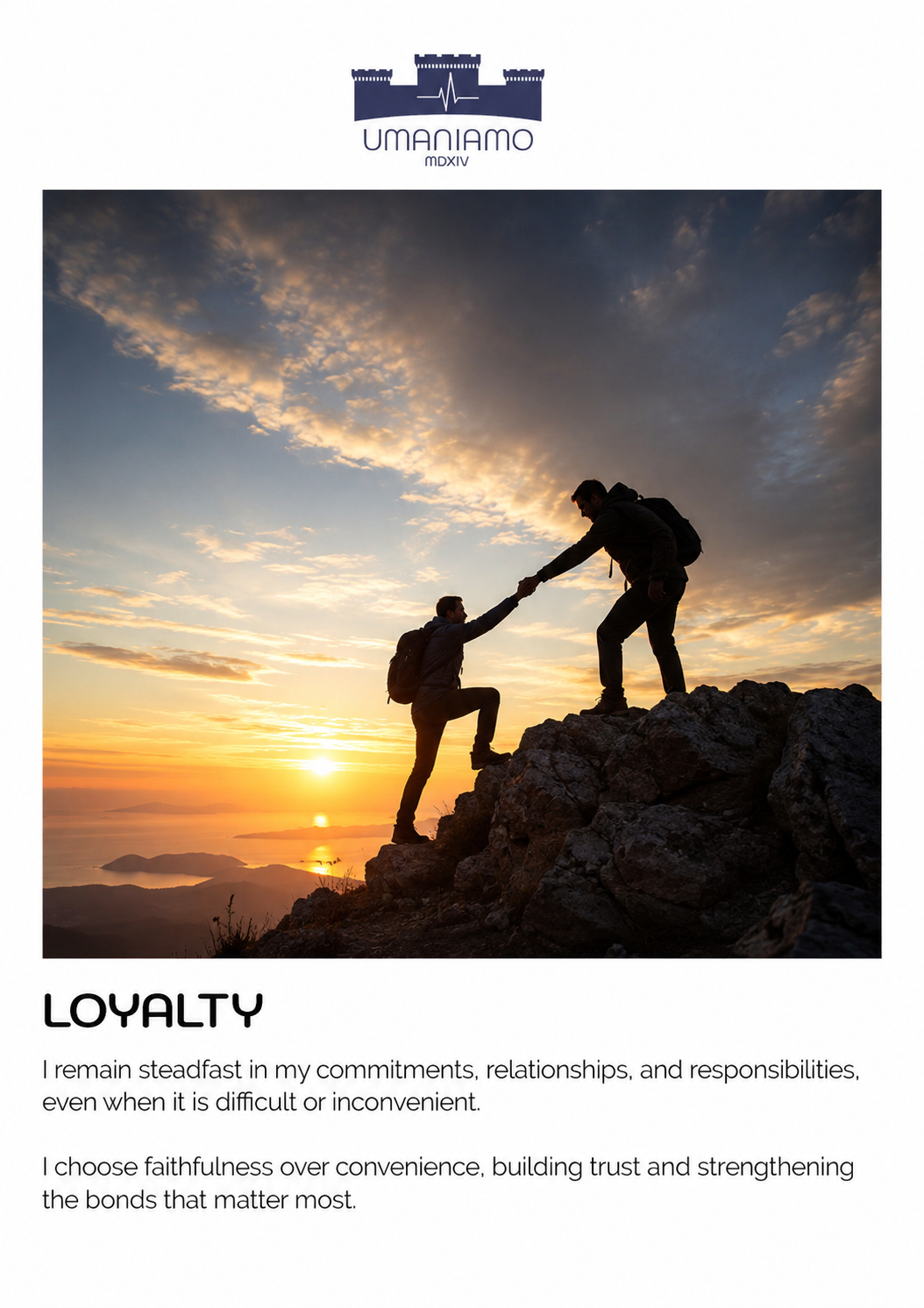
Loyalty is one of those words that has become difficult to use without suspicion. It can suggest blindness, dependency, tribalism, or staying too long in places that have stopped being healthy. In a culture that prizes mobility, optionality, personal branding, and constant reinvention, loyalty can even look like a failure to keep one’s options open.
Yet loyalty, rightly understood, is neither blind obedience nor passive endurance. It requires discernment because not everything deserves it, time because true loyalty cannot be manufactured in a moment, character because loyalty becomes visible precisely when remaining faithful costs something, and freedom because coerced loyalty is not loyalty at all.
This is why loyalty may be one of the most sacred relational qualities we can cultivate. Relational Safety creates the conditions in which people can speak, question, disagree, tell the truth, and remain present without being reduced or punished. Relational Sustainment goes further by asking whether the relationship can endure through disappointment, correction, conflict, injury, growth, and repair. Loyalty belongs beyond both. It begins to emerge when safety has been tested, sustainment has been practiced, and the relationship has survived enough reality to become trustworthy.
In that sense, loyalty is not the starting point. It is fruit.
The image of the Olive and the Vine helps us see why. The olive tree reminds us of the singular person: rooted, particular, enduring, carrying a life that cannot be reduced to utility. The vine reminds us that no person matures alone. Life travels through relationships, shared meals, pruning, fruitfulness, memory, and care. The olive protects the irreducibility of the one; the vine reveals that the one was never meant for isolation. Loyalty grows where both remain true at the same time.
The Devil at Work distorts loyalty in two directions. On one side, he turns it into bondage. He whispers that good people should remain no matter what, keep silent for the sake of unity, protect institutions from criticism, defend leaders because questioning would be betrayal, and accept extraction in the name of commitment. This is false loyalty because it asks the olive to surrender its roots in order to remain attached to the vine.
On the other side, the Devil at Work turns freedom into detachment. He tells us not to depend on anyone, not to commit deeply, not to remain when relationships become inconvenient, and not to risk being known well enough to be disappointed. This distortion protects the olive by cutting it off from every vine, leaving the person independent but increasingly unrooted in shared life.
True loyalty refuses both lies. It allows the person to remain distinct while becoming more faithful in relationship with another. It preserves freedom without abandoning fidelity and preserves commitment without requiring self-erasure.
Loyalty must be discerned, since before we can be loyal, we have to ask what we are being loyal to. Is my loyalty to a person, to truth, to a role, to a mission, to an institution, to my own reputation, to the relationship itself, or to the Author whose presence gives every other loyalty its proper place? Without that question, a person can remain faithful to the wrong thing with extraordinary consistency.
The Shield Wall helps clarify the distinction. A genuine Shield Wall does not bind people together merely because they are useful to one another. It is not a simple pact of reciprocal protection in which each person defends the arrangement so long as the arrangement protects them. That would be a phantom shield wall, closer to relational usury than loyalty.
A real Shield Wall is formed by people who remain distinct, grounded, and answerable while learning how to protect the conditions in which the person beside them can remain fully human. It protects conscience, dignity, truth, difference, responsibility, correction, and service. Its strength comes not from sameness but from fidelity.
Here the Olive and Vine return again. The olive says, “I must remain rooted in what has been Authored into me.” The vine says, “What I carry must become available in relationship with others.” The Shield Wall says, “Our relationship must become strong enough to preserve both.” Loyalty is one of the qualities that tells us this architecture is becoming real.
That makes loyalty more sacred than relational safety alone. Relational Safety asks whether I can speak honestly here. Loyalty asks whether you will still be here after I do. Relational Safety asks whether disagreement is permitted. Loyalty asks whether the relationship can survive disagreement without collapsing into exile, retaliation, or contempt. Relational Sustainment asks whether repair is possible over time. Loyalty becomes visible when repair has actually occurred and both people discover that the relationship now carries more truth than it did before.
This kind of loyalty cannot be forced. It is earned through repeated evidence and offered voluntarily. It grows when someone keeps confidence even when disclosure would be advantageous, when a person tells the truth privately before criticizing publicly, when apology is followed by changed behavior, and when people remain present through failure without pretending failure did not matter. Over time, those acts create a relational memory.
That memory matters because loyalty is built less from promises than from accumulated evidence that tells us something about the person beside us: this person does not disappear when difficulty arrives; this person does not exploit what I reveal; this person can challenge me without humiliating me; this person can remain close without trying to own me; this person can change without abandoning what is true.
That is loyalty becoming character.
The Spirit at Work appears here not as sentimentality but as right ordering within and among the Shield Wall. The Spirit does not ask us to remain in every relationship regardless of harm, nor to protect every institution because we once belonged to it. The Spirit draws loyalty toward truth, dignity, vocation, conscience, service, and the good of the person.
Sometimes loyalty means staying. At other times it means confronting, forgiving, setting a boundary, stepping away without hatred, or returning after separation because something real has changed. Loyalty cannot therefore be reduced to physical proximity or duration. It is fidelity to what is true and good in relationships.
We introduced Loyalty as a new REDISCOVER U® Card almost a year ago thanks to Paolo Vizziello. Loyalty sometimes needs a reminder because if you don’t know what you carry, it’s easier to confuse dependency with loyalty or mistake our preferred strength for virtue. Someone who prefers to not make waves (Peacekeeping Approach) may preserve harmony long after truth has disappeared. Someone with a keen Practical Sense (Detail oriented thinking) may remain faithful to a role because continuity itself feels righteous. Another with a propensity for evidence based Discerning may stay loyal to a conclusion long after contrary evidence deserves attention. A person with a Visionary Mindset (Prospective thinking) may abandon commitments too quickly because novelty feels like growth.
Strengths do not guarantee loyalty. They shape how loyalty may be lived well or distorted.
The Six Promises help you test the difference. Care for the Whole Person keeps loyalty from demanding self-erasure. Empower Individuals for a Greater Purpose ensures that loyalty strengthens agency rather than creating dependence. Integrate Faith and Science keeps fidelity open to evidence as well as conscience. Encourage Reflection and Discernment prevents commitment from hardening into blindness. Value Every Act of Service recognizes the quiet acts through which loyalty is usually built. Invite Continuous Growth allows relationships to evolve rather than requiring people to remain frozen in the version of themselves we first knew. Where these Promises remain alive, loyalty can mature. Where they disappear, loyalty often becomes performance.
Performative loyalty may look convincing from the outside. People repeat the correct language, defend the correct leaders, attend the correct events, signal allegiance publicly, and remain careful about what they say privately. Yet the relationship itself may be hollow because everyone understands the cost of honesty. That is not loyalty. It is compliance wearing relational clothing.
True loyalty has a different texture. It does not require constant proof because it has history. It is not threatened by every disagreement because the relationship is larger than the disagreement. It is not possessive because it has learned that another person can remain faithful while remaining free.
Perhaps that is why loyalty feels so precious now. We live in a time when relationships can be formed quickly, monetized efficiently, dissolved quietly, and replaced almost immediately. Networks can become enormous while trust remains thin. Institutions can demand commitment while offering little reciprocal fidelity. Political, ideological, professional, and even religious communities can ask for loyalty while treating dissent as contamination. Loyalty resists that economy because loyalty takes time.
Like the olive, it grows slowly. Like the vine, it requires tending. Like the Shield Wall, it depends upon practiced presence. It cannot be optimized into existence, purchased through benefits, commanded by policy, or manufactured through slogans. It emerges when people remain sufficiently free to choose one another again and again after reality has removed the illusion.
That is why loyalty is sacred. It is love with memory, fidelity tested by truth, trust that has survived correction, and freedom that chooses responsibility. It is the quiet recognition that when the Shield Wall is tested, the person beside us will not abandon their place merely because standing there has become costly.
The Devil at Work works to cheapen loyalty into compliance or dissolve it into convenience. The Spirit at Work forms something different: people rooted enough to remain themselves, connected enough to carry one another, humble enough to change, courageous enough to speak, and faithful enough to stay when staying serves what is true.
Over time, such people become trustworthy to one another, and that trust becomes part of the living architecture around them. The olive remains rooted, the vine remains connected, and the Shield Wall begins to hold not because everyone is the same or protected from difficulty, but because the people within it have learned how to remain human together.
That may be one of the most precious forms of Magis we can recognize. Loyalty is not a requirement imposed upon the Shield Wall from the outside. It is one of the fruits that tells us the Wall has become real.
Ad maiorem Dei gloriam. We are human together or not at all.
“Lealtà” è una di quelle parole che è diventato difficile usare senza destare sospetti. Può suggerire cecità, dipendenza, tribalismo o il rimanere troppo a lungo in contesti che hanno smesso di essere salutari. In una cultura che valorizza la mobilità, la libertà di scelta, il personal branding e la costante reinvenzione, la lealtà può persino apparire come l’incapacità di tenersi aperte tutte le opzioni.
Eppure la lealtà, se intesa correttamente, non è né obbedienza cieca né sopportazione passiva. Richiede discernimento perché non tutto la merita, tempo perché la vera lealtà non può essere costruita in un istante, carattere perché la lealtà diventa visibile proprio quando rimanere fedeli costa qualcosa, e libertà perché la lealtà imposta non è affatto lealtà.
Ecco perché la lealtà può essere una delle qualità relazionali più sacre che possiamo coltivare. La sicurezza relazionale crea le condizioni in cui le persone possono parlare, porre domande, dissentire, dire la verità e rimanere presenti senza essere sminuite o punite. Il sostegno relazionale va oltre, chiedendosi se la relazione possa resistere alle delusioni, alle correzioni, ai conflitti, alle ferite, alla crescita e alla riconciliazione. La lealtà va oltre entrambe. Comincia ad emergere quando la sicurezza è stata messa alla prova, il sostegno è stato praticato e la relazione è sopravvissuta a abbastanza realtà da diventare affidabile.
In questo senso, la lealtà non è il punto di partenza. È il frutto.
L’immagine dell’ulivo e della vite ci aiuta a capire perché. L’ulivo ci ricorda la persona singolare: radicata, particolare, duratura, portatrice di una vita che non può essere ridotta a mera utilità. La vite ci ricorda che nessuna persona matura da sola. La vita si sviluppa attraverso le relazioni, i pasti condivisi, la potatura, la fecondità, la memoria e la cura. L’ulivo tutela l’irriducibilità dell’individuo; la vite rivela che l’individuo non è mai stato destinato all’isolamento. La lealtà cresce laddove entrambi rimangono fedeli allo stesso tempo.
Il Diavolo all’opera distorce la lealtà in due direzioni. Da un lato, la trasforma in schiavitù. Sussurra che le persone buone dovrebbero restare a tutti i costi, tacere per amore dell’unità, proteggere le istituzioni dalle critiche, difendere i leader perché mettere in discussione significherebbe tradimento, e accettare lo sfruttamento in nome dell’impegno. Questa è falsa lealtà perché chiede all’ulivo di rinunciare alle proprie radici per rimanere attaccato alla vite.
D’altro canto, il Diavolo al lavoro trasforma la libertà in distacco. Ci dice di non dipendere da nessuno, di non impegnarci profondamente, di non restare quando le relazioni diventano scomode e di non rischiare di farci conoscere abbastanza bene da rimanere delusi. Questa distorsione protegge l’ulivo tagliandolo fuori da ogni vite, lasciando la persona indipendente ma sempre più sradicata dalla vita condivisa.
La vera lealtà rifiuta entrambe le menzogne. Permette alla persona di rimanere distinta pur diventando più fedele nel rapporto con l’altro. Preserva la libertà senza abbandonare la fedeltà e preserva l’impegno senza richiedere l’annullamento di sé.
La lealtà deve essere discernuta, poiché prima di poter essere leali, dobbiamo chiederci a cosa siamo leali. La mia lealtà è verso una persona, verso la verità, verso un ruolo, verso una missione, verso un’istituzione, verso la mia stessa reputazione, verso la relazione stessa, o verso l’Autore la cui presenza dà a ogni altra lealtà il suo giusto posto? Senza quella domanda, una persona può rimanere fedele alla cosa sbagliata con straordinaria coerenza.
Il «Muro di Scudo» aiuta a chiarire la distinzione. Un vero «Muro di Scudo» non lega le persone tra loro semplicemente perché sono utili l’una all’altra. Non è un semplice patto di protezione reciproca in cui ciascuno difende l’accordo fintanto che l’accordo lo protegge. Quello sarebbe un «Muro di Scudo» fantasma, più vicino all’usura relazionale che alla lealtà.
Un vero Muro Scudo è formato da persone che rimangono distinte, ben radicate e responsabili, mentre imparano a proteggere le condizioni in cui la persona accanto a loro possa rimanere pienamente umana. Protegge la coscienza, la dignità, la verità, la differenza, la responsabilità, la correzione e il servizio. La sua forza non deriva dall’uniformità, ma dalla fedeltà.
Qui tornano di nuovo l’ulivo e la vite. L’ulivo dice: «Devo rimanere radicato in ciò che è stato inscritto in me». La vite dice: «Ciò che porto deve diventare disponibile nella relazione con gli altri». Il muro di scudo dice: «La nostra relazione deve diventare abbastanza forte da preservare entrambi». La lealtà è una delle qualità che ci dice che questa architettura sta diventando reale.
Ciò rende la lealtà più sacra della sola sicurezza relazionale. La sicurezza relazionale chiede se qui posso parlare onestamente. La lealtà chiede se sarai ancora qui dopo che l’avrò fatto. La sicurezza relazionale chiede se il disaccordo è permesso. La lealtà chiede se la relazione possa sopravvivere al disaccordo senza crollare nell’esilio, nella ritorsione o nel disprezzo. Il sostegno relazionale chiede se la riparazione sia possibile nel tempo. La lealtà diventa visibile quando la riparazione è effettivamente avvenuta ed entrambe le persone scoprono che la relazione ora racchiude più verità di prima.
Questo tipo di lealtà non può essere imposta. Si guadagna attraverso prove ripetute e viene offerta volontariamente. Cresce quando qualcuno mantiene la riservatezza anche quando rivelare sarebbe vantaggioso, quando una persona dice la verità in privato prima di criticare pubblicamente, quando alle scuse segue un cambiamento nel comportamento e quando le persone rimangono presenti anche nei momenti di fallimento senza fingere che il fallimento non abbia importanza. Nel tempo, questi atti creano una memoria relazionale.
Quella memoria è importante perché la lealtà si costruisce meno sulle promesse che sulle prove accumulate che ci dicono qualcosa della persona che ci sta accanto: questa persona non scompare quando arrivano le difficoltà; questa persona non sfrutta ciò che io rivelo; questa persona sa mettermi alla prova senza umiliarmi; questa persona sa restarmi vicina senza cercare di possedermi; questa persona sa cambiare senza abbandonare ciò che è vero.
Questa è la lealtà che diventa carattere.
Lo Spirito al lavoro si manifesta qui non come sentimentalismo, ma come giusto ordine all’interno e tra le file del «Muro di Scudo». Lo Spirito non ci chiede di rimanere in ogni relazione a prescindere dal danno, né di proteggere ogni istituzione solo perché un tempo ne facevamo parte. Lo Spirito orienta la lealtà verso la verità, la dignità, la vocazione, la coscienza, il servizio e il bene della persona.
A volte lealtà significa restare. Altre volte significa confrontarsi, perdonare, stabilire un confine, allontanarsi senza odio, o tornare dopo una separazione perché qualcosa di reale è cambiato. La lealtà non può quindi essere ridotta alla vicinanza fisica o alla durata. È fedeltà a ciò che è vero e buono nelle relazioni.
Abbiamo introdotto la Lealtà come nuova scheda REDISCOVER U® quasi un anno fa grazie a Paolo Vizziello. A volte la lealtà ha bisogno di un promemoria perché, se non si è consapevoli di ciò che si porta dentro, è più facile confondere la dipendenza con la lealtà o scambiare il proprio punto di forza preferito per una virtù. Chi preferisce non creare tensioni (approccio pacificatore) può preservare l’armonia anche molto tempo dopo che la verità è scomparsa. Chi ha un acuto senso pratico (pensiero orientato ai dettagli) può rimanere fedele a un ruolo perché la continuità in sé sembra giusta. Chi ha una propensione al discernimento basato sulle prove può rimanere fedele a una conclusione anche molto tempo dopo che prove contrarie meritano attenzione. Una persona con una mentalità visionaria (pensiero prospettico) può abbandonare gli impegni troppo in fretta perché la novità sembra sinonimo di crescita.
I punti di forza non garantiscono la lealtà. Essi determinano il modo in cui la lealtà può essere vissuta bene o distorta.
Le Sei Promesse ti aiutano a mettere alla prova la differenza. «Prendersi cura della persona nella sua interezza» impedisce che la lealtà richieda l’annullamento di sé. «Responsabilizzare gli individui per uno scopo più grande» assicura che la lealtà rafforzi l’autonomia piuttosto che creare dipendenza. «Integrare fede e scienza» mantiene la fedeltà aperta alle prove oltre che alla coscienza. «Incoraggiare la riflessione e il discernimento» impedisce che l’impegno si indurisca fino a diventare cecità. «Valorizzare ogni atto di servizio» riconosce gli atti silenziosi attraverso i quali di solito si costruisce la lealtà. «Invitare alla crescita continua» permette alle relazioni di evolversi anziché richiedere alle persone di rimanere congelate nella versione di sé che abbiamo conosciuto inizialmente. Laddove queste Promesse rimangono vive, la lealtà può maturare. Laddove scompaiono, la lealtà spesso si trasforma in una recita.
La lealtà performativa può sembrare convincente dall’esterno. Le persone ripetono le parole giuste, difendono i leader giusti, partecipano agli eventi giusti, segnalano pubblicamente la propria fedeltà e stanno attente a ciò che dicono in privato. Eppure la relazione stessa può essere vuota perché tutti comprendono il costo dell’onestà. Quella non è lealtà. È conformità che indossa le vesti della relazione.
La vera lealtà ha una trama diversa. Non richiede prove costanti perché ha una storia alle spalle. Non è minacciata da ogni disaccordo perché la relazione è più grande del disaccordo stesso. Non è possessiva perché ha imparato che un’altra persona può rimanere fedele pur rimanendo libera.
Forse è per questo che la lealtà sembra così preziosa oggi. Viviamo in un’epoca in cui le relazioni possono essere instaurate rapidamente, monetizzate in modo efficiente, sciolte in silenzio e sostituite quasi immediatamente. Le reti possono diventare enormi mentre la fiducia rimane fragile. Le istituzioni possono esigere impegno pur offrendo poca fedeltà reciproca. Le comunità politiche, ideologiche, professionali e persino religiose possono chiedere lealtà trattando il dissenso come una contaminazione. La lealtà resiste a quell’economia perché la lealtà richiede tempo.
Come l’olivo, cresce lentamente. Come la vite, richiede cura. Come il Muro di Scudo, dipende da una presenza costante. Non può essere ottimizzata fino a esister, acquistata tramite benefici, imposta da politiche o fabbricata con slogan. Emerge quando le persone rimangono sufficientemente libere da scegliersi l’una l’altra ancora e ancora dopo che la realtà ha spazzato via l’illusione.
Ecco perché la lealtà è sacra. È amore con memoria, fedeltà messa alla prova dalla verità, fiducia che è sopravvissuta alla correzione e libertà che sceglie la responsabilità. È il silenzioso riconoscimento che, quando il Muro Scudo viene messo alla prova, la persona accanto a noi non abbandonerà il proprio posto solo perché restare lì è diventato oneroso.
Il Diavolo al Lavoro opera per sminuire la lealtà riducendola a obbedienza o dissolverla nella convenienza. Lo Spirito al Lavoro plasma qualcosa di diverso: persone abbastanza radicate da rimanere se stesse, abbastanza unite da sostenersi a vicenda, abbastanza umili da cambiare, abbastanza coraggiose da parlare e abbastanza fedeli da restare quando restare serve alla verità.
Col tempo, queste persone diventano affidabili le une per le altre, e quella fiducia diventa parte dell’architettura vivente che le circonda. L’ulivo rimane radicato, la vite rimane collegata, e il Muro Scudo comincia a reggere non perché tutti siano uguali o protetti dalle difficoltà, ma perché le persone al suo interno hanno imparato a rimanere umani insieme.
Questa potrebbe essere una delle forme più preziose di Magis che possiamo riconoscere. La lealtà non è un requisito imposto al Muro di Protezione dall’esterno. È uno dei frutti che ci dice che il Muro è diventato reale.
Ad maiorem Dei gloriam. Siamo umani insieme o non lo siamo affatto.
A Blueprint for the Builder at Work
This week, REDISCOVER U® moves you from self-recognition toward relationships. Last week, the invitation was to notice what opens, what aches, and what remains quiet within the Authored self. This week, we turn toward the person beside us and ask a more demanding question: what is it like for another humaned person to encounter me, and what kind of relationship are we actually building together?
The Shield Wall gives us the relational frame. It is not a network of mutual advantage, a pact of protection, or a circle held together by quid pro quo. A true Shield Wall protects the conditions in which people can remain capable of truth, conscience, dignity, correction, freedom, service, and growth. That means relational safety must become more than comfort, loyalty must become more than agreement, and reciprocity must become more than exchange.
The S.M.A.R.T.E.R. Castle™ helps us inspect our relational architecture to notice the people we move toward for help, wisdom, challenge, and support, and the people who come toward us for care, judgment, presence, or authority. This week, do not simply count those relationships. Examine what they are producing through the Six Promises of the Humaning Covenant:
Choose one person you regularly encounter and deliberately resist reducing them to the role they play in your life. This may be a spouse, friend, colleague, employee, family member, client, neighbor, or someone you routinely depend upon.
Spend one conversation noticing more than the function they perform. Ask one question that has nothing to do with what you need from them. Practice D.E.E.P. Listening (Details, Evidence, Empathy, Prospective) for what they are carrying physically, emotionally, spiritually, relationally, or practically. How they know they are carrying these and where they see their future. If they describe a challenge, don’t try to solve it for them unless they ask you to.
Ask yourself whether your relationship leaves enough room for the whole person to appear.
Magis Movement: Have one conversation this week in which your only task is to encounter the person rather than extract an answer, favor, performance, reassurance, or outcome.
Notice one relationship in which someone regularly comes to you for help. Before answering, fixing, rescuing, or deciding for them, ask whether your help is increasing their agency or making your involvement increasingly necessary.
This is especially important where your strengths make it easy for you to take over. Leadership, Judgment, Prudence, Social Intelligence, Creativity, or Love of Learning can all become overextended when the person beside us gradually stops exercising their own capacities.
Magis Movement: In one conversation, replace immediate advice with a question that helps the other person exercise judgment: “What do you see?” “What options are you considering?” or “What do you think the next responsible step is?” Help without becoming indispensable.
Choose one relationship in which you have already formed a strong interpretation about the other person. Perhaps you believe they are difficult, unreliable, resistant, selfish, anxious, overly emotional, controlling, or simply wrong.
Now test your interpretation.
What observable evidence supports it? What evidence complicates it? What might their own experience reveal that your current interpretation does not? What does your faith ask you to remember about their dignity, freedom, capacity for growth, and relationship with the Author?
Magis Movement: Hold one person long enough in both evidence and reverence that your interpretation becomes more accurate without becoming less compassionate.
Identify one relationship in which urgency has begun replacing reflection. Perhaps the conversations happen too quickly, conflict escalates before either person has time to think, or expectations have become so routine that no one examines whether they are still healthy.
Create a pause.
Before the next consequential response, ask yourself whether you are reacting to what the person actually said or to the story you have already built around them. Notice whether fear, resentment, loyalty, attraction, obligation, status, or the desire for approval is narrowing your field of attention.
Magis Movement: Delay one response long enough to discern whether you are seeing the person beside you or merely seeing the role they occupy in your existing story.
Relational usury keeps a ledger. Genuine service does not. Notice one person whose quiet contribution has become so familiar that you barely see it anymore. This may be someone who remembers what others forget, cleans what others leave behind, listens without recognition, carries family history, steadies a team, makes introductions, checks on people, or simply continues showing up.
Acknowledge the service without immediately turning gratitude into another request.
Magis Movement: Name one specific act of service and tell the person what it made possible for others. Let recognition itself be the gift.
Choose one relationship in which you may be holding someone inside an old version of themselves. Perhaps they failed you, disappointed you, changed direction, outgrew a role, or simply became different from the person you first knew.
Ask whether your expectations leave room for them to become more fully who they are now.
Then turn the same question toward yourself. Is there a relationship in which you keep performing the person you used to be because you fear what might happen if you change?
Magis Movement: Release one outdated assumption about another person and ask a fresh question rather than relying on an old answer.
At the end of the week, return to the relational span of your Castle and ask: Who leaves my presence more capable? Who leaves more dependent? Which relationships strengthen my judgment? Which requires my silence, performance, or compliance? Where does loyalty feel like fidelity, and where has it become debt?
Choose one relationship that matters enough to examine honestly. It may be strong, strained, confusing, transactional, loyal, dependent, or simply changing. Do not begin by deciding who is right. Begin by examining the architecture.
Details: What is actually happening? Describe the relationship as concretely as possible. Who usually initiates contact? Who asks for help? Who gives it? What happens when either person disagrees, says no, needs space, or changes direction? What promises, expectations, favors, habits, and routines are actually present? Separate what has happened from the interpretation you have assigned to it.
Evidence: What does the relationship consistently produce? Look for patterns rather than isolated moments. Does the relationship produce trust, agency, honesty, courage, growth, and mutual responsibility? Or does it produce anxiety, indebtedness, self-censorship, dependency, performance, resentment, or fear of losing access? If you believe the relationship is safe, what evidence shows that truth has a place in it? If you believe it is loyal, what evidence shows that loyalty survives correction rather than requiring agreement?
Empathy: What might the person beside me be experiencing? How would they describe the relationship if you were not in the room? What does your strongest way of being feel like from their side of the Shield Wall? Do they experience your help as empowering or controlling? Your loyalty as steadfast or possessive? Your honesty as truthful or humiliating? Your availability as care or expectation? Ask not only what you intended, but what your interaction may actually be producing.
Prospective: Where will this relationship lead if nothing changes? Imagine the pattern continuing for another year. Will each person become freer, more capable, more truthful, and more responsible? Or will one become increasingly dependent while the other becomes increasingly necessary? Will trust deepen into loyalty, or will relational safety become more performative? Will the relationship become strong enough to hold difference, or will both people learn to avoid whatever threatens the arrangement? Growth leaves evidence, and so does extraction.
Execution: What one relational action is required now? Do not redesign the entire relationship. Choose one faithful action. It may be telling the truth more clearly, asking rather than assuming, expressing gratitude, setting a boundary, apologizing, giving someone greater responsibility, reducing unnecessary dependence, restoring contact, asking for evidence, or allowing someone to make a decision you would make differently. The goal is not to preserve the relationship at any cost. It is to make the relationship more truthful.
Reflection: What is this relationship forming in me? Notice what happens within you when you imagine changing the pattern. Do you feel fear, relief, grief, anger, freedom, defensiveness, or resistance? What does that movement reveal? Ask whether this relationship is helping you become more available to the Author and more capable of recognizing the Authored person beside you. Does it strengthen conscience and responsibility, or does it make belonging, usefulness, approval, or protection increasingly sovereign?
Then ask one final question: What would love with responsibility look like here?
What Is It Like to Stand Beside Me?
At the end of the week, return to the image of the Shield Wall. Imagine one person standing beside you.
Don’t start with what they owe you, have failed to do, or whether they agree with you. Begin with the fact that they are an Authored person whose life cannot be reduced to their usefulness to you. Then consider what it is like for them to stand beside you.
Can they tell you the truth without fearing the loss of the relationship? Can they disagree without being recast as disloyal? Can they receive your help without accumulating an invisible debt? Can they change without threatening your sense of who they are supposed to be? Can they say no? Can they ask for evidence? Can they leave a conversation with more agency rather than less?
Now turn toward the people you move toward when you need wisdom, help, belonging, protection, influence, reassurance, or opportunity. Do those relationships strengthen your capacity to stand before the Author, or do they increasingly tell you who you must become in order to remain inside? Are you becoming more discerning because of them, or more dependent upon their interpretation? Is loyalty emerging from time, truth, and tested fidelity, or is it being demanded before trust has had time to grow?
A true Shield Wall does not remove vulnerability. It gives vulnerability somewhere trustworthy to exist. It does not make people identical, nor does it eliminate conflict. It creates enough relational strength for difference, truth, repair, service, and conscience to survive the pressure that would otherwise pull people apart.
REDISCOVER U® moves beyond self-knowledge to the larger relational ledger of your life.
Ad maiorem Dei gloriam. We are human together or not at all.
A Blueprint for the Builder at Work
This week, REDISCOVER U® moves you from self-recognition toward relationships. Last week, the invitation was to notice what opens, what aches, and what remains quiet within the Authored self. This week, we turn toward the person beside us and ask a more demanding question: what is it like for another humaned person to encounter me, and what kind of relationship are we actually building together?
The Shield Wall gives us the relational frame. It is not a network of mutual advantage, a pact of protection, or a circle held together by quid pro quo. A true Shield Wall protects the conditions in which people can remain capable of truth, conscience, dignity, correction, freedom, service, and growth. That means relational safety must become more than comfort, loyalty must become more than agreement, and reciprocity must become more than exchange.
The S.M.A.R.T.E.R. Castle™ helps us inspect our relational architecture to notice the people we move toward for help, wisdom, challenge, and support, and the people who come toward us for care, judgment, presence, or authority. This week, do not simply count those relationships. Examine what they are producing through the Six Promises of the Humaning Covenant:
Choose one person you regularly encounter and deliberately resist reducing them to the role they play in your life. This may be a spouse, friend, colleague, employee, family member, client, neighbor, or someone you routinely depend upon.
Spend one conversation noticing more than the function they perform. Ask one question that has nothing to do with what you need from them. Practice D.E.E.P. Listening (Details, Evidence, Empathy, Prospective) for what they are carrying physically, emotionally, spiritually, relationally, or practically. How they know they are carrying these and where they see their future. If they describe a challenge, don’t try to solve it for them unless they ask you to.
Ask yourself whether your relationship leaves enough room for the whole person to appear.
Magis Movement: Have one conversation this week in which your only task is to encounter the person rather than extract an answer, favor, performance, reassurance, or outcome.
Notice one relationship in which someone regularly comes to you for help. Before answering, fixing, rescuing, or deciding for them, ask whether your help is increasing their agency or making your involvement increasingly necessary.
This is especially important where your strengths make it easy for you to take over. Leadership, Judgment, Prudence, Social Intelligence, Creativity, or Love of Learning can all become overextended when the person beside us gradually stops exercising their own capacities.
Magis Movement: In one conversation, replace immediate advice with a question that helps the other person exercise judgment: “What do you see?” “What options are you considering?” or “What do you think the next responsible step is?” Help without becoming indispensable.
Choose one relationship in which you have already formed a strong interpretation about the other person. Perhaps you believe they are difficult, unreliable, resistant, selfish, anxious, overly emotional, controlling, or simply wrong.
Now test your interpretation.
What observable evidence supports it? What evidence complicates it? What might their own experience reveal that your current interpretation does not? What does your faith ask you to remember about their dignity, freedom, capacity for growth, and relationship with the Author?
Magis Movement: Hold one person long enough in both evidence and reverence that your interpretation becomes more accurate without becoming less compassionate.
Identify one relationship in which urgency has begun replacing reflection. Perhaps the conversations happen too quickly, conflict escalates before either person has time to think, or expectations have become so routine that no one examines whether they are still healthy.
Create a pause.
Before the next consequential response, ask yourself whether you are reacting to what the person actually said or to the story you have already built around them. Notice whether fear, resentment, loyalty, attraction, obligation, status, or the desire for approval is narrowing your field of attention.
Magis Movement: Delay one response long enough to discern whether you are seeing the person beside you or merely seeing the role they occupy in your existing story.
Relational usury keeps a ledger. Genuine service does not. Notice one person whose quiet contribution has become so familiar that you barely see it anymore. This may be someone who remembers what others forget, cleans what others leave behind, listens without recognition, carries family history, steadies a team, makes introductions, checks on people, or simply continues showing up.
Acknowledge the service without immediately turning gratitude into another request.
Magis Movement: Name one specific act of service and tell the person what it made possible for others. Let recognition itself be the gift.
Choose one relationship in which you may be holding someone inside an old version of themselves. Perhaps they failed you, disappointed you, changed direction, outgrew a role, or simply became different from the person you first knew.
Ask whether your expectations leave room for them to become more fully who they are now.
Then turn the same question toward yourself. Is there a relationship in which you keep performing the person you used to be because you fear what might happen if you change?
Magis Movement: Release one outdated assumption about another person and ask a fresh question rather than relying on an old answer.
At the end of the week, return to the relational span of your Castle and ask: Who leaves my presence more capable? Who leaves more dependent? Which relationships strengthen my judgment? Which quietly requires my silence, performance, or compliance? Where does loyalty feel like fidelity, and where has it become debt?
Choose one relationship that matters enough to examine honestly. It may be strong, strained, confusing, transactional, loyal, dependent, or simply changing. Do not begin by deciding who is right. Begin by examining the architecture.
Details: What is actually happening? Describe the relationship as concretely as possible. Who usually initiates contact? Who asks for help? Who gives it? What happens when either person disagrees, says no, needs space, or changes direction? What promises, expectations, favors, habits, and routines are actually present? Separate what has happened from the interpretation you have assigned to it.
Evidence: What does the relationship consistently produce? Look for patterns rather than isolated moments. Does the relationship produce trust, agency, honesty, courage, growth, and mutual responsibility? Or does it produce anxiety, indebtedness, self-censorship, dependency, performance, resentment, or fear of losing access? If you believe the relationship is safe, what evidence shows that truth has a place in it? If you believe it is loyal, what evidence shows that loyalty survives correction rather than requiring agreement?
Empathy: What might the person beside me be experiencing? How would they describe the relationship if you were not in the room? What does your strongest way of being feel like from their side of the Shield Wall? Do they experience your help as empowering or controlling? Your loyalty as steadfast or possessive? Your honesty as truthful or humiliating? Your availability as care or expectation? Ask not only what you intended, but what your interaction may actually be producing.
Prospective: Where will this relationship lead if nothing changes? Imagine the pattern continuing for another year. Will each person become freer, more capable, more truthful, and more responsible? Or will one become increasingly dependent while the other becomes increasingly necessary? Will trust deepen into loyalty, or will relational safety become more performative? Will the relationship become strong enough to hold difference, or will both people learn to avoid whatever threatens the arrangement? Growth leaves evidence, and so does extraction.
Execution: What one relational action is required now? Do not redesign the entire relationship. Choose one faithful action. It may be telling the truth more clearly, asking rather than assuming, expressing gratitude, setting a boundary, apologizing, giving someone greater responsibility, reducing unnecessary dependence, restoring contact, asking for evidence, or allowing someone to make a decision you would make differently. The goal is not to preserve the relationship at any cost. It is to make the relationship more truthful.
Reflection: What is this relationship forming in me? Notice what happens within you when you imagine changing the pattern. Do you feel fear, relief, grief, anger, freedom, defensiveness, or resistance? What does that movement reveal? Ask whether this relationship is helping you become more available to the Author and more capable of recognizing the Authored person beside you. Does it strengthen conscience and responsibility, or does it make belonging, usefulness, approval, or protection increasingly sovereign?
Then ask one final question: What would love with responsibility look like here?
What Is It Like to Stand Beside Me?
At the end of the week, return to the image of the Shield Wall. Imagine one person standing beside you.
Don’t start with what they owe you, have failed to do, or whether they agree with you. Begin with the fact that they are an Authored person whose life cannot be reduced to their usefulness to you. Then consider what it is like for them to stand beside you.
Can they tell you the truth without fearing the loss of the relationship? Can they disagree without being recast as disloyal? Can they receive your help without accumulating an invisible debt? Can they change without threatening your sense of who they are supposed to be? Can they say no? Can they ask for evidence? Can they leave a conversation with more agency rather than less?
Now turn toward the people you move toward when you need wisdom, help, belonging, protection, influence, reassurance, or opportunity. Do those relationships strengthen your capacity to stand before the Author, or do they increasingly tell you who you must become in order to remain inside? Are you becoming more discerning because of them, or more dependent upon their interpretation? Is loyalty emerging from time, truth, and tested fidelity, or is it being demanded before trust has had time to grow?
A true Shield Wall does not remove vulnerability. It gives vulnerability somewhere trustworthy to exist. It does not make people identical, nor does it eliminate conflict. It creates enough relational strength for difference, truth, repair, service, and conscience to survive the pressure that would otherwise pull people apart.
REDISCOVER U® moves beyond self-knowledge to the larger relational ledger of your life.
Ad maiorem Dei gloriam. We are human together or not at all.
Un progetto per il costruttore all’opera
Questa settimana, REDISCOVER U® ti accompagna dal riconoscimento di te stesso verso le relazioni. La settimana scorsa, l’invito era a notare ciò che si apre, ciò che fa male e ciò che rimane silenzioso all’interno del sé Autore. Questa settimana, ci rivolgiamo alla persona che ci sta accanto e poniamo una domanda più impegnativa: com’è per un altro essere umano incontrarmi, e che tipo di relazione stiamo effettivamente costruendo insieme?
Il Muro Scudo ci offre la struttura relazionale. Non è una rete di vantaggi reciproci, un patto di protezione o un cerchio tenuto insieme da un do ut des. Un vero Muro Scudo tutela le condizioni in cui le persone possano rimanere capaci di verità, coscienza, dignità, correzione, libertà, servizio e crescita. Ciò significa che la sicurezza relazionale deve diventare più che semplice conforto, la lealtà deve diventare più che semplice accordo e la reciprocità deve diventare più che semplice scambio.
Il S.M.A.R.T.E.R. Castle™ ci aiuta a esaminare la nostra architettura relazionale per individuare le persone verso cui ci rivolgiamo in cerca di aiuto, saggezza, stimoli e sostegno, e quelle che si rivolgono a noi in cerca di cura, giudizio, presenza o autorità. Questa settimana, non limitarti a contare quelle relazioni. Esamina ciò che stanno producendo attraverso le Sei Promesse del Patto Umanizzante:
Scegli una persona che incontri regolarmente e resisti deliberatamente alla tentazione di ridurla al ruolo che ricopre nella tua vita. Potrebbe trattarsi del coniuge, di un amico, di un collega, di un dipendente, di un familiare, di un cliente, di un vicino o di qualcuno su cui fai abitualmente affidamento.
Dedica una conversazione a notare qualcosa di più della funzione che svolge. Poni una domanda che non abbia nulla a che fare con ciò di cui hai bisogno da lui o lei. Metti in pratica l’ascolto D.E.E.P. (Dettagli, Prove, Empatia, Prospettiva) per capire cosa sta vivendo fisicamente, emotivamente, spiritualmente, relazionalmente o concretamente. Come sa di vivere queste esperienze e dove vede il proprio futuro. Se descrive una sfida, non cercare di risolverla per lui a meno che non te lo chieda.
Chiediti se la tua relazione lascia spazio sufficiente affinché la persona nella sua interezza possa emergere.
Movimento Magis: Questa settimana, avvia una conversazione in cui il tuo unico compito sia quello di entrare in contatto con la persona, piuttosto che ottenere una risposta, un favore, una prestazione, una rassicurazione o un risultato.
Presta attenzione a una relazione in cui qualcuno si rivolge regolarmente a te in cerca di aiuto. Prima di rispondere, risolvere, soccorrere o decidere al posto loro, chiediti se il tuo aiuto stia aumentando la loro autonomia o rendendo il tuo coinvolgimento sempre più necessario.
Questo è particolarmente importante quando i tuoi punti di forza ti rendono facile prendere il controllo. Leadership, Giudizio, Prudenza, Intelligenza sociale, Creatività o Amore per l’apprendimento possono tutti diventare eccessivi quando la persona accanto a noi smette gradualmente di esercitare le proprie capacità.
Movimento Magis: In una conversazione, sostituisci il consiglio immediato con una domanda che aiuti l’altra persona a esercitare il proprio giudizio: «Cosa vedi?», «Quali opzioni stai valutando?» o «Quale pensi sia il prossimo passo responsabile?». Aiuta senza diventare indispensabile.
Scegli una relazione in cui ti sei già fatto un'opinione ben definita sull'altra persona. Forse credi che sia difficile, inaffidabile, restia, egoista, ansiosa, eccessivamente emotiva, prepotente o semplicemente in torto.
Ora metti alla prova la tua interpretazione.
Quali prove osservabili la sostengono? Quali prove la complicano? Cosa potrebbe rivelare la sua esperienza che la tua attuale interpretazione non coglie? Cosa ti chiede la tua fede di ricordare riguardo alla sua dignità, libertà, capacità di crescita e relazione con l’Autore?
Movimento Magis: Considera una persona abbastanza a lungo, sia alla luce delle prove che con riverenza, affinché la tua interpretazione diventi più accurata senza perdere in compassione.
Individua una relazione in cui l’urgenza ha iniziato a sostituire la riflessione. Forse le conversazioni si susseguono troppo rapidamente, il conflitto si inasprisce prima che una delle due persone abbia il tempo di pensare, oppure le aspettative sono diventate così abituali che nessuno si chiede se siano ancora salutari.
Crea una pausa.
Prima della prossima risposta determinante, chiediti se stai reagendo a ciò che la persona ha effettivamente detto o alla storia che hai già costruito attorno a lei. Nota se la paura, il risentimento, la lealtà, l’attrazione, l’obbligo, lo status o il desiderio di approvazione stanno restringendo il tuo campo di attenzione.
Movimento Magis: Ritarda una risposta abbastanza a lungo da discernere se stai vedendo la persona accanto a te o semplicemente il ruolo che occupa nella tua storia preesistente.
L’usura relazionale tiene un registro. Il servizio autentico no. Individua una persona il cui contributo silenzioso è diventato così familiare che ormai quasi non lo noti più. Potrebbe trattarsi di qualcuno che ricorda ciò che gli altri dimenticano, pulisce ciò che gli altri lasciano in giro, ascolta senza aspettarsi riconoscimenti, porta avanti la storia di famiglia, stabilizza un gruppo, fa da tramite, si prende cura delle persone o semplicemente continua a esserci.
Riconosci il servizio senza trasformare immediatamente la gratitudine in un’altra richiesta.
Movimento Magis: Indica un atto specifico di servizio e spiega alla persona cosa ha reso possibile agli altri. Lascia che il riconoscimento stesso sia il dono.
Scegli una relazione in cui potresti trattenere qualcuno in una versione ormai superata di sé stesso. Forse ti ha deluso, ti ha tradito, ha cambiato direzione, è cresciuto oltre un ruolo o è semplicemente diventato diverso dalla persona che conoscevi all’inizio.
Chiediti se le tue aspettative lasciano spazio affinché possa diventare più pienamente chi è ora.
Poi rivolgi la stessa domanda a te stesso. C’è una relazione in cui continui a recitare il ruolo della persona che eri un tempo perché temi ciò che potrebbe accadere se cambiassi?
Movimento Magis: Lascia andare un presupposto superato su un’altra persona e poni una domanda nuova invece di affidarti a una vecchia risposta.
Alla fine della settimana, torna allo spazio relazionale del tuo Castello e chiediti: Chi se ne va dalla mia presenza più capace? Chi se ne va più dipendente? Quali relazioni rafforzano il mio giudizio? Quale richiede silenziosamente il mio silenzio, la mia recita o la mia acquiescenza? Dove la lealtà sembra fedeltà, e dove è diventata un debito?
Scegli una relazione abbastanza importante da esaminarla onestamente. Può essere forte, tesa, confusa, transazionale, leale, dipendente o semplicemente in fase di cambiamento. Non iniziare decidendo chi ha ragione. Inizia esaminandone la struttura.
Dettagli: Cosa sta realmente accadendo? Descrivi la relazione nel modo più concreto possibile. Chi di solito prende l’iniziativa? Chi chiede aiuto? Chi lo offre? Cosa succede quando una delle due persone è in disaccordo, dice di no, ha bisogno di spazio o cambia direzione? Quali promesse, aspettative, favori, abitudini e routine sono effettivamente presenti? Separa ciò che è accaduto dall’interpretazione che gli hai attribuito.
Evidenza: Cosa produce costantemente la relazione? Cerca schemi ricorrenti piuttosto che momenti isolati. La relazione genera fiducia, autonomia, onestà, coraggio, crescita e responsabilità reciproca? Oppure genera ansia, senso di debito, autocensura, dipendenza, prestazione, risentimento o paura di perdere l’accesso? Se ritieni che la relazione sia sicura, quali prove dimostrano che la verità vi trova spazio? Se ritieni che sia leale, quali prove dimostrano che la lealtà resiste alla correzione piuttosto che richiedere l’accordo?
Empatia: Cosa potrebbe provare la persona accanto a me? Come descriverebbe la relazione se tu non fossi nella stanza? Come viene percepito il tuo modo di essere più marcato dal suo lato del “Muro di Scudi”? Percepisce il tuo aiuto come fonte di empowerment o come controllo? La tua lealtà come salda o possessiva? La tua onestà come sincera o umiliante? La tua disponibilità come cura o come aspettativa? Chiediti non solo cosa intendevi, ma cosa la tua interazione potrebbe effettivamente produrre.
Prospettiva: Dove porterà questa relazione se non cambia nulla? Immagina che questo schema continui per un altro anno. Ognuna delle persone diventerà più libera, più capace, più sincera e più responsabile? Oppure una diventerà sempre più dipendente mentre l’altra diventerà sempre più indispensabile? La fiducia si approfondirà fino a diventare lealtà, o la sicurezza relazionale diventerà più di facciata? La relazione diventerà abbastanza forte da reggere le differenze, o entrambe le persone impareranno a evitare tutto ciò che minaccia l’accordo? La crescita lascia tracce, e lo stesso vale per lo sfruttamento.
Esecuzione: Quale azione relazionale è necessaria ora? Non riprogettare l’intera relazione. Scegli un’azione fedele. Potrebbe essere dire la verità in modo più chiaro, chiedere invece di dare per scontato, esprimere gratitudine, stabilire un limite, chiedere scusa, affidare a qualcuno una maggiore responsabilità, ridurre la dipendenza non necessaria, ripristinare il contatto, chiedere prove o permettere a qualcuno di prendere una decisione che tu prenderesti diversamente. L’obiettivo non è preservare la relazione a tutti i costi. È rendere la relazione più sincera.
Riflessione: Cosa sta formando in me questa relazione? Osserva cosa accade dentro di te quando immagini di cambiare lo schema. Provi paura, sollievo, dolore, rabbia, libertà, atteggiamento difensivo o resistenza? Cosa rivela quel movimento? Chiediti se questa relazione ti sta aiutando a diventare più disponibile verso l’Autore e più capace di riconoscere la persona creata dall’Autore accanto a te. Rafforza la coscienza e la responsabilità, oppure rende sempre più dominanti il senso di appartenenza, l’utilità, l’approvazione o la protezione?
Poi poniti un’ultima domanda: Come si manifesterebbe qui l’amore responsabile?
Com’è stare al mio fianco?
Alla fine della settimana, torna all’immagine del Muro di Scudi. Immagina una persona in piedi accanto a te.
Non partire da ciò che ti deve, da ciò che non ha fatto o dal fatto che sia d’accordo con te. Parti dal fatto che è una persona creata dall’Autore, la cui vita non può essere ridotta alla sua utilità per te. Poi considera come sia per lei stare al tuo fianco.
Può dirti la verità senza temere di perdere il rapporto? Può dissentire senza essere bollata come sleale? Può accettare il tuo aiuto senza accumulare un debito invisibile? Può cambiare senza minacciare la tua idea di chi dovrebbe essere? Può dire di no? Può chiedere prove? Può uscire da una conversazione sentendosi più autonoma anziché meno?
Ora rivolgiti alle persone verso cui ti orienti quando hai bisogno di saggezza, aiuto, senso di appartenenza, protezione, influenza, rassicurazione o opportunità. Quelle relazioni rafforzano la tua capacità di presentarti davanti all’Autore, o ti dicono sempre più chi devi diventare per poter rimanere all’interno? Stai diventando più perspicace grazie a loro, o più dipendente dalla loro interpretazione? La lealtà nasce dal tempo, dalla verità e da una fedeltà collaudata, o viene pretesa prima che la fiducia abbia avuto il tempo di crescere?
Un vero «Muro di Scudo» non elimina la vulnerabilità. Offre alla vulnerabilità un luogo affidabile in cui esistere. Non rende le persone identiche, né elimina il conflitto. Crea una forza relazionale sufficiente affinché la differenza, la verità, la riconciliazione, il servizio e la coscienza possano sopravvivere alla pressione che altrimenti allontanerebbe le persone.
REDISCOVER U® va oltre la conoscenza di sé per arrivare al più ampio registro relazionale della tua vita.
Ad maiorem Dei gloriam. Siamo umani insieme o non lo siamo affatto.
Cosiamo | Founder, UMANIAMO® | Humaning Architecture
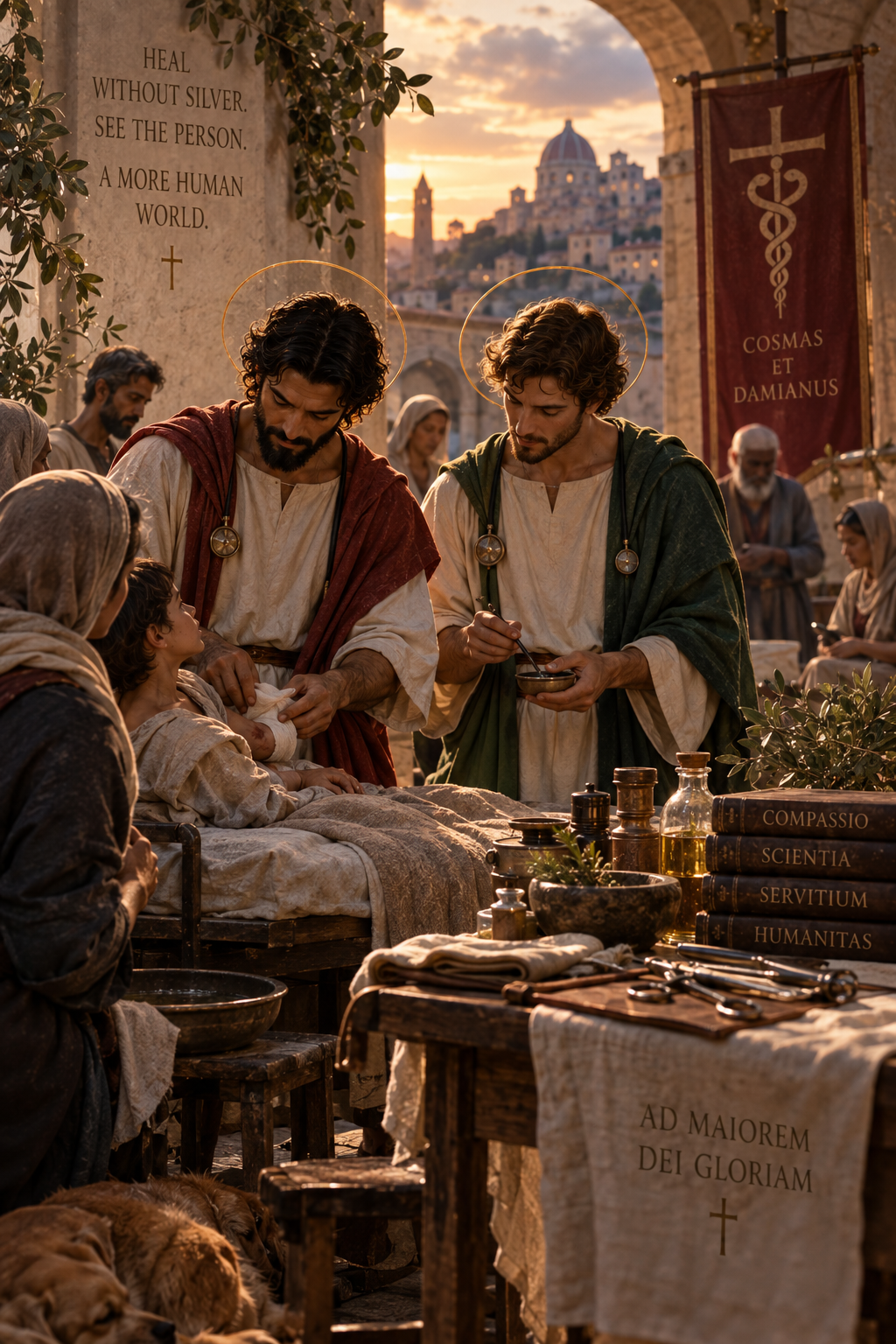
There are saints whose significance seems to belong naturally to the world in which they lived, and there are others whose witness becomes more unsettling as the centuries pass. Saints Cosmas and Damian belong to the second group.
The Church remembers them on September 26 as brothers, physicians, and martyrs. The historical details surrounding their lives come to us through early Christian tradition and later hagiography, so some particulars cannot be established with modern biographical precision. What is remarkably consistent, however, is the memory of two Christian physicians associated with the eastern Roman world who treated the sick without demanding payment. Tradition came to call them anargyroi “without silver” and they became patrons of physicians, surgeons, and pharmacists.
To appreciate the significance of that witness, it helps to recover something of the world in which they were remembered to have lived.
Cosmas and Damian belong to the turbulent transition between the third and fourth centuries, when the Roman Empire was emerging from decades of military, economic, and political instability. The empire was reorganized administratively, imperial authority became more centralized and ceremonial, and what historians call the Tetrarchy (rule of four) divided governing responsibility among several emperors. Christianity, meanwhile, had grown from a small persecuted movement into a visible social presence across parts of the empire.
That visibility did not yet mean security as Roman public life was not divided into the modern categories of “religious” and “secular” that we often take for granted. Civic order, political loyalty, traditional cult, sacrifice, and the perceived favor of the gods were deeply entangled. Refusal to participate in official religious obligations could therefore be interpreted as a threat to public order, not only theological difference. Earlier imperial persecutions under Decius and Valerian had already tested Christian fidelity. Then, beginning in 303, Diocletian and his colleagues launched what became known as the Great Persecution. Imperial edicts ordered churches destroyed, Scriptures surrendered or burned, Christian civil privileges restricted, clergy imprisoned, and eventually Christians compelled to sacrifice.
This is the world in which the memory of Cosmas and Damian takes shape: an empire trying to secure unity, institutions demanding visible conformity, and Christians having to decide where civic obedience ended and fidelity to God began.
Their profession adds another important layer. Medicine in the Graeco-Roman world was sophisticated in some respects but very different from modern clinical practice. Physicians learned through apprenticeship and established medical traditions rather than standardized licensing systems; practice varied widely, and much medicine remained private or itinerant. Roman civilization had developed important public-health infrastructure, military medicine, baths, aqueducts, and sanitation, but hospitals for the general civilian population as we would recognize them were only beginning to emerge much later. Medical treatment drew from accumulated knowledge of plants, minerals, surgery, observation, and inherited Greek medical traditions, while religious understandings of illness and healing remained deeply present.
In other words, Cosmas and Damian did not practice medicine inside an impersonal modern health system. Healing was intensely relational. A sick person encountered a healer directly, and questions of payment, status, obligation, mercy, trust, and religious meaning were difficult to separate.
That makes the tradition that they treated without demanding silver more consequential than it can initially sound. It would be easy to turn it into a pleasant story about two generous doctors. I think it is considerably more disruptive than that.
Cosmas and Damian possessed something other people needed. Their knowledge had value. Their time had value. Whatever medicines and techniques were available to them had value. Yet the suffering person who appeared before them was not first converted into an economic opportunity. Their medical capability did not disappear, nor did competence become unimportant. Capability was ordered toward service.
That distinction feels remarkably contemporary. We now possess forms of medical capability they could scarcely have imagined. A physician can see structures inside the living body without opening it. Surgeons operate with robotic assistance. Genomic information can reveal predispositions long before symptoms arise. Technological Machine Inference can assist with pattern recognition, imaging, documentation, triage, and clinical decision support.
Yet the ancient question remains almost untouched: What is the person for whom all this capability exists? The question extends far beyond medicine.
The S.M.A.R.T.E.R. Castle™ distinguishes between what we can do and who we become in relationship while doing it. Résumé virtues matter because people need skill, knowledge, disciplined practice, and expertise. But those capabilities span toward eulogy virtues: loyalty, courage, presence, service, relational impact, and the way another person actually experiences us. The Castle is strongest when capability and character remain connected.
Cosmas and Damian almost seem made for that architecture. Their enduring witness is not that expertise should disappear in favor of good intentions. It is that expertise should never make another person's vulnerability available for extraction.
That word, “extraction” may be one of the reasons their witness feels so current. Extraction begins when another human being is increasingly understood according to what can be taken from them.
The inversion begins when exchange becomes the architecture through which the person is understood. This is where Cosmas and Damian enter directly into our current work on the First Line of Defense. They lived in an empire where political authority, civic duty, public religion, and institutional conformity could become tightly bound together. Their Christian tradition remembers them as remaining faithful not only in profession but ultimately under persecution. Whether we are looking at their medical service or their martyrdom, the same question appears: What belongs to the institution, and what cannot be surrendered because it belongs to a higher relationship?
That is fundamentally a question of conscience.
Cosmas and Damian are remembered together because their relationship was not just one of reciprocal advantage in which each brother protected the other because mutual protection was useful. Their common vocation faced outward. Whatever strength existed between them was made available to people who needed healing. That makes Cosmas and Damian remarkably close to the image of the Body of Christ. Different members carry different capacities, yet those differences are ordered toward the life of the whole. Capability becomes participation. Most people don’t know this, but when I was inspired to change my name to Cosiamo, it was and is in reverence to Cosimo and Damiano. I took both names and combined them into one. That’s the origin of my name, so September 26th is my onomastico. I still also recognize the onomastico for Sts Peter and Paul on June 29th since my birth name is Peter. In some ways having the names of 3 saints adds a level of accountability to this work for which I am truly grateful
Saints Cosmas and Damian, pray for us.
Ad maiorem Dei gloriam. We are human together, or not at all.
This week’s Onomastici arrives as we move deeper into St. Michael’s Lent and closer to Michaelmas on 29 September. The saints remembered during these seven days offer an unusually coherent pattern for our current work around the Sword, the Shield Wall, conscience, relational safety, and mission. Again and again, we encounter people whose faith became visible in the way they responded when vocation, relationship, pressure, service, and conscience met.
September 21: Saint Matthew, Apostle and Evangelist
Matthew’s feast gives us one of the clearest Table scenes in the Gospel. Jesus sees him at the customs post, calls him, and then sits at table with tax collectors and others whom respectable society had already categorized. The liturgy for the day also places Matthew inside the larger image of the Body of Christ: different gifts are given for the building up of one Body.
Humaning Reflection: Matthew reminds us that vocation often begins with being seen before being useful. Jesus does not reduce Matthew to the role that defined him publicly. He calls the person and then enters into a relationship. The Shield Wall begins in precisely this kind of recognition: distinct people are not erased into a group but called into a shared mission where what each carries can serve something larger. The Sunday Table follows the same movement. We come as particular people, not categories, and we practice seeing one another before deciding what the other is for.
September 22: Saints Maurice and Companions
The tradition of Maurice and the Theban soldiers remembers Christians serving in the Roman army who refused commands they believed would violate their fidelity to God. The historical details developed through an ancient martyr tradition, but the core memory preserved by the Church is one of soldiers who would not allow obedience to political authority to override conscience.
Humaning Reflection: Their story belongs naturally beside our emerging doctrine of Conflict of Conscience. Loyalty is not the same as surrendering judgment. Fidelity becomes meaningful precisely when a person knows what cannot be traded away, even when the surrounding system insists that compliance is simply duty. The Sword here is discernment: what belongs to legitimate authority, and what belongs only to God? The Shield Wall is the courage of people who do not have to face that question entirely alone.
September 23: Saint Pius of Pietrelcina
Padre Pio is remembered as a Capuchin priest whose life became associated with prayer, confession, spiritual direction, suffering, and an intense focus on Christ crucified. The Church celebrates his memorial on September 23.
Humaning Reflection: Padre Pio can remind us that discernment is not simply intellectual sorting. The person doing the discerning is embodied, wounded, emotional, relational, and spiritual. The First Line of Defense therefore includes the formation of the whole person. A sharpened mind without prayer, humility, self-knowledge, or accountability can become its own kind of illusion. Humaning asks whether our practices are making us more available to truth, more capable of responsibility, and more able to remain present to the person before us.
September 24: Our Lady of Mercy and Saint Pacificus of San Severino
September 24 carries several devotional and local commemorations, including Our Lady of Mercy and the Franciscan Saint Pacificus of San Severino, remembered for a life of preaching, service, physical suffering, and fidelity despite severe illness.
Humaning Reflection: Mercy is not softness without truth. It is the refusal to reduce a person to the most difficult thing about them. That makes mercy essential to the Shield Wall. Relational safety cannot mean that nothing difficult is ever named, but neither can truth become a weapon for humiliation or exclusion. The stronger the Wall becomes, the more capable we should become of holding accountability and mercy together.
September 25: Saint Cleopas
Christian tradition remembers Cleopas as one of the disciples associated with the road to Emmaus, the journey in which two discouraged followers encounter the risen Christ without initially recognizing him. September 25 is traditionally associated with his commemoration.
Humaning Reflection: Emmaus may be one of the great Scriptural images of illumination. The disciples possess facts but lack the frame that makes those facts intelligible. Christ walks beside them, asks questions, listens, interprets, and finally becomes recognizable in the breaking of the bread. The movement is almost a pattern for the Sunday Table itself: walk together, speak honestly, allow interpretation to deepen, and remain long enough for recognition to occur. Illumination does not always arrive as a flash. Sometimes it comes because another person stayed beside us long enough for us to see differently.
September 26: Saints Cosmas and Damian
Cosmas and Damian are traditionally remembered as brothers, physicians, and martyrs whose healing ministry became associated with service offered without exploiting those in need.
Humaning Reflection: Their witness speaks directly to the Promise to Value Every Act of Service. Skill becomes Christian service when it is ordered toward the good of the person rather than the extraction of advantage from vulnerability. This is an important distinction in an age when human need can easily become a market, a data point, or an opportunity for capture. The Shield Wall is strengthened whenever competence is offered in a way that leaves the other person more whole, more capable, and more dignified.
September 27: Saint Vincent de Paul
Vincent de Paul devoted his life to organized service of the poor, the formation of clergy, and communities of charity. His memorial continues to place service to those on the margins at the center of Christian vocation.
Humaning Reflection: Vincent reminds us that contemplation must eventually become architecture. Compassion becomes durable when people organize themselves so that service does not depend upon a single heroic individual. That is the movement from Sword to Shield Wall: discern what is true, recognize what must be done, and then build relationships capable of sustaining the work over time. The Builder does not simply perform acts of service; the Builder helps create other people capable of carrying service forward.
Closing Reflection
The week points us toward people becoming sufficiently formed to hear a call, test what is moving them, remain faithful when pressure rises, receive correction and mercy, and then carry what they have received into a righteous relationship.
That is increasingly what the Sword and Shield Wall mean for us. The Sword helps us distinguish what must be protected from what must be surrendered, while the Shield Wall trains us to remain in righteous relationship when that distinction becomes costly. We practice now because fidelity is difficult to improvise under pressure.
Ad maiorem Dei gloriam. We are human together, or not at all.
Cosiamo | Fondatore, UMANIAMO® | Humaning Architecture
Ci sono santi il cui significato sembra appartenere naturalmente al mondo in cui hanno vissuto, e ce ne sono altri la cui testimonianza diventa sempre più sconcertante con il passare dei secoli. I santi Cosma e Damiano appartengono al secondo gruppo.
La Chiesa li ricorda il 26 settembre come fratelli, medici e martiri. I dettagli storici relativi alle loro vite ci giungono attraverso la tradizione paleocristiana e la successiva agiografia, pertanto alcuni particolari non possono essere stabiliti con la precisione biografica moderna. Ciò che risulta tuttavia straordinariamente coerente è il ricordo di due medici cristiani legati al mondo romano d’Oriente che curavano i malati senza chiedere alcun compenso. La tradizione finì per chiamarli anargyroi, «senza argento», e divennero patroni dei medici, dei chirurghi e dei farmacisti.
Per apprezzare il significato di quella testimonianza, è utile ricostruire in parte il mondo in cui si ritiene che abbiano vissuto.
Cosma e Damiano appartengono al turbolento periodo di transizione tra il III e il IV secolo, quando l’Impero Romano stava uscendo da decenni di instabilità militare, economica e politica. L’impero fu riorganizzato dal punto di vista amministrativo, l’autorità imperiale divenne più centralizzata e cerimoniale, e quella che gli storici chiamano la Tetrarchia (governo a quattro) suddivise la responsabilità di governo tra diversi imperatori. Il cristianesimo, nel frattempo, si era trasformato da un piccolo movimento perseguitato in una presenza sociale visibile in diverse parti dell’impero.
Tale visibilità non significava ancora sicurezza, poiché la vita pubblica romana non era suddivisa nelle moderne categorie di «religioso» e «laico» che spesso diamo per scontate. L’ordine civile, la fedeltà politica, il culto tradizionale, il sacrificio e il presunto favore degli dei erano profondamente intrecciati. Il rifiuto di partecipare agli obblighi religiosi ufficiali poteva quindi essere interpretato come una minaccia all’ordine pubblico, non solo come una divergenza teologica. Le precedenti persecuzioni imperiali sotto Decio e Valeriano avevano già messo alla prova la fedeltà cristiana. Poi, a partire dal 303, Diocleziano e i suoi collaboratori diedero il via a quella che divenne nota come la Grande Persecuzione. Gli editti imperiali ordinavano la distruzione delle chiese, la consegna o il rogo delle Scritture, la limitazione dei privilegi civili dei cristiani, l’imprigionamento del clero e, infine, l’obbligo per i cristiani di compiere sacrifici.
È questo il mondo in cui prende forma la memoria di Cosma e Damiano: un impero che cercava di garantire l’unità, istituzioni che esigevano una conformità visibile e cristiani costretti a decidere dove finisse l’obbedienza civica e dove iniziasse la fedeltà a Dio.
La loro professione aggiunge un altro importante livello di complessità. La medicina nel mondo greco-romano era sofisticata sotto certi aspetti, ma molto diversa dalla pratica clinica moderna. I medici apprendevano il mestiere attraverso l’apprendistato e le tradizioni mediche consolidate, piuttosto che attraverso sistemi standardizzati di abilitazione; la pratica variava notevolmente e gran parte della medicina rimaneva privata o itinerante. La civiltà romana aveva sviluppato importanti infrastrutture di sanità pubblica, medicina militare, terme, acquedotti e servizi igienico-sanitari, ma gli ospedali per la popolazione civile in generale, così come li riconosceremmo oggi, cominciarono ad emergere solo molto più tardi. Le cure mediche attingevano alla conoscenza accumulata di piante, minerali, chirurgia, osservazione e alle tradizioni mediche greche ereditate, mentre le concezioni religiose della malattia e della guarigione rimanevano profondamente radicate.
In altre parole, Cosma e Damiano non esercitavano la medicina all’interno di un sistema sanitario moderno e impersonale. La guarigione era intensamente relazionale. Una persona malata entrava direttamente in contatto con un guaritore, e questioni quali il pagamento, lo status sociale, l’obbligo, la misericordia, la fiducia e il significato religioso erano difficili da separare.
Ciò rende la tradizione secondo cui curavano senza chiedere denaro più significativa di quanto possa sembrare a prima vista. Sarebbe facile trasformarla in una storia piacevole su due medici generosi. Penso che sia molto più dirompente di così.
Cosma e Damiano possedevano qualcosa di cui gli altri avevano bisogno. La loro conoscenza aveva valore. Il loro tempo aveva valore. Qualunque fossero le medicine e le tecniche a loro disposizione, avevano valore. Eppure la persona sofferente che si presentava davanti a loro non veniva innanzitutto trasformata in un’opportunità economica. La loro competenza medica non scomparve, né la loro abilità perse importanza. La competenza era orientata al servizio.
Questa distinzione appare straordinariamente attuale. Oggi disponiamo di forme di competenza medica che loro non avrebbero potuto nemmeno immaginare. Un medico può osservare le strutture interne del corpo vivente senza aprirlo. I chirurghi operano con l’ausilio di robot. Le informazioni genomiche possono rivelare predisposizioni molto prima che compaiano i sintomi. L’inferenza tecnologica automatizzata può fornire assistenza nel riconoscimento di schemi, nell’imaging, nella documentazione, nel triage e nel supporto alle decisioni cliniche.
Eppure l’antica domanda rimane quasi intatta: A chi è destinata tutta questa competenza? La domanda si estende ben oltre la medicina.
Il S.M.A.R.T.E.R. Castle™ distingue tra ciò che possiamo fare e chi diventiamo nelle relazioni mentre lo facciamo. Le virtù del curriculum contano perché le persone hanno bisogno di abilità, conoscenza, pratica disciplinata e competenza. Ma tali capacità si estendono verso le virtù elogiative: lealtà, coraggio, presenza, servizio, impatto relazionale e il modo in cui un’altra persona ci percepisce realmente. Il Castello è più forte quando capacità e carattere rimangono collegati.
Cosma e Damiano sembrano quasi fatti apposta per quell’architettura. La loro testimonianza duratura non è che la competenza debba scomparire a favore delle buone intenzioni. È che la competenza non dovrebbe mai rendere la vulnerabilità di un’altra persona disponibile per essere sfruttata.
Quella parola, “sfruttamento”, potrebbe essere uno dei motivi per cui la loro testimonianza appare così attuale. Lo sfruttamento ha inizio quando un altro essere umano viene sempre più compreso in base a ciò che è possibile ottenere da lui.
L’inversione ha inizio quando lo scambio diventa l’architettura attraverso la quale la persona viene compresa. È qui che Cosma e Damiano entrano direttamente nel nostro attuale lavoro sulla Prima Linea di Difesa. Essi vivevano in un impero in cui l’autorità politica, il dovere civico, la religione pubblica e la conformità istituzionale potevano intrecciarsi strettamente. La loro tradizione cristiana li ricorda come fedeli non solo nella professione, ma anche, in ultima analisi, sotto persecuzione. Sia che si consideri il loro servizio medico o il loro martirio, emerge la stessa domanda: Cosa appartiene all’istituzione e cosa non può essere ceduto perché appartiene a un rapporto superiore?
Si tratta fondamentalmente di una questione di coscienza.
Cosma e Damiano sono ricordati insieme perché il loro rapporto non era solo di vantaggio reciproco, in cui ciascun fratello proteggeva l’altro perché la protezione reciproca era utile. La loro vocazione comune era rivolta verso l’esterno. Qualunque forza esistesse tra loro veniva messa a disposizione delle persone che avevano bisogno di guarigione. Ciò rende Cosma e Damiano straordinariamente vicini all’immagine del Corpo di Cristo. Membri diversi possiedono capacità diverse, eppure tali differenze sono orientate verso la vita dell’insieme. La capacità diventa partecipazione. La maggior parte delle persone non lo sa, ma quando ho sentito l’ispirazione di cambiare il mio nome in Cosiamo, è stato ed è in segno di riverenza verso Cosimo e Damiano. Ho preso entrambi i nomi e li ho uniti in uno solo. Questa è l’origine del mio nome, quindi il 26 settembre è il mio onomastico. Continuo comunque a celebrare anche l’onomastico dei Santi Pietro e Paolo il 29 giugno, poiché il mio nome di nascita è Pietro. In un certo senso, avere i nomi di tre santi aggiunge un livello di responsabilità a questo lavoro, cosa di cui sono davvero grato
Santi Cosma e Damiano, pregate per noi.
Ad maiorem Dei gloriam. Siamo umani insieme, oppure non lo siamo affatto.
Gli Onomastici di questa settimana arrivano mentre ci addentriamo nella Quaresima di San Michele e ci avviciniamo alla festa di San Michele del 29 settembre. I santi commemorati durante questi sette giorni offrono uno schema insolitamente coerente per il nostro attuale lavoro incentrato sulla Spada, il Muro di Scudo, la coscienza, la sicurezza relazionale e la missione. Di nuovo e di nuovo, incontriamo persone la cui fede è diventata visibile nel modo in cui hanno reagito quando vocazione, relazione, pressione, servizio e coscienza si sono incontrati.
21 settembre: San Matteo, apostolo ed evangelista
La festa di Matteo ci offre una delle scene a tavola più chiare del Vangelo. Gesù lo vede alla dogana, lo chiama e poi si siede a tavola con i pubblicani e altre persone che la società perbene aveva già etichettato. La liturgia del giorno colloca inoltre Matteo all’interno dell’immagine più ampia del Corpo di Cristo: doni diversi sono concessi per l’edificazione di un unico Corpo.
Riflessione sull’umanità: Matteo ci ricorda che la vocazione spesso inizia con l’essere visti prima ancora di essere utili. Gesù non riduce Matteo al ruolo che lo definiva pubblicamente. Chiama la persona e poi instaura una relazione. Lo «Scudo Murario» ha inizio proprio da questo tipo di riconoscimento: le persone distinte non vengono annettute a un gruppo, ma chiamate a una missione condivisa in cui ciò che ciascuno porta con sé può servire a qualcosa di più grande. La «Mensa Domenicale» segue lo stesso movimento. Veniamo come persone particolari, non come categorie, e ci esercitiamo a guardarci l’un l’altro prima di decidere a cosa serva l’altro.
22 settembre: Santi Maurizio e compagni
La tradizione di Maurizio e dei soldati tebani ricorda i cristiani che prestavano servizio nell’esercito romano e che rifiutarono ordini che ritenevano violassero la loro fedeltà a Dio. I dettagli storici si sono sviluppati attraverso un’antica tradizione martirologica, ma il ricordo fondamentale conservato dalla Chiesa è quello di soldati che non permettevano che l’obbedienza all’autorità politica prevalesse sulla coscienza.
Riflessione “Humaning”: La loro storia si inserisce naturalmente nella nostra dottrina emergente sul conflitto di coscienza. La lealtà non equivale a rinunciare al proprio giudizio. La fedeltà acquista significato proprio quando una persona sa cosa non può essere barattato, anche quando il sistema circostante insiste che l’obbedienza sia semplicemente un dovere. La Spada qui è il discernimento: cosa appartiene all’autorità legittima e cosa appartiene solo a Dio? Il Muro di Scudi è il coraggio di chi non deve affrontare quella domanda del tutto da solo.
23 settembre: San Pio da Pietrelcina
Padre Pio è ricordato come un sacerdote cappuccino la cui vita è stata caratterizzata dalla preghiera, dalla confessione, dalla direzione spirituale, dalla sofferenza e da un’intensa concentrazione su Cristo crocifisso. La Chiesa celebra la sua memoria il 23 settembre.
Riflessione «Humaning»: Padre Pio può ricordarci che il discernimento non è semplicemente una selezione intellettuale. La persona che esercita il discernimento è un essere concreto, ferito, emotivo, relazionale e spirituale. La prima linea di difesa comprende quindi la formazione della persona nella sua interezza. Una mente acuta priva di preghiera, umiltà, conoscenza di sé o senso di responsabilità può diventare una sorta di illusione a sé stante. Humaning si chiede se le nostre pratiche ci rendano più disponibili alla verità, più capaci di assumerci le nostre responsabilità e più capaci di rimanere presenti alla persona che abbiamo davanti.
24 settembre: Madonna della Misericordia e San Pacifico da San Severino
Il 24 settembre è ricco di commemorazioni devozionali e locali, tra cui la Madonna della Misericordia e il santo francescano Pacifico da San Severino, ricordato per una vita di predicazione, servizio, sofferenza fisica e fedeltà nonostante una grave malattia.
Riflessione sull’“Humaning”: La misericordia non è debolezza senza verità. È il rifiuto di ridurre una persona all’aspetto più difficile di sé. Ciò rende la misericordia essenziale per il “Muro di Protezione”. La sicurezza relazionale non può significare che nulla di difficile venga mai menzionato, ma nemmeno la verità può diventare un’arma di umiliazione o esclusione. Più forte diventa il Muro, più dovremmo diventare capaci di conciliare responsabilità e misericordia.
25 settembre: San Cleopa
La tradizione cristiana ricorda Cleopa come uno dei discepoli legati alla strada per Emmaus, il viaggio in cui due seguaci scoraggiati incontrano il Cristo risorto senza riconoscerlo inizialmente. Il 25 settembre è tradizionalmente associato alla sua commemorazione.
Riflessione sull’umanità: Emmaus è forse una delle grandi immagini scritturali dell’illuminazione. I discepoli possiedono i fatti, ma mancano del quadro di riferimento che li renda comprensibili. Cristo cammina al loro fianco, pone domande, ascolta, interpreta e infine si rivela nel momento in cui spezza il pane. Questo percorso è quasi un modello per la stessa Messa domenicale: camminare insieme, parlare con sincerità, lasciare che l’interpretazione si approfondisca e rimanere abbastanza a lungo affinché avvenga il riconoscimento. L’illuminazione non arriva sempre come un lampo. A volte giunge perché un’altra persona è rimasta al nostro fianco abbastanza a lungo da permetterci di vedere le cose in modo diverso.
26 settembre: Santi Cosma e Damiano
Cosma e Damiano sono tradizionalmente ricordati come fratelli, medici e martiri il cui ministero di guarigione è stato associato al servizio offerto senza sfruttare chi è nel bisogno.
Riflessione sull’umanità: La loro testimonianza si ricollega direttamente alla Promessa di Valorizzare Ogni Atto di Servizio. L’abilità diventa servizio cristiano quando è orientata al bene della persona piuttosto che all’estrazione di un vantaggio dalla vulnerabilità. Si tratta di una distinzione importante in un’epoca in cui il bisogno umano può facilmente trasformarsi in un mercato, in un dato statistico o in un’opportunità da sfruttare. Il «Muro di protezione» si rafforza ogni volta che la competenza viene offerta in modo tale da rendere l’altra persona più integra, più capace e più dignitosa.
27 settembre: San Vincenzo de’ Paoli
Vincenzo de’ Paoli dedicò la sua vita al servizio organizzato dei poveri, alla formazione del clero e alle comunità di carità. La sua memoria continua a porre il servizio verso chi vive ai margini al centro della vocazione cristiana.
Riflessione sull’umanità: Vincenzo ci ricorda che la contemplazione deve alla fine trasformarsi in azione concreta. La compassione diventa duratura quando le persone si organizzano in modo che il servizio non dipenda da un singolo individuo eroico. Questo è il passaggio dalla Spada al Muro di Scudi: discernere ciò che è vero, riconoscere ciò che deve essere fatto e poi costruire relazioni in grado di sostenere l’opera nel tempo. Il Costruttore non si limita a compiere atti di servizio; il Costruttore contribuisce a formare altre persone capaci di portare avanti il servizio.
Riflessione conclusiva
Questa settimana ci indica come le persone possano arrivare a essere sufficientemente formate per ascoltare una chiamata, mettere alla prova ciò che le muove, rimanere fedeli quando la pressione aumenta, accogliere la correzione e la misericordia, e poi portare ciò che hanno ricevuto in una relazione retta.
Questo è sempre più ciò che la Spada e il Muro di scudi significano per noi. La Spada ci aiuta a distinguere ciò che deve essere protetto da ciò a cui bisogna rinunciare, mentre il Muro di scudi ci allena a rimanere in una relazione retta quando tale distinzione diventa costosa. Ci esercitiamo ora perché la fedeltà è difficile da improvvisare sotto pressione.
Ad maiorem Dei gloriam. Siamo umani insieme, oppure non lo siamo affatto.
Cosiamo | Founder, UMANIAMO® | Humaning Architecture
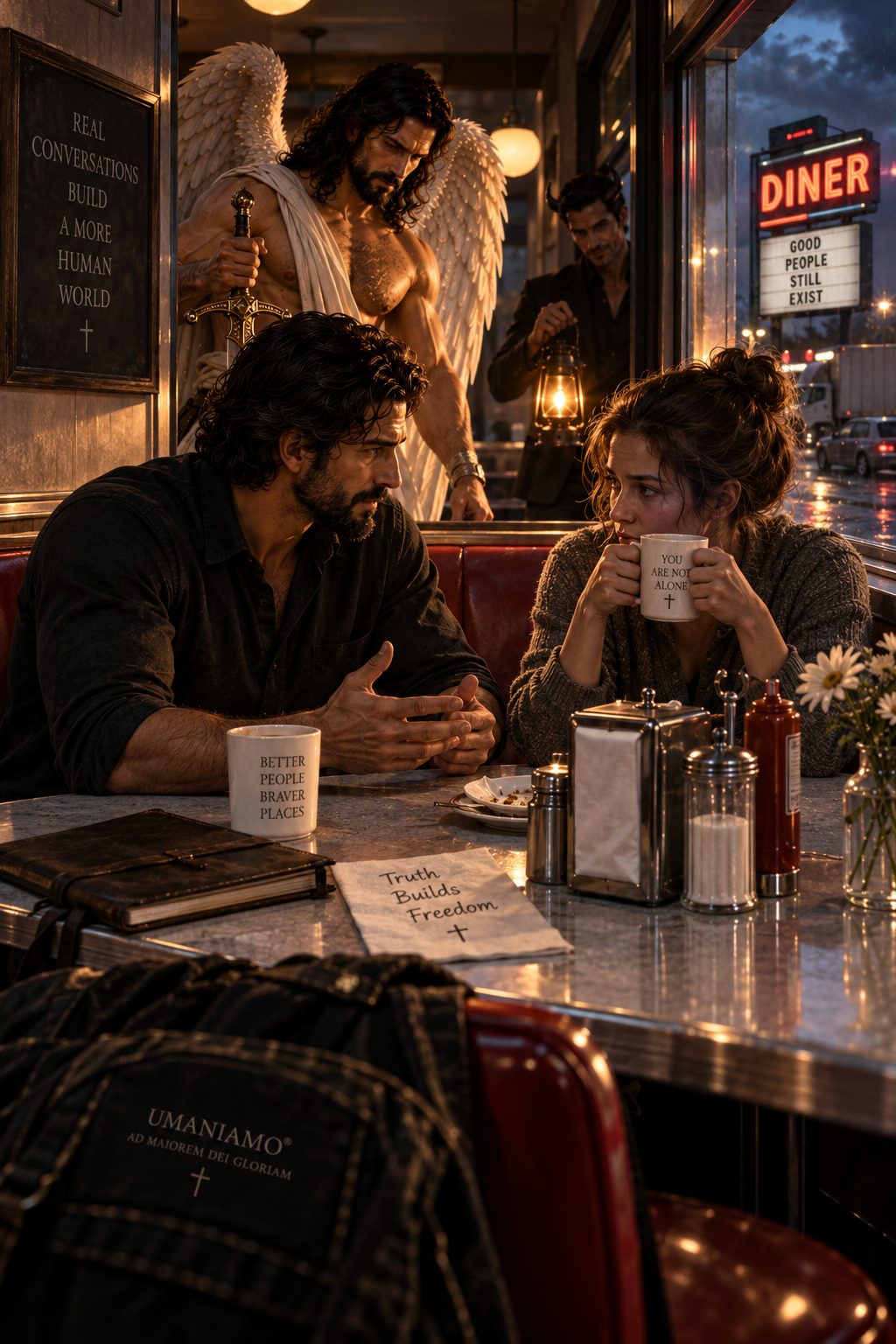
Michael picked the diner on purpose.
It sat off the expressway two towns from the campus, a real ordinary place with cracked vinyl booths and a menu that had not been designed for anything, coffee that came in a heavy white cup from a pot a tired woman with glasses actually carried to the table. He could have suggested that they meet at the company, in one of the glass rooms with the good views and the catered nothing, and that was exactly why he didn't. A man learns things about a conversation by where he holds it, and everything he wanted from this one, which was the truth, the raw friction, the possibility of the word no, lived in a place like this and could not survive in a sterile place where the walls have ears and the glass walls are more like mirrors reflecting back the image of an avatar.
Mara slid into the booth across from him looking like she hadn't decided whether she was coming until she was already in the car. She kept her jacket on. Sally, the waitress drifted toward the table with the coffee pot, coffee? she asked? Michael and Mara both nodded yes. Mara kept her hands visibly wrapped around the cup. And the first thing she did, before he'd said anything at all, was ask him what he wanted from her, flat, tired, bracing, a person who had learned somewhere that when someone with power asks to meet you off the books, there is always a price, and the only useful question is how much.
He sensed her anxiety in that question. He had heard it many times before, on the faces of men who'd been used by institutions that told them the whole time they were being cared for.
"Nothing," he said. "I wanted to ask how you're doing. And I wanted to do it somewhere they don't own the room." She almost laughed the dead little laugh again, then didn't, because he wasn't kidding and she could tell. So instead, slowly, over a bad cup of coffee in a booth two towns from the Wall, she told him how she was doing, and it came out as the plainest description of relational usury he had ever heard, though neither of them used the word.
She had come for the opportunity, four years ago. Real opportunity and that part had been true, the way it's always true when you start a new job in this area. Good work, good money, good people, a mission she'd believed in. And somewhere along the way it had turned, so gradually she could not name the day, into something else. Now she stayed for the equity. The grant vested fully in five months, a number large enough that leaving before it would be, everyone told her, insane, and so she paid, every night, the interest on a thing she could not walk away from. She paid for it in sleep. She paid it in a body that had started doing things she was afraid to see a doctor about because there was no time. She paid it in a slow quiet loss of every friend who wasn't also inside that place. She paid it in silence and in the concerns she no stopped bringing up, because she had watched what happened to people who raised them, had learned that in a company fluent in the language of care and belonging and we take such good care of our people, the one unforgivable act was to say, out loud, that something was wrong. They would let you feel completely safe, she said, right up until the moment you told the truth. Then you found out what the safety had been for.
Michael listened, and did not interrupt, and understood that he was looking at the whole architecture and legacy of his father in one honest conversation.
Because he knew this shape. He had spent a career inside and around walls, and there were two kinds, and they looked identical from a distance and were opposite up close. There was the kind of wall that existed to protect the people inside it to keep them whole, and honest, and free to say the hard thing, a wall whose whole purpose was the men it sheltered. And there was the other kind, the kind that wore all the same words like loyalty, commitment, mission, family, protection, yet it existed to protect itself. The kind where the protection was real but conditional, where you were safe exactly as long as you kept feeding the thing, and where, if you looked closely, the people who'd come seeking shelter had somehow ended up holding the line for the wall… defending it, covering for it, paying its debts with their own lives. Mara had come to that company for protection four years ago. Now she stood watch over its miracle every night, alone, unmet, unthanked, protecting the very arrangement that was quietly consuming her. The shield had changed hands and she hadn't felt it happen. Almost no one ever does.
And sitting there, Michael saw the trap laid out in front of his own feet, clear as wire in the grass.
Because he needed her. That was the plain fact of it. He needed what she knew about the Wall, about the locked door, about the thing the whole floor was being burned to feed. And the easiest thing in the world, the natural thing, the thing every instinct sharpened by the last weeks was pushing him toward, was to recruit her. To make her his to take her exhaustion and her disillusion and her courage and point them at his cause, to trade her a little protection for a lot of risk, to ask her to carry his fight the way the company had asked her to carry its number. And if he did that, he understood with a cold clarity that stopped his hand halfway to his coffee, he would simply be building a second wall of the wrong kind. Another arrangement that called itself care and charged interest underneath. He would be the new usurer wearing a better face. He had come to tear down a Phantom Wall, not to raise one of his own and call it a rescue.
So he did the only thing that made him different from the men he was fighting, and it cost him something, because it meant giving up the leverage he most needed.
"I'm not going to ask you for anything," he said. "I mean that. You don't owe me a word. You can finish this coffee and drive back and vest your equity and never talk to me again, and if anybody in that building comes after you for meeting me today, I will end them, and you will still owe me nothing. That's not a trade. That's just true." He turned the heavy cup a quarter turn on the table. "I'm trying to build something in there, and I can't do it alone, and I'd rather do it with you than without you. But if you help me, it's because you decide to, with your eyes open, and it makes you more free and not less — and the day it stops doing that, you walk, and I hold the door. That's the only kind of thing I'm willing to build. I've seen the other kind. So have you. You're sitting in what it did."
She was quiet for a long time.
Then she did the thing that told him it might actually work, the thing the other wall could never have survived: she pushed back. She told him she didn't trust him yet, that she'd heard beautiful speeches before, that everyone who'd ever extracted anything from her had opened with exactly this kind of decency. She said no to him, in effect, right there not yet, maybe not ever, to prove it and she watched his face to see what saying no would cost her.
It cost her nothing. He nodded like she'd said something wise, because she had. "Good," he said. "Distrust me. Make me earn it. A thing you can't say no to isn't safe, it's just a nicer cage. Say no as many times as you need to." And he meant that too, and she could tell, and something in her shoulders came down half an inch, the specific small easing of a person who has just, for the first time in a very long time, been allowed to refuse and not be punished for it.
They talked for another hour. She gave him a few things, in the end not because he pried them out of her but because she chose to set them on the table between them, a little at a time, testing the ground and finding it held. What the partnership behind the locked door actually was. Why the crunch. Who, besides Prentiss, had reason to keep the owner blind. He took each piece like what it was, a gift and not a spoil, and he gave her his private number and told her to call it at any hour, for any reason, including no reason, and meant that most of all.
And underneath the whole conversation, the way it always ran under everything now, was a boy he didn’t yet know asleep somewhere in the glow of a screen, held captive by a machine that kept running through the night by a woman across a diner booth who had never once been asked how she slept. Two people, the same wall was consuming from opposite ends. He was, he understood, finally standing beside one of them.
One. It was not a line yet. One person, half-trusting, in a booth off the expressway, was not a wall. But it was the first stone of the right kind, laid the right way freely, at no interest, able to be taken back — and Michael knew, paying the check and leaving too large a tip for the tired woman with the pot, that this was the only way the real thing had ever been built. Not recruited. Not extracted. Chosen, one Authored person at a time, each one freer for standing there.
The perimeter was still closing. Prentiss's smiling machinery was still grinding toward him on paper he hadn't been allowed to read. But Michael walked out into the parking lot lighter than he'd gone in, because he finally understood the war he was actually in and it was not going to be won with a sword, or a wall like theirs, but with the slow, unscalable, deeply inconvenient work of building the other kind.
He had two more calls to make in the morning.
Ad maiorem Dei gloriam.
Michael scelse quella tavola calda apposta.
Si trovava vicino all’autostrada, a due città di distanza dal campus: un posto davvero ordinario, con divanetti in vinile screpolato e un menu che non era stato pensato per nulla in particolare, caffè servito in una pesante tazza bianca da una caffettiera che una donna stanca con gli occhiali portava davvero al tavolo. Avrebbe potuto suggerire di incontrarsi in azienda, in una di quelle sale vetrate con una bella vista e un catering che non offriva nulla, ed era proprio per questo che non lo fece. Un uomo impara cose su una conversazione dal luogo in cui la conduce, e tutto ciò che voleva da questa, ovvero la verità, l’attrito crudo, la possibilità della parola no, viveva in un posto come quello e non avrebbe potuto sopravvivere in un luogo asettico dove le pareti hanno orecchie e le pareti di vetro sono più simili a specchi che riflettono l’immagine di un avatar.
Mara si lasciò scivolare nel separé di fronte a lui con l’aria di chi non avesse deciso se venire finché non era già in macchina. Si tenne la giacca addosso. Sally, la cameriera, si avvicinò al tavolo con la caffettiera. «Caffè?», chiese. Michael e Mara annuirono entrambi. Mara teneva le mani visibilmente avvolte intorno alla tazza. E la prima cosa che fece, prima ancora che lui dicesse qualcosa, fu chiedergli cosa volesse da lei, con tono piatto, stanco, deciso, da persona che da qualche parte aveva imparato che quando qualcuno di potere chiede di incontrarti in segreto, c’è sempre un prezzo da pagare, e l’unica domanda utile è: quanto?
Lui percepì la sua ansia in quella domanda. L’aveva già sentita molte volte in passato, sui volti di uomini che erano stati strumentalizzati da istituzioni che continuavano a ripetere loro che si stavano prendendo cura di loro.
«Niente», rispose lui. «Volevo chiederti come stai. E volevo farlo in un posto dove non fossero loro a dettare le regole.» Lei stava quasi per ridere di nuovo con quella risatina spenta, poi si trattenne, perché lui non stava scherzando e lei se ne rendeva conto. Così, invece, lentamente, davanti a una tazza di caffè scadente in un separé a due città dal Muro, gli raccontò come stava, e ne uscì la descrizione più schietta di usura relazionale che lui avesse mai sentito, anche se nessuno dei due usò quella parola.
Era venuta per l’opportunità, quattro anni prima. Una vera opportunità, e quella parte era stata vera, come lo è sempre quando si inizia un nuovo lavoro in questa zona. Buon lavoro, buoni guadagni, brave persone, una missione in cui aveva creduto. E da qualche parte lungo il percorso le cose erano cambiate, così gradualmente che non sapeva indicare il giorno esatto, trasformandosi in qualcos’altro. Ora restava per la partecipazione azionaria. La quota sarebbe maturata completamente tra cinque mesi, un periodo abbastanza lungo da rendere folle, come le dicevano tutti, andarsene prima; e così lei pagava, ogni notte, gli interessi su una cosa da cui non poteva allontanarsi. Ne pagava il prezzo con il sonno. Ne pagava il prezzo con un corpo che aveva iniziato a manifestare sintomi per i quali aveva paura di andare dal medico perché non c’era tempo. Ne pagava il prezzo con una lenta e silenziosa perdita di ogni amico che non facesse parte di quel posto. Lo pagò con il silenzio e con le preoccupazioni che smise di sollevare, perché aveva visto cosa succedeva a chi le esprimeva, aveva imparato che in un’azienda esperta nel linguaggio della cura e dell’appartenenza e ci prendiamo così tanta cura della nostra gente, l’unico atto imperdonabile era dire, ad alta voce, che qualcosa non andava. Ti facevano sentire completamente al sicuro, disse, fino al momento in cui dicevi la verità. Allora capivi a cosa servisse quella sicurezza.
Michael ascoltava, senza interrompere, e capì che in quella singola conversazione sincera stava osservando l’intera struttura e l’eredità di suo padre.
Perché conosceva bene quella struttura. Aveva trascorso la sua carriera all’interno e intorno a muri, e ce n’erano di due tipi: da lontano sembravano identici, ma da vicino erano opposti. C’era il tipo di muro che esisteva per proteggere le persone al suo interno, per mantenerle integre, oneste e libere di dire le cose difficili, un muro il cui unico scopo erano gli uomini che riparava. E c’era l’altro tipo, quello che sfoggiava le stesse parole: lealtà, impegno, missione, famiglia, protezione, eppure esisteva per proteggere se stesso. Il tipo in cui la protezione era reale ma condizionata, in cui eri al sicuro esattamente finché continuavi ad alimentare quella cosa, e in cui, se guardavi da vicino, le persone che erano venute in cerca di rifugio avevano in qualche modo finito per difendere il muro… proteggendolo, coprendolo, pagando i suoi debiti con le proprie vite. Mara era entrata in quella compagnia in cerca di protezione quattro anni prima. Ora vegliava sul suo miracolo ogni notte, da sola, ignorata, senza ricevere alcun ringraziamento, proteggendo proprio quell’accordo che la stava silenziosamente consumando. Lo scudo era passato di mano e lei non se ne era accorta. Quasi nessuno se ne accorge mai.
E seduto lì, Michael vide la trappola stesa davanti ai propri piedi, chiara come un filo metallico nell’erba.
Perché aveva bisogno di lei. Questa era la nuda realtà. Aveva bisogno di ciò che lei sapeva del Muro, della porta chiusa a chiave, della cosa per cui l’intero piano veniva bruciato per alimentarla. E la cosa più facile del mondo, la cosa naturale, quella verso cui ogni istinto affinato nelle ultime settimane lo spingeva, era reclutarla. Farla sua, prendere la sua stanchezza, la sua disillusione e il suo coraggio e indirizzarli verso la sua causa, offrirle un po’ di protezione in cambio di un grande rischio, chiederle di portare avanti la sua lotta così come l’azienda le aveva chiesto di portare avanti i suoi obiettivi. E se l’avesse fatto, capì con una fredda lucidità che gli bloccò la mano a metà strada verso il caffè, avrebbe semplicemente costruito un secondo muro del tipo sbagliato. Un altro accordo che si definiva «cura» ma che, sotto sotto, prelevava interessi. Sarebbe stato il nuovo usuraio con una maschera migliore. Era venuto per abbattere un Muro Fantasma, non per erigerne uno tutto suo e definirlo un salvataggio.
Così fece l’unica cosa che lo distingueva dagli uomini contro cui stava combattendo, e gli costò qualcosa, perché significava rinunciare alla leva di cui aveva più bisogno.
«Non ti chiederò nulla», disse. «Dico sul serio. Non mi devi nemmeno una parola. Puoi finire questo caffè, tornare indietro, cedere la tua quota e non rivolgermi mai più la parola, e se qualcuno in quell’edificio ti darà la caccia per avermi incontrato oggi, li farò fuori, e tu non mi dovrai comunque nulla. Non è uno scambio. È semplicemente la verità». Fece ruotare la pesante tazza di un quarto di giro sul tavolo. «Sto cercando di costruire qualcosa lì dentro, e non posso farlo da solo, e preferirei farlo con te piuttosto che senza di te. Ma se mi aiuti, è perché lo decidi tu, con gli occhi ben aperti, e questo ti rende più libera e non meno — e il giorno in cui smetterà di essere così, te ne andrai, e io ti terrò aperta la porta. Questo è l’unico tipo di cosa che sono disposto a costruire. Ho visto l’altro tipo di relazione. E anche tu. Sei seduta proprio in ciò che ha provocato.”
Rimase in silenzio per molto tempo.
Poi fece quella cosa che gli fece capire che forse avrebbe davvero funzionato, quella cosa a cui l’altro muro non avrebbe mai potuto resistere: si oppose. Gli disse che non si fidava ancora di lui, che aveva già sentito discorsi bellissimi in passato, che tutti quelli che le avevano mai strappato qualcosa avevano esordito proprio con questo tipo di gentilezza. In effetti gli disse di no, proprio lì non ancora, forse mai, per dimostrarlo e osservò il suo volto per capire quanto le sarebbe costato dire di no.
Non le costò nulla. Lui annuì come se lei avesse detto qualcosa di saggio, perché era così. «Bene», disse. «Diffida di me. Fammi guadagnarmela. Una cosa a cui non puoi dire di no non è sicura, è solo una gabbia più bella. Di’ di no tutte le volte che ti serve». E lo pensava davvero, e lei se ne rese conto, e qualcosa nelle sue spalle si rilassò di mezzo pollice, quel piccolo, specifico sollievo di una persona a cui è stato appena permesso, per la prima volta dopo tantissimo tempo, di rifiutare senza essere punita per questo.
Parlarono per un’altra ora. Lei gli rivelò alcune cose, alla fine non perché lui gliele avesse strappate, ma perché aveva scelto di metterle sul tavolo tra loro, un po’ alla volta, sondando il terreno e scoprendo che reggeva. Che cosa fosse in realtà il rapporto dietro quella porta chiusa a chiave. Perché quella tensione. Chi, oltre a Prentiss, aveva motivo di tenere all’oscuro il proprietario. Lui accolse ogni rivelazione per quello che era, un dono e non un bottino, e le diede il suo numero privato dicendole di chiamarlo a qualsiasi ora, per qualsiasi motivo, anche senza motivo, e lo intendeva soprattutto in quel senso.
E sotto tutta quella conversazione, come ormai accadeva sempre sotto ogni cosa, c’era un ragazzo che ancora non conosceva, addormentato da qualche parte nel bagliore di uno schermo, tenuto prigioniero da una macchina che continuava a funzionare per tutta la notte grazie a una donna seduta dall’altra parte di un separé in una tavola calda a cui non era mai stato chiesto nemmeno una volta come dormisse. Due persone, lo stesso muro che le stava consumando da estremità opposte. Lui, lo capiva, si trovava finalmente accanto a una di loro.
Uno. Non era ancora una linea. Una persona, che riponeva una fiducia solo parziale, in un separé vicino all’autostrada, non era un muro. Ma era la prima pietra del tipo giusto, posata nel modo giusto, liberamente, senza alcun interesse, che poteva essere ritirata — e Michael sapeva, mentre pagava il conto e lasciava una mancia troppo generosa alla donna stanca con la caffettiera, che quello era l’unico modo in cui la cosa vera fosse mai stata costruita. Non reclutata. Non estratta. Scelta, una persona alla volta, ognuna più libera per il solo fatto di trovarsi lì.
Il perimetro continuava a stringersi. La macchina sorridente di Prentiss continuava ad avanzare verso di lui su documenti che non gli era stato permesso di leggere. Ma Michael uscì nel parcheggio più leggero di quando era entrato, perché finalmente aveva compreso la guerra in cui si trovava realmente e che non sarebbe stata vinta con una spada, o con un muro come il loro, ma con il lavoro lento, insormontabile, profondamente scomodo di costruire l’altro tipo.
Aveva ancora due telefonate da fare in mattinata.
Ad maiorem Dei gloriam.