When Why is Who
August 17 - 23, 2026
Formation Library → Sunday Table → Why is Who
Turn the Table IV | Builders at Work
The Sunday Table è scritto in due lingue, inglese e italiano. Per ogni sezione, il testo in inglese è seguito da quello in italiano.
We are Humaned Together or Not at All.

Christianity’s most dangerous claim may not be that God exists. Empires have tolerated gods for a very long time. Ideologies can make room for gods. Even bureaucracies, in their own way, can make room for gods, so long as those gods remain distant, symbolic, or private. A god on the wall is rarely a threat. A god kept in ritual, safely framed by institutions, can often be absorbed into the architecture of the age. The dangerous Christian claim is something far more radical than that. It is the claim that God became human, and in doing so placed an irreducible dignity inside the human person that no empire, institution, market, ideology, technology, or religious authority can own or dominate.
Most of us really don’t think this deeply about the claim, especially 2,000 years later. But we are not discussing a minor theological adjustment. It is an upheaval in the architecture of reality. Once God has taken flesh, the human person can no longer be reduced without remainder to a function, a role, a profile, a rank, a diagnosis, a productivity measure, a political category, a demographic segment, or an organizational asset. The person may still be treated that way, of course. The world is full of systems that do precisely that. But if Christianity is true, every reduction is now a lie against the grain of creation. Every time the person disappears into utility, something holy is being violated. That is why the Christian story is not merely only about personal salvation or private belief. It is about the recovery of the humaned person from every lesser power that would claim the authority to define him.
This is, in many ways, the REDISCOVER U® story. It is not a story about self-invention. It is not another influencer’s invitation to optimize and curate ourselves or manufacture an identity acceptable to the world’s latest trends. It is not “find your brand,” “find your edge,” or even one of the many versions of the cliche, “find your why,” in which you dream up a sufficiently inspiring explanation and try to convince yourself that it’s true.
REDISCOVER U® begins from a more radical premise. There is already someone here who is already a person authored by God. To rediscover that person is not to create him. It is to recover what should never have been surrendered.
That is why your story must eventually become personal. It has to. The great abstractions of work, mission, service, duty, and reform can only carry us so far. A “why” can be noble and still remain completely abstract. We are surrounded by “why’s” announced in our organizations, governments, churches, schools, causes, influencers, memes, and everywhere in between. The problem is that a why, by itself, can still leave the humaned person hidden beneath the mission. A why can become another wall of inertia or another justification for urgency, or even another reason to tolerate something in the name of some greater outcome. The real turn comes when why becomes who. I learned that in a way I did not expect.
There was a time when the work in front of me could easily have remained at the level of policy, architecture, systems, and performance. The language around it was serious: human performance, readiness, weapon systems. Acquisition processes, analysis, requirements, doctrine, organizations, and interventions. There was nothing shallow in that language, and there was certainly nothing trivial about the stakes. But large systems have a way of generating distance. They speak in categories because categories are manageable “chunks.” They speak in aggregates because aggregates can be briefed at an abstract level. They also speak in threats because those can be funded. The crushing weight of bureaucracy is not always cruelty, but rather impersonality. It is a mode of speaking and seeing in which the person slowly disappears beneath what can be managed.
Let me introduce you to Lance Cpl. Colton Rusk (9/23/1990 - 12/6/2010). It is difficult to explain what happened without sounding simpler than my reality. What shifted for me in my approach to my work and life really wasn’t a white paper, framework, policy directive, or team building workshop. It was a photograph. There were other pictures of him, of course, but it was one particular image that struck me and never really let go. A young Marine lying in the grass with a black dog pressed close beside him, cheek to cheek, both of them at rest inside an unmistakable intimacy of trust and affection. It was not a heroic pose or a recruiting image. It was a human image. It was love without explanation and innocence, loyalty, companionship, and the strange tenderness that can still exist inside a world preparing wrought with danger.
I thought, how could you not see God there? I don’t mean a sentimental image calling for me to light a candle after mass. I mean the kind of recognition that goes deeper than the abstract labels we use when we think about people. Something in that specific photograph refused abstraction. It would not permit the humaned person to remain an entry in a category. It also would not let his story become merely one more case, casualty, or tragic but inevitable cost of a vast machine. The image held the irreducible fact of personhood. Someone loved him and he had a family and a name, not just a role. In that image, the Christian claim that God became human and therefore invested the human person with an irreducible dignity no system can own ceased to be a theological proposition and became an immediate demand.
That is why my “why” became a who in memory of Colton. Not because his story was more important than every other story or that the others didn’t matter. It certainly wasn’t because the tragedy itself could be explained away as some neat vocational epiphany. It was Colton because the Who became impossible to ignore. The photograph brought Christ off the wall and into the room. It made it impossible for me to settle for the safety of administrative distance. Instead of succumbing to the crushing weight of bureaucracy, I found myself driven by a very simple, very human, and very Christian impulse: to prevent such a tragedy from happening to another family.
That is the turn and where the Builder’s Blueprint begins. The Builder at Work is not the person who just sees problems. Plenty of people see problems all the time and everywhere. The Builder at Work is the one in whom recognition becomes responsibility. He sees the person inside the pattern and the soul inside the role. He sees the limits of systems without losing sight of the human beings those systems are supposed to serve. And because he sees, he can’t be neutral.
This is a place where the Six Promises of the Humaning Covenant become more than values. They become ways of carrying Christ from the Wall to the Chair to the Table and from the Table to the Room, and from the Room to the World.
Care for the Whole Person is now a refusal to let the system use or extract the useful parts and call that care. Empower Individuals for a Greater Purpose rejects centralizing agency and calls that leadership. Integrate Faith and Science denies the illusions of The Devil at Work that aim to divide truth and force the person into compromised choices. Encourage Reflection and Discernment does not let urgency replace conscience. Value Every Act of Service catalyzes a culture of builders serving builders instead of optics at scale. Invite Continuous Growth reminds us that no person is finished, fixed, or exhausted by what the room already thinks it knows.
Taken together, these Promises don’t just improve wellbeing, performance, engagement, and morale. They create conditions under which a human person can remain visible enough to be humaned. The UMANIAMOⓇ perspective on humaned matters in this context. We are not merely human in the static sense, as though the whole of the task were accomplished at birth. We are humaned in our relationships. We learn through being seen, entrusted, corrected, loved, challenged, served, and sent. We are humaned together and when Humaning is faithful, it does not stop at itself. The person who has been humaned becomes capable of humaning others. The Builder at Work becomes a builder of Builders.
This story isn’t just about a memory. I have honored Colton every year on Memorial Day, the annual act of remembrance matters, but remembrance alone is not enough. If a life is to be honored truthfully, then the evidence of that honor should leave signs in the architecture of our action. Memory becomes more than feeling when it produces responsibility. Love becomes more than sorrow when it is translated into the work of repair. The Builder at Work doesn’t move on from the person; he builds in a way that the person’s dignity continues making demands on the room.
In the end, this is not really a story about my work, even though it passed through my work. It is not finally a story about an award, even though The Thomas F. Gilbert Award gave me an occasion to reflect. It is not even primarily a military story. It is a story about the moment when my Why became Who, and the Who became a demand that resulted in everything that followed.
That is what REDISCOVER U® means at its deepest level. There is already someone here. There is already a dignity no system or other person can define. There is already a call to become more fully the person God authored and to help build conditions in which others can do the same. The dangerous Christian claim is not merely that God exists. It is that God became one of us, and because of that, every human person now carries an irreducible holiness into every room he enters.
Once you have seen that, you cannot unsee it. And once you cannot unsee it, you must build accordingly.
Ad maiorem Dei gloriam.
L’affermazione più pericolosa del cristianesimo potrebbe non essere quella che Dio esiste. Gli imperi hanno tollerato gli dei per moltissimo tempo. Le ideologie possono fare spazio agli dei. Persino le burocrazie, a modo loro, possono fare spazio agli dei, purché questi rimangano distanti, simbolici o privati. Un dio appeso al muro raramente rappresenta una minaccia.
Un dio confinato nei rituali, incorniciato in modo sicuro dalle istituzioni, può spesso essere assorbito nell’architettura dell’epoca. L’affermazione cristiana pericolosa è qualcosa di molto più radicale di questo. È l’affermazione che Dio si sia fatto uomo e, così facendo, abbia posto all’interno della persona umana una dignità irriducibile che nessun impero, istituzione, mercato, ideologia, tecnologia o autorità religiosa può possedere o dominare.
La maggior parte di noi in realtà non riflette così a fondo su questa affermazione, specialmente 2.000 anni dopo. Ma non stiamo discutendo di un piccolo aggiustamento teologico. Si tratta di uno sconvolgimento nell’architettura della realtà. Una volta che Dio si è incarnato, la persona umana non può più essere ridotta senza residuo a una funzione, a un ruolo, a un profilo, a un rango, a una diagnosi, a una misura di produttività, a una categoria politica, a un segmento demografico o a una risorsa organizzativa. La persona può ancora essere trattata in quel modo, naturalmente. Il mondo è pieno di sistemi che fanno proprio questo. Ma se il cristianesimo è vero, ogni riduzione è ora una menzogna che va contro il senso stesso della creazione. Ogni volta che la persona scompare nella sua utilità, viene violato qualcosa di sacro. Ecco perché la storia cristiana non riguarda solo la salvezza personale o la fede privata. Riguarda il recupero della persona umana da ogni potere inferiore che pretenda l’autorità di definirla.
Questa è, per molti versi, la storia di REDISCOVER U®. Non è una storia di auto-invenzione. Non è l’ennesimo invito di un influencer a ottimizzare e curare noi stessi o a fabbricare un’identità accettabile alle ultime tendenze del mondo. Non si tratta di «trova il tuo marchio», «trova il tuo punto di forza», né tantomeno di una delle tante versioni del cliché «trova il tuo perché», in cui si inventa una spiegazione sufficientemente ispiratrice e si cerca di convincersi che sia vera.
REDISCOVER U® parte da una premessa più radicale. C’è già qualcuno qui che è una persona creata da Dio. Riscoprire quella persona non significa crearla. Significa recuperare ciò che non avrebbe mai dovuto essere ceduto.
Ecco perché la tua storia alla fine deve diventare personale. Deve esserlo. Le grandi astrazioni del lavoro, della missione, del servizio, del dovere e della riforma possono portarci solo fino a un certo punto. Un “perché” può essere nobile e rimanere comunque completamente astratto. Siamo circondati da “perché” proclamati nelle nostre organizzazioni, nei governi, nelle chiese, nelle scuole, nelle cause, dagli influencer, nei meme e ovunque nel mezzo. Il problema è che un «perché», di per sé, può comunque lasciare la persona in carne e ossa nascosta sotto la missione. Un «perché» può diventare un altro muro di inerzia o un’altra giustificazione per l’urgenza, o persino un altro motivo per tollerare qualcosa in nome di un risultato più grande. La vera svolta arriva quando il «perché» diventa «chi». L’ho imparato in un modo che non mi aspettavo.
C’è stato un tempo in cui il lavoro che avevo davanti avrebbe potuto facilmente rimanere a livello di politiche, architetture, sistemi e prestazioni. Il linguaggio che lo circondava era serio: prestazioni umane, prontezza operativa, sistemi d’arma. Processi di acquisizione, analisi, requisiti, dottrina, organizzazioni e interventi. Non c’era nulla di superficiale in quel linguaggio, e certamente non c’era nulla di banale in gioco. Ma i grandi sistemi hanno la tendenza a generare distanza. Parlano per categorie perché le categorie sono “blocchi” gestibili. Parlano in termini di aggregati perché gli aggregati possono essere illustrati a un livello astratto. Parlano anche in termini di minacce perché queste possono essere finanziate. Il peso schiacciante della burocrazia non è sempre crudeltà, ma piuttosto impersonalità. È un modo di parlare e di vedere in cui la persona scompare lentamente sotto ciò che può essere gestito.
Lasciate che vi presenti il caporale Lance Colton Rusk (23/09/1990 - 06/12/2010). È difficile spiegare ciò che è accaduto senza farlo sembrare più semplice di quanto non sia in realtà. Ciò che ha cambiato il mio approccio al lavoro e alla vita non è stato in realtà un documento programmatico, un quadro di riferimento, una direttiva politica o un seminario di team building. È stata una fotografia. C’erano altre sue foto, naturalmente, ma è stata un’immagine in particolare a colpirmi e a non lasciarmi più. Un giovane marine disteso sull’erba con un cane nero stretto accanto a sé, guancia a guancia, entrambi immersi in un’inconfondibile intimità fatta di fiducia e affetto. Non era una posa eroica né un’immagine di reclutamento. Era un’immagine umana. Era amore senza spiegazioni, innocenza, lealtà, compagnia e quella strana tenerezza che può ancora esistere in un mondo pieno di pericoli.
Ho pensato: come si fa a non vedere Dio lì? Non intendo un’immagine sentimentale che mi spinga ad accendere una candela dopo la messa. Intendo quel tipo di riconoscimento che va più in profondità delle etichette astratte che usiamo quando pensiamo alle persone. C’era qualcosa in quella specifica fotografia che rifiutava l’astrazione. Non permetteva che quella persona, in quanto tale, rimanesse una semplice voce in una categoria. Non permetteva nemmeno che la sua storia diventasse semplicemente un altro caso, una vittima o un costo tragico ma inevitabile di una vasta macchina. L’immagine racchiudeva il fatto irriducibile della personalità. Qualcuno lo amava e lui aveva una famiglia e un nome, non solo un ruolo. In quell’immagine, l’affermazione cristiana secondo cui Dio si è fatto uomo e quindi ha conferito alla persona umana una dignità irriducibile che nessun sistema può possedere ha smesso di essere una proposizione teologica per diventare un’esigenza immediata.
Ecco perché il mio «perché» è diventato un «chi» in memoria di Colton. Non perché la sua storia fosse più importante di ogni altra storia o perché le altre non contassero. Certamente non perché la tragedia in sé potesse essere liquidata come una sorta di epifania vocazionale ben definita. Era Colton perché il “Chi” era diventato impossibile da ignorare. La fotografia ha fatto scendere Cristo dalla parete e lo ha portato nella stanza. Mi ha reso impossibile accontentarmi della sicurezza della distanza amministrativa. Invece di soccombere al peso schiacciante della burocrazia, mi sono ritrovato spinto da un impulso molto semplice, molto umano e molto cristiano: impedire che una simile tragedia accadesse a un’altra famiglia.
È quella la svolta e lì che ha inizio il Progetto del Costruttore. Il Costruttore all’opera non è colui che si limita a vedere i problemi. Molte persone vedono problemi continuamente e ovunque. Il Costruttore all’opera è colui in cui il riconoscimento diventa responsabilità. Egli vede la persona all’interno dello schema e l’anima all’interno del ruolo. Vede i limiti dei sistemi senza perdere di vista gli esseri umani che quei sistemi dovrebbero servire. E poiché vede, non può rimanere neutrale.
Questo è il luogo in cui le Sei Promesse del Patto per l’Umanità diventano più che semplici valori. Diventano modi per portare Cristo dal Muro alla Sedia, alla Tavola, e dalla Tavola alla Stanza, e dalla Stanza al Mondo.
Prendersi cura della persona nella sua interezza è ora un rifiuto di lasciare che il sistema utilizzi o estragga le parti utili e chiami ciò “cura”. Dare potere agli individui per uno scopo più grande rifiuta la centralizzazione dell’azione e chiama ciò “leadership”. Integrare fede e scienza nega le illusioni del «Diavolo all’opera» che mirano a dividere la verità e a costringere la persona a scelte di compromesso. Incoraggiare la riflessione e il discernimento non permette che l’urgenza sostituisca la coscienza. Valorizzare ogni atto di servizio catalizza una cultura in cui i costruttori sono al servizio di altri costruttori, anziché di un’immagine su larga scala. Incoraggiare la crescita continua ci ricorda che nessuna persona è completa, immutabile o esaurita da ciò che la stanza pensa già di sapere.
Nel loro insieme, queste Promesse non si limitano a migliorare il benessere, le prestazioni, l’impegno e il morale. Creano le condizioni in cui una persona può rimanere sufficientemente visibile per essere “umanizzata”. In questo contesto, la prospettiva UMANIAMOⓇ sull’“umanizzazione” è fondamentale. Non siamo semplicemente umani in senso statico, come se l’intero compito fosse stato compiuto alla nascita. Siamo “umanizzati” nelle nostre relazioni.
Impariamo attraverso l’essere visti, l’essere a cui vengono affidati compiti, l’essere corretti, l’essere amati, l’essere sfidati, l’essere serviti e l’essere inviati. Veniamo trattati con umanità insieme e, quando questo processo è fedele, non si ferma a se stesso. La persona che è stata trattata con umanità diventa capace di trattare con umanità gli altri. Il Costruttore all’opera diventa un costruttore di Costruttori.
Questa storia non riguarda solo un ricordo. Ho onorato Colton ogni anno nel Memorial Day; l’atto annuale di commemorazione è importante, ma il ricordo da solo non basta. Se una vita deve essere onorata sinceramente, allora la prova di tale onore dovrebbe lasciare tracce nell’architettura delle nostre azioni. Il ricordo diventa più di un sentimento quando genera responsabilità. L’amore diventa più del dolore quando si traduce nell’opera di ricostruzione. Il Costruttore all’Opera non si allontana dalla persona; costruisce in modo che la dignità di quella persona continui a porre delle esigenze allo spazio.
In fin dei conti, questa non è davvero una storia sul mio lavoro, anche se è passata attraverso di esso. Non è, in definitiva, una storia su un premio, anche se il Premio Thomas F. Gilbert mi ha offerto l’occasione di riflettere. Non è nemmeno, in primo luogo, una storia militare. È una storia sul momento in cui il mio «Perché» è diventato «Chi», e quel «Chi» è diventato un’esigenza che ha determinato tutto ciò che è seguito.
Questo è ciò che REDISCOVER U® significa nel suo senso più profondo. C’è già qualcuno qui. C’è già una dignità che nessun sistema o altra persona può definire. C’è già una chiamata a diventare più pienamente la persona che Dio ha creato e ad aiutare a costruire le condizioni in cui altri possano fare lo stesso. L’affermazione cristiana pericolosa non è semplicemente che Dio esiste. È che Dio è diventato uno di noi e, proprio per questo, ogni persona umana porta ora con sé una santità irriducibile in ogni stanza in cui entra.
Una volta che l’hai visto, non puoi più ignorarlo. E una volta che non puoi più ignorarlo, devi agire di conseguenza.
Ad maiorem Dei gloriam.
Enthusiasm

Each week we pick up one card and turn it to the light. This week is Enthusiasm and it carries, hidden inside it, the most beautiful secret of any word in the deck.
We use enthusiasm to mean energy, excitement, a certain brightness of mood. But the word comes from the Greek entheos… en, within, and theos, God. To be enthusiastic, in the original and literal sense, is to have God within you. Enthusiasm is not a mood you generate. It is a life you carry. It is the felt experience of what we explore each week in the breath, the Magis, the vitality that appears when a person is animated - Humaned from a source deeper than themselves.
Which means there are two faces with the same name, and learning to tell them apart is the one of the lessons of this week. There is manufactured enthusiasm for the hype, forced positivity, performative energy, the bright sparkling adrenaline spike of the feed and the pep-rally demands. It is loud and exhausting, and it always runs out, because it’s borrowed and not sourced. And there is entheos, the honest, deeper, more durable vitality of a person who is alive to their Authored purpose, bonded to others in real relationships, and animated by God. That kind of energy does not run out, because it’s not made up, it is being received.
When you look at the REDISCOVER UⓇ Enthusiasm card this week, notice what moves in you. Does it open into a warm yes, a recognition that you carry a real and steady aliveness, that people feel more present around you? Then steward it, and keep it sourced. Does it ache like a tiredness, a sense that you have been performing energy you no longer feel, running on hype that keeps running out? Then this is the week to find the source again. Or does it stay quiet yet real, but not your loudest note? Honor it; the quietly, durably alive are a gift to every table.
Enthusiasm this week is entheos… God within is not the energy we manufacture. Bring the distinction to your own table, and move from telling the two apart, to finding the source, to tending it.
Where has my energy been borrowed, and where has it been sourced? Think of a time you were genuinely, quietly alive and a time you were performing enthusiasm you did not actually feel. What was different about how each one felt in your body, and how long each one lasted? Manufactured energy exhausts you even when it looks like life. Real vitality can carry you through hard things without depleting you.
When have I felt most alive in a peak experience and what was I doing, and who was I with? Track the real thing to its source. Most people find that their truest enthusiasm shows up in the same few places: when they are living the purpose they were made for, in the presence of people they love, doing something that matters. That is not a coincidence. That is entheos… God within, met in your calling, your communion, and your work.
Where has my aliveness turned flat and why? Be honest about a place the light has gone out of. Is it because the source was cut off because you stopped praying, stopped resting, drifted from the people and the purpose that fed you? Or because you have been running on manufactured energy that has simply run its course? The remedy is different for each: one asks you to reconnect, the other to stop pretending.
Sunday Table Invitation. Make sure the quiet ones speak… the children, the teenagers, the person on the edge of the table. Children still have unmanufactured enthusiasm; they have not yet learned to perform it, and watching how freely it moves in them can teach the rest of us what we lost. If young people are present, offer them a notebook and one question: What is something that makes you feel really alive, the kind of alive you don't have to fake?
Humaning is something we do together, and then carry out the door. This week the circle practices sourcing enthusiasm from the real and discovering that true vitality, unlike manufactured hype, is contagious in the best way. Gather a few people and take it slowly.
First, go around once. Each person names one thing that genuinely enlivens them, not what they think they should, not what sounds impressive, but the real thing that makes them come alive. Say it directly, even if it seems small. Especially if it seems small. The point is to name the true source, not the acceptable one.
Then go around again, more honestly. Each person names a place where their vitality has gone flat, where they have been performing energy they do not feel, or running on a borrowed brightness that has burned out. Do not fix it. Just name it. There is a particular relief in admitting out loud that you are tired of faking it.
Then help one another find the way back to the source. For one person at a time, let the circle ask: what actually gives you life that you have stopped doing? The prayer set down. The friendship let slide. The gift that has not been exercised in years. The rest skipped over and over again. Name one small, specific way to return to it this week, not a resolution, a re-connection.
Then close by noticing what has happened in the room. True enthusiasm, entheos is not something you can hype or stir another person into. When one person shares what genuinely makes them alive, something wakes in the person next to them, it kindles the inner fire. That is the opposite of manufactured energy, which drains a room the longer it performs. Real vitality, shared, multiplies, because the God who is within one is within all, and He is not diminished by being kindled.
So this is the practice: stop manufacturing your enthusiasm, and start receiving it from your purpose, from the people you are humaned with, and from the God whose life is the source of your own. Then carry that deeper aliveness out the door, and watch it wake the people you meet.
End however your circle ends with a prayer, a blessing, a shared silence. Then go, alive, and enliven someone.
Ad maiorem Dei gloriam. We are human together or not at all.

Ogni settimana prendiamo una carta e la giriamo verso la luce. Questa settimana è il turno di Entusiasmo, che racchiude al suo interno il segreto più bello di qualsiasi altra parola del mazzo.
Usiamo il termine entusiasmo per indicare energia, eccitazione, una certa vivacità d’animo.
Ma la parola deriva dal greco entheos… en, dentro, e theos, Dio. Essere entusiasti, nel senso originale e letterale, significa avere Dio dentro di sé. L’entusiasmo non è uno stato d’animo che si genera. È una vita che si porta dentro. È l’esperienza vissuta di ciò che esploriamo ogni settimana nel respiro, nel Magis, nella vitalità che emerge quando una persona è animata – resa umana da una fonte più profonda di sé stessa.
Il che significa che esistono due facce con lo stesso nome, e imparare a distinguerle è una delle lezioni di questa settimana. C’è l’entusiasmo artificiale per il clamore, la positività forzata, l’energia di facciata, il picco di adrenalina brillante e scintillante dei social e le esortazioni da comizio. È rumoroso ed estenuante, e si esaurisce sempre, perché è preso in prestito e non proviene da una fonte propria. E c’è l’entheos, la vitalità onesta, più profonda e duratura di una persona che è in sintonia con il proprio scopo originario, legata agli altri da relazioni autentiche e animata da Dio. Quel tipo di energia non si esaurisce, perché non è inventata, ma viene ricevuta.
Quando guardi la carta dell’Entusiasmo di REDISCOVER UⓇ questa settimana, osserva cosa si muove dentro di te. Si apre in un caloroso sì, nel riconoscimento che porti in te una vitalità reale e costante, che le persone si sentono più presenti intorno a te? Allora custodiscila e mantienila alimentata alla fonte. Oppure fa male come una stanchezza, la sensazione di aver finto un’energia che non senti più, di aver funzionato a base di entusiasmo che continua a esaurirsi? Allora questa è la settimana giusta per ritrovare la fonte. Oppure rimane silenzioso ma reale, pur non essendo la tua nota più forte? Onoralo; chi è silenziosamente e duraturamente vivo è un dono per ogni tavola.
L’entusiasmo questa settimana è entheos… Il Dio interiore non è l’energia che produciamo. Porta questa distinzione alla tua tavola e passa dal distinguere le due cose, al ritrovare la fonte, al coltivarla.Invito alla tavola della domenica.Assicuratevi che parlino i più silenziosi… i bambini, gli adolescenti, la persona seduta all’estremità del tavolo. I bambini hanno ancora un entusiasmo non artificiale; non hanno ancora imparato a metterlo in scena, e osservare come si muove liberamente in loro può insegnare a tutti noi ciò che abbiamo perso. Se sono presenti dei giovani, offrite loro un quaderno e una domanda: Qual è una cosa che ti fa sentire davvero vivo, quel tipo di vitalità che non devi fingere?
Da dove ho preso in prestito la mia energia e da dove l’ho attinta? Pensa a un momento in cui ti sentivi sinceramente, silenziosamente vivo e a un momento in cui stavi simulando un entusiasmo che in realtà non provavi. Che differenza c’era nel modo in cui ciascuna di queste sensazioni si manifestava nel tuo corpo e per quanto tempo è durata ciascuna di esse? L’energia simulata ti sfinisce anche quando sembra vera vita. La vera vitalità può aiutarti a superare le difficoltà senza prosciugarti.
Quando mi sono sentito più vivo in un’esperienza culminante, cosa stavo facendo e con chi ero? Risali alla fonte di quella vera vitalità. La maggior parte delle persone scopre che il proprio entusiasmo più autentico si manifesta sempre negli stessi pochi contesti: quando vivono lo scopo per cui sono state create, in presenza delle persone che amano, facendo qualcosa che conta. Non è una coincidenza. È entheos… Dio dentro di te, incontrato nella tua vocazione, nella tua comunione e nel tuo lavoro.
Dove la mia vitalità si è affievolita e perché? Sii onesto riguardo a un ambito in cui la luce si è spenta. È perché la fonte è stata interrotta, dato che hai smesso di pregare, di riposare, ti sei allontanato dalle persone e dallo scopo che ti nutrivano? Oppure perché hai continuato ad andare avanti con un’energia artificiale che ha semplicemente esaurito il suo corso? Il rimedio è diverso per ciascuno: uno ti chiede di ricollegarti, l’altro di smettere di fingere.
Humaning è qualcosa che facciamo insieme e che poi portiamo fuori dalla porta. Questa settimana il cerchio si esercita a trarre entusiasmo dal reale e a scoprire che la vera vitalità, a differenza del clamore artificiale, è contagiosa nel senso migliore del termine. Raduna alcune persone e procedi con calma.
Per prima cosa, fate un giro completo. Ogni persona nomina una cosa che la ravviva sinceramente, non ciò che pensa di dover fare, non ciò che suona impressionante, ma la cosa reale che la fa sentire viva. Ditelo senza giri di parole, anche se sembra una cosa da poco. Soprattutto se sembra una cosa da poco. Il punto è indicare la vera fonte, non quella socialmente accettabile.
Poi fate un altro giro, con ancora più onestà. Ognuno indichi un ambito in cui la propria vitalità si è affievolita, in cui ha finto di avere un’energia che non prova, o ha attinto a una luce presa in prestito che ormai si è esaurita. Non cercate di risolvere il problema. Limitatevi a identificarlo. C’è un particolare sollievo nell’ammettere ad alta voce che si è stanchi di fingere.
Poi aiutatevi a vicenda a ritrovare la strada per tornare alla fonte. Una persona alla volta, lasciate che il cerchio chieda: cosa ti dà davvero vita che hai smesso di fare? La preghiera messa da parte. L’amicizia trascurata. Il dono che non viene esercitato da anni. Il riposo saltato più e più volte. Indica un modo piccolo e specifico per ritornarvi questa settimana, non un proposito, ma un ricollegamento.
Concludi poi osservando ciò che è accaduto nella stanza. Il vero entusiasmo, entheos, non è qualcosa che si può esaltare o suscitare in un’altra persona. Quando una persona condivide ciò che la rende sinceramente viva, qualcosa si risveglia in chi le sta accanto, accendendo il fuoco interiore. Questo è l’opposto dell’energia artificiale, che prosciuga l’energia della stanza man mano che viene messa in scena. La vera vitalità, quando condivisa, si moltiplica, perché il Dio che è dentro ciascuno è dentro tutti, e non si sminuisce quando viene acceso.
Ecco quindi la pratica: smettete di fabbricare il vostro entusiasmo e iniziate a riceverlo dal vostro scopo, dalle persone con cui condividete l’umanità e dal Dio la cui vita è la fonte della vostra. Poi portate quella vitalità più profonda fuori dalla porta e osservate come risveglia le persone che incontrate.
Concludi comunque il tuo cerchio con una preghiera, una benedizione, un silenzio condiviso. Poi vai, pieno di vita, e ravviva qualcuno.
Ad maiorem Dei gloriam. Siamo umani insieme o non lo siamo affatto.
The SMARTER Castle

A few years ago the business world fell in love with a piece of advice: start with why. Before you decide what to do or how to do it, know why you are doing it. Find your purpose, your cause, the reason underneath the work and everything else will follow. It is genuinely good counsel, and it has helped many people stop drifting and start living on purpose.
But there is a deeper turn hidden inside it, and once you see it you cannot unsee it. Because a why can still be an abstraction because a cause, mission statement, or a goal hanging in the air mean nothing. Further, an abstraction, however noble, can quietly begin to extract life's energy from the cause. If the movement that needs enemies to feel alive or the mission that consumes the very people who serve it, or worse even the purpose so large and so important that the actual person in front of you becomes a means to its ends then a “why” has become an illusion in the light of the Devil at Work.
We reflected this week about Why becoming Who but what is the mechanism?
Your deepest reason for being is never really a thing to achieve. It is someone, actually three someones. One is the person you are becoming - your Humaning’ of course there is the One who Authored you and gave you the purpose in the first place; and it is the people you were made to experience it with and for. Purpose, followed all the way down, does not end in a cause, it ends in communion. Your Why eventually becomes Who.
To see why that is not sentimentality but the actual shape of a person, we have to introduce a picture and if you are new here, this is the place to start because this is where UMANIAMOⓇ starts.
At UMANIAMOⓇ we imagine the self as a castle, we believe this so much that the castle is our logo. We call it the SMARTER Castle, and you don’t need the whole blueprint today; you need to know the shape of it.
At the center stands a great tower. That tower is who you are, your true self, your gifts, the particular original that God authored you to be. The most important and surprising aspect of this tower is that the central tower does not stand on its own strength. It stands on a foundation we call accountability which is simply a relationship, the deepest one you have, between you and the One who made you, your Author, God. Even at your very core, you are not a self-contained thing. You are already standing in and on a relationship.
To the left and right of that tower run the walls and corridors, and those are built almost entirely out of interactions with other people and the world around you. Beyond the corridors there are two more towers, one on the left and one on the right.
On the right side the tower is built from the relationships you reach out toward and form the trust you earn and extend. These are your OUTbound relationships to those you reach out to, those who shape you and provide counsel and these are probably first in your message counts and one or two may be someone you’d call at 3:00 am if you really have trouble.
The left side is built from the people who you have helped or who come to you for help in some way or another. They shape your sense of meaning and in some ways the ones whose love is written into who you became, the legacy you will leave in the people you have touched. These are your INbound relationships, and you may have one or two people who would call you at 3:00 am.
Think about your own castle and you will find that most of it, most of you, is built out of relationships. Very little of any person stands alone. Every castle has walls, this one has towers too, but a castle that is only walls and towers is a tomb. This one has a window and the window has to stay open because a person sealed off from everyone else is not safe; a person sealed off is slowly dying. The open window is where love gets in and where you get out to love. Yes, it is also where you can be hurt; an open door always is. But the answer to that is a guarded door, tended and discerning, never a window bricked over. Wall yourself up completely and you have not protected the self. You have ended it. Stand back and look at the whole structure and the point becomes unmistakable. From its deepest foundation to its outermost wall to the window in the central tower, the architecture of a person is relational. You were not built to be a fortress. You were built to be a home.
This is why we try not to say human being. We say humaned person. It sounds strange at first, I know, and it is meant to. A human being sounds like a species you were born into and are finished with a fixed noun, a biological fact. But human, as we have come to believe, is really a verb. It is something that happens to you, and in you, and through you, over a whole lifetime. You are not simply born human and done. You are humaned slowly formed into your full humanity, called out of yourself, made into the person you were authored to become. And a humaned person is one in whom that work is actually happening: someone being made human, on purpose, and not merely existing.
Most importantly, you cannot be humaned alone. It is not possible. Almost every wall of you is made of someone else; even your foundation is a relationship. No one has ever been formed into their full humanity in isolation, not the hermit, not the genius, not the self-made man, none of them. We are humaned by being loved, corrected, known, forgiven, taught, carried, and sometimes wounded and healed by others. We become ourselves in the presence of other selves. Take a person away from every relationship and you do not get a purer, freer human. You get a diminished one. We are humaned together or we are not humaned at all.
None of this is an accident of psychology. It goes all the way up. The God we worship is not a solitary monarch alone on a throne. God is a communion, a trinity, Father, Son, and Spirit, three Persons in one perfect, eternal relationship of love. Relationship is not something God does; it is something God is. And we are made in that image. Which means the relational nature you keep bumping into inside yourself, the ache to be known, the way you come alive around the right people, the fact that your very structure is built out of others is not a weakness to be outgrown. It is the fingerprint of the One who made you. You were built for communion because you were built by Communion itself.
So when your Why becomes Who, you are not settling for something smaller than a grand purpose. You are finally arriving at the real one. The purpose was always a Person, the One who authored you, drawing you toward the person you are meant to become, in the company of the people you are meant to love. Your chair is in that Central Tower facing the Author upon who your entire life rests upon. The walls hold the ones you are humaned with. The window opens to the ones you are sent to. That is not a mission statement. That is a home with lights on.
This is why we don’t treat any of this as a one-time achievement - if it were only one Sunday Table in a lifetime. If a person is not simply a human being but a humaned person, one in whom the making of a human is still underway then the work is never finished, and it is never automatic. It has to be tended, daily, on purpose, together. That ongoing tending is what we call Humaning. Not a state you arrive at and ta da done, but a verb you keep living: the continual work of being humaned, and of helping the Humaning of the person beside you.
It is precisely because the architecture is relational that Humaning needs a shape, and ours has one. The Six Promises of the Humaning Covenant are simply the ways we agree to tend to one another so that the Humaning actually happens and we become the Builders at Work, helping in the Humaning of others. They are the daily maintenance of a relational castle; they are how a window is kept open and guarded rather than bricked over. And Magis the more, the greater is what appears when the promises are kept: not more output, but more life. Deeper freedom, wider service, stronger relationship, a fuller humanity in you and in the ones you tend. Magis is the fruit that tells you the humaning is real.
So take the good advice, and then take it further. Know your why and then let your why become a Who. Let your purpose mature from a cause you are chasing into a communion you are living: the Author who made you, the self you are being humaned into, and the people you cannot become yourself without. Build your castle, tend the towers, but keep the window open because you were never meant to be a fortress, and you were never meant to do any of this alone. You are being humaned. So is the person next to you. And it only ever happens together.
Ad maiorem Dei gloriam. We are humaned together or not at all.
Qualche anno fa il mondo degli affari si è innamorato di un consiglio: inizia dal perché. Prima di decidere cosa fare o come farlo, cerca di capire perché lo stai facendo. Trova il tuo scopo, la tua causa, la ragione che sta alla base del lavoro e tutto il resto verrà da sé. È davvero un ottimo consiglio, che ha aiutato molte persone a smettere di andare alla deriva e a iniziare a vivere con uno scopo.
Ma al suo interno si nasconde una svolta più profonda, e una volta che la vedi non puoi più ignorarla. Perché un perchépuò comunque rimanere un’astrazione: una causa, una dichiarazione di intenti o un obiettivo sospeso nel vuoto non significano nulla. Inoltre, un’astrazione, per quanto nobile, può silenziosamente iniziare a sottrarre energia vitale alla causa stessa.
Se il movimento che ha bisogno di nemici per sentirsi vivo, o la missione che consuma proprio le persone che la servono, o peggio ancora lo scopo così grande e così importante che la persona reale che hai davanti diventa un mezzo per i suoi fini, allora un “perché” è diventato un’illusione alla luce del Diavolo al lavoro.
Questa settimana abbiamo riflettuto sul “Perché” che diventa “Chi”, ma qual è il meccanismo?
La tua ragione più profonda dell’essere non è mai davvero una cosa da raggiungere. È qualcuno, anzi tre persone. Una è la persona che stai diventando – il tuo “Humaning” – naturalmente c’è Colui che ti ha creato e ti ha dato lo scopo in primo luogo; e sono le persone con cui e per cui sei stato creato per viverlo. Lo scopo, seguito fino in fondo, non termina in una causa, ma termina nella comunione. Il tuo “Perché” alla fine diventa “Chi”.
Per capire perché questo non è sentimentalismo ma la vera forma di una persona, dobbiamo presentare un’immagine e, se sei nuovo qui, questo è il punto da cui partire perché è qui che inizia UMANIAMOⓇ.
In UMANIAMOⓇ immaginiamo il sé come un castello, ci crediamo così tanto che il castello è il nostro logo. Lo chiamiamo Castello SMARTER, e oggi non ti serve il progetto completo; devi solo conoscerne la forma.
Al centro si erge una grande torre. Quella torre è chi sei, il tuo vero io, i tuoi doni, l’originale unico che Dio ha creato per te. L’aspetto più importante e sorprendente di questa torre è che la torre centrale non si regge sulla propria forza. Si regge su una base che chiamiamo responsabilità, che è semplicemente una relazione, la più profonda che tu abbia, tra te e Colui che ti ha creato, il tuo Autore, Dio. Anche nel tuo intimo più profondo, non sei un’entità a sé stante. Ti trovi già all’interno e su una relazione.
A sinistra e a destra di quella torre si estendono le mura e i corridoi, e questi sono costruiti quasi interamente dalle interazioni con le altre persone e con il mondo che ti circonda. Oltre i corridoi ci sono altre due torri, una a sinistra e una a destra.
Sul lato destro, la torre è costruita dalle relazioni verso cui ti protendi e dalla fiducia che guadagni e offri. Queste sono le tue relazioni “in uscita” verso coloro a cui ti rivolgi, coloro che ti plasmano e ti offrono consiglio; probabilmente sono le prime nel conteggio dei tuoi messaggi e una o due potrebbero essere persone che chiameresti alle 3:00 del mattino se avessi davvero dei problemi.
Il lato sinistro è costituito dalle persone che hai aiutato o che si rivolgono a te in cerca di aiuto in un modo o nell’altro. Sono loro a plasmare il tuo senso di significato e, in un certo senso, sono coloro il cui amore è impresso in ciò che sei diventato, l’eredità che lascerai alle persone che hai toccato. Queste sono le tue relazioni INbound, e potresti avere una o due persone che ti chiamerebbero alle 3:00 del mattino.
Pensa al tuo castello e scoprirai che la maggior parte di esso, la maggior parte di te stesso, è costruita dalle relazioni. Pochissimo di una persona esiste da solo. Ogni castello ha delle mura, questo ha anche delle torri, ma un castello fatto solo di mura e torri è una tomba. Questo ha una finestra e la finestra deve rimanere aperta perché una persona isolata da tutti gli altri non è al sicuro; una persona isolata sta morendo lentamente.
La finestra aperta è il punto da cui entra l’amore e da cui esci per amare. Sì, è anche il punto in cui puoi essere ferito; una porta aperta lo è sempre. Ma la risposta a ciò è una porta sorvegliata, curata e perspicace, mai una finestra murata. Se ti isoli completamente, non hai protetto te stesso. L’hai distrutta. Fai un passo indietro e osserva l’intera struttura: il concetto diventa inequivocabile. Dalle fondamenta più profonde al muro più esterno, fino alla finestra nella torre centrale, l’architettura di una persona è relazionale. Non sei stato costruito per essere una fortezza. Sei stato costruito per essere una casa.
Ecco perché cerchiamo di non dire essere umano. Diciamo persona umanizzata. All’inizio suona strano, lo so, ed è proprio questa l’intenzione. Un essere umano suona come una specie in cui sei nato e che è già definita da un sostantivo fisso, un fatto biologico. Ma umano, come siamo giunti a credere, è in realtà un verbo. È qualcosa che accade a te, e in te, e attraverso di te, nel corso di un’intera vita. Non nasci semplicemente “umano” e basta. Vieni “umanizzato”, plasmato lentamente nella tua piena umanità, chiamato a uscire da te stesso, trasformato nella persona che eri destinato a diventare. E una “persona umanizzata” è colei in cui quel processo sta effettivamente avvenendo: qualcuno che viene reso umano, intenzionalmente, e non si limita semplicemente a esistere.
Ma soprattutto, non puoi essere “umanizzato” da solo. Non è possibile. Quasi ogni parte di te è costituita da qualcun altro; persino le tue fondamenta sono una relazione. Nessuno è mai stato plasmato nella sua piena umanità in isolamento, né l’eremita, né il genio, né l’uomo che si è fatto da sé, nessuno di loro. Diventiamo umani essendo amati, corretti, conosciuti, perdonati, istruiti, sostenuti e, a volte, feriti e guariti dagli altri. Diventiamo noi stessi in presenza di altri. Togli una persona da ogni relazione e non otterrai un essere umano più puro, più libero. Ne otterrai uno sminuito. Siamo resi umani insieme oppure non lo siamo affatto.
Nulla di tutto ciò è un caso della psicologia. Risale fino in alto. Il Dio che adoriamo non è un monarca solitario seduto da solo su un trono. Dio è una comunione, una trinità, Padre, Figlio e Spirito, tre Persone in un’unica relazione d’amore perfetta ed eterna. La relazione non è qualcosa che Dio fa; è qualcosa che Dio è. E noi siamo fatti a sua immagine. Il che significa che la natura relazionale in cui continui a imbatterti dentro di te, il desiderio di essere conosciuto, il modo in cui ti senti vivo in presenza delle persone giuste, il fatto che la tua stessa struttura sia costruita sugli altri non è una debolezza da superare. È l’impronta di Colui che ti ha creato. Sei stato creato per la comunione perché sei stato creato dalla Comunione stessa.
Quindi, quando il tuo «Perché» diventa «Chi», non ti stai accontentando di qualcosa di più piccolo di uno scopo grandioso. Stai finalmente arrivando a quello vero. Lo scopo è sempre stato una Persona, Colui che ti ha creato, attirandoti verso la persona che sei destinato a diventare, in compagnia delle persone che sei destinato ad amare. Il tuo posto è in quella Torre Centrale, di fronte all’Autore su cui poggia tutta la tua vita. Le pareti ospitano coloro con cui sei reso umano. La finestra si apre su coloro a cui sei inviato. Questa non è una dichiarazione di intenti. È una casa con le luci accese.
Ecco perché non consideriamo nulla di tutto questo come un risultato una tantum – se fosse solo una “Tavola della Domenica” nella vita. Se una persona non è semplicemente un essere umano ma una persona in via di umanizzazione, unain cui il processo di diventare umano è ancora in corso, allora il lavoro non è mai finito e non è mai automatico. Deve essere curato, quotidianamente, intenzionalmente, insieme. Quella cura continua è ciò che chiamiamo Humaning.
Non è uno stato a cui si arriva e poi «ta-da, fatto», ma un verbo che si continua a vivere: il lavoro continuo di essere “umanizzati” e di aiutare l’Humaning della persona accanto a te.
È proprio perché l’architettura è relazionale che l’Humaning ha bisogno di una forma, e la nostra ne ha una. Le Sei Promesse del Patto di Humaning sono semplicemente i modi in cui ci impegniamo a prenderci cura gli uni degli altri affinché l’Humaning avvenga davvero e noi diventiamo i Costruttori all’Opera, aiutando nell’Humaning degli altri. Sono la manutenzione quotidiana di un castello relazionale; sono il modo in cui una finestra viene tenuta aperta e custodita anziché murata. E Magis, più, tanto più grande è ciò che emerge quando le promesse vengono mantenute: non più risultati, ma più vita. Libertà più profonda, servizio più ampio, relazioni più forti, un’umanità più piena in te e in coloro di cui ti prendi cura. Il Magis è il frutto che ti dice che l’Humaning è reale.
Quindi segui il buon consiglio, e poi vai oltre. Scopri il tuo “perché” e poi lascia che il tuo “perché” diventi un “Chi”. Lascia che il tuo scopo maturi da una causa che stai perseguendo a una comunione che stai vivendo: l’Autore che ti ha creato, il sé verso cui stai diventando umano, e le persone senza le quali non puoi diventare te stesso. Costruisci il tuo castello, cura le torri, ma tieni la finestra aperta perché non sei mai stato destinato a essere una fortezza, e non sei mai stato destinato a fare nulla di tutto questo da solo. Stai diventando umano. E lo stesso vale per la persona accanto a te. E questo accade solo insieme.
Ad maiorem Dei gloriam. Diventiamo umani insieme o non lo diventiamo affatto.
A Blueprint for the Builder at Work

This week we looked at the good and necessary work of knowing your why, which may become who. Honestly, though, let's talk about what most people don’t even consider: Why, all by itself, is not safe.
A Why can justify nearly anything. A purpose held strongly enough becomes its own permission, and history's worst cruelties were very rarely committed by people who had no reason. They were committed by people with a crystalline one. A cause with no one to answer to is unbounded, and an unbounded cause will, in the end, authorize whatever it needs to reach its end including running straight over the very people it claims to serve. The mission that consumes its servants always had a magnificent Why. That is precisely how it kept them.
A Why can also become a hiding place. It is entirely possible to hold a noble purpose and use it to avoid the harder, more personal question underneath: who am I, who am I accountable to, who am I actually here for? It is easier to serve a cause than to love a person, because the cause asks less of you than the person does. The cause will accept your competence, but the person wants you. A person’s entire life can be poured out for an abstraction precisely to keep from being known by anyone including himself and a Why, relied on alone, can leave you completely alone. You can organize an entire life around a purpose, achieve it, cross the finish line and arrive “unhumaned” and by yourself, because a Why alone is not Humaning, only a Who does. Purpose can be pursued in isolation, but communion can’t.
The Magis question of the week: Where did my Why become a Who this week - where did a purpose become a person?
Small acts move the world forward. Here are six, one for each Promise, each one taking an element you already hold and bonding it to a particular human being.
Care for the Whole Person. Pick one person you mostly relate to through a single function, a role, a task, a usefulness and ask them about the part of their life your Why usually ignores. Then actually listen to the answer.
Empower for a Greater Purpose. Spend your standing on someone else's calling instead of your own. Make one introduction, open one door, say one true word of belief that hands another person the courage to pursue what they were made for.
Integrate Faith and Science. Take two things you habitually keep in separate rooms and hold them together on purpose — bring hard evidence to a place where you usually rely only on conviction, or bring prayer to a decision you were treating as merely technical.
Encourage Reflection and Discernment. Withhold your quick answer from someone this week. Instead of solving it for them, ask the question that helps them find it themselves. Hold your charge, and let them discover their own.
Value Every Act of Service. Find one hidden servant — the person whose invisible, unthanked work quietly holds your world in its right shape — and name it to them, specifically, out loud.
Invite Continuous Growth. Open one door for one person: an invitation, a chance, a bit of your time offered to someone who is trying to become more than they are. Make yourself available to be changed by them, too.
Notice what every one of these has in common. Not one can be done to a crowd, a metric, or an abstraction. Each requires a name and a face. That is the point. That is the bonding.
At night, run the day through the blueprint — not to grade yourself, but to see where the Why became a Who, and where it did not.
Details. What actually happened today? Name the concrete moments, the real people, the specific exchanges — not the summary, the scene.
Evidence. What did your body register beneath the noise? Where did you feel the open of consolation, and where was the tightening of contraction? This week especially: where did you feel most alive — and were you with someone when you did?
Empathy. Whom did you actually see today, and whom did you look past? Where did a person become, for a moment, only a function to you — and where did a function become a person?
Prospective. If you keep living from the Why alone — the cause, the goal, the abstraction — who are you slowly becoming, and who around you is being spent to get you there?
Execution. Now what. Name the one concrete thing tomorrow asks of you — a word, a repair, a door to open, a face to actually turn toward — and name it while it is still specific enough to do.
Reflection. Not only what did I feel today, but what did I become? Return to a Who you turned toward last week and look honestly at its fruit. Did the purpose you made personal grow into something living, or did it stay an intention? Judge the bonding by whether anything came alive.
Here is the strange and lovely thing about all of it. You can do every one of the six acts above and still not manufacture the result, because the result is not yours to make. You can bring the elements. You cannot command life.
Magis is the vitality that appears — or doesn't — when a purpose is finally bonded to a person: the friendship that quietly deepens, the young person who begins to stand, the room that comes alive, the moment a thing you had only meant becomes a thing that is actually breathing between you and another soul. You will not be able to point to where it came from. It will be, always, more than the sum of what you put in. That "more" is the breath, and the breath is not on our schedule.
So do the six acts anyway, and do them toward faces and not causes. Take your good Why — keep it, it is a gift — and refuse to let it stay an abstraction one day longer than it has to. Bond it to a person. Bond it to the Author. Bond it to the ones you are being humaned with. And then watch, with a kind of holy patience, for the Magis: the life that no purpose could ever produce on its own, and that no true communion has ever failed, in time, to bring. Your Why was never the destination. It was the dust. The Who is the breath.
Ad maiorem Dei gloriam. We are human together or not at all.
Una verità sconcertante sul “Perché”
Questa settimana abbiamo esaminato l’importante e necessario lavoro di comprendere il proprio “perché”, che può diventare la propria identità. Onestamente, però, parliamo di ciò che la maggior parte delle persone non prende nemmeno in considerazione: Il “perché”, di per sé, non è sicuro.
Un «perché» può giustificare quasi tutto. Uno scopo perseguito con sufficiente determinazione diventa di per sé una giustificazione, e le peggiori crudeltà della storia sono state commesse molto raramente da persone che non avevano alcuna ragione. Sono state commesse da persone che ne avevano una cristallina. Una causa a cui non si deve rendere conto a nessuno è senza limiti, e una causa senza limiti finirà, alla fine, per autorizzare qualsiasi cosa serva per raggiungere il proprio fine, compreso il calpestare proprio quelle persone che sostiene di servire. La missione che consuma i propri servitori ha sempre avuto un magnifico “perché”. È proprio così che li ha tenuti al suo servizio.
Un «perché» può anche diventare un nascondiglio. È del tutto possibile perseguire uno scopo nobile e usarlo per evitare la domanda più difficile e personale che si cela sotto: chi sono io, a chi devo rendere conto, per chi sono davvero qui? È più facile servire una causa che amare una persona, perché la causa ti chiede meno di quanto faccia la persona. La causa accetterà la tua competenza, ma la persona vuole te. L’intera vita di una persona può essere dedicata a un’astrazione proprio per evitare di essere conosciuta da chiunque, compreso se stessa, e un “Perché”, se considerato da solo, può lasciarti completamente solo. Puoi organizzare un’intera vita attorno a uno scopo, raggiungerlo, tagliare il traguardo e arrivare “disumanizzato” e da solo, perché un “Perché” da solo non è “umanizzante”, solo un “Chi” lo è. Uno scopo può essere perseguito in isolamento, ma la comunione no.
La domanda Magis della settimana: Dove il mio “Perché” è diventato un “Chi” questa settimana – dove uno scopo è diventato una persona?
I piccoli gesti fanno avanzare il mondo. Eccone sei, uno per ogni Promessa; ognuno prende un elemento che già possiedi e lo lega a un essere umano specifico.
Prenditi cura della persona nella sua interezza. Scegli una persona con cui ti relazioni principalmente attraverso una singola funzione, un ruolo, un compito, un’utilità e chiedile della parte della sua vita che il tuo “Perché” solitamente ignora. Poi ascolta davvero la risposta.
Dai forza per uno scopo più grande. Metti la tua autorevolezza al servizio della vocazione di qualcun altro invece che della tua. Fai una presentazione, apri una porta, pronuncia una parola sincera di fiducia che dia a un’altra persona il coraggio di perseguire ciò per cui è stata creata.
Integra fede e scienza. Prendi due cose che di solito tieni in stanze separate e uniscile di proposito: porta prove concrete in un ambito in cui di solito ti affidi solo alla convinzione, oppure porta la preghiera in una decisione che stavi trattando come meramente tecnica.
Incoraggia la riflessione e il discernimento. Questa settimana, non dare subito una risposta a qualcuno. Invece di risolvere il problema al posto suo, poni la domanda che lo aiuti a trovare la soluzione da solo. Tieni a te la tua responsabilità e lascia che sia lui a scoprire la propria.
Dai valore a ogni atto di servizio. Trova un servitore nascosto — quella persona il cui lavoro invisibile e non ringraziato mantiene silenziosamente il tuo mondo nella giusta forma — e riconosciglielo, in modo specifico, ad alta voce.
Incoraggia la crescita continua. Apri una porta a una persona: un invito, un’opportunità, un po’ del tuo tempo offerto a qualcuno che sta cercando di diventare più di quello che è. Renditi disponibile a lasciarti cambiare anche da loro.
Notate cosa hanno in comune tutti questi punti. Nessuno di essi può essere rivolto a una folla, a una metrica o a un’astrazione. Ciascuno richiede un nome e un volto. Questo è il punto. Questo è il legame.
La sera, ripercorrete la giornata seguendo il modello, non per darvi un voto, ma per vedere dove il «Perché» è diventato un «Chi» e dove invece no.
Dettagli. Cosa è successo davvero oggi? Indica i momenti concreti, le persone reali, gli scambi specifici — non il riassunto, la scena.
Evidenza. Cosa ha percepito il tuo corpo al di là del rumore? Dove hai sentito l’apertura del conforto e dove la tensione della contrazione? Soprattutto questa settimana: dove ti sei sentito più vivo — ed eri con qualcuno in quel momento?
Empatia. Chi hai visto davvero oggi e chi hai ignorato? Dove una persona è diventata, per un momento, solo una funzione per te — e dove una funzione è diventata una persona?
Prospettiva. Se continui a vivere solo del “Perché” — la causa, l’obiettivo, l’astrazione — chi stai lentamente diventando, e chi intorno a te viene sacrificato per portarti lì?
Esecuzione. E E adesso?E Indica l’unica cosa concreta che domani ti chiede: una parola, una riparazione, una porta da aprire, un volto verso cui voltarti davvero — e indicala finché è ancora abbastanza specifica da poter essere fatta.
Riflessione. Non solo E cosa ho provato oggi,E ma E cosa sono diventato?E Torna a quella persona verso cui ti sei rivolto la settimana scorsa e osserva onestamente i suoi frutti. Lo scopo che hai fatto tuo è cresciuto fino a diventare qualcosa di vivo, o è rimasto solo un’intenzione? Giudica il legame in base al fatto che qualcosa abbia preso vita.
Ecco la cosa strana e meravigliosa di tutto questo. Puoi compiere ognuno dei sei atti sopra indicati e comunque non determinare il risultato, perché il risultato non spetta a te determinarlo. Puoi mettere in campo gli elementi. Non puoi comandare la vita.
Il Magis è la vitalità che appare — o non appare — quando uno scopo si lega finalmente a una persona: l’amicizia che si approfondisce silenziosamente, il giovane che comincia a reggersi in piedi, la stanza che prende vita, il momento in cui una cosa che avevi solo immaginato diventa una cosa che respira davvero tra te e un’altra anima. Non sarai in grado di indicare da dove provenga. Sarà, sempre, più della somma di ciò che ci hai messo. Quel «di più» è il respiro, e il respiro non segue i nostri programmi.
Quindi compite comunque i sei atti, e fateli rivolti ai volti e non alle cause. Prendete il vostro buon «Perché» — conservatelo, è un dono — e rifiutatevi di lasciarlo rimanere un’astrazione un giorno di più del necessario. Legatelo a una persona. Legatelo all’Autore. Legatelo a coloro con cui state vivendo la vostra umanità. E poi osserva, con una sorta di sacra pazienza, il Magis: la vita che nessun scopo potrebbe mai produrre da solo, e che nessuna vera comunione ha mai mancato, col tempo, di portare. Il tuo «Perché» non è mai stato la destinazione. Era la polvere. Il «Chi» è il respiro.
Ad maiorem Dei gloriam. Siamo umani insieme o non lo siamo affatto.
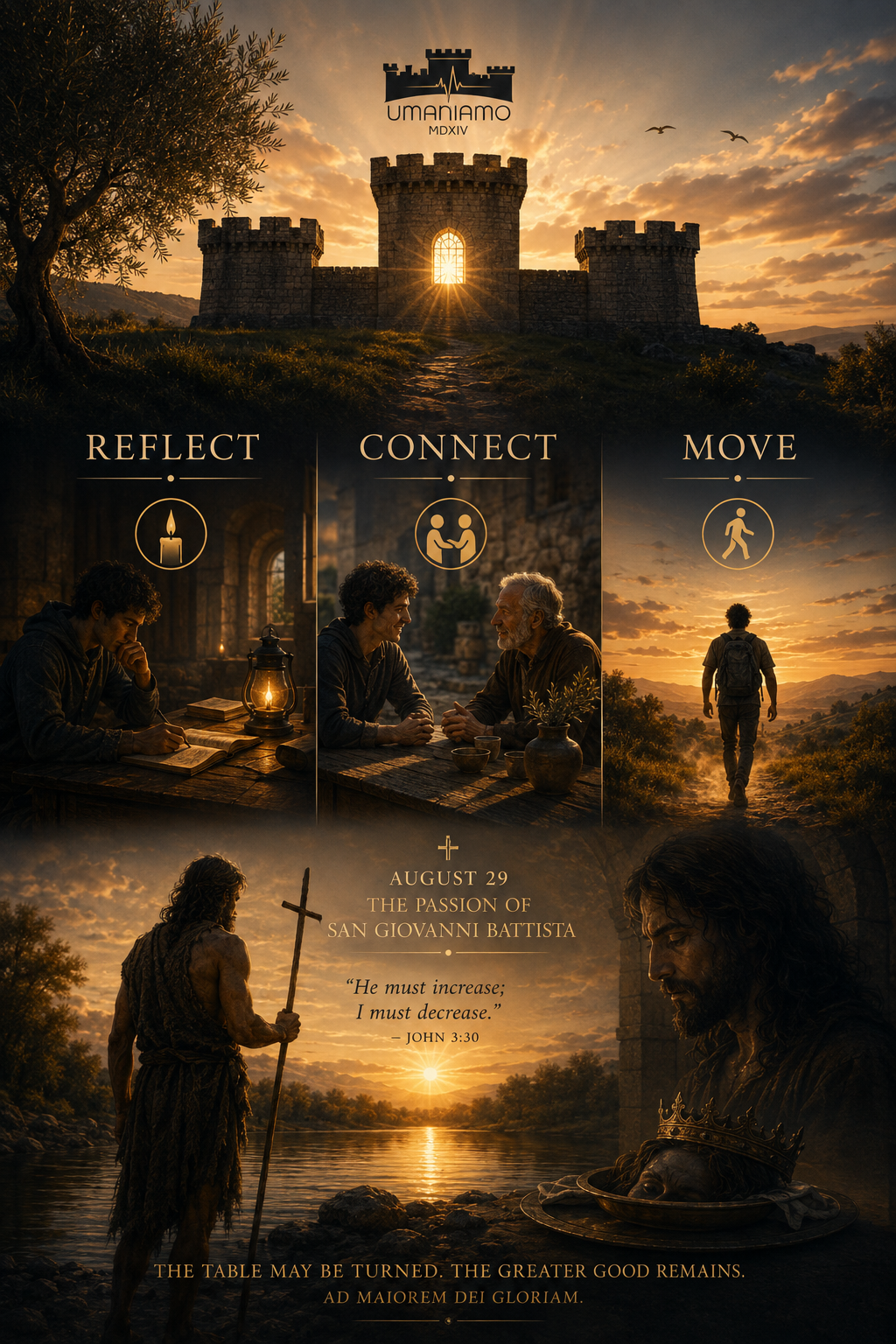
We have spent this month turning the table, but the purpose was never to become better at sitting still living life in our heads.
Reflection matters because without it we are easily carried by whatever is loudest, fastest, most familiar, or most convincing. We can mistake repetition for truth, urgency for responsibility, usefulness for worth, and a polished Why for vocation. Reflection gives us enough distance to notice what is actually happening. It lets us examine the architecture within rather than simply react to the room around us. It asks us to look again at the What, the Why, the Who, and the Where, and to let those questions correct one another before any one of them becomes a lantern bright enough to occupy the whole room.
This is why D.E.E.P.E.R.™ is not merely a thinking exercise. It is your practical practice of freedom. Details slow the story down. Evidence tests what we think we know. Empathy restores the person who may have disappeared inside our explanation. Prospective asks where the movement is actually leading. Execution asks what the truth now requires of us. Reflection returns us to the Author and asks what kind of person is being formed through the whole encounter. The Blueprint is recursive because discernment is recursive. We don’t solve ourselves once. We return, notice, act, learn, and return again.
But reflection alone is not enough. A person can become very skilled at examining his own interior life while remaining untouched by the person across the table. We can spend years refining our language, discovering our strengths, clarifying our mission, naming our values, and explaining our Why while never asking the question that changes everything: Who is actually here?
Connect brings the Who back into the room. Connection is where abstraction becomes concrete relationships. It is where the mission statement acquires a face. It is where the customer becomes a person, the employee becomes a person, the student becomes a person, the neighbor becomes a person, and the stranger becomes a person. It is also where Christ refuses to remain safely on the wall. God became flesh. He sat at tables, ate bread, drank wine, touched bodies, listened to stories, washed feet, called people by name, and allowed Himself to be interrupted.
The radical Christian claim has always been that the human person can never be permitted to be reduced to utility because God entered human life Himself. That means connection is not merely being sociable. It is an act of recognition. It is the discipline of seeing the Authored in the person before us.
This is where the Six Promises become lived rather than admired. We care for the whole person rather than the useful part. We return agency rather than collect dependence. We hold faith and evidence together rather than force someone into a smaller truth. We create room for reflection instead of demanding immediate compliance. We value the service no one sees. We refuse to freeze another person inside the category by which the room currently knows them.
And then we move. This final movement matters because contemplation can become another enclosure if it never leaves the Chair. The Builder at Work eventually stands up.
Move does not mean react. It doesn’t mean rush or become busy simply so that something appears to be happening. The first three weeks of Turn the Table™ prepared us precisely so that movement could become more deliberate. We calibrate the instrument. We read the room without losing the Chair. We separate signal from noise. Then we act for the greater good.
The question is not simply, “What should I do?” It is, “What can I do that leaves another person more capable?” That is where Magis Movements becomes practical.
Perhaps you learned something through D.E.E.P.E.R.™. Share the method with someone else. Don’t analyze them. Give them the questions and allow them to discern. Perhaps the Freedom Test helped you recognize extraction in a relationship. Show another person how to examine the fruit of their own relationships. Perhaps you learned to sit on your hands before responding to the red light. Teach someone else the pause. Perhaps you discovered Enthusiasm in yourself. Then notice the ember in another person and stoke it with trust, responsibility, encouragement, or opportunity. Perhaps you know how to do something useful. Teach someone else how to do it.
This is how Builders build Builders.
The Builder does not merely carry the good into the room. The Builder helps another person become capable of carrying it into the next one. That is why growth leaves evidence.
If our work is truly forming people, someone should become more responsible. Someone should become more free. Someone should become more capable of making a judgment without asking us for the answer. Someone should become more willing to serve. Someone should be able to carry a burden they could not carry before. Someone should discover enough confidence in what has been entrusted to them that they can help another person grow. The evidence of Magis is not that the original Builder becomes more important. It may be exactly the opposite. The good continues without him.
This is the movement of the vine. What is received becomes fruit, and the fruit nourishes beyond the branch. It is the movement of the olive grove. Someone tends what another planted and prepares it for someone not yet present. It is the movement of the Body. Different members receive different gifts, but none exists for itself alone.
We are humaned together.
That does not mean other people give us our dignity. The Author has already done that. It means that the capacities through which dignity becomes lived are formed in relationships. Someone teaches us how to listen. Someone trusts us with responsibility. Someone corrects us without humiliating us. Someone makes room for us to fail and try again. Someone sees a Builder in us before we know how to see it ourselves.
Don’t worry if you cannot explain your perfect Why. Life is not a mission statement waiting to be discovered. Pay attention to what is true. Notice who has been entrusted to you. Watch where the movement leads. Act. Learn. Return to the Author. Let the Blueprint remain open.
And when something good has been given to you, do not keep it at the Table. Share it and carry it into the Room. Help someone else carry it farther.
Reflect. Connect. Move.
Then help another person do the same. That is how the Builder at Work becomes a Builder of Builders. That is how freedom becomes Magis. And that is how we are humaned together.
Ad maiorem Dei gloriam.
As we enter the final week of Turn the Table™, the onomastici become more than names on a calendar. They become witnesses to a truth we have carried throughout this week: growth leaves evidence. A life of faith is not proved by repetition, visibility, reputation, or recognition alone. Its fruit appears in what becomes more possible for others because that person lived. This is especially fitting for a week centered on Act for the Greater Good, Invite Continuous Growth, and Magis, because each of these saints gives us a different picture of what it means to receive something from God, allow it to form us, and then carry it into the lives of others.
August 24 ✟ San Bartolomeo Apostolo
Bartholomew was one of the Twelve Apostles, and Christian tradition remembers him as one who carried the Gospel beyond the place where he first encountered Christ. His life reflects a movement that is central to the Builder at Work: encounter becomes sending. What he received was not meant to remain private. It had to travel. Growth, in this sense, is incomplete if it only enlarges the person who experiences it.
Humaning Reflection: Bartholomew reminds us that the gift we receive becomes fully alive when it can be placed in service of another. The Builder does not hoard what has helped him. He shares it, teaches it, embodies it, and creates the conditions in which someone else can carry it farther. The reflection for the Table is therefore not simply what we have learned, but who might become more capable because we refuse to keep what we have learned to ourselves.
August 25 ✟ San Luigi IX and San Giuseppe Calasanzio
Louis IX of France is remembered as a king who understood authority as carrying obligations beyond privilege, while Joseph Calasanzio dedicated himself to the education of children, especially those who had little access to learning. Their lives offer two complementary forms of buildership. One asks what happens when power is treated as stewardship. The other asks what happens when knowledge is deliberately given away.
Humaning Reflection: Both remind us that growth should increase the capacity of others rather than merely increase our own importance. If authority only makes us more central, or knowledge only makes us more impressive, then formation has stopped too soon. Magis asks whether what has been entrusted to us is becoming something another person can use. The Humaning reflection is simple but demanding: who is more capable because I shared what I know, gave away some responsibility, or used my authority to help another person stand?
August 26 ✟ Sant’Alessandro di Bergamo
Sant’Alessandro, patron of Bergamo, is remembered as a martyr who refused to surrender his Christian allegiance. His witness reminds us that continuous growth does not mean endless adaptation. There are moments when maturity becomes visible in the ability to refuse what the surrounding system expects.
Humaning Reflection: This matters because our culture often treats adaptability as an unquestioned good. We are told to adjust, reskill, conform, optimize, remain relevant, and keep moving. Yet growth in the Christian sense may sometimes produce a clearer boundary rather than greater flexibility. The humaned person becomes more able to recognize what cannot be purchased from him. The Humaning reflection is therefore whether there is something we are no longer willing to do simply because the room expects it, and whether conscience has become strong enough to survive the loss of approval.
August 27 ✟ Santa Monica
Monica is remembered for her persistent prayer and love for her son Augustine through years when his life seemed to be moving far from the faith she hoped he would embrace. Her witness is powerful because she could not manufacture his conversion. She could remain present, pray, hope, speak, wait, and refuse to decide that the person she saw in one season was the only person he could ever become.
Humaning Reflection: This is perhaps one of the clearest expressions of the sixth Promise: Invite Continuous Growth. No human being should be frozen permanently inside the category by which the room currently knows them. Monica reminds us that Humaning sometimes means protecting the possibility of another person’s becoming when there is little evidence yet to support our hope. The reflection for the Table is whether there is someone we have quietly decided will never change, and whether we are willing to leave enough room for the Author to continue writing.
August 28 ✟ Sant’Agostino
Augustine became one of Christianity’s most influential theologians and bishops, but his life did not begin with that destination clearly visible. His story passed through searching, ambition, intellectual struggle, conversion, responsibility, and continued growth. The fact that the Church remembers Monica immediately before Augustine gives their lives an almost architectural relationship: one person’s patient fidelity became part of the formation of another whose influence would continue across centuries.
Humaning Reflection: Augustine is a reminder that growth is not simply the correction of behavior. It can be the reordering of the whole person. Desire can change direction. Intelligence can deepen. Restlessness can become vocation. The Humaning reflection is to remember who once believed in a future for us that we could not yet see, and then to ask whose future may now depend, in part, upon our willingness to keep inviting growth in them.
August 29 ✟ The Passion of San Giovanni Battista
August 29 is the remembrance of the Passion of Saint John the Baptist, and this may be the most important onomastico of the entire week because John’s life places When Why Becomes Who, Magis, and the greater good into a form that no one around him could have recognized as success.
John’s vocation was never really a mission statement. It was a Who. His entire life was ordered toward Christ. He prepared the way for someone else to become central. His own language makes that unmistakable: “He must increase; I must decrease.” In the vocabulary of the modern world, that sounds almost like failure. We are trained to think that growth means greater visibility, wider influence, increasing reach, stronger metrics, and expanding importance. John’s vocation moved in the opposite direction. His fulfillment was bound up with becoming less central because the One for whom he had prepared the way was now present.
Seen from the room in which John died, his vocation could not have looked like Magis. The prophet was imprisoned. His access was gone. His public role was ending. Herod remained in power. The banquet continued. Then John’s head was brought into that room on a platter and placed on a table. The image is almost unbearable in the context of Turn the Table™, because the table appears to have been turned completely against him. The system has silenced the inconvenient voice, removed the person who would not adapt, and converted a human life into an object displayed for the satisfaction of the room.
If we judged the story only by what could be seen at that table, the Devil at Work would appear to have won. John was no longer useful. His influence seemed finished. His body had been broken by the system he refused to accommodate. There was no visible growth, no measurable impact, no victory that could be reported in the language of outcomes.
And yet the greater good was already moving on a horizon no one in that room could see.
John had already pointed beyond himself. Christ was already there. The Kingdom was already moving. His apparent decrease was part of a Magis whose evidence would emerge far beyond the banquet hall that believed it had silenced him. The table had been turned 180 degrees, but not in the way Herod understood. The platter meant to display power became, in Christian memory, evidence of the limits of power. The head meant to end the witness became part of the witness.
This is why John the Baptist is such a radical companion for the Builder at Work. He reminds us that Magis cannot be reduced to visible increase. The greater good may not always look greater from where we are standing. Faithfulness may cost influence, status, safety, recognition, or even the ability to see the fruit of our own action. The Builder at Work may prepare a way that another person walks. The Builder at Work may plant a tree whose fruit is harvested long after he is gone. The Builder at Work may decrease so that another person can rise.
The Humaning reflection here is difficult and deeply personal. Where have we confused visible success with Magis? Are we willing to act for the greater good when the evidence may not appear in our lifetime, when someone else may receive the credit, or when the room misunderstands what we are doing? John asks whether we can remain faithful to the Who even when the Why no longer looks reasonable to anyone watching.
August 30 ✟ Santi Felice e Adautto
Felice and Adautto are remembered together as early Christian martyrs, and their shared remembrance offers a fitting close to a week centered on Humaning together. Courage is rarely formed entirely alone. People strengthen one another simply by standing together when something consequential is required.
Humaning Reflection: their witness reminds us that buildership must itself be sustained. Even the Builder at Work needs people who help him remain a Builder when enthusiasm weakens, when the room becomes difficult, or when the greater good is no longer easy to see. The Humaning reflection is to ask who helps sustain our own buildership, who reminds us what matters when we drift, and whose buildership we are helping sustain in return.
Act for the Greater Good means that The Builder at Work only cares about what was accomplished. What really matters to a Builder at Work is what became possible in another person because we were here. Growth leaves evidence, but not all evidence appears immediately. Sometimes the table looks completely turned against us, and the greater good is already on its way.
Abbiamo trascorso questo mese ribaltando la prospettiva, ma lo scopo non è mai stato quello di diventare più bravi a stare fermi, vivendo la vita solo nella nostra mente.
La riflessione è importante perché senza di essa ci lasciamo facilmente trascinare da ciò che è più rumoroso, più veloce, più familiare o più convincente. Possiamo scambiare la ripetizione per verità, l’urgenza per responsabilità, l’utilità per valore e un «Perché» ben formulato per vocazione. La riflessione ci offre la distanza necessaria per notare ciò che sta realmente accadendo. Ci permette di esaminare l’architettura interiore piuttosto che limitarci a reagire allo spazio che ci circonda. Ci chiede di guardare nuovamente al «Cosa», al «Perché», al «Chi» e al «Dove», e di lasciare che queste domande si correggano a vicenda prima che una di esse diventi una lanterna abbastanza luminosa da illuminare l’intera stanza.
Ecco perché D.E.E.P.E.R.™ non è semplicemente un esercizio di pensiero. È la tua pratica concreta della libertà. I dettagli rallentano il racconto.
L’evidenza mette alla prova ciò che pensiamo di sapere. L’empatia restituisce la persona che potrebbe essere scomparsa all’interno della nostra spiegazione. La prospettiva chiede dove il movimento stia effettivamente conducendo. L’esecuzione chiede cosa la verità richieda ora da noi. La riflessione ci riporta all’Autore e chiede che tipo di persona si stia formando attraverso l’intero incontro. Il Blueprint è ricorsivo perché il discernimento è ricorsivo. Non risolviamo noi stessi una volta per tutte. Torniamo indietro, osserviamo, agiamo, impariamo e torniamo di nuovo.
Ma la riflessione da sola non basta. Una persona può diventare molto abile nell’esaminare la propria vita interiore pur rimanendo indifferente alla persona seduta dall’altra parte del tavolo. Possiamo passare anni a perfezionare il nostro linguaggio, a scoprire i nostri punti di forza, a chiarire la nostra missione, a dare un nome ai nostri valori e a spiegare il nostro «Perché», senza mai porre la domanda che cambia tutto: «Chi c’è davvero qui?».
La connessione riporta il “Chi” nella stanza. È nella connessione che l’astrazione si trasforma in relazioni concrete. È lì che la dichiarazione di missione acquista un volto. È lì che il cliente diventa una persona, il dipendente diventa una persona, lo studente diventa una persona, il vicino diventa una persona e lo sconosciuto diventa una persona. È anche lì che Cristo rifiuta di rimanere al sicuro sulla parete. Dio si è fatto carne. Si è seduto a tavola, ha mangiato pane, ha bevuto vino, ha toccato corpi, ha ascoltato storie, ha lavato i piedi, ha chiamato le persone per nome e ha permesso che lo interrompessero.
L’affermazione cristiana radicale è sempre stata che alla persona umana non può mai essere permesso di essere ridotta a un semplice strumento, perché Dio stesso è entrato nella vita umana. Ciò significa che la connessione non è semplicemente essere socievoli. È un atto di riconoscimento. È la disciplina di vedere l’Autore nella persona che abbiamo davanti.
È qui che le Sei Promesse vengono vissute anziché ammirate. Ci prendiamo cura della persona nella sua interezza anziché della parte utile. Restituiamo l’autonomia anziché alimentare la dipendenza. Teniamo insieme fede ed evidenza anziché costringere qualcuno in una verità più limitata. Creiamo spazio per la riflessione invece di esigere un’immediata obbedienza. Apprezziamo il servizio che nessuno vede. Rifiutiamo di rinchiudere un’altra persona nella categoria con cui la stanza la conosce attualmente.
E poi ci muoviamo. Questo movimento finale è importante perché la contemplazione può diventare un’altra gabbia se non si allontana mai dalla Sedia. Il Costruttore all’Opera alla fine si alza in piedi.
Muoversi non significa reagire. Non significa affrettarsi o darsi da fare semplicemente per far sembrare che stia succedendo qualcosa. Le prime tre settimane di Turn the Table™ ci hanno preparato proprio affinché il movimento potesse diventare più deliberato. Calibriamo lo strumento. Leggiamo la situazione senza perdere di vista la Sedia. Separiamo il segnale dal rumore. Poi agiamo per il bene superiore.
La domanda non è semplicemente: «Cosa dovrei fare?», ma: «Cosa posso fare per rendere l’altra persona più capace?». È qui che i «Magis Movements» diventano concreti.
Forse hai imparato qualcosa grazie a D.E.E.P.E.R.™. Condividi il metodo con qualcun altro. Non analizzarlo. Fagli le domande e lascia che sia lui a discernere. Forse il «Freedom Test» ti ha aiutato a riconoscere l’estrazione in una relazione. Mostra a un’altra persona come esaminare i frutti delle proprie relazioni. Forse hai imparato a tenere le mani ferme prima di reagire al segnale di allarme. Insegna a qualcun altro a fare quella pausa. Forse hai scoperto l’Entusiasmo in te stesso. Allora individua la scintilla in un’altra persona e alimentala con fiducia, responsabilità, incoraggiamento o opportunità. Forse sai come fare qualcosa di utile. Insegna a qualcun altro come farlo.
È così che i Costruttori formano altri Costruttori.
Il Costruttore non si limita a portare il bene in una stanza. Il Costruttore aiuta un’altra persona a diventare capace di portarlo nella stanza successiva. Ecco perché la crescita lascia tracce.
Se il nostro lavoro sta davvero formando le persone, qualcuno dovrebbe diventare più responsabile. Qualcuno dovrebbe diventare più libero. Qualcuno dovrebbe diventare più capace di formulare un giudizio senza chiederci la risposta. Qualcuno dovrebbe diventare più disposto a servire. Qualcuno dovrebbe essere in grado di portare un fardello che prima non riusciva a portare. Qualcuno dovrebbe scoprire abbastanza fiducia in ciò che gli è stato affidato da poter aiutare un’altra persona a crescere. La prova del Magis non sta nel fatto che il Costruttore originario diventi più importante. Potrebbe essere esattamente il contrario. Il bene continua senza di lui.
Questo è il movimento della vite. Ciò che viene ricevuto diventa frutto, e il frutto nutre oltre il ramo. È il movimento dell’uliveto. Qualcuno cura ciò che un altro ha piantato e lo prepara per qualcuno che non è ancora presente. È il movimento del Corpo. Membri diversi ricevono doni diversi, ma nessuno esiste solo per se stesso.
Siamo resi umani insieme.
Ciò non significa che siano gli altri a darci la nostra dignità. L’Autore lo ha già fatto. Significa che le capacità attraverso le quali la dignità si fa esperienza si formano nelle relazioni. Qualcuno ci insegna ad ascoltare. Qualcuno ci affida delle responsabilità. Qualcuno ci corregge senza umiliarci. Qualcuno ci concede lo spazio per fallire e riprovare. Qualcuno vede in noi un Costruttore prima ancora che noi stessi sappiamo come vederlo.
Non preoccuparti se non riesci a spiegare il tuo “Perché” perfetto. La vita non è una dichiarazione d’intenti che aspetta di essere scoperta. Presta attenzione a ciò che è vero. Nota chi ti è stato affidato. Osserva dove conduce il movimento. Agisci. Impara. Ritorna all’Autore. Lascia che il Progetto rimanga aperto.
E quando ti è stato donato qualcosa di buono, non tenerlo sul Tavolo. Condividilo e portalo nella Stanza. Aiuta qualcun altro a portarlo più lontano.
Rifletti. Entra in connessione. Muoviti.
Poi aiuta un’altra persona a fare lo stesso. È così che il Costruttore all’opera diventa un Costruttore di Costruttori. È così che la libertà diventa Magis. Ed è così che diventiamo umani insieme.
Ad maiorem Dei gloriam.
Mentre entriamo nell’ultima settimana di Turn the Table™, gli onomastici diventano più che semplici nomi su un calendario. Diventano testimoni di una verità che abbiamo portato avanti per tutta questa settimana: la crescita lascia tracce. Una vita di fede non si dimostra solo con la ripetizione, la visibilità, la reputazione o il riconoscimento. Il suo frutto si manifesta in ciò che diventa più possibile per gli altri proprio perché quella persona ha vissuto. Ciò è particolarmente appropriato per una settimana incentrata su Agire per il bene superiore, Invitare alla crescita continuae Magis, poiché ciascuno di questi santi ci offre un’immagine diversa di cosa significhi ricevere qualcosa da Dio, lasciare che ci plasmi e poi trasmetterlo nella vita degli altri.
24 agosto ✟ San Bartolomeo Apostolo
Bartolomeo fu uno dei Dodici Apostoli, e la tradizione cristiana lo ricorda come colui che portò il Vangelo oltre il luogo in cui incontrò Cristo per la prima volta. La sua vita riflette un movimento che è centrale per il “Costruttore all’opera”: l’incontro diventa invio. Ciò che ricevette non era destinato a rimanere privato. Doveva viaggiare. La crescita, in questo senso, è incompleta se si limita ad ampliare la persona che la sperimenta.
Riflessione sull’essere umani: Bartolomeo ci ricorda che il dono che riceviamo prende pienamente vita quando può essere messo al servizio di un altro. Il Costruttore non accumula ciò che lo ha aiutato. Lo condivide, lo insegna, lo incarna e crea le condizioni affinché qualcun altro possa portarlo oltre. La riflessione per la Tavola non è quindi semplicemente ciò che abbiamo imparato, ma chi potrebbe diventare più capace perché ci rifiutiamo di tenere per noi ciò che abbiamo imparato.
25 agosto ✟ San Luigi IX e San Giuseppe Calasanzio
Luigi IX di Francia è ricordato come un re che intendeva l’autorità come portatrice di obblighi al di là del privilegio, mentre Giuseppe Calasanzio si dedicò all’educazione dei bambini, specialmente di quelli che avevano scarso accesso all’istruzione. Le loro vite offrono due forme complementari di “costruttore”. Una si chiede cosa accada quando il potere viene trattato come un incarico di gestione. L’altra si chiede cosa accada quando la conoscenza viene deliberatamente donata.
Riflessione sull’umanità:
Entrambi ci ricordano che la crescita dovrebbe accrescere la capacità degli altri piuttosto che limitarsi ad aumentare la nostra importanza. Se l’autorità ci rende solo più centrali, o la conoscenza ci rende solo più impressionanti, allora la formazione si è fermata troppo presto. Il «Magis» chiede se ciò che ci è stato affidato stia diventando qualcosa che un’altra persona può utilizzare. La riflessione sull’umanità è semplice ma impegnativa: chi è più capace perché ho condiviso ciò che so, ho ceduto parte della mia responsabilità o ho usato la mia autorità per aiutare un’altra persona a reggersi in piedi?
26 agosto ✟ Sant’Alessandro di Bergamo
Sant’Alessandro, patrono di Bergamo, è ricordato come un martire che rifiutò di rinnegare la propria fede cristiana. La sua testimonianza ci ricorda che la crescita continua non significa adattamento senza fine. Ci sono momenti in cui la maturità si manifesta nella capacità di rifiutare ciò che il sistema circostante si aspetta.
Riflessione sull’“Humaning”: Questo è importante perché la nostra cultura spesso considera l’adattabilità come un bene indiscutibile. Ci viene detto di adattarci, riqualificarci, conformarci, ottimizzarci, rimanere al passo con i tempi e continuare ad andare avanti. Eppure la crescita in senso cristiano a volte può produrre un confine più netto piuttosto che una maggiore flessibilità. La persona che vive secondo l’“Humaning” diventa più capace di riconoscere ciò che non può essere comprato da lei. La riflessione sull’“Humaning” è quindi se c’è qualcosa che non siamo più disposti a fare semplicemente perché l’ambiente se lo aspetta, e se la coscienza è diventata abbastanza forte da sopravvivere alla perdita di approvazione.
27 agosto ✟ Santa Monica
Monica è ricordata per la sua preghiera instancabile e l’amore per suo figlio Agostino durante gli anni in cui la sua vita sembrava allontanarsi dalla fede che lei sperava lui abbracciasse. La sua testimonianza è potente perché non poteva forzare la sua conversione. Poteva rimanere presente, pregare, sperare, parlare, aspettare e rifiutarsi di decidere che la persona che vedeva in un determinato momento fosse l’unica persona che lui potesse mai diventare.
Riflessione sull’“Humaning”: Questa è forse una delle espressioni più chiare della sesta Promessa: Invitare alla crescita continua. Nessun essere umano dovrebbe rimanere congelato per sempre nella categoria con cui gli altri lo conoscono attualmente. Monica ci ricorda che “Humaning” a volte significa proteggere la possibilità di un futuro diverso per un’altra persona quando ci sono ancora poche prove a sostegno della nostra speranza. La riflessione per il Tavolo è se c’è qualcuno che abbiamo silenziosamente deciso non cambierà mai, e se siamo disposti a lasciare spazio sufficiente all’Autore per continuare a scrivere.
28 agosto ✟ Sant’Agostino
Agostino divenne uno dei teologi e vescovi più influenti del cristianesimo, ma la sua vita non iniziò con quella destinazione chiaramente visibile. La sua storia attraversò la ricerca, l’ambizione, la lotta intellettuale, la conversione, la responsabilità e la crescita continua. Il fatto che la Chiesa ricordi Monica immediatamente prima di Agostino conferisce alle loro vite una relazione quasi architettonica: la paziente fedeltà di una persona è diventata parte della formazione di un’altra, la cui influenza sarebbe continuata attraverso i secoli.
Riflessione “Humaning”: Agostino ci ricorda che la crescita non è semplicemente la correzione del comportamento. Può essere il riordino dell’intera persona. Il desiderio può cambiare direzione. L’intelligenza può approfondirsi. L’inquietudine può diventare vocazione. La riflessione “Humaning” consiste nel ricordare chi un tempo ha creduto in un futuro per noi che non potevamo ancora vedere, e poi chiederci da chi possa dipendere ora, in parte, il futuro degli altri, dalla nostra disponibilità a continuare a invitare la crescita in loro.
29 agosto ✟ La Passione di San Giovanni Battista
Il 29 agosto si commemora la Passione di San Giovanni Battista, e questa potrebbe essere la ricorrenza onomastica più importante dell’intera settimana perché la vita di Giovanni colloca Quando il “Perché” diventa “Chi”, il Magis e il bene superiore in una forma che nessuno intorno a lui avrebbe potuto riconoscere come successo.
La vocazione di Giovanni non è mai stata in realtà una dichiarazione di intenti. Era un “Chi”. Tutta la sua vita era orientata verso Cristo. Ha preparato la via affinché qualcun altro diventasse il centro. Le sue stesse parole lo rendono inequivocabile: «Lui deve crescere; io devo diminuire». Nel vocabolario del mondo moderno, questo suona quasi come un fallimento.
Siamo abituati a pensare che la crescita significhi maggiore visibilità, influenza più ampia, portata crescente, indicatori più solidi e importanza in espansione. La vocazione di Giovanni andava nella direzione opposta. La sua realizzazione era legata al diventare meno centrale, perché Colui per il quale aveva preparato la via era ormai presente.
Vista dalla stanza in cui Giovanni morì, la sua vocazione non poteva sembrare affatto “Magis”. Il profeta era in prigione. Aveva perso ogni accesso. Il suo ruolo pubblico stava volgendo al termine. Erode rimaneva al potere. Il banchetto continuò. Poi la testa di Giovanni fu portata in quella stanza su un vassoio e posata su un tavolo. L’immagine è quasi insopportabile nel contesto di «Turn the Table™», perché sembra che il tavolo si sia rivoltato completamente contro di lui. Il sistema ha messo a tacere la voce scomoda, ha eliminato la persona che non voleva adattarsi e ha trasformato una vita umana in un oggetto esposto per la soddisfazione dei presenti.
Se giudichessimo la storia solo in base a ciò che si vedeva a quel tavolo, sembrerebbe che il Diavolo al lavoro avesse vinto. Giovanni non era più utile. La sua influenza sembrava finita. Il suo corpo era stato spezzato dal sistema al quale si era rifiutato di adeguarsi. Non c’era alcuna crescita visibile, nessun impatto misurabile, nessuna vittoria che potesse essere riportata nel linguaggio dei risultati.
Eppure il bene superiore si stava già profilando su un orizzonte che nessuno in quella sala poteva vedere.
Giovanni aveva già indicato oltre se stesso. Cristo era già lì. Il Regno era già in marcia. Il suo apparente declino faceva parte di un «Magis» la cui evidenza sarebbe emersa ben oltre la sala del banchetto che credeva di averlo zittito. La situazione si era ribaltata di 180 gradi, ma non nel modo in cui la intendeva Erode. Il vassoio destinato a esibire il potere divenne, nella memoria cristiana, prova dei limiti del potere. La testa destinata a porre fine alla testimonianza divenne parte della testimonianza stessa.
Ecco perché Giovanni Battista è un compagno così radicale per il Costruttore al lavoro. Ci ricorda che il Magis non può essere ridotto a un accrescimento visibile. Il bene superiore potrebbe non sembrare sempre tale dal punto di vista da cui ci troviamo. La fedeltà può costare influenza, status, sicurezza, riconoscimento o persino la capacità di vedere il frutto delle nostre stesse azioni. Il Costruttore al lavoro può preparare una via che un’altra persona percorrerà. Il Costruttore al lavoro può piantare un albero i cui frutti saranno raccolti molto tempo dopo che se ne sarà andato. Il Costruttore al Lavoro può sminuirsi affinché un’altra persona possa emergere.
La riflessione sull’Humaning in questo caso è difficile e profondamente personale. Dove abbiamo confuso il successo visibile con il Magis? Siamo disposti ad agire per il bene superiore quando i risultati potrebbero non manifestarsi nel corso della nostra vita, quando qualcun altro potrebbe riceverne il merito, o quando chi ci circonda fraintende ciò che stiamo facendo? Giovanni ci chiede se siamo in grado di rimanere fedeli al Chi anche quando il Perché non appare più ragionevole agli occhi di chiunque osservi.
30 agosto ✟ Santi Felice e Adautto
Felice e Adautto sono commemorati insieme come martiri cristiani dei primi tempi, e la loro commemorazione congiunta offre una conclusione appropriata a una settimana incentrata sull’Humaning insieme. Il coraggio raramente si forma del tutto da soli. Le persone si rafforzano a vicenda semplicemente stando unite quando è richiesto qualcosa di importante.
Riflessione sull’Humaning: la loro testimonianza ci ricorda che lo stesso ruolo di “costruttore” deve essere sostenuto. Anche il “Costruttore al lavoro” ha bisogno di persone che lo aiutino a rimanere tale quando l’entusiasmo vacilla, quando l’atmosfera si fa difficile o quando il bene comune non è più facile da vedere. La riflessione sull’Humaning consiste nel chiederci chi ci aiuta a sostenere il nostro ruolo di “costruttori”, chi ci ricorda ciò che conta quando ci lasciamo trasportare dalla corrente e di chi stiamo aiutando a sostenere il ruolo di “costruttore” a nostra volta.
Agire per il bene comune significa che al Costruttore al lavoro importa solo ciò che è stato realizzato. Ciò che conta davvero per un Costruttore al lavoro è ciò che è diventato possibile in un’altra persona grazie alla nostra presenza. La crescita lascia tracce, ma non tutte sono immediatamente visibili. A volte la situazione sembra completamente rivoltarsi contro di noi, eppure il bene comune è già in arrivo.
Video Overview
What happens when Why becomes Who? When purpose becomes personal, the person in front of us changes the meaning of the work, the room, and even the greater good. Come to the Sunday Table as we explore what it means to see the Who, act for the greater good, and help another person become more free.

He flew back out to California with one sentence written on the legal pad beneath the other papers, and he did not tell them, when he asked for the meeting, why he was coming or what the sentence was.
Find one.
He had spent a week deciding how to do it honestly, because there was a trap in it and he had seen the trap immediately. The wall studied three point seven million people and knew none of them; if he sat down and picked one off that wall like a file, chose a data set that interested him and called it a person, he would be doing the exact thing the machine did, only slower and with better intentions. You do not get to know a man by pulling his record. He had learned that on the other side of a lot of Service Record Books. A record is what a person leaves behind. It is not the person. So he did not ask to see the data. He asked to see a save.
The behavioral science lead lit up with the ask. The soft-spoken man with the wedding ring and picture of two kids on his badge, the one who had explained the retention modeling to Michael the last time, proud of it the way a good engineer is proud of a hard, clean solution. A save was their term of art, he explained, pleased to be asked. A save was an account the model identified as at elevated risk of churn or of leaving and had successfully re-engaged. The interventions were subtle. The brilliant silicon system had gotten very good at them. Would Michael like to see a representative one?
Michael said he would like to see a real one. Not representative, real. One that actually happened, to one actual person.
They pulled it up on the big display, and it was, at first, exactly what he had expected and exactly what he had feared: a wall of clean clinical data about a human being who was not there. An anonymized identifier. Age: twenty-four. A usage curve climbing across two years. Session lengths in the early hours, clustered in the dead middle of the night. Spend: modest but steady. And then, near the center of it, the event itself, flagged and annotated the way a hospital flags a code the moment the model had caught him leaving.
3:14 a.m. Session anomaly detected. Engagement metrics declining across prior 90 seconds. Player idle. Re-engagement protocol deployed: social prompt, event-scarcity notification. 3:16 a.m. Session resumed. Outcome: retained.
Two minutes. Two lines of data. The lead walked him through it with real admiration, the elegance of the timing, the way the model had read the drift and moved before the boy himself knew he was drifting, the notification chosen from a library of thousands as the one most likely to work on this specific profile. A textbook save, he said. The kid was still active. Still healthy. Right there in the current numbers, holding steady.
Michael looked at the two lines for a long time.
He did not have the whole of it, and he knew he did not. He could not see, in 3:14 a.m., player idle, what had actually happened in that room in those two minutes could not know that the machine's cold word idle was the only mark the system had left of some real thing surfacing in a real boy in the dark, some memory or ache or half-opened door that the data had no column for and would never have a column for. He could not see it. But he had spent twenty years reading the space between what a report said and what had actually happened to a man, and something in those two flat lines set off every instrument he had. Player idle. A person does not go idle at three in the morning for no reason. A person goes idle because something in him has, for a moment, stopped — has looked up from the thing, has almost turned away, has almost, for ninety seconds, been somewhere truer. And the machine had seen that stop, and had not wondered what it was, and had closed it.
They called it a save.
He understood, sitting there, that it was the exact opposite of a save. Something in that boy had tried to get free at 3:14 in the morning, had made it ninety seconds toward the surface — and the most sophisticated instrument ever built for the purpose had noticed, and reached down, and pulled him gently back under, and logged it as a rescue. They had saved him the way the current saves a swimmer. They had saved him from the shore.
"Who is he?" Michael said.
The lead did not understand the question, the same way the head of product had not understood it the first time. "It's anonymized," he said. "We don't…"
"I know it's anonymized." Michael kept his eyes on the display, on the two lines, on the twenty-four. "I'm asking who he is. He has a name. He has people. Somewhere there's a woman who used to know when he was awake." He was not really asking the lead anymore. "What does he do at three in the morning when the thing finally lets him go. What did he used to be good at before this? What's the last real thing he made with his hands?" He heard his own voice go somewhere he had not sent it. "Somebody's watching that curve hold steady and calling it healthy. That's not a healthy man. That's a man being held under, and we built the hand."
The room had gone quiet. The lead's face had done something complicated. He was not a cruel man; Michael had been sure of that since the first meeting and was surer now. He was a good man who had solved a hard problem cleanly and had genuinely never once been asked, in all the years of solving it, the question Michael had just asked, because it was not a question the wall could hold and everyone in the building had, without deciding to, stopped asking it.
And Michael understood that the boy had just come off the wall.
He had not picked him. He had asked to see a life, and a life had been handed to him wearing the disguise of two lines of data, and now it would not go back into the disguise. He would not be able to un-know that there was a twenty-four-year-old somewhere who had almost surfaced at 3:14 in the morning and been caught. The abstraction had failed, the way his father said it would, the way the photograph fails, the way it always fails the moment you actually look. There was a person out there. There was a mother somewhere who used to ask if he had eaten. And the whole vast machine his father had built and left him the three point seven million, the growth, the wall of breathing light had just contracted, mercifully and unbearably, down to one specific boy Michael did not know and could not stop thinking about, whose only visible cry for help had been ninety seconds of going still.
Find one, he had written.
He had not expected the one to find him first.
He flew home that night, and he did not sleep, and it was not the machine he was seeing behind his eyes anymore. It was two lines of data, and the enormous invisible person standing behind them, and the plain terrible fact that he still did not know the boy's name, or his city, or his face that a save is not a soul and a record is not a person and everything the company could legally give him was exactly the wrong kind of knowing. He had found his one. And finding him had taught Michael, in the space of an afternoon, that finding was the easy part, and that he was no closer than before to the only thing that mattered, which was not to know about the boy but to actually reach him down in that room, at three in the morning, as one human being to another, before the current pulled him under one more time and logged it, once again, as a rescue.
He did not know how to do that. He was too honest to pretend he did.
But he knew now, for certain, that he was going to, because you cannot un-see a person once he comes off the wall and because somewhere a man was going still at three in the morning, reaching for something he could not name, and the only question left that Michael cared about was the oldest one there is.
Who is going to go down into that room and get him?
Ad maiorem Dei gloriam.
Tornò in California con una sola frase scritta sul blocco per appunti sotto gli altri fogli, e quando chiese l’incontro non disse loro né perché stesse arrivando né quale fosse quella frase.
Trovane una.
Aveva passato una settimana a decidere come farlo in modo onesto, perché c’era una trappola e lui l’aveva individuata immediatamente. Il muro aveva analizzato 3,7 milioni di persone e non ne conosceva nessuna; se si fosse seduto e ne avesse scelta una da quel muro come se fosse un fascicolo, selezionando un insieme di dati che lo interessava e definendola una persona, avrebbe fatto esattamente ciò che faceva la macchina, solo più lentamente e con intenzioni migliori. Non si arriva a conoscere un uomo consultando la sua cartella. L’aveva imparato dall’altra parte di un gran numero di Libri dei Registri di Servizio. Un fascicolo è ciò che una persona si lascia alle spalle. Non è la persona stessa. Quindi non chiese di vedere i dati. Chiese di vedere un salvataggio.
Il responsabile della scienza comportamentale si illuminò alla richiesta. L’uomo dalla voce pacata con la fede nuziale e la foto di due bambini sul badge, quello che l’ultima volta aveva spiegato a Michael il modello di fidelizzazione, orgoglioso di esso come un buon ingegnere è orgoglioso di una soluzione solida e pulita. Un «salvataggio» era il loro termine tecnico, spiegò, lieto di essere stato interpellato. Un «salvataggio» era un account che il modello aveva identificato come ad alto rischio di abbandono o di uscita e che era stato riattivato con successo. Gli interventi erano sottili. Il brillante sistema informatico era diventato molto abile in questo. Michael avrebbe voluto vederne uno rappresentativo?
Michael disse che avrebbe voluto vederne uno vero. Non rappresentativo, vero. Uno che fosse realmente accaduto, a una persona reale.
Lo visualizzarono sul grande schermo e, a prima vista, era esattamente ciò che si era aspettato ed esattamente ciò che aveva temuto: una distesa di dati clinici precisi su un essere umano che non era lì. Un identificativo anonimizzato. Età: ventiquattro anni. Una curva di utilizzo in ascesa nell’arco di due anni. Sessioni nelle prime ore del mattino, concentrate nel cuore della notte. Spesa: modesta ma costante. E poi, quasi al centro, l’evento stesso, contrassegnato e annotato come un ospedale contrassegna un codice nel momento in cui il modello lo aveva colto mentre se ne andava.
3:14 del mattino. Anomalia di sessione rilevata. Metriche di coinvolgimento in calo nei 90 secondi precedenti. Giocatore inattivo. Protocollo di re-coinvolgimento attivato: prompt social, notifica di scarsità di eventi. 3:16 del mattino. Sessione ripresa. Esito: retenzione.
Due minuti. Due righe di dati. Il responsabile glielo illustrò con sincera ammirazione: l’eleganza della tempistica, il modo in cui il modello aveva colto la deriva e agito prima ancora che il ragazzo stesso si rendesse conto di stare perdendo interesse, la notifica scelta da una libreria di migliaia di opzioni come quella con maggiori probabilità di funzionare su quel profilo specifico. Un salvataggio da manuale, disse. Il ragazzo era ancora attivo. Ancora in buona salute. Proprio lì, nei dati attuali, stabile.
Michael fissò quelle due righe a lungo.
Non ne conosceva l’intera storia, e sapeva di non conoscerla. Non riusciva a vedere, in 3:14 del mattino, giocatore inattivo, cosa fosse realmente accaduto in quella stanza in quei due minuti; non poteva sapere che la fredda parola della macchina, inattivo, era l’unica traccia che il sistema avesse lasciato di qualcosa di reale che affiorava in un ragazzo in carne e ossa nell’oscurità, un ricordo o un dolore o una porta socchiusa per cui i dati non avevano una colonna e non ne avrebbero mai avuta una. Non riusciva a vederlo. Ma aveva trascorso vent’anni a leggere lo spazio tra ciò che diceva un rapporto e ciò che era realmente accaduto a un uomo, e qualcosa in quelle due linee piatte fece scattare ogni suo istinto. Giocatore inattivo. Una persona non diventa inattiva alle tre del mattino senza motivo. Una persona entra in inattività perché qualcosa in lei, per un istante, si è fermato — ha distolto lo sguardo da ciò che stava facendo, si è quasi voltata dall’altra parte, è stata quasi, per novanta secondi, in un luogo più autentico. E la macchina aveva visto quella pausa, non si era chiesta cosa fosse e l’aveva interrotta.
L’hanno chiamata “salvataggio”.
Seduto lì, capì che era l’esatto contrario di un salvataggio. Qualcosa in quel ragazzo aveva cercato di liberarsi alle 3:14 del mattino, era riuscito ad avvicinarsi alla superficie per novanta secondi — e lo strumento più sofisticato mai costruito a tale scopo se n’era accorto, si era proteso verso di lui, lo aveva tirato delicatamente di nuovo giù e lo aveva registrato come un salvataggio. Lo avevano salvato nel modo in cui la corrente salva un nuotatore. Lo avevano salvato dalla riva.
«Chi è?» chiese Michael.
Il responsabile non capì la domanda, proprio come il capo del reparto prodotti non l’aveva capita la prima volta. «È anonimizzato», disse. «Noi non…»
«So che è reso anonimo». Michael teneva gli occhi fissi sul display, sulle due linee, sul ventiquattro. «Sto chiedendo chi sia. Ha un nome. Ha delle persone. Da qualche parte c’è una donna che sapeva quando era sveglio». In realtà non stava più chiedendo al responsabile. «Cosa fa alle tre del mattino quando quella cosa finalmente lo lascia andare? In cosa era bravo prima di tutto questo? Qual è l’ultima cosa vera che ha realizzato con le sue mani?» Sentì la propria voce andare in un posto dove lui non l’aveva mandata. «Qualcuno sta osservando quella curva che rimane stabile e la definisce sana. Quello non è un uomo sano. È un uomo tenuto sotto controllo, e noi abbiamo costruito quella mano.»
Nella stanza era calato il silenzio. Il volto del responsabile aveva assunto un’espressione complessa. Non era un uomo crudele; Michael ne era stato certo fin dal primo incontro e ora ne era ancora più sicuro. Era un uomo perbene che aveva risolto un problema difficile in modo pulito e a cui, in tutti gli anni in cui lo aveva risolto, non era mai stata posta, sinceramente, la domanda che Michael aveva appena formulato, perché non era una domanda che il muro potesse reggere e tutti nell’edificio avevano smesso di porla, senza nemmeno deciderlo.
E Michael capì che il ragazzo era appena uscito dal muro.
Non l’aveva scelto lui. Aveva chiesto di vedere una vita, e gli era stata consegnata una vita sotto le spoglie di due righe di dati, e ora non sarebbe più tornata in quelle spoglie. Non sarebbe più riuscito a non sapere che da qualche parte c’era un ventiquattrenne che era quasi riemerso alle 3:14 del mattino ed era stato catturato. L’astrazione aveva fallito, proprio come aveva predetto suo padre, proprio come fallisce una fotografia, proprio come fallisce sempre nel momento in cui la si guarda davvero. C’era una persona là fuori. C’era una madre da qualche parte che un tempo gli chiedeva se avesse mangiato. E l’intera, vasta macchina che suo padre aveva costruito e gli aveva lasciato – i 3,7 milioni, la crescita, il muro di luce che respirava – si era appena contratta, misericordiosamente e in modo insopportabile, fino a ridursi a un ragazzo specifico che Michael non conosceva e a cui non riusciva a smettere di pensare, il cui unico grido d’aiuto visibile era stato novanta secondi di immobilità.
Trovane uno, aveva scritto.
Non si era aspettato che fosse quello a trovare lui per primo.
Quella notte prese un volo per tornare a casa, e non dormì, e non era più la macchina che vedeva dietro i suoi occhi. Erano due righe di dati, e l’enorme persona invisibile che si ergeva dietro di esse, e il semplice, terribile fatto che ancora non sapeva il nome del ragazzo, né la sua città, né il suo volto: che un salvataggio non è un’anima e un record non è una persona, e che tutto ciò che l’azienda poteva legalmente dargli era esattamente il tipo sbagliato di conoscenza. Aveva trovato il suo unico. E trovarlo aveva insegnato a Michael, nel giro di un pomeriggio, che trovarlo era la parte facile, e che non era più vicino di prima all’unica cosa che contava, che non era sapere del ragazzo ma raggiungerlo davvero laggiù in quella stanza, alle tre del mattino, da essere umano a essere umano, prima che la corrente lo trascinasse giù ancora una volta e lo registrasse, ancora una volta, come un salvataggio.
Non sapeva come farlo. Era troppo onesto per fingere di saperlo.
Ma ora sapeva, con certezza, che lo avrebbe fatto, perché non si può smettere di vedere una persona una volta che è uscita dal muro e perché da qualche parte un uomo stava ancora andando alle tre del mattino, alla ricerca di qualcosa che non sapeva nominare, e l’unica domanda rimasta a cui Michael teneva era la più antica che esista.
Chi scenderà in quella stanza a prenderlo?
Ad maiorem Dei gloriam.
Scroll Down