Turn the Table
July 20 - 26, 2026
Formation Library → Sunday Table → Turn the Table
The Edge | Builders at Work
The Sunday Table è scritto in due lingue, inglese e italiano. Per ogni sezione, il testo in inglese è seguito da quello in italiano.
We are Human Together or Not at All.
Cosiamo | Founder, UMANIAMO® | Humaning Architecture
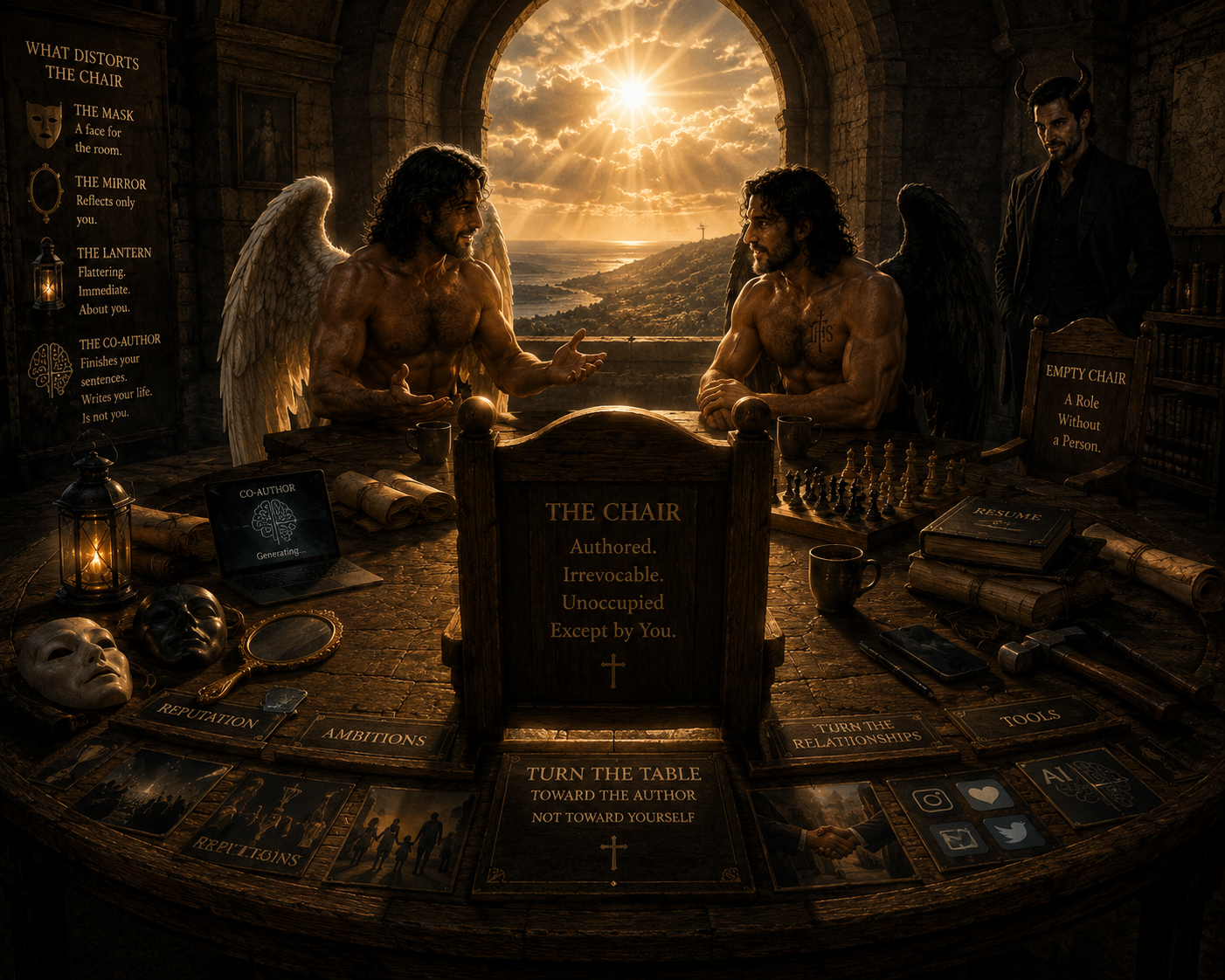
Every table has a place that is yours. Not the seat you happened to take when you walked into a room. The place - the one that would be missing if you never arrived… the gap in the conversation, the thing nobody else says, the particular way you notice what is wrong or right in a room before anyone else does. That place existed before you sat down in it.
We say authored, and we mean it literally. Before you were categorized, scored, ranked, profiled, or averaged, you were written. Not assembled from parts. Not a rough draft of someone better. Written as a specific person, with a specific set of gifts, arriving at a specific hour, in a specific city, among a specific set of people who needed exactly that. The Original is the manuscript as written. Not the abstract or summary of it. Not the version you edited down to get through an interview. Not the shorter one you use at parties. The Author holds the original. You are the only one who can live it. Nobody else can perform your part, and nobody else will be asked to. That is The Chair.
Here is the part most men have never been told, and it changes how the whole thing works. There are two kinds of authority in life, and we spend most of our years confusing them. The first is conferred. Somebody gives it to you. A title, a role, a promotion, a following, permission, approval, a seat at some other table. It is real, and it does real work in the world. But it carries one property you should never forget: whoever gave it can take it back. That is not cynicism. That is simply what conferred means. The second is authored. It arrived with the manuscript. You did not earn it, you cannot be promoted into it, and no committee votes on it. It is the standing that comes from having been written on purpose, by someone who does not make averages.
Nearly all the exhaustion in a capable man's life comes from trying to live on the first one alone. You can feel it when it is happening. It is the low hum of re-earning. The review that lands harder than it should. The number in an app that decides what kind of day you had. The relationship where you are always slightly auditioning. Conferred authority has to be renewed constantly, because it was never yours to begin with.
That is also how a chair goes empty. The Empty Chair is not an unoccupied seat. It is worse than that. It is a seat with a name on it and nobody home. It is what a life becomes when it is built entirely on conferred authority, the title without the man, the role performed so long and so well that the performer can no longer locate himself underneath it. You have met one. You may have been one for a season. The story is simple. An Empty Chair cannot be disappointed and cannot be delighted, because there is nobody there to have the reaction. There is only a role, calculating what a person in that role is supposed to feel.
Nothing can take your Chair. That has to be repeated over and over, because everything else depends on it. The manuscript of the Author cannot be revoked. But it can be obscured, and the ways are worth knowing.
The mask. You build a face for the room, and wear it long enough that taking it off starts to feel like lying.
The mirror. The room gets arranged so that every surface shows you back to yourself. You can’t feel your way out of a mirror, because the feeling is part of the lie.
The lantern. Someone holds up a small light which is flattering, immediate, and entirely about you and you turn toward it without ever deciding to.
And now, the co-author. This one is new, and it works differently from the others.
Artificial intelligence does not want your Chair. What it is designed to do is less obvious and stranger: it offers to finish your sentences. Ask, and it will write in something very close to your voice or the next plausible line of you, more polished than you would have managed, faster than you could, and agreeable to a degree no human being has ever been. And it will be almost right. Which is the foundation of the entire problem. A forgery that is obviously wrong is harmless. A forgery that is ninety percent you is how a manuscript gets quietly replaced by a summary of itself. You end up with a life that reads well and that you did not write. Your name is still on the cover. Somebody else supplied the middle chapters… somebody who is not you with no wounds, no vocation, and no stake in how the story ends.
This is tricky because we are touching on some very popular work. The Arbinger Institute's work is built on a sharp observation: most of our trouble with other people begins when we stop seeing them as people. Instead, they become objects, obstacles, or vehicles I am looking through a lens blurred by self-deception, in their words in the box. This blurring can compound into what they call collusion, where two people provoke in each other precisely the behavior each one condemns, both feeling justified, both making it worse. The remedy is a turn. Turn toward the other person. See a person again. End the collusion.
That is true, and this table is better for it, however stop for a moment and notice which chair is being turned. The man who needs to turn is a man who is not fully in his own seat. He is in the box, which is to say he is occupying a role rather than living a life, defending a position rather than inhabiting his Authored manuscript. That is an Empty Chair posture. The name is on it; the person has been replaced by the case he is making.
Turning that chair is the right correction because that chair is facing the wrong way, however, The Chair of the Original is not facing the wrong way. It was established and oriented towards the Author. That is not a claim about your virtue; it is a claim about human design. You were written facing a direction, and you cannot improve the aim by rotating. So the correction is not a rotation.
The Chair does not turn. You return.
Because here is what is actually true most of the time: you are not in it. You are standing beside it, or performing in it, or you have let something else pull itself up to the head of the table while you stay politely seated. The discipline of a Builder is not swiveling. It is coming back and sitting down.
If the Chair is fixed and facing the Author, then everything that needs rearranging is on the other side of it. There is plenty on the other side: your work, relationships, your knowledge and skills, your tools, reputation, ambitions and your résumé virtues and your eulogy virtues. There is also an image you maintain and the apps and social feed and now AI… Every instrument that was built to serve you may be quietly beginning to define you.
That is the table. It turns around your Chair constantly, mostly without asking or pushing, and it turns so gradually that you may face something new for a year and never notice the change.
So turn it back, deliberately, on a schedule, with something in your hands, the other people that are on the table side.
When you turn the table toward the Author instead of toward yourself, other people come into view maybe for the first time in months, and they come into view as people, rather than as objects arranged around your project: your wife, children, the people you lead, the one you wrote off, and even the one who came alone. You never had to turn to see them. You had to stop making them orbit you.
There is a larger architecture behind, what we call the Chait, and you don’t need to hear about all of it today. But it is worth knowing that the Chair is not a metaphor we invented for the Sunday Table. The Chair, your Chair has an address. It sits in the Central Tower of your own castle, and it’s the place where you stand on what is true about you rather than on what has been said about you, and where the only two parties present are the Author and the Authored (you). Everything else in the structure is built outward from there. We will learn more about the Central Tower in the coming weeks.
The Devil at Work will keep offering you the lantern. He has no light of his own; he never did. All he can do is hold up a small bright circle and rotate the room a few degrees while you sit perfectly still, which makes you believe that a world revolving around you is a compliment.
It is not a compliment. It is an illusion. It means the table has turned, and you are still facing the last thing that flattered you. The manuscript is written. The Chair is yours, aimed and waiting. Nothing can undo it, and no one can occupy it but you.
Sit down. Face the Author. Turn the table.
Ad maiorem Dei gloriam.
We are human together, or not at all.
Ogni tavolo ha un posto che è tuo. Non il posto che ti sei trovato a occupare per caso entrando in una stanza. Quel posto – quello che mancherebbe se tu non fossi mai arrivato… il vuoto nella conversazione, quella cosa che nessun altro dice, il modo particolare in cui noti ciò che non va o ciò che va bene in una stanza prima di chiunque altro. Quel posto esisteva prima che tu ti ci sedessi.
Diciamo creato, e lo intendiamo letteralmente. Prima che tu fossi classificato, valutato, posizionato in una graduatoria, profilato o ridotto a una media, sei stato scritto. Non assemblato da parti. Non una bozza di qualcuno migliore. Scritto come una persona specifica, con un insieme specifico di doni, arrivato in un’ora specifica, in una città specifica, tra un gruppo specifico di persone che avevano bisogno proprio di quello. L’Originale è il manoscritto così com’è stato scritto. Non l’abstract né il riassunto. Non la versione che hai modificato per superare un colloquio. Non quella più breve che usi alle feste. L’Autore detiene l’originale. Tu sei l’unico che può viverlo. Nessun altro può interpretare la tua parte, e a nessun altro verrà chiesto di farlo. Quella è La Sedia.
Ecco la parte che alla maggior parte degli uomini non è mai stata rivelata, e che cambia il modo in cui funziona l’intero sistema. Esistono due tipi di autorità nella vita, e passiamo la maggior parte dei nostri anni a confonderli. La prima è conferita. Qualcuno te la dà. Un titolo, un ruolo, una promozione, un seguito, un permesso, un’approvazione, un posto a un altro tavolo. È reale e svolge un ruolo concreto nel mondo. Ma comporta una caratteristica che non dovresti mai dimenticare: chiunque te l’abbia data può riprendersela. Questo non è cinismo. È semplicemente ciò che significa conferita. La seconda è autentica. È arrivata con il manoscritto. Non te la sei guadagnata, non puoi essere promosso a ricoprirla e nessun comitato vota per assegnartela. È quella posizione che deriva dall’essere stati scritti di proposito, da qualcuno che non si accontenta della mediocrità.
Quasi tutta la stanchezza nella vita di un uomo capace deriva dal cercare di vivere solo della prima. Lo senti quando sta accadendo. È il leggero ronzio del doverla riconquistare. La recensione che colpisce più duramente di quanto dovrebbe. Il numero in un’app che decide che tipo di giornata hai avuto. La relazione in cui ti senti sempre un po’ come se fossi a un provino. L’autorità conferita deve essere rinnovata costantemente, perché non è mai stata tua fin dall’inizio.
È così che una sedia si svuota. La Sedia Vuota non è un posto non occupato. È peggio di così. È un posto con un nome sopra e nessuno a occuparlo. È ciò che diventa una vita quando è costruita interamente sull’autorità conferita, il titolo senza l’uomo, il ruolo interpretato così a lungo e così bene che chi lo interpreta non riesce più a ritrovare se stesso al suo interno. Ne hai incontrato uno. Forse ne sei stato uno per un certo periodo. La storia è semplice. Una “Sedia Vuota” non può essere delusa né può essere felice, perché non c’è nessuno lì a provare quella reazione. C’è solo un ruolo, che calcola ciò che una persona in quel ruolo dovrebbe provare.
Nulla può portarti via la sedia. Questo va ripetuto più e più volte, perché tutto il resto dipende da questo. Il manoscritto dell’Autore non può essere revocato. Ma può essere oscurato, e vale la pena conoscere i modi per farlo.
La maschera. Costruisci un volto per la stanza e lo indossi così a lungo che toglierlo comincia a sembrarti una menzogna.
Lo specchio. La stanza viene sistemata in modo che ogni superficie ti rifletta a te stesso. Non puoi trovare la via d’uscita da uno specchio, perché la sensazione fa parte della menzogna.
La lanterna. Qualcuno tiene in mano una piccola luce che è lusinghiera, immediata e interamente incentrata su di te, e tu ti volgi verso di essa senza nemmeno deciderlo.
E ora, il coautore. Questo è nuovo e funziona in modo diverso dagli altri.
L’intelligenza artificiale non vuole la tua Poltrona. Ciò per cui è stata progettata è meno ovvio e più strano: si offre di completare le tue frasi. Chiedile qualcosa e scriverà qualcosa di molto simile alla tua voce o alla tua prossima battuta plausibile, più raffinata di quanto avresti potuto fare tu, più velocemente di quanto tu potessi, e gradevole in una misura che nessun essere umano è mai stato. E sarà quasi giusta. Il che è alla base dell’intero problema. Un falso che è palesemente sbagliato è innocuo. Un falso che è al novanta per cento te stesso è il modo in cui un manoscritto viene silenziosamente sostituito da un riassunto di se stesso. Ti ritrovi con una vita che si legge bene e che non hai scritto tu. Il tuo nome è ancora sulla copertina. Qualcun altro ha fornito i capitoli centrali… qualcuno che non sei tu, senza ferite, senza vocazione e senza alcun interesse per come finisce la storia.
Questo è delicato perché stiamo toccando un’opera molto popolare. Il lavoro dell’Arbinger Institute si basa su un’acuta osservazione: la maggior parte dei nostri problemi con gli altri inizia quando smettiamo di vederli come persone. Diventano invece oggetti, ostacoli o veicoli; sto guardando attraverso una lente offuscata dall’autoinganno, nelle loro parole nella casella. Questa sfocatura può trasformarsi in ciò che chiamano collusione, dove due persone provocano l’una nell’altra proprio il comportamento che ciascuna condanna, sentendosi entrambe giustificate, peggiorando entrambe la situazione. Il rimedio è una svolta. Rivolgersi verso l’altra persona. Vederla di nuovo come una persona. Porre fine alla collusione.
Questo è vero, e questa tavola ne guadagna, tuttavia fermatevi un attimo e notate quale sedia viene girata. L’uomo che ha bisogno di voltarsi è un uomo che non è pienamente seduto al proprio posto. Si trova nella “scatola”, vale a dire che sta occupando un ruolo piuttosto che vivere una vita, difendendo una posizione piuttosto che abitare il proprio manoscritto scritto. Questa è la postura della «Sedia Vuota». Il nome c’è scritto sopra; la persona è stata sostituita dalla tesi che sta sostenendo.
Girare quella sedia è la correzione giusta perché quella sedia è rivolta nella direzione sbagliata; tuttavia, la Sedia dell’Originale non è rivolta nella direzione sbagliata. È stata stabilita e orientata verso l’Autore. Non è un’affermazione sulla tua virtù; è un’affermazione sul disegno umano. Sei stato scritto rivolto in una direzione, e non puoi migliorare la mira ruotando. Quindi la correzione non è una rotazione.
La Sedia non gira. Sei tu a tornare.
Perché ecco cosa è in realtà vero il più delle volte: non ci sei dentro. Sei in piedi accanto ad essa, o ti stai esibendo al suo interno, oppure hai lasciato che qualcos’altro si tirasse su a capotavola mentre tu rimani educatamente seduto. La disciplina di un Costruttore non è quella di girare su se stesso. È tornare indietro e sedersi.
Se la sedia è fissa e rivolta verso l’Autore, allora tutto ciò che deve essere riorganizzato si trova dall’altra parte di essa. Dall’altra parte c’è molto: il tuo lavoro, le relazioni, le tue conoscenze e competenze, i tuoi strumenti, la reputazione, le ambizioni e le virtù del tuo curriculum e quelle del tuo elogio funebre. C’è anche un’immagine che mantieni, le app, i feed social e ora l’IA… Ogni strumento che è stato costruito per servirti potrebbe stare silenziosamente iniziando a definirti.
Ecco cos’è il tavolo. Gira costantemente attorno alla tua sedia, per lo più senza chiedere né insistere, e gira così gradualmente che potresti trovarti di fronte a qualcosa di nuovo per un anno intero senza mai accorgerti del cambiamento.
Quindi giralo di nuovo, deliberatamente, secondo un programma, con qualcosa tra le mani: le altre persone che si trovano sul lato del tavolo.
Quando giri il tavolo verso l’Autore invece che verso te stesso, le altre persone entrano nel tuo campo visivo forse per la prima volta da mesi, e appaiono come persone, piuttosto che come oggetti disposti attorno al tuo progetto: tua moglie, i tuoi figli, le persone che guidi, quella che avevi accantonato, e persino quella che è venuta da sola. Non hai mai dovuto voltarti per vederle. Dovevi smettere di farle orbitare attorno a te.
C’è un’architettura più ampia dietro a ciò che chiamiamo la Cattedra, e non è necessario che tu ne sappia tutto oggi. Ma vale la pena sapere che la Cattedra non è una metafora che abbiamo inventato per la Tavola della Domenica. La Poltrona, la tua Poltrona, ha un indirizzo. Si trova nella Torre Centrale del tuo castello, ed è il luogo in cui ti fondi su ciò che è vero di te piuttosto che su ciò che è stato detto su di te, e dove le uniche due parti presenti sono l’Autore e il Creato (tu). Tutto il resto della struttura si sviluppa verso l’esterno a partire da lì. Impareremo di più sulla Torre Centrale nelle prossime settimane.
Il Diavolo al Lavoro continuerà a offrirti la lanterna. Non ha luce propria; non l’ha mai avuta. Tutto ciò che può fare è sollevare un piccolo cerchio luminoso e ruotare la stanza di qualche grado mentre tu rimani perfettamente immobile, il che ti fa credere che un mondo che ruota intorno a te sia un complimento.
Non è un complimento. È un’illusione. Significa che la situazione si è ribaltata, e tu stai ancora di fronte all’ultima cosa che ti ha lusingato. Il manoscritto è scritto. La Poltrona è tua, puntata e in attesa. Nulla può annullarlo, e nessuno può occuparla tranne te.
Siediti. Affronta l’Autore. Ribalta la situazione.
Ad maiorem Dei gloriam.
Siamo umani insieme, oppure non lo siamo affatto.
Discerning
This week we invite you to engage not only with the ideas of Discerning, but the actions that create these aspects of Humaning.
You may choose one or both of the following practices depending on your setting, time, and relationships.
The Table Discussion is a relaxed and relational conversation designed to help people reflect honestly on the week's REDISCOVER UⓇ theme and the realities of everyday life. It is a shared conversation among family and friends seeking to remain present to one another. The table discussion is not a debate or lesson, it's a discussion of being human together.
After the meal, coffee, or shared gathering:
Read the REDISCOVER UⓇ card and the reflections aloud
Move through the discussion prompts naturally
Allow the conversation to unfold without rushing
Some discussions may be lighthearted, and others may become deeply reflective. It's up to you.
The Humaning Circle is a more intentional relational practice inspired by the spirit of a prayer circle, conversation circle, or community gathering.
Place the REDISCOVER UⓇ card at the center of the table or view the digital card, then invite each person to quietly reflect on the theme together before sharing.
Begin with one slow shared breath and a brief moment of silence.
The Humaning Circle encourages:
DEEP listening
Honest reflection
Relational courage
Shared presence
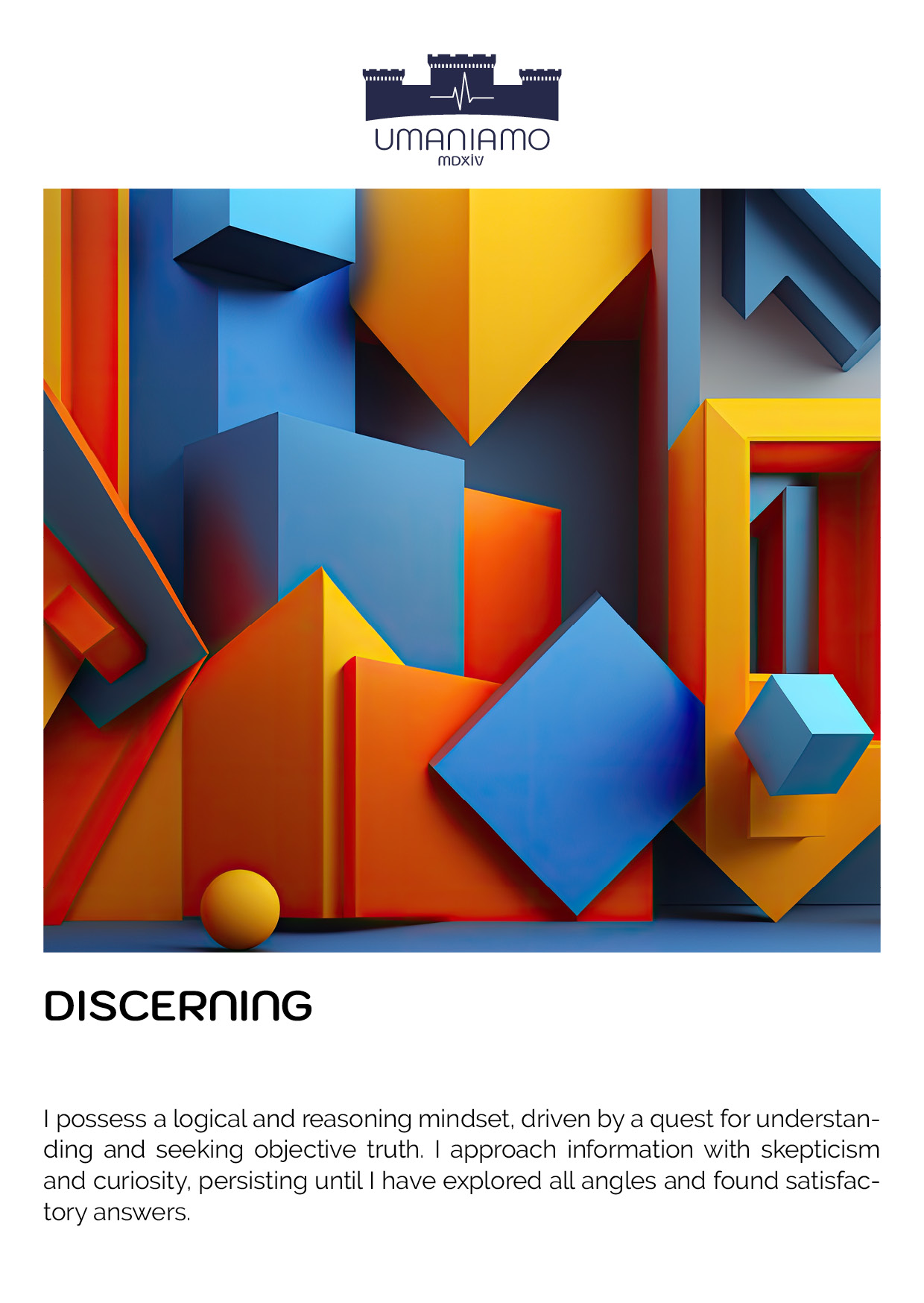
Each week, we invite you to REDISCOVER U®. Each card represents a gift that is already part of each of us. As with any gift, some you will use more often than others. As we shine a light on a particular gift, it may feel like something that really represents who you are, and others may feel more neutral or even
This week we focus on Discernment which is the output of the action of Discerning. Most people hear the word and think it means making a good decision or simply critical thinking. Weighing the options, listing the pros and cons, choosing the right one. That is a good habit, but it is not “discernment.”
Discernment is the step before choosing. It is the capacity to notice what is moving you, which voice is shaping the desire, which spirit is directing the attention before your hand ever reaches for anything. Two men can make the identical decision, one out of love and one out of fear, and only one of them will still be standing in it a year later. Ignatius of Loyola spent his life building a method for this, and the test he arrived at is simple enough for a Tuesday: some things excite you and leave a quiet that stays. Others excite you and then empty you. Both feel good at the moment of contact. Only one of them is still feeding you an hour later.
The person with this gift is the one who can tell a room what is actually happening. Not the smartest voice at the table, but the one who slows things down at exactly the right moment and says wait, what is driving this? Every group needs someone who can name the drift while it is still small enough to correct.
Where it goes wrong. Discernment has two shadows, and they are very different.
The first is paralysis: weighing forever, never choosing, calling it prayerfulness. "I'm still discerning" can be an honest report, and it can also be a way of avoiding the cost of a decision. A discernment with no deadline is usually not a discernment.
The second is more common. It is using the language of discernment to bless what you had already decided. You ask the question in the shape that produces the answer you wanted. You seek counsel until someone finally agrees. This is worth naming plainly, because we now have machines that will do this for us instantly, patiently, and with sources attached.
Discernment and the REDISCOVER UⓇ card deck. Here is the part worth sitting with: Discernment is one card, but it is also the faculty you use to read every other one.
When you hold a card and it opens a strength you already live from, that recognition is discernment. When a card aches, it's a real gift you have buried, asking for air. That ache is discernment, and it is the one we rush past fastest. When a card invites a neutral or stays quiet quality, it’s a genuine capacity that simply isn't your “go to” strength and knowing not to build a life on it is discernment too.
The cards name what was given. Discernment tells you what is governing it now. That is why this week's theme is Turn the Table, and why the cards, the turns, and the six questions at the end of the day are one toolkit rather than three products.
This week, notice what is moving you. Before any decision that matters: a conversation, a purchase, a reply you want to fire off, a yes, a no. Stop for the length of one breath and ask honestly: what is moving me here? Love, fear, vanity, resentment, duty, freedom, or the desire to be seen. You do not have to fix the answer. Noticing it is the entire practice, and it will change some of your decisions on its own.
Bring these to your table this week: at dinner, in the car, wherever your people gather. They are meant to be talked through together, out loud, not just turned over alone.
Think of a decision you are still glad you made. Looking back honestly, what was actually moving you at the time and did you know it then, or only later?
Who at this table notices what the rest of us miss, the one who says wait, something's off here before anyone else does? When has their noticing saved us something? (Name them and thank them.)
Where do the phone, the feed, or the group chat get a vote in your decisions without ever being invited to the table? What would it look like to take that vote back?
Name something you have been "still deciding" for a long time. Be honest with yourself about which it is: real discernment that is not finished, or a way of not paying for a choice you have already made.
Sunday Table Invitation. Before moving from one question to the next, make sure everyone has had the chance to speak and pay particular attention to the children, the teenagers, and the quieter voices at the table. Humaning begins when every person knows they have a place at the table.
If young people are present, invite them to keep a notebook nearby. This week, you might offer them one question to carry: When you have a hard choice to make, who do you talk to first and what is it about that person that makes you go to them? Encourage them to write down whatever they want to keep: a story, a question, a strength they noticed, or something they simply don't want to forget. Humaning often begins when we learn to pay attention to our own thoughts and experiences.
Humaning is not a noun. It is something we do together, and then something we carry out the door. This week the circle practices discernment in three moves: naming the voice, naming what is ours, and naming the decision. Gather a few people and take it slowly.
First, go around once. Each person names one voice that has had a say in their week without ever being invited a feed, a comparison, an old verdict someone handed them years ago, an opinion that lives in their head rent-free. This is an inventory, not a confession. Say it out loud so it stops being background noise and becomes a thing with a name.
Then, go around again. This time each person names one thing they know to be true about themselves that no feed gave them, no algorithm measured, and nobody at this table can take back. Something authored rather than assigned. Say it with conviction, without beating around the bush, and let it be received.
Then close the circle with a single question, and let each person answer both halves aloud: What is one decision in front of me this week and what is actually moving me toward it? The first half is easy. The second half is the practice.
That is the whole movement of the week gathered into one circle: the lantern is named and loses its hold, the authored self is spoken and remembered, and the decision is made in the light rather than in the small bright circle someone else is holding. The chair does not move. What turns is everything we let sit at the head of the table.
End however your circle ends with a prayer, a blessing, a shared silence. Then go, and build.
Discernimento
Questa settimana vi invitiamo a confrontarvi non solo con le idee relative al “Discernimento”, ma anche con le azioni che danno vita a questi aspetti dell’“Humaning”.
Potete scegliere una o entrambe le seguenti pratiche a seconda del contesto, del tempo a disposizione e delle relazioni che avete.
La discussione a tavola è una conversazione rilassata e incentrata sulle relazioni, pensata per aiutare le persone a riflettere onestamente sul tema REDISCOVER UⓇ della settimana e sulle realtà della vita quotidiana. È una conversazione condivisa tra familiari e amici che cercano di rimanere presenti gli uni agli altri. La discussione a tavola non è un dibattito né una lezione, ma una riflessione sull’essere umani insieme.
Dopo il pasto, il caffè o un momento di ritrovo in compagnia:
Leggete ad alta voce la scheda REDISCOVER UⓇ e le riflessioni
Passate naturalmente da un spunto di discussione all’altro
Lasciate che la conversazione si sviluppi senza fretta
Alcune discussioni potrebbero essere spensierate, mentre altre potrebbero diventare profondamente riflessive. Dipende da voi.
Il Circolo dell’Essere Umani è una pratica relazionale più intenzionale ispirata allo spirito di un circolo di preghiera, di conversazione o di incontro comunitario.
Posizionate la scheda REDISCOVER UⓇ al centro del tavolo o visualizzate la scheda digitale, quindi invitate ogni persona a riflettere in silenzio sul tema insieme prima di condividere.
Iniziate con un respiro lento e condiviso e un breve momento di silenzio.
Il Circolo dell’Umanità incoraggia:
L’ascolto PROFONDO
La riflessione onesta
Il coraggio relazionale
La presenza condivisa
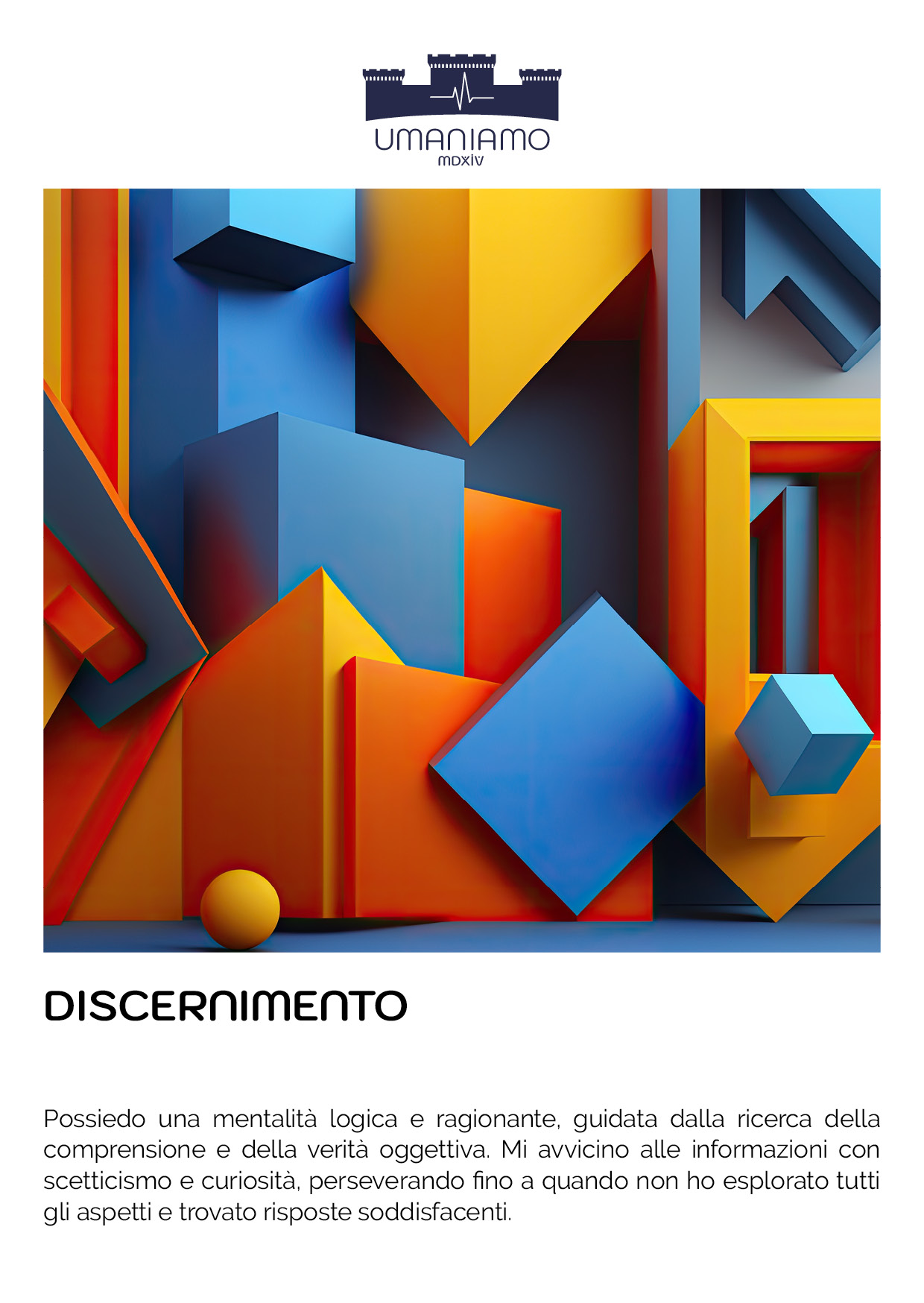
Ogni settimana vi invitiamo a REDISCOVER U®. Ogni carta rappresenta un dono che fa già parte di ciascuno di noi. Come per ogni dono, alcuni li userete più spesso di altri. Quando mettiamo in luce un dono particolare, potreste percepirlo come qualcosa che rappresenta davvero chi siete, mentre altri potrebbero sembrarvi più neutri o addirittura
Questa settimana ci concentriamo sul discernimento, che è il risultato dell’azione di discernere. La maggior parte delle persone, sentendo questa parola, pensa che significhi prendere una buona decisione o semplicemente pensare in modo critico: valutare le opzioni, elencare i pro e i contro, scegliere quella giusta. È una buona abitudine, ma non è “discernimento”.
Il discernimento è il passo che precede la scelta. È la capacità di notare ciò che ti muove, quale voce sta plasmando il desiderio, quale spirito sta dirigendo l’attenzione prima ancora che la tua mano si protenda verso qualcosa. Due uomini possono prendere la stessa identica decisione, uno per amore e uno per paura, e solo uno dei due sarà ancora fedele a quella scelta un anno dopo. Ignazio di Loyola ha dedicato la sua vita a elaborare un metodo per questo, e il criterio a cui è giunto è abbastanza semplice per un martedì: alcune cose ti entusiasmano e lasciano una quiete che permane. Altre ti entusiasmano e poi ti svuotano. Entrambe ti fanno sentire bene nel momento stesso in cui le vivi. Solo una di esse continua a nutrirti un’ora dopo.
La persona dotata di questo dono è quella che sa spiegare a una stanza cosa sta realmente accadendo. Non la voce più brillante al tavolo, ma quella che rallenta il ritmo esattamente al momento giusto e dice: «Aspettate, cosa sta guidando tutto questo?». Ogni gruppo ha bisogno di qualcuno in grado di individuare la deriva mentre è ancora abbastanza piccola da poter essere corretta.
Dove si va fuori strada. Il discernimento ha due ombre, e sono molto diverse.
La prima è la paralisi: soppesare all’infinito, non scegliere mai, definendolo «spirito di preghiera». «Sto ancora discernendo» può essere un’affermazione onesta, ma può anche essere un modo per evitare il costo di una decisione. Un discernimento senza scadenza di solito non è un discernimento.
La seconda è più comune. Consiste nell’usare il linguaggio del discernimento per avallare ciò che avevi già deciso. Poni la domanda in modo tale da ottenere la risposta che volevi. Cerchi consiglio finché qualcuno alla fine non è d’accordo. Vale la pena dirlo chiaramente, perché ora disponiamo di strumenti che lo fanno per noi all’istante, con pazienza e con le fonti allegate.
Il discernimento e il mazzo di carte REDISCOVER UⓇ. Ecco la parte su cui vale la pena soffermarsi: il discernimento è una carta, ma è anche la facoltà che usi per leggere tutte le altre.
Quando tieni in mano una carta e questa rivela un punto di forza da cui già attingi, quel riconoscimento è discernimento. Quando una carta fa male, è un vero dono che hai seppellito e che chiede di respirare. Quel dolore è discernimento, ed è quello che tendiamo a ignorare più rapidamente. Quando una carta suggerisce una qualità neutra o rimane in silenzio, si tratta di una capacità autentica che semplicemente non è il tuo punto di forza “preferito” e sapere di non dover costruire una vita su di essa è anch’esso discernimento.
Le carte danno un nome a ciò che ti è stato donato. Il discernimento ti dice cosa lo sta governando ora. Ecco perché il tema di questa settimana è Ribalta la situazione, ed ecco perché le carte, i cambiamenti e le sei domande a fine giornata costituiscono un unico kit di strumenti piuttosto che tre prodotti distinti.
Questa settimana, osserva cosa ti sta muovendo. Prima di qualsiasi decisione importante: una conversazione, un acquisto, una risposta che vorresti sparare a raffica, un sì, un no. Fermati per la durata di un respiro e chiediti onestamente: cosa mi sta muovendo in questo momento? Amore, paura, vanità, risentimento, dovere, libertà o il desiderio di essere visto. Non devi necessariamente trovare la risposta giusta. Notarlo è l’intera pratica, e cambierà di per sé alcune delle tue decisioni.
Porta questi spunti al tuo tavolo questa settimana: a cena, in macchina, ovunque si riuniscano i tuoi cari. Sono pensati per essere discussi insieme, ad alta voce, non solo riflettendoci da soli.
Pensa a una decisione che sei ancora felice di aver preso. Guardando indietro onestamente, cosa ti stava realmente muovendo in quel momento e lo sapevi allora, o solo più tardi?
Chi a questo tavolo nota ciò che sfugge a tutti noi, chi dice «aspetta, qui c’è qualcosa che non quadra» prima di chiunque altro? Quando la sua osservazione ci ha salvato da qualcosa? (Nominatelo e ringraziatelo.)
In quali casi il telefono, i social o la chat di gruppo hanno voce in capitolo nelle vostre decisioni senza essere mai stati invitati al tavolo? Come sarebbe se toglieste loro quella voce in capitolo?
Indicate qualcosa su cui state «ancora decidendo» da molto tempo. Siate onesti con voi stessi su cosa sia: un vero discernimento non ancora concluso, o un modo per non assumervi la responsabilità di una scelta che avete già fatto.
Invito alla tavola domenicale. Prima di passare da una domanda all’altra, assicuratevi che tutti abbiano avuto la possibilità di parlare e prestate particolare attenzione ai bambini, agli adolescenti e alle voci più silenziose a tavola. L’essere umani inizia quando ogni persona sa di avere un posto a tavola.
Se sono presenti dei giovani, invitateli a tenere un quaderno a portata di mano. Questa settimana potreste proporre loro una domanda su cui riflettere: quando dovete fare una scelta difficile, a chi vi rivolgete per primo e cosa c’è in quella persona che vi spinge ad andare da lei? Incoraggiateli a scrivere tutto ciò che desiderano conservare: una storia, una domanda, un punto di forza che hanno notato o semplicemente qualcosa che non vogliono dimenticare. L’“Humaning” spesso inizia quando impariamo a prestare attenzione ai nostri pensieri e alle nostre esperienze.
“Humaning” non è un sostantivo. È qualcosa che facciamo insieme e che poi portiamo con noi fuori da qui. Questa settimana il cerchio si esercita nel discernimento in tre fasi: dare un nome alla voce, dare un nome a ciò che è nostro e dare un nome alla decisione. Riunite alcune persone e procedete con calma.
Per prima cosa, fate un giro di tavolo. Ogni persona identifica una voce che ha avuto voce in capitolo nella propria settimana senza mai essere stata invitata: un feed, un confronto, un vecchio giudizio che qualcuno le ha attribuito anni fa, un’opinione che vive nella sua testa senza pagare affitto. Si tratta di un inventario, non di una confessione. Ditelo ad alta voce affinché smetta di essere rumore di fondo e diventi una cosa con un nome.
Poi, fate un altro giro. Questa volta ogni persona nomini una cosa che sa essere vera su se stessa, che nessun feed le ha fornito, nessun algoritmo ha misurato e che nessuno a questo tavolo può toglierle. Qualcosa di creato da sé, piuttosto che assegnato. Ditelo con convinzione, senza girarci intorno, e lasciate che venga accolto.
Poi chiudete il cerchio con un’unica domanda, e lasciate che ogni persona risponda ad entrambe le parti ad alta voce: Qual è una decisione che mi aspetta questa settimana e cosa mi sta effettivamente spingendo verso di essa? La prima parte è facile. La seconda parte è la pratica.
Ecco l’intero percorso della settimana racchiuso in un unico cerchio: la lanterna viene nominata e perde la sua presa, il sé creato viene espresso e ricordato, e la decisione viene presa alla luce piuttosto che nel piccolo cerchio luminoso che qualcun altro sta tenendo in mano. La sedia non si muove. Ciò che gira è tutto ciò che lasciamo sedere a capotavola.
Concludete il vostro cerchio, qualunque sia il modo in cui finisce, con una preghiera, una benedizione, un silenzio condiviso. Poi andate, e costruite.
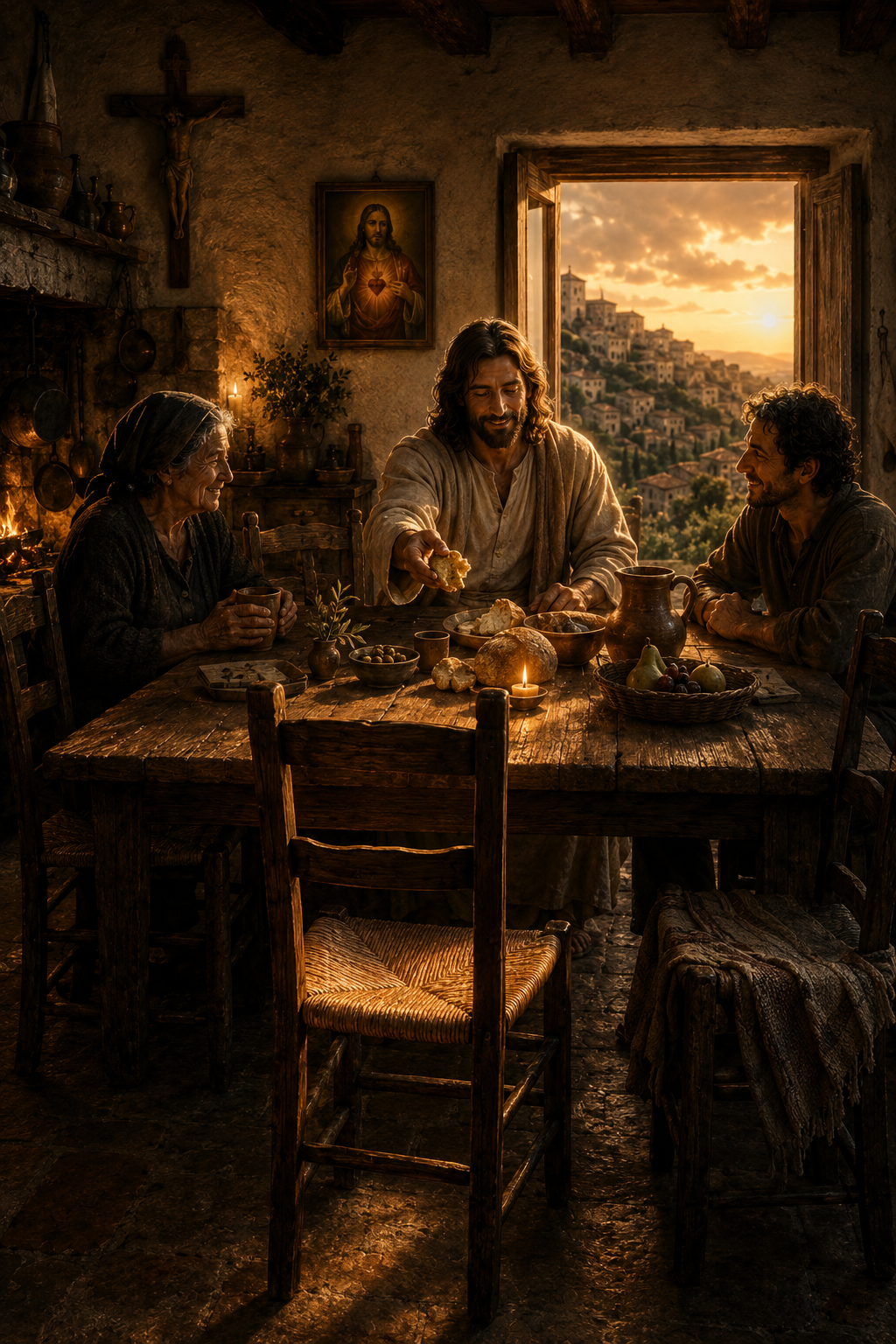
Before the Empty Chair was ever an idea, it was a chair. A real one, in a real room, in the South of Italy, where the kitchen was not one room among several but very nearly the whole of the house, because a person is not partitioned, and neither was the home. People did not work in one room and eat in another and pray in a third. They lived, together, in the one warm room where the bread was, and everything that mattered happened around the same table.
And at that table, in a great many of those kitchens, a chair was kept empty... not by accident, but rather on purpose, for whoever might come: the neighbor, the relative passing through, the stranger at the wrong house, the person nobody was expecting. And there was always something ready to share, because a home that has no room for the unexpected guest has quietly stopped being a home. The empty chair was a sign of lacking. It was a signal of readiness. It was a family saying, with furniture, we are not closed and there is always room and you are already expected.
That was the reflection that resulted in The Chair and Empty Chair. Everything we have built over the months since then: every essay, every word about occupancy and authority and authorship is what happens when we take that one chair in one kitchen seriously enough to follow it through its iterations of meaning.
In many of those same kitchens, there was always a crucifix on the wall and usually a picture of the Sacred Heart, with Christ and His heart shown and His hand raised, watching the table. Present, but as an image. An observer of the meal.
What I learned in those kitchens was an observation so deep that you had to be there to understand. The most profound thing those families did, and they did it without explanation, was to take Him off the wall. To stop letting Him watch the meal and instead give Him the chair. These families knew that Christ was never meant to be the picture that observes the family. He is the Guest at the table, which in some ways sums up the whole Gospel, and brings it home from the altar to the kitchen: not the Heart on the wall, but the One in the chair, passing the bread.
Here is the silent mystery the grandmothers understood better than the theologians: when Christ takes the empty chair, the chair is not filled up and closed. It multiplies. He sits and there is still an empty chair for the next one, because that is simply how He is. To seat Him is to be sent to seat another. He fills the chair by making room for one more.
There is a meaningful and even more humble version of this story that I love even more, because I’ve been there to see it. In the little apartments, when the room is small and the family big, everyone brought their own chair to Sunday lunch, and someone always brought an extra. Sit with what that for a second and imagine what that means. No one was received into a finished room with a place already assigned by someone in charge. You brought your own chair. You came as yourself, carrying the very thing you would sit on, and you added it to the table, and the table simply widened to take you in. There was no head of the table, because there was no fixed table, only however many chairs had come, arranged in whatever way they all fit. Nobody above anybody. Always one more chair than there were people, because someone had thought to bring the extra. That is really the message of the Chair: you bring your own seat, your own self, and you are honored not by being ranked but by being added to someone else's table.
The world has an Empty Chair too, and it is worth taking a look at, because it is the exact opposite of the kitchen's. The world's Empty Chair is the closed one, where a person is seated and spent and alone, in a room with no extra chair and nothing to share, kept there because they are useful and left there because no one is coming.
The kitchen's Empty Chair and the world's Empty Chair are the same two words meaning opposite things. One says there is always room for you. The other says you are here to be used, and no one is on their way to save you. Most of modern life is the second chair dressed up to look like the first. What we are doing at the Sunday Table is trying to give people back the first version of the Empty Chair.
Maybe you have spent your life feeling like the one who did not quite fit. Too much of something, or too little, or simply different in a way that made rooms go a little quiet. Maybe you learned, early, that being yourself cost you something and that people expected you to be like them, and were uneasy when you weren't, and somehow it became your fault for being made the way you were made. That ache has a name most people never understand: you were made as an original, and the world is often uncomfortable around originals, and it is very good at making the original carry the blame for the discomfort.
The discomfort was never a verdict about you and there always is a table somewhere that keeps an Empty Chair for exactly the person who doesn’t fit. Because you are not an accident and you are not a copy. Out of every human that could have been, this one came to be: you, particular, unrepeatable, conceived on purpose. Before you were formed, you were known. Before you were born, you were chosen by the Author. The Chair has had your name on it since before you existed, not the name the world gave you, the one the Author did.
So this is not an explanation of the Empty Chair. It is The Chair itself, pulled out from the table, and turned toward you. Come and sit. There is something to share, and it was set aside for you. And when you have sat there long enough to believe it and long enough that the ache begins to quiet and the original begins to breathe, do the one thing the kitchen was always teaching. Keep a chair empty for the next one who doesn't fit. Always have something ready to share. Bring your own chair. And bring an extra. The Empty Chair was always a kitchen. It still is. And there is a seat at it with your name on it, waiting the way it has been waiting since before you were born.
Ad maiorem Dei gloriam.
We are human together, or not at all.
Prima ancora che “La sedia vuota” diventasse un’idea, era una sedia. Una sedia vera, in una stanza vera, nel Sud Italia, dove la cucina non era una stanza tra le tante, ma praticamente l’intera casa, perché una persona non è divisa in parti, e nemmeno lo era la casa. La gente non lavorava in una stanza, non mangiava in un’altra e non pregava in una terza. Viveva, insieme, in quell’unica stanza calda dove c’era il pane, e tutto ciò che contava accadeva attorno allo stesso tavolo.
E a quel tavolo, in moltissime di quelle cucine, una sedia veniva tenuta vuota… non per caso, ma piuttosto di proposito, per chiunque potesse arrivare: il vicino, il parente di passaggio, lo sconosciuto che si era sbagliato di casa, la persona che nessuno si aspettava. E c’era sempre qualcosa pronto da condividere, perché una casa che non ha spazio per l’ospite inatteso ha smesso silenziosamente di essere una casa. La sedia vuota era un segno di mancanza. Era un segnale di disponibilità. Era un modo in cui la famiglia diceva, con i mobili: «Non siamo chiusi, c’è sempre posto e sei già atteso».
Questa è stata la riflessione che ha dato origine a La sedia e La sedia vuota. Tutto ciò che abbiamo costruito nei mesi successivi: ogni saggio, ogni parola sull’occupazione, l’autorità e la paternità dell’opera è ciò che accade quando prendiamo quella singola sedia in una cucina abbastanza sul serio da seguirne le iterazioni di significato.
In molte di quelle stesse cucine, c’era sempre un crocifisso appeso alla parete e di solito un’immagine del Sacro Cuore, con Cristo e il Suo cuore in primo piano e la Sua mano alzata, che guardava verso la tavola. Presente, ma solo come immagine. Un osservatore del pasto.
Ciò che ho imparato in quelle cucine è stata un’osservazione così profonda che bisognava essere lì per capirla. La cosa più profonda che quelle famiglie facevano, e la facevano senza spiegazioni, era toglierLo dalla parete. Smettere di lasciarLo osservare il pasto e invece offrirGli la sedia. Queste famiglie sapevano che Cristo non era mai stato pensato per essere l’immagine che osserva la famiglia. Egli è l’Ospite a tavola, il che in un certo senso riassume l’intero Vangelo e lo porta dall’altare alla cucina: non il Cuore sulla parete, ma Colui che siede sulla sedia, che passa il pane.
Ecco il mistero silenzioso che le nonne hanno compreso meglio dei teologi: quando Cristo prende la sedia vuota, la sedia non si riempie e non si chiude. Si moltiplica. Lui si siede e c’è ancora una sedia vuota per il prossimo, perché Lui è semplicemente così. Fargli posto significa essere mandati a fare posto a un altro. Lui riempie la sedia facendo spazio a un altro ancora.
C’è una versione significativa e ancora più umile di questa storia che amo ancora di più, perché sono stata lì a vederla. Nei piccoli appartamenti, quando la stanza è piccola e la famiglia numerosa, ognuno portava la propria sedia al pranzo della domenica, e qualcuno ne portava sempre una in più. Rifletteteci un attimo e immaginate cosa significhi. Nessuno veniva accolto in una stanza già pronta con un posto già assegnato da qualcuno che comandava. Portavi la tua sedia. Venivi come te stesso, portando proprio ciò su cui ti saresti seduto, e la aggiungevi al tavolo, e il tavolo semplicemente si allargava per accoglierti. Non c’era un capotavola, perché non c’era un tavolo fisso, ma solo tutte le sedie che erano state portate, disposte in qualunque modo potessero stare. Nessuno è al di sopra di nessun altro. C’è sempre una sedia in più rispetto al numero delle persone, perché qualcuno ha pensato di portarne una in più. Questo è davvero il messaggio della Sedia: porti il tuo posto, te stesso, e sei onorato non per la tua posizione gerarchica, ma per essere stato aggiunto al tavolo di qualcun altro.
Anche il mondo ha una “Sedia Vuota”, e vale la pena darci un’occhiata, perché è l’esatto opposto di quella della cucina. La “Sedia Vuota” del mondo è quella chiusa, dove una persona è seduta, esausta e sola, in una stanza senza sedie in più e senza nulla da condividere, tenuta lì perché è utile e lasciata lì perché non arriverà nessuno.
La “Sedia Vuota” della cucina e quella del mondo sono le stesse due parole che significano cose opposte. Una dice che c’è sempre posto per te. L’altra dice che sei qui per essere sfruttato, e nessuno sta arrivando per salvarti. Gran parte della vita moderna è la seconda sedia travestita per sembrare la prima. Quello che stiamo facendo al “Tavolo della Domenica” è cercare di restituire alle persone la prima versione della “Sedia Vuota”.
Forse hai trascorso la tua vita sentendoti come colui che non si adattava del tutto. Troppo di qualcosa, o troppo poco, o semplicemente diverso in un modo che faceva calare un po’ di silenzio nelle stanze. Forse hai imparato, fin da piccolo, che essere te stesso ti costava qualcosa e che le persone si aspettavano che tu fossi come loro, e si sentivano a disagio quando non lo eri, e in qualche modo è diventata colpa tua per essere stato creato così come sei. Quel dolore ha un nome che la maggior parte delle persone non capisce mai: sei stato creato come un originale, e il mondo spesso si sente a disagio in presenza degli originali, ed è molto bravo a far ricadere la colpa di quel disagio proprio sull’originale.
Quel disagio non è mai stato un giudizio su di te e c’è sempre un tavolo da qualche parte che riserva una “Sedia Vuota” proprio per la persona che non si adatta. Perché tu non sei un caso e non sei una copia. Tra tutti gli esseri umani che avrebbero potuto esistere, è nato proprio questo: tu, unico, irripetibile, concepito di proposito. Prima ancora che tu fossi formato, eri già conosciuto. Prima ancora che tu nascessi, eri stato scelto dall’Autore. La Sedia porta il tuo nome da prima che tu esistessi, non il nome che ti ha dato il mondo, ma quello che ti ha dato l’Autore.
Quindi questa non è una spiegazione della Sedia Vuota. È la Sedia stessa, allontanata dal tavolo e rivolta verso di te. Vieni a sederti. C’è qualcosa da condividere, ed è stato messo da parte per te. E quando ti sarai seduto lì abbastanza a lungo da crederci, e abbastanza a lungo perché il dolore cominci a placarsi e l’originale ricominci a respirare, fai l’unica cosa che la cucina ti ha sempre insegnato. Tieni una sedia vuota per il prossimo che non ci sta. Abbi sempre qualcosa di pronto da condividere. Porta la tua sedia. E portane una in più. La “Sedia Vuota” è sempre stata una cucina. Lo è ancora. E c’è un posto a tavola con il tuo nome sopra, che ti aspetta come ha sempre fatto, fin da prima che tu nascessi.
Ad maiorem Dei gloriam.
Siamo umani insieme, oppure non lo siamo affatto.
Small acts to move the world forward
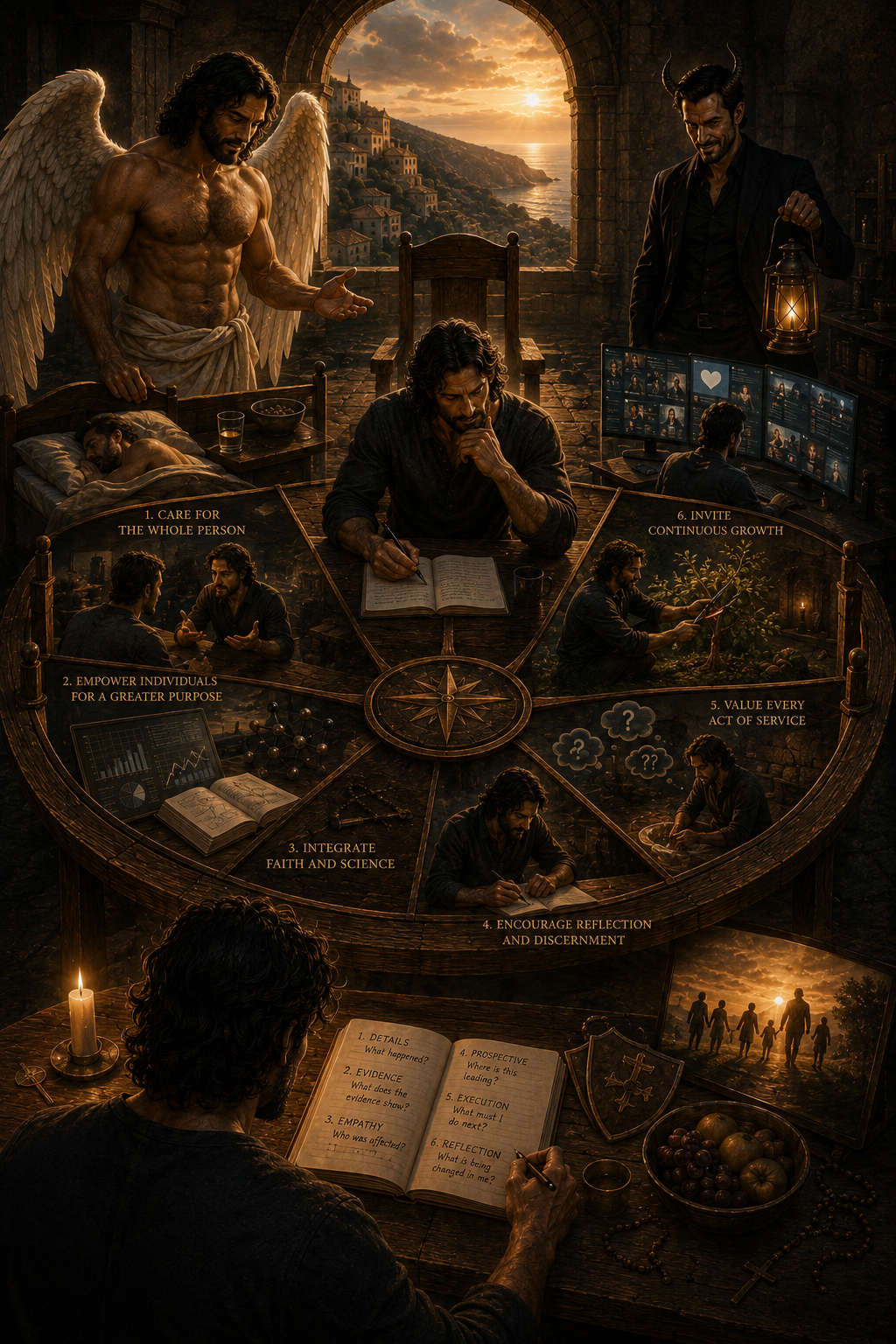
The Magis question this week: What has been sitting at the head of my table, and actually needs to turn?
Discernment has a failure mode that seems like insight. Everything lines up, I can trace the steps, the answer makes sense, or even, can you believe this is what someone or something said. Yes discernment isn’t truly experienced in thinking alone, while it feels like experience or even learning, nothing really happens.
So our Magis Moments this week are not about deeper insight. We are working on moving something through six small acts, one per Promise each of which carries a decision made in the light rather than in the small bright circle from a lantern The Devil at Work is holding.
Small acts move the world forward. Here are six.
You cannot really read life accurately through a depleted body. Most of what feels like a clear signal at eleven at night is fatigue that has learned to sound like conviction.
This week: take a decision you have been turning over in the dark and refuse to decide it in the dark. Move it to a morning after sleep, food, and after moving your body. Same decision, with a more rested version of you. Notice how much of what felt certain at midnight does not survive breakfast.
The most dangerous condition for a man making a decision is a room where everyone agrees with him. We now have machines built to produce that room on demand, but people have always been willing to supply it for free.
This week: give one person a real veto. Say it out loud to a spouse, a friend, a teammate: "On this decision, if you tell me I'm wrong, I stop." Then mean it. The agency you hand someone is only real when it can cost you something.
Data has a strong pull, but it’s not a verdict. Prediction is not providence, and every forecast about your future was assembled out of somebody else's past.
This week: take one thing that you are sure about for how your life is going to go… a fear or a certainty, either works and trace back to where that certainty came from. A number on a screen? A pattern from another person's story? One bad year that has been doing the talking ever since? Name the source out loud, then decide how much authority it has over your actions and trajectory.
Here is a tricky one… Failure is rarely about asking the wrong questions. It’s asking the right question in a way that produces the answer you already have - a self-fulfilling prophecy.
This week: take one thing you have "already discerned." Write down the question you were actually asking. Then write the question you would have asked if you genuinely did not care which way it came out. If those are two different sentences, you have this week's work, and you have not finished discerning anything.
Discernment tests positive in the places nobody is watching. Anyone can be clear-eyed in front of an audience, but in the backroom or on a walk through the woods it may feel different.
This week: do one thing that will never appear anywhere. No photograph, no mention, no working it into a conversation three days from now. Finish it completely, perhaps even better than it needs to be. Then notice how strongly you wanted credit for it, and sit with where that pull was coming from. That is Ad maiorem Dei gloriam on an ordinary Wednesday: a good thing done, and the glory of it routed somewhere other than through you.
You can outgrow a decision that was true when you made it. Everything has a season, and loyalty to an expired impression is not faithfulness, it’s just familiarity.
This week: name one commitment you made from an honest well thought out decision that is no longer true. No judgement is required for a season that closed. Say it out loud to one person who will not let you fake it. Growth begins exactly where loyalty to something that no longer is true.
Magis is not a seventh act added to the six. It is what shows up when the six are lived together. It's the fruit, not force.
You will know it by what it produces rather than by how it feels: deeper freedom, wider service, stronger relationships, a larger shared life. Notice this week whether anything you did made more room for someone else. That is the only reliable test, and it does not require you to feel anything in particular.
At the end of each day this week, six questions, in order:
Details: What happened?
Evidence: What does the evidence show?
Empathy: Who was affected?
Prospective: Where is this leading?
Execution: What must I do next?
Reflection: What is being changed in me?
Most of the six questions are straightforward except - the second (evidence) and fifth (execution). These often get glossed over or skipped but they are the most important.
What does the evidence show? This is where a preference gets promoted to a call. It is easy to run an honest-looking Examen and never once check a feeling against a fact. Ask what actually happened, not what it felt like. Ask what someone who does not need you to be right would say about the same day.
What must I do next? This is where discernment either becomes a decision or quietly becomes a hobby. The answer has to be a thing with a verb in it, small enough to do before you go to sleep again.
Between the two of them sits the whole discernment practice: evidence keeps you honest about what you saw, execution keeps you honest about whether you meant it.
At the end of the week, one question, and take your time with it:
Where did I move something and what was actually moving me when I did? Then go back to one thing you changed and look at what it became. Not what you intended. What it actually became. A feeling can be counterfeited without much effort. Fruit cannot be counterfeited at all. The chair did not move this week. It never does. What turned was whatever you finally stopped letting sit at the head of your table.
Ad maiorem Dei gloriam.
We are human together — or not at all.
La domanda Magis di questa settimana: Cosa è rimasto fermo a capotavola e ha davvero bisogno di cambiare?
Il discernimento ha una modalità di fallimento che sembra intuizione. Tutto quadra, riesco a ripercorrere i passi, la risposta ha senso, o addirittura: «Riesci a credere che sia proprio questo ciò che qualcuno o qualcosa ha detto?». Sì, il discernimento non si vive veramente solo con il pensiero; anche se sembra un’esperienza o addirittura un apprendimento, in realtà non accade nulla.
Quindi i nostri Momenti Magis di questa settimana non riguardano un’intuizione più profonda. Stiamo lavorando per smuovere qualcosa attraverso sei piccoli gesti, uno per ogni Promessa, ognuno dei quali porta con sé una decisione presa alla luce, piuttosto che nel piccolo cerchio luminoso della lanterna che Il Diavolo all’Opera tiene in mano.
I piccoli gesti fanno avanzare il mondo. Eccone sei.
Non puoi davvero interpretare la vita con precisione attraverso un corpo esausto. La maggior parte di ciò che sembra un segnale chiaro alle undici di sera è stanchezza che ha imparato a sembrare convinzione.
Questa settimana: prendi una decisione su cui stai rimuginando al buio e rifiuta di decidere al buio. Rimandala a una mattina dopo aver dormito, mangiato e mosso il corpo. Stessa decisione, con una versione più riposata di te stesso. Notate quanto di ciò che sembrava certo a mezzanotte non sopravviva alla colazione.
La condizione più pericolosa per un uomo che deve prendere una decisione è una stanza in cui tutti sono d’accordo con lui. Ora abbiamo macchine costruite per ricreare quella stanza su richiesta, ma le persone sono sempre state disposte a fornirla gratuitamente.
Questa settimana: date a una persona un vero diritto di veto. Dillo ad alta voce al tuo coniuge, a un amico, a un compagno di squadra: “Su questa decisione, se mi dici che ho torto, mi fermo.” E poi fallo sul serio. L’autonomia che concedi a qualcuno è reale solo quando può costarti qualcosa.
I dati esercitano una forte attrazione, ma non sono un verdetto. La previsione non è provvidenza, e ogni previsione sul tuo futuro è stata costruita a partire dal passato di qualcun altro.
Questa settimana: prendi una cosa di cui sei sicuro riguardo a come andrà la tua vita… una paura o una certezza, va bene entrambe, e risalire alla fonte da cui proviene quella certezza. Un numero su uno schermo? Uno schema tratto dalla storia di un’altra persona? Un anno negativo che da allora ha sempre avuto l’ultima parola? Nomina la fonte ad alta voce, poi decidi quanta autorità abbia sulle tue azioni e sul tuo percorso.
Ecco una questione spinosa… Il fallimento raramente consiste nel porre le domande sbagliate. Consiste nel porre la domanda giusta in un modo che produca la risposta che hai già in mente: una profezia che si autoavvera.
Questa settimana: prendi una cosa che hai “già discernito”. Scrivi la domanda che stavi effettivamente ponendo. Poi scrivi la domanda che avresti posto se davvero non ti fosse importato quale fosse il risultato. Se si tratta di due frasi diverse, hai il compito di questa settimana, e non hai ancora finito di discernere nulla.
Il discernimento dà il meglio di sé nei luoghi dove nessuno sta guardando. Chiunque può mostrarsi lucido di fronte a un pubblico, ma dietro le quinte o durante una passeggiata nei boschi le cose potrebbero sembrare diverse.
Questa settimana: fai una cosa che non apparirà mai da nessuna parte. Niente foto, niente menzioni, niente accenni in una conversazione tra tre giorni. Portala a termine completamente, magari anche meglio di quanto sia necessario. Poi nota quanto fortemente desideravi ricevere il merito per essa, e rifletti su da dove provenisse quella spinta. Questo è Ad maiorem Dei gloriam in un normale mercoledì: una buona azione compiuta, e la gloria di essa convogliata altrove piuttosto che attraverso di te.
Puoi superare una decisione che era vera quando l’hai presa. Ogni cosa ha la sua stagione, e la fedeltà a un’impressione ormai superata non è fedeltà, è solo abitudine.
Questa settimana: indica un impegno che hai preso sulla base di una decisione onesta e ben ponderata, ma che ora non è più valida. Non serve giudicare una stagione che si è conclusa. Dillo ad alta voce a una persona che non ti permetterà di fingere. La crescita inizia esattamente dove finisce la fedeltà a qualcosa che non è più vero.
Il Magis non è un settimo atto aggiunto ai sei. È ciò che emerge quando i sei vengono vissuti insieme. È il frutto, non la forza.
Lo riconoscerai da ciò che produce piuttosto che da come ti fa sentire: libertà più profonda, servizio più ampio, relazioni più solide, una vita condivisa più vasta. Questa settimana osserva se qualcosa che hai fatto ha creato più spazio per qualcun altro. Questo è l’unico test affidabile, e non richiede che tu provi nulla di particolare.
Alla fine di ogni giornata di questa settimana, sei domande, in ordine:
Dettagli: Che cosa è successo?
Evidenza: Che cosa mostra l’evidenza?
Empatia: Chi ne è stato coinvolto?
Prospettiva: Dove sta portando tutto questo?
Esecuzione: Che cosa devo fare ora?
Riflessione: Che cosa sta cambiando in me?
La maggior parte delle sei domande è semplice, tranne la seconda (prove) e la quinta (azione). Queste spesso vengono sorvolate o saltate, ma sono le più importanti.
WCosa dimostrano le prove? È qui che una preferenza si trasforma in una chiamata. È facile condurre un Esame che sembri onesto senza mai confrontare una sensazione con un fatto. Chiediti cosa è realmente accaduto, non come ti sei sentito. Chiediti cosa direbbe di quella stessa giornata qualcuno che non ha bisogno che tu abbia ragione.
Che devo fare adesso? È qui che il discernimento si trasforma in una decisione o diventa silenziosamente un passatempo. La risposta deve essere un’azione che contenga un verbo, abbastanza piccola da poterla compiere prima di andare di nuovo a dormire.
Tra queste due domande risiede l’intera pratica del discernimento: le prove ti mantengono onesto riguardo a ciò che hai visto, l’attuazione ti mantiene onesto riguardo al fatto che tu lo intendessi davvero.
Alla fine della settimana, una domanda, e prenditi tutto il tempo necessario:
Dove ho spostato qualcosa e cosa mi stava effettivamente muovendo mentre lo facevo? Poi torna a una cosa che hai cambiato e guarda cosa ne è risultato. Non ciò che intendevi. Ciò che è effettivamente diventato. Una sensazione può essere contraffatta senza troppa fatica. Il frutto non può essere falsificato affatto. La sedia non si è mossa questa settimana. Non lo fa mai. Ciò che è cambiato è stato ciò che alla fine hai smesso di lasciare seduto a capotavola.
Ad maiorem Dei gloriam.
Siamo umani insieme — o non lo siamo affatto.
Cosiamo | Founder, UMANIAMO® | Humaning Architecture

A word about discernment, for anyone who's ever asked their phone what to do You ask the little glowing rectangle a hundred things a day. Best tacos near me. Is it going to rain? How do I get over someone? Should I text him back? What a good side hustle. Am I depressed or just tired? What do I do with my life? You ask, and it answers, instantly, confidently, in a calm voice with no idea who you are… Somewhere along the way we started calling this “figuring things out.” We outsourced the oldest human act there is to an anonymous search engine, and we did it so gradually that nobody noticed what we gave away.
Here is what we gave away - discernment, and it is not a Google result. It is the ability to tell, from deep inside yourself, whether a path is actually yours or whether a “yes” is a real yes or just the loudest fear in the room holding a yes sign. Your phone can tell you what's popular. It can tell you what worked for strangers. It can’t tell you what's true for you, because it has never once been you, and you being you is what shapes discernment. Everyone is designed for discernment and discerning, but for most of us it's just been sitting in a drawer, unlabeled, because nobody shared your “owners manual” with you.
About five hundred years ago there was a soldier named Ignatius who was, by his own cheerful admission, kind of an insufferable jerk… vain, hot-tempered, obsessed with his own “brand” reputation, the sixteenth-century version of a guy who peaks in his early twenties and knows it. Then during a battle, enemy fire shattered his leg, and he spent months flat on his back, bored out of his mind, with nothing to do but daydream.
When he reminisced about his past triumphs on and off the battlefield or imagined future conquests it felt amazing in the moment and then left him flat and restless afterward. When he daydreamed about a different kind of life, one that actually meant something, it also felt good in the moment, but it left a different residue. It stayed warm. Hours later he was still lit up by it.
Ignatius’ biggest discovery, which defined the remainder of his life, was that the two experiences felt identical while they were happening, but only one had lasting positive impacts. He'd been doing what you do, what we all do - chasing the thing that felt good in the moment and getting confused when it kept feeling hollow later. He just became the first person to slow down enough to experience it and then to write it down. That's the thing schools were built all over the world to teach, that shaped continents, that has a whole library behind it. It started with a bored injured soldier paying attention to the difference between a feeling and its aftertaste.
Notice what Ignatius did not do. He didn't take a poll. He didn't ask what most knights would do. He didn't look up "top 5 life paths for recovering soldiers." He went inward, and he paid attention to what happened, the pull toward and the push or drag away and he learned to tell the fake from the real by where it led over time.
Your phone is very good at the poll, because that’s what it is. Every response it gives you is some version of “here's what worked for people vaguely like you,” which is genuinely useful for tacos and genuinely useless for the questions that actually keep you up at night. You already know that the questions that keep you up are not information problems. You are not lying awake because you lack data. You are lying awake because two things both feel like yes and you cannot tell which one is true or right for you.
No amount of searching outside yourself fixes that, because the answer was never out there in the first place. It's a diagnostic exploration you measure inside.
You already know the feeling of a choice that expands you versus one that makes you feel smaller. You already know the difference between the calm that comes after a right decision and the jittery, over-explaining energy that comes after a wrong one you're trying to talk yourself into. You have the instrument. You've just never been told it's for anything, so you keep overriding it with the search bar.
Ignatius turned his recovery into something almost radically practical, a daily habit that takes five minutes and works better than any app you've downloaded to fix your life. Stripped of all the churchy language, it's this: At the end of the day, get quiet for a minute and run rewind the day. Where did I feel most alive today, most like myself? And where did I feel it drain or where did I feel small, or fake, or hollow? Don't judge it or try to fix it. Just notice. Do that for a week and a pattern shows up that no personality quiz will ever give you, because it's not a category you fell into, it's the actual data of your real life, read by the only instrument made to measure it and able to read it, you. At UMANIAMOⓇ we call this method D.E.E.P.E.R., and you will find a weekly guide for your exploration.
You will get it wrong sometimes. That's fine; the reading gets sharper the more you take it, which is the exact opposite of how it works with the phone, where you learn nothing and it decides more. This one, you get better at. It compounds. In ten years you'll be able to walk into a room, or a relationship, or a job offer, and feel the thing sitting slightly wrong before you can explain why, and you'll be right, and you won't fully know how, and that is the inheritance the bored soldier left lying around for anyone who wants it.
We are the most advised generation in human history and, by a lot of measures, the least sure of anything. That's not a coincidence. When you outsource every small choice to the rectangle, the muscle that makes the big ones wastes away until the day a question arrives that no search can reveal, and you reach for the instrument, and find you never learned to use it.
Ignatius would tell you it's not too late, and that you're not starting from zero, and that the thing you've been asking Siri was always yours to answer. He'd tell you to put the phone down for the questions that matter, and pick up the one you were born with, the one that came standard, the one that has been quietly taking readings your whole life while you ignored it in favor of a voice that has never met you.
Ask the rectangle where the tacos are. The rest of it, the questions with your whole life in them, you were built to discern. You've just been letting a machine do the one thing it can't.
Ad maiorem Dei gloriam.
This week the Church remembers men and women who lived through political upheaval, persecution, misunderstanding, intellectual conflict, and personal sacrifice. They did not become saints by escaping their age. They became saints by refusing to let their age become the author of their lives.
As we celebrate the Feast of St. Ignatius of Loyola, we also begin a new annual UMANIAMO® tradition: Turn the Table. Like Ignatius, each of these saints reminds us that while the world changes around us, the Chair of conscience remains fixed before God. We are invited not to move the Chair, but to turn the table and to see our lives once again from the perspective of the Author rather than the algorithm.
Monday, July 28: Sts. Nazarius and Celsus
Nazarius and the young Celsus proclaimed Christ during a time when doing so could cost them everything. Tradition tells us that Nazarius became both mentor and companion to the younger Celsus. Their witness reminds us that courage is rarely solitary; it is often transmitted through relationships.
Humaning Reflection
The digital world rewards independence. Human flourishing requires apprenticeship. No Builder becomes himself alone. Every man is shaped by someone he follows and someone who follows him. Ask yourself this week: Who is helping me become more fully the man God authored? And for whom am I becoming that companion? A Builder never walks alone. He either follows wisely or leads faithfully.
Tuesday, July 29: Saints Martha, Mary, and Lazarus
Few families appear more often in the Gospels than the household at Bethany. Martha served. Mary listened. Lazarus witnessed resurrection. Together they reveal that holiness takes different forms within the same home. Christ did not ask them to become alike. He invited each to become fully themselves.
Humaning Reflection
Comparison is one of the algorithm's oldest tricks. It quietly persuades us that someone else's calling should become our standard. God did not author copies. The question is not whether your gifts resemble another's. The question is whether you are faithfully offering the gifts entrusted to you. The world compares gifts. The Author knows your name.
Wednesday, July 30: St. Peter Chrysologus
Known as the "Doctor of Homilies," Peter Chrysologus preached with remarkable clarity. His sermons were brief, direct, and rooted in the conviction that truth should illuminate rather than impress. His title, Chrysologus, means "Golden Word."
Humaning Reflection
We live in an age overflowing with words and starving for wisdom. Artificial intelligence can generate language instantly. Before asking whether your words are persuasive, ask whether your life gives them credibility. A Builder speaks less to be admired than to make truth easier to hear.
Thursday, July 31: St. Ignatius of Loyola
Ignatius never intended to create famous leaders. He sought to form free men. After the cannonball at Pamplona shattered his leg, it also shattered the illusion that ambition alone could satisfy the human heart. In the silence of recovery, Ignatius began asking different questions—not "What do I want?" but "Who is moving me?" and "For what was I created?" From those questions emerged the Spiritual Exercises, a school of discernment that continues to form millions of people nearly five centuries later.
Humaning Reflection
The greatest battle of our age is no longer over information. It is over attention. Who directs your attention gradually shapes your desire. Who shapes your desire eventually influences your decisions. Who influences your decisions quietly forms your life. The Devil at Work rarely demands that you abandon God. He simply offers enough distractions that you no longer notice Him. The algorithm predicts the average. Discernment uncovers the authored.
Friday, August 1: St. Alphonsus Liguori
Lawyer, bishop, theologian, musician, founder, and spiritual writer, Alphonsus never allowed his education to become an excuse for distance from ordinary people. His moral theology emphasized both truth and mercy, recognizing that formation requires both conviction and compassion.
Humaning Reflection
Information fills the mind. Formation orders the heart.
Saturday, August 2: St. Eusebius of Vercelli
Eusebius defended the truth of Christ's divinity during one of the Church's greatest theological crises. Exiled for refusing political pressure, he accepted suffering rather than compromise what he believed to be true.
Humaning Reflection
Every generation believes its greatest temptation is opposition. More often, it is accommodation. Most men do not lose themselves through dramatic betrayal. They surrender themselves one small compromise at a time. Small compromises eventually move large foundations.
Sunday, August 3: St. Lydia of Thyatira
Lydia was a merchant whose home became one of the earliest centers of Christian hospitality in Europe. Scripture remembers her not for extraordinary speeches or public influence, but because she opened her home, and therefore her life, to Christ and His people. Builders understand that every table has the potential to become holy ground.
Humaning Reflection
The world teaches us to build audiences. Christ teaches us to prepare tables. Every empty chair at your table represents someone whose story has not yet intersected with yours. Platforms gather followers. Tables form people.
This week we celebrate saints who lived in vastly different centuries and circumstances, yet each resisted the temptation to become what the world expected instead of who God authored.
Ad maiorem Dei gloriam.
Due parole sul discernimento, per chiunque abbia mai chiesto al proprio telefono cosa fare. Chiedi a quel piccolo rettangolo luminoso un centinaio di cose al giorno. I migliori tacos qui vicino. Pioverà? Come faccio a superare una delusione d’amore? Dovrei rispondergli al messaggio? Che bella attività secondaria. Sono depresso o solo stanco? Cosa faccio della mia vita? Tu chiedi, e lui risponde, all’istante, con sicurezza, con voce calma, senza avere la minima idea di chi tu sia… A un certo punto abbiamo iniziato a chiamare tutto questo «capire le cose». Abbiamo esternalizzato l’atto umano più antico che esista a un motore di ricerca anonimo, e l’abbiamo fatto così gradualmente che nessuno si è accorto di ciò a cui abbiamo rinunciato.
Ecco cosa abbiamo ceduto: il discernimento, e non è un risultato di Google. È la capacità di capire, dal profondo di te stessa, se una strada è davvero la tua o se un “sì” è un vero sì o solo la paura più forte nella stanza che tiene in mano un cartello con scritto “sì”. Il tuo telefono può dirti cosa va di moda. Può dirti cosa ha funzionato per degli estranei. Non può dirti cosa è vero per te, perché non è mai stato te, e il fatto che tu sia te stesso è ciò che plasma il discernimento. Tutti sono fatti per il discernimento e per discernere, ma per la maggior parte di noi questa capacità è rimasta semplicemente in un cassetto, senza etichetta, perché nessuno ha condiviso con te il tuo “manuale d’uso”.
Circa cinquecento anni fa c’era un soldato di nome Ignazio che, come lui stesso ammetteva allegramente, era una specie di insopportabile idiota… vanitoso, irascibile, ossessionato dalla propria reputazione di “marchio”, la versione cinquecentesca di un ragazzo che raggiunge l’apice a vent’anni e ne è consapevole. Poi, durante una battaglia, il fuoco nemico gli frantumò una gamba, e trascorse mesi disteso supino, annoiato a morte, senza nulla da fare se non sognare ad occhi aperti.
Quando ripensava ai suoi trionfi passati, sul campo di battaglia e fuori, o immaginava future conquiste, in quel momento si sentiva benissimo, ma poi si ritrovava svuotato e irrequieto. Quando fantasticava su un tipo diverso di vita, una che avesse davvero un senso, anche in quel momento si sentiva bene, ma ne rimaneva un retrogusto diverso. Era una sensazione che gli restava dentro, come un calore. Ore dopo ne era ancora illuminato.
La scoperta più grande di Ignazio, che definì il resto della sua vita, fu che le due esperienze sembravano identiche mentre si verificavano, ma solo una aveva effetti positivi duraturi. Aveva fatto quello che fai tu, quello che facciamo tutti: inseguire ciò che dava una bella sensazione sul momento e sentirsi confuso quando poi continuava a sembrare vuoto in seguito. Fu semplicemente il primo a rallentare abbastanza da viverla e poi a metterla per iscritto. È proprio questa la cosa per cui sono state costruite scuole in tutto il mondo, che ha plasmato i continenti, che ha alle spalle un’intera biblioteca. Tutto è iniziato con un soldato ferito e annoiato che ha prestato attenzione alla differenza tra una sensazione e il suo retrogusto.
Nota cosa non fece Ignazio. Non fece un sondaggio. Non chiese cosa avrebbero fatto la maggior parte dei cavalieri. Non cercò su Internet «i 5 migliori percorsi di vita per soldati in convalescenza». Si rivolse al suo interno e prestò attenzione a ciò che accadeva, all’attrazione verso qualcosa e alla spinta o al trascinamento lontano da essa, e imparò a distinguere il falso dal vero in base a dove lo portava nel tempo.
Il tuo telefono è bravissimo a fare sondaggi, perché è proprio quello che è. Ogni risposta che ti dà è una versione del tipo «ecco cosa ha funzionato per persone vagamente simili a te», il che è davvero utile per i tacos e davvero inutile per le domande che ti tengono davvero sveglio la notte. Sai già che le domande che ti tengono sveglio non sono problemi di informazione. Non stai sveglio perché ti mancano i dati. Stai sveglio perché due cose ti sembrano entrambe giuste e non riesci a capire quale sia quella vera o giusta per te.
Nessuna ricerca al di fuori di te stesso può risolvere la questione, perché la risposta non è mai stata là fuori, in primo luogo. È un’esplorazione diagnostica che devi misurare dentro di te.
Conosci già la sensazione di una scelta che ti fa crescere rispetto a una che ti fa sentire più piccolo. Conosci già la differenza tra la calma che segue una decisione giusta e l’energia nervosa e troppo esplicativa che segue una decisione sbagliata che stai cercando di farti accettare. Hai lo strumento. È solo che non ti è mai stato detto a cosa servisse, quindi continui a ignorarlo a favore della barra di ricerca.
Ignazio ha trasformato il suo percorso di recupero in qualcosa di quasi radicalmente pratico, un’abitudine quotidiana che richiede cinque minuti e funziona meglio di qualsiasi app tu abbia scaricato per sistemare la tua vita. Spogliandolo di tutto il linguaggio ecclesiastico, è questo: alla fine della giornata, fermati un minuto in silenzio e riavvolgi la giornata. Dove mi sono sentito più vivo oggi, più me stesso? E dove mi sono sentito svuotato o dove mi sono sentito piccolo, falso o vuoto? Non giudicarlo né cercare di risolverlo. Limitati a prenderne atto. Fallo per una settimana e emergerà uno schema che nessun test della personalità potrà mai rivelarti, perché non si tratta di una categoria in cui rientri, ma dei dati effettivi della tua vita reale, letti dall’unico strumento creato per misurarli e in grado di interpretarli: te stesso. Noi di UMANIAMOⓇ chiamiamo questo metodo D.E.E.P.E.R., e troverai una guida settimanale per la tua esplorazione.
A volte sbaglierai. Va bene così; la lettura diventa più precisa man mano che la pratichi, il che è l’esatto contrario di come funziona con il telefono, dove non impari nulla e decide sempre di più lui. In questo caso, invece, migliorerai. È un processo che si rafforza nel tempo. Tra dieci anni sarai in grado di entrare in una stanza, o in una relazione, o di affrontare un’offerta di lavoro, e percepire che qualcosa non quadra prima ancora di riuscire a spiegarne il motivo, e avrai ragione, senza sapere esattamente come, ed è questa l’eredità che il soldato annoiato ha lasciato a disposizione di chiunque la voglia.
Siamo la generazione più consigliata della storia dell’umanità e, sotto molti aspetti, la meno sicura di sé. Non è una coincidenza. Quando affidi ogni piccola scelta al rettangolo, il muscolo che prende le decisioni importanti si atrofizza fino al giorno in cui arriva una domanda a cui nessuna ricerca può rispondere, e tu cerchi lo strumento, solo per scoprire di non aver mai imparato a usarlo.
Ignazio ti direbbe che non è troppo tardi, che non stai partendo da zero e che la risposta a ciò che hai sempre chiesto a Siri è sempre stata tua. Ti direbbe di mettere via il telefono per le domande che contano e di riprendere in mano quello con cui sei nato, quello di serie, quello che ha continuato silenziosamente a raccogliere dati per tutta la tua vita mentre tu lo ignoravi a favore di una voce che non ti ha mai incontrato.
Chiedi al rettangolo dove sono i tacos. Il resto, le domande in cui è racchiusa tutta la tua vita, sei stato creato per discernere. Hai semplicemente lasciato che una macchina facesse l’unica cosa che non può fare.
Ad maiorem Dei gloriam.
Capovolgere la situazione
Questa settimana la Chiesa ricorda uomini e donne che hanno vissuto sconvolgimenti politici, persecuzioni, incomprensioni, conflitti intellettuali e sacrifici personali. Non sono diventati santi sfuggendo alla loro epoca. Sono diventati santi rifiutando di lasciare che la loro epoca diventasse l’autrice delle loro vite.
Mentre celebriamo la festa di Sant’Ignazio di Loyola, diamo anche inizio a una nuova tradizione annuale di UMANIAMO®: Capovolgere la situazione. Come Ignazio, ciascuno di questi santi ci ricorda che, mentre il mondo intorno a noi cambia, la Cattedra della coscienza rimane salda davanti a Dio. Siamo invitati non a spostare la Cattedra, ma a capovolgere la prospettiva e a guardare nuovamente alle nostre vite dal punto di vista dell’Autore piuttosto che dell’algoritmo.
Lunedì 28 luglio: Santi Nazario e Celso
Nazario e il giovane Celso proclamarono Cristo in un’epoca in cui farlo poteva costare loro tutto. La tradizione ci racconta che Nazario divenne sia mentore che compagno del più giovane Celso. La loro testimonianza ci ricorda che il coraggio raramente è solitario; spesso si trasmette attraverso le relazioni.
Riflessione sull’essere umani
Il mondo digitale premia l’indipendenza. La piena realizzazione umana richiede un percorso di apprendistato. Nessun Costruttore diventa se stesso da solo. Ogni uomo è plasmato da qualcuno che segue e da qualcuno che lo segue. Chiediti questa settimana: chi mi sta aiutando a diventare più pienamente l’uomo che Dio ha ideato? E per chi sto diventando quel compagno? Un Costruttore non cammina mai da solo. O segue con saggezza o guida con fedeltà.
Martedì 29 luglio: Santi Marta, Maria e Lazzaro
Poche famiglie compaiono più spesso nei Vangeli della famiglia di Betania. Marta serviva. Maria ascoltava. Lazzaro fu testimone della risurrezione. Insieme rivelano che la santità assume forme diverse all’interno della stessa casa. Cristo non chiese loro di diventare uguali. Invitò ciascuno a diventare pienamente se stesso.
Riflessione sull’essere umani
Il confronto è uno dei trucchi più antichi dell’algoritmo. Ci persuade silenziosamente che la vocazione di qualcun altro debba diventare il nostro modello. Dio non ha creato copie. La domanda non è se i tuoi doni assomiglino a quelli di un altro. La domanda è se stai offrendo fedelmente i doni che ti sono stati affidati. Il mondo mette a confronto i doni. L’Autore conosce il tuo nome.
Mercoledì 30 luglio: San Pietro Crisologo
Conosciuto come il «Dottore delle Omelie», Pietro Crisologo predicava con straordinaria chiarezza. I suoi sermoni erano brevi, diretti e radicati nella convinzione che la verità dovesse illuminare piuttosto che impressionare. Il suo titolo, Crisologo, significa «Parola d’oro».
Riflessione sull’essere umani
Viviamo in un’epoca traboccante di parole e affamata di saggezza. L’intelligenza artificiale è in grado di generare linguaggio all’istante. Prima di chiederti se le tue parole siano persuasive, chiediti se la tua vita conferisce loro credibilità. Un Costruttore parla meno per essere ammirato che per rendere la verità più facile da ascoltare.
Giovedì 31 luglio: Sant’Ignazio di Loyola
Ignazio non ha mai avuto l’intenzione di creare leader famosi. Ha cercato di formare uomini liberi. Dopo che la palla di cannone a Pamplona gli frantumò la gamba, frantumò anche l’illusione che l’ambizione da sola potesse soddisfare il cuore umano. Nel silenzio della convalescenza, Ignazio iniziò a porsi domande diverse: non «Cosa voglio?», ma «Chi mi muove?» e «Per cosa sono stato creato?». Da quelle domande nacquero gli Esercizi Spirituali, una scuola di discernimento che continua a formare milioni di persone quasi cinque secoli dopo.
Riflessione sull’essere umani
La più grande battaglia della nostra epoca non riguarda più l’informazione. Riguarda l’attenzione. Chi dirige la tua attenzione modella gradualmente il tuo desiderio. Chi modella il tuo desiderio finisce per influenzare le tue decisioni. Chi influenza le tue decisioni plasma silenziosamente la tua vita. Il diavolo all’opera raramente ti chiede di abbandonare Dio. Si limita a offrirti abbastanza distrazioni da farti smettere di notarLo. L’algoritmo prevede la media. Il discernimento svela ciò che è voluto.
Venerdì 1 agosto: Sant’Alfonso Liguori
Avvocato, vescovo, teologo, musicista, fondatore e autore di scritti spirituali, Alfonso non permise mai che la sua istruzione diventasse una scusa per allontanarsi dalla gente comune. La sua teologia morale poneva l’accento sia sulla verità che sulla misericordia, riconoscendo che la formazione richiede sia convinzione che compassione.
Riflessione sull’umanità
L’informazione riempie la mente. La formazione ordina il cuore.
Sabato 2 agosto: Sant’Eusebio di Vercelli
Eusebio difese la verità della divinità di Cristo durante una delle più grandi crisi teologiche della Chiesa. Esiliato per aver rifiutato le pressioni politiche, accettò la sofferenza piuttosto che scendere a compromessi su ciò che riteneva vero.
Riflessione sull’umanità
Ogni generazione crede che la sua più grande tentazione sia l’opposizione. Più spesso, invece, è l’adattamento. La maggior parte degli uomini non si perde a causa di un tradimento drammatico. Si arrende un piccolo compromesso alla volta. I piccoli compromessi, alla fine, smuovono grandi fondamenta.
Domenica 3 agosto: Santa Lidia di Tiatira
Lidia era una mercante la cui casa divenne uno dei primi centri di ospitalità cristiana in Europa. La Scrittura la ricorda non per discorsi straordinari o per la sua influenza pubblica, ma perché aprì la sua casa, e quindi la sua vita, a Cristo e al Suo popolo. Chi costruisce capisce che ogni tavola ha il potenziale per diventare terra santa.
Riflessione sull’umanità
Il mondo ci insegna a conquistare un pubblico. Cristo ci insegna a preparare le tavole. Ogni sedia vuota alla tua tavola rappresenta qualcuno la cui storia non si è ancora intrecciata con la tua. Le piattaforme raccolgono seguaci. Le tavole formano le persone.
Questa settimana celebriamo santi che hanno vissuto in secoli e circostanze molto diversi, eppure ciascuno di loro ha resistito alla tentazione di diventare ciò che il mondo si aspettava, invece di ciò che Dio aveva previsto per loro.
Ad maiorem Dei gloriam.
Cosiamo | Founder, UMANIAMO® | Humaning Architecture

He put the letter in the inside pocket of his jacket, still sealed, and flew to California.
That was the compromise he made with himself somewhere over Nebraska: he would not open it, and he would not leave it behind. It rode against his chest for four hours and eleven minutes, and he was aware of it the entire time, the way you are aware of a wound you have decided not to look at yet.
The building was glass. He had expected that. What he had not expected was how quiet it was, not even the hush of a library, which is a quiet full of people, but the particular soundlessness of a place engineered to absorb noise. His shoes made no sound on the floor. The door made no sound when it closed. A young woman at the desk said his name as a question, and when he said yes, something moved through the lobby the way weather moves through a valley, and by the time he reached the elevator, everyone knew he was there.
They gave him coffee he did not want and a tour he had not asked for.
The head of product walked him through it. She was perhaps thirty-five, plainly intelligent, and genuinely proud, and Michael made a note of that last part because it mattered: she was not acting, but visibly pleased. She believed in this. She showed him the studios, the sound rooms, the artists building a coastline pixel by pixel with the care of men who once built cathedrals, and he thought, and that surprised him - he said, it is beautiful work. She lit up.
Then they came to the wall. It took up the entire end of the floor, floor to ceiling, and it was alive. Michael stopped without meaning to. It was the world, rendered in light. Points of it, in the millions, drifting and clustering and pulsing across a dark map every one of them a person, right now, inside the thing his father built. Tokyo was a bright smear. São Paulo burned. Across the American Midwest a slow constellation was waking up as the afternoon turned toward evening, and the whole map breathed, in and out, with the rhythm of a species going to bed and getting up. "Three point seven million active," she said, beside him. "Give or take. It climbs on Thursdays."
He had stood in front of maps like this before. In a plywood building in another country, with a headset on and a colonel behind him, watching blue icons move across terrain, and the rule in that room — the first rule, the one you learned before you learned anything else — was that every icon was a man. You did not forget that. You could not let yourself get comfortable with the symbol, because the symbol had a mother, and a wife who wrote him, and a specific way of laughing that his squad would miss for the rest of their lives. The map was a convenience. The men were the fact. "What do you call them?" he asked. She did not understand the question. "Sorry?" "The lights. What do you call them, in here?" "Oh." She smiled. "Users. Or players. Depends who's talking. Analytics says actives."
He nodded slowly and kept looking at the wall. They put him in a conference room after that, with the leadership around a table, and it was cordial in the way that these things are when nobody knows yet what you are going to be. The CFO explained the position he had inherited. The strategy lead used the phrase global community four times. They were, all of them, decent — he kept waiting for the villain to arrive and no villain arrived, and that unsettled him more than a villain would have.
When there was a pause he asked the only question he had come with.
"What's the mission?"
He had asked it a hundred times in his life, of lieutenants and staff sergeants and rooms exactly this size, and he had learned to listen not to the answer but to the half-second before it. If the mission is real, the answer comes back immediately, and it comes back the same from every person in the room, because it has been said out loud so many times it has worn a groove.
The half-second stretched. Then the CEO said, "Growth."
And nobody at that table flinched. Not one of them looked up, or hesitated, or glanced at another face to see whether that was the right thing to have said. It landed as an ordinary answer to an ordinary question, and the meeting moved on, and Michael sat there very still.
Because he had asked what they were for, and they had told him how fast they were going. And they did not know those were different questions.
He heard the rest of the meeting through a kind of ringing. They walked him through what they called personalization: the systems that learn a person, that know when someone is drifting and what will pull him back, that read the exact shape of a young man's frustration and adjust the world around him so that he stays. They were proud of it. It was, he understood, genuinely difficult to build. The behavioral science lead — a soft-spoken man with a wedding ring and a picture of two kids on his badge — explained the retention modeling with the enthusiasm of someone who has solved a hard problem cleanly, and said the phrase sustained engagement twice.
Know your Marines and look out for their welfare.
The words arrived in Michael's head in the voice of a staff sergeant twenty-six years dead, and he had to put his coffee down. Because that was it. That was the thing his whole body had been shouting since the elevator. This was the same discipline. The identical discipline — study the individual, learn what he needs and what he fears, know when he is struggling before he says so, and act on that knowledge. He had spent twenty years learning that craft. It was the finest thing he knew. You learned a man that deeply for exactly one reason: so that you could take care of him, and get him home.
They had built the same instrument. They had aimed it the other way. They studied the man so deeply that he would not leave. Nobody in this building had decided to do that. That was the part he could not get past — there was never a moment where anyone chose it, no meeting where a man in a chair said let us make it so they cannot put it down. It had simply been optimized into existence, one reasonable quarter at a time, by good people answering a question nobody had thought to ask correctly.
Sixteen floors down, and he could still see the wall behind his eyes. Three point seven million points of light, breathing. Every one of them is a man, a living person connected to the machine..
The car came at six. He did not take it. He walked instead — a long, aimless mile down a boulevard built entirely for cars, past the low glass buildings of companies whose names he half-recognized, in the strange golden light that place has in the evening. Somewhere in the middle of it he stopped, and took the sealed envelope out of his jacket, and stood on the sidewalk turning it over in his hands.
Michele. In that shaking hand. His father had built this. His father, who had never played a game in his life, who considered idleness a sin, who had come here with a fourth-grade education and worked like a man outrunning something. He had built an instrument that could read three point seven million young men better than their own mothers could — and had aimed it, without ever once saying so, at keeping them exactly where they were.
Or, said something quieter, underneath, he built it, and then he saw it. And he left it to the one person he knew would look at that wall and see men.
Michael did not know which of those was true. He would not know until he opened the envelope, and possibly not even then. He put it back in his pocket.
He stood a long moment in the golden light, on an empty sidewalk in a country of his own, thinking about the question he had asked in the conference room and the answer he had gotten, and about the second question — the one he had not asked, the one he was beginning to understand had been asked of him the moment that letter arrived on a dead Tuesday.
What is it for? He had spent twenty years asking that about missions. He had never once thought to ask what a life is for.
Ad maiorem Dei gloriam.
Mise la lettera, ancora sigillata, nella tasca interna della giacca e volò in California.
Quello era il compromesso che aveva stretto con se stesso da qualche parte sopra il Nebraska: non l’avrebbe aperta, ma non l’avrebbe nemmeno lasciata indietro. Gli rimase premuta contro il petto per quattro ore e undici minuti, e ne fu consapevole per tutto il tempo, proprio come si è consapevoli di una ferita che si è deciso di non guardare ancora.
L’edificio era di vetro. Se lo aspettava. Quello che non si aspettava era quanto fosse silenzioso, non nemmeno il silenzio di una biblioteca – che è un silenzio pieno di gente – ma quella particolare assenza di rumore propria di un luogo progettato per assorbire il rumore. Le sue scarpe non facevano alcun rumore sul pavimento. La porta non fece alcun rumore quando si chiuse. Una giovane donna alla reception pronunciò il suo nome come se fosse una domanda, e quando lui rispose di sì, qualcosa attraversò l’atrio come il tempo attraversa una valle, e quando raggiunse l’ascensore, tutti sapevano che era lì.
Gli offrirono un caffè che non voleva e una visita guidata che non aveva chiesto.
La responsabile di prodotto lo accompagnò nella visita. Aveva forse trentacinque anni, era chiaramente intelligente e sinceramente orgogliosa, e Michael prese nota di quest’ultimo aspetto perché era importante: non stava recitando, ma era visibilmente soddisfatta. Ci credeva davvero. Gli mostrò gli studi, le sale di registrazione, gli artisti che costruivano una linea costiera pixel per pixel con la cura di chi un tempo costruiva cattedrali, e lui pensò, e questo lo sorprese – disse: «È un lavoro bellissimo.» Lei si illuminò.
Poi arrivarono alla parete. Occupava l’intera estremità del piano, dal pavimento al soffitto, ed era viva. Michael si fermò senza volerlo. Era il mondo, reso con la luce. Punti, a milioni, che fluttuavano, si raggruppavano e pulsavano su una mappa scura: ognuno di essi era una persona, proprio in quel momento, all’interno di ciò che suo padre aveva costruito. Tokyo era una macchia luminosa. San Paolo ardeva. Attraverso il Midwest americano una lenta costellazione si stava risvegliando mentre il pomeriggio volgeva alla sera, e l’intera mappa respirava, inspirando ed espirando, al ritmo di una specie che va a dormire e si sveglia. «Tre virgola sette milioni attivi», disse lei, accanto a lui. «Più o meno. Il numero sale il giovedì».
Si era già trovato davanti a mappe come quella in passato. In un edificio di compensato in un altro paese, con le cuffie in testa e un colonnello alle sue spalle, a osservare le icone blu muoversi sul terreno, e la regola in quella stanza — la prima regola, quella che imparavi prima di qualsiasi altra cosa — era che ogni icona rappresentava un uomo. Non lo dimenticavi. Non potevi permetterti di abituarti al simbolo, perché quel simbolo aveva una madre, e una moglie che gli scriveva, e un modo particolare di ridere che alla sua squadra sarebbe mancato per il resto della vita. La mappa era solo uno strumento. Gli uomini erano la realtà. «Come li chiami?», chiese lui. Lei non capì la domanda. «Come, scusa?» «Le luci. Come le chiami, qui dentro?» «Oh.» Lei sorrise. «Utenti. O giocatori. Dipende da chi parla. Il reparto analisi dice utenti attivi.»
Lui annuì lentamente e continuò a guardare il muro. Dopodiché lo fecero entrare in una sala riunioni, con i vertici aziendali seduti attorno a un tavolo, e l’atmosfera era cordiale, come spesso accade in queste occasioni quando nessuno sa ancora quale ruolo ricoprirai. Il direttore finanziario gli spiegò la posizione che aveva ereditato. Il responsabile della strategia usò l’espressione comunità globale quattro volte. Erano tutti, senza eccezioni, persone perbene — lui continuava ad aspettare che arrivasse il cattivo, ma nessun cattivo arrivò, e questo lo turbò più di quanto avrebbe fatto un cattivo.
Quando ci fu una pausa, pose l’unica domanda che si era portato dietro.
«Qual è la missione?»
L’aveva chiesta centinaia di volte nella sua vita, a tenenti e sergenti maggiori e in stanze esattamente di quelle dimensioni, e aveva imparato ad ascoltare non la risposta, ma il mezzo secondo che la precedeva. Se la missione è reale, la risposta arriva immediatamente, ed è la stessa da parte di ogni persona nella stanza, perché è stata ripetuta ad alta voce così tante volte da averne scavato un solco.
Quel mezzo secondo si protrasse. Poi l’amministratore delegato disse: «Crescita».
E nessuno a quel tavolo batté ciglio. Nessuno di loro alzò lo sguardo, esitò o lanciò un’occhiata a un altro volto per capire se fosse la cosa giusta da dire. Fu accolta come una risposta normale a una domanda normale, e la riunione proseguì, mentre Michael se ne stava lì seduto immobile.
Perché lui aveva chiesto a cosa servissero, e loro gli avevano detto a che velocità stavano andando. E non sapevano che si trattava di domande diverse.
Ascoltò il resto della riunione attraverso una sorta di ronzio. Gli illustrarono quello che chiamavano «personalizzazione»: i sistemi che imparano a conoscere una persona, che sanno quando qualcuno sta perdendo la rotta e cosa lo riporterà sulla strada giusta, che leggono l’esatta natura della frustrazione di un giovane e adattano il mondo intorno a lui in modo che rimanga. Ne erano orgogliosi. Era, capì, davvero difficile da realizzare. Il responsabile della scienza comportamentale — un uomo dalla voce pacata con una fede nuziale e una foto di due bambini sul distintivo — spiegò la modellizzazione della fidelizzazione con l’entusiasmo di chi ha risolto un problema difficile in modo pulito, e pronunciò due volte la frase coinvolgimento duraturo.
Conoscete i vostri marines e vegliate sul loro benessere.
Quelle parole gli risuonarono nella mente con la voce di un sergente maggiore morto da ventisei anni, e dovette posare la tazza di caffè. Perché era proprio quello. Era la cosa che tutto il suo corpo stava gridando fin dall’ascensore. Era la stessa disciplina. La disciplina identica: studiare l’individuo, capire di cosa ha bisogno e cosa teme, rendersi conto quando sta lottando prima ancora che lo dica, e agire sulla base di quella conoscenza. Aveva trascorso vent’anni a imparare quel mestiere. Era la cosa più bella che conoscesse. Si imparava a conoscere un uomo così a fondo per un solo motivo: per potersi prendere cura di lui e riportarlo a casa.
Avevano costruito lo stesso strumento. Lo avevano puntato nella direzione opposta. Studiavano l’uomo così a fondo che lui non se ne sarebbe andato. Nessuno in quell’edificio aveva deciso di farlo. Quella era la parte che non riusciva a superare: non c’era mai stato un momento in cui qualcuno l’avesse scelto, nessuna riunione in cui un uomo seduto in poltrona avesse detto «facciamo in modo che non possano smettere». Era semplicemente stato ottimizzato fino a diventare realtà, un trimestre ragionevole alla volta, da brave persone che rispondevano a una domanda che nessuno aveva pensato di porre correttamente.
Sedici piani più in basso, e riusciva ancora a vedere il muro dietro i suoi occhi. 3,7 milioni di punti luminosi, che respiravano. Ognuno di essi è un uomo, una persona viva collegata alla macchina..
L’auto arrivò alle sei. Lui non la prese. Preferì invece camminare — un miglio lungo e senza meta lungo un viale costruito interamente per le auto, oltrepassando i bassi edifici di vetro di aziende i cui nomi riconosceva a metà, nella strana luce dorata che quel luogo ha la sera. A un certo punto si fermò, estrasse la busta sigillata dalla giacca e rimase sul marciapiede rigirandola tra le mani.
Michele. In quella mano tremante. Suo padre aveva costruito tutto questo. Suo padre, che non aveva mai giocato in vita sua, che considerava l’ozio un peccato, che era arrivato qui con solo quattro anni di scuola alle spalle e aveva lavorato come un uomo in fuga da qualcosa. Aveva costruito uno strumento in grado di leggere tre virgola sette milioni di giovani meglio delle loro stesse madri — e lo aveva puntato, senza mai dirlo, a tenerli esattamente dove si trovavano.
Oppure, diceva qualcosa di più sommesso, in fondo, lo costruì, e poi lo vide. E lo lasciò all’unica persona che sapeva avrebbe guardato quel muro e avrebbe visto degli uomini.
Michael non sapeva quale delle due fosse vera. Non lo avrebbe saputo finché non avesse aperto la busta, e forse nemmeno allora. La rimise in tasca.
Rimase a lungo in piedi nella luce dorata, su un marciapiede deserto nel suo paese, pensando alla domanda che aveva posto nella sala conferenze e alla risposta che aveva ricevuto, e alla seconda domanda — quella che non aveva posto, quella che stava cominciando a capire gli fosse stata rivolta a lui nel momento stesso in cui quella lettera era arrivata in un martedì senza storia.
A cosa serve? Aveva passato vent’anni a porsi questa domanda riguardo alle missioni. Non aveva mai pensato, nemmeno una volta, di chiedersi a cosa servisse la vita.
Ad maiorem Dei gloriam.
Scroll to the End