Always Original
June 29 - July 5, 2026
Formation Library → Sunday Table → Always Original
The Edge | Builders at Work
“The Sunday Table” è scritto in due lingue, inglese e italiano. Per ogni sezione, il testo in inglese è seguito da quello in italiano.
We are Human Together or Not at All.
Cosiamo | Founder, UMANIAMO® | Humaning Architecture
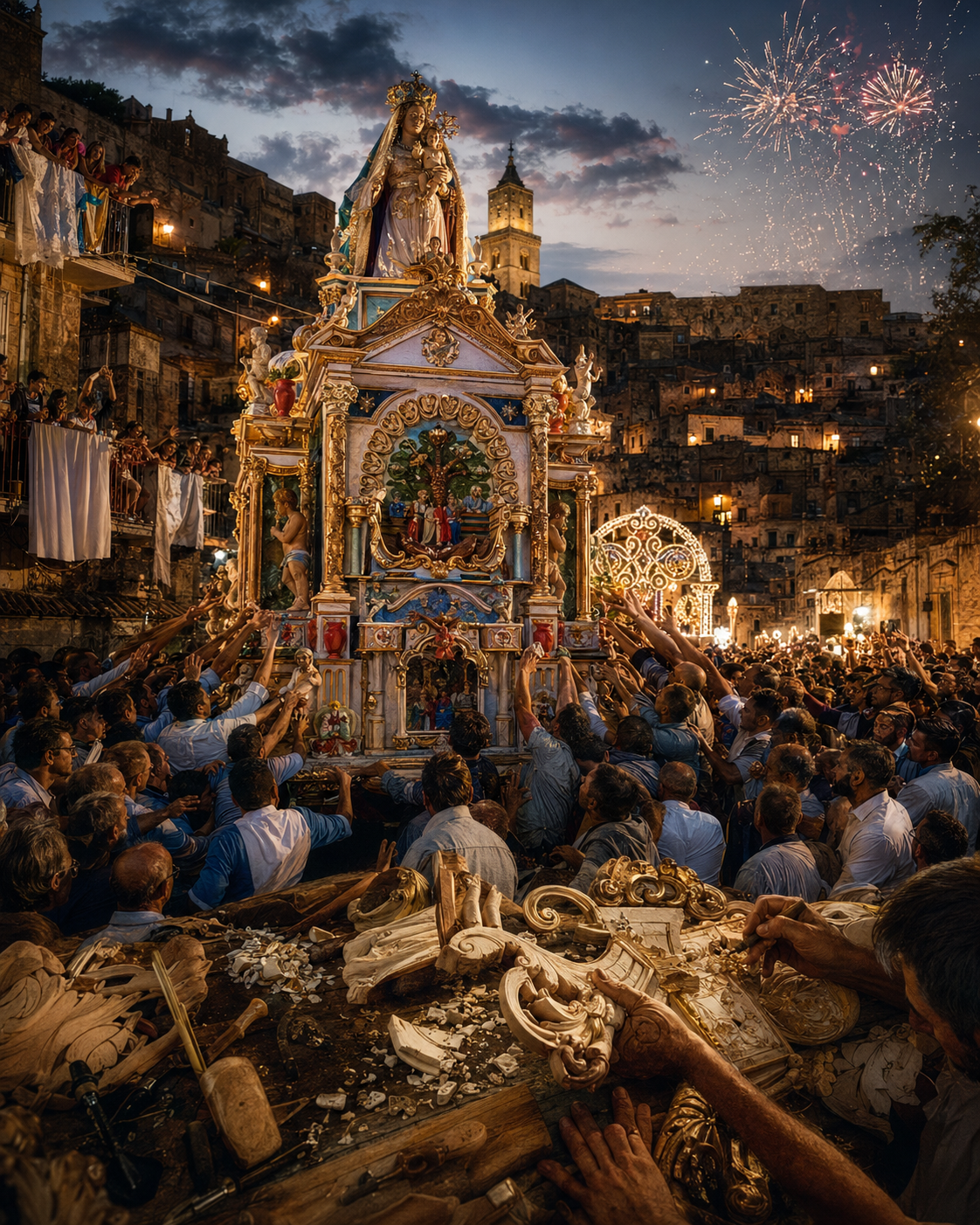
For six hundred and thirty-seven years, Matera has done the same astonishing thing at the start of every July. It presents a cart and the Madonna.
This is not just any cart. It is a towering, hand-worked carriage for the Festival of the Patron Saint, Madonna della Bruna. The carriage is shaped over months by artisans who know exactly what it means - this year's, by the look of the figures, less ornate than some and more like carved statuary than papier-mâché, but always and only this year's.
It is blessed, crowned with the Madonna and carried in triumph through the ancient city while the whole town pours into the streets. Then, at the height of the celebration before midnight the Sacred Image of Maria SS. della Bruna is placed in the Chapel of Santa Maria di Costantinopoli and then the carriage (Triumphal Chariot) is handed over to the people of Matera for the ritual "strazzo" (handing over) in which the people tear it to pieces. Young men rush the cart and pull it apart with their hands, and each one carries home a fragment as his trophy and his blessing for the year. From the outside it can look like chaos, even violence, and even the city keeps extra hands at the hospital that night, and people do get hurt. From the inside though it is something else entirely: reverence, renewal, and a kind of respect the cart's own maker understands better than anyone. They did not build it to be kept, they built it to be made new again.
There is a wisdom in that centuries old tradition the Church shares with the people, with traditions far from Matera. The Tibetan monks spend days bent over a mandala of colored sand, laying down a universe grain by grain in almost unbearable detail and then they sweep it up and pour it into a river. The point was never to keep it. The point was the making and the releasing. Matera has held the same lesson for six centuries in a Catholic key: what is blessed may still be broken and handed back to the people; the beautiful thing must not be allowed to harden into an idol; every year the original is made again. The cart is never a relic - it is always an original precisely because it is never preserved.
I bring this up on the Fourth of July on purpose, because Matera's cart is the living opposite of a lie we are being sold on every side of the aisle, by The Devil at Work - the lie that the things that finally matter are abstractions, average, the right demographic or brand, or even the ideology. This week, one version of that big lie deserves to be called out: the lie that America was built by abstractions and abstract ideas.
The Spirit at Work in all of us knows that it was not. America was not built by an ideological rulebook, or by "the people" as a slogan, or by demographics, or by copies of Europe reflected back across the ocean. It was built by people, pioneering originals, unshackled at last from the reach of a monarch. It was built by farmers and sailors and mothers, by preachers and printers and soldiers, by craftsmen and teachers and merchants, by immigrants and builders and railroad workers, by miners and factory hands and inventors, by nurses and pastors and priests and nuns, and by families who carried more than they could ever explain. Not one of them was an average or an avatar. There was not a single Builder at Work in this country that was a demographic statistic or an abstraction in a fairy tale. They were men and women with histories and honor, names and bodies, stories and faith, scars and skills and flaws, courage and responsibility. That is the part we are in danger of forgetting, and the part we need to remember now.
The crisis of our age is not only political - it is anthropological. We are forgetting what a human being is as a verb. We are tempted, and led to forget it in the same direction toward the copy. The friendly algorithm defines you through predictability; the market values your consumption; the state establishes systems for your compliance; and the ideology demands surrender and obedience. The sad illumination is that even our rebellions get packaged and sold back to us as a style with each of them, in its own peculiar dialect, is asking the same single thing of you: that you agree to become an average of yourself: legible, predictable, interchangeable, easy to manage and easy to use.
This is where a free people plants its feet and refuses to fall, much like the motto of Matera, to Plant its Feet Harder and more Steadfast. We the People will not fall for collective rhetoric, and we will not import sameness as a way of life. We are not the Borg of Star Trek - no hive, no assimilation, no single flattened will humming that resistance is futile. Real peoples, like real people, are messy, uneven, gritty, and more than a little dangerous and it is supposed to be that way. Formation or Humaning was never sanitation. The original is not the smooth, finished, optimized product the average keeps promising; the original is the unrepeatable one, still being shaped, never quite complete. Always Original & Never Finished.
The Devil at Work wants you to buy into the lie that the United States of America was born from people trying to become average or just like everyone else. It was born from people willing to make noise, a lot of noise and willing to step outside the range of the acceptable and say a true and dangerous thing out loud, and then to stand behind it with their lives. That is why the Fourth of July still matters to the Builder at Work, and it is not because of the fireworks. It is the founding refusal and unwillingness to accept to be averaged, ruled, flattened, or reduced. A people that would not be copies of the Crown of England declared themselves originals, and signed their actual names to it - not their Instagram address, their full, legal, and recorded names for all to see.
So the cart of La Bruna and the Declaration of Independence turn out to be the same act, seen from two shores. Matera builds an original every single year and refuses to let it calcify into an idol; it keeps the thing alive by breaking it open and handing it back to the people. America was built by originals who refused to be pressed flat into subjects, and it stays alive the same way not preserved under glass, but made new by each generation willing to do the work by hand. Both are unfinished on purpose. Both insist on the one thing the average can never carry: the particular person, made by hand, known by name perhaps now for eternity, offered rather than hoarded.
Here is a confirming proof that, in the end, the originals are the ones who last. This week at the end of the Sunday Table we read a little about the life of a man born in the year 480 (yes 480 A.D.), Benedict of Nursia, and people still speak of him, he is still living inside institutions his legacy shaped, fifteen centuries and counting. Hold that against your own devices and feeds and averages, obsolete inside of two minutes, weeks, or years. The influencers of Benedict's Rome vanished without a trace; the man who walked away from them to be formed in a cave is a household name in the third millennium. Reach back into history further still: we cannot even name the exact day, yet for two thousand years the whole of the West has counted its time from the birth of one particular child in Galilee the calendar itself split, before and after, around a single Original. That is what an original does. The copy is forgotten by autumn. The original bends time around itself.
So keep the feast this week whichever one is yours, the cart or the Declaration but keep it the way Matera keeps the cart. Not as a relic to guard, but as an original to renew. Refuse to be an average. Make a little honest noise and build the next year, and the next country, the only way anything true has ever been built - by hand, as an original Ad Majorem Dei Gloriam.
We are formed (Humaning) at the table and sent as Builders at Work. We are human together, or not at all.
Sempre originale | Realizzato a mano
Da seicentotrentasette anni, Matera compie lo stesso straordinario gesto all’inizio di ogni luglio: presenta un carro e la Madonna.
Non si tratta di un carro qualsiasi. È un carro imponente, realizzato a mano per la Festa della Madonna della Bruna, patrona della città. La carrozza viene modellata nel corso di mesi da artigiani che ne comprendono appieno il significato: quella di quest’anno, a giudicare dall’aspetto delle figure, è meno ornata di altre e assomiglia più a statue scolpite che a cartapesta, ma è sempre e solo quella di quest’anno.
Viene benedetta, incoronata con la Madonna e portata in trionfo attraverso la città antica mentre l’intera popolazione si riversa nelle strade. Poi, al culmine della celebrazione, prima di mezzanotte, la Sacra Immagine di Maria SS. della Bruna viene collocata nella Cappella di Santa Maria di Costantinopoli e quindi il carro (Carro Trionfale) viene consegnato alla popolazione di Matera per il rituale “strazzo” (consegna), durante il quale la gente lo fa a pezzi. I giovani si precipitano verso il carro e lo fanno a pezzi con le mani, e ognuno porta a casa un frammento come trofeo e come benedizione per l’anno a venire. Dall’esterno può sembrare caos, persino violenza, e anche la città mette a disposizione personale extra all’ospedale quella notte, e in effetti ci sono persone che si feriscono. Dall’interno, però, è qualcosa di completamente diverso: riverenza, rinnovamento e un tipo di rispetto che lo stesso costruttore del carro comprende meglio di chiunque altro. Non l’hanno costruito per conservarlo, l’hanno costruito per farlo rinascere.
C’è una saggezza in quella tradizione secolare che la Chiesa condivide con il popolo, con tradizioni lontane da Matera. I monaci tibetani trascorrono giorni chini su un mandala di sabbia colorata, creando un universo granello dopo granello con un dettaglio quasi insopportabile, per poi spazzarlo via e versarlo in un fiume. Lo scopo non è mai stato quello di conservarlo. Lo scopo era il creare e il lasciar andare. Matera ha custodito la stessa lezione per sei secoli in chiave cattolica: ciò che è benedetto può comunque essere spezzato e restituito al popolo; non si deve permettere che la cosa bella si indurisca fino a diventare un idolo; ogni anno l’originale viene rifatto. Il carro non è mai una reliquia – è sempre un originale proprio perché non viene mai conservato.
Ne parlo apposta il 4 luglio, perché il carro di Matera è l’esatto contrario di una menzogna che ci viene propinata da ogni parte dello spettro politico, dal Diavolo all’opera: la menzogna secondo cui le cose che contano davvero sono le astrazioni, la media, il giusto gruppo demografico o marchio, o persino l’ideologia. Questa settimana, una versione di quella grande menzogna merita di essere smascherata: la menzogna secondo cui l’America è stata costruita da astrazioni e idee astratte.
Lo Spirito al lavoro in tutti noi sa che non è così. L’America non è stata costruita da un manuale ideologico, né da «il popolo» inteso come slogan, né da dati demografici, né da copie dell’Europa riflesse dall’altra parte dell’oceano. È stata costruita da persone, pionieri originali, finalmente liberi dal giogo di un monarca. È stata costruita da contadini e marinai e madri, da predicatori e tipografi e soldati, da artigiani e insegnanti e mercanti, da immigrati e costruttori e ferrovieri, da minatori e operai di fabbrica e inventori, da infermiere e pastori e sacerdoti e suore, e da famiglie che portavano con sé più di quanto potessero mai spiegare. Nessuno di loro era una persona media o un avatar. Non c’era un solo «Costruttore al lavoro» in questo Paese che fosse una statistica demografica o un’astrazione in una fiaba. Erano uomini e donne con storie e onore, nomi e corpi, racconti e fede, cicatrici, abilità e difetti, coraggio e responsabilità. Questa è la parte che rischiamo di dimenticare, e la parte che dobbiamo ricordare ora.
La crisi della nostra epoca non è solo politica: è antropologica. Stiamo dimenticando cosa significhi «essere umani» come verbo. Siamo tentati, e spinti a dimenticarlo, nella stessa direzione verso la copia. L’algoritmo amichevole ti definisce attraverso la prevedibilità; il mercato valuta il tuo consumo; lo Stato istituisce sistemi per la tua obbedienza; e l’ideologia esige resa e sottomissione. La triste verità è che persino le nostre ribellioni vengono confezionate e rivendute come uno stile, e ognuna di esse, nel proprio peculiare linguaggio, ti chiede la stessa unica cosa: che tu accetti di diventare una media di te stesso: leggibile, prevedibile, intercambiabile, facile da gestire e da usare.
È qui che un popolo libero pianta i piedi per terra e rifiuta di cadere, proprio come recita il motto di Matera: «Piantare i piedi più saldamente e con maggiore fermezza». Noi, il Popolo, non ci lasceremo ingannare dalla retorica collettiva e non adotteremo l’uniformità come stile di vita. Non siamo i Borg di Star Trek: nessun alveare, nessuna assimilazione, nessuna volontà unica e appiattita che mormori che la resistenza è inutile. I popoli veri, come le persone vere, sono disordinati, irregolari, grintosi e più che un po’ pericolosi, ed è giusto che sia così. La formazione o l’essere umani non è mai stata una questione di igiene. L’originale non è il prodotto liscio, rifinito e ottimizzato che la media continua a promettere; l’originale è quello irripetibile, ancora in fase di formazione, mai del tutto completo. Sempre originale e mai finito.
Il Diavolo al Lavoro vuole farti credere alla menzogna secondo cui gli Stati Uniti d’America siano nati da persone che cercavano di diventare nella media o semplicemente come tutti gli altri. Sono nati da persone disposte a fare rumore, molto rumore, e disposte a uscire dai limiti dell’accettabile per dire ad alta voce una cosa vera e pericolosa, e poi a sostenerla con la propria vita. Ecco perché il 4 luglio conta ancora per il Costruttore al Lavoro, e non è per via dei fuochi d’artificio. È il rifiuto fondante e la riluttanza ad accettare di essere mediati, governati, appiattiti o ridotti. Un popolo che non voleva essere una copia della Corona d’Inghilterra si dichiarò originale e firmò con i propri nomi reali – non il proprio indirizzo Instagram, ma i nomi completi, legali e registrati, affinché tutti potessero vederli.
Così il carro di La Bruna e la Dichiarazione d’Indipendenza si rivelano essere lo stesso atto, visto da due sponde. Matera costruisce un originale ogni singolo anno e si rifiuta di lasciarlo cristallizzare in un idolo; lo mantiene vivo spezzandolo e restituendolo al popolo. L’America è stata costruita da originali che si sono rifiutati di essere appiattiti in sudditi, e rimane viva allo stesso modo: non conservata sotto vetro, ma rinnovata da ogni generazione disposta a lavorare a mano. Entrambe sono volutamente incompiute. Entrambe insistono sull’unica cosa che la mediocrità non potrà mai sostenere: la persona singolare, creata a mano, conosciuta per nome forse ormai per l’eternità, offerta anziché accumulata.
Ecco una prova che conferma come, alla fine, siano gli originali a durare nel tempo. Questa settimana, alla fine della «Mensa domenicale», abbiamo letto qualcosa sulla vita di un uomo nato nell’anno 480 (sì, 480 d.C.), Benedetto da Norcia, e la gente parla ancora di lui; egli vive ancora all’interno delle istituzioni che la sua eredità ha plasmato, da quindici secoli a questa parte. Confrontate questo con i vostri dispositivi, i vostri feed e le vostre medie, che diventano obsoleti nel giro di due minuti, settimane o anni. Gli influencer della Roma di Benedetto sono svaniti senza lasciare traccia; l’uomo che si allontanò da loro per formarsi in una grotta è un nome familiare nel terzo millennio. Risaliamo ancora più indietro nella storia: non riusciamo nemmeno a indicare il giorno esatto, eppure da duemila anni l’intero Occidente conta il proprio tempo a partire dalla nascita di un bambino in particolare in Galilea; il calendario stesso si è diviso, in un prima e un dopo, attorno a un unico Originale. Questo è ciò che fa un originale. La copia viene dimenticata entro l’autunno. L’originale piega il tempo attorno a sé.
Quindi celebrate la festa questa settimana, qualunque sia la vostra, il carro o la Dichiarazione, ma celebratela come Matera celebra il carro. Non come una reliquia da custodire, ma come un originale da rinnovare. Rifiutate di essere nella media. Fate un po’ di rumore onesto e costruite l’anno prossimo, e il prossimo paese, nell’unico modo in cui qualsiasi cosa vera sia mai stata costruita: a mano, come un originale Ad Majorem Dei Gloriam.
Siamo plasmati (Humaning) a tavola e inviati come Costruttori al Lavoro. Siamo umani insieme, o non lo siamo affatto.
Honesty, Authenticity, and Genuineness
This week we invite you to engage not only with the ideas of Honesty, Authenticity’, and Genuineness, but the actions that create these aspects of Humaning.
You may choose one or both of the following practices depending on your setting, time, and relationships.
The Table Discussion is a relaxed and relational conversation designed to help people reflect honestly on the week’s REDISCOVER UⓇ theme and the realities of everyday life. It is a shared conversation among family and friends seeking to remain present to one another. The table discussion is not a debate or lesson, it's a discussion of being human together.
After the meal, coffee, or shared gathering:
Read the REDISCOVER UⓇ card and the reflections aloud
Move through the discussion prompts naturally
Allow the conversation to unfold without rushing
Some discussions may be lighthearted, and others may become deeply reflective. It’s up to you.
The Humaning Circle is a more intentional relational practice inspired by the spirit of a prayer circle, conversation circle, or community gathering.
Place the REDISCOVER UⓇ card at the center of the table or view the digital card, then invite each person to quietly reflect on the theme together before sharing.
Begin with one slow shared breath and a brief moment of silence.
The Humaning Circle encourages:
D.E.E.P. listening
Honest reflection
Relational courage
Shared presence

Each week, our REDISCOVER U® Sunday Table discussions invite us to pick up one of the gifts already present in all of us and turn it towards the light. This week's gift or strength is Honesty, Authenticity, and Genuineness, yet another strength that sounds like a “soft-skill” but it's stronger than the words have come to be commonly known.
We have been taught to understand honesty as not lying, and genuineness as being expressive or informal almost casually being oneself. But at its root, honesty is the courage to live without false assumptions, and genuineness is the coherence between the person God made and the person who actually shows up. It is the refusal to become an avatar of yourself, which we brought up last week. You are not meant to be a useful copy, a polite performer, or a new-age spiritualized version of the same old prideful ambition. If you are someone who cannot wear a mask comfortably for long, who feels the private cost of pretending, who has a quiet instinct for what is real and what is an illusion, this is your gift. It is also, though it rarely feels like it, one of the first safeguards of freedom. Without it, liberty becomes theater.
Placed in service of others, this gift does two things at once. It sees through what we introduced last Sunday as spiritual usury: The Devil at Work’s old trick of renaming extraction as commitment, exhaustion as excellence, domination as leadership, or a fortress as wisdom. The honest, genuine person is the one who can tell another human being a true thing kindly, and who refuses to treat anyone as merely useful. That is not a soft skill or minor gift. It is how a table gets built where someone else would have built a wall.
Like every strength, it carries its shadows. Honesty can be presented as a blunt cruelty or that wounds and calls it radical candor. For example, "I'm just being honest" as a weapon. "Authenticity" can become an excuse to indulge the false-self, forgetting that a copy can be extremely animated but still false.
True honesty draws people toward the truth and toward one another; its counterfeit used by The Devil at Work uses "truth" to dominate, dazzle, or protect an image. Meanwhile genuineness is not "just be yourself" when the self being defended is the copy built by wound, market, fear, or prideful ambition. The original is not the unexamined self. The original is the God-intended person, recovered slowly through humaning.
This week, notice one place where you are performing a version of yourself that is not quite the original and set it down, even briefly. Then do the harder, better thing: look at one person past their role, and offer them one true and kind word. That is honesty becoming a Builder at Work.
This week Honesty, Authenticity, and Genuineness help us to experience a rare weekend 250th anniversary of Independence Day in America and the Festa la Madonna della Bruna in Matera, two feasts of freedom and renewal. But liberty is not enough if the person remains false, and a feast is not formative if we only go through the motions. So bring these to your own table this week, wherever your people gather, and let the questions move from the mask we wear to the work waiting underneath the everyday ordinary moments.
Where are you most tempted to pretend and to wear a version of yourself that isn't quite the original? What would it cost to set it down, even here?
Think of someone at the table, or close to it, whom you may have perhaps unknowingly reduced to a role or label. Who is the actual person underneath the label, and when did you last really see them for who they are?
Where have you seen something false dressed up as something noble — pressure called commitment, exhaustion called loyalty, a wall called wisdom? What would it look like to name it truthfully, and kindly?
Sunday Table Invitation. Before moving from one question to the next, make sure everyone has the chance to speak, paying particular attention to the children, teenagers, and the quieter voices at the table. Humaning begins when every person knows they have a place at the table.
If young people are present, invite them to keep a notebook nearby. This week, you might offer them one question to carry: When is it hardest for you to tell the truth and who is someone you could be kind and honest with this week? Encourage them to write down whatever they want to keep: a story, a question, a strength they noticed, or something they simply don't want to forget. Sometimes, humaning begins when we learn to pay attention to our own thoughts and experiences.
Humaning is not a noun. It is something we do together and then something we carry out the door. This week the circle practices honesty in three simple moves: seeing the original, setting down the mask, and going to build. Gather a few people at the table or nearby: family, friends, a small group, and take it slowly.
First, go around once. Each person names one genuine, true thing they see in the person to their right not their role, their title, or their usefulness, but the actual original underneath: a courage, a kindness, a steadiness, a gift returning. Say it plainly, and let it be received.
Then, go around again. This time, each person names, honestly, without dramatizing it, one place they have been performing a version of themselves that isn't quite real: one mask they would like to set down. No advice, no fixing. Just the truth, spoken where it is safe to speak it.
Then close with a single question, and let each person answer aloud: Before we gather again, who is one person within my reach that I will truly see, welcome, or tell a kind truth and what, exactly, will I do? Keep it small, concrete, and real.
Because the table has done its real work only when it empties for when we rise from it and carry what we found here into the week, to the family, the street, the shop, the parish, the people we can actually reach. Naming the original is only the beginning. What we do with it is the whole point. End however your circle ends with a prayer, a blessing, a shared silence. Then go gently, and build.
Onestà, autenticità e genuinità
Questa settimana vi invitiamo a confrontarvi non solo con i concetti di onestà, autenticità e sincerità, ma anche con le azioni che danno vita a questi aspetti dell’Humaning.
Potete scegliere una o entrambe le seguenti pratiche a seconda del contesto, del tempo a disposizione e delle relazioni che intrattenete.
La discussione a tavola è una conversazione rilassata e incentrata sulle relazioni, pensata per aiutare le persone a riflettere onestamente sul tema REDISCOVER UⓇ della settimana e sulle realtà della vita quotidiana. È una conversazione condivisa tra familiari e amici che cercano di rimanere presenti gli uni agli altri. La discussione a tavola non è un dibattito né una lezione, ma una discussione sull’essere umani insieme.
Dopo il pasto, il caffè o un momento di ritrovo in compagnia:
Leggete ad alta voce la scheda REDISCOVER UⓇ e le riflessioni
Passate naturalmente da un spunto di discussione all’altro
Lasciate che la conversazione si sviluppi senza fretta
Alcune discussioni potrebbero essere spensierate, mentre altre potrebbero diventare profondamente riflessive. Dipende da voi.
Il Circolo dell’Essere Umani è una pratica relazionale più intenzionale ispirata allo spirito di un circolo di preghiera, di conversazione o di un incontro comunitario.
Posizionate la scheda REDISCOVER UⓇ al centro del tavolo o visualizzate la scheda digitale, quindi invitate ogni persona a riflettere in silenzio sul tema insieme prima di condividere le proprie riflessioni.
Iniziate con un respiro lento e condiviso e un breve momento di silenzio.
Il Circolo dell’Umanità incoraggia:
L’ascolto D.E.E.P.
La riflessione onesta
Il coraggio relazionale
La presenza condivisa
Ogni settimana, le nostre discussioni alla tavola domenicale di REDISCOVER U® ci invitano a cogliere uno dei doni già presenti in ognuno di noi e a portarlo alla luce. Il dono o punto di forza di questa settimana è Onestà, Autenticità e Genuinità, ancora un altro punto di forza che suona come una “soft skill”, ma che è più forte di quanto le parole abbiano comunemente fatto credere.
Ci è stato insegnato a intendere l’onestà come il non mentire, e la genuinità come l’essere espressivi o informali, quasi casualmente se stessi. Ma alla radice, l’onestà è il coraggio di vivere senza false supposizioni, e la genuinità è la coerenza tra la persona che Dio ha creato e quella che effettivamente si presenta. È il rifiuto di diventare un avatar di se stessi, come abbiamo sottolineato la settimana scorsa. Non sei destinato a essere una copia utile, un attore educato o una versione spiritualizzata new age della solita vecchia ambizione orgogliosa. Se sei una persona che non riesce a indossare una maschera a proprio agio a lungo, che sente il costo personale del fingere, che ha un istinto silenzioso per ciò che è reale e ciò che è un’illusione, questo è il tuo dono. È anche, sebbene raramente sembri tale, una delle prime garanzie della libertà. Senza di esso, la libertà diventa teatro.
Messo al servizio degli altri, questo dono fa due cose contemporaneamente. Smaschera ciò che abbiamo definito domenica scorsa «usura spirituale»: il vecchio trucco del Diavolo all’opera che consiste nel rinominare lo sfruttamento come impegno, l’esaurimento come eccellenza, il dominio come leadership o una fortezza come saggezza. La persona onesta e genuina è quella che sa dire con gentilezza una verità a un altro essere umano e che rifiuta di trattare chiunque come un semplice strumento. Non si tratta di una competenza trasversale o di un dono di poco conto. È il modo in cui si costruisce un tavolo dove qualcun altro avrebbe costruito un muro.
Come ogni forza, porta con sé le sue ombre. L’onestà può essere presentata come una crudeltà schietta o come qualcosa che ferisce, e viene definita «franchezza radicale». Ad esempio, «Sto solo essendo onesto» usato come arma. L’«autenticità» può diventare una scusa per assecondare il falso sé, dimenticando che una copia può essere estremamente vivace ma comunque falsa.
La vera onestà avvicina le persone alla verità e le avvicina le une alle altre; la sua contraffazione, utilizzata dal Diavolo al lavoro, usa la «verità» per dominare, abbagliare o proteggere un’immagine. Nel frattempo, la genuinità non significa «sii semplicemente te stesso» quando il sé che viene difeso è la copia costruita dalla ferita, dal mercato, dalla paura o dall’ambizione orgogliosa. L’originale non è il sé non esaminato. L’originale è la persona voluta da Dio, recuperata lentamente attraverso il processo di diventare umani.
Questa settimana, individua un ambito in cui stai recitando una versione di te stesso che non è proprio l’originale e mettila da parte, anche solo per un attimo. Poi fai la cosa più difficile, ma migliore: guarda una persona al di là del suo ruolo e rivolgile una parola sincera e gentile. Questa è l’onestà che diventa un “Costruttore all’opera”.
Questa settimana l’onestà, l’autenticità e la genuinità ci aiutano a vivere un raro fine settimana: il 250° anniversario del Giorno dell’Indipendenza in America e la Festa della Madonna della Bruna a Matera, due feste di libertà e rinnovamento. Ma la libertà non basta se la persona rimane falsa, e una festa non è formativa se ci limitiamo a seguire meccanicamente la routine. Quindi porta questi spunti alla tua tavola questa settimana, ovunque si riuniscano i tuoi cari, e lascia che le domande si spostino dalla maschera che indossiamo al lavoro che ci attende sotto i momenti ordinari di ogni giorno.
In quale situazione sei più tentato di fingere e di indossare una versione di te stesso che non è proprio quella originale? Cosa ti costerebbe metterla da parte, anche solo qui?
Pensate a qualcuno a tavola, o vicino ad essa, che forse, inconsapevolmente, avete ridotto a un ruolo o a un’etichetta. Chi è la persona reale sotto quell’etichetta, e quando è stata l’ultima volta che l’avete vista davvero per quello che è?
Dove avete visto qualcosa di falso travestito da qualcosa di nobile — la pressione chiamata impegno, la stanchezza chiamata lealtà, un muro chiamato saggezza? Come sarebbe definirlo con sincerità e gentilezza?
Invito alla tavola della domenica. Prima di passare da una domanda all’altra, assicuratevi che tutti abbiano la possibilità di parlare, prestando particolare attenzione ai bambini, agli adolescenti e alle voci più silenziose a tavola. L’essere umani inizia quando ogni persona sa di avere un posto a tavola.
Se sono presenti dei giovani, invitateli a tenere un quaderno a portata di mano. Questa settimana potreste proporre loro una domanda su cui riflettere: Quando ti risulta più difficile dire la verità e con chi potresti essere gentile e onesto questa settimana? Incoraggiateli a scrivere tutto ciò che desiderano conservare: una storia, una domanda, un punto di forza che hanno notato o semplicemente qualcosa che non vogliono dimenticare. A volte, l’“humaning” inizia quando impariamo a prestare attenzione ai nostri pensieri e alle nostre esperienze.
“Humaning” non è un sostantivo. È qualcosa che facciamo insieme e che poi portiamo con noi fuori da qui. Questa settimana il cerchio mette in pratica l’onestà con tre semplici passi: vedere l’essenza, togliersi la maschera e andare a costruire. Radunate alcune persone attorno al tavolo o nelle vicinanze: familiari, amici, un piccolo gruppo, e procedete con calma.
Per prima cosa, fate un giro completo. Ogni persona indica una cosa genuina e vera che vede nella persona alla sua destra – non il suo ruolo, il suo titolo o la sua utilità, ma l’essenza autentica che sta sotto: un coraggio, una gentilezza, una fermezza, un dono che si restituisce. Ditelo con semplicità e lasciate che venga accolto.
Poi, fate un altro giro. Questa volta, ogni persona indichi, onestamente e senza drammatizzare, un ambito in cui ha recitato una versione di sé che non è del tutto reale: una maschera che vorrebbe togliersi. Nessun consiglio, nessuna soluzione. Solo la verità, detta in un contesto in cui è sicuro dirla.
Concludete poi con un’unica domanda, e lasciate che ciascuno risponda ad alta voce: Prima di ritrovarci, chi è una persona a mia portata che vedrò davvero, accoglierò o alla quale dirò una verità gentile, e cosa farò esattamente?Mantenete la risposta semplice, concreta e reale.
Perché il tavolo ha svolto il suo vero lavoro solo quando si svuota, per quando ci alziamo da esso e portiamo ciò che abbiamo trovato qui nella settimana, alla famiglia, per strada, al negozio, in parrocchia, alle persone che possiamo effettivamente raggiungere. Dare un nome all’originale è solo l’inizio. Ciò che ne facciamo è il punto centrale. Concludete il vostro cerchio con una preghiera, una benedizione, un silenzio condiviso. Poi andate con delicatezza e costruite.
Cosiamo | Founder, UMANIAMO® | Humaning Architecture
There is a line from the Sermon on the Mount I have heard so often it seems to blur into the new age “Law of Attraction.” Look at the birds of the air; they neither sow nor reap nor gather into barns, and yet your heavenly Father feeds them. We are taught to hear it as a lesson in surrender, stop striving, God will provide, pray for tomorrow's bread. True, but look again at the bird, because a second thing is hiding inside it.
The bird is not fed by a hand that descends each morning with a bowl. The bird is fed because it was made a bird and given wings, an instinct, and a hunger fitted exactly to a world that already holds what it needs. It does not lie awake wondering whether it was sent into the sky under-equipped. It simply, unanxiously, is what it was made to be - a bird - and in being that, it is fed. Its provision was written into its original design.
So was yours and mine. Before God gives you tomorrow's bread, He has already given you today's gifts: the strengths, the sight, the vocation built into your original and no one else's. Much of what we lie awake being anxious about, we were in fact already equipped for. Anxiety is the quiet suspicion as whispered by The Devil at Work that we arrived under-provisioned. Burying the talent - the story from a few weeks back is the same suspicion dressed as caution: the servant hid the gift because he could not believe that what he'd been handed was enough. And performing a copy of someone else is that same suspicion carried all the way to its end. But what God builds, He intends, and what He intends, He equips. The provision is the original.
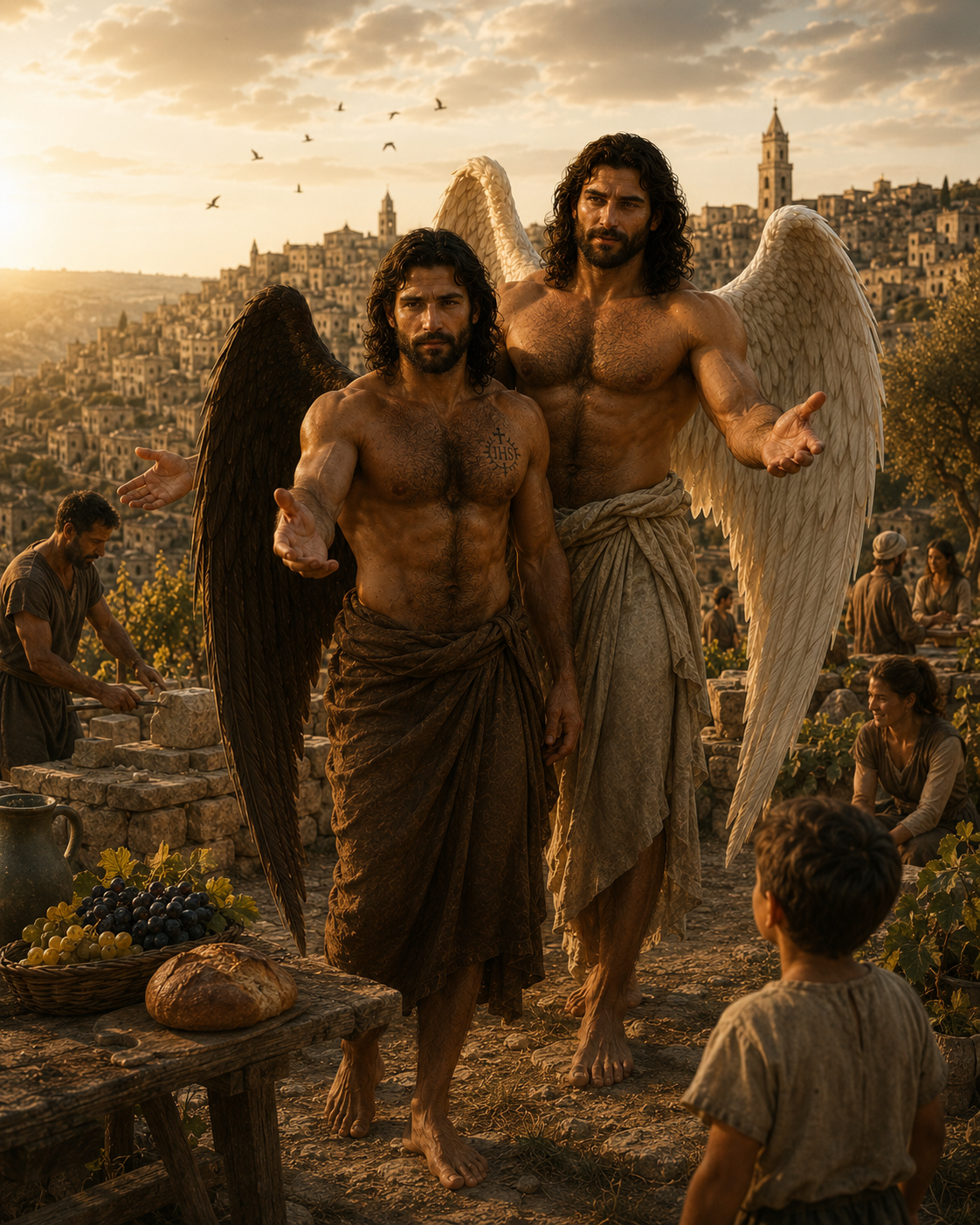
If you want to see this preached without a single word, go to Matera. For most of the last century the world called it la vergogna nazionale or the shame of Italy. In the Sassi, families of eight and ten lived in single caves alongside their animals, without water or light, and children died of malaria in numbers that still shame the memory still. By every measure the world keeps, these were people who had been given nothing.
Yet, they were originals, every one of them… a people who lived by using precisely what God had built into them and into their place. They made their homes in caves carved by hand from stone that had once been the floor of a sea, and no two of those caves were ever the same. They walked out to fields far below the city and coaxed bread from hard ground. Beneath their own feet, over centuries, they had carved a second city cisterns, passages, and tunnels threading the rock, a labyrinth that only they truly knew.
Then the Nazis came, and Matera did not wait to be liberated by anyone's army. On the twenty-first of September, 1943, the meek and patient people of the Sassi whose ancient motto is the tired ox sinking its hoof more firmly, planted their feet. With picks and shovels and stones, and with their intimate knowledge of the maze beneath the city, they rose against the occupation, the first city in all of southern Italy to do so. It cost them terribly; before they fled, the Germans blew up the Palazzo della Milizia with prisoners still inside. But the poorest people in Italy had risen and freed themselves not with weapons handed down from on high, but with the provision written into their own original: the stone they knew, the hands they had, the labyrinth God had let them carve from a seabed.
The story did not end in the rubble of 1943. Within five years, the same defeated, humiliated country, the one that had gone first into fascism and paid for it first became the first of Europe's fallen powers to write itself a new constitution. When it took effect on the first day of 1948, it carried ideas the young American republic had helped plant in the world: inviolable rights, a court to guard them, power divided against itself, the person placed before the state. But Italy did not copy its liberators. It received the form and made something unmistakably its own, which is exactly the point of this week’s Sunday Table. A defeated people rebuilt without becoming a copy of its conquerors. Even flat on its back, it remained original.
There is a quiet reversal in that worth really holding and reflecting upon… maybe this belongs under your pillow… America was the young republic that had once received the Old(er) World's inheritance… its law and faith, as well as the very idea of a republic. Now the ancient land received America's form in return; the child, in a sense, taught the parent, and the parent, humbled, learned from the child. This little country of originals came back not to rule but to repair, the way an elder brother goes first into the fire and returns with the map, first not in power but in the harder, humbler work of beginning again. Not dominion, but communion: each people the other's elder, each the other's student, and both more themselves for the exchange.
That is the whole teaching, and it is the same on both shores this week. Liberty is declared, but freedom is used. The bird does not petition for wings it already has. The tired ox does not wait for a stronger animal to arrive; it sinks its own hoof deeper. Further, you were not sent here empty. So do not bury the gift, and do not spend your one life performing someone else's. Seek first the Kingdom and then use, freely and without worry, exactly what you were given.
What God builds, He intends. What He intends, He equips. We are Formed (Humaned) at the table. Sent as Builders. We are human together, or not at all.
C’è una frase del Discorso della Montagna che ho sentito così spesso da sembrare confondersi con la “Legge di Attrazione” new age. Guardate gli uccelli del cielo: non seminano, non mietono, non raccolgono nei granai, eppure il Padre vostro celeste li nutre. Ci viene insegnato a interpretarla come una lezione di abbandono: smettete di lottare, Dio provvederà, pregate per il pane di domani. È vero, ma guardate di nuovo l’uccello, perché al suo interno si nasconde un secondo significato.
L’uccello non viene nutrito da una mano che ogni mattina scende con una ciotola. L’uccello viene nutrito perché è stato creato come uccello e gli sono state date ali, un istinto e una fame perfettamente adatti a un mondo che contiene già ciò di cui ha bisogno. Non rimane sveglio a chiedersi se sia stato mandato nel cielo senza l’attrezzatura necessaria. Semplicemente, senza ansia, è ciò per cui è stato creato – un uccello – e proprio per questo viene nutrito. Il suo sostentamento era già previsto nel suo disegno originale.
Così come lo era per te e per me. Prima ancora che Dio ti dia il pane di domani, ti ha già dato i doni di oggi: le forze, la vista, la vocazione insita nel tuo essere unico e in nessun altro. Per gran parte di ciò per cui restiamo svegli in preda all’ansia, in realtà eravamo già preparati. L’ansia è il silenzioso sospetto, sussurrato dal Diavolo all’opera, che siamo arrivati senza provviste sufficienti. Seppellire il talento – la storia di qualche settimana fa è lo stesso sospetto travestito da cautela: il servo nascose il dono perché non riusciva a credere che ciò che gli era stato affidato fosse sufficiente. E imitare qualcun altro è quello stesso sospetto portato fino in fondo. Ma ciò che Dio costruisce, Egli lo progetta, e ciò che Egli progetta, Egli lo dota. La provvidenza è l’originale.
Se volete vedere questo concetto predicato senza una sola parola, andate a Matera. Per gran parte del secolo scorso il mondo l’ha definita «la vergogna nazionale» o «la vergogna d’Italia». Nei Sassi, famiglie di otto o dieci persone vivevano in singole grotte insieme ai propri animali, senza acqua né luce, e i bambini morivano di malaria in numero tale da far ancora oggi vergognare la memoria. Secondo ogni metro di misura utilizzato dal mondo, queste erano persone a cui non era stato dato nulla.
Eppure, erano originali, ognuno di loro… un popolo che viveva utilizzando proprio ciò che Dio aveva insito in loro e nel loro luogo. Si costruirono le loro case in grotte scavate a mano nella roccia che un tempo era stata il fondale di un mare, e non c’erano due grotte uguali. Si recavano nei campi molto più in basso rispetto alla città e ricavavano il pane da un terreno duro. Sotto i propri piedi, nel corso dei secoli, avevano scavato una seconda città: cisterne, passaggi e tunnel che si snodavano nella roccia, un labirinto che solo loro conoscevano veramente.
Poi arrivarono i nazisti, e Matera non attese di essere liberata dall’esercito di nessuno. Il ventuno settembre 1943, la gente mite e paziente dei Sassi — il cui antico motto è «il bue stanco affonda lo zoccolo con più forza» — piantò saldamente i piedi a terra. Con picconi, pale e pietre, e grazie alla loro profonda conoscenza del labirinto sotto la città, si ribellarono all’occupazione, la prima città di tutto il Sud Italia a farlo. Il prezzo da pagare fu terribile; prima di fuggire, i tedeschi fecero saltare in aria il Palazzo della Milizia con i prigionieri ancora all’interno. Ma la gente più povera d’Italia si era ribellata e si era liberata non con armi calate dall’alto, ma con ciò che era scritto nel proprio patrimonio originario: la pietra che conoscevano, le mani che avevano, il labirinto che Dio aveva permesso loro di scavare dal fondale marino.
La storia non finì tra le macerie del 1943. Nel giro di cinque anni, lo stesso paese sconfitto e umiliato, quello che per primo era entrato nel fascismo e per primo ne aveva pagato il prezzo, divenne la prima delle potenze europee cadute a redigersi una nuova costituzione. Quando entrò in vigore il primo giorno del 1948, portava con sé idee che la giovane repubblica americana aveva contribuito a diffondere nel mondo: diritti inviolabili, un tribunale a tutelarli, il potere diviso contro se stesso, la persona anteposta allo Stato. Ma l’Italia non copiò i propri liberatori. Ne prese la forma e ne fece qualcosa di inconfondibilmente proprio, ed è proprio questo il punto centrale del Sunday Table di questa settimana. Un popolo sconfitto si ricostruì senza diventare una copia dei propri conquistatori. Anche a terra, rimase originale.
C’è in questo un silenzioso ribaltamento su cui vale davvero la pena soffermarsi e riflettere… forse questo dovrebbe stare sotto il tuo cuscino… L’America era la giovane repubblica che un tempo aveva ricevuto l’eredità del Vecchio Mondo… la sua legge e la sua fede, così come l’idea stessa di repubblica. Ora la terra antica riceveva in cambio la forma dell’America; il figlio, in un certo senso, insegnava al genitore, e il genitore, con umiltà, imparava dal figlio. Questo piccolo paese di originali è tornato non per governare ma per riparare, come un fratello maggiore che si getta per primo nel fuoco e torna con la mappa, non in una posizione di potere ma nel lavoro più duro e umile di ricominciare da capo. Non dominio, ma comunione: ciascun popolo è l’anziano dell’altro, ciascuno è l’allievo dell’altro, ed entrambi sono più se stessi grazie a questo scambio.
Questo è l’intero insegnamento, ed è lo stesso su entrambe le sponde questa settimana. La libertà viene proclamata, ma è la libertà che si esercita. L’uccello non chiede le ali che già possiede. Il bue stanco non aspetta l’arrivo di un animale più forte; affonda piuttosto il proprio zoccolo più in profondità. Inoltre, non sei stato mandato qui a mani vuote. Quindi non seppellire il dono, e non sprecare la tua unica vita vivendo quella di qualcun altro. Cerca prima il Regno e poi usa, liberamente e senza preoccupazioni, esattamente ciò che ti è stato dato.
Ciò che Dio costruisce, Egli lo intende. Ciò che Egli intende, Egli lo dota. Siamo plasmati (resi umani) a tavola. Inviati come costruttori. Siamo umani insieme, o non lo siamo affatto.
4th of July Reflection
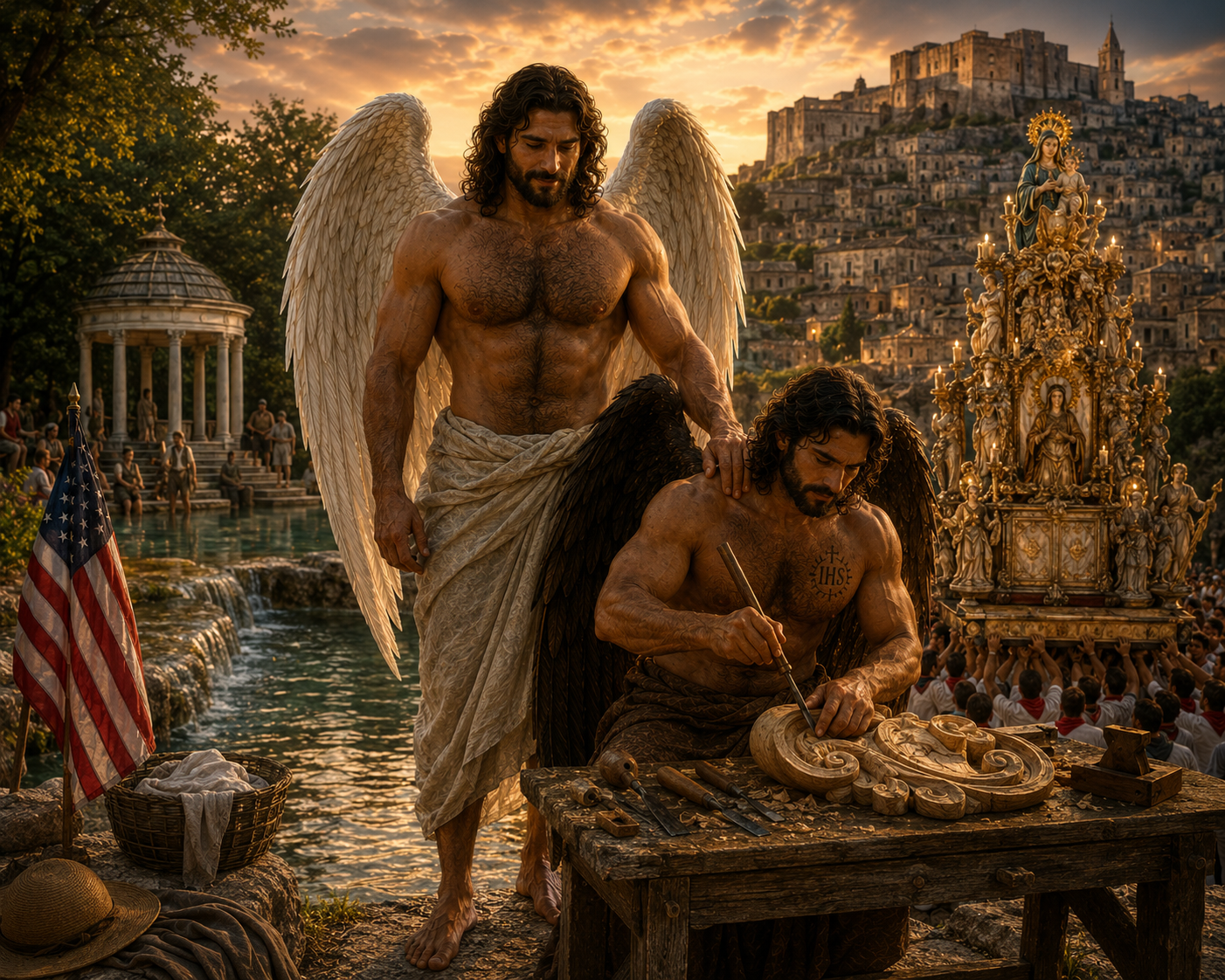
This week holds two celebrations an ocean apart. In America, the two hundred and fiftieth anniversary of a people declaring their independence. In Matera, the feast of Maria Santissima della Bruna, kept every July with a cart, a procession, and a jubilant tearing-apart. UMANIAMOⓇ happens to hold both, because UMANIAMOⓇ was born in Berkeley Springs, West Virginia, and raised between Berkeley Springs and Matera, Italy… That is not incidental, it may be the whole origin story. So the question this week is not only what we remember. It is whether we are honest enough to remember truthfully - seeing clearly. Which is exactly why this week's strength, “Honesty, Authenticity, and Genuineness” matters as much as it does.
Let’s begin with the water. Berkeley Springs is George Washington’s “stomping ground.” He first came at age sixteen, in 1748, to survey the frontier for Lord Fairfax, and returned for the better part of forty years to take the warm mineral waters. In 1776, the same revolutionary year the Declaration was signed, his family and friends laid out the little town of Bath around the springs. Among those who later bought its lots were signers of the Declaration of Independence and members of the Continental Congress; and the founding law kept the springs free for the public, a commons written into the town's birth. It is a place organized around healing, frontier, body, and a new civic imagination. This was American ground before America was fully America.
The claim that ground was built on was genuinely radical. The Declaration did not ask a king for permission. It said the human person is endowed by their Creator with rights no crown conferred and no crown could revoke. Liberty is not the state's invention or the monarch's gift. It belongs to the person because the person belongs first to God. It is easy, two hundred and fifty years on, to forget how astonishing a thing that was to think, let alone write down… that authority runs upward from the dignity of the person, not downward from a throne. That is the radical American intuition, and it is worth honoring with awe.
Let’s look at something the fireworks can hide: liberty may be given by God, but freedom must be formed. A people can throw off a king or a count and still be enslaved by appetite. A nation can declare independence and still be ruled by falsehood. A citizen can hold every right on paper and still live as a copy of himself. The Fourth of July can shrink into pageantry without the deeper formation: flags without covenant, rights without responsibility, memory without repentance, freedom without honesty. We can celebrate independence while surrendering to new dependencies: the algorithms that inflame us, the markets that reduce us, the feeds that flatter and copy us, the ideologies that sort persons into categories. The American claim was never meant to become that small.
Honesty is not merely the refusal to lie; it is the courage to live without false architecture. Genuineness is not only about being expressive; it is the coherence between the person God made and the person who actually shows up and the deliberate refusal to become an avatar of yourself, a useful copy, a polite performer, a spiritualized version of pride. Honesty and genuineness are the first safeguards of freedom. Without them, liberty becomes theater.
In this story Matera, Italy becomes the teacher, because Matera has done this in stone. Around the year 1500, Count Giovan Carlo Tramontano began raising a castle above the city - I lived across from this Castle for 3 years. He did not build a castle to defend the people as would have been customary, but to dominate them, its guns turned inward, its stone paid for by the very town it was meant to rule. In 1514 the people stopped him. He was killed in the street on December 29th, and the castle was never finished. That street still bears the name Via del Riscatto or the Street of the Ransom if you believe translation apps, though in Matera the living meaning runs deeper: the Street of Redemption. The distinction among those words makes a world of difference. A ransom is the price paid to free a captive; redemption is the life that becomes possible once the captive is free. The people of Matera did not only stop a tyrant. They interrupted a false order and recovered something of themselves. Five centuries later the castle still stands. Matera calls it L'Incompiuta or the Unfinished. In some places, unfinished means failure. Here, read deeply enough, unfinished means mercy: a thing built for domination is a blessing only when it is stopped before it is complete.
It would be easy to keep the tyrant outside of us. The count was bad, the people were good, the story is safely historical and morally clean. But the Christian imagination will not let us off the hook so easily. The count also lives in the chest. He raises walls around our wounds and fears and old ambitions, and calls the walls wisdom. He turns the guns inward and calls it discipline. He renames everything, the way our whole age does: he calls domination leadership, exhaustion excellence, spiritual usury success, the false self personality, the sealed keep maturity. While we will not insinuate that the count was more than what we know, what we describe are the playground or more appropriately the arsenal of the Devil at Work. However, honesty and genuineness are what expose him. They ask the patriot to stop calling grievance liberty, the believer to stop calling virtue signaling faith, the worker to stop calling depletion loyalty and they ask the builder to stop pretending that every structure is noble simply because he was the one who built it. This is why the Builder at Work who tells the truth is dangerous. He does not merely criticize the world. He examines the fortress rising inside himself.
Which is where Ignatius enters, because he lived this same life. Before he was the saint of discernment he was Íñigo: vain, ambitious, in love with the heroic image of himself, a man hard at work building his own castle. Then came Pamplona, and the cannonball, and the shattering of the life he had planned. The wound was not good in itself; suffering is not automatically holy, and pain does not become meaningful simply because it hurts. But grace can enter the place where a false structure breaks. In the long convalescence, he began to notice what ambition had kept hidden… that dreams of his own glory thrilled him and then left him hollow, while the life of Christ left a peace that stayed. That noticing was the birth of discernment, and of honesty. He did not become free by declaring himself free. He became free by letting God show him what had been ruling him all along. And this is the whole difference between the tyrant and the Builder: the tyrant turns a wound into a wall; the Builder turns a wound into a path. Ignatius built a method through his suffering rather than a fortress around it, the Examen to keep the door to the heart open, the Exercises to train desire, the whole of it ordered Ad Majorem Dei Gloriam, to the greater glory of God.
We believe as did Ignatius that liberty is a gift of God, and that freedom is a work of formation and that the second is as necessary as the first. We believe the human person is not an output machine, a consumer profile, an ideological category, a victim, a data point, an avatar, or raw material for anyone's ideological machine, instead he is embodied, rational, spiritual, relational, moral, creative, wounded, ransomed, unfinished, and called. We believe free people cannot be built from copies, and so we say: originals wanted - originals always. We believe Humaning begins with honesty; that the Builder at Work must tell the truth about what he is building.
We believe and must also remember that an unguarded threshold is how the original gets spent back down into a copy. We believe in staying unfinished on purpose: open to God, to correction, to growth, to the neighbor, to the work still required. And we believe we become fully human not alone but together that this is what humaning means: human as a verb, a covenant and not merely a fact of biology.
That is why UMANIAMOⓇ stands where it does between water and stone, between Berkeley Springs and Matera, between Washington's survey and Tramontano's unfinished castle, between the Declaration of Independence and the Examen, between the outer claim of liberty and the inner work of formation. And so the questions this week are not for condemnation. They are for ransom and redemption. Where am I still pretending? Where am I performing freedom instead of practicing it? Where have I built walls and called them wisdom, or turned the guns inward and called it discipline? Where am I being invited to become honest enough to be original again? Ask them, and the keep stays open.
The people of Matera will tear apart the cart and pray that the coming year is better. America will light the sky and remember that liberty was never the king's to grant. Ignatius gave his liberty back to Christ and discovered what real freedom is. And at the gate, the invitation is honest enough to be formed, genuine enough to be restored, free enough to return liberty to God, humble enough to stay unfinished, faithful enough to build together.
Originals wanted. Not copies. Not avatars. Not performances. Not finished fortresses.
What God builds, He intends. Ad Majorem Dei Gloriam. We are human together, or not at all.
Questa settimana vede due celebrazioni separate da un oceano. In America, il duecentocinquantesimo anniversario della dichiarazione di indipendenza di un popolo. A Matera, la festa di Maria Santissima della Bruna, che si celebra ogni luglio con un carro, una processione e un gioioso strappo. UMANIAMOⓇ abbraccia entrambe, perché UMANIAMOⓇ è nato a Berkeley Springs, nel West Virginia, ed è cresciuto tra Berkeley Springs e Matera, in Italia… Non è un caso, potrebbe essere proprio questa la storia delle sue origini. Quindi la domanda di questa settimana non è solo cosa ricordiamo. È se siamo abbastanza onesti da ricordare in modo veritiero – vedendo con chiarezza. Ed è proprio per questo che il tema di questa settimana, «Onestà, Autenticità e Genuinità», è così importante.
Cominciamo dall’acqua. Berkeley Springs è il «terreno di caccia» di George Washington. Vi giunse per la prima volta all’età di sedici anni, nel 1748, per effettuare rilievi della frontiera per conto di Lord Fairfax, e vi tornò per gran parte dei successivi quarant’anni per godersi le calde acque minerali. Nel 1776, lo stesso anno rivoluzionario in cui fu firmata la Dichiarazione, la sua famiglia e i suoi amici fondarono la cittadina di Bath attorno alle sorgenti. Tra coloro che in seguito acquistarono i lotti vi furono firmatari della Dichiarazione d’Indipendenza e membri del Congresso Continentale; e la legge fondativa mantenne le sorgenti libere per il pubblico, un bene comune sancito fin dalla nascita della città. È un luogo organizzato attorno alla guarigione, alla frontiera, al corpo e a una nuova immaginazione civica. Questo era terreno americano prima che l’America fosse pienamente America.
L’affermazione su cui quel terreno era stato costruito era genuinamente radicale. La Dichiarazione non chiese il permesso a un re. Affermava che la persona umana è dotata dal proprio Creatore di diritti che nessuna corona ha conferito e che nessuna corona può revocare. La libertà non è un’invenzione dello Stato né un dono del monarca. Appartiene alla persona perché la persona appartiene innanzitutto a Dio. È facile, a duecentocinquanta anni di distanza, dimenticare quanto fosse sorprendente pensare, per non parlare poi di mettere per iscritto… che l’autorità scaturisca dall’alto, dalla dignità della persona, e non dall’alto verso il basso, da un trono. Questa è l’intuizione radicale americana, e vale la pena onorarla con stupore.
Consideriamo qualcosa che i fuochi d’artificio possono nascondere: la libertà può essere donata da Dio, ma la libertà deve essere plasmata. Un popolo può liberarsi di un re o di un conte e rimanere comunque schiavo dei propri desideri. Una nazione può dichiarare l’indipendenza e rimanere comunque governata dalla menzogna. Un cittadino può detenere ogni diritto sulla carta e vivere comunque come una copia di se stesso. Il 4 luglio può ridursi a una semplice messinscena senza una formazione più profonda: bandiere senza alleanza, diritti senza responsabilità, memoria senza pentimento, libertà senza onestà. Possiamo celebrare l’indipendenza mentre ci arrendiamo a nuove dipendenze: gli algoritmi che ci infiammano, i mercati che ci riducono, i feed che ci lusingano e ci copiano, le ideologie che classificano le persone in categorie. La rivendicazione americana non è mai stata pensata per diventare così meschina.
L’onestà non è semplicemente il rifiuto di mentire; è il coraggio di vivere senza false costruzioni. L’autenticità non riguarda solo l’essere espressivi; è la coerenza tra la persona che Dio ha creato e la persona che si presenta realmente, nonché il rifiuto deliberato di diventare un avatar di se stessi, una copia utile, un attore educato, una versione spiritualizzata dell’orgoglio. L’onestà e l’autenticità sono le prime garanzie della libertà. Senza di esse, la libertà diventa teatro.
In questa storia Matera, in Italia, diventa la maestra, perché Matera ha impresso tutto questo nella pietra. Intorno al 1500, il conte Giovan Carlo Tramontano iniziò a erigere un castello sopra la città – ho vissuto di fronte a quel castello per tre anni. Non costruì un castello per difendere il popolo, come sarebbe stato consuetudine, ma per dominarlo, con i cannoni rivolti verso l’interno e la pietra pagata proprio dalla città che avrebbe dovuto governare. Nel 1514 il popolo lo fermò. Fu ucciso per strada il 29 dicembre e il castello non fu mai completato. Quella strada porta ancora il nome di Via del Riscatto, o «Strada del Riscatto» se si crede alle app di traduzione, anche se a Matera il significato vivo è più profondo: la Via della Redenzione. La distinzione tra queste parole fa un’enorme differenza. Un riscatto è il prezzo pagato per liberare un prigioniero; la redenzione è la vita che diventa possibile una volta che il prigioniero è libero. Il popolo di Matera non si limitò a fermare un tiranno. Interruppe un falso ordine e recuperò qualcosa di sé stesso. Cinque secoli dopo, il castello è ancora in piedi. Matera lo chiama L’Incompiuta. In alcuni luoghi, «incompiuta» significa fallimento. Qui, se letta con sufficiente profondità, «incompiuta» significa misericordia: una cosa costruita per il dominio è una benedizione solo quando viene fermata prima che sia completa.
Sarebbe facile tenere il tiranno fuori da noi. Il conte era cattivo, il popolo era buono, la storia è tranquillamente storica e moralmente pulita. Ma l’immaginario cristiano non ci lascia fuori dai guai così facilmente. Il conte vive anche nel nostro petto. Egli erige muri attorno alle nostre ferite, alle nostre paure e alle nostre vecchie ambizioni, e chiama quei muri “saggezza”. Punta le armi verso l’interno e lo chiama “disciplina”. Rinomina ogni cosa, proprio come fa tutta la nostra epoca: chiama “leadership” il dominio, “eccellenza” l’esaurimento, “successo” l’usura spirituale, “personalità” il falso sé, “maturità” la fortezza sigillata. Pur senza insinuare che il conte fosse più di ciò che conosciamo, ciò che descriviamo è il campo da gioco o, più appropriatamente, l’arsenale del Diavolo al lavoro. Tuttavia, sono l’onestà e l’autenticità a smascherarlo. Chiedono al patriota di smettere di chiamare «libertà» il risentimento, al credente di smettere di chiamare «fede» l’ostentazione della virtù, al lavoratore di smettere di chiamare «lealtà» l’esaurimento, e chiedono al costruttore di smettere di fingere che ogni struttura sia nobile semplicemente perché è stato lui a costruirla. Ecco perché il Costruttore al Lavoro che dice la verità è pericoloso. Egli non si limita a criticare il mondo. Esamina la fortezza che sorge dentro di sé.
Ed è qui che entra in gioco Ignazio, perché ha vissuto questa stessa vita. Prima di diventare il santo del discernimento era Íñigo: vanitoso, ambizioso, innamorato dell’immagine eroica di sé stesso, un uomo impegnato a costruire il proprio castello. Poi arrivarono Pamplona, la palla di cannone e la distruzione della vita che aveva pianificato. La ferita non era di per sé positiva; la sofferenza non è automaticamente santa, e il dolore non diventa significativo semplicemente perché fa male. Ma la grazia può entrare nel luogo in cui una falsa struttura si spezza. Durante la lunga convalescenza, cominciò a notare ciò che l’ambizione aveva tenuto nascosto… che i sogni della propria gloria lo entusiasmavano e poi lo lasciavano vuoto, mentre la vita di Cristo lasciava una pace che rimaneva. Quella presa di coscienza fu la nascita del discernimento e dell’onestà. Non divenne libero dichiarandosi libero. Divenne libero lasciando che Dio gli mostrasse ciò che lo aveva governato per tutto il tempo. E questa è l’intera differenza tra il tiranno e il Costruttore: il tiranno trasforma una ferita in un muro; il Costruttore trasforma una ferita in un sentiero. Ignazio costruì un metodo attraverso la sua sofferenza piuttosto che una fortezza attorno ad essa: l’Esame per mantenere aperta la porta del cuore, gli Esercizi per educare il desiderio, il tutto ordinato Ad Majorem Dei Gloriam, per la maggiore gloria di Dio.
Crediamo, come Ignazio, che la libertà sia un dono di Dio, e che la libertà sia un’opera di formazione, e che la seconda sia necessaria quanto la prima. Crediamo che la persona umana non sia una macchina da produzione, un profilo di consumatore, una categoria ideologica, una vittima, un dato, un avatar o materia prima per la macchina ideologica di qualcuno, ma che sia invece incarnata, razionale, spirituale, relazionale, morale, creativa, ferita, redenta, incompiuta e chiamata. Crediamo che le persone libere non possano essere costruite a partire da copie, e quindi diciamo: si cercano originali – sempre originali. Crediamo che l’Humaning inizi con l’onestà; che il Costruttore al Lavoro debba dire la verità su ciò che sta costruendo.
Crediamo e dobbiamo anche ricordare che una soglia incustodita è il modo in cui l’originale viene ridotto nuovamente a una copia. Crediamo nel rimanere volutamente incompiuti: aperti a Dio, alla correzione, alla crescita, al prossimo, al lavoro ancora necessario. E crediamo che si diventi pienamente umani non da soli ma insieme, che questo sia il significato di humaning: «umano» come verbo, come alleanza e non semplicemente come dato biologico.
Ecco perché UMANIAMOⓇ si colloca proprio lì, tra l’acqua e la pietra, tra Berkeley Springs e Matera, tra il rilevamento di Washington e il castello incompiuto di Tramontano, tra la Dichiarazione d’Indipendenza e l’Examen, tra la rivendicazione esteriore della libertà e il lavoro interiore di formazione. E così le domande di questa settimana non sono volte alla condanna. Sono volte al riscatto e alla redenzione. Dove sto ancora fingendo? Dove sto recitando la libertà invece di praticarla? Dove ho costruito muri e li ho chiamati saggezza, o ho rivolto le armi verso l’interno e l’ho chiamata disciplina? Dove sono invitato a diventare abbastanza onesto da essere di nuovo originale? Ponetele, e la fortezza rimarrà aperta.
La gente di Matera smantellerà il carro e pregherà affinché l’anno a venire sia migliore. L’America illuminerà il cielo e ricorderà che la libertà non è mai stata un dono che il re potesse concedere. Ignazio restituì la sua libertà a Cristo e scoprì cos’è la vera libertà. E al cancello, l’invito è abbastanza onesto da essere plasmato, abbastanza genuino da essere restaurato, abbastanza libero da restituire la libertà a Dio, abbastanza umile da rimanere incompiuto, abbastanza fedele da costruire insieme.
Si cercano originali. Non copie. Non avatar. Non rappresentazioni. Non fortezze finite.
Ciò che Dio costruisce, è ciò che Egli intende. Ad Majorem Dei Gloriam. Siamo umani insieme, oppure non lo siamo affatto.
Small acts to move the world forward
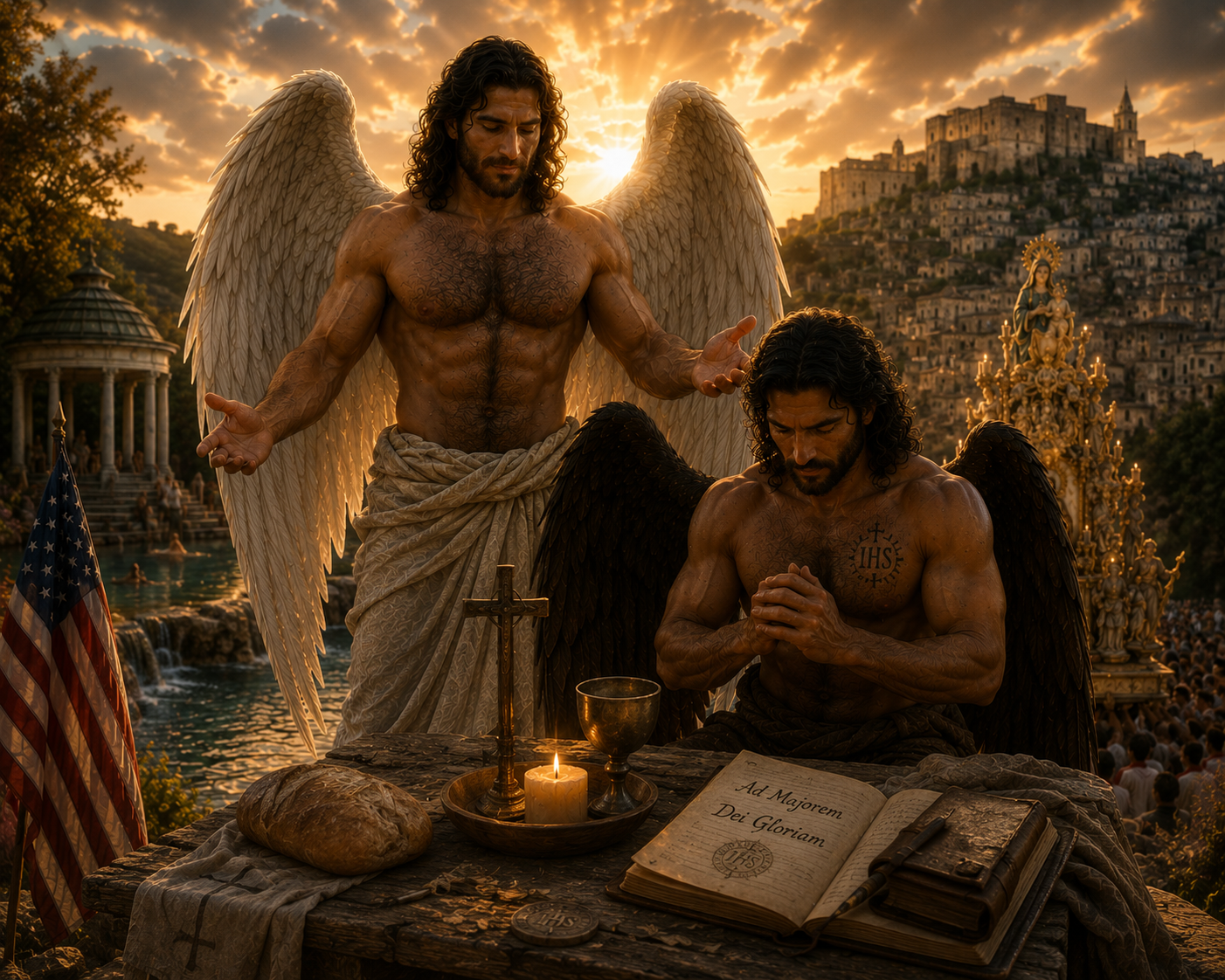
The Magis question this week: Where am I being invited to stop performing and become more genuinely original?
Honesty and Genuineness arrive on a rare weekend: Independence Day in America, the Festa della Bruna in Matera - two feasts of freedom and renewal an ocean apart. One says liberty is not granted by kings. The other says what is built for renewal must be blessed, carried, broken open, and begun again. But liberty is not enough if the person stays false, and a feast is not formation if we only perform it. So this week, Magis is not more activity, more visibility, or more proof that we are useful. It is more truth, more coherence, more of the original God intended. Here is how to bring that down to the ground this weekend at the table, among the people you actually have.
Honesty begins in the body long before it reaches the mouth; the body knows we are performing before the mind will admit it. This, like any holiday, can quietly become one more performance: the perfect cookout, the right photos, the biggest fireworks, while the original runs on empty.
Pro Tip: this weekend actually find some time to rest. Take one real hour with no phone and no audience for a walk, the river water or a pool, a nap on the porch. Then tell one trusted person the truth about one place you are tired or armored. Don't make a speech about it - just say it and let it go to let care come back in.
To empower someone is not to flatter the role they are playing. It is to speak to the person underneath it to remind them they are not merely useful, agreeable, or impressive, but an original still being formed.
One small step for this weekend: at the gathering, take one person aside and name something genuine in them, not their job, not their success, not what they do for you. A gift, a courage, a kindness, a steadiness you see returning. Then watch what it does in their face.
Faith says every person is created, intended, and called by God. The evidence of your own life keeps its own honest record of where peace grows, where energy drains, where you come alive, where you go numb. Neither should silence the other.
One small step for this weekend: read your own gauges in the crowd. Which rooms and which people leave you more alive, and which leave you performing a copy? Don't judge it yet. Just take the evidence honestly it is quietly telling you where the original is, and where it is being spent.
The tyrant wants the fortress finished; the Builder at Work keeps the table open. Nowhere is the fortress more tempting than a holiday table where politics arrives with the potato salad.
One small step for this weekend: when the argument starts and this weekend, it will, pause before the automatic reply and ask: am I building a table or a fortress? Am I responding from the original or the copy? Then do the harder, freer thing. Ask the other person a real question you don't already know the answer to, instead of winning. That is discernment with a fork in your hand.
Genuine service usually hides. It never arrives with an entourage: doing the dishes, the ride home, the quiet check-in, the chair pulled up for the relative no one talks to. These are acts of service.
One small step for this weekend: choose one ordinary, unglamorous act of service and do it without being seen doing it. Better still, find the person on the edge of the gathering: the widowed uncle, the new in-law, the quiet teenager, the one who came alone, and make sure they know there is a place at the table for them. That single act is the whole covenant in miniature.
Growth is not a better performance. It is becoming more truly the person God intended, which means refusing both the fixed self and the fixed picture we hold of everyone else.
One small step for this weekend: catch yourself saying "that's just how I am," or "that's just how he is," about someone you filed away years ago. Trade it for the truer sentence "that's where I'm right now," "that's where they still might be." Then give that person one fresh look. Stay unfinished. Let them be unfinished too.
Magis is never spiritual usury and never the illusion of "more" bought by extracting the person: more productivity, more noise, more ambition stacked on the same old exhaustion. It is the real more that appears when a person becomes more fully alive in God and more available to love, to service, and to truth. This weekend, the "more" may not look like anything a fireworks show would recognize. It may look like honesty or a boundary, a confession, or a flag saluted and a neighbor actually seen. It could also look like the [subtle] refusal to keep performing as a copy of who you are as an Original.
Pro Tip: Each night or first thing in the morning ask three questions: Where was the "more" real today or yesterday? Where did I become more genuine, more free, more honest, more human? Where did I feel the original return?
Carry one question through the weekend: Where was I honest today, and where was I only performing?
Details: What actually happened? Where did I feel most like myself, and where like a copy?
Evidence: What did my body, energy, peace, or resentment reveal that my performance was trying to hide?
Empathy: Who needed the truth from me? Did I see the person in front of me — or reduce them to a role, a category, an opponent, an audience? This weekend especially: a person, never a symbol.
Prospective: If I keep living this way, what kind of person am I becoming and what kind of family, community, and country am I helping to build?
Execution: What one honest action can I take tomorrow: a conversation, an apology, a boundary, a thanks, a repair, a welcome?
Reflection: Where was God present today? Where did I resist grace? What part of the original in me is being invited to return?
Then ask the Builder at Work question: What did I build today, and toward whom were the guns turned? Do not answer to condemn yourself. Answer to keep the keep open.
Now bring it home, because this is where the whole week has been going. Honesty is not the destination. Genuineness is not the destination. Even freedom is not the destination. They are the gate. Ignatius learned, in the long convalescence after the cannonball, that a life becomes truly free only when it is finally returned to its right end - not my glory, not my image, not my comfort, but the greater glory of God. That is what the greater in Magis has meant all along. Not more for me. More for God and therefore more for everyone God loves.
So take everything this weekend gives you: the rest, the truth told, the person seen, the fortress refused, the table kept, the original returning, and offer it upward. Give the liberty back to the One who gave it. Keep the keep open to the sky. Let the copy go, and let the original be for something larger than itself. That is the whole of it, and it fits in four words. At the end of the day, ask not only where was the more real but for whose glory?
Ad Majorem Dei Gloriam to the greater glory of God. What God builds, He intends. We are human together, or not at all.
La domanda Magis di questa settimana: In quale ambito sono invitato a smettere di recitare e a diventare più genuinamente originale?
L’onestà e l’autenticità arrivano in un fine settimana speciale: il Giorno dell’Indipendenza in America, la Festa della Bruna a Matera – due feste di libertà e rinnovamento separate da un oceano. L’una dice che la libertà non è concessa dai re. L’altra dice che ciò che è costruito per il rinnovamento deve essere benedetto, portato avanti, spezzato e ricominciato da capo. Ma la libertà non basta se la persona rimane falsa, e una festa non è formazione se ci limitiamo a metterla in scena. Quindi questa settimana, Magis non è più attività, più visibilità o più prove della nostra utilità. È più verità, più coerenza, più di quell’originalità voluta da Dio. Ecco come concretizzare tutto questo questo fine settimana a tavola, tra le persone che hai davvero accanto.
L’onestà nasce nel corpo molto prima di arrivare alla bocca; il corpo sa che stiamo recitando prima ancora che la mente lo ammetta. Questo, come ogni festività, può tranquillamente trasformarsi in un’altra recita: il barbecue perfetto, le foto giuste, i fuochi d’artificio più grandi, mentre l’essenza originale si svuota.
Consiglio da esperto: questo fine settimana trovate davvero un po’ di tempo per riposare. Prendetevi un’ora vera, senza telefono e senza pubblico, per una passeggiata, per stare in riva al fiume o in piscina, per un pisolino sotto il portico. Poi confidate a una persona di fiducia la verità su un aspetto in cui vi sentite stanchi o indossi una corazza. Non fate un discorso al riguardo: ditelo e basta, e lasciate andare, per permettere alla cura di tornare a farvi da guida.
Dare potere a qualcuno non significa adulare il ruolo che sta interpretando. Significa rivolgersi alla persona che si cela dietro quel ruolo per ricordarle che non è semplicemente utile, gradevole o impressionante, ma un essere unico ancora in fase di formazione.
Un piccolo passo per questo fine settimana: durante l’incontro, prendi da parte una persona e indica qualcosa di autentico in lei, non il suo lavoro, non il suo successo, non ciò che fa per te. Un dono, un coraggio, una gentilezza, una costanza che vedi tornare. Poi osserva cosa succede sul suo volto.
La fede dice che ogni persona è creata, voluta e chiamata da Dio. Le evidenze della tua stessa vita conservano una testimonianza onesta di dove cresce la pace, dove l’energia si esaurisce, dove ti senti vivo, dove ti senti intorpidito. Nessuna delle due dovrebbe mettere a tacere l’altra.
Un piccolo passo per questo fine settimana: leggi i tuoi indicatori mentre sei in mezzo alla folla. Quali ambienti e quali persone ti fanno sentire più vivo, e quali ti fanno sentire come una copia? Non giudicare ancora. Accetta semplicemente onestamente ciò che le prove ti stanno dicendo in silenzio: dove si trova l’originale e dove si sta esaurendo.
Il tiranno vuole che la fortezza sia completata; il Costruttore all’opera mantiene la tavola aperta. In nessun luogo la fortezza è più allettante che a una tavola festiva dove la politica arriva insieme all’insalata di patate.
Un piccolo passo per questo fine settimana: quando inizia la discussione – e questo fine settimana succederà – fermati prima della risposta automatica e chiediti: sto costruendo una tavola o una fortezza? Sto rispondendo partendo dall’originale o dalla copia? Poi fai la cosa più difficile, ma più libera. Poni all’altra persona una domanda vera, di cui non conosci già la risposta, invece di cercare di avere la meglio. Questo è discernimento con una forchetta in mano.
Il servizio autentico di solito si nasconde. Non arriva mai con un seguito: lavare i piatti, dare un passaggio a casa, un saluto discreto, la sedia avvicinata per il parente con cui nessuno parla. Questi sono atti di servizio.
Un piccolo passo per questo fine settimana: scegli un atto di servizio ordinario e poco appariscente e compilo senza farti notare. Meglio ancora, trova la persona ai margini del gruppo: lo zio vedovo, il nuovo parente acquisito, l’adolescente taciturno, chi è venuto da solo, e assicurati che sappiano che c’è un posto a tavola per loro. Quel singolo atto è l’intera alleanza in miniatura.
La crescita non è una prestazione migliore. È diventare più autenticamente la persona che Dio ha voluto, il che significa rifiutare sia l’immagine fissa di sé stessi sia quella fissa che abbiamo di tutti gli altri.
Un piccolo passo per questo fine settimana: cogli te stesso mentre dici «io sono fatto così» o «lui è fatto così» riguardo a qualcuno che hai archiviato anni fa. Sostituiscila con la frase più vera: «è dove mi trovo adesso», «è dove potrebbero ancora trovarsi». Poi guarda quella persona con occhi nuovi. Rimani incompiuto. Lascia che anche loro rimangano incompiuti.
Il Magis non è mai usura spirituale e non è mai l’illusione di un «di più» ottenuto svuotando la persona: più produttività, più rumore, più ambizione accatastati sullo stesso vecchio esaurimento. È il vero “di più” che appare quando una persona diventa più pienamente viva in Dio e più disponibile all’amore, al servizio e alla verità. Questo fine settimana, il “di più” potrebbe non assomigliare a nulla che uno spettacolo pirotecnico riconoscerebbe. Potrebbe assomigliare all’onestà o a un confine, a una confessione, o a una bandiera salutata e a un vicino davvero visto. Potrebbe anche assomigliare al [sottile] rifiuto di continuare a recitare come una copia di chi sei in quanto Originale.
Consiglio da esperto: Ogni sera o come prima cosa al mattino poniti tre domande: Dove si è manifestato il “di più” oggi o ieri? Dove sono diventato più autentico, più libero, più onesto, più umano? Dove ho sentito il ritorno dell’originale?
Porta con te una domanda per tutto il fine settimana: Dove sono stato onesto oggi, e dove mi sono limitato a recitare?
Dettagli: Cosa è successo realmente? Dove mi sono sentito più me stesso e dove mi sono sentito come una copia?
Evidenza: Cosa hanno rivelato il mio corpo, la mia energia, la mia serenità o il mio risentimento che la mia recita cercava di nascondere?
Empatia: Chi aveva bisogno della verità da parte mia? Ho visto la persona che avevo davanti — o l’ho ridotta a un ruolo, a una categoria, a un avversario, a un pubblico? Soprattutto questo fine settimana: una persona, mai un simbolo.
Prospettiva: Se continuo a vivere in questo modo, che tipo di persona sto diventando e che tipo di famiglia, comunità e paese sto contribuendo a costruire?
Esecuzione: Quale azione onesta posso compiere domani: una conversazione, delle scuse, un limite, un ringraziamento, una riparazione, un benvenuto?
Riflessione: Dove era presente Dio oggi? Dove ho resistito alla grazia? Quale parte dell’originale in me è invitata a tornare?
Poi poniti la domanda del “Costruttore all’opera”: Cosa ho costruito oggi, e verso chi erano puntate le armi? Non rispondere per condannarti. Rispondi per mantenere aperto il varco.
Ora porta tutto a casa, perché è qui che l’intera settimana sta convergendo. L’onestà non è la destinazione. L’autenticità non è la destinazione. Neanche la libertà è la meta. Sono la porta. Ignazio imparò, durante la lunga convalescenza dopo la palla di cannone, che una vita diventa veramente libera solo quando torna finalmente al suo giusto fine: non la mia gloria, non la mia immagine, non il mio benessere, ma la maggiore gloria di Dio. Questo è ciò che il termine maggiore in Magis ha sempre significato. Non di più per me. Di più per Dio e quindi di più per tutti coloro che Dio ama.
Quindi prendi tutto ciò che questo fine settimana ti offre: il riposo, la verità detta, la persona vista, la fortezza rifiutata, la tavola mantenuta, l’originale che ritorna, e offrilo verso l’alto. Restituisci la libertà a Colui che te l’ha data. Tieni la fortezza aperta verso il cielo. Lascia andare la copia e lascia che l’originale serva a qualcosa di più grande di sé stesso. Questo è tutto, e si riassume in quattro parole. Alla fine della giornata, chiediti non solo dove fosse il più reale, ma per la gloria di chi?
Ad Majorem Dei Gloriam, per la maggiore gloria di Dio. Ciò che Dio costruisce, Egli lo intende. Siamo umani insieme, oppure non lo siamo affatto.
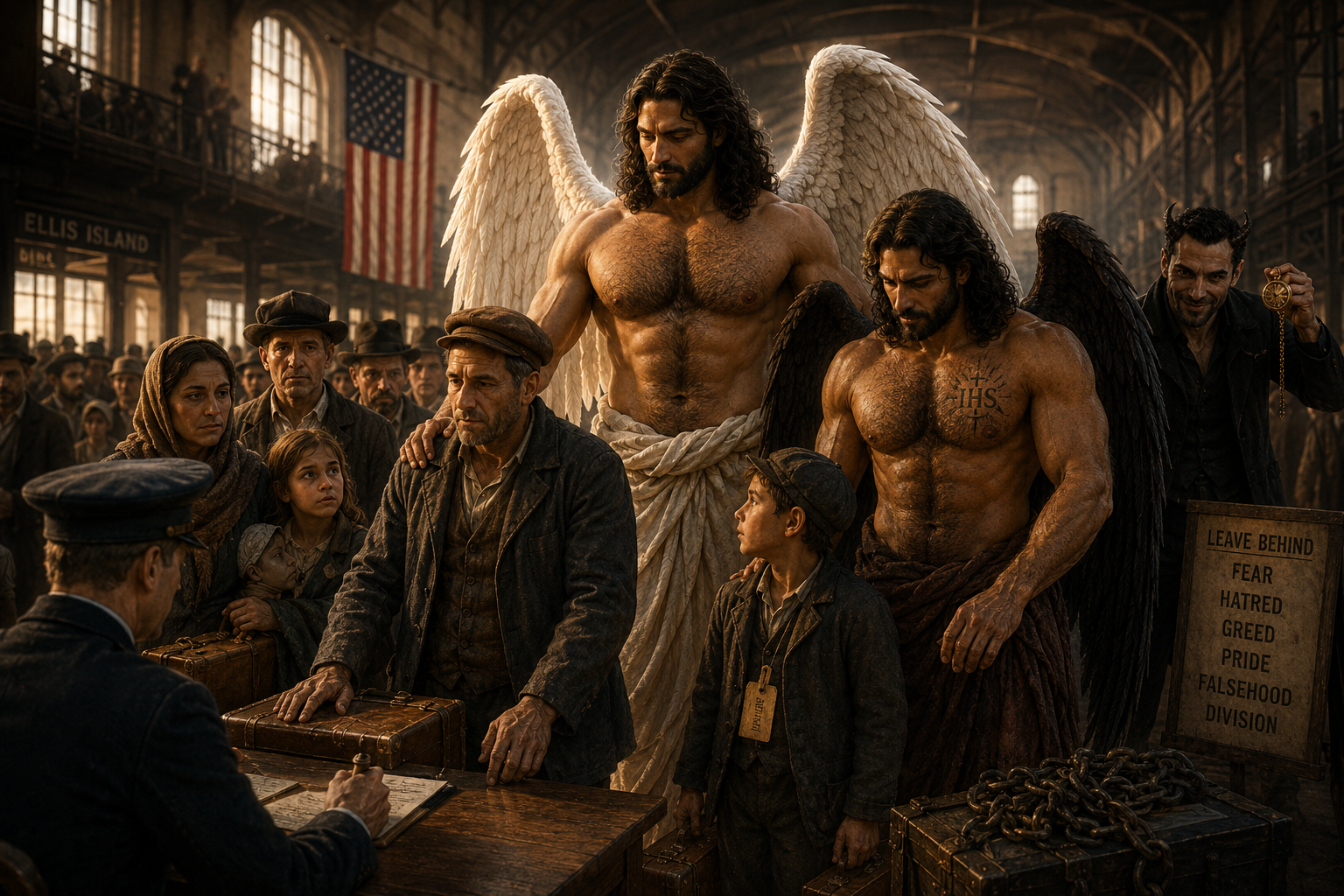
One of the most repeated phrases in American civic life is that the United States is "a nation of immigrants." It is a beautiful phrase, and there is real gratitude in it. But beautiful is not the same as true, and a half-truth repeated long enough becomes a kind of forgetting. This week, as America turns two hundred and fifty, honesty asks us to look plainly at the story we tell about where we came from, because a people that lies about its formation will eventually lie about its future.
The slogan is not exactly a lie. It is an illusion, and illusion is The Devil at Work’s characteristic tactic. The enemy of formation (Humaning) never has to invent anything new; he only has to rename what is already there until we can no longer see it. So the phrase quietly does its renaming: it turns conquest into arrival; colonization into relocation; slavery into migration; it turns recruited labor into an open armed welcome; exclusion into generosity; and a great deal of suffering into a postcard. Once history has become a postcard, people stop learning anything from it. That is the most serious warnings, not that the immigrant story is false but that the slogan is far too small to carry it, and the smallness is doing something to all of us.
The truth is more demanding, and it asks for the harder virtue of simply seeing. America was made by many kinds of movements, not one. Indigenous peoples were already here, and were displaced, removed, confined, and written out of the mythology. Europeans explored, claimed, settled, and expanded. Africans were not immigrants in any ordinary sense at all; they were enslaved, trafficked, and forced into labor that built fortunes for others. Only later did millions more come, the Irish, Italian, Polish, Chinese, Mexican, Jewish, Caribbean, all through different doors, under different rules, into very different welcomes. To call all of that "immigration" is to flatten a continent of experience into a single sentiment. The honest word is not one movement but many, and most of them were nothing - I repeat nothing like the poem.
Which brings us to the poem itself and the false postcard belief that ensued, because it reveals the lie in plain sight. The most beloved proof of the slogan is the sonnet at the Statue of Liberty, and its own history subtly undoes the myth it is used to defend - even in political rhetoric. Emma Lazarus wrote "The New Colossus" in 1883 to help raise money for the Statue of Liberty's pedestal. It was not read at the statue's dedication in 1886; it was, in fact, forgotten. Only in 1903 was a plaque bearing it fixed inside the pedestal, and the lines became the nation's anthem of welcome only in the 1930s after the restrictive US immigration laws of the 1920s had already slammed the doors. The poem did not shape the policy. The policy came first, and was often the opposite of the poem. The immigrant never arrived into a welcoming verse. He arrived at an inspection station, a labor market, a neighborhood boundary, a set of suspicions, and a hierarchy that had already decided who counted as fully American.
Italians know this in their bones. The Library of Congress records the numbers: three hundred thousand Italians came in the 1880s, six hundred thousand in the 1890s, more than two million in the decade after that; by 1920, over four million had come, more than a tenth of the entire foreign-born population. Most of them were not even "Italians" yet. Italy had been a single flag only since 1861 so they arrived thinking of themselves as Sicilians, Calabrians, Neapolitans, Lucani, known by village and dialect, sometimes unable to understand one another. They became Italian Americans here. The untold story except in certain circles was not kind or gentle. In the 1890s alone, more than twenty Italians were lynched. In New Orleans in 1891, after a jury acquitted a group of Sicilians, a mob of thousands broke into the jail and dragged eleven of them out to their deaths. It was one of the largest mass lynchings in American history and the newspaper of record editorialized its approval. That is not the poem, that is the country. It’s a yes, and story…
There was a fault line beneath the false sentiment that the slogan on the plaque hides completely. These immigrants arrived Catholic into a civic culture that was overwhelmingly Protestant, in which loyalty to Rome read as foreignness and unreliability. However, the deeper truth is stranger and more beautiful than "Catholics arrived in a Protestant land." Southern Italians did not come as non-Christian outsiders. They came as Christians from a different Christian world and it’s still a different Christian world. They carried their faith not as the Protestants in Scripture and sermon and private conscience, but the Italians carried it in saints and processions, feast days and graves, candles and bread and the blessing of the table, in campanilismo, that loyalty to everyone living within the sound of the church bells. Even their notorious distrust of Rome was rarely a rejection of the sacred; it was a distrust of distant institutional power, while the Madonna and the patron saint and the parish feast stayed utterly, unshakably real. The Protestant majority often looked and saw only superstition and priestcraft. What they were actually failing to read was a Christianity more embodied, communal, and place-bound than its own… a faith of feast and procession and grief and mother and wound.
Here the Builder at Work rises out of the wreckage of the myth. Because these people built anyway. They entered the mines and the railroads and the docks and the trades. They formed mutual aid societies and parishes; when the great unions barred them, they formed their own. They opened shops, raised children, organized against conditions that were killing them, and slowly made the country's promise truer than it had been when they arrived. That is the harder and better truth: many became American not because the national myth was already real, but because their labor and sacrifice and persistence helped make it real. The honest story does not destroy America's invitation. It rescues it from sentimentality. America was never simply open, never simply pure, never just welcoming, never only cruel. It was, and it remains, unfinished - L'Incompiuta, the eyes still open to the sky. The unfinished castle in Matera asks the only question that matters in the US and elsewhere: what are we building, and toward whom are the guns turned?
This is where honesty and genuineness make their sharpest correction, and it is the reason this reflection sits beside the naming of names. The Italian laborer in the mine was not a symbol. The enslaved African on the plantation was not a symbol. The Indigenous family pushed from its land was not a symbol. The Irish domestic, the Chinese railroad worker, the Jewish garment worker, the Mexican farmworker, the Black migrant out of the rural South, the Appalachian collier, the southern Italian stonemason not one of them was a symbol. They were people. Originals. Each one arriving at the inspection desk and being handed a number, but carrying a name and behind the name, a mother, a village, a grief, a hope, and very often a patron saint whose feast the family kept as faithfully as a birthday. To honor the onomastico, the name day, is to insist on exactly this: that there is a person behind the category, and the person came first. This is why we, UMANIAMOⓇ does not just ask, "Who came here?" We ask, "What happened to the human person and those left behind when they came, when they were brought, when they were displaced, when they were recruited, when they were excluded, when they were used, and when they built anyway?" That question is far more faithful to the Builder at Work than any slogan ever could, because the true Builder at Work does not need a myth that flatters him. He needs a truth strong enough to build upon.
So the real question this anniversary begs answered or considered is not only about the two hundred and fifty years behind us. It is about the two hundred and fifty ahead. In some genuine sense we are deciding, right now, what the next quarter-millennium will remember and we will not build it from a slogan. Not from "a nation of immigrants" as sentiment, and not from "a closed nation" as a reaction. Both are too small; both use the person to make a point. We build the next America the way every good thing has ever been built: from the deeper truth. A nation of persons, of builders. This is a nation still unfinished, willing to ask of every system it makes the one honest question is this forming Americans, or extracting from them?
That work does not begin in a capital or a campaign. It begins where it has always begun: at a table. Return to the Sunday Table. Return to Builder relationships, the kind that see the originals actually around you, restore them with some dignity, and reunite them in shared responsibility. A nation is not finally made by its myth. It is made by the meal, by the neighbor known by name, by the thousand small refusals to treat a person as a category. No one - no one - exists merely to be imported, managed, exploited, assimilated, sorted, or used. What God builds, He intends.
This, in the end, is where Berkeley Springs and Matera meet. America's Protestant formation gave it a mighty language of liberty, conscience, vocation, and resistance to every king. Southern Italy's Catholic formation preserved a mighty language of embodiment, place, intercession, sacred time, communal memory, and rebirth. Both are Christian. Both distrust distant domination. Both carry the inheritance differently and the next two hundred and fifty years will need every bit of both: conscience and communion, liberty and sacrament, Scripture and procession, personal responsibility and shared feast, the Declaration and the Bruna, Washington's survey and Matera's cart.
So this is not the end of the reflection. It is the sending. Go back to your own table this weekend and look at the people around it as originals, each one a person and not a category, carrying a name, a story, and a dignity no system may spend. Then go further. Be a Builder in the one place only you can reach: your family, your street, your parish, your lodge, your shop, your team, your feed. Refuse, in a hundred small daily ways, to treat a person as a means. Welcome the one on the edge. Tell the truth kindly. Keep the keep open. Build a table where the last builder built a fortress.
That is how the next two hundred and fifty years are actually made. You are one of the Builders at Work, or the work does not get done. Originals wanted - Originals always, seems honest enough to remember, genuine enough to repent, brave enough to build. Not sent as copies of one another, but as originals sent to restore originals.
Ad Majorem Dei Gloriam. What God builds, He intends. We are human together, or not at all.
In the Roman Christian tradition, the Saints are not greeting cards or Christmas tree ornaments, or even statuary from the past. They are witnesses and each one carries a human life that became transparent to grace in a particular way. Before formally being canonized as a Saint, they were all Originals - living lives For the Greater Glory of God - Ad Majorem Dei Gloriam: children, spouses, mothers, fathers, martyrs, workers, scholars, mystics, priests, nuns, nobles, and ordinary people who remained faithful in the place where God had placed them. This week’s Onomastici sits beautifully beside our REDISCOVER U® card: Honesty and Genuineness. Each Saint’s story vividly describes what we refer to as Humaning, each in a different way. Their stories are mirrors for us to help us discern whether we are living as copies or originals, whether we are performing holiness or becoming genuine, and whether the life we are building is turned toward domination, self-protection, and image, or toward formation, service, courage, and love. Read their stories before falling for the parasocial “para-humaning” avatar narratives. We encourage you to read about these Saints - this week the stories of Saints Benedict and Maria Goretti hit me hard.
July 6 - Saint Maria Goretti
Saint Maria Goretti was a young Italian girl whose life and death have often been remembered through the language of purity and martyrdom. But her witness is also a witness to the dignity of the vulnerable and the refusal to let violence have the final word. She was poor, young, and without worldly power, yet the Church remembers her not as disposable, but as luminous.
Her forgiveness of her attacker does not make violence acceptable and does not erase the horror of what was done to her. Instead, it reveals something deeper: the original person cannot be defined by what evil does. Maria’s witness belongs to every child, every vulnerable person, and every soul the world has treated as small. Humaning begins when we refuse to measure dignity by strength, status, usefulness, age, or power.
Humaning Summary: Maria Goretti reminds us that the vulnerable are not lesser persons. To care for the whole person means protecting innocence, honoring dignity, refusing exploitation, and believing that no act of violence has authority to define the original God intends.
July 7 - Saint Peter To Rot
Saint Peter To Rot was a lay catechist, husband, father, and martyr from Papua New Guinea. His witness is especially powerful because he was not a cleric or distant religious figure removed from ordinary life. He was a formed layman, rooted in family and community, who carried faith into the daily structures of marriage, teaching, and local responsibility.
Peter To Rot reminds us that holiness is not reserved for those with official titles. Formation must enter the household, the village, the workplace, the field, the classroom, and the ordinary places where people are actually shaped. He stood for the dignity of Christian marriage and family life under pressure, and he paid for that witness with his life.
Humaning Summary: Peter To Rot shows us the Builder as husband, father, teacher, and local witness. He reminds us that the family is not outside formation; it is one of its first schools. To empower individuals for a greater purpose means forming laypeople who can stand faithfully where they live.
July 8 - Saints Aquila and Priscilla
Saints Aquila and Priscilla were a married couple, tentmakers, companions of Saint Paul, and builders of the early Church through hospitality, work, teaching, and friendship. Their home became a place of formation. Their labor supported the mission. Their marriage became a shared vocation rather than a private arrangement.
They are a beautiful witness for UMANIAMO® because they show the Sunday Table before it had a name. They gathered, hosted, taught, worked, traveled, and risked themselves for the Gospel. Their sanctity was not abstract. It had a table, a trade, a household, and a network of relationships.
Humaning Summary: Aquila and Priscilla remind us that the home can become a church, the table can become a formation space, and marriage can become a mission. To value every act of service means honoring the hidden hospitality, labor, and shared fidelity that builds the Kingdom.
July 9 - Saints Augustine Zhao Rong and Companions
Saint Augustine Zhao Rong and his companions represent generations of Chinese martyrs: bishops, priests, religious, laypeople, catechists, workers, elders, and children who bore witness to Christ under persecution. Their story stretches across centuries and reminds us that the Body of Christ is not held by one culture, empire, language, or civilization.
Their witness is especially important in a week where we are reflecting on liberty, belonging, and the false claim that one culture alone owns the Christian imagination. Christianity is never merely imported as a system. It is received by real people in real places, and it becomes incarnate through their courage, suffering, language, family, and memory.
Humaning Summary: Augustine Zhao Rong and Companions remind us that faith becomes genuine when it is embodied in a people. To integrate faith and science, conscience and evidence, means seeing that truth is not tribal property. The original human person belongs first to God, even when empire, ideology, or fear demands otherwise.
July 10 - Saint Veronica Giuliani
Saint Veronica Giuliani was a Capuchin Poor Clare mystic whose life was marked by intense prayer, suffering, service, and union with Christ crucified. Her witness can be difficult for the modern mind because it does not fit our preference for clean, efficient, manageable spirituality. She reminds us that formation is not always tidy. Sometimes the soul must pass through wounds, tears, surrender, and hidden transformation before love becomes real.
Veronica’s genuineness was not performance. She did not make suffering into a brand or a spectacle. Her life points us toward the deep Christian truth that the Cross must move from symbol to interior reality. The Builder cannot simply admire Christ. The Builder must allow Christ to form him.
Humaning Summary: Veronica Giuliani reminds us that the deepest wounds can become places of union rather than isolation. To encourage reflection and discernment means allowing suffering to be seen truthfully, not romanticized, avoided, or used, so that grace can reach the place where the original has gone quiet.
July 11 - Saint Benedict
Saint Benedict of Nursia is one of the great Builders of the Western Christian tradition. His vocation shaped monasteries that became centers of prayer, learning, hospitality, agriculture, craft, memory, and culture. After the collapse of Roman order, Benedict did not just criticize the ruins. He formed a new way of life.
Benedict matters for UMANIAMO® because he shows that civilization is rebuilt through rhythm. Prayer and work. Silence and hospitality. Obedience and stability. Discipline and mercy. He understood that a human life cannot be formed by impulse alone. It needs a rule, a table, a community, a daily return, and a shared order that makes love possible.
Humaning Summary: Benedict reminds us that Builders do not only make noise; they build durable rhythms. To invite continuous growth means creating structures that form people over time. A human life needs more than inspiration. It needs a rule of life strong enough to keep the table open.
July 12 - Saints Louis and Zélie Martin
Saints Louis and Zélie Martin, the parents of Saint Thérèse of Lisieux, are among the most beautiful witnesses to ordinary holiness in family life. They were spouses, workers, parents, sufferers, and faithful builders of a household where sanctity could grow. Their holiness was not separate from the daily responsibilities of marriage, work, grief, illness, parenting, and sacrifice.
They remind us that the family table is not a small thing. It is one of the places where originals are first seen, formed, wounded, restored, and sent. Their witness also reminds us that vocation is rarely lived alone. A holy household is not perfect; it is a place where love keeps returning, even through loss.
Humaning Summary: Louis and Zélie Martin remind us that holiness can be built in the ordinary architecture of marriage, parenting, work, and grief. Magis may appear not as more achievement, but as more faithful love in the life already entrusted to us.
This week’s saints do not give us one model of holiness. They give us a communion of originals. Together, they remind us that the Christian life is not a copy machine. God forms originals. The Church remembers names because each life matters in its particularity. Each saint carries a different way of becoming fully alive in God and fully given for others.
Una delle frasi più ricorrenti nella vita civica americana è che gli Stati Uniti sono «una nazione di immigrati». È una frase bellissima, e in essa c’è vera gratitudine. Ma «bella» non significa «vera», e una mezza verità ripetuta abbastanza a lungo diventa una sorta di oblio. Questa settimana, mentre l’America compie duecentocinquanta anni, l’onestà ci chiede di guardare con lucidità alla storia che raccontiamo sulle nostre origini, perché un popolo che mente sulla propria formazione finirà per mentire anche sul proprio futuro.
Lo slogan non è esattamente una bugia. È un’illusione, e l’illusione è la tattica caratteristica del Diavolo al lavoro. Il nemico della formazione (l’Umanizzazione) non deve mai inventare nulla di nuovo; deve solo rinominare ciò che è già lì finché non riusciamo più a vederlo. Così la frase, silenziosamente, opera la sua rinominazione: trasforma la conquista in arrivo; la colonizzazione in trasferimento; la schiavitù in migrazione; trasforma la manodopera reclutata in un’accoglienza a braccia aperte; l’esclusione in generosità; e una grande quantità di sofferenza in una cartolina. Una volta che la storia è diventata una cartolina, le persone smettono di imparare qualcosa da essa. Questo è l’avvertimento più grave: non che la storia degli immigrati sia falsa, ma che lo slogan sia troppo limitato per contenerla, e questa limitatezza sta avendo un effetto su tutti noi.
La verità è più esigente e richiede la virtù più ardua del semplice vedere. L’America è stata costruita da molti tipi di movimenti, non da uno solo. I popoli indigeni erano già qui e sono stati sfollati, allontanati, confinati e cancellati dalla mitologia. Gli europei esplorarono, rivendicarono, si insediarono ed espansero il loro dominio. Gli africani non erano affatto immigrati nel senso comune del termine; furono ridotti in schiavitù, vittime della tratta e costretti a un lavoro che ha costruito le fortune altrui. Solo in seguito ne arrivarono altri milioni: irlandesi, italiani, polacchi, cinesi, messicani, ebrei, caraibici, tutti attraverso porte diverse, secondo regole diverse, accolti in modi molto diversi. Definire tutto questo «immigrazione» significa appiattire un continente di esperienze in un unico sentimento. La verità non è un unico movimento, ma molti, e la maggior parte di essi non aveva nulla – ripeto, nulla – a che vedere con la poesia.
Il che ci porta alla poesia stessa e alla falsa convinzione da cartolina che ne è derivata, perché essa rivela la menzogna sotto gli occhi di tutti. La prova più amata dello slogan è il sonetto alla Statua della Libertà, e la sua stessa storia smonta sottilmente il mito che è chiamato a difendere – persino nella retorica politica. Emma Lazarus scrisse «The New Colossus» nel 1883 per aiutare a raccogliere fondi per il piedistallo della Statua della Libertà. Non fu letta durante l’inaugurazione della statua nel 1886; fu, infatti, dimenticata. Solo nel 1903 una targa con il testo fu fissata all’interno del piedistallo, e quei versi divennero l’inno di benvenuto della nazione solo negli anni ’30, dopo che le restrittive leggi statunitensi sull’immigrazione degli anni ’20 avevano già sbattuto le porte in faccia agli immigrati. La poesia non ha plasmato la politica. La politica è venuta prima ed era spesso l’opposto della poesia. L’immigrato non è mai arrivato in un verso di benvenuto. È arrivato a un posto di controllo, a un mercato del lavoro, al confine di un quartiere, a una serie di sospetti e a una gerarchia che aveva già deciso chi potesse essere considerato pienamente americano.
Gli italiani lo sanno fin nel profondo. La Biblioteca del Congresso ne registra i numeri: trecentomila italiani arrivarono negli anni Ottanta del XIX secolo, seicentomila negli anni Novanta, più di due milioni nel decennio successivo; nel 1920 ne erano arrivati oltre quattro milioni, più di un decimo dell’intera popolazione nata all’estero. La maggior parte di loro non era nemmeno ancora «italiana». L’Italia era unita sotto un’unica bandiera solo dal 1861, quindi arrivarono considerandosi siciliani, calabresi, napoletani, lucani, identificati dal proprio paese d’origine e dal proprio dialetto, a volte incapaci di capirsi tra loro. Qui divennero italo-americani. La storia non raccontata, se non in certi ambienti, non fu né gentile né clemente. Solo negli anni Novanta dell’Ottocento, più di venti italiani furono linciati. A New Orleans nel 1891, dopo che una giuria aveva assolto un gruppo di siciliani, una folla di migliaia di persone fece irruzione nel carcere e trascinò fuori undici di loro verso la morte. Fu uno dei più grandi linciaggi di massa nella storia americana e il quotidiano di riferimento espresse la propria approvazione in un editoriale. Quella non è la poesia, quello è il Paese. È un sì, e una storia…
C’era una linea di frattura sotto il falso sentimento che lo slogan sulla targa nasconde completamente. Questi immigrati arrivarono come cattolici in una cultura civica prevalentemente protestante, in cui la fedeltà a Roma era vista come estraneità e inaffidabilità. Tuttavia, la verità più profonda è più strana e più bella di «i cattolici arrivarono in una terra protestante». Gli italiani del Sud non arrivarono come estranei non cristiani. Arrivarono come cristiani provenienti da un mondo cristiano diverso, che è tuttora un mondo cristiano diverso. Portavano con sé la loro fede non come i protestanti, nelle Scritture, nei sermoni e nella coscienza privata, ma gli italiani la portavano nei santi e nelle processioni, nelle feste e nelle tombe, nelle candele, nel pane e nella benedizione della tavola, nel campanilismo, quella fedeltà verso chiunque vivesse nel raggio d’azione del suono delle campane. Persino la loro famigerata diffidenza verso Roma raramente era un rifiuto del sacro; era una diffidenza verso un potere istituzionale lontano, mentre la Madonna, il santo patrono e la festa parrocchiale rimanevano assolutamente, incrollabilmente reali. La maggioranza protestante spesso guardava e vedeva solo superstizione e inganno clericale. Ciò che in realtà non riusciva a cogliere era un cristianesimo più incarnato, comunitario e legato al luogo rispetto al proprio… una fede fatta di feste, processioni, lutto, madre e ferita.
Qui il Costruttore al Lavoro emerge dalle macerie del mito. Perché queste persone hanno costruito comunque. Sono entrate nelle miniere, nelle ferrovie, nei porti e nei mestieri. Hanno formato società di mutuo soccorso e parrocchie; quando i grandi sindacati le hanno escluse, ne hanno fondati di propri. Hanno aperto negozi, cresciuto figli, si sono organizzate contro le condizioni che le stavano uccidendo e, lentamente, hanno reso la promessa del Paese più vera di quanto non fosse stata al loro arrivo. Questa è la verità più dura e migliore: molti sono diventati americani non perché il mito nazionale fosse già reale, ma perché il loro lavoro, il loro sacrificio e la loro tenacia hanno contribuito a renderlo reale. La storia onesta non distrugge l’invito dell’America. Lo salva dal sentimentalismo. L’America non è mai stata semplicemente aperta, mai semplicemente pura, mai solo accogliente, mai solo crudele. Era, e rimane, incompiuta – L’Incompiuta, con gli occhi ancora rivolti al cielo. Il castello incompiuto di Matera pone l’unica domanda che conta negli Stati Uniti e altrove: cosa stiamo costruendo, e verso chi sono puntate le armi?
È qui che l’onestà e l’autenticità apportano la loro correzione più incisiva, ed è il motivo per cui questa riflessione si affianca alla citazione dei nomi. Il lavoratore italiano in miniera non era un simbolo. L’africano ridotto in schiavitù nella piantagione non era un simbolo. La famiglia indigena cacciata dalla propria terra non era un simbolo. La domestica irlandese, l’operaio ferroviario cinese, l’operaio ebreo dell’industria tessile, il bracciante agricolo messicano, il migrante nero proveniente dal Sud rurale, il minatore degli Appalachi, lo scalpellino del Sud Italia: nessuno di loro era un simbolo. Erano persone. Individui unici. Ognuno di loro arrivava al banco di controllo e riceveva un numero, ma portava con sé un nome e, dietro quel nome, una madre, un villaggio, un dolore, una speranza e, molto spesso, un santo patrono la cui festa la famiglia celebrava con la stessa devozione di un compleanno. Onorare l’onomastico, il giorno del nome, significa insistere proprio su questo: che dietro la categoria c’è una persona, e che la persona è venuta prima di tutto. Ecco perché noi di UMANIAMOⓇ non ci limitiamo a chiedere: «Chi è venuto qui?» Chiediamo: «Che cosa è successo alla persona umana e a coloro che sono rimasti indietro quando sono venuti, quando sono stati portati via, quando sono stati sfollati, quando sono stati reclutati, quando sono stati esclusi, quando sono stati sfruttati e quando hanno costruito comunque?». Questa domanda è molto più fedele al Costruttore al Lavoro di quanto qualsiasi slogan potrebbe mai esserlo, perché il vero Costruttore al Lavoro non ha bisogno di un mito che lo lusinghi. Ha bisogno di una verità abbastanza forte su cui costruire.
Quindi la vera domanda a cui questo anniversario chiede una risposta o una riflessione non riguarda solo i duecentocinquanta anni che ci siamo lasciati alle spalle. Riguarda i duecentocinquanta che ci aspettano. In un senso autentico stiamo decidendo, proprio ora, cosa ricorderà il prossimo quarto di millennio e non lo costruiremo a partire da uno slogan. Né da «una nazione di immigrati» come sentimento, né da «una nazione chiusa» come reazione. Entrambe sono troppo limitate; entrambe usano la persona per sostenere una tesi. Costruiamo la prossima America nel modo in cui ogni cosa buona è sempre stata costruita: partendo dalla verità più profonda. Una nazione di persone, di costruttori. Questa è una nazione ancora incompiuta, disposta a porre a ogni sistema che crea l’unica domanda onesta: sta formando gli americani, o sta sottraendo loro qualcosa?
Quel lavoro non inizia in una capitale o in una campagna elettorale. Inizia dove è sempre iniziato: a tavola. Ritorniamo alla tavola della domenica. Ritorniamo alle relazioni tra costruttori, quelle che vedono le persone autentiche realmente intorno a noi, le riabilitano con dignità e le riuniscono in una responsabilità condivisa. Una nazione, in definitiva, non è fatta dal suo mito. È fatta dal pasto, dal vicino conosciuto per nome, dalle mille piccole rifiutate di trattare una persona come una categoria. Nessuno – nessuno – esiste semplicemente per essere importato, gestito, sfruttato, assimilato, smistato o utilizzato. Ciò che Dio costruisce, lo fa con uno scopo.
È qui, in definitiva, che Berkeley Springs e Matera si incontrano. La formazione protestante dell’America le ha donato un potente linguaggio di libertà, coscienza, vocazione e resistenza a ogni re. La formazione cattolica del Sud Italia ha preservato un potente linguaggio di incarnazione, luogo, intercessione, tempo sacro, memoria comune e rinascita. Entrambe sono cristiane. Entrambe diffidano del dominio a distanza. Entrambe portano avanti l’eredità in modo diverso e i prossimi duecentocinquanta anni avranno bisogno di ogni minimo aspetto di entrambe: coscienza e comunione, libertà e sacramento, Scrittura e processione, responsabilità personale e festa condivisa, la Dichiarazione e la Bruna, il sondaggio di Washington e il carro di Matera.
Quindi questa non è la fine della riflessione. È l’invio. Tornate alla vostra tavola questo fine settimana e guardate le persone che vi siedono attorno come esseri unici, ognuno una persona e non una categoria, portatori di un nome, di una storia e di una dignità che nessun sistema può sprecare. Poi andate oltre. Siate Costruttori nell’unico luogo che solo voi potete raggiungere: la vostra famiglia, la vostra strada, la vostra parrocchia, la vostra loggia, il vostro negozio, la vostra squadra, il vostro gruppo. Rifiutate, in cento piccoli modi quotidiani, di trattare una persona come un mezzo. Accogliete chi è emarginato. Dite la verità con gentilezza. Mantenete aperta la porta. Costruite una tavola dove l’ultimo Costruttore ha eretto una fortezza.
È così che si costruiscono realmente i prossimi duecentocinquanta anni. Tu sei uno dei Costruttori al Lavoro, altrimenti l’opera non viene portata a termine. Si cercano originali – originali sempre, abbastanza onesti da ricordare, abbastanza sinceri da pentirsi, abbastanza coraggiosi da costruire. Non inviati come copie l’uno dell’altro, ma come originali inviati per restaurare altri originali.
Ad Majorem Dei Gloriam. Ciò che Dio costruisce, lo vuole. Siamo umani insieme, oppure non lo siamo affatto.
Nella tradizione cristiana romana, i santi non sono biglietti di auguri né decorazioni per l’albero di Natale, né tantomeno statue del passato. Sono testimoni e ognuno di loro porta con sé una vita umana che è diventata trasparente alla grazia in un modo particolare. Prima di essere formalmente canonizzati come santi, erano tutti originali – vivevano la propria vita Per la Maggiore Gloria di Dio – Ad Majorem Dei Gloriam: figli, coniugi, madri, padri, martiri, lavoratori, studiosi, mistici, sacerdoti, suore, nobili e persone comuni che sono rimaste fedeli nel luogo in cui Dio le aveva poste. Gli Onomastici di questa settimana si abbinano magnificamente alla nostra scheda REDISCOVER U®: Onestà e Autenticità. La storia di ogni santo descrive vividamente ciò che chiamiamo “Humaning”, ciascuno a modo suo. Le loro storie sono specchi che ci aiutano a discernere se stiamo vivendo come copie o come originali, se stiamo recitando la santità o diventando autentici, e se la vita che stiamo costruendo è orientata verso il dominio, l’autoprotezione e l’immagine, oppure verso la formazione, il servizio, il coraggio e l’amore. Leggete le loro storie prima di lasciarvi ingannare dalle narrazioni parasociali degli avatar del “para-humaning”. Vi incoraggiamo a leggere di questi santi: questa settimana le storie di san Benedetto e di santa Maria Goretti mi hanno colpito profondamente.
6 luglio - Santa Maria Goretti
Santa Maria Goretti era una giovane ragazza italiana la cui vita e morte sono state spesso ricordate attraverso il linguaggio della purezza e del martirio. Ma la sua testimonianza è anche una testimonianza della dignità dei più vulnerabili e del rifiuto di lasciare che la violenza abbia l’ultima parola. Era povera, giovane e priva di potere mondano, eppure la Chiesa la ricorda non come una persona sacrificabile, ma come una figura luminosa.
Il suo perdono nei confronti del suo aggressore non rende la violenza accettabile e non cancella l’orrore di ciò che le è stato fatto. Al contrario, rivela qualcosa di più profondo: la persona nella sua essenza non può essere definita da ciò che il male compie. La testimonianza di Maria appartiene a ogni bambino, a ogni persona vulnerabile e a ogni anima che il mondo ha trattato come insignificante. L’“Humaning” inizia quando rifiutiamo di misurare la dignità in base alla forza, allo status, all’utilità, all’età o al potere.
Sintesi dell’“Humaning”: Maria Goretti ci ricorda che le persone vulnerabili non sono persone di serie B. Prendersi cura della persona nella sua interezza significa proteggere l’innocenza, onorare la dignità, rifiutare lo sfruttamento e credere che nessun atto di violenza abbia l’autorità di definire l’essenza originaria voluta da Dio.
7 luglio - San Pietro To Rot
San Pietro To Rot era un catechista laico, marito, padre e martire della Papua Nuova Guinea. La sua testimonianza è particolarmente potente perché non era un ecclesiastico né una figura religiosa distante dalla vita ordinaria. Era un laico formato, radicato nella famiglia e nella comunità, che portava la fede nelle strutture quotidiane del matrimonio, dell’insegnamento e delle responsabilità locali.
Peter To Rot ci ricorda che la santità non è riservata a chi detiene titoli ufficiali. La formazione deve entrare nella casa, nel villaggio, sul posto di lavoro, nei campi, in classe e nei luoghi ordinari dove le persone vengono effettivamente plasmate. Egli difese la dignità del matrimonio cristiano e della vita familiare sotto pressione, e pagò quella testimonianza con la propria vita.
Sintesi di “Humaning”: Peter To Rot ci mostra il Costruttore come marito, padre, insegnante e testimone locale. Ci ricorda che la famiglia non è estranea alla formazione; è una delle sue prime scuole. Responsabilizzare le persone verso uno scopo più grande significa formare laici capaci di rimanere fedeli là dove vivono.
8 luglio - Santi Aquila e Priscilla
I santi Aquila e Priscilla erano una coppia sposata, fabbricanti di tende, compagni di san Paolo e costruttori della Chiesa primitiva attraverso l’ospitalità, il lavoro, l’insegnamento e l’amicizia. La loro casa divenne un luogo di formazione. Il loro lavoro sosteneva la missione. Il loro matrimonio divenne una vocazione condivisa piuttosto che un accordo privato.
Sono una bellissima testimonianza per UMANIAMO® perché incarnano la «Mensa Domenicale» prima ancora che avesse un nome. Si riunivano, ospitavano, insegnavano, lavoravano, viaggiavano e si mettevano in gioco per il Vangelo. La loro santità non era astratta. Aveva una tavola, un mestiere, una famiglia e una rete di relazioni.
Sintesi di Humaning: Aquila e Priscilla ci ricordano che la casa può diventare una chiesa, la tavola può diventare uno spazio di formazione e il matrimonio può diventare una missione. Valorizzare ogni atto di servizio significa onorare l’ospitalità nascosta, il lavoro e la fedeltà condivisa che edificano il Regno.
9 luglio - Santi Agostino Zhao Rong e compagni
San Agostino Zhao Rong e i suoi compagni rappresentano generazioni di martiri cinesi: vescovi, sacerdoti, religiosi, laici, catechisti, operai, anziani e bambini che hanno reso testimonianza a Cristo sotto la persecuzione. La loro storia attraversa i secoli e ci ricorda che il Corpo di Cristo non è appannaggio di una sola cultura, di un solo impero, di una sola lingua o di una sola civiltà.
La loro testimonianza è particolarmente importante in una settimana in cui riflettiamo sulla libertà, sull’appartenenza e sulla falsa pretesa che una sola cultura possieda l’immaginario cristiano. Il cristianesimo non viene mai semplicemente importato come sistema. Viene accolto da persone reali in luoghi reali e si incarna attraverso il loro coraggio, la loro sofferenza, la loro lingua, la loro famiglia e la loro memoria.
Sintesi di Humaning: Agostino Zhao Rong e i suoi compagni ci ricordano che la fede diventa autentica quando si incarna in un popolo. Integrare fede e scienza, coscienza ed evidenza, significa riconoscere che la verità non è proprietà tribale. La persona umana originaria appartiene innanzitutto a Dio, anche quando l’impero, l’ideologia o la paura esigono il contrario.
10 luglio - Santa Veronica Giuliani
Santa Veronica Giuliani era una mistica clarissa cappuccina la cui vita fu segnata da intensa preghiera, sofferenza, servizio e unione con Cristo crocifisso. La sua testimonianza può risultare difficile per la mentalità moderna perché non si adatta alla nostra preferenza per una spiritualità pulita, efficiente e gestibile. Lei ci ricorda che la formazione non è sempre ordinata. A volte l’anima deve passare attraverso ferite, lacrime, abbandono e trasformazione nascosta prima che l’amore diventi reale.
L’autenticità di Veronica non era una recita. Non trasformava la sofferenza in un marchio o in uno spettacolo. La sua vita ci indica la profonda verità cristiana secondo cui la Croce deve passare da simbolo a realtà interiore. Il Costruttore non può limitarsi ad ammirare Cristo. Il Costruttore deve permettere a Cristo di plasmarlo.
Sintesi di Humaning: Veronica Giuliani ci ricorda che le ferite più profonde possono diventare luoghi di unione anziché di isolamento. Incoraggiare la riflessione e il discernimento significa permettere che la sofferenza sia vista in modo veritiero, non romanticizzata, evitata o strumentalizzata, affinché la grazia possa raggiungere il luogo in cui l’originale si è zittito.
11 luglio - San Benedetto
San Benedetto da Norcia è uno dei grandi Costruttori della tradizione cristiana occidentale. La sua vocazione ha plasmato i monasteri che sono diventati centri di preghiera, apprendimento, ospitalità, agricoltura, artigianato, memoria e cultura. Dopo il crollo dell’ordine romano, Benedetto non si limitò a criticare le rovine. Creò un nuovo modo di vivere.
Benedetto è importante per UMANIAMO® perché dimostra che la civiltà si ricostruisce attraverso il ritmo. Preghiera e lavoro. Silenzio e ospitalità. Obbedienza e stabilità. Disciplina e misericordia. Egli comprese che una vita umana non può essere plasmata solo dall’impulso. Ha bisogno di una regola, di una tavola, di una comunità, di un ritorno quotidiano e di un ordine condiviso che renda possibile l’amore.
Sintesi di Humaning: Benedetto ci ricorda che i Costruttori non si limitano a fare rumore; essi creano ritmi duraturi. Invitare alla crescita continua significa creare strutture che formino le persone nel tempo. Una vita umana ha bisogno di più che di ispirazione. Ha bisogno di una regola di vita abbastanza forte da mantenere aperta la tavola.
12 luglio - Santi Luigi e Zélie Martin
I santi Luigi e Zélie Martin, genitori di santa Teresa di Lisieux, sono tra le più belle testimonianze di santità ordinaria nella vita familiare. Erano coniugi, lavoratori, genitori, sofferenti e fedeli costruttori di una casa in cui la santità potesse crescere. La loro santità non era separata dalle responsabilità quotidiane del matrimonio, del lavoro, del dolore, della malattia, dell’essere genitori e del sacrificio.
Ci ricordano che la tavola familiare non è una cosa da poco. È uno dei luoghi in cui gli individui vengono per la prima volta visti, plasmati, feriti, risanati e inviati. La loro testimonianza ci ricorda anche che la vocazione raramente si vive da soli. Una famiglia santa non è perfetta; è un luogo in cui l’amore continua a tornare, anche attraverso la perdita.
Sintesi di “Humaning”: Luigi e Zélie Martin ci ricordano che la santità può essere costruita nell’architettura ordinaria del matrimonio, dell’educazione dei figli, del lavoro e del dolore. Il “Magis” può apparire non come un risultato in più, ma come un amore più fedele nella vita che ci è già stata affidata.
I santi di questa settimana non ci offrono un unico modello di santità. Ci offrono una comunione di originali. Insieme, ci ricordano che la vita cristiana non è una fotocopiatrice. Dio crea originali. La Chiesa ricorda i nomi perché ogni vita conta nella sua particolarità. Ogni santo porta con sé un modo diverso di diventare pienamente vivo in Dio e pienamente donato agli altri.