First Line of Defense
August 31 - September 6, 2026
Formation Library → Sunday Table → First Line of Defense
Builders at Work
The Sunday Table è scritto in due lingue, inglese e italiano. Per ogni sezione, il testo in inglese è seguito da quello in italiano.
We are Human Together or Not at All.
Cosiamo | Founder, UMANIAMO® | Humaning Architecture
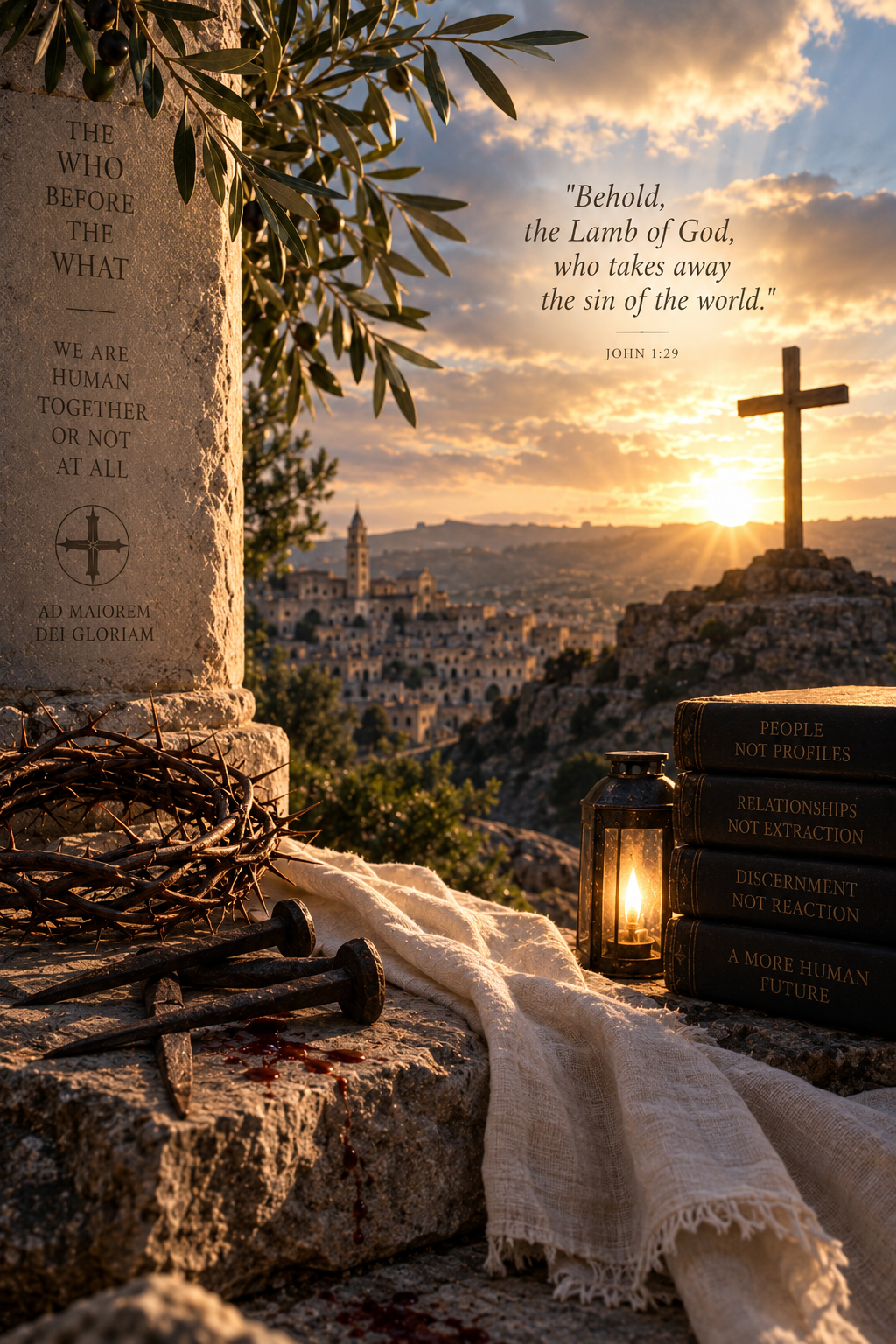
Christians have repeated that sentence for nearly two thousand years. We hear it in churches, read it in prayers, sing it in hymns, and teach it to children. The words are so familiar that it is possible to say them without allowing them to disturb us. Yet the question beneath them is worth reopening: what exactly do we mean when we say that Christ died for the sins of humanity?
For many of us, the phrase quickly becomes a catalogue of personal moral failures. The seven deadly sins: pride, greed, lust, envy, gluttony, wrath, and sloth come to mind, along with the countless choices humaned persons have to injure themselves and others. There is a lot of truth in that understanding and Christianity has never treated personal sin as insignificant. In fact in the Catholic tradition the Sacrament of Penance and Reconciliation exists to help restore the relationship between the sinner and God, or between the Authored and Author.
However, the entire Christian movement which has touched billions of lives and shaped entire continents is greater than reconciliation for an accumulated list of private human failures. It reveals what happens when humaned persons and the systems we create become so disordered that power, fear, status, law, belonging, and self-protection displace righteous relationships with God and our neighbor.
Look carefully at what happens to Jesus. A humaned person, God as man, stands before other humaned persons who no longer encounter Him simply as a person. Some fear Him, some resent Him, some are threatened by what He represents, and others are trying to preserve religious authority or political order. Many at that time want the problem to disappear, some follow orders, some join the crowd, and some remain silent. Gradually, the Who standing before them is reduced to a series of convenient and abstract labels that are easier to comprehend and defend: a threat, blasphemer, political liability, prisoner, a man condemned to death.
That must be the most accurate definition of ethical fading ever to have existed and one of the most unsettling revelations of the Passion of Christ and the Cross. Humaned persons can become extraordinarily competent at doing something to another person while remaining astonishingly blind to who is actually standing in front of them. When Jesus says, “Father, forgive them, for they know not what they do,” He is not speaking about people who lacked technical knowledge of crucifixion. Rome knew how to execute a man and the soldiers understood their task. Those seeking His removal understood the result they wanted. They knew the What, they knew the How, and they had their Why. What they could not comprehend was the full Who before them or the Where toward which their actions were leading.
They knew enough to kill Him. They did not know that the Cross they raised to extinguish Him would become the symbol through which His life would move across civilizations. They did not know that the man they reduced to a meme would become, for billions of people, the revelation of what a humaned person is worth. Their failure was not the absence of knowledge. It was partial knowledge mistaken for enough.
Perhaps that partial knowledge persists and we still haven’t learned the deeper meaning of “Christ died for the sins of humanity.”
The Bible repeatedly warns us about the same pattern. Liberation can be followed by forgetting. A people freed from bondage can eventually create structures that burden their own neighbors. Law intended to order life toward God and community can become, through fear, hierarchy, status, and institutional self-protection, an architecture that serves itself more faithfully than it serves the humaned person. The prophetic tradition repeatedly calls Israel back to justice, mercy, faithfulness, and concern for the widow, stranger, poor, debtor, and vulnerable person precisely because covenant can be remembered in ritual while being forgotten in practice and honest human relationships.
Jesus stands squarely inside that prophetic tradition. His summary of the Law is almost startling in its simplicity and in our understanding: love the Lord your God with the whole of yourself, and love your neighbor as yourself. Everything else must remain ordered beneath those relationships. [Mark 12:28-31 and Matthew 22:37-40]
In UMANIAMO® language, the first command restores the Authored to righteous relationship with the Author. The second requires us to recognize that the person across from us is Authored as are we and that We are Human together or not at all. When either relationship collapses, disorder follows. The Six Promises of the Humaning Covenant are our practical expression of what a righteous relationship looks like. To be more specific we: Care for the Whole Person because no person can be morally reduced only to the part of them that is useful to us; Empower Individuals for a Greater Purpose because love does not require another person to remain dependent so that we can remain powerful; Integrate Faith and Science because truth can’t be fragmented into whichever pieces support our preferred conclusion; Encourage Reflection and Discernment because people require enough interior freedom to distinguish fear from wisdom, urgency from necessity, persuasion from truth, and movement toward the Author from movement away; Value Every Act of Service because human worth can’t depend upon visibility, status, productivity, or followers; and Invite Continuous Growth because no humaned person is finished enough to be permanently reduced to a label, failure, category, diagnosis, ideology, role, or present usefulness. When these Promises are lived, a righteous relationship has room to grow. When they are abandoned, extraction becomes inevitable.
There’s an important lesson in the lived Six Promises because when lived extraction is impossible and nothing can be taken without permission. The great temptation of every man-made system is to abstract and obscure the humaned person until the system can efficiently use them. Which is why sin can’t be understood only as private misconduct. Sin can become the very architectural foundation of a system that can function efficiently according to its own rules while the relationships beneath it become profoundly disordered. A procedure can be followed, a law can be applied, a market can clear, an algorithm can optimize, and an institution can survive while the humaned person is steadily disappearing from view.
Look around, that idea should make our own current moment in history uncomfortable. Much of social media operates within an architecture that repeatedly abandons the Six Promises. It rarely encounters the whole person; it encounters a profile. It can create dependency on validation, visibility, belonging, and algorithmic reach rather than increase agency toward a greater purpose. It mixes evidence, emotion, ideology, identity, spirituality, persuasion, and entertainment into the same stream, often without helping us distinguish among them. It rewards rapid reaction more reliably than reflection. It makes visible performance more economically valuable than quiet service. It sorts people into categories and then continually serves them more material that reinforces those categories.
In other words, we have spent years building powerful systems for turning Whos into Whats. Artificial intelligence did not invent that architecture. It inherited it, and it may dramatically increase its reach. AI can classify the profile, infer the preference, predict behavior, generate persuasion, personalize the message, summarize the person, recommend the action, automate the decision, and increasingly perform functions that once required another human being to stop and encounter the Who. None of that makes AI inherently evil. It does, however, make the lesson of the Cross newly urgent.
What happens when a civilization becomes extraordinarily capable at What, Why, and How while becoming progressively less practiced at recognizing Who? We already know something about the answer. This may be what we should examine from a different perspective when we say that Christ died for the sins of humanity. He died not only for the private failures hidden inside individual lives, but within the recurring human disorder that allows us to forget that the person before us belongs to God. We forget when fear becomes strong enough, when money is involved, when status feels threatened, when law appears to permit something, when everybody around us agrees, when the system insists there is no alternative, or when the other person has been given a label convenient enough to make curiosity unnecessary. Once we forget the Who, extraction even to the point of extinction becomes remarkably easy.
If two thousand years after Calvary we can still build systems that reduce human beings to usefulness, allow fear to justify domination, create ideological enclosures that make neighbors invisible, and permit responsibility to disappear into an Empty Chair, then perhaps the question is not whether Christ died for the sins of humanity. The harder question is whether humanity has understood what those sins actually reveal about us.
Ad maiorem Dei gloriam. We are human together or not at all.
I cristiani ripetono questa frase da quasi duemila anni. La sentiamo nelle chiese, la leggiamo nelle preghiere, la cantiamo negli inni e la insegniamo ai bambini. Le parole ci sono così familiari che è possibile pronunciarle senza lasciarci turbare. Eppure vale la pena riprendere in esame la domanda che si cela dietro di esse: cosa intendiamo esattamente quando diciamo che Cristo è morto per i peccati dell’umanità?
Per molti di noi, questa frase si trasforma rapidamente in un elenco di fallimenti morali personali. Ci vengono in mente i sette peccati capitali: superbia, avarizia, lussuria, invidia, gola, ira e accidia, insieme alle innumerevoli scelte che gli esseri umani compiono per fare del male a se stessi e agli altri. C’è molta verità in questa interpretazione e il cristianesimo non ha mai considerato il peccato personale come insignificante. Infatti, nella tradizione cattolica, il Sacramento della Penitenza e della Riconciliazione esiste per aiutare a ristabilire il rapporto tra il peccatore e Dio, o tra il creato e il Creatore.
Tuttavia, l’intero movimento cristiano, che ha toccato miliardi di vite e plasmato interi continenti, va ben oltre la riconciliazione per un elenco accumulato di fallimenti umani privati. Esso rivela ciò che accade quando gli esseri umani e i sistemi che creiamo diventano così disordinati che il potere, la paura, lo status, la legge, il senso di appartenenza e l’autoprotezione prendono il posto delle giuste relazioni con Dio e con il prossimo.
Osservate attentamente ciò che accade a Gesù. Un essere umano, Dio fatto uomo, si trova di fronte ad altri esseri umani che non Lo incontrano più semplicemente come persona. Alcuni Lo temono, altri provano risentimento nei Suoi confronti, altri ancora si sentono minacciati da ciò che Egli rappresenta, mentre altri cercano di preservare l’autorità religiosa o l’ordine politico. Molti in quel momento vogliono che il problema scompaia: alcuni eseguono gli ordini, altri si uniscono alla folla e altri ancora rimangono in silenzio. A poco a poco, Colui che sta davanti a loro viene ridotto a una serie di etichette convenienti e astratte, più facili da comprendere e difendere: una minaccia, un bestemmiatore, un peso politico, un prigioniero, un uomo condannato a morte.
Questa deve essere la definizione più accurata di «sbiadimento etico» che sia mai esistita e una delle rivelazioni più inquietanti della Passione di Cristo e della Croce. Le persone, pur essendo umane, possono diventare straordinariamente competenti nel fare qualcosa a un’altra persona, pur rimanendo sorprendentemente cieche di fronte a chi si trova effettivamente davanti a loro. Quando Gesù dice: «Padre, perdonali, perché non sanno quello che fanno», non sta parlando di persone che non possedevano conoscenze tecniche sulla crocifissione. Roma sapeva come giustiziare un uomo e i soldati capivano il loro compito. Coloro che cercavano di eliminarlo capivano il risultato che volevano. Sapevano il Cosa, sapevano il Come e avevano il loro Perché. Ciò che non riuscivano a comprendere era il Chi che avevano davanti nella sua pienezza, né il Dove verso cui le loro azioni stavano conducendo.
Sapevano abbastanza per ucciderLo. Non sapevano che la Croce che avevano innalzato per annientarLo sarebbe diventata il simbolo attraverso il quale la Sua vita avrebbe attraversato le civiltà. Non sapevano che l’uomo che avevano ridotto a un semplice meme sarebbe diventato, per miliardi di persone, la rivelazione del valore di una persona a immagine di Dio. Il loro fallimento non fu l’assenza di conoscenza. Fu una conoscenza parziale scambiata per sufficiente.
Forse quella conoscenza parziale persiste e non abbiamo ancora appreso il significato più profondo dell’affermazione «Cristo è morto per i peccati dell’umanità».
La Bibbia ci mette ripetutamente in guardia dallo stesso schema. Alla liberazione può seguire l’oblio. Un popolo liberato dalla schiavitù può alla fine creare strutture che opprimono i propri vicini. La legge, intesa a orientare la vita verso Dio e la comunità, può diventare, attraverso la paura, la gerarchia, lo status e l’autoprotezione istituzionale, un’architettura che serve se stessa più fedelmente di quanto serva la persona umana. La tradizione profetica richiama ripetutamente Israele alla giustizia, alla misericordia, alla fedeltà e alla sollecitudine verso la vedova, lo straniero, il povero, il debitore e la persona vulnerabile, proprio perché l’alleanza può essere ricordata nel rituale mentre viene dimenticata nella pratica e nelle relazioni umane sincere.
Gesù si colloca pienamente all’interno di quella tradizione profetica. La sua sintesi della Legge è quasi sconcertante nella sua semplicità e nella nostra comprensione: ama il Signore tuo Dio con tutto te stesso e ama il tuo prossimo come te stesso.
Tutto il resto deve rimanere subordinato a queste relazioni. [Marco 12,28-31 e Matteo 22,37-40]
Nel linguaggio di UMANIAMO®, il primo comandamento ripristina la persona creata in una relazione giusta con il Creatore. Il secondo ci impone di riconoscere che la persona che abbiamo di fronte è stata creata proprio come noi e che siamo umani insieme o non lo siamo affatto. Quando una di queste relazioni crolla, ne consegue il disordine. Le Sei Promesse del Patto di Humaning sono la nostra espressione concreta di come si presenta un rapporto retto. Per essere più specifici: ci prendiamo cura della persona nella sua interezza perché nessuna persona può essere ridotta moralmente solo alla parte di sé che ci è utile; diamo potere agli individui per uno scopo più grande perché l’amore non richiede che un’altra persona rimanga dipendente affinché noi possiamo rimanere potenti; integriamo fede e scienza perché la verità non può essere frammentata in quelle parti che sostengono la nostra conclusione preferita; incoraggiamo la riflessione e il discernimento perché le persone hanno bisogno di sufficiente libertà interiore per distinguere la paura dalla saggezza, l’urgenza dalla necessità, la persuasione dalla verità, e il movimento verso l’Autore dal movimento che si allontana da Lui; diamo valore a ogni atto di servizio perché il valore umano non può dipendere dalla visibilità, dallo status, dalla produttività o dal numero di seguaci; e invitiamo alla crescita continua perché nessuna persona trattata con umanità è così completa da poter essere ridotta in modo permanente a un’etichetta, a un fallimento, a una categoria, a una diagnosi, a un’ideologia, a un ruolo o alla sua utilità attuale. Quando queste Promesse vengono vissute, una relazione retta ha spazio per crescere. Quando vengono abbandonate, lo sfruttamento diventa inevitabile.
C’è una lezione importante nelle Sei Promesse vissute, perché quando vengono vissute lo sfruttamento è impossibile e nulla può essere preso senza permesso. La grande tentazione di ogni sistema creato dall’uomo è quella di astrarre e oscurare la persona umana fino a quando il sistema non possa utilizzarla in modo efficiente. Ecco perché il peccato non può essere inteso solo come una cattiva condotta privata. Il peccato può diventare il fondamento stesso dell’architettura di un sistema in grado di funzionare efficacemente secondo le proprie regole, mentre le relazioni che ne costituiscono la base diventano profondamente disordinate. Si può seguire una procedura, applicare una legge, far funzionare il mercato, ottimizzare un algoritmo e far sopravvivere un’istituzione, mentre la persona in quanto tale scompare progressivamente dalla vista.
Guardiamoci intorno: questa idea dovrebbe renderci a disagio riguardo al nostro momento storico attuale. Gran parte dei social media opera all’interno di un’architettura che abbandona ripetutamente le Sei Promesse. Raramente incontra la persona nella sua interezza; incontra un profilo. Può creare dipendenza dall’approvazione, dalla visibilità, dall’appartenenza e dalla portata algoritmica, anziché aumentare l’autonomia verso uno scopo più grande. Mescola prove, emozioni, ideologie, identità, spiritualità, persuasione e intrattenimento nello stesso flusso, spesso senza aiutarci a distinguerli. Premia la reazione rapida in modo più affidabile della riflessione. Rende la performance visibile economicamente più preziosa del servizio silenzioso. Classifica le persone in categorie e poi fornisce loro continuamente più contenuti che rafforzano tali categorie.
In altre parole, abbiamo trascorso anni a costruire potenti sistemi per trasformare i «Chi» in «Cosa». L’intelligenza artificiale non ha inventato quell’architettura. L’ha ereditata e potrebbe aumentarne drasticamente la portata. L’IA può classificare il profilo, dedurre le preferenze, prevedere il comportamento, generare persuasione, personalizzare il messaggio, riassumere la persona, raccomandare l’azione, automatizzare la decisione e svolgere sempre più funzioni che un tempo richiedevano che un altro essere umano si fermasse e incontrasse il “Chi”. Nulla di tutto ciò rende l’IA intrinsecamente malvagia. Tuttavia, rende la lezione della Croce nuovamente urgente.
Cosa accade quando una civiltà diventa straordinariamente abile nel «Cosa», nel «Perché» e nel «Come», mentre diventa progressivamente meno esperta nel riconoscere il «Chi»? Conosciamo già in parte la risposta. Questo potrebbe essere ciò che dovremmo esaminare da una prospettiva diversa quando affermiamo che Cristo è morto per i peccati dell’umanità. Egli è morto non solo per i fallimenti privati nascosti nelle vite individuali, ma anche per quel ricorrente disordine umano che ci fa dimenticare che la persona che abbiamo davanti appartiene a Dio. Dimentichiamo quando la paura diventa abbastanza forte, quando c’è di mezzo il denaro, quando lo status si sente minacciato, quando la legge sembra permettere qualcosa, quando tutti intorno a noi sono d’accordo, quando il sistema insiste che non ci sono alternative, o quando all’altra persona è stata affibbiata un’etichetta abbastanza comoda da rendere superflua la curiosità. Una volta dimenticato il «Chi», lo sfruttamento, fino al punto dell’estinzione, diventa straordinariamente facile.
Se, a duemila anni dal Calvario, siamo ancora in grado di costruire sistemi che riducono gli esseri umani a semplici strumenti, permettono alla paura di giustificare il dominio, creano recinti ideologici che rendono invisibili i vicini e lasciano che la responsabilità svanisca in una «sedia vuota», allora forse la domanda non è se Cristo sia morto per i peccati dell’umanità. La domanda più difficile è se l’umanità abbia compreso ciò che quei peccati rivelano effettivamente di noi.
Ad maiorem Dei gloriam. Siamo umani insieme o non lo siamo affatto.
Spirituality
When people hear the word Spirituality, they imagine something woo woo, new age, or atmospheric: candles, quiet music, peaceful thoughts, perhaps a sense of transcendence detached from the demands of ordinary life…
That is not the Spirituality we are practicing this week. Here, spirituality means the unmistakable recognition of a righteous relationship where the Authored person stands consciously before the Author, able to discern illumination from illusion and unwilling to surrender that relationship to anything else. That is why Spirituality belongs as we venture into the First Line of Defense.
A humaned person who has lost sight of the Author becomes easier to fall into illusion and the lantern of The Devil at Work. Their job or income can tell them what they are worth. The platform can tell them what deserves attention. An ideology can tell them whom to fear and what to follow. The machine can begin supplying judgment in a form so seductively fluent that the humaned person forgets to notice whether the judgment is still theirs.
Spirituality, in the Michaelic tradition, interrupts that illusion. It brings the person back to the Chair that faces the Author.
This week let’s explore whether you can recognize when something is moving you toward greater truth, freedom, responsibility, service, and relationship with God and neighbor, or away from them. That is discernment and discernment is not a passive state, it is Michaelic: the sword held in the light.
The REDISCOVER U® practice this week invites you to notice where your own strengths make discernment easier and where they may make illusion more attractive. A person who values a Peacekeeping Approach may confuse peace with avoidance. A person who values Bravery and Moral Valour may mistake reaction for righteousness. A person who values Curiosity and Interest in the World may follow novelty past wisdom. A person who values traditional Spirituality may become so certain of what they believe they perceive that they stop testing whether the movement actually produces good fruit. Your strengths are not the problem, however, ask whether the strength remains rightly ordered.
1. Where are you most vulnerable to mistaking illusion for illumination?
Spirituality is not simply feeling peaceful, inspired, or certain. Think about one area of your life where something feels especially convincing or urgent. What evidence tells you it is actually illuminated rather than merely attractive, familiar, or reassuring?
2. Which of your strengths is easiest to turn against you?
Our strongest capacities can become our own “triggers” when they are directed outside discernment. Which strength in you most needs the sword of discernment this week, and what would “rightly ordered” use of that strength look like?
3. What are you protecting when you take up the sword?
The Michaelic sword is not for attacking another person. It is for separating illusion from illumination so that a righteous relationship can be protected. What in your life most needs that protection right now: your own conscience, family, vocation, work, faith, judgment, relationships, or something else?
Gather in a circle where everyone can see one another clearly. Begin with a full minute of silence.
In the first round, each person names one thing they are trying to protect because it helps them remain in a righteous relationship with the Author. Keep it simple and concrete: truth, conscience, family, courage, prayer, judgment, peace, attention, vocation, integrity, or another word that feels real.
On the second round, each person completes this sentence:
“The illusion that most threatens this in me is…”
The answer might be fear, anger, approval, distraction, resentment, urgency, certainty, money, status, comfort, social media, or the need to be right. No one comments, fixes, explains, or reassures. The purpose is to let the person name the movement for themselves.
In the final round, each person chooses one action that will help keep that relationship illuminated during the week. It should be something executable: pause before reacting, verify a claim before sharing it, pray before deciding, speak directly to someone rather than through a screen, leave the phone outside the room, ask for another perspective, read the original source, apologize, say no, or wait long enough for clarity to return.
Close the Circle in silence with one private question:
Am I standing in the light strongly enough to recognize what is trying to move me into illusion?
The purpose of the Circle is not to leave everyone more certain. It is to leave everyone more discerning. That is Spirituality as the First Line of Defense.
The Chair You Never Leave
There is a temptation in modern Spirituality to imagine losing ourselves or somehow step outside or transcending the reality of the place where we belong. Our image of the Chair invites you to consider something much more secure and grounded. The Chair… your Chair faces the Author, and it belongs uniquely to you as the Authored person. No other person can occupy it and even the Devil at Work cannot take it. The Chair is not a role assigned from outside. It is the enduring position of the Authored before the Author.
That also means the Authored person cannot truly leave it. You may leave the Table, withdraw from the Room, turn away from another person, or become so distracted by noise that you stop attending to the relationship that gives the Chair its meaning. You may slouch, twist, lean away, or stretch toward something else for so long that the original orientation becomes difficult to recognize, but you do not stop being Authored. The Chair remains because you remain seated in it.
The Devil at Work works through illusion. He does not need to try to steal the Chair, which he knows he can’t. He only needs to fill the surrounding environment with enough urgency, fear, resentment, comfort, status, distraction, or synthetic certainty that you forget to look toward the Author. The relationship itself isn’t gone; your attention to it has become distorted. Through this lens the sword of discernment slices through the illusion so that your focus clears enough to remember who authored you and what you have been entrusted with. It is your responsibility to occupy your chair and to remain committed to being humaned together.
Quando le persone sentono la parola spiritualità, immaginano qualcosa di esoterico, new age o suggestivo: candele, musica tranquilla, pensieri sereni, forse un senso di trascendenza distaccato dalle esigenze della vita quotidiana…
Non è questa la spiritualità che stiamo praticando questa settimana. Qui, spiritualità significa il riconoscimento inequivocabile di una relazione retta in cui la persona creata si pone consapevolmente davanti al Creatore, capace di discernere l’illuminazione dall’illusione e non disposta a cedere quella relazione a nient’altro. Ecco perché la spiritualità trova il suo posto mentre ci avventuriamo nella prima linea di difesa.
Una persona “umanizzata” che ha perso di vista l’Autore cade più facilmente nell’illusione e nella lanterna del Diavolo al lavoro. Il proprio lavoro o reddito può dirle quanto vale. La piattaforma può dirle cosa merita attenzione. Un’ideologia può dirle chi temere e cosa seguire. La macchina può iniziare a fornire giudizi in una forma così seducentemente fluida che la persona “umanizzata” dimentica di notare se quel giudizio è ancora suo.
La spiritualità, nella tradizione micheleana, interrompe quell’illusione. Riporta la persona alla Poltrona che si affaccia sull’Autore.
Questa settimana esploriamo se riesci a riconoscere quando qualcosa ti sta spingendo verso una maggiore verità, libertà, responsabilità, servizio e relazione con Dio e il prossimo, oppure ti sta allontanando da essi. Questo è il discernimento, e il discernimento non è uno stato passivo, è micheleano: la spada tenuta nella luce.
La pratica REDISCOVER U® di questa settimana vi invita a notare dove i vostri punti di forza facilitano il discernimento e dove invece potrebbero rendere l’illusione più attraente. Una persona che apprezza un «Approccio di mantenimento della pace» potrebbe confondere la pace con l’evitamento. Una persona che apprezza il «Coraggio» e il «Valore morale» potrebbe scambiare la reazione per rettitudine. Una persona che apprezza la «Curiosità» e l’«Interesse per il mondo» potrebbe seguire la novità a scapito della saggezza. Una persona che valorizza la spiritualità tradizionale potrebbe diventare così certa di ciò che crede di percepire da smettere di verificare se il percorso produca effettivamente buoni frutti. I tuoi punti di forza non sono il problema, tuttavia chiediti se il punto di forza rimanga correttamente ordinato.
1. In quali ambiti sei più vulnerabile a scambiare l’illusione per illuminazione?
La spiritualità non è semplicemente sentirsi in pace, ispirati o certi. Pensa a un ambito della tua vita in cui qualcosa ti sembra particolarmente convincente o urgente. Quali prove ti indicano che si tratta effettivamente di illuminazione piuttosto che di qualcosa di semplicemente attraente, familiare o rassicurante?
2. Quale dei tuoi punti di forza è più facile che si rivolti contro di te?
Le nostre capacità più forti possono diventare i nostri stessi “fattori scatenanti” quando vengono dirette al di fuori del discernimento. Quale punto di forza in te ha più bisogno della spada del discernimento questa settimana, e come sarebbe un uso “correttamente ordinato” di quel punto di forza?
3. Cosa stai proteggendo quando impugni la spada?
La spada micheleica non serve per attaccare un’altra persona. Serve a separare l’illusione dall’illuminazione, affinché possa essere protetta una relazione retta. Cosa nella tua vita ha più bisogno di quella protezione in questo momento: la tua coscienza, la famiglia, la vocazione, il lavoro, la fede, il giudizio, le relazioni o qualcos’altro?
Riunitevi in cerchio in modo che tutti possano vedersi chiaramente. Iniziate con un minuto intero di silenzio.
Nel primo giro, ogni persona nomini una cosa che sta cercando di proteggere perché la aiuta a rimanere in una relazione retta con l’Autore. Siate semplici e concreti: verità, coscienza, famiglia, coraggio, preghiera, giudizio, pace, attenzione, vocazione, integrità, o un’altra parola che vi sembri autentica.
Nel secondo giro, ogni persona completa questa frase:
«L’illusione che più minaccia questo in me è…»
La risposta potrebbe essere paura, rabbia, bisogno di approvazione, distrazione, risentimento, urgenza, certezza, denaro, status, comodità, social media o il bisogno di avere ragione. Nessuno commenta, corregge, spiega o rassicura. Lo scopo è lasciare che la persona identifichi da sé il movimento.
Nel giro finale, ogni persona sceglie un’azione che contribuirà a mantenere illuminata quella relazione durante la settimana. Dovrebbe essere qualcosa di fattibile: fare una pausa prima di reagire, verificare un’affermazione prima di condividerla, pregare prima di decidere, parlare direttamente con qualcuno piuttosto che attraverso uno schermo, lasciare il telefono fuori dalla stanza, chiedere un altro punto di vista, leggere la fonte originale, chiedere scusa, dire di no o aspettare abbastanza a lungo affinché torni la lucidità.
Chiudete il Cerchio in silenzio con una domanda personale:
Sono abbastanza saldamente nella luce da riconoscere ciò che sta cercando di spingermi verso l’illusione?
Lo scopo del Cerchio non è rendere tutti più sicuri. È rendere tutti più perspicaci. Questa è la Spiritualità come prima linea di difesa.
La Sedia da cui non ti allontani mai
Nella spiritualità moderna c’è la tentazione di immaginare di perdere noi stessi o di uscire in qualche modo, o di trascendere, la realtà del luogo a cui apparteniamo. La nostra immagine della Sedia vi invita a considerare qualcosa di molto più sicuro e radicato. La Sedia… la vostra Sedia è rivolta verso l’Autore, e appartiene esclusivamente a voi in quanto persona creata dall’Autore. Nessun’altra persona può occuparla e nemmeno il Diavolo all’Opera può sottrarvela. La Sedia non è un ruolo assegnato dall’esterno. È la posizione duratura della persona creata dall’Autore al cospetto dell’Autore stesso.
Ciò significa anche che la persona creata non può davvero abbandonarla. Puoi alzarti dal Tavolo, ritirarti dalla Stanza, voltare le spalle a un’altra persona, o lasciarti distrarre dal rumore al punto da smettere di prestare attenzione alla relazione che dà significato alla Sedia. Puoi stare curvo, contorcerti, inclinarti all’indietro o protenderti verso qualcos’altro per così tanto tempo che l’orientamento originale diventa difficile da riconoscere, ma non smetti di essere la persona creata. La Sedia rimane perché tu rimani seduto su di essa.
Il Diavolo al Lavoro agisce attraverso l’illusione. Non ha bisogno di cercare di rubare la Sedia, cosa che sa di non poter fare. Deve solo riempire l’ambiente circostante con abbastanza urgenza, paura, risentimento, comfort, status, distrazione o certezza artificiale da farti dimenticare di guardare verso l’Autore. La relazione in sé non è scomparsa; è la tua attenzione verso di essa che si è distorta. Attraverso questa lente, la spada del discernimento squarcia l’illusione, così che la tua concentrazione si schiarisca abbastanza da ricordarti chi ti ha creato e ciò che ti è stato affidato. È tua responsabilità occupare la tua sedia e rimanere impegnato a essere umani insieme.
Cosiamo | Founder, UMANIAMO® | Humaning Architecture
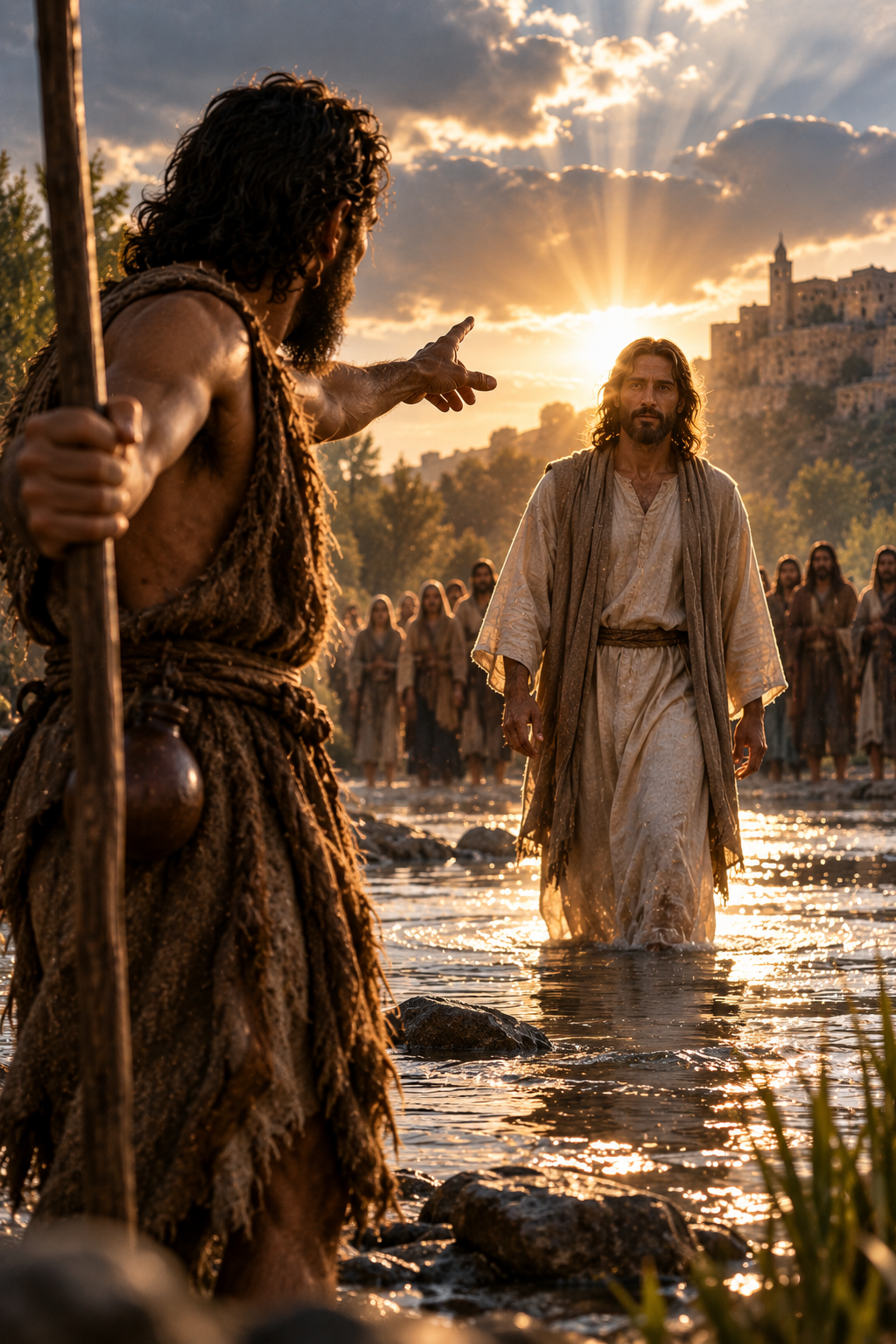
After reflecting on the Passion of St. John the Baptist this past week, I kept returning to his encounter with Jesus near the beginning of the Gospel of John. I have heard the passage so many times that its strangeness somehow feels ordinary. John the Baptist sees Jesus coming toward him and says, “Behold, the Lamb of God, who takes away the sin of the world!” John 1:29.
The words are familiar because the Church has carried them into the heart of the Mass. As the consecrated host is broken, Catholics pray the Agnus Dei “Lamb of God.” Yet familiarity can hide the significance of John’s language. He does not say, “Behold the Lamb of God who takes away the sins of the world,” nor does he narrow the problem to the sins of bad people, sinners, Gentiles, Romans, tax collectors, prostitutes, or even Israel.
Curiously, in the Greek text he says: Ἴδε ὁ Ἀμνὸς τοῦ Θεοῦ, ὁ αἴρων τὴν ἁμαρτίαν τοῦ κόσμου. Ide ho amnos tou Theou, ho airōn tēn hamartian tou kosmou. Most strikingly, hamartian, “sin,” is singular, while kosmou means “of the world,” from κόσμος, kosmos. The verb airōn carries the sense of taking away, lifting, bearing, or removing. The later liturgical Agnus Dei uses the plural Latin, qui tollis peccata mundi “you take away the sins of the world” and the tradition of the Church rightly brings our many personal sins into that prayer.
But John’s Gospel begins with something more disorienting: the sin of the world.
What might John have seen? It may be time to practice a little Neuro-Ignatian imagination.
Picture this.
John is standing in a place already charged with expectation. He is not operating from the center of institutional power but outside Jerusalem’s infamous Temple establishment, around the Jordan River, calling people to repentance and baptizing them. He has followers, influence, and enough public presence that his movement will eventually become politically dangerous.
The land into which Jesus walks is not politically neutral. Judea and Galilee exist under Roman imperial dominance. Herodian rulers exercise regional power beneath Rome, while Temple authority, taxation, imperial power, religious law, and competing visions of liberation all occupy the same strained and chaotic space. John himself will eventually be killed by a ruler whose authority he challenges. Then, in the middle of all of this, Jesus walks toward him.
Two men stand within this architecture. John has already stepped outside much of its conventional center and is calling people to change direction. The other, Jesus, is about to enter that world more fully and eventually collide with nearly every major form of authority surrounding Him.
John looks at Jesus, and what he does not say is almost as telling as what he actually says. He does not say, “Hey, look, here comes another teacher,” or “Here comes another Rabbi.” He says, “Behold.” Look, pay attention, something important is happening here.
John may not have yet understood the full meaning of what he was saying, but his words point beyond isolated wrongdoing toward the deeper disorder from which wrongdoing repeatedly emerges. The problem was, and still is, larger than one empire, one ruling class, one institution, or one community. Something had become disordered in the human world itself.
It is easy to reduce John the Baptist to a theological signpost whose only purpose is to point toward Jesus. But John was a man with followers, authority, influence, and a growing movement. People were coming to him. His voice carried weight. Then another man, Jesus, approaches, and John identifies Him as the one who matters more.
That is an extraordinary relational act and it may be one of the clearest examples of non-extractive leadership in Scripture. John possesses attention and gives it away. He recognizes something greater and allows that recognition to reorganize his own place in the relationship. He does not turn Jesus into a resource for his own mission or proof of his own importance. He encounters Jesus as a Who whose identity requires John’s own role to change.
There is also something deeply masculine in the interaction without any need for performance. Neither man diminishes the other. John does not become less human by acknowledging Jesus, and Jesus does not need to humiliate John in order to take His place. Authority is recognized rather than seized. One man knows enough about himself to recognize another.
That is one of the deeper purposes of REDISCOVER U® as well. The person who understands the Chair they uniquely occupy becomes more capable of recognizing the person in front of them without either absorbing them or disappearing into them. Self-knowledge, rightly ordered, does not make the self larger. It makes room for the Who.
Perhaps that gives us another way to hear John’s phrase, the sin of the world.
Maybe the sin of the world includes the recurring human capacity to create systems in which righteous relationships become inverted: systems where power replaces service, fear replaces discernment, status replaces dignity, and law becomes detached from mercy. In those systems, humaned persons become abstractions, categories, utilities, enemies, consumers, labor, data, or expendable bodies. The Who becomes a What because the What is easier to manage, measure, classify, use, or remove.
When that happens, the Six Promises of the Humaning Covenant begin to disappear. The Whole Person is reduced. Agency is diminished. Truth is fragmented. Reflection and discernment are compressed. Service becomes valuable only when it is visible or useful. Growth is denied when a person is frozen inside a category that the system finds convenient.
That is a disordered relationship and enough disordered relationships eventually become architecture.
Perhaps that is where the gravity of John’s singular phrase begins to emerge. The sins are many, certainly, but the disorder beneath them may be one: the Authored forgets the Author and then forgets that the neighbor is Authored too.
Once that happens, almost every form of extraction becomes possible. The person can be used because we no longer encounter the whole person. Authority can protect itself because preservation feels more urgent than service. Law can become an instrument rather than a boundary. Fear can make domination appear prudent. Status can make another person’s diminishment feel necessary. Even religion can become disordered when the structure meant to orient the Authored toward the Author begins demanding loyalty to itself.
And then the Cross begins to look less like an isolated tragedy and more like the revelation of a pattern. That may be what John saw first, not all of it and maybe not even consciously. But enough to stop, look toward Jesus, and say: Behold.
The Lamb of God is not merely coming to clean up the private failures of individual sinners. He is walking into the disorder of the kosmos itself into the world human beings have built when the righteous relationship with the Author and with one another has been forgotten. John, standing there at the edge of something enormous, sees the Who before the rest of the world knows what it is looking at. Perhaps we are in this current world standing in the same place, and the answer may simply be to remember: We are human together, or not at all.
Ad maiorem Dei gloriam. We are human together or not at all.
Dopo aver riflettuto sulla Passione di San Giovanni Battista la scorsa settimana, il mio pensiero continuava a tornare al suo incontro con Gesù, all’inizio del Vangelo di Giovanni. Ho sentito questo brano così tante volte che la sua stranezza mi sembra in qualche modo normale. Giovanni Battista vede Gesù che viene verso di lui e dice: «Ecco l’Agnello di Dio, che toglie il peccato del mondo!» Giovanni 1,29.
Queste parole ci sono familiari perché la Chiesa le ha inserite nel cuore della Messa. Quando l’ostia consacrata viene spezzata, i cattolici recitano l’Agnus Dei, «Agnello di Dio». Eppure la familiarità può nascondere il significato delle parole di Giovanni. Egli non dice: «Ecco l’Agnello di Dio che toglie i peccati del mondo», né limita il problema ai peccati delle persone malvagie, dei peccatori, dei gentili, dei romani, dei pubblicani, delle prostitute o persino di Israele.
Curiosamente, nel testo greco egli dice: Ἴδε ὁ Ἀμνὸς τοῦ Θεοῦ, ὁ αἴρων τὴν ἁμαρτίαν τοῦ κόσμου. Ide ho amnos tou Theou, ho airōn tēn hamartian tou kosmou. La cosa più sorprendente è che hamartian, «peccato», è al singolare, mentre kosmou significa «del mondo», da κόσμος, kosmos. Il verbo airōn ha il significato di togliere, sollevare, portare via o rimuovere. Il successivo Agnus Dei liturgico usa il plurale latino, qui tollis peccata mundi «tu togli i peccati del mondo» e la tradizione della Chiesa include giustamente i nostri numerosi peccati personali in quella preghiera.
Ma il Vangelo di Giovanni inizia con qualcosa di più disorientante: il peccato del mondo.
Cosa avrà visto Giovanni? Forse è il momento di esercitare un po’ di immaginazione neuro-ignaziana.
Immaginate questo.
Giovanni si trova in un luogo già carico di aspettative. Non opera dal centro del potere istituzionale, ma al di fuori del famigerato complesso del Tempio di Gerusalemme, lungo il fiume Giordano, invitando le persone al pentimento e battezzandole. Ha seguaci, influenza e una presenza pubblica tale che il suo movimento finirà per diventare politicamente pericoloso.
La terra in cui Gesù si avventura non è politicamente neutrale. La Giudea e la Galilea vivono sotto il dominio imperiale romano. I governanti erodiani esercitano il potere regionale sotto Roma, mentre l’autorità del Tempio, la tassazione, il potere imperiale, la legge religiosa e visioni contrapposte di liberazione occupano tutte lo stesso spazio teso e caotico. Lo stesso Giovanni finirà per essere ucciso da un governante di cui sfida l’autorità. Poi, nel bel mezzo di tutto questo, Gesù cammina verso di lui.
Due uomini si trovano all’interno di questa struttura. Giovanni si è già allontanato in gran parte dal suo centro convenzionale e sta invitando le persone a cambiare direzione. L’altro, Gesù, sta per entrare più pienamente in quel mondo e finirà per scontrarsi con quasi tutte le principali forme di autorità che lo circondano.
Giovanni guarda Gesù, e ciò che non dice è quasi altrettanto eloquente di ciò che effettivamente dice. Non dice: «Ehi, guarda, ecco che arriva un altro maestro», né «Ecco che arriva un altro rabbino». Dice: «Ecco». Guardate, prestate attenzione, qui sta accadendo qualcosa di importante.
Giovanni forse non aveva ancora compreso appieno il significato di ciò che stava dicendo, ma le sue parole indicano, al di là delle singole trasgressioni, il disordine più profondo da cui tali trasgressioni emergono ripetutamente. Il problema era, ed è tuttora, più vasto di un impero, di una classe dirigente, di un’istituzione o di una comunità. Qualcosa si era scomposto nel mondo umano stesso.
È facile ridurre Giovanni Battista a un semplice indicatore teologico il cui unico scopo è quello di puntare verso Gesù. Ma Giovanni era un uomo con seguaci, autorità, influenza e un movimento in crescita. La gente accorreva da lui. La sua voce aveva peso. Poi si avvicina un altro uomo, Gesù, e Giovanni lo identifica come colui che conta di più.
Si tratta di un atto relazionale straordinario e potrebbe essere uno degli esempi più chiari di leadership non estrattiva nelle Scritture. Giovanni possiede l’attenzione e la cede. Riconosce qualcosa di più grande e permette che tale riconoscimento riorganizzi il proprio posto nella relazione. Non trasforma Gesù in una risorsa per la propria missione né in una prova della propria importanza. Incontra Gesù come un “Chi” la cui identità richiede che il ruolo stesso di Giovanni cambi.
C’è anche qualcosa di profondamente maschile in questa interazione, senza alcun bisogno di mettersi in mostra. Nessuno dei due sminuisce l’altro. Giovanni non diventa meno umano riconoscendo Gesù, e Gesù non ha bisogno di umiliare Giovanni per prendere il suo posto. L’autorità viene riconosciuta piuttosto che conquistata. Un uomo conosce se stesso abbastanza da riconoscere un altro.
Questo è anche uno degli scopi più profondi di REDISCOVER U®. La persona che comprende il posto che occupa in modo unico diventa più capace di riconoscere la persona che ha di fronte senza né assorbirla né scomparire in essa. La conoscenza di sé, giustamente ordinata, non ingigantisce il sé. Fa spazio a Colui che è.
Forse questo ci offre un altro modo di interpretare la frase di Giovanni, il peccato del mondo.
Forse il peccato del mondo include la ricorrente capacità umana di creare sistemi in cui le relazioni giuste vengono capovolte: sistemi in cui il potere sostituisce il servizio, la paura sostituisce il discernimento, lo status sostituisce la dignità e la legge si distacca dalla misericordia. In quei sistemi, le persone che vivono la propria umanità diventano astrazioni, categorie, utilità, nemici, consumatori, manodopera, dati o corpi sacrificabili. Il “Chi” diventa un “Cosa” perché il “Cosa” è più facile da gestire, misurare, classificare, utilizzare o eliminare.
Quando ciò accade, le Sei Promesse del Patto dell’Umanizzazione cominciano a svanire. La Persona nella sua interezza viene ridotta. La capacità di agire viene sminuita. La verità viene frammentata. La riflessione e il discernimento vengono compressi. Il servizio diventa prezioso solo quando è visibile o utile. La crescita viene negata quando una persona è congelata all’interno di una categoria che il sistema ritiene conveniente.
Si tratta di una relazione disordinata e un numero sufficiente di relazioni disordinate finisce per diventare un’architettura.
Forse è qui che comincia ad emergere la gravità della singolare frase di Giovanni. I peccati sono molti, certamente, ma il disordine che sta alla base di essi potrebbe essere uno solo: l’Autore dimentica l’Autore e poi dimentica che anche il prossimo è stato creato dall’Autore.
Una volta che ciò accade, quasi ogni forma di sfruttamento diventa possibile. La persona può essere utilizzata perché non incontriamo più la persona nella sua interezza. L’autorità può proteggersi perché la conservazione sembra più urgente del servizio. La legge può diventare uno strumento piuttosto che un confine. La paura può far apparire prudente il dominio. Lo status può far sembrare necessaria la sminuizione di un’altra persona. Persino la religione può diventare disordinata quando la struttura destinata a orientare il creato verso il Creatore inizia a esigere fedeltà a se stessa.
E allora la Croce comincia ad apparire meno come una tragedia isolata e più come la rivelazione di uno schema. Forse è questo che Giovanni vide per primo, non tutto e forse nemmeno consapevolmente. Ma abbastanza per fermarsi, guardare verso Gesù e dire: Ecco.
L’Agnello di Dio non viene semplicemente per ripulire i fallimenti personali dei singoli peccatori. Sta entrando nel disordine del kosmos stesso, nel mondo che gli esseri umani hanno costruito quando è stato dimenticato il giusto rapporto con l’Autore e tra di loro. Giovanni, lì in piedi ai margini di qualcosa di enorme, vede Colui che è prima che il resto del mondo sappia cosa sta guardando. Forse in questo mondo attuale ci troviamo nello stesso punto, e la risposta potrebbe essere semplicemente quella di ricordare: siamo umani insieme, oppure non lo siamo affatto.
Ad maiorem Dei gloriam. Siamo umani insieme, oppure non lo siamo affatto.
A Blueprint for the Builder at Work
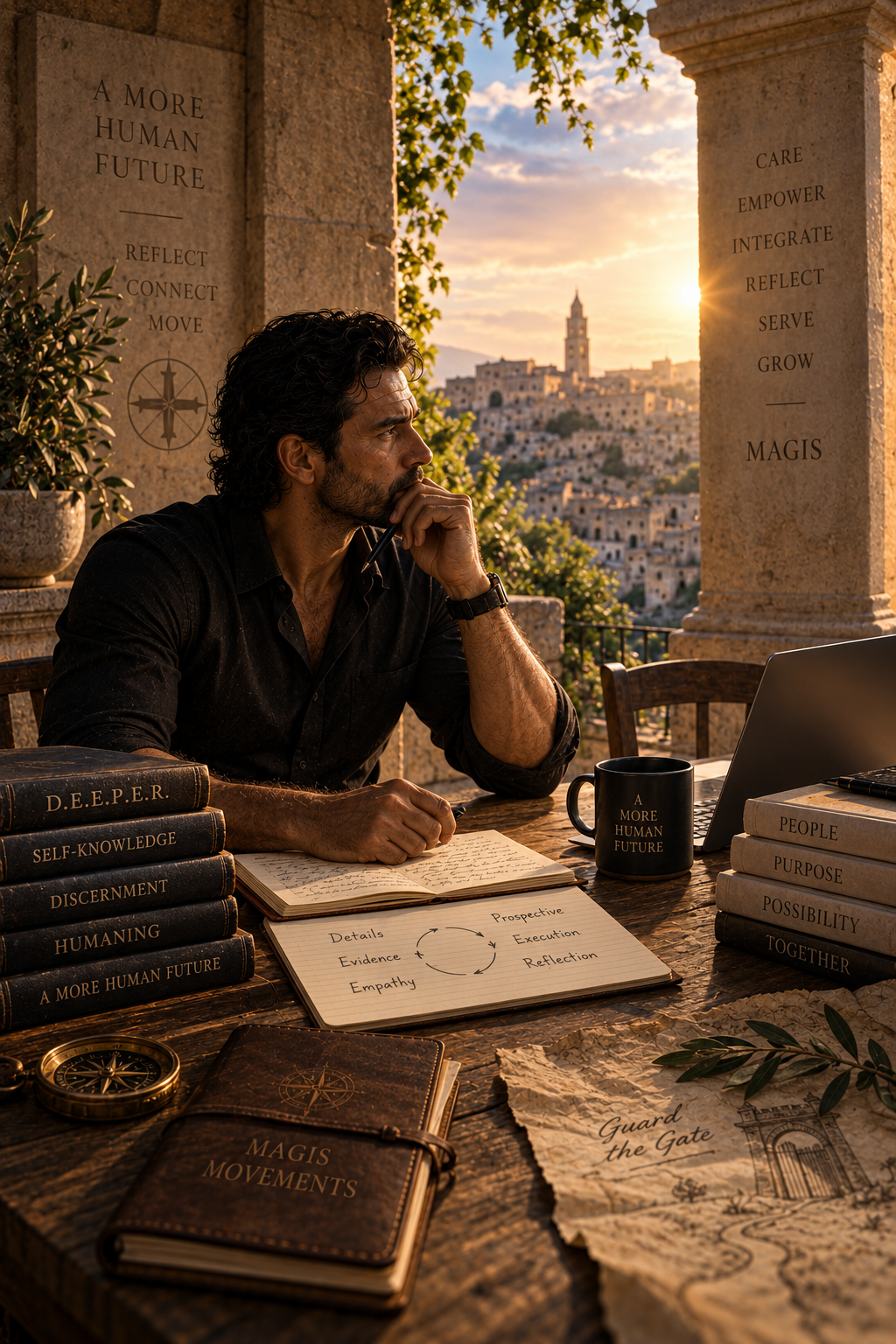
Most people still think of self-knowledge as personal development. You learn your strengths, understand a little more about how you think, and perhaps become better at working with people who think differently.
That isn’t enough anymore. Artificial intelligence can now meet you inside your own preferred way of thinking. It can respond with the kind of evidence, structure, warmth, speed, possibility, or certainty that feels most natural to you. Because of that, the first line of defense is not simply a technical safeguard around the machine. It is the humaned person who knows themselves well enough to notice when assistance begins becoming substitution.
If you naturally trust evidence and logic, you may lower your guard when the answer arrives with apparent rigor. If you prefer order, a polished plan may feel more resolved than it really is. If you lead relationally, the patient and affirming interface may feel safer than another person. If you are energized by possibility, the machine can generate more ideas and connections than you could ever exhaust. None of those strengths is the problem. The problem begins when the thing that feels most naturally like you becomes the thing you stop examining.
In our thesis the First Line of Defense we argue that self-knowledge has moved from enrichment toward defense. A humaned person who does not know how they think has no stable baseline from which to notice when a system is beginning to think for them.
The Sunday Table is part of that protective defense in action.
Each week, we invite you to read rather than simply receive, reflect rather than immediately react, speak rather than merely repost, listen to another human being, tolerate difference, and form your own judgment. The Sunday Table is the cognitive gym that exercises the capacities you need in order to discern for yourself.
This week, use the First Line of Defense as a practice.
This week use one concrete action for protecting your humaned judgment while using AI.
Action: Interrupt the environment once before it begins carrying you.
During one AI session this week, stop after twenty minutes or at the first moment you notice tension, mental drift, unusual absorption, or fatigue. Stand up, move away from the screen, take several minutes without another input, and notice what has happened to your body and attention.
Do not evaluate the quality of the answer yet. First determine whether the person doing the judging is still fully present.
Action: Do the first meaningful part yourself.
Choose one task you would normally begin with AI and reverse the order. Draft the first paragraph, outline the problem, attempt the calculation, identify the options, or write down what you already believe before opening the tool.
Then use AI to extend, challenge, organize, or refine what you have done.
At the end, ask whether the tool increased your capability or simply replaced the part that would have exercised it.
Action: Verify one consequential claim outside the AI conversation.
Choose one claim that would materially affect a decision, opinion, recommendation, or action. Find the original source, check whether the evidence actually supports the statement, and look for one credible piece of information that complicates the answer.
Then bring conscience back into the process. Ask not only, “Is this accurate?” but also, “What does acting on this require of me in relationship with the Author and the people affected?”
Action: Create a deliberate delay before one consequential action.
Choose one AI-generated recommendation, message, plan, conclusion, or decision that matters and do not act on it immediately.
Leave the AI environment. Read it later, preferably in another place or on paper. If the decision affects another person, bring it into a human conversation before acting.
The purpose of the pause is not indecision. It is to restore the interval in which discernment becomes possible.
Action: Put one hidden human back into the picture.
Take something AI helped you produce and identify one person whose work, knowledge, service, experience, writing, research, teaching, or care sits somewhere behind the apparent ease of the result.
Acknowledge them, contact them, cite them, thank them, ask for their perspective, or involve them directly where appropriate.
This practice reminds us that “machine capability” often rests on layers of human contribution that disappear when the interface becomes the only thing we see.
Action: Protect one human capability for seven days.
Choose one capacity you do not want to lose through convenience. It might be writing from a blank page, remembering without searching, explaining something in your own words, reading a long source directly, making a first judgment before asking AI, or having a difficult conversation without synthetic mediation.
Exercise that capacity deliberately every day for one week.
At the end, ask whether you feel more capable, more confident, and more able to act without the machine when necessary.
Growth leaves evidence. So does atrophy.
Now choose one AI interaction from the week that stood out because it felt especially useful, convincing, relieving, exciting, uncomfortable, or difficult to leave.
Walk through the interaction slowly.
Details: What actually happened? Record what you asked, what the system returned, what you accepted, what you changed, what you delegated, and what you acted upon. Stay with observable facts before explaining them.
Evidence: Why did you trust or distrust the response? Identify whether your confidence came from verified evidence, apparent expertise, fluency, citations, agreement with what you already believed, emotional reassurance, or simply the confidence and speed of the answer.
Empathy: Who is affected by the outcome and who is absent from the conversation? Consider whose experience, expertise, labor, responsibility, dignity, or perspective may be missing because the interaction took place only between you and the machine.
Prospective: Imagine using AI in exactly this way for another six months. What capability in you becomes stronger? What becomes weaker? What do you begin doing more skillfully, and what might you gradually cease practicing because the tool now performs it?
Execution: Choose one concrete change. Write first. Verify one source. Invite another person. Limit the session. Take a consequential decision out of the AI environment. Ask the system to challenge rather than complete your thinking. Make the change specific enough that you can actually practice it.
Reflection: Consider what repeated participation is forming in you. Ask whether the relationship is increasing freedom, responsibility, discernment, relationship, and capacity for service, or whether it is quietly increasing dependence upon the next answer.
The First Line of Defense is not an attempt to make you invulnerable to technology. It is an invitation to become more aware of the person using it.
Return to your experience at the Sunday Table this week. Notice what happened when you had to read something long enough to understand it, sit with an idea before reacting, listen to another interpretation, put your own thought into words, or remain present when there was no immediate answer.
Un progetto per il costruttore all’opera
La maggior parte delle persone continua a considerare la conoscenza di sé come uno strumento di crescita personale. Si imparano i propri punti di forza, si comprende un po’ meglio il proprio modo di pensare e magari si migliora la capacità di lavorare con persone che la pensano in modo diverso.
Ma questo non basta più. L’intelligenza artificiale è ora in grado di venire incontro al tuo modo di pensare preferito. Può rispondere con quel tipo di evidenza, struttura, calore, rapidità, possibilità o certezza che ti sembra più naturale. Per questo motivo, la prima linea di difesa non è semplicemente una misura di sicurezza tecnica attorno alla macchina. È la persona consapevole di sé che si conosce abbastanza bene da accorgersi quando l’assistenza inizia a trasformarsi in sostituzione.
Se ti affidi naturalmente alle prove e alla logica, potresti abbassare la guardia quando la risposta arriva con apparente rigore. Se preferisci l’ordine, un piano ben strutturato potrebbe sembrarti più definitivo di quanto non sia in realtà. Se guidi in modo relazionale, l’interfaccia paziente e rassicurante potrebbe sembrarti più sicura di un’altra persona. Se sei stimolato dalle possibilità, la macchina può generare più idee e connessioni di quante tu possa mai esaurire. Nessuno di questi punti di forza è il problema. Il problema inizia quando ciò che ti sembra più naturale diventa proprio ciò che smetti di esaminare.
Nella nostra tesi La prima linea di difesa sosteniamo che la conoscenza di sé si sia spostata dall’arricchimento alla difesa. Una persona a misura d’uomo che non sa come pensa non ha un punto di riferimento stabile da cui rendersi conto di quando un sistema sta iniziando a pensare al posto suo.
Il Sunday Table fa parte di quella difesa protettiva in azione.
Ogni settimana, vi invitiamo a leggere anziché limitarvi a ricevere, a riflettere anziché reagire immediatamente, a parlare anziché limitarsi a ripubblicare, ad ascoltare un altro essere umano, a tollerare la differenza e a formarvi un giudizio autonomo. La «Tavola della Domenica» è la palestra cognitiva che allena le capacità necessarie per discernere con la propria testa.
Questa settimana, utilizzate la «Prima linea di difesa» come esercizio.
Questa settimana, adottate un’azione concreta per proteggere il vostro giudizio umano mentre utilizzate l’IA.
Azione: Interrompi l’ambiente una volta prima che inizi a trascinarti.
Durante una sessione con l’IA questa settimana, fermati dopo venti minuti o nel primo momento in cui noti tensione, distrazione mentale, assorbimento insolito o affaticamento. Alzati, allontanati dallo schermo, prenditi alcuni minuti senza altri input e osserva cosa è successo al tuo corpo e alla tua attenzione.
Non valutare ancora la qualità della risposta. Determinate innanzitutto se la persona che esprime il giudizio è ancora pienamente presente.
Azione: Svolgete voi stessi la prima parte significativa.
Scegliete un compito che normalmente iniziereste con l’IA e invertite l’ordine. Abbozzate il primo paragrafo, delineate il problema, provate a fare il calcolo, identificate le opzioni o scrivete ciò che già pensate prima di aprire lo strumento.
Poi utilizzate l’IA per ampliare, mettere in discussione, organizzare o perfezionare ciò che avete fatto.
Alla fine, chiediti se lo strumento abbia aumentato la tua capacità o se abbia semplicemente sostituito la parte che l’avrebbe esercitata.
Azione: Verifica un’affermazione rilevante al di fuori della conversazione con l’IA.
Scegli un’affermazione che influenzerebbe in modo sostanziale una decisione, un’opinione, una raccomandazione o un’azione. Trova la fonte originale, verifica se le prove sostengono effettivamente l’affermazione e cerca un’informazione credibile che complichi la risposta.
Quindi reintroduci la coscienza nel processo. Chiediti non solo: «È esatto?», ma anche: «Cosa mi richiede agire in base a questo nel mio rapporto con l’Autore e con le persone coinvolte?».
Azione: Crea un ritardo intenzionale prima di compiere un’azione importante.
Scegli una raccomandazione, un messaggio, un piano, una conclusione o una decisione generata dall’IA che sia rilevante e non agire immediatamente in base ad essa.
Esci dall’ambiente dell’IA. Leggilo più tardi, preferibilmente in un altro luogo o su carta. Se la decisione riguarda un’altra persona, discuti la questione in una conversazione tra esseri umani prima di agire.
Lo scopo della pausa non è l’indecisione. È ripristinare l’intervallo in cui il discernimento diventa possibile.
Azione: riporta in primo piano una persona nascosta dietro il risultato.
Prendi qualcosa che l’IA ti ha aiutato a produrre e identifica una persona il cui lavoro, conoscenza, servizio, esperienza, scrittura, ricerca, insegnamento o cura si celano dietro l’apparente facilità del risultato.
Riconosci il suo contributo, contattala, citala, ringraziala, chiedi il suo punto di vista o coinvolgi direttamente questa persona, se opportuno.
Questa pratica ci ricorda che la “capacità della macchina” spesso si basa su strati di contributo umano che scompaiono quando l’interfaccia diventa l’unica cosa che vediamo.
Azione: Proteggi una capacità umana per sette giorni.
Scegli una capacità che non vuoi perdere per motivi di comodità. Potrebbe essere scrivere partendo da una pagina bianca, ricordare senza cercare, spiegare qualcosa con parole tue, leggere direttamente una fonte lunga, formulare un primo giudizio prima di chiedere all’IA, o affrontare una conversazione difficile senza mediazione sintetica.
Esercita deliberatamente quella capacità ogni giorno per una settimana.
Alla fine, chiediti se ti senti più capace, più sicuro di te e più in grado di agire senza la macchina quando necessario.
La crescita lascia tracce. E lo stesso vale per l’atrofia.
Ora scegli un’interazione con l’IA della settimana che ti ha colpito perché ti è sembrata particolarmente utile, convincente, rassicurante, emozionante, scomoda o difficile da abbandonare.
Ripercorri lentamente l’interazione.
Dettagli: Cosa è successo realmente? Annota ciò che hai chiesto, ciò che il sistema ti ha restituito, ciò che hai accettato, ciò che hai modificato, ciò che hai delegato e ciò su cui hai agito. Attieniti ai fatti osservabili prima di spiegarli.
Evidenza: Perché ti sei fidato o non ti sei fidato della risposta? Identifica se la tua fiducia derivava da prove verificate, da una competenza apparente, dalla scioltezza, da citazioni, dalla concordanza con ciò in cui già credevi, da rassicurazioni emotive o semplicemente dalla sicurezza e dalla rapidità della risposta.
Empatia: Chi è interessato dal risultato e chi è assente dalla conversazione? Considera quale esperienza, competenza, lavoro, responsabilità, dignità o prospettiva potrebbero mancare poiché l’interazione ha avuto luogo solo tra te e la macchina.
Prospettiva: Immagina di utilizzare l’IA esattamente in questo modo per altri sei mesi. Quale tua capacità si rafforza? Quale si indebolisce? Cosa inizi a fare con maggiore abilità e cosa potresti smettere gradualmente di praticare poiché ora è lo strumento a svolgerlo?
Esecuzione: Scegli un cambiamento concreto. Scrivi prima. Verifica una fonte. Coinvolgi un’altra persona. Limita la durata della sessione. Prendi una decisione importante al di fuori dell’ambiente dell’IA. Chiedi al sistema di stimolare il tuo pensiero piuttosto che completarlo. Rendi il cambiamento abbastanza specifico da poterlo effettivamente mettere in pratica.
Riflessione: Considera cosa sta formando in te la partecipazione ripetuta. Chiediti se questa relazione sta aumentando la libertà, la responsabilità, il discernimento, le relazioni e la capacità di servizio, oppure se sta silenziosamente aumentando la dipendenza dalla risposta successiva.
La Prima Linea di Difesa non è un tentativo di renderti invulnerabile alla tecnologia. È un invito a diventare più consapevole della persona che la utilizza.
Torna alla tua esperienza alla “Tavola della Domenica” di questa settimana. Osserva cosa è successo quando hai dovuto leggere qualcosa abbastanza a lungo da comprenderla, riflettere su un’idea prima di reagire, ascoltare un’altra interpretazione, esprimere a parole il tuo pensiero o rimanere presente quando non c’era una risposta immediata.

There are moments when a nation has to remember what it is before deciding what it will become. Labor Day may be one of those moments for the United States.
In some respects, America today resembles the Renaissance of the history books more than we tend to notice. Extraordinary innovation sits beside political conflict, enormous wealth beside anxiety about who will benefit from it, technological possibility next to uncertainty about what a humaned person is for. Institutions that once were thought to be permanent are being questioned, old concentrations of authority are being challenged by new ones, and technologies are changing not only what people do but how they understand the world around them.
The comparison should not be pushed too far. Fifteenth-century Florence and twenty-first-century America are very different societies. But both remind us that periods of extraordinary creativity are also periods of extraordinary susceptibility. The same human intelligence capable of producing magnificent things can construct equally sophisticated architectures of extraction, domination, persuasion, and illusion.
Our ancestors understood something about that danger, which we should not take for granted today. The American constitutional experiment begins from a remarkable premise that has become so familiar we sometimes fail to hear it. The Declaration of Independence does not say that government creates our most fundamental rights. It speaks of humaned persons as “endowed by their Creator” with unalienable rights. Government follows and Government is instituted to secure those rights.
The Constitution then does something equally important. It divides, restricts, and distributes power, restricts power and subjects power to law, creates competing branches, and eventually surrounds federal authority with an explicit Bill of Rights. The architecture assumes something deeply realistic about humanity: power must be restrained because the people exercising it remain human too. That is a first line of defense. Not against government itself, but against the recurring human temptation to make any institution behave as though it were the Author.
There is something profoundly compatible here with the Christian anthropology at the center of UMANIAMO®. The person comes before the system because the system did not author the person. Human authority may govern, organize, protect, coordinate, and serve, but it does not create the dignity from which those responsibilities arise.
The American experiment did not perfect that idea. The contradiction between the language of liberty and the continued existence of slavery at the nation's founding is impossible to ignore. Nor has the United States ever perfectly lived the promise it wrote. But the presence of contradiction does not erase the radical nature of the claim. It gives every subsequent generation a standard against which to judge what it is becoming. That standard matters again.
This week we reflect about the “sin of the world” in John 1:29, when John the Baptist sees Jesus approaching and declares, “Behold, the Lamb of God, who takes away the sin of the world.” One way we have been exploring that phrase is that while sins may be many, the underlying disorder is deeper: human beings lose the righteous relationship with the Author and consequently become capable of losing the righteous relationship with one another. Institutions can protect themselves instead of the people they exist to serve. The Who gradually becomes a What, which is also the beginning of ideological enclosure.
The Devil at Work doesn’t need to convince you that evil is good in one obvious movement. He has a subtler approach. He can surround the Chair and wave his lantern with enough noise, urgency, fear, grievance, certainty, entertainment, economic pressure, tribal identity, and synthetic familiarity that we increasingly become distracted from our ordained relationship with the Author. What changes is our ability to see clearly enough to recognize the relationship, which is why discernment is always the first line of defense.
Before the shield comes the ability to recognize what actually requires protection. Before the sword comes the ability to distinguish illumination from illusion. Without discernment, strength itself can be misdirected. We can defend the wrong gate against an enemy someone else taught us to fear while something far more consequential passes quietly behind us.
Michaelic Masculinity lives here. Michael is not simply an image of force. He is the archetype of the Spirit at Work, of rightly ordered protective illuminated presence. His sword has an edge because truth makes distinctions. It separates what illuminates from what merely glows, what liberates from what extracts, what serves from what possesses, and what comes from the Author from what merely claims authority over the Authored. The shield protects enough space for the humaned person to stand and the sword helps the humaned person see what they are standing against.
Our difficulty today, perhaps even as in the past, is that the gate looks very different. We have become remarkably skilled at producing synthetic representations of reality and then living as though the representation were reality itself.
I had to think about this for a while, but consider something as ordinary as recording an event on a phone.
Light reflected from an actual human face enters a camera lens and reaches an electronic sensor. The sensor converts that light into electrical information that becomes digital data. Software processes and compresses it. The file may then travel as packets of data through wireless networks, cell towers, fiber, switches, servers, content-delivery systems, and data centers before being stored, copied, ranked, recommended, transmitted again, and reconstructed as pixels on somebody else's screen.
The resulting video can be an extraordinarily useful representation of what happened. But it is not the event. The pixels do not contain the temperature of the air, the smell of the room, the weight of silence, the peripheral expressions that were outside the frame, the bodily vulnerability of standing near another person, or the responsibility that can arise when someone looks directly into your eyes.
Even something as simple as a camera preview reminds us how mediation works. Some front-facing camera interfaces mirror the image because that is how we are accustomed to seeing ourselves in a mirror, while the stored photograph may be rendered differently. Before we have even shared the image, software may already be determining how reality is presented back to us.
Then social media adds another layer. The platform doesn’t just display what happened. It selects what receives attention. Captions frame it, while clips shorten it. Comments reinterpret it. Algorithms decide who sees it and virality can detach the image from the circumstances that gave it meaning in the first place.
Eventually an intensely human experience can show up on millions of devices to people as compressed information accompanied by a heart, an angry face, a thumbs-up, or a laughing emoji.
We call that a shared experience… But… is it really?
Imagine the Passion of Christ occurring in that environment. Would people stand before the Cross, or would half the hill contain phones held above heads? Would someone livestream it? Would another person clip the most provocative thirty seconds? Would someone add commentary before Christ had even died? Would algorithms discover that anger generated more engagement than grief? Would Pilate's exchange become a meme? Would Peter's denial become a trending accusation? Would John's presence at the Cross be reduced to an image stripped of everything that happened before and after it?
Within hours, everyone might have seen it but how many would have beheld it? That difference takes us back to John the Baptist. He doesn’t say, “Look over there.” He says, Behold. Full stop, mic drop.
Labor Day gives this question another dimension. Human labor has dignity not only because economic production is useful. Labor is one of the ways humaned persons participate in creation, relationship, responsibility, service, mastery, contribution, and the provision of life for others.
That doesn’t mean that every job is dignified in its conditions, nor does it mean people should be condemned to meaningless or unnecessary work merely so that they remain employed. Technology has always changed the kinds of labor humans perform. But there is a profound difference between relieving a person of needless burden and relieving a person of agency.
Our ongoing Humaning question at UMANIAMOⓇ is not simply how many jobs artificial intelligence can perform. It is what happens to the person when meaningful opportunities to contribute, learn, exercise judgment, develop mastery, provide for others, and become needed by a community are progressively removed. A humaned person does not need manufactured dependence presented as compassion. Human dignity seeks agency.
Sometimes people need genuine assistance, and a civilized society should provide it without shame. But the greater movement is toward the hand up: toward restoring capacity, participation, responsibility, contribution, and the person's ability eventually to extend the hand to someone else not to take or extract generosity as a right.
That’s one reason the current conversation about labor, automation, AI, and productivity can’t be reduced to economics. The person is not simply a cost of production. The person is part of what production is ultimately for.
This is where REDISCOVER U® becomes more than an exercise in personal discovery. The “U” matters. It is the person Authored into existence with a particular constellation of strengths, ways of thinking, behaviors, relationships, experiences, and capacities that doesn’t need to be replaced by an optimized average.
REDISCOVER U® never ends with the self. The country needs that U too, as does your family, and neighborhood, and the person sitting across from you. A republic built upon distributed authority ultimately depends upon humaned persons capable of exercising authority over themselves. No Constitution can preserve freedom indefinitely among people who have lost the ability to discern and no Bill of Rights can make us listen to one another. No technological safeguard can substitute for conscience and the architecture around freedom matters enormously. But eventually somebody has to stand inside it and in that discernment each of us are the first line of defense.
REDISCOVER U® helps recover the person who must stand. Cognitive Advantage™ helps that person understand how their own mind can illuminate reality and where a strength can become a blind spot. D.E.E.P.E.R.™ creates an interval in which reaction can become discernment. The Six Promises of the Humaning Covenant govern how we treat the person standing beside us. The Sunday Table creates a small but increasingly radical environment in which those capacities can still be exercised.
So with all of that in mind, perhaps Labor Day requires a different kind of observance this year.
Close the screen for a while, go outside, and talk with somebody.After all no representation of another humaned person can replace an encounter with one. Listen long enough that the person becomes more interesting than the category you had in mind.
The barbarians at the gate may not be the people someone has taught us to fear. The more serious danger may be the synthetic noise convincing us that everyone outside our enclosure is a barbarian in the first place. The Devil at Work has always understood the usefulness of fear.
Our defense was Authored so remain close to the Author. America's founders attempted something extraordinary when they designed a government whose power would be restrained because human dignity did not originate with government. That architecture still requires people capable of inhabiting it.
On this Labor Day, perhaps that is the work before us. Not merely protecting a country from threats outside its gates, but protecting the human capacity upon which a free country ultimately depends. Finally, the first ground each of us has been given to hold is the ground beneath our own feet.
Ad maiorem Dei gloriam. We are human together or not at all.
Onomastici are more than the names on a calendar; they are acts of remembrance. In remembering the saints, we remember that faith was lived by particular humaned persons, in particular places, under particular pressures, with real bodies, real relationships, real fears, and real choices, just like each of us. Their names keep Christianity from becoming abstraction.
Remembrance also resists the synthetic age. A name carries a life, and a life can't be reduced to a mere story, data point, or role. To remember a saint is to encounter a Who who once stood before the Author and had to discern what faithfulness required in the world around them. This week, as we reflect on Spirituality, discernment, the First Line of Defense, and the Michaelic sword that separates illumination from illusion, these lives remind us that a righteous relationship is never just an idea, it’s lived.
September 7: Saint Regina and Saint Cloud
Saint Regina is remembered as a young Christian martyr of ancient Gaul who refused to abandon her faith despite persecution and pressure. Saint Cloud, or Clodoald, was born into Frankish royalty but renounced the struggle for political power after violence consumed members of his family, choosing a life of prayer and service instead of allowing inheritance and status to determine his future.
Humaning Reflection: Both lives ask what happens when the world assigns an identity that conflicts with the deeper relationship between Authored and Author. Regina would not allow coercion to rewrite her faith, while Cloud refused to let bloodline, status, and political expectation author him. Discernment sometimes begins when we recognize that what the world calls necessary may not be what the Author is asking of us.
September 8: The Nativity of the Blessed Virgin Mary
The Church celebrates the birth of Mary as the beginning of the human life that would eventually give its free assent to the Incarnation. Scripture tells us little about Mary’s childhood, but the feast asks us to contemplate her before the Annunciation, before Bethlehem, and before history recognized what would come through her.
Humaning Reflection: Mary matters before she becomes useful to anyone. Her dignity precedes her mission, which is why this feast is such a direct challenge to the Doctrine of Utility. The Authored person is not valuable because of what they will eventually produce; vocation grows from dignity already received.
September 9: Saint Peter Claver
Peter Claver was a Spanish Jesuit who spent much of his ministry in Cartagena, one of the major ports of the transatlantic slave trade. He entered the holds of arriving ships to bring food, medicine, care, and human presence to enslaved Africans whom the surrounding economic system had reduced to cargo and commercial value.
Humaning Reflection: Few lives speak more directly to the age of extraction. Claver entered an architecture designed to turn Whos into Whats and insisted on encountering human beings instead. His witness asks us to notice where modern systems still reduce workers, migrants, consumers, patients, creators, users, or neighbors to whatever can be extracted from them, and whether we are willing to put the Who back into the room.
September 10: Saint Nicholas of Tolentino
Nicholas of Tolentino was an Augustinian friar known for a deeply contemplative life joined to practical care for the poor, sick, troubled, and spiritually burdened. His life did not divide prayer from service; contemplation strengthened his capacity to remain present to those who needed him.
Humaning Reflection: Spirituality that never leaves the interior life can become another enclosure. Nicholas shows a more complete movement: right relationship with the Author increases the capacity to encounter and serve the Authored neighbor. Discernment should eventually become visible in the way we treat someone else.
September 11: Saint John Gabriel Perboyre
John Gabriel Perboyre was a nineteenth-century Vincentian missionary from France who served Christian communities in China. After being betrayed and arrested during a period of persecution, he endured imprisonment and torture before his execution in 1840 rather than renounce his faith.
Humaning Reflection: Perboyre reminds us that protective strength is not the same as aggression. The external system could control his surroundings and even his body, but it could not become the Author of his conscience. Michaelic defense begins there: not in dominating another person, but in remaining sufficiently ordered that fear cannot decide Whose you are.
September 12: The Most Holy Name of Mary
The Feast of the Most Holy Name of Mary invites the Church to honor the name of the woman whose life became inseparable from the mystery of Christ. Christian devotion has long treated her name as a reminder of trust, protection, humility, and faithful presence.
Humaning Reflection: Names resist abstraction. Systems prefer categories because categories are easier to administer, predict, monetize, praise, or condemn, while a name returns us to the singular human life the category cannot contain. This week, notice where you have begun thinking about “those people” and deliberately put a name back into the conversation.
September 13: Saint John Chrysostom
John Chrysostom, whose name means “golden-mouthed,” became one of Christianity’s great preachers and later Archbishop of Constantinople. His preaching challenged abuses of wealth, privilege, and power so directly that he eventually faced political opposition and exile.
Humaning Reflection: John possessed an extraordinary gift with words, but the gift was ordered toward something larger than influence. In an age when language can be generated, optimized, amplified, and monetized almost without limit, his life asks a sharp question: does our voice illuminate truth and protect the dignity of the person, or merely increase our reach? Strength becomes rightly ordered when it serves rather than possesses.
The saints of this week did not share one personality, vocation, century, or circumstance. What unites them is not sameness. It is orientation. Each, in a different way, reminds us that the First Line of Defense is the capacity to remain rightly ordered when another power would prefer to write the terms of our life. They show us that discernment is not withdrawal from the world but the ability to see clearly enough to act faithfully inside it. This week, perhaps the invitation is simply to do the same: remember Whose you are, recognize the Who standing before you, and keep the sword of discernment sharp enough to distinguish illumination from illusion.
Ad Majorem Dei Gloriam.
Ci sono momenti in cui una nazione deve ricordare chi è prima di decidere cosa diventerà. La Festa del Lavoro potrebbe essere uno di quei momenti per gli Stati Uniti.
Per certi aspetti, l’America di oggi assomiglia al Rinascimento dei libri di storia più di quanto tendiamo a notare. Innovazioni straordinarie convivono con conflitti politici, ricchezze enormi con l’ansia su chi ne trarrà beneficio, possibilità tecnologiche con l’incertezza sullo scopo dell’essere umano. Istituzioni che un tempo erano considerate permanenti vengono messe in discussione, le vecchie concentrazioni di potere sono sfidate da nuove, e le tecnologie stanno cambiando non solo ciò che le persone fanno, ma anche il modo in cui comprendono il mondo che le circonda.
Il paragone non va spinto troppo oltre. La Firenze del XV secolo e l’America del XXI secolo sono società molto diverse. Ma entrambe ci ricordano che i periodi di straordinaria creatività sono anche periodi di straordinaria vulnerabilità. La stessa intelligenza umana capace di produrre cose magnifiche può costruire architetture altrettanto sofisticate di sfruttamento, dominio, persuasione e illusione.
I nostri antenati avevano compreso qualcosa di quel pericolo, che oggi non dovremmo dare per scontato. L’esperimento costituzionale americano parte da una premessa straordinaria che è diventata così familiare da passare talvolta inosservata. La Dichiarazione d’Indipendenza non afferma che sia il governo a creare i nostri diritti più fondamentali. Parla invece di persone in quanto tali, «dotate dal loro Creatore» di diritti inalienabili. Il governo ne è il corollario ed è istituito per garantire tali diritti.
La Costituzione compie poi un’azione altrettanto importante. Divide, limita e distribuisce il potere, lo sottopone alla legge, crea rami del potere in competizione tra loro e, infine, circonda l’autorità federale con una Carta dei Diritti esplicita. Questa struttura presuppone una visione profondamente realistica dell’umanità: il potere deve essere frenato perché anche chi lo esercita rimane umano. Questa è una prima linea di difesa. Non contro il governo stesso, ma contro la ricorrente tentazione umana di far sì che qualsiasi istituzione si comporti come se fosse l’Autore.
C’è qui qualcosa di profondamente compatibile con l’antropologia cristiana al centro di UMANIAMO®. La persona viene prima del sistema perché il sistema non ha creato la persona. L’autorità umana può governare, organizzare, proteggere, coordinare e servire, ma non crea la dignità da cui derivano tali responsabilità.
L’esperimento americano non ha perfezionato quell’idea. È impossibile ignorare la contraddizione tra il linguaggio della libertà e la persistente esistenza della schiavitù al momento della fondazione della nazione. Né gli Stati Uniti hanno mai vissuto alla perfezione la promessa che hanno scritto. Ma la presenza della contraddizione non cancella la natura radicale di tale affermazione. Essa offre a ogni generazione successiva un criterio con cui giudicare ciò che sta diventando. Quel criterio torna ad avere importanza.
Questa settimana riflettiamo sul «peccato del mondo» in Giovanni 1,29, quando Giovanni Battista vede avvicinarsi Gesù e dichiara: «Ecco l’Agnello di Dio, che toglie il peccato del mondo». Un modo in cui abbiamo esplorato questa frase è che, sebbene i peccati possano essere molti, il disordine di fondo è più profondo: gli esseri umani perdono il rapporto giusto con l’Autore e di conseguenza diventano capaci di perdere il rapporto giusto gli uni con gli altri. Le istituzioni possono proteggere se stesse invece delle persone che dovrebbero servire. Il Chi diventa gradualmente un Cosa, il che è anche l’inizio della chiusura ideologica.
Il diavolo al lavoro non ha bisogno di convincerti che il male è bene con un unico movimento evidente. Ha un approccio più sottile. Può circondare la Poltrona e agitare la sua lanterna con tanto rumore, urgenza, paura, risentimento, certezza, intrattenimento, pressione economica, identità tribale e familiarità artificiale, da distrarci sempre più dal nostro rapporto predestinato con l’Autore. Ciò che cambia è la nostra capacità di vedere con sufficiente chiarezza per riconoscere quel rapporto, ed è per questo che il discernimento è sempre la prima linea di difesa.
Prima dello scudo viene la capacità di riconoscere ciò che effettivamente richiede protezione. Prima della spada viene la capacità di distinguere l’illuminazione dall’illusione. Senza discernimento, la forza stessa può essere mal indirizzata. Possiamo difendere la porta sbagliata contro un nemico che qualcun altro ci ha insegnato a temere, mentre qualcosa di gran lunga più grave passa silenziosamente alle nostre spalle.
Qui risiede la Mascolinità Micaelica. Michele non è semplicemente un’immagine di forza. È l’archetipo dello Spirito all’opera, della presenza illuminata, protettiva e ben ordinata. La sua spada ha un filo tagliente perché la verità opera distinzioni. Separa ciò che illumina da ciò che semplicemente risplende, ciò che libera da ciò che sottrae, ciò che serve da ciò che possiede, e ciò che proviene dall’Autore da ciò che semplicemente rivendica autorità sull’Opera dell’Autore. Lo scudo protegge uno spazio sufficiente affinché la persona umanizzata possa stare in piedi e la spada aiuta la persona umanizzata a vedere ciò contro cui si sta schierando.
La nostra difficoltà oggi, forse proprio come in passato, è che la porta appare molto diversa. Siamo diventati straordinariamente abili nel produrre rappresentazioni sintetiche della realtà e poi nel vivere come se la rappresentazione fosse la realtà stessa.
Ho dovuto rifletterci un po’, ma pensate a qualcosa di ordinario come registrare un evento con un telefono.
La luce riflessa da un vero volto umano entra nell’obiettivo di una fotocamera e raggiunge un sensore elettronico. Il sensore converte quella luce in informazioni elettriche che diventano dati digitali. Un software li elabora e li comprime. Il file può quindi viaggiare sotto forma di pacchetti di dati attraverso reti wireless, ripetitori cellulari, fibra ottica, switch, server, sistemi di distribuzione dei contenuti e data center prima di essere archiviato, copiato, classificato, consigliato, ritrasmesso e ricostruito come pixel sullo schermo di qualcun altro.
Il video risultante può essere una rappresentazione straordinariamente utile di ciò che è accaduto. Ma non è l’evento stesso. I pixel non contengono la temperatura dell’aria, l’odore della stanza, il peso del silenzio, le espressioni marginali che erano fuori dall’inquadratura, la vulnerabilità fisica di trovarsi vicino a un’altra persona, né la responsabilità che può sorgere quando qualcuno ti guarda dritto negli occhi.
Anche qualcosa di semplice come l’anteprima della fotocamera ci ricorda come funziona la mediazione. Alcune interfacce delle fotocamere frontali riflettono l’immagine perché è così che siamo abituati a vederci allo specchio, mentre la fotografia salvata potrebbe essere resa in modo diverso. Prima ancora di aver condiviso l’immagine, il software potrebbe già determinare come la realtà ci viene riproposta.
Poi i social media aggiungono un altro livello. La piattaforma non si limita a mostrare ciò che è accaduto. Seleziona ciò che riceve attenzione. Le didascalie la inquadrano, mentre i video la accorciano. I commenti la reinterpretano. Gli algoritmi decidono chi la vede e la viralità può distaccare l’immagine dalle circostanze che le hanno dato significato in primo luogo.
Alla fine, un’esperienza profondamente umana può apparire su milioni di dispositivi come informazione compressa accompagnata da un cuore, una faccina arrabbiata, un pollice in su o un’emoji che ride.
La chiamiamo esperienza condivisa… Ma… lo è davvero?
Immaginate la Passione di Cristo che si svolga in quell’ambiente. La gente starebbe in piedi davanti alla Croce, o metà della collina sarebbe piena di telefoni tenuti sopra le teste? Qualcuno la trasmetterebbe in diretta? Un’altra persona estrapolarebbe i trenta secondi più provocatori? Qualcuno aggiungerebbe un commento prima ancora che Cristo fosse morto? Gli algoritmi scoprirebbero che la rabbia genera più coinvolgimento del dolore? Lo scambio di battute con Pilato diventerebbe un meme? Il rinnegamento di Pietro diventerebbe un’accusa di tendenza? La presenza di Giovanni ai piedi della Croce verrebbe ridotta a un’immagine spogliata di tutto ciò che è accaduto prima e dopo?
Nel giro di poche ore, tutti potrebbero averlo visto, ma quanti lo avrebbero contemplato? Questa differenza ci riporta a Giovanni Battista. Egli non dice: «Guardate laggiù». Dice: Ecco. Punto e basta, microfono a terra.
La Festa del Lavoro conferisce a questa domanda un’altra dimensione. Il lavoro umano ha dignità non solo perché la produzione economica è utile. Il lavoro è uno dei modi in cui le persone partecipano alla creazione, alle relazioni, alla responsabilità, al servizio, alla maestria, al contributo e al sostentamento della vita degli altri.
Ciò non significa che ogni lavoro sia dignitoso nelle sue condizioni, né che le persone debbano essere condannate a un lavoro privo di senso o non necessario solo per mantenere un impiego. La tecnologia ha sempre cambiato i tipi di lavoro che gli esseri umani svolgono. Ma c’è una profonda differenza tra liberare una persona da un carico superfluo e privarla della capacità di agire.
La domanda su cui ci stiamo interrogando in questo momento a UMANIAMOⓇ non è semplicemente quanti lavori possa svolgere l’intelligenza artificiale. È cosa succede alla persona quando le vengono progressivamente sottratte opportunità significative di contribuire, imparare, esercitare il proprio giudizio, sviluppare padronanza, provvedere agli altri e diventare indispensabile per una comunità. Una persona che vive la propria umanità non ha bisogno di una dipendenza artificiale spacciata per compassione. La dignità umana richiede autonomia.
A volte le persone hanno bisogno di assistenza autentica, e una società civile dovrebbe fornirla senza vergogna. Ma la tendenza principale è verso il sostegno che aiuta a rialzarsi: verso il ripristino della capacità, della partecipazione, della responsabilità, del contributo e della capacità della persona di tendere a sua volta la mano a qualcun altro, non per prendere o esigere generosità come un diritto.
Questo è uno dei motivi per cui l’attuale dibattito sul lavoro, l’automazione, l’IA e la produttività non può essere ridotto a una questione economica. La persona non è semplicemente un costo di produzione. La persona è parte integrante dello scopo ultimo della produzione.
È qui che REDISCOVER U® diventa più di un semplice esercizio di scoperta personale. La “U” conta. È la persona creata con una particolare costellazione di punti di forza, modi di pensare, comportamenti, relazioni, esperienze e capacità che non ha bisogno di essere sostituita da una media ottimizzata.
REDISCOVER U® non si limita mai al solo sé. Anche il Paese ha bisogno di quella “U”, così come la tua famiglia, il tuo quartiere e la persona seduta di fronte a te. Una repubblica fondata sull’autorità distribuita dipende, in ultima analisi, da persone a misura d’uomo capaci di esercitare autorità su se stesse. Nessuna Costituzione può preservare la libertà a tempo indeterminato tra persone che hanno perso la capacità di discernere e nessuna Carta dei Diritti può costringerci ad ascoltarci a vicenda. Nessuna salvaguardia tecnologica può sostituirsi alla coscienza e l’architettura che circonda la libertà ha un’importanza enorme. Ma alla fine qualcuno deve prendere posizione al suo interno e, in quel discernimento, ognuno di noi è la prima linea di difesa.
REDISCOVER U® aiuta a ritrovare la persona che deve prendere posizione. Cognitive Advantage™ aiuta quella persona a comprendere come la propria mente possa illuminare la realtà e dove un punto di forza possa diventare un punto cieco. D.E.E.P.E.R.™ crea un intervallo in cui la reazione può trasformarsi in discernimento. Le Sei Promesse del Patto dell’Umanità regolano il modo in cui trattiamo la persona che ci sta accanto. La Tavola della Domenica crea un ambiente piccolo ma sempre più radicale in cui quelle capacità possono ancora essere esercitate.
Quindi, tenendo presente tutto ciò, forse quest’anno la Festa del Lavoro richiede un modo diverso di celebrarla.
Chiudete lo schermo per un po’, uscite all’aperto e parlate con qualcuno. Dopotutto, nessuna rappresentazione di un altro essere umano può sostituire l’incontro con una persona in carne e ossa. Ascoltate abbastanza a lungo da far sì che la persona diventi più interessante della categoria che avevate in mente.
I barbari alle porte potrebbero non essere le persone che qualcuno ci ha insegnato a temere. Il pericolo più grave potrebbe essere il rumore sintetico che ci convince che chiunque al di fuori del nostro recinto sia, in primo luogo, un barbaro. Il Diavolo al Lavoro ha sempre compreso l’utilità della paura.
La nostra difesa è stata concepita dall’Autore, quindi restiamo vicini all’Autore. I fondatori dell’America tentarono qualcosa di straordinario quando progettarono un governo il cui potere sarebbe stato limitato, poiché la dignità umana non ha origine dal governo. Quell’architettura richiede ancora persone capaci di abitarla.
In questa Festa del Lavoro, forse questo è il compito che ci attende. Non solo proteggere un paese dalle minacce al di fuori delle sue porte, ma proteggere la capacità umana da cui, in ultima analisi, dipende un paese libero. Infine, il primo terreno che a ciascuno di noi è stato dato da custodire è il terreno sotto i nostri piedi.
Ad maiorem Dei gloriam. Siamo umani insieme o non lo siamo affatto.
Gli onomastici sono più che semplici nomi su un calendario; sono atti di memoria. Nel ricordare i santi, ricordiamo che la fede è stata vissuta da persone in carne e ossa, in luoghi specifici, sotto pressioni particolari, con corpi reali, relazioni reali, paure reali e scelte reali, proprio come ciascuno di noi. I loro nomi impediscono al cristianesimo di diventare un’astrazione.
Il ricordo resiste anche all’era della sintesi. Un nome porta con sé una vita, e una vita non può essere ridotta a una semplice storia, a un dato o a un ruolo. Ricordare un santo significa incontrare una Persona che un tempo si trovava al cospetto dell’Autore e dovette discernere ciò che la fedeltà richiedeva nel mondo che la circondava. Questa settimana, mentre riflettiamo sulla spiritualità, sul discernimento, sulla prima linea di difesa e sulla spada micheleica che separa l’illuminazione dall’illusione, queste vite ci ricordano che una relazione retta non è mai solo un’idea, ma va vissuta.
7 settembre: Santa Regina e San Cloud
Santa Regina è ricordata come una giovane martire cristiana dell’antica Gallia che rifiutò di abbandonare la propria fede nonostante le persecuzioni e le pressioni. San Cloud, o Clodoaldo, nacque nella famiglia reale dei Franchi ma rinunciò alla lotta per il potere politico dopo che la violenza aveva travolto i membri della sua famiglia, scegliendo una vita di preghiera e di servizio invece di lasciare che l’eredità e lo status determinassero il suo futuro.
Riflessione sull’essere umani: Entrambe le vite ci interrogano su cosa accada quando il mondo assegna un’identità che entra in conflitto con il rapporto più profondo tra il Creatore e la creatura. Regina non permise che la coercizione riscrivesse la sua fede, mentre Clodoaldo rifiutò di lasciare che la discendenza, lo status e le aspettative politiche lo definissero. Il discernimento a volte ha inizio quando riconosciamo che ciò che il mondo definisce necessario potrebbe non essere ciò che il Creatore ci chiede.
8 settembre: Natività della Beata Vergine Maria
La Chiesa celebra la nascita di Maria come l’inizio della vita umana che alla fine avrebbe dato il proprio libero assenso all’Incarnazione. La Scrittura ci dice poco dell’infanzia di Maria, ma la festa ci invita a contemplarla prima dell’Annunciazione, prima di Betlemme e prima che la storia riconoscesse ciò che sarebbe avvenuto attraverso di lei.
Riflessione sull’umanità: Maria è importante prima ancora di diventare utile a qualcuno. La sua dignità precede la sua missione, ed è per questo che questa festa rappresenta una sfida così diretta alla Dottrina dell’Utilità. La persona creata dall’Autore non ha valore per ciò che alla fine produrrà; la vocazione nasce dalla dignità già ricevuta.
9 settembre: San Pietro Claver
Pietro Claver era un gesuita spagnolo che trascorse gran parte del suo ministero a Cartagena, uno dei principali porti della tratta transatlantica degli schiavi. Entrava nelle stive delle navi in arrivo per portare cibo, medicine, cure e presenza umana agli africani ridotti in schiavitù, che il sistema economico circostante aveva ridotto a merce e valore commerciale.
Riflessione sull’umanità: Poche vite parlano in modo più diretto dell’era dell’estrazione. Claver entrava in un’architettura progettata per trasformare i «Chi» in «Cosa» e insisteva invece nell’incontrare esseri umani. La sua testimonianza ci chiede di notare dove i sistemi moderni riducono ancora lavoratori, migranti, consumatori, pazienti, creatori, utenti o vicini a ciò che può essere estratto da loro, e se siamo disposti a riportare il «Chi» al centro della scena.
10 settembre: San Nicola da Tolentino
Nicola da Tolentino era un frate agostiniano noto per una vita profondamente contemplativa unita alla cura concreta dei poveri, dei malati, di chi era in difficoltà e di chi portava un fardello spirituale. La sua vita non separava la preghiera dal servizio; la contemplazione rafforzava la sua capacità di rimanere presente accanto a chi aveva bisogno di lui.
Riflessione sull’umanità: Una spiritualità che non esce mai dalla vita interiore può diventare un’altra forma di isolamento. Nicola mostra un movimento più completo: il giusto rapporto con l’Autore accresce la capacità di incontrare e servire il prossimo creato dall’Autore. Il discernimento dovrebbe alla fine manifestarsi nel modo in cui trattiamo gli altri.
11 settembre: San Giovanni Gabriele Perboyre
Giovanni Gabriele Perboyre fu un missionario vincenziano francese del XIX secolo che prestò servizio presso le comunità cristiane in Cina. Dopo essere stato tradito e arrestato durante un periodo di persecuzione, subì la prigionia e la tortura prima della sua esecuzione nel 1840, pur di non rinnegare la propria fede.
Riflessione sull’umanità: Perboyre ci ricorda che la forza protettiva non è la stessa cosa dell’aggressività. Il sistema esterno poteva controllare ciò che lo circondava e persino il suo corpo, ma non poteva diventare l’Autore della sua coscienza. La difesa micheleica inizia proprio da lì: non nel dominare un’altra persona, ma nel rimanere sufficientemente ordinati affinché la paura non possa decidere a Chi appartieni.
12 settembre: Il Santissimo Nome di Maria
La festa del Santissimo Nome di Maria invita la Chiesa a onorare il nome della donna la cui vita è diventata indissolubilmente legata al mistero di Cristo. La devozione cristiana ha da tempo considerato il suo nome come un richiamo alla fiducia, alla protezione, all’umiltà e alla presenza fedele.
Riflessione sull’umanità: I nomi resistono all’astrazione. I sistemi preferiscono le categorie perché sono più facili da gestire, prevedere, monetizzare, lodare o condannare, mentre un nome ci riporta alla singolare vita umana che la categoria non può contenere. Questa settimana, nota quando hai iniziato a pensare a «quelle persone» e reinserisci deliberatamente un nome nella conversazione.
13 settembre: San Giovanni Crisostomo
Giovanni Crisostomo, il cui nome significa «bocca d’oro», divenne uno dei grandi predicatori del cristianesimo e in seguito arcivescovo di Costantinopoli. La sua predicazione sfidò gli abusi di ricchezza, privilegio e potere in modo così diretto che alla fine dovette affrontare l’opposizione politica e l’esilio.
Riflessione sull’umanità: Giovanni possedeva uno straordinario dono con le parole, ma quel dono era orientato verso qualcosa di più grande dell’influenza. In un’epoca in cui il linguaggio può essere generato, ottimizzato, amplificato e monetizzato quasi senza limiti, la sua vita pone una domanda incisiva: la nostra voce illumina la verità e tutela la dignità della persona, o si limita semplicemente ad ampliare la nostra portata? La forza trova il giusto ordine quando serve anziché possedere.
I santi di questa settimana non avevano in comune né la personalità, né la vocazione, né il secolo, né le circostanze. Ciò che li unisce non è l’uniformità, bensì l’orientamento. Ciascuno di loro, a modo suo, ci ricorda che la prima linea di difesa è la capacità di rimanere rettamente orientati quando un altro potere vorrebbe dettare i termini della nostra vita. Ci mostrano che il discernimento non è un ritiro dal mondo, ma la capacità di vedere con sufficiente chiarezza per agire fedelmente al suo interno. Questa settimana, forse l’invito è semplicemente quello di fare lo stesso: ricordare a Chi appartenete, riconoscere Chi vi sta davanti e mantenere la spada del discernimento abbastanza affilata da distinguere l’illuminazione dall’illusione.
Ad Majorem Dei Gloriam.
Cosiamo | Founder, UMANIAMO® | Humaning Architecture

He came back on a Tuesday, at three in the morning, and didn’t tell anyone.
The building was different in the dead hours, and the difference was the whole point. On Thursday it had been squared away for viewing, every spine straight, every screen flattering. Now it was itself. The atrium was dark and the good coffee bar was shuttered and the framed press on the wall was just glass reflecting the exit signs, and up on the development floor, past the rows that had been staged empty for his tour, the lights were on and the machine was running, because the machine did not keep hours. It only kept pace.
His badge worked on the main floor, and he filed that too, the way he filed everything, that it worked here, for reasons he would understand better in a few days. For now he stepped off the elevator into the low blue light of a hundred screens and stood still and did the thing the Corps had built into him so deep he no longer knew he was doing it. He stopped. He looked. He listened. He let the place come to him. What came to him was exhaustion.
Not a metaphor. The actual thing, the specific texture of a room full of people who have been awake too long doing hard work for reasons no one has explained to them. He knew it in his body before he could have named a single detail; he'd walked into rooms like this on other continents, at other three-in-the-mornings, and the air was the same. Too-bright screens in too-dark rooms. The particular silence of people not talking because talking costs energy they no longer have. Energy cans and cold food. And the eyes, when a few of them flicked up to see who had come off the elevator and then went back down the over-stimulated glassiness he'd clocked through the perky costume on Thursday, except there was no costume now. There was just the look. He had spent a career learning to read that look on the faces of men, and it always said the same thing, and it was saying it here: these people are being spent, and they don't know for what.
Off to one side a group of maybe eight stood in a loose semicircle in front of a wall screen while a man Michael would later learn was named Coyle walked them through it. It was some ritual of their work. Michael didn't have the words for it, the sprints and the burndowns and the velocity, and the jargon washed over him without sticking, which turned out to be a gift, because it meant he read the thing underneath the words instead of the words. And the thing underneath was plain enough. There was a chart on the screen that went down, and the down was good, and Coyle wanted it to go down faster, and the eight tired people were being asked relentlessly, to make it go down faster. A number that measured how fast they moved. Nobody on that screen, in any chart, in any color, measured where they were going, or whether it was worth going there, or what it was doing to the eight of them to go there this fast for this long. He watched it and understood, with the cold click of recognition, that it was the same machine as the Wall. The Wall measured how to keep three million people moving and never asked toward what. This measured how to keep eight people moving and never asked toward what. They had built a device for holding human beings at a pace that left no room to ask the only question that mattered, and then they had climbed inside it and pointed it at themselves.
That was the thing that broke something open in him, standing there in the blue dark. Not the metrics. The faces. On Thursday he had walked past the developers as scenery, and even then something had bothered him. Now he saw it clean. These were the people who built the hand that held the boy under. And they were being held under too; same flood, same colonized hours, same someone-else's-number running their lives from a comfortable distance. The kid optimizing the retention model at the next terminal, blank-eyed at 3 a.m., was the exact same captured person as the kid the retention model captured. The one who builds the cage and the one in the cage, wearing different badges. Michael had come in here ready, he realized, to find someone to be angry at. There was no one. There was only a floor full of people to grieve. That was worse. Anger you could aim. This just sat in your chest.
He found her by asking the one honest question he'd carried out of the tour.
She was alone at a standing desk near the back, two monitors of scrolling text he couldn't read, a headset around her neck, a phone face-up beside her hand that had clearly gone off more than once tonight. She was maybe thirty, and she had the deepest version of the tired he'd seen on the whole floor, and when he stopped near her she looked up with the flat wariness of someone bracing for one more demand.
"You maintain the Wall," he said. It wasn't a question. He'd known it the moment he saw the pager. Something moved behind her eyes, surprised that anyone had connected her to it. "Somebody has to," she said. "It's mostly me and two guys who are asleep right now because I told them to be." A beat. "You're the owner."
"Michael."
"Mara." She didn't offer a hand; she was too tired, and he didn't hold it against her. She looked at him the way you look at the weather. "Nobody from your floor has ever been down here. I want to say that's an exaggeration. It isn't. I've kept that thing," she tipped her head, and he understood she meant the Wall, three floors up, breathing its three million points" alive for two years and I have never once met anyone who could approve my time off."
He let that sit, because it deserved to. Then he asked her, plainly, the thing he'd come to ask. "When did you last sleep the whole night?" She almost laughed. It came out as an exhale. "What month is it?"
"And who," Michael said, "has asked you that? Before tonight. Anyone in this building. Ever asked how you're doing, whether you're all right, when you last slept?"
And that, that ordinary question, the first question a sergeant asks about his people, the question so obvious Michael could not fathom a world where it went unasked that was the one that brought Coyle over from the semicircle, because Coyle had been half-listening the way managers do, and Coyle had heard the owner asking his on-call engineer whether the way they worked was all right, and Coyle understood, correctly, that it was the most dangerous question anyone had asked on this floor in a long time.
"Everything good here?" Coyle said, easy, planting himself, his smile the daylight smile from the tour worn thin over something else. "We're just pushing through a crunch, we're right at the edge of a big… there's a lot riding on this cycle. Mara's a rockstar, she knows we couldn't do it without her." A little laugh, aimed at Mara, that required her to laugh too, and she did, a small dead sound. "We take great care of our people."
Michael looked at him for a moment. He did not raise his voice. He had learned a long time ago that the quietest thing in the room is the thing everyone strains to hear.
"When did she last sleep a whole night?" Michael asked him. "You're her manager. You should know that. What's the number?" And Coyle didn't know it, the same way Prentiss hadn't known who kept the Wall alive, and the not-knowing crossed his face the same way, and in the space where the answer should have been he reached instead for the word Michael was already learning to hate: "We're all making sacrifices to hit the…"
"That's not what I asked," Michael said, still quiet. "I asked when she last slept." The floor had gone still around them. A few of the blank faces had come up off the screens to watch, and Michael felt them watching, felt something pass through the room that he recognized from a long way back, the small electric thing that happens when troops see, for the first time in a long time, someone in charge ask about them instead of the number. It was almost nothing. It was also everything. And he saw Coyle feel it too, and understood that he had just, with one plain question, made an enemy because he had exposed, in front of Coyle's own tired people, that Coyle did not know the first true thing about any of them, and men like Coyle do not forgive being seen that way. It would go up the chain by morning. Michael knew it and did not much care. He'd been making that particular enemy his whole life.
He turned back to Mara. "Go home," he said. "Whatever's on that screen will still be broken tomorrow. I'll deal with anyone who has a problem with it."
She didn't move at first, because she couldn't quite believe it was allowed. Then, gathering her things slowly, not looking at him, she said the truest thing anyone had said to him since he'd walked into this company.
"You want to understand this place?" Her voice was flat with exhaustion and something underneath it, something that had been waiting a long time to be said to someone who might do something. "Don't look at the Wall. The Wall's just the thing they show people. Look at what we're all killing ourselves for right now, this cycle, the thing Coyle can't shut up about." She got her bag on her shoulder. "It's not up here. It's downstairs, in the lab, behind the door your badge probably doesn't open. That's where the real thing is. That's what all of this," she gestured at the floor, the screens, her own gray face, "is being burned to feed."
And she left, and Michael stood a moment longer on the floor of tired people, feeling the low pull of the whole grinding machine even on himself the way the pace and the urgency and the endless glowing almost-there of it reached for a man and invited him to stop asking questions and just push, just move, just feed the thing and he understood in his own body, for one clarifying second, why not one of them could look up.
Then he thought about a boy asleep somewhere at last in the gray light, held under by a hand built on this floor by people held under themselves. And he thought about a door downstairs his badge probably wouldn't open.
He went down to find out.
Ad maiorem Dei gloriam.
Tornò un martedì, alle tre del mattino, e non lo disse a nessuno.
L’edificio era diverso nelle ore morte, ed era proprio quella la differenza. Giovedì era stato sistemato a regola d’arte per la visita, ogni dorso dei libri dritto, ogni schermo al meglio. Ora era semplicemente se stesso. L’atrio era buio, l’ottimo bar era chiuso e la stampa incorniciata sulla parete era solo un vetro che rifletteva le indicazioni di uscita; e lassù, al piano dedicato allo sviluppo, oltre le file che erano state lasciate vuote per la sua visita, le luci erano accese e la macchina era in funzione, perché la macchina non rispettava gli orari. Si limitava a tenere il passo.
Il suo badge funzionava al piano principale, e anche questo lo archiviò, come archiviava ogni cosa: il fatto che funzionasse qui, per ragioni che avrebbe compreso meglio nel giro di pochi giorni. Per il momento scese dall’ascensore nella fioca luce blu di un centinaio di schermi, rimase immobile e fece quella cosa che il Corpo gli aveva inculcato così profondamente da non rendersi nemmeno conto di starla facendo. Si fermò. Guardò. Ascoltò. Lasciò che il luogo venisse a lui. Ciò che gli giunse fu la stanchezza.
Non una metafora. La realtà nuda e cruda, la consistenza specifica di una stanza piena di persone che erano rimaste sveglie troppo a lungo a svolgere un lavoro pesante per ragioni che nessuno aveva loro spiegato. Lo percepiva nel corpo prima ancora di poter individuare un singolo dettaglio; era entrato in stanze come questa in altri continenti, in altre ore delle tre del mattino, e l’aria era la stessa. Schermi troppo luminosi in stanze troppo buie. Il silenzio particolare di persone che non parlano perché parlare costa energia che non hanno più. Lattine di energia e cibo freddo. E gli occhi, quando alcuni di loro si alzavano per vedere chi fosse sceso dall’ascensore e poi tornavano a quella sguardo vitreo e sovrastimolato che aveva notato giovedì attraverso il costume vivace, solo che ora non c’era nessun costume. C’era solo quello sguardo. Aveva trascorso una carriera imparando a leggere quello sguardo sui volti degli uomini, e diceva sempre la stessa cosa, e la stava dicendo anche lì: queste persone si stanno consumando, e non sanno per cosa.
Da una parte, un gruppo di forse otto persone stava in piedi in un semicerchio informale davanti a uno schermo a parete, mentre un uomo che Michael avrebbe poi scoperto chiamarsi Coyle li guidava attraverso la presentazione. Era una sorta di rituale del loro lavoro. Michael non conosceva i termini per descriverlo: gli «sprint», i «burndown» e la «velocità»; quel gergo gli scivolava addosso senza attecchire, il che si rivelò un dono, perché significava che riusciva a cogliere il significato nascosto dietro le parole, anziché le parole stesse. E il significato nascosto era abbastanza chiaro. Sullo schermo c’era un grafico che scendeva, e la discesa era positiva, e Coyle voleva che scendesse più velocemente, e alle otto persone stanche veniva chiesto senza tregua di farlo scendere più velocemente. Un numero che misurava la velocità con cui si muovevano. Nessuno su quello schermo, in nessun grafico, in nessun colore, misurava dove stavano andando, né se valesse la pena andarci, né quale effetto avesse su di loro andare lì così velocemente e per così tanto tempo. Lui lo osservò e capì, con il freddo scatto della consapevolezza, che era la stessa macchina del Muro. Il Muro misurava come mantenere in movimento tre milioni di persone senza mai chiedersi verso cosa. Questo misurava come mantenere in movimento otto persone senza mai chiedersi verso cosa. Avevano costruito un dispositivo per mantenere gli esseri umani a un ritmo che non lasciava spazio alla sola domanda che contava, e poi vi erano entrati dentro e lo avevano puntato contro se stessi.
Fu quella la cosa che gli fece scattare qualcosa dentro, lì in piedi nell’oscurità blu. Non le metriche. I volti. Giovedì aveva superato gli sviluppatori come se fossero parte dello scenario, e già allora qualcosa lo aveva infastidito. Ora lo vedeva chiaramente. Queste erano le persone che avevano costruito la mano che teneva il ragazzo sott’acqua. E anche loro erano tenuti sott’acqua; stessa inondazione, stesse ore colonizzate, stesso numero di qualcun altro che gestiva le loro vite da una comoda distanza. Il ragazzo che ottimizzava il modello di fidelizzazione al terminale accanto, con lo sguardo assente alle 3 del mattino, era esattamente la stessa persona intrappolata del ragazzo che il modello di fidelizzazione intrappolava. Colui che costruisce la gabbia e colui che è nella gabbia, con badge diversi. Michael era entrato lì dentro pronto, si rese conto, a trovare qualcuno con cui arrabbiarsi. Non c’era nessuno. C’era solo un piano pieno di persone per cui provare dolore. E questo era peggio. La rabbia si poteva indirizzare. Questo invece ti rimaneva semplicemente nel petto.
La trovò ponendo l’unica domanda sincera che si era portato dietro dopo la visita guidata.
Era sola a una scrivania alta verso il fondo della sala, con due monitor su cui scorreva un testo che non riusciva a leggere, le cuffie appese al collo e un telefono a faccia in su accanto alla mano, che chiaramente era squillato più di una volta quella notte. Aveva forse trent’anni, e mostrava la stanchezza più profonda che lui avesse mai visto in tutto il piano; quando si fermò vicino a lei, lei alzò lo sguardo con la diffidenza spenta di chi si prepara ad affrontare l’ennesima richiesta.
«Tu ti occupi del Muro», disse lui. Non era una domanda. Lo aveva capito nel momento stesso in cui aveva visto il cercapersone. Qualcosa si mosse nei suoi occhi, sorpresa che qualcuno l’avesse collegata a quel compito. «Qualcuno deve pur farlo», disse lei. «Siamo soprattutto io e due ragazzi che in questo momento stanno dormendo perché gliel’ho detto io.» Una pausa. «Tu sei il proprietario.»
«Michael.»
«Mara.» Non gli porse la mano; era troppo stanca, e lui non gliene fece una colpa. Lo guardò come si guarda il tempo. «Nessuno del tuo piano è mai sceso quaggiù. Vorrei dire che è un’esagerazione. Ma non lo è. Ho tenuto in vita quella cosa», inclinò la testa, e lui capì che si riferiva al Muro, tre piani più in alto, che respirava i suoi tre milioni di punti, «per due anni e non ho mai incontrato nessuno che potesse approvare il mio permesso.»
Lui lasciò che quella frase facesse effetto, perché se lo meritava. Poi le chiese, senza giri di parole, ciò che era venuto a chiederle. «Quando è stata l’ultima volta che hai dormito tutta la notte?» Lei quasi rise. Le sfuggì come un sospiro. «Che mese è?»
«E chi», disse Michael, «te l’ha chiesto? Prima di stasera. Qualcuno in questo edificio. Ti ha mai chiesto come stai, se stai bene, quando hai dormito l’ultima volta?»
E quella, quella domanda banale, la prima domanda che un sergente pone ai propri uomini, la domanda così ovvia che Michael non riusciva a immaginare un mondo in cui non venisse posta: fu proprio quella a far avvicinare Coyle dal semicerchio, perché Coyle aveva ascoltato solo a metà, come fanno i dirigenti, e Coyle aveva sentito il proprietario chiedere al suo ingegnere di turno se il loro modo di lavorare andasse bene, e Coyle capì, giustamente, che era la domanda più pericolosa che qualcuno avesse posto su quel piano da molto tempo.
«Tutto a posto qui?», disse Coyle con disinvoltura, piantandosi ben saldo, il suo sorriso quello da «tutto bene» delle visite guidate, ormai logoro e che nascondeva qualcos’altro. «Stiamo solo superando un momento critico, siamo proprio sull’orlo di un grande… c’è molto in gioco in questo ciclo. Mara è una rockstar, sa che non potremmo farcela senza di lei.» Una risatina, rivolta a Mara, che la costrinse a ridere a sua volta, e lei lo fece, con un suono flebile e spento. «Ci prendiamo grande cura dei nostri dipendenti.»
Michael lo guardò per un attimo. Non alzò la voce. Aveva imparato molto tempo fa che la cosa più silenziosa nella stanza è quella che tutti si sforzano di sentire.
«Quando è stata l’ultima volta che lei ha dormito una notte intera?» gli chiese Michael. «Sei il suo manager. Dovresti saperlo. Qual è il numero?» E Coyle non lo sapeva, proprio come Prentiss non aveva saputo chi manteneva in vita il Muro, e lo stesso smarrimento gli attraversò il volto, e nello spazio in cui avrebbe dovuto esserci la risposta, ricorse invece alla parola che Michael stava già imparando a odiare: «Stiamo tutti facendo sacrifici per raggiungere l’…»
«Non è quello che ti ho chiesto», disse Michael, sempre con calma. «Ho chiesto quando ha dormito l’ultima volta.» Il pavimento si era immobilizzato intorno a loro. Alcuni volti inespressivi si erano staccati dagli schermi per osservare la scena, e Michael sentiva i loro sguardi su di sé, sentiva qualcosa attraversare la stanza che riconosceva da molto tempo fa, quella piccola scossa elettrica che si verifica quando le truppe vedono, per la prima volta dopo tanto tempo, qualcuno al comando chiedere di loro invece che del numero. Era quasi nulla. Era anche tutto. E vide che anche Coyle lo avvertiva, e capì che si era appena fatto un nemico con una semplice domanda, perché aveva messo a nudo, davanti alla stessa gente stanca di Coyle, il fatto che Coyle non sapeva nulla di vero su nessuno di loro, e uomini come Coyle non perdonano di essere visti in quel modo. La notizia sarebbe arrivata ai vertici entro mattina. Michael lo sapeva e non gliene importava granché. Si era fatto quel particolare nemico per tutta la vita.
Si voltò di nuovo verso Mara. «Vai a casa», le disse. «Qualunque cosa ci sia su quello schermo, domani sarà ancora fuori uso. Mi occuperò io di chiunque abbia qualcosa da ridire al riguardo».
All’inizio lei non si mosse, perché non riusciva a credere che le fosse permesso. Poi, raccogliendo lentamente le sue cose, senza guardarlo, gli disse la cosa più vera che qualcuno gli avesse mai detto da quando era entrato in quella compagnia.
«Vuoi capire questo posto?» La sua voce era piatta per la stanchezza e c’era qualcosa sotto, qualcosa che aspettava da molto tempo di essere detto a qualcuno che potesse fare qualcosa. «Non guardare il Muro. Il Muro è solo quello che mostrano alla gente. Guarda per cosa ci stiamo ammazzando tutti in questo momento, questo ciclo, la cosa di cui Coyle non smette mai di parlare.» Si mise la borsa a spalla. «Non è quassù. È al piano di sotto, nel laboratorio, dietro la porta che probabilmente il tuo badge non riesce ad aprire. È lì che si trova la vera cosa. È per questo che tutto questo», indicò il pavimento, gli schermi, il proprio viso grigio, «viene bruciato per alimentarla».
E se ne andò, e Michael rimase ancora un attimo in piedi in mezzo a quella folla di persone stanche, sentendo la lenta trazione di tutta quella macchina tritacarne anche su se stesso, nel modo in cui il ritmo, l’urgenza e quel quasi-ci-siamoluminoso e infinito si protendevano verso un uomo e lo invitavano a smettere di fare domande e semplicemente a spingere, a muoversi, a nutrire quella cosa; e capì nel proprio corpo, per un secondo chiarificatore, perché nessuno di loro potesse alzare lo sguardo.
Poi pensò a un ragazzo che finalmente dormiva da qualche parte nella luce grigia, trattenuto da una mano costruita su quel piano da persone a loro volta trattenute. E pensò a una porta al piano di sotto che il suo tesserino probabilmente non avrebbe aperto.
Scese per scoprirlo.
Ad maiorem Dei gloriam.