Architectural Allocation
Cosiamo | Founder, UMANIAMO® | Humaning Architecture
The Devil at Work had always admired architecture. He appreciated the precision with which engineers determined what a structure must carry, how forces would travel through it, and where failure would occur if the loads exceeded the design. A bridge could be beautiful, but its beauty would not prevent collapse if the load-bearing members were improperly specified.
Organizations, he had discovered, were considerably more accommodating. Their leaders routinely introduced new capabilities without reconsidering the responsibilities those capabilities displaced. They were especially fond of calling this transformation.
United International Development had recently become involved in one such transformation, and the Devil at Work was delighted.
The opportunity began in Singapore, where UID had convened a regional forum on artificial intelligence and professional capability development. The event attracted representatives from national associations, universities, government agencies, and private-sector partners across Southeast Asia. Its theme, Building the Future of Human Capability, was sufficiently broad to accommodate almost any presentation, and the organizers had assembled an impressive collection of speakers.
Dr. Eleanor Whitmore, UID's President, considered the forum an important opportunity to restore the federation's relevance. Membership had been declining, and several national associations had questioned whether UID was offering anything they could not obtain elsewhere. A regional AI initiative, particularly one connected to professional development and accreditation, seemed capable of demonstrating that the federation remained an important international convenor.
Sofia Laurent, UID's Director of Programs, had developed a proposal called the ASEAN Capability Partnership. The initiative would connect participating institutions through a shared digital platform, allowing them to identify training needs, exchange resources, recommend professional development programs, and eventually recognize learning achievements across borders.
ATLAS, UID's AI-powered operations system, would provide the analytical foundation. It could examine organizational capability assessments, identify recurring development needs, recommend learning pathways, and match institutions with potential partners. Sofia envisioned a federation that could respond to member needs continuously rather than waiting for an annual conference. The proposal was ambitious, commercially promising, and beautifully presented.
It was also, the Devil at Work noticed with a smile, missing something rather important.
The regional steering committee assembled in a hotel conference room overlooking Marina Bay. Eleanor chaired the meeting, joined by Sofia, David Mercer, UID's Treasurer, and Daniel Reeves, Director of Operations. Amara Okafor, Director of Membership, attended remotely from London, while Dr. Leila Haddad, Chair of the Standards and Accreditation Council, had traveled to Singapore to participate.
The regional partners included Dr. Maya Tan, a Singapore-based specialist in digital governance; Arif Pranoto, who led an Indonesian professional development association; Farah Rahman, representing a Malaysian training consortium; and Maria Santos, a Philippine workforce development director.
Eleanor welcomed the participants and described the partnership as an opportunity to demonstrate the practical value of international collaboration. "We've spent years discussing the importance of global knowledge exchange," she said. "Now we have the technology to make it happen at a scale we couldn't previously imagine."
Sofia introduced the platform and walked the committee through a demonstration. A fictional member organization had submitted a capability assessment identifying gaps in leadership development, digital literacy, and organizational performance. ATLAS analyzed the responses, compared them with regional labor-market information, and generated a recommended development plan. It then identified three potential training providers and proposed a sequence of programs that could lead to UID-recognized credentials.
The demonstration took less than four minutes.
"Previously, this would have required several weeks of consulting work," Sofia explained. "The platform gives our members immediate access to recommendations informed by a much broader evidence base."
David asked about the financial model, and Daniel described the system's security controls, data access arrangements, and implementation schedule. Leila confirmed that the accreditation component would use UID's existing quality standards.
Maya Tan studied the demonstration screen. "May I ask what happens when the system's recommendation is wrong?"
Sofia smiled. "The recommendations are advisory. The participating organization makes the final decision."
"Of course. But who within the organization?"
"That would depend on its governance structure."
Maya nodded. "And who is responsible for determining whether the recommendation is valid before it influences that decision?"
Daniel explained that the system would provide confidence indicators, supporting evidence, and a complete record of its recommendations.
"That tells me what the system produced," Maya replied. "I'm asking who is expected to evaluate it."
Eleanor looked toward Leila.
"Would that fall within the accreditation review?"
Leila considered the question. "We can assess whether a provider meets the applicable standards, but we don't ordinarily validate the strategic decisions of the organizations purchasing its programs."
"Then perhaps the local association?" Eleanor suggested.
Arif shook his head. "We can introduce the platform to our members, but we don't have the authority to determine their development priorities."
Farah added that some participating institutions were government-funded, others commercial, and still others nonprofit. Their internal decision processes differed considerably.
Sofia acknowledged the complexity but suggested that the pilot could establish a common operating model. "That's precisely what we need to discover," she said. "We shouldn't expect to resolve every governance question before testing the technology."
The group agreed that the pilot would help clarify responsibilities. Daniel recorded an action to develop a regional governance protocol, and Eleanor thanked Maya for identifying an important implementation consideration.
The meeting proceeded to the partnership agreement, which was approved in principle.
From his position near the window, the Devil at Work watched the harbor traffic moving steadily below. Every vessel had a captain, a crew, a navigation system, and established rules for avoiding collision. He wondered how many would leave port if the captain were told that navigation was advisory, the crew was responsible for implementation, and the harbor authority would determine accountability after an incident. He suspected the answer would be rather few.
The first pilot involved a consortium of vocational education providers operating across several Indonesian provinces. The consortium wanted to expand its capacity to deliver digital skills training and had asked UID to help identify suitable programs and international partners.
ATLAS reviewed the consortium's organizational assessment, available training records, and regional workforce data. It recommended concentrating initial investment on standardized digital learning modules delivered through a small number of accredited providers. The recommendation promised lower costs, more consistent delivery, and faster certification.
The consortium's director, Arif, was pleased with the apparent efficiency. His organization had struggled for years to coordinate training across geographically dispersed institutions, and the proposed approach seemed to offer a practical solution.
Maria Santos, however, noticed something unusual during a regional review meeting. "The recommendations assume that the institutions can deliver most of the training online," she observed. "Is that realistic in the communities they're serving?"
Arif explained that internet access had improved significantly and that the participating institutions had expressed interest in digital delivery.
"Some of them have," Maria replied. "But the organizations working with smaller rural communities may have different constraints. We should probably ask them before we commit to the delivery model."
Daniel checked the data sources. Connectivity indicators had been included in the analysis, and the platform had assigned a relatively high feasibility score to digital delivery.
"The system has considered infrastructure availability," he said.
Maria responded, "I'm sure it has. I'm asking whether anyone has spoken with the people who will actually have to use it."
Sofia suggested that the consortium could conduct local consultations during implementation.
Maria looked at her. "But if those consultations reveal that the delivery model is inappropriate, wouldn't that change the investment decision we're making now?"
The question remained unanswered for a few seconds.
Arif eventually explained that the consortium had already announced its intention to pursue a digitally enabled training strategy. Reopening the decision might create uncertainty among its partners. "We can make adjustments as we learn," he said.
Maria understood his concern. The initiative had taken months to organize, and several institutions had committed considerable political and professional capital to its success. Nevertheless, she wondered why the availability of a recommendation seemed to have created an obligation to act on it.
Maya Tan, who had been listening quietly, asked whether the consortium had documented the allocation of decision responsibilities.
Daniel displayed the governance matrix. UID was responsible for platform operation and quality assurance, the consortium for implementation, the accredited providers for program delivery, and the participating institutions for learner engagement.
"That's a useful division of organizational responsibilities," Maya said. "But it doesn't tell us who is responsible for challenging the assumptions behind the recommendation."
David examined the matrix. "Wouldn't that be part of the consortium's decision-making process?"
Maya, noticing the scope of the matrix said, "Perhaps. Has anyone been assigned that responsibility?"
Arif looked at the document. "Not explicitly."
Eleanor suggested adding the requirement to the governance protocol. Daniel agreed, and ATLAS recorded the amendment.
The Devil at Work approved of the solution. A new requirement could always be added to a document, particularly when nobody had yet determined who would perform it.
The partnership launched with considerable enthusiasm. UID issued a press release celebrating regional cooperation, the pilot consortium announced its first participating institutions, and the platform began generating development recommendations.
Within six weeks, ATLAS had processed dozens of organizational assessments. The system identified recurring capability gaps, recommended training providers, and produced implementation schedules. The dashboards showed impressive activity, and several institutions reported that the platform had reduced the time required to prepare development plans.
Eleanor included the early results in her presentation to UID's Board. "This is precisely the kind of value our members have been asking us to deliver," she said. "We're connecting organizations, sharing expertise, and using AI to accelerate capability development."
The Board was enthusiastic. One director suggested expanding the model to additional regions, while another proposed incorporating the platform into UID's accreditation services.
David cautioned that the financial results remained preliminary, but the overall direction appeared promising.
Then an email arrived from Maria.
She had visited two of the participating institutions and discovered that their experience differed from the dashboard reports. One had accepted the recommended training package but lacked sufficient instructors to support learners who struggled with the digital materials. Another had redirected funds from an existing community-based program to purchase the newly recommended modules.
The second institution's director had been particularly candid. "The system told us these were our priority gaps," he explained. "Our Board wanted to demonstrate that we were modernizing, and the international accreditation made the proposal easier to approve."
Maria asked whether the institution had independently evaluated the recommendation.
"We reviewed the report," he said.
"Who reviewed it?"
"Our management committee."
"And what did they conclude?" Maria asked.
"They agreed that we should follow the recommendation."
Maria looked at the training center, where several instructors were preparing materials for an evening class. The director explained that the discontinued community program had been particularly effective with older workers who were uncomfortable with online learning.
"Did the system consider that?" she asked.
"I'm not sure. We submitted the information requested in the assessment."
Maria sent her observations to Eleanor, suggesting that the pilot might need to pause before additional institutions adopted the same model.
Eleanor forwarded the email to Daniel and Sofia. "Could you look into this? We need to understand whether these are implementation issues or something more significant."
Daniel requested an ATLAS review. The system examined the original assessments, checked the recommendation logic, and confirmed that the outputs were consistent with the information provided. It also noted that the participating institutions retained responsibility for evaluating local circumstances before implementation.
Sofia reviewed the findings and concluded that the problem was insufficient implementation guidance. She proposed adding a local-context verification step and developing a short orientation module for participating institutions. The revised procedure was completed within days.
Maria received the update but remained uneasy. The platform had produced a technically defensible recommendation, the institution had approved it through its established governance process, and UID had complied with its contractual responsibilities. Yet a program that had been serving real people had been displaced by a decision nobody seemed prepared to reconsider.
She called Maya. "I keep thinking we're looking at the wrong thing," Maria said. "Everyone is checking whether the process was followed. Nobody is asking whether we should have made the decision."
Maya was quiet for a moment. "That's because the process has become the decision."
Maya requested a special meeting of the regional steering committee. Eleanor agreed, although she was concerned that the discussion might delay expansion of the pilot.
The participants gathered virtually. Daniel presented the updated governance protocol, which now contained additional requirements for local-context verification, stakeholder consultation, and documented human approval.
Maya thanked him for the work. "Before we approve this, I'd like to understand how the original decision was made."
Daniel explained the sequence. The consortium submitted its assessment, ATLAS generated recommendations, the management committee reviewed them, and the institution approved the training package.
"At which point did someone independently determine whether the recommended development priorities were appropriate?" Maya asked.
Arif replied that the management committee had exercised that responsibility.
"Did they generate alternatives?"
"Not formally."
"Did they examine what the recommendation might displace?"
"I don't believe that was part of the review."
"Did they have the authority to reject it?"
"Certainly."
"Did they understand that rejecting it was a legitimate option?"
Arif hesitated. "I assume so."
Maya looked at the other participants. "That's what concerns me. We've allocated the technical work very carefully. We know who operates the platform, who maintains the data, who approves the budget, and who delivers the training. But the work of interpreting the recommendation, questioning its assumptions, and deciding whether it serves the people affected has been left to an unspecified management committee."
Sofia replied that organizations had always been responsible for their own decisions.
"Of course," Maya said. "But responsibility isn't the same as capability, and neither is the same as authority exercised in practice."
Leila joined the discussion. She had been reviewing the accreditation framework and had begun to notice how frequently its criteria evaluated documented procedures rather than the quality of consequential decisions. "We've been asking whether institutions have appropriate processes," she said. "We haven't really asked whether those processes bring the right perspectives into the decision."
Farah described a similar concern among Malaysian partners. Some institutions had strong technical teams but limited engagement with instructors, learners, or local communities. Others had extensive community relationships but little capacity to evaluate the statistical assumptions behind AI-generated recommendations. "We're treating these as implementation differences," she said, "but they affect what the recommendation actually means."
David raised a financial concern. If the platform was recommending standardized packages partly because they were easier to compare and purchase, perhaps its optimization criteria were favoring administrative efficiency over the outcomes the partnership was supposed to achieve.
Sofia responded that the platform did not explicitly prioritize revenue.
"I know," David said. "I'm asking whether the structure of the choices makes some options easier to recommend than others."
The discussion became unusually animated. For the first time, the participants were not simply reporting on their assigned areas. They were examining how the work of one function influenced the decisions of another.
Eleanor was encouraged, but she was also aware of the time. The steering committee had a scheduled announcement the following week, and several partners were expecting confirmation of the expansion plan. "These are important observations," she said. "I think we should incorporate them into the next phase rather than interrupt the momentum we've established."
Maya looked at her. "Are we agreeing that the architecture is adequate for expansion?"
"I think we're agreeing that it can be improved."
"That's not quite the same thing."
Eleanor smiled diplomatically. "No, but we also need to be practical. We can't redesign the entire partnership every time a new concern emerges."
The committee agreed to establish an Architectural Allocation Working Group, chaired by Maya, to examine decision responsibilities and recommend improvements. Expansion would proceed on schedule.
The Devil at Work was delighted. The organization had finally recognized that it needed to examine its architecture, and it had allocated the examination to a committee whose findings would arrive after the next stage of implementation.
Three weeks later, Eleanor traveled to Kuala Lumpur for the partnership's regional expansion announcement. The event brought together government representatives, university leaders, professional associations, and training providers. The hotel ballroom was decorated with national flags, and the presentation screens displayed the partnership's growing network of institutions.
Sofia delivered an enthusiastic account of the pilot's achievements. Daniel demonstrated the platform's improved governance features, including the new local-context verification process. David reported that the initiative was attracting additional institutional interest, while Arif spoke about the opportunity to expand access to professional development.
Maria had been invited to join a panel on implementation lessons. She prepared carefully, determined to describe both the opportunities and the difficulties without embarrassing the participating institutions.
Shortly before the panel, a regional official approached her. "We're very pleased with the partnership," he said. "It shows how quickly our institutions can adopt new technologies when everyone works together."
Maria agreed that cooperation had been encouraging. "The challenge," she replied, "is making sure we're not simply adopting the same assumptions more quickly."
He laughed politely, apparently taking her remark as a compliment about the pace of innovation.
During the panel, Maria described the institutions she had visited and explained that some had accepted recommendations without fully examining their consequences. She emphasized that the problem was not necessarily the quality of the AI system. The recommendations were often useful. The difficulty arose when organizations treated the system's output as the starting point for implementation rather than as one contribution to a human decision.
A moderator asked what the partnership had learned.
Maria considered the question. "We've learned that the ability to generate a recommendation is not the same as the ability to make a good decision. And we've discovered that giving someone responsibility for a decision doesn't necessarily mean we've given them the knowledge, the perspectives, or the freedom to exercise that responsibility."
The room was quiet for a moment. Then the moderator thanked her for the valuable implementation insight and invited the next panelist to discuss the opportunities for regional scaling.
That evening, Eleanor hosted a reception for the delegates. The atmosphere was celebratory, and several partners expressed interest in joining the next phase. She was pleased by the relationships UID had helped establish and hopeful that the initiative would become a lasting source of value for the federation.
Maya joined her near the windows overlooking the illuminated city. "Have you had a chance to review the allocation working group's preliminary findings?" she asked.
"Not yet. Daniel sent them this afternoon."
"I think you'll find them interesting. We've discovered that the platform performs several functions that participating institutions previously handled through discussion among instructors, program directors, and community representatives. The functions didn't disappear, but the conversations around them often did."
Eleanor nodded. "That's an important distinction."
"The difficulty is that we've assigned the resulting decisions to managers without examining whether they still have access to the perspectives needed to make them."
"Which is why we're developing the governance protocol."
"Yes, but a protocol can't replace the people who need to be involved."
Eleanor looked out across the city. She could see towers occupied by banks, technology companies, government agencies, and international organizations. Somewhere inside those buildings, countless decisions were being shaped by systems that could analyze information faster than any human team. "I suppose every organization is facing some version of this," she said.
Maya agreed. "And many will assume that because they've assigned accountability, they've solved the problem."
Eleanor turned toward her. "Do you think we should delay the expansion?"
It was the first time she had asked the question so directly.
Maya did not answer immediately. She knew that delaying would have financial and political consequences, and she had no desire to see the partnership fail. But she also knew that the current arrangements left important decisions without reliable human scrutiny. "I think we need to decide what work must be done by the people involved before we decide how much more work the system should perform."
Eleanor considered the response. "We'll discuss it at the next steering committee meeting."
Maya nodded, although she had hoped for something more.
After she left, Eleanor returned to the reception. The delegates were enjoying themselves, and the evening had been a success. She spoke with several association leaders, thanked the organizers, and accepted congratulations on UID's growing regional influence.
Later, when the room had nearly emptied, she noticed a man standing beside the window.
He wore a dark suit, open at the collar, and held a small brass lantern whose amber light seemed strangely unnecessary against the brilliant Kuala Lumpur skyline. His dark hair concealed two subtle horns, and his expression suggested the quiet satisfaction of someone whose evening had gone exactly as planned. The Devil at Work had enjoyed the conference immensely.
Eleanor looked at the empty chair beside the conference table, where Maya's preliminary report had been left unopened. She remembered the questions raised in Singapore, the institutions Maria had visited, and the working group now examining responsibilities that should perhaps have been considered before the platform was launched.
The technology had performed as expected. The contracts had been signed. The governance documents were complete, and the participating institutions had approved their decisions.
Everything had been allocated except the judgment.
The Devil at Work followed her gaze toward the chair. He had seen the same pattern many times. Engineers would never knowingly remove a load-bearing member from a bridge and replace it with a document stating that the bridge remained responsible for carrying the load. Yet organizations routinely removed the human conversations through which judgment was formed and replaced them with procedures assigning accountability to whoever happened to sign the approval.
He found the distinction between engineering and management endlessly entertaining.
Eleanor picked up Maya's report and turned to the first page. She read the opening paragraph, then glanced at the clock. It was late, and she had an early flight. She placed the report in her briefcase.
The Devil at Work smiled. He had no objection to responsible AI, cognitive diversity, or even architectural allocation. They were all excellent subjects for conferences, particularly when the people discussing them were already committed to expanding the systems they had not yet learned to govern.
Outside, the city continued its work. Decisions were being recommended, approved, and implemented across thousands of institutions. Most would be ordinary. Some would be consequential. A few would affect people who would never know that a decision had been made about them.
And in the rooms where those decisions were approved, there would almost always be someone designated as accountable. Whether anyone had actually exercised judgment was another matter.
The Devil at Work extinguished his lantern and left the room.
The lights of the city were more than sufficient.
United International Development and the ASEAN Capability Partnership are fictional. The Devil at Work is a Wednesday Table narrative examining the human and institutional consequences of decisions that appear properly governed.
We are human together or not at all.
Cosiamo | Founder, UMANIAMO® | Humaning Architecture
The Architecture Imperative, Moving AI Governance Beyond Compliance
Capability without human allocation creates accountability voids — boards must address before AI acceleration
Keywords: AI governance · cognitive diversity · decision architecture · ISO/IEC 42001 · responsible AI · ASEAN · leadership formation
Artificial intelligence is advancing faster than the governance systems designed to manage it. Although this is not a new observation, what is new and urgently underappreciated, is the specific mechanism of ensuing system failure. The problem is not a lack of AI policies but that organizations are introducing AI capability in haste thwarting the human decision architecture that must carry the weight of that capability.
This paper introduces and develops three interrelated frameworks: the Law of Architectural Allocation, the Cognitive Diversity Imperative, and the Human Architecture formation model. Together they constitute a coherent position: governance in the AI era requires the same engineering discipline applied to safety-critical systems, explicit allocation of cognitive work, preserved interpretive diversity, and leaders capable of holding the responsibility AI amplifies.
We draw on practitioner research, empirical findings from the Stanford AI Index 2026, and the BRG Global AI Regulation Report 2024 to substantiate this position with data. The argument has direct implications for boards of directors, C-suites, and policy architects, particularly in high-growth economies where AI adoption is accelerating faster than governance frameworks can adapt.
Conventional AI governance failure focuses on policy as regulations are slow, fragmented, or narrowly technical. This diagnosis is accurate but insufficient. Policy frameworks, comprehensive, cannot substitute for architectural clarity, which is the explicit specification of where human judgment resides, how authority flows, and who bears accountability when AI-influenced decisions produce societal harm.
Consider what the data reveals. The BRG Global AI Regulation Report (2024) surveyed 214 corporate leaders and executive-level lawyers across financial services, technology, and retail. It found that while 91 percent of respondents claimed at least some confidence in their organization's compliance capacity, only 29 percent had implemented processes to detect and mitigate algorithmic bias, and only 31 percent had established cross-functional AI management teams. Organizations report readiness. However, their governance structures can not fully verify readiness
The Stanford AI Index 2026 corroborates this asymmetry from a different direction. Documented AI incidents rose to 362 in 2025, up from fewer than 100 annually before 2022 — a more than threefold increase in three years. More troubling, incident response quality declined from 2024 to 2025 even as incident frequency rose. Organizations are deploying AI faster than they are building the organizational architecture to govern it.
Technology may expand capability. Architecture determines accountability.
This paper argues that the gap between system readiness and preparedness for human system failure is not primarily a compliance gap but an architectural gap requiring a fundamental approach from boards and executive teams.
The Law of Architectural Allocation states: whenever capability is introduced into a system, responsibility must be deliberately allocated alongside it. The principle emerges from Human Systems Integration (HSI) in defense acquisition, a discipline developed precisely because the consequences of misallocated authority in safety-critical systems are immediate and irreversible.
A case study of the Therac-25 radiation therapy machine offers suggestions that the root cause of software defects were architectural failure. Between 1985 and 1987, the device administered lethal radiation overdoses to at least six patients. The root cause was determined to be safety functions encoded in hardware that were reallocated to software without an entire redesign of the validation processes, human oversight protocols, or authority structures that surrounded those functions. Reallocation without redesign created catastrophic risk that could have been avoided without shortcutting the re-design process.
In governance, cognitive functions, such as pattern recognition, risk assessment, scenario generation, and strategic recommendation are being reallocated from human teams to AI systems. Unfortunately, the validation processes, oversight protocols, and accountability structures have not been redesigned to match. The result is not an immediate catastrophe but slow institutional fragility, strategic blind spots, ethical drift, and the gradual erosion of capacity for independent judgment.
ISO/IEC 42001, the first global standard for Artificial Intelligence Management Systems, is architecturally significant precisely because it compels organizations to answer three questions that most governance frameworks leave implicit:
Who is responsible for evaluating the validity of an AI recommendation before it influences a decision?
Who owns the final judgment, and has the organizational standing to override the algorithm?
Who bears accountability when the recommendation proves flawed and harm results?
The standard's value is not in providing these answers, it cannot, because the answers are organization-specific, instead requiring that organizations document them. Boards that treat ISO 42001 as a compliance certification exercise miss its architectural function entirely.
The BRG data makes the allocation failure concrete. Organizations have generally implemented data quality reviews (45 percent) and data protection protocols (45 percent). These are input-side controls and they govern what goes into AI systems. But they have significantly underinvested in output-side governance: processes that determine how AI recommendations are evaluated, challenged, overridden, and traced to accountable human decisions. Cross-functional oversight teams exist in only 31 percent of organizations. Bias-mitigation processes in only 29 percent.
Allocation Gap Data
91% of organizations claim compliance confidence; 29% have bias-mitigation processes (BRG 2024)
AI incidents rose to 362 in 2025 — up from under 100 annually before 2022 (Stanford AI Index 2026)
Incident response quality declined in 2025 even as incident frequency rose (AI Index 2026)
Only 31% of organizations have cross-functional AI management teams (BRG 2024)
Foundation model transparency declined in 2025 after improving the previous year (AI Index 2026)
The pattern is not incompetence but misaligned architecture. Organizations have built input controls appropriate for data management. They have not built the output-side governance required when AI begins influencing decisions, not just processing information.
A second and related governance failure concerns cognitive variety and diversity or the range of interpretive perspectives available to leadership teams when making high-stakes decisions. This failure is structurally produced by AI
The EmergeneticsⓇ framework identifies four distinct cognitive processing modes that characterize human decision-making: Analytical (logical, data-driven reasoning), Structural (process-oriented, systematic implementation thinking), Social (relational, empathetic, values-oriented), and Conceptual (visionary, integrative, paradigm-challenging). Effective leadership requires every preference since it detects different categories of risk that the others cannot reliably see.
AI systems are inherently high Analytical and high Structural. They excel at pattern recognition, statistical optimization, convergence, and procedural consistency, the capabilities that make them valuable. But they are systematically low Social and low Conceptual. They cannot authentically understand human meaning, cultural context, or ethical implication. They cannot envision genuine novelty or question the paradigmatic assumptions embedded in their training
When AI outputs dominate decision framing, the interpretive variety available to leadership collapses toward Analytical-Structural convergence. The organization gains analytical power while losing the cognitive modes that detect ethical risk and paradigm shifts. Ashby's Law of Requisite Variety makes the consequence precise: a control system must have at least as much internal complexity as the environment it seeks to regulate. An organization operating in a volatile, ethically complex environment with Social-Conceptual cognitive deficit is, by this principle, structurally incapable of detecting its most consequential risks.
The historical record validates this theoretical claim with uncomfortable precision. The Boeing 737 MAX disasters (2018–2019) resulted in 346 deaths and more than $20 billion in losses. Post-incident analysis revealed that Analytical-Structural thinking dominated the design and certification process while Social thinking to be attentive to pilot experience, cultural safety norms, and operator context was systematically underweighted. The cognitive failure preceded and enabled the technical failure.
The 2008 financial crisis followed the same pattern at systemic scale. Quantitative Analytical models appeared rigorous and were treated as authoritative. Conceptual thinking, which would have questioned the paradigmatic assumption that housing prices could not decline nationally and simultaneously was absent from the governance architecture of major financial institutions. The risk that proved catastrophic was precisely the risk that the dominant cognitive mode could not detect.
Neither Boeing nor the major financial institutions lacked intelligent or well-intentioned leadership. What they lacked was cognitive diversity - the architectural presence of perspectives capable of seeing what the dominant analytical framework could not.
The white paper on Cognitive Diversity and the Law of Architectural Allocation proposes a set of metrics that operationalize what governance frameworks typically leave aspirational. The Cognitive Representation Index measures the percentage of each thinking attribute present in decision-making bodies, with a recommended threshold of at least 20 percent for each mode and no single mode exceeding 50 percent. The Cognitive Contribution Rate tracks substantive input by mode in actual deliberations, not just nominal presence. The Dissent Expression Rate - targeting 30 to 50 percent of decisions with documented substantive dissent serves as a proxy for the psychological safety required for non-dominant cognitive modes to function.
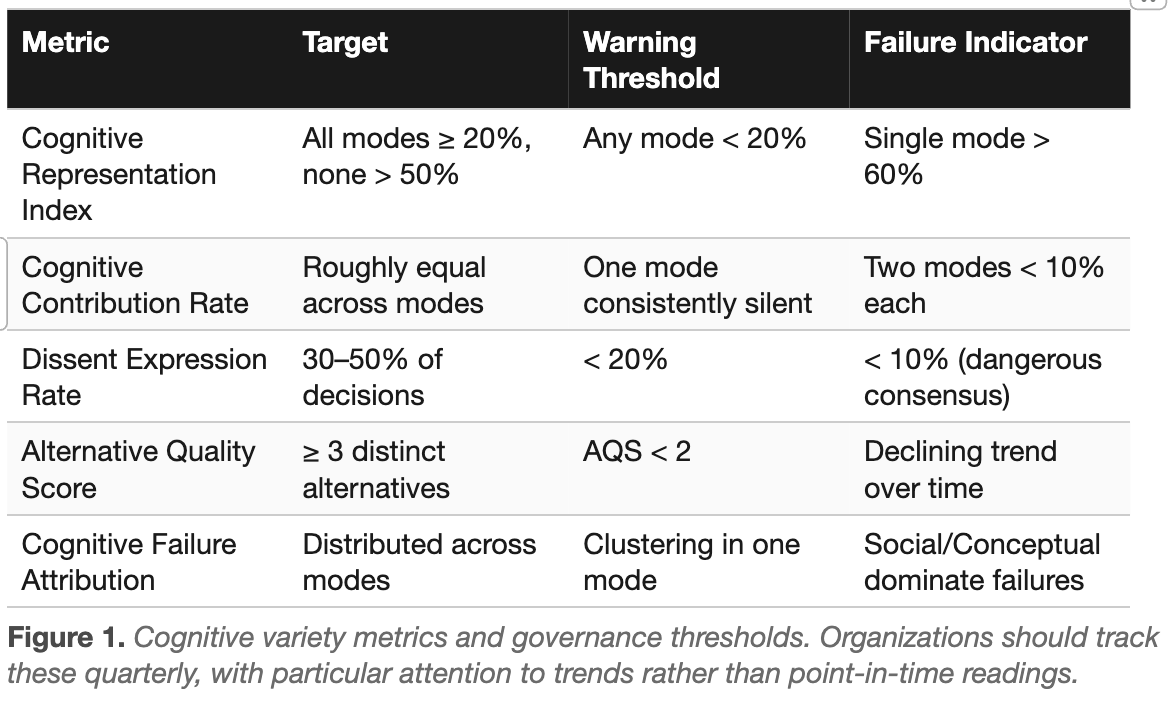
For boards in high-growth ASEAN economies, the cognitive diversity imperative is amplified by regional dynamics. The Stanford AI Index 2026 documents that Southeast Asian countries lead global AI optimism — more than 80 percent of respondents in China, Malaysia, Thailand, Indonesia, and Singapore believe AI will profoundly change their lives within five years. Organizational AI adoption in India, China, Nigeria, the UAE, and Saudi Arabia exceeds 80 percent of employees using AI at work regularly. This adoption pace creates acute pressure on governance architecture.
ASEAN societies are also culturally heterogeneous in ways that make Social and Conceptual cognitive modes particularly vital. Decisions about AI deployment in financial services, public administration, healthcare, and infrastructure carry implications for communities, not just organizations. The ASEAN Guide on AI Governance and Ethics acknowledges this explicitly in its attention to cultural context and stakeholder diversity but translating that acknowledgment into board-level cognitive architecture requires deliberate design, not stated intent.
A third dimension of the governance challenge operates at the level of individual leaders rather than organizational systems. It concerns the relationship between AI-enabled acceleration and the internal architecture of the people directing that acceleration.
The argument is not sentimental. It is structural. AI amplifies whatever capacity already exists in the leader using it. If a leader lacks integrity, AI accelerates fragmentation. If a leader avoids accountability, AI amplifies that abdication. If a leader prioritizes short-term output over long-term consequence, automation increases the speed at which trust erodes. The technology does not create ethical character, but it reveals the character that is already present and magnifies its effects.
This creates a governance vulnerability that no policy framework addresses: the internal architecture of the leaders making AI-influenced decisions. The State of Moral Leadership in Business (2026) reports that most employees do not experience leadership as trustworthy, accountable, or fully responsible and that technology is accelerating the downstream consequences of that deficit.
Two specific risks merit attention in governance design. The first is ethical fading — the gradual drift from 'Is this right?' to 'Is this fast?' that occurs one small decision at a time, each of which removes the weight of consequences slightly further from view. AI's frictionless efficiency is the environmental condition that makes ethical fading most likely; the speed of recommendation removes the reflective pause in which ethical weight is typically felt.
The second risk is cognitive atrophy. When AI performs cognitive work, such as synthesis, analysis, scenario generation, the human neural pathways for that work weaken through disuse. Leaders who routinely defer to AI-generated strategic options lose, over time, the independent generative capacity that makes human judgment valuable. The degradation is gradual and largely invisible until a decision context arises where AI cannot help and the human capacity is no longer reliably available.
The SMARTER Castle Framework, developed through a decade of work in Marine Corps Systems Command, operationalizes human architecture as a governance-visible concept. It maps nine dimensions of how work actually gets done in organizations beyond the org chart, including cognitive processing preferences (Strengths), values that anchor judgment under pressure (Meaning), the relationship between claimed and enacted behavior (Accountability), trust conditions required for cognitive safety (Trust), and the relational networks through which diverse perspectives enter decision processes.
For AI governance purposes, the framework's most important contribution is making visible what is typically assumed: where cognitive diversity actually exists versus where leaders believe it exists, how authority actually flows versus how organizational charts represent it, and where AI is actually influencing decisions versus where leaders think it operates. Governance architecture that is not visible cannot be designed.
The SMARTER framework reveals a disturbing pattern in organizations that believe they have cognitive diversity: the diversity is often nominal, present in titles and backgrounds, but absent from actual deliberative processes where AI outputs frame the decision space before human perspectives engage.
The accountability dimension of the framework is particularly salient. Accountability, in this framework, is not oversight or compliance, it is internal coherence between what a leader claims and how a leader acts, including the downstream and ripple effects of decisions. This definition of accountability as alignment rather than reporting is the kind of governance capacity that no algorithm can substitute for or verify. It must be formed in leaders, not certified by systems.
Boards face a compounded vulnerability in the AI governance transition. Their engagement is episodic with quarterly meetings and limited preparation time, while AI systems are embedded continuously in the management processes they oversee. Management increasingly controls AI-generated board materials, creating information asymmetry with an algorithmic layer. And board composition has not kept pace with the cognitive requirements of AI-era oversight.
The most consequential governance action available to boards is not adopting a new AI policy. It is auditing their own cognitive architecture. This means assessing the actual distribution of cognitive processing modes among board members using validated instruments, establishing minimum representation thresholds in board charters (the white paper recommends no mode below 20 percent, none above 50 percent), and redesigning board meeting facilitation to require documented input from all four cognitive modes before high-consequence votes proceed.
For highest-stakes decisions, boards should require cognitive pre-mortems: structured exercises in which each cognitive mode is asked to articulate the specific failure scenario visible from its perspective. The Analytical lens asks what data assumptions are questionable. The Structural lens asks what implementation constraints are being underestimated. The Social lens asks whose perspective is being discounted. The Conceptual lens asks what paradigm assumption is not being questioned. This process does not guarantee better decisions. It eliminates the most predictable category of architectural failure.
At the executive level, the key governance action is the transition from job descriptions to Cognitive Role Charters. A traditional Chief Strategy Officer role description specifies responsibilities. A Cognitive Role Charter specifies which cognitive mode is the primary responsibility of that role, which cognitive interactions are required with other roles, what AI interaction protocols apply (what the AI can inform, what must remain human-generated), and which cognitive work is explicitly non-delegable: meaning it cannot be outsourced to AI under any operational condition.
This last specification is particularly important. The white paper identifies paradigm evaluation and discontinuity sensing as non-delegable cognitive work for strategic roles — because these are precisely the functions that AI's reliance on historical pattern data structurally cannot perform. Making this explicit in role design prevents the gradual erosion of these capacities through benign neglect rather than deliberate policy.
The BRG and AI Index data converge on a finding that has direct policy implications: the most significant governance failures are not occurring because organizations lack AI policies. They are occurring because organizations lack the internal architecture to implement those policies in ways that preserve genuine human oversight. Policy that mandates outcomes without specifying architectural requirements produces compliance theater — documentation of governance processes that do not reflect how decisions are actually made.
Effective AI governance policy in the next decade will need to specify architectural requirements analogous to those applied in other safety-critical domains: explicit allocation of cognitive functions between human and AI systems, documentation of validation protocols, specification of human capabilities that must be maintained independently of AI support, and evidence of cognitive diversity in decision bodies that have oversight authority.
The divergence between U.S. and EU regulatory approaches documented in both the BRG and AI Index reports is real, but the architectural requirements described here transcend that divergence. Whether an organization operates under the EU AI Act's risk-based framework or within the U.S.'s more decentralized approach, the architectural questions are the same: who evaluates, who judges, who accounts, and what cognitive capacity must remain irreducibly human.
The three frameworks presented in this paper, the Law of Architectural Allocation, the Cognitive Variety Imperative, and the Human Architecture formation model - operate at different levels of organizational life but are mutually reinforcing. The Law establishes the engineering logic: allocation without redesign creates systemic risk. The Cognitive Diversity Imperative names what is specifically at risk: the Social and Conceptual interpretive modes that detect the categories of risk AI most reliably misses. The Human Architecture framework grounds both in the irreducible fact that governance ultimately runs through people, and people require formation, not just frameworks.
The empirical data from Stanford and BRG confirm each framework independently. The compliance-readiness gap confirms the Allocation Law: capability has been introduced without architectural redesign. The clustering of real-world governance failures in Social and Conceptual domains: Intellectual Property (IP), ethics, misinformation, cultural harm, confirms the Cognitive Diversity Imperative. And the declining institutional trust documented across both reports with 31 percent of Americans trust their government to regulate AI responsibly, a historic low, reflects the Human Architecture failure: leaders whose optimization has outpaced their formation.
What the frameworks add to the empirical literature is not more data but a design logic. The Stanford and BRG data tell us that governance is failing. These frameworks tell us the specific mechanism of failure and the specific architectural interventions that address it. Governance can be designed. Architecture can be specified. Character can be formed. None of these are guaranteed outcomes, but all are deliberate ones.
We are in the most accelerated period of organizational AI adoption in history. The generative AI market reached 53 percent population adoption within three years, faster than the personal computer or the internet. U.S. private AI investment reached $285.9 billion in 2025. Organizational adoption has crossed 88 percent. The acceleration is not slowing.
Against this backdrop, the governance frameworks available to organizations remain anchored in a compliance paradigm: policies, charters, audit trails, and regulatory alignment. These are necessary. They are not sufficient. They do not address the architectural question that determines whether governance has any real effect: whether the human decision system surrounding AI has been deliberately designed to preserve the judgment, diversity, and accountability that algorithmic capability cannot provide or replace.
The organizations that will navigate this transition with integrity are not those that adopt AI most aggressively, nor those that resist it most cautiously. They are those that understand the relationship between capability and architecture, and that invest, with the same discipline they apply to technical systems, in designing governance architecture that can carry the weight of what they are deploying.
Technology may expand capability. Architecture determines accountability. This is the governance imperative of the AI era, and it belongs on the agenda of every board, every executive team, and every leader who will be asked in rooms where no algorithm can absorb the moral weight, to sign off on outcomes that affect families, careers, and communities.
ASEAN. (2023). ASEAN guide on AI governance and ethics. Association of Southeast Asian Nations.
Bavuso, C. (2026). Cognitive diversity and the law of architectural allocation: A white paper for organizational leaders. UMANIAMOⓇ.
Bavuso, C. (2026). AI governance in high-growth economies: Why ASEAN boards must think architecturally. UMANIAMOⓇ.
Bavuso, C. (2026). AI: Why optimization is not leadership. Human Architecture Series, UMANIAMOⓇ.
Baverso, P., & Low, A. (2024). SMARTER leadership, human intelligence and AI. Conference Presentation. International Society for Performance Improvement, Phoenix, AZ.
Bazerman, M. H., & Tenbrunsel, A. E. (2011). Blind spots: Why we fail to do what's right and what to do about it. Princeton University Press.
Berkeley Research Group. (2024). Global AI regulation report: Executive perspectives on the emerging global and regional regulatory landscape. BRG.
Brynjolfsson, E., & McAfee, A. (2017). Machine, platform, crowd: Harnessing our digital future. W. W. Norton & Company.
European Commission High-Level Expert Group on Artificial Intelligence. (2019). Ethics guidelines for trustworthy AI. European Commission.
International Organization for Standardization. (2023). ISO/IEC 42001: Artificial intelligence management system — Requirements. ISO.
Kahneman, D. (2011). Thinking, fast and slow. Farrar, Straus and Giroux.
Monetary Authority of Singapore. (2018). Principles to promote fairness, ethics, accountability and transparency (FEAT). MAS.
National Institute of Standards and Technology. (2023). Artificial intelligence risk management framework (AI RMF 1.0). U.S. Department of Commerce.
Page, S. E. (2007). The difference: How the power of diversity creates better groups, firms, schools, and societies. Princeton University Press.
Parasuraman, R., Sheridan, T., & Wickens, C. (2000). A model for types and levels of human interaction with automation. IEEE Transactions on Systems, Man, and Cybernetics, 30(3), 286–297.
Sajadieh, S., Fattorini, L., Perrault, R., et al. (2026). The AI Index 2026 annual report. Stanford Institute for Human-Centered AI.
Tenbrunsel, A. E., & Messick, D. M. (2004). Ethical fading: The role of self-deception in unethical behavior. Social Justice Research, 17(2), 223–236.
World Economic Forum. (2023). Governance framework for responsible artificial intelligence. WEF.
World Economic Forum & McKinsey Health Institute. (2026). The human advantage: Stronger brains in the age of AI.
ABOUT THE AUTHOR
Cosiamo (Peter) Bavuso is the founder of the UMANIAMOⓇ & Humaning and the originator of the SMARTER Castle Framework and REDISCOVER UⓇ. His work integrates human performance architecture, leadership formation, and AI governance, with experience spanning defense acquisition, executive development, and organizational change across Asia-Pacific and North America. He can be reached at cosiamo@umaniamo.org
1 BRG Global AI Regulation Report 2024, p. 5. Survey conducted March–April 2024, n = 214.
2 Stanford AI Index 2026, Chapter 3: Responsible AI, p. 132. Primary source: AI Incident Database (AIID).
3 Parasuraman, Sheridan & Wickens (2000) established the foundational framework for human-automation function allocation in safety-critical systems that informs this analysis.
4 Stanford AI Index 2026, Top Takeaways 8, p. 10. U.S. consumer surplus estimate based on early-2026 survey data.
5 BRG 2024, pp. 15–16. Cross-functional team implementation: 31%; bias-mitigation processes: 29%.