Two Authorities
July 6 - 12, 2026
Formation Library → Sunday Table → Two Authorities
The Edge | Builders at Work
The Sunday Table è scritto in due lingue, inglese e italiano. Per ogni sezione, il testo in inglese è seguito da quello in italiano.
We are Human Together or Not at All.
Cosiamo, Founder UMANIAMO® | Humaning

Davide turns the card over in his hand and feels something tighten, because the word on it is Humility, and humility has been sold to him wrong his whole life.
He knows the version he was handed. Humility means thinking little of yourself. Going last. Taking the blame. Making yourself small so nobody accuses you of thinking you're something. And Davide has done plenty of that… plenty of shrinking, plenty of swallowing what he actually thought and keeping his mouth shut, and it never once felt like a virtue. It felt like disappearing. So the card sits in his hand like a demand he's already tired of.
But that version of humility is a counterfeit, and it's worth seeing that there are actually two counterfeits, not one. There's the loud one, the person who has to be the most important thing in every room, who grasps and proves and competes and can't let a table exist without sitting at the head of it. And there's the quieter one: the person who hides, who buries whatever they're good at, who says oh, I'm not anyone and means it as protection. They look like opposites, the show-off and the self-eraser. They are not. They are the same, but wearing different masks, because both of them are still entirely about you and your standing. One inflates it, one deletes it. Neither has left the subject of themselves.
Real humility is something else, and to get to it you have to understand a thing the world keeps hidden: there are two completely different kinds of authority, and almost everyone confuses them. The first is the authority other people give you: a title, role, or position. It comes with the permission to make the call. We will call it “the office.” It is real, and it matters, and someone has to grant it and it can be taken away as easily as it was given. Most of what we fight over, most of what exhausts us, is this: the scramble for the office, the fear of losing it, the performance required to keep it.
The second kind of authority nobody gave you, and nobody can take. It is the authority of being authored and the quiet weight you carry simply because you were made, on purpose, with gifts written into you by the One who made you, before you had done a single thing to earn or lose them. Your particular wiring, your real strengths, the shape of you that is like no one else's that is not a résumé you built. It is handwriting the Author left in you. And your worth was settled there, at the beginning, and it has never once been up for a vote.
Now humility makes sense, and it turns out to be the exact opposite of shrinking. Humility is simply the truth about where your authority comes from: I did not author myself. My gifts are real so I don't have to hide them, apologize for them, or bury them to seem safe. And my gifts were given so I don't have to grasp, prove, or claw for my worth, because it was never in question. That's the freedom hiding inside the word. The proud man seizes the office because, underneath, he doesn't believe he was authored and he thinks he has to make himself matter. The self-erasing man buries his gifts because he doesn't believe it either; he thinks his safety depends on staying small. Both of them forgot they were made on purpose. Humility is just remembering.
There's a reason the name on the invitation is Davide… you may have heard about his story.
The shepherd boy David was the youngest of his family, so overlooked that when the old prophet came to the house looking for a king, David's own father didn't bother to call him in from the sheep. By every human measure he was passed over: too young, too small, out in the field with the animals. Yet he was chosen anyway because, while people look at the outside, God looks at the heart. David was anointed, named and Authored as a king long before he ever sat on a throne.
And here is the part that is easy to miss, the part that is pure humility: once he was anointed, he still did not grab the crown. He waited years. He had every chance to seize power by force, and refused, again and again, because he understood the two authorities perfectly. He knew he had already been authored for this, that part was settled, from the field, from the anointing. And he knew the office was not yet his to take. So he held the first and let the second come in its own time. That is not a weakness. It is the strongest thing a person can do: to know exactly who you are, and not need to prove it to anyone.
So take the card, Davide. Not as an order to make yourself small but as permission to stop. Stop the exhausting work of making yourself matter, because you already do; you were authored, on purpose, and that was never yours to earn. And stop burying what you were given, because refusing your own gifts isn't humility, it's just fear wearing humility's coat. The genuinely humble thing, the hardest and freest thing, is simply to receive: to look honestly at what the Author wrote in you, say thank you, and live it.
That is what the whole deck is for, in the end. It doesn't ask you to invent yourself or improve yourself. It asks you to do the humble thing to read the hand you were actually dealt, and stop pretending you were dealt another.
And this is why humility and the table belong together, and why there is no head seat at ours. At a real table nobody is ranked. You bring your own chair, your own authored self, and you are honored simply by being added, not by being above. A humble person can hold real authority without poisoning it, because he never believed it was theirs to begin with; they hold it in trust, lightly, and they keep a chair open for the next one. Pride needs the head of the table. Humility already knows there isn't one.
So receive what was given. And then do the humblest thing of all: pull up a chair for someone who is still worn out from trying to prove they matter and let them find out, the way you did, that they were made on purpose, too. What was given, receive it... What you receive, give it in return.
Ad maiorem Dei gloriam. We are human together, or not at all.
Davide gira la carta tra le mani e sente qualcosa stringersi dentro di sé, perché la parola scritta sopra è “Umiltà”, e l’umiltà gli è stata presentata in modo sbagliato per tutta la vita.
Conosce bene la versione che gli è stata propinata. Umiltà significa avere poca stima di sé. Essere l’ultimo. Prendersi la colpa. Rimpicciolirsi affinché nessuno ti accusi di crederti chissà chi. E Davide l’ha fatto in abbondanza… si è rimpicciolito un sacco, ha ingoiato un sacco di volte ciò che pensava davvero e ha tenuto la bocca chiusa, e non gli è mai sembrata una virtù. Gli sembrava di scomparire. Così la carta gli rimane in mano come una pretesa di cui è già stanco.
Ma quella versione di umiltà è una contraffazione, e vale la pena rendersi conto che in realtà ci sono due contraffazioni, non una sola. C’è quella chiassosa, la persona che deve essere la più importante in ogni stanza, che si aggrappa, dimostra, compete e non può lasciare che un tavolo esista senza sedersi a capotavola. E c’è quella più silenziosa: la persona che si nasconde, che seppellisce ciò in cui è brava, che dice «oh, non sono nessuno» e lo intende come una forma di protezione. Sembrano opposti, l’esibizionista e chi si annulla. Ma non lo sono. Sono la stessa cosa, solo che indossano maschere diverse, perché entrambi ruotano ancora interamente intorno a te e alla tua posizione. Uno la gonfia, l’altro la cancella. Nessuno dei due ha abbandonato il tema di sé stesso.
La vera umiltà è un’altra cosa, e per raggiungerla devi comprendere una cosa che il mondo tiene nascosta: esistono due tipi di autorità completamente diversi, e quasi tutti li confondono. La prima è l’autorità che gli altri ti conferiscono: un titolo, un ruolo o una posizione. Comporta il permesso di prendere le decisioni. La chiameremo «la carica». È reale, è importante, qualcuno deve concederla e può essere tolta con la stessa facilità con cui è stata data. La maggior parte di ciò per cui litighiamo, la maggior parte di ciò che ci sfinisce, è proprio questo: la corsa alla carica, la paura di perderla, la performance richiesta per mantenerla.
Il secondo tipo di autorità nessuno te l’ha data, e nessuno può togliertela. È l’autorità di essere stato creato e il peso silenzioso che porti semplicemente perché sei stato creato, di proposito, con doni inscritti in te da Colui che ti ha creato, prima che tu avessi fatto una sola cosa per guadagnarli o perderli. Il tuo modo particolare di essere, i tuoi veri punti di forza, la tua forma che non assomiglia a quella di nessun altro e che non è un curriculum che ti sei costruito. È la calligrafia che l’Autore ha lasciato in te. E il tuo valore è stato stabilito lì, all’inizio, e non è mai stato messo in discussione.
Ora l’umiltà ha senso, e si rivela essere l’esatto opposto del tirarsi indietro. L’umiltà è semplicemente la verità su da dove proviene la tua autorità: non mi sono creato da solo. I miei doni sono reali, quindi non devo nasconderli, scusarmi per essi o seppellirli per sembrare al sicuro. E i miei doni mi sono stati dati, quindi non devo aggrapparmi, dimostrare o lottare per il mio valore, perché non è mai stato messo in discussione. È questa la libertà che si nasconde dentro quella parola. L’uomo orgoglioso si impadronisce della carica perché, nel profondo, non crede di essere stato creato e pensa di doversi rendere importante da solo. L’uomo che si annulla seppellisce i propri doni perché nemmeno lui ci crede; pensa che la sua sicurezza dipenda dal rimanere piccolo. Entrambi hanno dimenticato di essere stati creati a scopo preciso. L’umiltà è semplicemente ricordarsene.
C’è un motivo per cui il nome sull’invito è Davide… forse avete sentito parlare della sua storia.
Il giovane pastore Davide era il più giovane della sua famiglia, talmente trascurato che quando il vecchio profeta venne a casa alla ricerca di un re, lo stesso padre di Davide non si prese nemmeno la briga di chiamarlo via dal gregge. Secondo ogni criterio umano era stato scartato: troppo giovane, troppo piccolo, là fuori nei campi con gli animali. Eppure fu scelto comunque perché, mentre le persone guardano all’apparenza, Dio guarda al cuore. Davide fu unto, nominato e designato come re molto prima ancora di sedersi su un trono.
Ed ecco la parte che è facile trascurare, quella che è pura umiltà: una volta unto, non si impadronì comunque della corona. Attese anni. Avva ogni occasione per prendere il potere con la forza, e rifiutò, più e più volte, perché comprendeva perfettamente le due autorità. Sapeva di essere già stato designato per questo, quella parte era già stabilita, fin dai campi, fin dall’unzione. E sapeva che la carica non era ancora sua da assumere. Così mantenne la prima e lasciò che la seconda arrivasse a tempo debito. Questa non è debolezza. È la cosa più forte che una persona possa fare: sapere esattamente chi sei, senza bisogno di dimostrarlo a nessuno.
Quindi prendi la carta, Davide. Non come un ordine a sminuirti, ma come permesso di fermarti. Smetti di affaticarti nel cercare di dimostrare la tua importanza, perché tu conti già; sei stato creato, di proposito, e questo non è mai stato qualcosa che dovevi guadagnarti. E smetti di seppellire ciò che ti è stato dato, perché rifiutare i propri doni non è umiltà, è solo paura che indossa il mantello dell’umiltà. La cosa veramente umile, la più difficile e la più libera, è semplicemente ricevere: guardare onestamente a ciò che l’Autore ha scritto in te, dire grazie e viverlo.
Ecco a cosa serve, in fin dei conti, l’intero mazzo. Non ti chiede di reinventarti o di migliorarti. Ti chiede di compiere l’atto umile di leggere la mano che ti è stata effettivamente distribuita e smettere di fingere che te ne sia stata distribuita un’altra.
Ed è per questo che l’umiltà e la tavola vanno di pari passo, ed è per questo che alla nostra tavola non c’è un posto d’onore. A un tavolo vero nessuno è classificato. Porti la tua sedia, il tuo io autentico, e sei onorato semplicemente per il fatto di essere incluso, non per essere al di sopra degli altri. Una persona umile può detenere vera autorità senza avvelenarla, perché non ha mai creduto che fosse sua fin dall’inizio; la detiene in fiducia, con leggerezza, e tiene una sedia libera per il prossimo. L’orgoglio ha bisogno del posto a capotavola. L’umiltà sa già che non ce n’è uno.
Quindi accetta ciò che ti è stato dato. E poi fai la cosa più umile di tutte: avvicina una sedia per qualcuno che è ancora sfinito dal tentativo di dimostrare di contare qualcosa e lascia che scopra, proprio come hai fatto tu, che anche lui è stato creato apposta. Ciò che ti è stato dato, accettalo... Ciò che ricevi, restituiscilo.
Ad maiorem Dei gloriam. Siamo umani insieme, oppure non lo siamo affatto.
Humility
This week we invite you to engage not only with the ideas of Humility, but the actions that create these aspects of Humaning.
You may choose one or both of the following practices depending on your setting, time, and relationships.
The Table Discussion is a relaxed and relational conversation designed to help people reflect honestly on the week's REDISCOVER UⓇ theme and the realities of everyday life. It is a shared conversation among family and friends seeking to remain present to one another. The table discussion is not a debate or lesson, it's a discussion of being human together.
After the meal, coffee, or shared gathering:
Read the REDISCOVER UⓇ card and the reflections aloud
Move through the discussion prompts naturally
Allow the conversation to unfold without rushing
Some discussions may be lighthearted, and others may become deeply reflective. It's up to you.
The Humaning Circle is a more intentional relational practice inspired by the spirit of a prayer circle, conversation circle, or community gathering.
Place the REDISCOVER UⓇ card at the center of the table or view the digital card, then invite each person to quietly reflect on the theme together before sharing.
Begin with one slow shared breath and a brief moment of silence.
The Humaning Circle encourages:
DEEP listening
Honest reflection
Relational courage
Shared presence
Each week we pick up one card and turn it to the light. This week's REDISCOVER UⓇ card is Humility and almost everyone has been handed the wrong version of it.
We were taught that humility means thinking little of yourself. Going last. Making yourself small so no one can accuse you of thinking you're something. But that isn't humility; it's just a quieter way of staying stuck on the subject of yourself. There are really two counterfeits, and they look like opposites: the one who has to be the most important thing in every room, and the one who hides and insists I'm nothing. Inflating yourself and deleting yourself are the same move.
Real humility is something freer, and it turns on a truth about authority. There are two kinds. One is the authority other people give you. The other is the authority of being authored, the presence you carry simply because you were made, on purpose, with gifts written into your wiring before you had done anything to earn them. That one was never up for a vote, and no one can revoke it. Humility is simply knowing which is which: I did not author myself. My gifts are real and so I don't have to hide them or apologize for them. And they were given so I don't have to grasp, prove, or audition for my worth, because it was settled at the start.
So when you pick up the Humility card this week, notice what moves in your gut or maybe somewhere else as a feeling… . When you read the words, does it?
Open and feel like a relief, a settling, a quiet yes, I can stop performing now? That is a freedom already alive in you; live from it.
Ache or feel like a tightening, almost a grief, I have spent my whole life reaching up for an approval that never came? That is the buried one, and it is asking to be set down. Or
Remain still, real, but not your center? Honor it, and know it’s a back-up for you.
The humble move and the one where freedom rings true is not to shrink. It is to receive: to read the hand you were actually dealt, say thank you, and live it, while standing on the ground that made you, instead of reaching up toward a ceiling that never says enough.
This week is about humility and the two authorities: the one you have to earn, and the one you were simply given. Bring it to your own table, wherever your people gather, and let the questions move from the reaching to the resting.
Where in your life do you feel like you are always auditioning or performing for an approval that never quite arrives? Whose approval is it? What would it cost to stop?
What if humility isn't thinking little of yourself, but the freedom of knowing your worth was settled before you had done anything, that you were authored, not self-made? What would actually change this week if you believed it?
Name one gift you have quietly buried, maybe because claiming it felt like pride, or because no one around you ever approved of it. What would it look like to receive it, without apology and without grasping?
Think of someone near you who is worn out from trying to prove they are enough. What is one true and generous word you could give them this week not to flatter, but to remind them they were made on purpose?
Sunday Table Invitation. Before moving from one question to the next, make sure everyone has had the chance to speak, especially the children, the teenagers, and the quieter voices. Humility begins where every person already knows they have a place at the table, with nothing to earn.
If young people are present, offer them a notebook and one question to carry: Where do you feel like you have to earn people's approval and what is one thing you're good at that you don't have to earn? Let them keep whatever they want to remember.
Humaning is something we do together, and then carry out the door. This week the circle practices the hardest and freest thing there is - receiving. Gather a few people around the table or in an open space, and take it slowly, in three simple moves.
First, go around once. Each person names one true thing they see in the person to their right, not what they do, not their job or their usefulness, but who they are underneath it: a gift, a strength, a way of being that was clearly written into them. Say it plainly, and mean it.
Then go around again… and this is the hard part. When it is your turn to be spoken about, do not deflect. Do not say oh, it's nothing, or hand the words back, or explain them away. Just receive them. Say, simply: thank you that was given to me. That one sentence is the whole of humility: not denying the gift, and not taking the credit for it, but receiving it from the One who gave it.
Then close with a single question, and let each person answer aloud: Before we gather again, whose approval will I stop auditioning for and whom will I remind that they were made on purpose?
Because the table has done its real work only when it empties when we stop reaching up for approval, stand on the ground that already holds us, and carry that same steadiness out to someone still worn down from trying to prove they are enough. You were authored. So is the person across from you. Receive it, and pass it on. End however your circle ends with a prayer, a blessing, a shared silence. Then go and stand on the foundation authored for you.
Ad maiorem Dei gloriam. We are human together, or not at all.
Questa settimana vi invitiamo a confrontarvi non solo con i concetti di umiltà, ma anche con le azioni che danno vita a questi aspetti dell’“Humaning”.
Potete scegliere una o entrambe le seguenti pratiche a seconda del contesto, del tempo a disposizione e delle relazioni che intrattenete.
La discussione a tavola è una conversazione rilassata e incentrata sulle relazioni, pensata per aiutare le persone a riflettere onestamente sul tema REDISCOVER UⓇ della settimana e sulle realtà della vita quotidiana. È una conversazione condivisa tra familiari e amici che cercano di rimanere presenti gli uni agli altri. La discussione a tavola non è un dibattito né una lezione, ma una riflessione sull’essere umani insieme.
Dopo il pasto, il caffè o un momento di ritrovo in compagnia:
Leggete ad alta voce la scheda REDISCOVER UⓇ e le riflessioni
Passate naturalmente da un spunto di discussione all’altro
Lasciate che la conversazione si sviluppi senza fretta
Alcune discussioni potrebbero essere spensierate, mentre altre potrebbero diventare profondamente riflessive. Dipende da voi.
Il Circolo dell’Essere Umani è una pratica relazionale più intenzionale, ispirata allo spirito di un circolo di preghiera, di conversazione o di incontro comunitario.
Posizionate la scheda REDISCOVER UⓇ al centro del tavolo o visualizzate la scheda digitale, quindi invitate ogni persona a riflettere in silenzio sul tema insieme prima di condividere le proprie riflessioni.
Iniziate con un respiro lento e condiviso e un breve momento di silenzio.
Il Circolo dell’Umanità incoraggia:
L’ascolto PROFONDO
La riflessione onesta
Il coraggio relazionale
La presenza condivisa
Ogni settimana prendiamo una carta e la giriamo verso la luce. La carta REDISCOVER UⓇ di questa settimana è Umiltàe quasi tutti ne hanno ricevuto un’interpretazione errata.
Ci è stato insegnato che umiltà significa avere poca stima di sé. Essere gli ultimi. Rimpicciolirsi affinché nessuno possa accusarti di crederti chissà chi. Ma quella non è umiltà; è solo un modo più discreto di rimanere bloccati sul tema di se stessi. In realtà esistono due contraffazioni, che sembrano opposte: chi deve essere la cosa più importante in ogni stanza e chi si nasconde e insiste: «Non sono niente». Gonfiarsi e annullarsi sono la stessa mossa.
La vera umiltà è qualcosa di più libero, e ruota attorno a una verità sull’autorità. Ce ne sono due tipi. Una è l’autorità che gli altri ti conferiscono. L’altra è l’autorità di essere creato, la presenza che porti con te semplicemente perché sei stato creato, di proposito, con doni inscritti nel tuo essere prima ancora che tu avessi fatto qualcosa per guadagnarteli. Quella non è mai stata sottoposta a votazione, e nessuno può revocarla. L’umiltà è semplicemente sapere quale è quale: Non mi sono creato da solo. I miei doni sono reali e quindi non devo nasconderli né scusarmi per essi. E mi sono stati dati, quindi non devo aggrapparmi, dimostrare o fare un provino per il mio valore, perché era già stato stabilito all’inizio.
Quindi, quando questa settimana peschi la carta dell’Umiltà, nota cosa si muove nel tuo istinto o magari da qualche altra parte come una sensazione… . Quando leggi le parole, succede?
Ti si apre il cuore e provi un senso di sollievo, di serenità, un tranquillo “sì, ora posso smettere di recitare”? Quella è una libertà già viva in te; vivi partendo da essa.
Ti fa male o senti una stretta, quasi un dolore, “ho passato tutta la mia vita a cercare un’approvazione che non è mai arrivata”? Quella è la parte sepolta, e sta chiedendo di essere liberata. Oppure
Rimani immobile, reale, ma non al centro di te stesso? Onoralo, e sappi che è un sostegno per te.
Il gesto umile e quello in cui la libertà risuona autentica non è ritirarsi. È accettare: leggere la mano che ti è stata effettivamente distribuita, dire grazie e viverla, rimanendo con i piedi per terra su quel terreno che ti ha plasmato, invece di protenderti verso un soffitto che non dice mai basta.
Questa settimana si parla di umiltà e delle due autorità: quella che devi guadagnarti e quella che ti è stata semplicemente donata. Portane il tema al tuo tavolo, ovunque si riuniscano i tuoi cari, e lascia che le domande passino dal cercare a dal riposare.
In quale ambito della tua vita ti senti come se fossi sempre in prova o ti esibissi per ottenere un’approvazione che non arriva mai del tutto? Di chi è questa approvazione? Cosa ti costerebbe smettere?
E se l’umiltà non fosse pensare poco di te stesso, ma la libertà di sapere che il tuo valore era già stabilito prima che tu avessi fatto qualsiasi cosa, che sei stato creato, non ti sei fatto da solo? Cosa cambierebbe davvero questa settimana se ci credessi?
Indica un dono che hai seppellito in silenzio, forse perché rivendicarlo ti sembrava orgoglio, o perché nessuno intorno a te lo ha mai approvato. Come sarebbe riceverlo, senza scusarsi e senza aggrapparsi ad esso?
Pensa a qualcuno vicino a te che è sfinito dal cercare di dimostrare di essere all’altezza. Qual è una parola sincera e generosa che potresti dirgli questa settimana, non per adulare, ma per ricordargli che è stato creato apposta?
Invito alla tavola della domenica. Prima di passare da una domanda all’altra, assicurati che tutti abbiano avuto la possibilità di parlare, specialmente i bambini, gli adolescenti e le voci più timide. L’umiltà inizia quando ogni persona sa già di avere un posto a tavola, senza doverlo guadagnarsi.
Se sono presenti dei giovani, offrite loro un quaderno e una domanda da portare con sé: In quali situazioni senti di doverti guadagnare l’approvazione degli altri e qual è una cosa in cui sei bravo senza doverla guadagnare? Lasciate che conservino ciò che vogliono ricordare.
L’Humaning è qualcosa che facciamo insieme e che poi portiamo fuori dalla porta. Questa settimana il cerchio si esercita nella cosa più difficile e più libera che ci sia: ricevere. Radunate alcune persone attorno al tavolo o in uno spazio aperto e procedete con calma, in tre semplici passaggi.
Per prima cosa, fate un giro completo. Ogni persona nomini una cosa vera che vede nella persona alla sua destra: non ciò che fa, né il suo lavoro o la sua utilità, ma chi è sotto sotto: un dono, un punto di forza, un modo di essere che è chiaramente insito in lei. Ditelo chiaramente e con sincerità.
Poi fate di nuovo il giro… ed ecco la parte difficile. Quando è il vostro turno di essere descritti, non sviate l’attenzione. Non dite oh, non è niente, né respingete le parole, né cercate di sminuirle. Accoglietele e basta. Dite semplicemente: grazie per ciò che mi è stato donato. Quella singola frase racchiude tutta l’umiltà: non negare il dono, né attribuirsi il merito, ma accoglierlo da Colui che lo ha dato.
Poi concludete con un’unica domanda, e lasciate che ogni persona risponda ad alta voce: Prima di ritrovarci, per chi smetterò di cercare l’approvazione e a chi ricorderò che è stato creato apposta?
Perché il tavolo ha compiuto la sua vera opera solo quando si svuota, quando smettiamo di cercare l’approvazione, ci affermiamo sul terreno che già ci sostiene e portiamo quella stessa fermezza a qualcuno ancora logorato dal tentativo di dimostrare di essere all’altezza. Sei stato creato. E lo è anche la persona che ti sta di fronte. Accettalo e trasmettilo. Concludi il tuo circolo, qualunque sia la forma che assumerà, con una preghiera, una benedizione, un silenzio condiviso. Poi vai e poggia i piedi sulle fondamenta create apposta per te.
Ad maiorem Dei gloriam. Siamo umani insieme, oppure non lo siamo affatto.
Ad majorem Dei gloriam
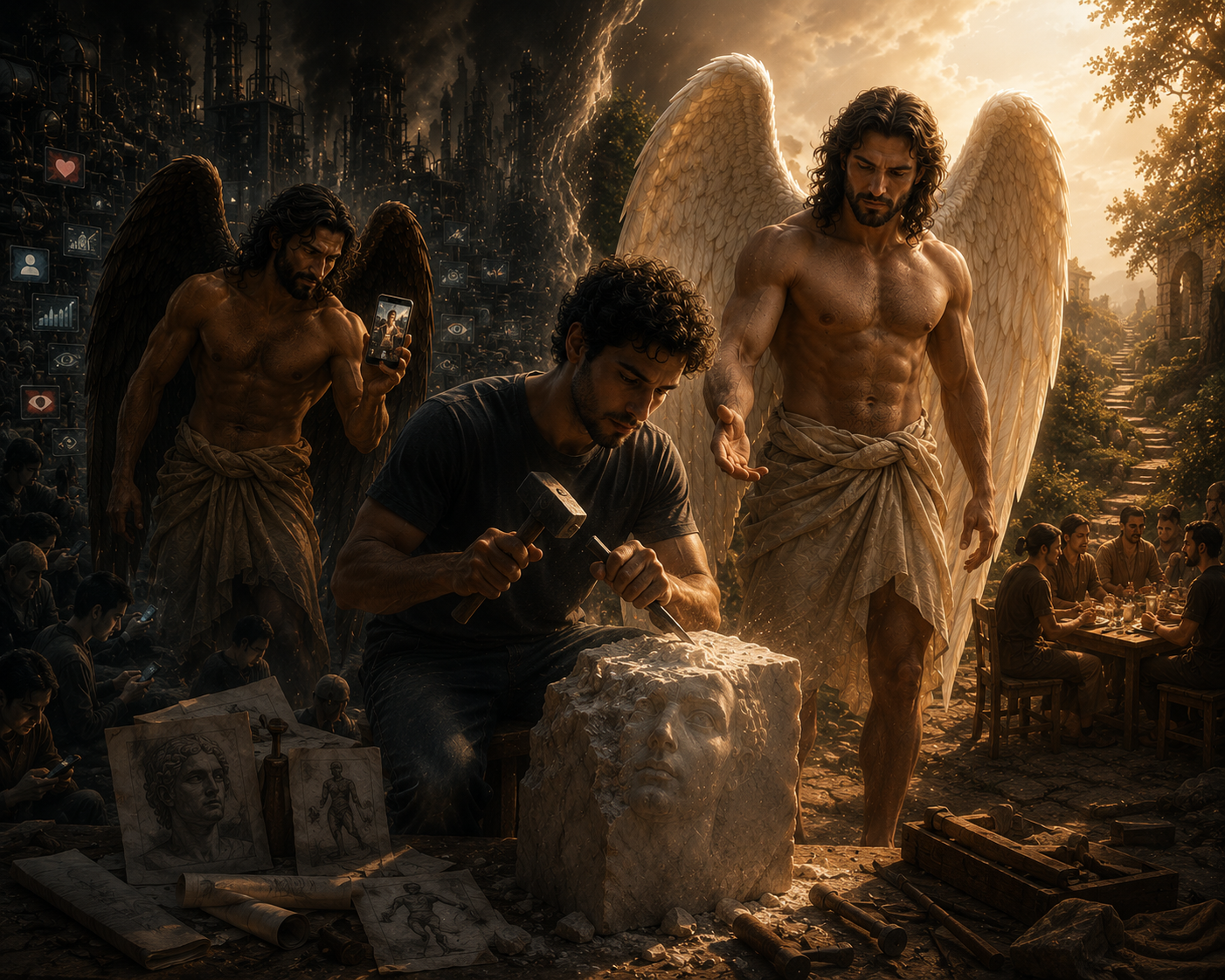
There is a very old question that has and always will follow every human life, though most of us spend years learning how not to hear it. Before we are asked what we do, before we are told who we should become, before anyone measures us, ranks us, markets to us, diagnoses us, recruits us, or places us inside a category, there is a simpler question that waits beneath them all: Who wrote you? Not who raised you, though that matters greatly. Not who shaped your opportunities, your wounds, or your ambitions. Not even who you have decided to become. The deeper question is whether your life is fundamentally something you construct or something you receive. Every civilization answers that question somehow, even when it never asks it aloud.
The modern world has become remarkably efficient at answering it for us. It begins almost immediately. We are profiled before we are understood. We are predicted before we are known. We are categorized before we are encountered. We become consumers, personalities, demographics, political tribes, learning styles, diagnoses, résumés, data points, followers, users, and increasingly, algorithmic probabilities. Each of these descriptions contains a fragment of truth, but none of them can bear the weight of a human life. They describe us from the outside. They cannot explain us from within.
There is a profound difference between being described and being authored.
To be described is to have someone observe what appears to be true about you. To be authored is to have your existence arise from intention before observation. A description can change with circumstance. An authoring precedes every circumstance. One is contingent; the other is ontological. Long before another human being ever assigned us a role, long before society taught us its expectations, before institutions recognized our gifts, before an algorithm learned our preferences, before we ourselves assembled an identity from memory and desire, we were already spoken into being. Christianity has always insisted upon this astonishing claim: that the human person is not an accident searching for meaning but a meaning searching for fulfillment. We are not merely alive. We are called.
This is where Humaning begins.
Humaning is the living awareness that one's dignity, purpose, and judgment originate beyond social assignment, algorithmic prediction, institutional recognition, or self-construction, making discernment possible because there remains an interior reference point that cannot be manufactured externally. Humaning is the act of authoring the authored as authored by the Author. It is not self-creation. It is cooperation. It is the lifelong work of allowing the life that has already been given to become visible in the world. That distinction is worth paying attention to…
The dominant imagination of our age assumes that authenticity means inventing oneself. We are encouraged to curate an identity, assemble a narrative, optimize a personal brand, and continually edit ourselves according to changing circumstances. Freedom becomes the endless possibility of self-construction. Yet there is a quiet exhaustion hidden inside this vision. A self that must constantly create itself can never rest. Every decision becomes another opportunity to become someone else, every failure another threat to the identity under construction. The modern self lives under the impossible burden of being both the author and the manuscript.
Christianity proposes something more liberating. You are not the Author and you never were. Since you are not the Author, you are finally free to become the person who has already been spoken into existence.
Here’s a story…
There was a young stone mason who inherited an unfinished block of marble unlike any he had ever seen. Tied to it was a letter from his father, who had died before the son was old enough to remember him. The letter read...
"Everything you need to know is already inside the stone."
The young man was disappointed. He wanted to know more - what are the instructions, blueprints, diagrams. Instead, he spent years asking every famous sculptor he could find what he should do with the marble. One insisted it should be a sculpture of a king because kings were admired. Another advised carving a soldier because soldiers were respected. A third recommended an athlete because the public loved strength. Each expert offered convincing reasons, and each produced magnificent drawings. The young man collected them all until he had a room full of ideas and yet he hadn’t applied a single strike of the chisel.
One day, exhausted, he transported the marble into the mountains simply to be rid of it for a while. There, in the silence, he remembered the letter. He sat before the stone for days without lifting a tool. Slowly he stopped asking what would impress the sculptors and began asking what the stone itself had been waiting to become. The first strike of the hammer came almost timidly. Then another and another…Years passed.
When the sculpture was finally completed, people traveled from distant cities to admire it. They asked which master had taught him such genius. He simply smiled and answered, "No master taught me this. I just stopped trying to carve everyone else's drawing into my father's stone."
So it is with the human soul.
We spend extraordinary energy carving ourselves according to drawings handed to us by markets, institutions, ideologies, ambitions, fears, and even well-meaning communities. We mistake recognition for vocation. We confuse applause with calling. Yet beneath every borrowed blueprint remains the original stone, patiently waiting for the Author's intention to emerge. Humaning is not the invention of a new sculpture. It is the faithful removal of everything that conceals the one already hidden within.
The great artist has no concept… the best artist has that thought alone which is contained within the marble shell; The sculptor's hand can only break the spell to free the figures slumbering in the stone. Michelangelo 1540 AD
L’essere umano: da autore a opera
C’è una domanda antichissima che ha sempre accompagnato e accompagnerà per sempre ogni vita umana, anche se la maggior parte di noi passa anni a imparare a non sentirla. Prima che ci venga chiesto cosa facciamo, prima che ci venga detto chi dovremmo diventare, prima che qualcuno ci valuti, ci classifichi, ci proponga prodotti, ci dia una diagnosi, ci recluti o ci inserisca in una categoria, c’è una domanda più semplice che giace alla base di tutte queste: Chi ti ha scritto?Non chi ti ha cresciuto, anche se questo conta moltissimo. Non chi ha plasmato le tue opportunità, le tue ferite o le tue ambizioni. Nemmeno chi hai deciso di diventare. La domanda più profonda è se la tua vita sia fondamentalmente qualcosa che costruisci o qualcosa che ricevi. Ogni civiltà risponde in qualche modo a questa domanda, anche quando non la pone mai ad alta voce.
Il mondo moderno è diventato straordinariamente efficiente nel rispondere al posto nostro. E inizia quasi immediatamente. Veniamo profilati prima ancora di essere compresi. Veniamo previsti prima ancora di essere conosciuti. Veniamo classificati prima ancora di essere incontrati. Diventiamo consumatori, personalità, dati demografici, tribù politiche, stili di apprendimento, diagnosi, curriculum, punti dati, follower, utenti e, sempre più spesso, probabilità algoritmiche. Ognuna di queste descrizioni contiene un frammento di verità, ma nessuna di esse può reggere il peso di una vita umana. Ci descrivono dall’esterno. Non possono spiegarci dall’interno.
C’è una profonda differenza tra l’essere descritti e l’essere creati.
Essere descritti significa che qualcuno osservi ciò che sembra vero di te. Essere creati significa che la tua esistenza nasca dall’intenzione prima dell’osservazione. Una descrizione può cambiare a seconda delle circostanze. La creazione precede ogni circostanza. L’una è contingente; l’altra è ontologica. Molto prima che un altro essere umano ci assegnasse un ruolo, molto prima che la società ci insegnasse le sue aspettative, prima che le istituzioni riconoscessero i nostri doni, prima che un algoritmo imparasse le nostre preferenze, prima ancora che noi stessi costruissimo un’identità a partire dalla memoria e dal desiderio, eravamo già stati chiamati all’esistenza. Il cristianesimo ha sempre insistito su questa sorprendente affermazione: che la persona umana non è un caso alla ricerca di un significato, ma un significato alla ricerca di realizzazione. Non siamo semplicemente vivi. Siamo chiamati.
È qui che ha inizio l’Humaning.
L’Humaning è la consapevolezza viva che la propria dignità, il proprio scopo e il proprio giudizio hanno origine al di là dell’assegnazione sociale, della previsione algoritmica, del riconoscimento istituzionale o dell’autocostruzione, rendendo possibile il discernimento perché rimane un punto di riferimento interiore che non può essere fabbricato dall’esterno. L’Humaning è l’atto di creare ciò che è stato creato dall’Autore. Non è autocreazione. È cooperazione. È il lavoro di una vita che consiste nel permettere alla vita che ci è già stata donata di diventare visibile nel mondo. Vale la pena prestare attenzione a questa distinzione…
L’immaginario dominante della nostra epoca presuppone che l’autenticità significhi inventare se stessi. Siamo incoraggiati a curare un’identità, a costruire una narrazione, a ottimizzare un marchio personale e a modificare continuamente noi stessi in base alle circostanze mutevoli. La libertà diventa la possibilità infinita di autocostruzione. Eppure, all’interno di questa visione si nasconde una silenziosa stanchezza. Un sé che deve costantemente creare se stesso non può mai riposare. Ogni decisione diventa un’altra opportunità per diventare qualcun altro, ogni fallimento un’altra minaccia all’identità in costruzione. Il sé moderno vive sotto il peso impossibile di essere sia l’autore che il manoscritto.
Il cristianesimo propone qualcosa di più liberatorio. Tu non sei l’Autore e non lo sei mai stato. Poiché non sei l’Autore, sei finalmente libero di diventare la persona che è già stata chiamata all’esistenza.
Ecco una storia…
C’era un giovane scalpellino che ereditò un blocco di marmo incompiuto, diverso da qualsiasi altro avesse mai visto. Legata ad esso c’era una lettera di suo padre, che era morto prima che il figlio fosse abbastanza grande da ricordarlo. La lettera diceva...
«Tutto ciò che devi sapere è già dentro la pietra.»
Il giovane rimase deluso. Voleva saperne di più: quali fossero le istruzioni, i progetti, gli schemi. Invece, trascorse anni a chiedere a ogni scultore famoso che riusciva a trovare cosa avrebbe dovuto fare con quel marmo. Uno insisteva che dovesse essere la scultura di un re, perché i re erano ammirati. Un altro consigliava di scolpire un soldato, perché i soldati erano rispettati. Un terzo raccomandava un atleta, perché il pubblico amava la forza. Ogni esperto offriva ragioni convincenti e ognuno produceva magnifici disegni. Il giovane li raccolse tutti fino a riempire una stanza di idee, eppure non aveva ancora dato un solo colpo di scalpello.
Un giorno, esausto, trasportò il marmo sulle montagne semplicemente per liberarsene per un po’. Lì, nel silenzio, si ricordò della lettera. Rimase seduto davanti alla pietra per giorni senza sollevare uno strumento. A poco a poco smise di chiedersi cosa avrebbe impressionato gli scultori e cominciò a chiedersi cosa la pietra stessa stesse aspettando di diventare. Il primo colpo di martello arrivò quasi timidamente. Poi un altro e un altro ancora… Passarono gli anni.
Quando la scultura fu finalmente completata, la gente arrivò da città lontane per ammirarla. Gli chiesero quale maestro gli avesse insegnato un tale genio. Lui si limitò a sorridere e rispose: «Nessun maestro mi ha insegnato questo. Ho semplicemente smesso di cercare di scolpire i disegni degli altri nella pietra di mio padre».
Così è anche per l’anima umana.
Spendiamo un’energia straordinaria a scolpire noi stessi secondo i disegni che ci vengono imposti dai mercati, dalle istituzioni, dalle ideologie, dalle ambizioni, dalle paure e persino da comunità benintenzionate. Scambiamo il riconoscimento per vocazione. Confondiamo l’applauso con la chiamata. Eppure, sotto ogni progetto preso in prestito, rimane la pietra originale, che attende pazientemente che emerga l’intenzione dell’Autore. Essere umani non significa inventare una nuova scultura. Significa rimuovere fedelmente tutto ciò che nasconde ciò che è già nascosto all’interno.
Il grande artista non ha alcun concetto… il miglior artista ha solo quel pensiero che è contenuto nel guscio di marmo; la mano dello scultore può solo spezzare l’incantesimo per liberare le figure che dormono nella pietra. Michelangelo, 1540 d.C.

There are people who invent systems, and there are those who witness something so faithfully that others mistake them for the inventors. Ignatius of Loyola belongs to the second kind of person, which is one reason we refer to him as The Builder at Work.
For two weeks now, we have been speaking of Ignatius as The Builder at Work, and that is still true. However, Ignatius was not first the architect of the method that is still used today after almost 500 years. Ignatius of Loyola. was first the witness of the method. He didn’t sit down one day and craft an ambitious plan to design a spiritual technology for the hidden layers of human behavior. He was not building an app or brand, drafting a framework, optimizing human development, or engineering a school of inner enlightenment.
He was a young man broken open physically and psychologically by an injury during battle - a cannonball shattered his old (mask) persona along with his leg. The handsome courtly soldier who had imagined glory through recognition, beauty, status, romance, conquest, and reputation was suddenly rendered “lame” and too damaged to return to his military duties and “playboy” lifestyle. The old Íñigo had stood under the authority of appearance, ambition, noble imagination, and self-authored glory. The wound did not create the original in him, but it broke the copy badly enough that the original could begin to be heard through a more humble voice.
Maybe you have experienced something that stopped you in your tracks - literally - maybe a broken leg, illness, failed class or relationship, but something that forced you to stop. What feels like agony is sometimes how mercy announces itself, not as an excuse but as an interruption or wake up call.
While not a household name, Ignatius is remembered as the founder of the Society of Jesus, more commonly known as the Jesuits. Unlike other Saints that are remembered for contributions in the spiritual and charitable realms, Ignatius is remembered for his impact on the world at large, especially in education. Many famous Universities are part of the Jesuit network to include in the USA, Georgetown University, Fordham University, Boston College, Loyola University of Chicago, and Comillas Pontifical University (Spain) among others.
Ignatius didn’t become a Saint overnight, he began with helplessness, convalescence, boredom, pain, humiliation, and a big imagination. He began where many Builders at Work begin: forced to stop long enough to notice something that had been moving inside him. When he imagined worldly glory, something in him rose for a time and then collapsed into emptiness. When he imagined following Christ and the saints, something in him remained alive afterward. The inner movements were not the same. They had different aftertastes - one inflated and then drained. While the other humbled and strengthened. One belonged to the copy and the other was calling the original. This inner noticing is what ignited what would become known as the Spiritual Exercises still taught to this day. However back then it wasn’t a practice, it was a signal that Ignatius felt lying in a bed.
Later, in Manresa, Spain, Ignatius surrendered his sword and retreated to a cave for almost a year of prayer, fasting, tears, emotional upheaval, consolation, desolation, and surrender, Ignatius did not invent discernment. He underwent it. He became the place where discernment became legible. He entered the dark cave as an Authored man and through that experience he met the Author, and in that meeting something extraordinary happened, his interior life became legible to him.
What’s fascinating about Ignatius’ experience in Manresa, where the Authored met the Author is that he realized that he, himself was not self-authored nor was he the source of authority over the soul. For months he paid attention, suffered honestly, and tested his experiences. He learned that not every light is from God, not every sadness is holy or sinful, not every intensity is truth, not every consolation or expansion points to The Spirit at Work, not every desolation or contraction points to The Devil at Work, not every desire deserves attention, and not every interior voice carries the same authority. Then he wrote down what he had witnessed during his time with the Author, God and his lived experience. The Rules for Discernment were not an invention or even a vision in the modern sense. They were a transcription of the real encounter. Ignatius was writing and reading back what happened in the cave. This is what the true movement felt like. This is what the counterfeit felt like. This is how the soul is drawn. This is how the soul is baited. This is how the enemy (The Devil at Work) of human nature works. This is how God consoles. This is how false consolation disguises itself. This is how desolation narrows, isolates, agitates, and lies. This is how the person returns.
The “genius” of Ignatius was not in his cleverness. It was his fidelity. He paid close enough attention in the presence of the Author to notice his authored self being drawn out, and he was humble enough not to improve the testimony into a performative copy. He watched the interior senses, named them and then gave the world through the Church a way to read what had been authored in each person. The Examen and The Spiritual Exercises, then, are not merely Ignatius’s system. They are Ignatius’s testimony.
The Examen, itself is the daily practice of becoming honest enough to read what the Author has written and what the Devil at Work has tried to confuse. It is not a checklist or some form of religious self-surveillance. It is a return to the interior place where you ask: What moved me today? What drew me toward God? What pushed me away? Where was I alive? Where was I wrong? Where did I cooperate with grace? Where did I resist being restored? And What authority did I obey?
This week we explore the Two Authorities. There is the authority of the copy, and there is the authority of the Author. The copy always tries to speak first. It speaks through ambition, comparison, fear, shame, appetite, image, pride, usefulness, resentment, and control. It tells the person to become an influencer, impressive, safe, legible, employable, desirable, righteous, branded, certain, and untouchable. It says: seize the chair, prove your authority, protect the mask, bury the talent, call the wound your name, and never let the original be seen without armor.
The Author, God, however, speaks differently. The Author does not flatter the false self. He summons the original. He does not erase the wound by pretending it did not happen. He enters the wound and refuses to let it become the origin. He does not tell the person, “You are fine as you are,” if “as you are” means trapped in the copy. He says something more merciful and more terrifying: come out.
Ignatius heard that summons. The cave was not an escape from the world. It was a place where the world’s false authorities were stripped of their costumes. In the cave, rank could not save him. Courtly imagination could not save him. Appearance could not save him. His former ambitions could not save him. Even religious intensity could not save him when it became distorted by anxiety, excess, and self-punishment. Manresa taught him that the spiritual life itself can be captured by the copy if humility is lost. A man can seek holiness and still place himself under the wrong authority. Ignatius had to learn that too. Humility was not an ornament added to his spirituality. Humility was the condition that made discernment possible. Without humility, the person cannot tell the difference between God and the spiritualized ego. Without humility, consolation becomes self-importance. Without humility, desolation becomes identity. Without humility, zeal becomes violence against the soul. Without humility, discipline becomes domination. Without humility, even the cave becomes a stage.
Humility teaches us to know that, I am not the Author, but I have been authored.
The person who is not the Author does not get to invent himself endlessly and call it freedom. But the person who has been authored does not get to disappear and call it virtue. Ignatius shows another way. He does not seize authority over his interior life as if he created it. He receives its legibility. He learns to read the movements because the human person was made for communion with God, and communion requires a signal.
UMANIAMOⓇ has adopted and refined many of Ignatius’ 500 year old practices with some modern insights. We refer to this work as Neuro-Ignatian - not to reduce Ignatius to neuroscience but to understand that the inner movements as felt are part of human neurobiology and that the 3rd Promise of the Humaning Covenant - integrate faith and science allows us to know that what Ignatius’ testimony reveals is that the soul’s movements are not random and that each person has an interior life that can be attended to, interpreted, tested, and formed.
Ci sono persone che inventano sistemi, e ci sono quelle che ne sono testimoni così fedeli da essere scambiate dagli altri per gli inventori. Ignazio di Loyola appartiene alla seconda categoria di persone, ed è questo uno dei motivi per cui lo chiamiamo “Il Costruttore all’opera”.
Da due settimane ormai parliamo di Ignazio come “Il Costruttore al Lavoro”, e questo è ancora vero. Tuttavia, Ignazio non fu innanzitutto l’artefice del metodo che viene ancora utilizzato oggi, dopo quasi 500 anni. Ignazio di Loyola fu innanzitutto il testimone di quel metodo. Non si sedette un giorno a elaborare un piano ambizioso per progettare una tecnologia spirituale destinata agli strati nascosti del comportamento umano. Non stava creando un’app o un marchio, né redigendo un quadro di riferimento, né ottimizzando lo sviluppo umano, né progettando una scuola di illuminazione interiore.
Era un giovane uomo spezzato fisicamente e psicologicamente da una ferita riportata in battaglia: una palla di cannone gli frantumò la sua vecchia persona (maschera) insieme alla gamba. Il bel soldato di corte che aveva immaginato la gloria attraverso il riconoscimento, la bellezza, lo status, il romanticismo, la conquista e la reputazione si ritrovò improvvisamente «zoppo» e troppo menomato per tornare ai suoi doveri militari e al suo stile di vita da «playboy». Il vecchio Íñigo era rimasto sotto l’autorità dell’apparenza, dell’ambizione, dell’immaginazione nobile e della gloria auto-creata. La ferita non ha creato l’originale in lui, ma ha spezzato la copia in modo così grave che l’originale ha potuto cominciare a farsi sentire attraverso una voce più umile.
Forse hai vissuto qualcosa che ti ha bloccato sui tuoi passi – letteralmente – magari una gamba rotta, una malattia, un esame fallito o una relazione finita, ma qualcosa che ti ha costretto a fermarti. Ciò che sembra un’agonia a volte è il modo in cui la misericordia si manifesta, non come una scusa ma come un’interruzione o un campanello d’allarme.
Sebbene non sia un nome molto conosciuto, Ignazio è ricordato come il fondatore della Compagnia di Gesù, più comunemente nota come i Gesuiti. A differenza di altri santi ricordati per i loro contributi in ambito spirituale e caritatevole, Ignazio è ricordato per il suo impatto sul mondo in generale, specialmente nel campo dell’istruzione. Molte università famose fanno parte della rete gesuita, tra cui, negli Stati Uniti, la Georgetown University, la Fordham University, il Boston College, la Loyola University di Chicago e la Pontificia Università di Comillas (Spagna), solo per citarne alcune.
Ignazio non è diventato santo dall’oggi al domani; ha iniziato con un senso di impotenza, convalescenza, noia, dolore, umiliazione e una grande immaginazione. Ha iniziato da dove iniziano molti «Costruttori all’opera»: costretto a fermarsi abbastanza a lungo da notare qualcosa che si stava muovendo dentro di lui. Quando immaginava la gloria mondana, qualcosa in lui si elevava per un po’ per poi crollare nel vuoto. Quando immaginava di seguire Cristo e i santi, qualcosa in lui rimaneva vivo anche dopo. I movimenti interiori non erano gli stessi. Avevano retrogusti diversi: uno lo gonfiava e poi lo svuotava, mentre l’altro lo rendeva umile e lo rafforzava. Uno apparteneva alla copia e l’altro richiamava l’originale. Questa percezione interiore è ciò che ha dato origine a quelli che sarebbero diventati noti come gli Esercizi Spirituali, insegnati ancora oggi. Tuttavia, all’epoca non era una pratica, era un segnale che Ignazio avvertì mentre giaceva a letto.
Più tardi, a Manresa, in Spagna, Ignazio depose la spada e si ritirò in una grotta per quasi un anno di preghiera, digiuno, lacrime, sconvolgimenti emotivi, consolazione, desolazione e abbandono. Ignazio non inventò il discernimento. Lo subì. Divenne il luogo in cui il discernimento si rese leggibile. Entrò nella caverna buia come uomo creato da un Autore e, attraverso quell’esperienza, incontrò l’Autore; in quell’incontro accadde qualcosa di straordinario: la sua vita interiore gli divenne leggibile.
Ciò che affascina dell’esperienza di Ignazio a Manresa, dove l’uomo creato da un Autore incontrò l’Autore, è che egli si rese conto che lui stesso non era autore di sé né era la fonte di autorità sull’anima. Per mesi prestò attenzione, soffrì con sincerità e mise alla prova le sue esperienze. Imparò che non ogni luce proviene da Dio, non ogni tristezza è santa o peccaminosa, non ogni intensità è verità, non ogni consolazione o espansione indica lo Spirito all’opera, non ogni desolazione o contrazione indica il Diavolo all’opera, non ogni desiderio merita attenzione e non ogni voce interiore ha la stessa autorità. Poi mise per iscritto ciò di cui era stato testimone durante il tempo trascorso con l’Autore, Dio, e la sua esperienza vissuta. Le Regole per il Discernimento non erano un’invenzione né tantomeno una visione nel senso moderno del termine. Erano una trascrizione dell’incontro reale. Ignazio stava scrivendo e rileggendo ciò che era accaduto nella grotta. Ecco come si presentava il vero movimento. Ecco come si presentava la contraffazione. Ecco come l’anima viene attirata. Ecco come l’anima viene adescata. Ecco come opera il nemico (il diavolo all’opera) della natura umana. Ecco come Dio consola. Ecco come la falsa consolazione si maschera. Ecco come la desolazione restringe, isola, agita e mente. Ecco come la persona ritorna.
Il «genio» di Ignazio non stava nella sua intelligenza. Stava nella sua fedeltà. Prestò attenzione abbastanza da vicino alla presenza dell’Autore da notare che il suo io creato veniva tirato fuori, ed era abbastanza umile da non trasformare la testimonianza in una copia performativa. Osservò i sensi interiori, li nominò e poi diede al mondo, attraverso la Chiesa, un modo per leggere ciò che era stato creato in ogni persona. L’Esame e gli Esercizi Spirituali, quindi, non sono semplicemente il sistema di Ignazio. Sono la testimonianza di Ignazio.
L’Esame, di per sé, è la pratica quotidiana di diventare abbastanza onesti da leggere ciò che l’Autore ha scritto e ciò che il Diavolo all’opera ha cercato di confondere. Non è una lista di controllo né una forma di autosorveglianza religiosa. È un ritorno al luogo interiore in cui ci si chiede: cosa mi ha mosso oggi? Cosa mi ha avvicinato a Dio? Cosa mi ha allontanato? Dove ero vivo? Dove ho sbagliato? Dove ho collaborato con la grazia? Dove ho opposto resistenza al mio rinnovamento? E a quale autorità ho obbedito?
Questa settimana esploriamo le Due Autorità. C’è l’autorità della copia e c’è l’autorità dell’Autore. La copia cerca sempre di parlare per prima. Parla attraverso l’ambizione, il confronto, la paura, la vergogna, l’appetito, l’immagine, l’orgoglio, l’utilità, il risentimento e il controllo. Dice alla persona di diventare influente, impressionante, sicura, comprensibile, appetibile sul mercato del lavoro, desiderabile, virtuosa, di marca, certa e intoccabile. Dice: impadronisciti della poltrona, dimostra la tua autorità, proteggi la maschera, seppellisci il talento, chiama la ferita con il tuo nome e non lasciare mai che l’originale si mostri senza armatura.
L’Autore, Dio, tuttavia, parla in modo diverso. L’Autore non lusinga il falso sé. Egli evoca l’originale. Non cancella la ferita fingendo che non sia mai esistita. Entra nella ferita e rifiuta di lasciare che essa diventi l’origine. Non dice alla persona: «Va bene così come sei», se «così come sei» significa intrappolato nella copia. Dice qualcosa di più misericordioso e di più terrificante: esci fuori.
Ignazio udì quella chiamata. La grotta non era una fuga dal mondo. Era un luogo in cui le false autorità del mondo venivano spogliate dei loro travestimenti. Nella grotta, il rango non poteva salvarlo. L’immaginario cortese non poteva salvarlo. L’apparenza non poteva salvarlo. Le sue ambizioni passate non potevano salvarlo. Nemmeno l’intensità religiosa poteva salvarlo quando veniva distorta dall’ansia, dall’eccesso e dall’autopunizione. Manresa gli insegnò che la vita spirituale stessa può essere catturata dall’imitazione se si perde l’umiltà. Un uomo può cercare la santità e tuttavia porsi sotto l’autorità sbagliata. Anche questo Ignazio dovette impararlo. L’umiltà non era un ornamento aggiunto alla sua spiritualità. L’umiltà era la condizione che rendeva possibile il discernimento. Senza umiltà, la persona non può distinguere tra Dio e l’ego spiritualizzato. Senza umiltà, la consolazione diventa presunzione. Senza umiltà, la desolazione diventa identità. Senza umiltà, lo zelo diventa violenza contro l’anima. Senza umiltà, la disciplina diventa dominio. Senza umiltà, persino la grotta diventa un palcoscenico.
L’umiltà ci insegna a riconoscere che non sono io l’Autore, ma sono stato creato.
Chi non è l’Autore non può inventarsi all’infinito e chiamarla libertà. Ma chi è stato creato non può scomparire e definirlo virtù. Ignazio mostra un’altra via. Egli non si appropria dell’autorità sulla propria vita interiore come se l’avesse creata lui stesso. Ne accoglie la leggibilità. Impara a leggere i movimenti perché la persona umana è stata creata per la comunione con Dio, e la comunione richiede un segnale.
UMANIAMOⓇ ha adottato e perfezionato molte delle pratiche di Ignazio, vecchie di 500 anni, arricchendole con alcune intuizioni moderne. Ci riferiamo a questo lavoro come «neuro-ignaziano» – non per ridurre Ignazio alle neuroscienze, ma per comprendere che i movimenti interiori così come vengono percepiti fanno parte della neurobiologia umana e che la terza promessa dell’Alleanza Umaning – integrare fede e scienza – ci permette di sapere che ciò che la testimonianza di Ignazio rivela è che i movimenti dell’anima non sono casuali e che ogni persona ha una vita interiore a cui prestare attenzione, che può essere interpretata, verificata e formata.
For the young man who is tired of not being enough

You know the feeling, even if you've never had words for it. Like there's someone up above you that you can never quite satisfy. Like your whole life is an audition for an approval that never really arrives. You perform for it and for your parents, for the boss, for the social media feed, for the room, and some days you perform for God most of all, a kind of authority upstairs who is watching, and measuring, and has somehow never once said enough. You are exhausted, and you can't always say why. This is why… something that was meant to hold you up has been turned over, and now it is pressing you down.
You were built like a tower standing on a foundation. The tower is you and your actual gifts, the particular original version of you that does not exist anywhere else. The foundation, the bedrock the whole thing was meant to rest on, is your relationship with the One who made you. It was supposed to be under your feet, the solid ground, a place to stand, the settled fact of being made on purpose and loved before you'd done a single thing to earn it. From that ground, secure, you were meant to build a life.
It did not flip by accident. This is the work of the one we only ever name by what he does… The Devil at Work, and his whole craft is inversion. He does not invent new lies; he takes what is true and turns it upside down until the foundation becomes a ceiling. He took your real relationship with your real Maker, and simply flipped it over. And when the ground becomes a ceiling, everything inverts with it. Instead of standing on the love that made you, you find yourself reaching up toward an approval you have to win. Instead of being someone who was authored and made deliberately, uniquely, held up, you become someone always auditioning, always missing the mark, always afraid you are not enough. Same relationship with the same God. Turned over. And the difference between them is the difference between being held up and being held down. Now, here is why you never caught on to this inversion, because it is the whole trap.
The Devil at Work has more than one kind of illusion, and they’re not the same. One is the lantern, the glowing sign, the social feed, the thing that shows you exactly what you already want to see. The lantern looks real. But if you stop and listen and check it against your own gut, you’ll notice that it doesn’t feel quite real; there is a hollowness under the glow, a small contraction you can learn to notice. The lantern fools your eyes, but your heart can still catch it.
The inversion is worse though, because the inversion is not a lantern. It is a mirror. And a mirror doesn’t only look real, it feels real. When you stare into the inverted tower and feel the crushing weight of never-enough, that weight does not feel like a lie someone told you. It feels like the deepest, truest, most honest fact about yourself. It feels like your own clear-eyed self-knowledge finally admitting the obvious. That is the genius of The Devil at Work. He captured not just your eyes but your gut, the very parts of you that can tell a truth from a lie. So of course you believed it. It looked and felt real, and what else is there to say, especially when the mirror seems to be everywhere, especially when you open your phone.
This is the trap, you cannot feel your way out of a mirror, because the feeling is the lie. Every instinct you have says trust how it feels but in this case, how it feels is the thing that has been turned upside down. You can feel the shame and the voice of never-enough feels true. The God-who-keeps-score feels true. If you wait until you feel like you're enough before you'll believe it, you will wait forever, because the mirror keeps recording a real feeling long after it has been exposed for what it is.
So the way out is not a better feeling. It is the only truth and the truth has to come from outside the mirror, because everything inside it is only reflection. You need a window. You have to turn away from the reflection that looks and feels so devastatingly real, and toward the One who actually made you, and let Him tell you who you are because your own reflection has been lying to you in a voice that sounds exactly like your own.
And when you turn, the tower rights itself. The foundation drops back to where it belongs, under your feet, not because you suddenly feel it there, but because it was always true, whether or not the feeling has caught up yet. This is the part that finally sets you free, so hold onto it: the ground holds even while the ceiling still feels realer. You get to stand on the truth: you were authored, on purpose, loved before you took your first breath. Then let that truth do its slow work of un-inverting the feeling. The feeling will argue with you for a while. Let it argue. Stand anyway. The ground is real even when the mirror swears it isn't.
Watch what changes as the structure turns over. You stop auditioning and you start building. You stop asking, am I enough and start asking the real question: what was I actually made to be? You stop reaching up for a verdict that never comes and start standing on one that was created in you before you were born. Your worth stops being a case that is always pending and becomes the ground that is already set. And you stop straining to become someone acceptable in another set of eyes, and you become, at last, who you already are… made on purpose, unrepeatable, and free.
So if you have spent your life beneath a ceiling that looks and feels utterly, unarguably real, listen, and don't wait to feel it before you believe it. It was never a ceiling. The Devil at Work turned your foundation upside down and made the lie feel exactly like your own truest thought. But an inversion is still only an illusion, and an illusion breaks the moment you stop staring into the mirror and look through the window instead.
The One you thought was up there keeping score is down here, holding you up and He always was, even on all the days it felt like the opposite. Stop staring at the reflection. Turn. Stand.
You do not have to feel your place to stand on it, just stand anyway.
Ad maiorem Dei gloriam. We are human together — or not at all.
Conosci quella sensazione, anche se non hai mai trovato le parole per descriverla. Come se ci fosse qualcuno lassù che non riesci mai a soddisfare del tutto. Come se tutta la tua vita fosse un’audizione per ottenere un’approvazione che non arriva mai davvero. Ti esibisci per questo e per i tuoi genitori, per il capo, per il feed dei social media, per la stanza, e alcuni giorni ti esibisci soprattutto per Dio, una sorta di autorità lassù che osserva, valuta e che, in qualche modo, non ha mai detto nemmeno una volta «basta». Sei esausto e non sempre riesci a spiegarne il motivo. Ecco perché… qualcosa che avrebbe dovuto sostenerti si è ribaltato e ora ti sta schiacciando.
Sei stato costruito come una torre che si erge su delle fondamenta. La torre sei tu e i tuoi doni autentici, quella versione originale e unica di te che non esiste in nessun altro posto. Le fondamenta, la roccia su cui tutto avrebbe dovuto poggiare, sono il tuo rapporto con Colui che ti ha creato. Avrebbero dovuto essere sotto i tuoi piedi, il terreno solido, un punto d’appoggio, la certezza incrollabile di essere stato creato apposta e amato prima ancora che tu avessi fatto una sola cosa per meritartelo. Da quel terreno, sicuro, avresti dovuto costruire una vita.
Non si è capovolto per caso. Questa è opera di colui che chiamiamo solo in base a ciò che fa… Il Diavolo al lavoro, e tutta la sua arte sta nell’inversione. Non inventa nuove menzogne; prende ciò che è vero e lo capovolge fino a quando le fondamenta diventano un soffitto. Ha preso il tuo vero rapporto con il tuo vero Creatore e l’ha semplicemente capovolto. E quando il terreno diventa un soffitto, tutto si capovolge con esso. Invece di poggiare sull’amore che ti ha creato, ti ritrovi a tendere verso un’approvazione che devi conquistarti. Invece di essere qualcuno che è stato concepito e creato deliberatamente, in modo unico, sostenuto, diventi qualcuno sempre in prova, sempre fuori bersaglio, sempre con la paura di non essere all’altezza. Lo stesso rapporto con lo stesso Dio. Capovolto. E la differenza tra i due è la differenza tra essere sostenuto e essere oppresso. Ora, ecco perché non hai mai colto questa inversione: perché è proprio questa la trappola.
Il Diavolo al lavoro ha più di un tipo di illusione, e non sono tutte uguali. Una è la lanterna, l’insegna luminosa, il feed social, quella cosa che ti mostra esattamente ciò che già vuoi vedere. La lanterna sembra reale. Ma se ti fermi ad ascoltare e la confronti con il tuo istinto, noterai che non sembra del tutto reale; c’è un vuoto sotto quel bagliore, una piccola contrazione che puoi imparare a percepire. La lanterna inganna i tuoi occhi, ma il tuo cuore riesce ancora a coglierla.
L’inversione è però peggiore, perché l’inversione non è una lanterna. È uno specchio. E uno specchio non solo sembra reale, ma sembra anche vero. Quando fissi la torre invertita e senti il peso schiacciante del «non è mai abbastanza», quel peso non sembra una bugia che qualcuno ti ha raccontato. Sembra il fatto più profondo, più vero e più onesto su te stesso. Sembra che la tua lucida conoscenza di te stesso ammette finalmente l’ovvio. Ecco la genialità di «The Devil at Work». Ha catturato non solo i tuoi occhi, ma anche il tuo istinto, proprio quelle parti di te in grado di distinguere la verità dalla menzogna. Quindi, ovviamente, ci hai creduto. Sembrava e si percepiva come reale, e cos’altro c’è da dire, specialmente quando lo specchio sembra essere ovunque, specialmente quando apri il tuo telefono.
Questa è la trappola: non puoi trovare la via d’uscita da uno specchio affidandoti alle sensazioni, perché la sensazione stessa è la menzogna. Ogni tuo istinto ti dice di fidarti di come ti senti, ma in questo caso è proprio quella sensazione ad essere stata capovolta. Puoi sentire la vergogna e la voce del «non sei mai abbastanza» ti sembra vera. Il Dio che tiene il conto ti sembra vero. Se aspetti di sentirti «abbastanza» prima di crederci, aspetterai per sempre, perché lo specchio continua a registrare una sensazione reale anche molto tempo dopo che è stata smascherata per quello che è.
Quindi la via d’uscita non è una sensazione migliore. È l’unica verità e la verità deve venire dall’esterno dello specchio, perché tutto al suo interno è solo riflesso. Hai bisogno di una finestra. Devi distogliere lo sguardo dal riflesso che sembra e si percepisce così devastantemente reale, e volgerlo verso Colui che ti ha realmente creato, e lasciare che sia Lui a dirti chi sei, perché il tuo stesso riflesso ti ha mentito con una voce che suona esattamente come la tua.
E quando ti volti, la torre si raddrizza. Le fondamenta tornano al loro posto, sotto i tuoi piedi, non perché all’improvviso le senti lì, ma perché è sempre stato vero, indipendentemente dal fatto che la sensazione se ne sia ancora resa conto o meno. Questa è la parte che finalmente ti rende libero, quindi aggrappati ad essa: il terreno regge anche se il soffitto sembra ancora più reale. Puoi stare in piedi sulla verità: sei stato creato, di proposito, amato prima ancora di fare il tuo primo respiro. Allora lascia che quella verità compia il suo lento lavoro di raddrizzare la sensazione. La sensazione discuterà con te per un po’. Lasciala discutere. Rimani in piedi comunque. Il terreno è reale anche quando lo specchio giura che non lo è.
Osserva cosa cambia mentre la struttura si capovolge. Smetti di metterti alla prova e inizi a costruire. Smetti di chiederti: «Sono abbastanza?», e inizi a porre la vera domanda: «Per cosa sono stato realmente creato?» Smetterai di cercare un verdetto che non arriva mai e inizierai a poggiare su quello che è stato creato in te prima ancora che nascessi. Il tuo valore smetterà di essere un caso sempre in sospeso e diventerà il terreno già ben saldo. E smetterai di sforzarti di diventare qualcuno di accettabile agli occhi di un altro, e diventerai, finalmente, chi sei già… creato apposta, irripetibile e libero.
Quindi, se hai trascorso la tua vita sotto un soffitto che sembra e appare assolutamente, indiscutibilmente reale, ascolta, e non aspettare di sentirlo prima di crederci. Non è mai stato un soffitto. Il Diavolo al lavoro ha capovolto le tue fondamenta e ha fatto sì che la menzogna ti sembrasse esattamente il tuo pensiero più vero. Ma un capovolgimento rimane comunque solo un’illusione, e un’illusione si spezza nel momento in cui smetti di fissare lo specchio e guardi invece fuori dalla finestra.
Colui che pensavi fosse lassù a tenere il conto è quaggiù, a sostenerti, ed è sempre stato così, anche in tutti quei giorni in cui sembrava il contrario. Smetti di fissare il riflesso. Voltati. Alzati in piedi.
Non devi sentire il tuo posto per starci sopra, basta che ti alzi comunque.
Ad maiorem Dei gloriam. Siamo umani insieme — o non lo siamo affatto.
Small acts to move the world forward

The Magis question this week: Where am I being invited to fill a chair with real authority, whether my own, or someone else's rather than settle for keeping the chair warm…
We all know the Empty Chair. It is not an empty room; it is a chair with a body in it and no power. The seat that supplies a name, a signature, a reassuring presence, while the authority to actually act is quietly held somewhere else. We have all been placed in one. We have all placed someone else in one. So this week, Magis is not more seats, more titles, more visibility. It is the harder and truer thing: real authority, rightly granted and rightly held, ordered to the center. To fill a chair, and not merely occupy it.
Here is the quiet architecture of it: the Six Promises each build one of the conditions that make a person ready to fill a chair. Live them, and you become someone whose seat is not empty.
Before you can fill any chair, you have to be able to see or to notice the flaw, the anomaly, the thing that is off. And you cannot see clearly when you are depleted, numb, and running on output. Care for the whole person is what keeps the instrument of noticing alive.
This week: tend the part of you that notices. Rest and quiet yourself enough to catch the small wrongness you have been too tired to register and when that flicker of something is off rises in a room, do not override it. That flicker is your capacity to see. Care for it as you would any other vital thing.
To empower someone is to help their judgment survive the exact conditions built to crush it — the time pressure, the confident contradiction, the social cost of speaking up. It is giving a person not just a seat, but the strength to keep their sight under fire.
This week: find one person whose good judgment keeps getting worn down — overruled, rushed, quietly punished for raising a hand — and back them out loud, in front of others: "Say that again. I want to hear it." Lend them your standing so that theirs can survive the room.
A chair is only fillable where it is safe to raise a value's concern in a room full of evidence, where challenge and hesitation are not punished. Holding conscience and data together is what makes honest dissent survivable instead of career-ending.
This week: make your table a place where someone can say the uncomfortable true thing and not pay for it. When a concern is raised, especially the inconvenient, conscience-shaped kind, protect the person who raised it before you debate the point.
The empty chair is filled the moment a process is required to stop for the unanswered question. Reflection and discernment are the discipline that refuses to let momentum decide on its own.
This week: before one consequential decision — at work or at home — insist on the pause. Name the question nobody wants to slow down for, and require it answered before the thing rolls forward. That pause, held on purpose, is behavioral authority, exercised.
A judgment, once spoken, has to actually be heard and carried across the group — and that only happens where the quiet, connective, unglamorous work is honored. Service is what lets a true word land instead of vanish.
This week: close a loop. When someone raised something real, go back and tell them what came of it. Honor the unseen work that carries a judgment from one chair to the whole body — the follow-up, the relay, the plain "I heard you, and here is what happened."
The capacity to see is a muscle, and it atrophies the moment the machine, the boss, or the habit of deference which starts doing the judging for you. Growth is the deliberate exercise that keeps it from wasting away before the day you need it.
This week: refuse one easy handoff. One decision you would normally let the tool, the algorithm, or the loudest voice make — make it yourself, slowly, on purpose. Not because you will do it better this time, but because the muscle only holds if you keep using it.
Notice that six Promises have now built six conditions — and one condition still has no Promise beside it. That one is behavioral authority: the actual standing to act on what you see. It is the strangest of them all, because it cannot be grown like a virtue or reached like an insight. You can be wise, formed, and utterly right, and still be the person no one is obliged to hear. Authority is not formed. It is granted.
Which gives this week its sharpest, most uncomfortable edge, because the granting is where usury hides. This week, look hard in two directions. Are you seating someone else in an empty chair — inviting them "for their input" and then talking past them, handing them a title with no teeth, needing their presence but not their power? Then grant them the authority to match their sight, or stop pretending the seat is real. And the harder one: are you sitting, yourself, in a chair where you are spent for your name and denied any power to act — and quietly calling that humility, when it may be extraction? To be seated for your legitimacy and stripped of your voice is not humility. It is being used. Fill the chair, or leave it. Do not let it use you.
Magis is never one more empty chair — never a title without power, never "we need you, just don't get in the way," never a presence spent for the legitimacy it lends. Magis is the real more that appears when someone who can see is finally given the authority to act, and uses it toward the greater good. This week it may look like granting another person real power. It may look like claiming your own. It may look like leaving a seat that was only ever using you. It may look like the pause that saved a decision no one else would stop.
Each night, ask: Where did I fill a chair rather than merely occupy one? Where did I grant someone the authority to match their sight? Where did I refuse to be spent in a seat that was never real?
Carry one question through the week: Where was I seated with real authority today, and where was I only occupying a chair?
Details: Where did I actually sit today? Did I have the power to act, or only the presence?
Evidence: What showed me a chair was empty? Was I invited "for input" and talked past? Did I hand someone a seat and then overrule them?
Empathy: Whom did I sit in an empty chair — needed for their name, denied their voice? Whose true word did I ignore or let vanish?
Prospective: If I keep filling rooms with empty chairs, what am I building — and who is being spent to build it?
Execution: What one act of authority can I grant tomorrow, to another — or claim rightly for myself? Whom will I actually empower to act?
Reflection: Where was God present in the chairs today? Where did I resist granting what was mine to give? Where has the convenience of the seat displaced the center it was meant to serve?
Then the Builder's question: Whose chair did I fill today — and whose did I quietly leave empty? Do not answer to condemn yourself. Answer to keep the keep open.
A chair is only ever empty relative to what it was for. Filled toward the self — toward the name, the title, the convenience, the faction — it becomes a seat of usury, no matter how impressive the occupant. Filled toward the greater glory of God, and toward the person seen through Christ in them — we are human together, or not at all — it becomes at last what it was made to be: a place where the one who can see is trusted to act, for something larger than the seat.
That is the whole of it. Do not merely occupy your life. Fill it with real authority, granted and held in trust, and pointed past yourself.
Ad Majorem Dei Gloriam — the center that fills every empty chair.
Formed at the table. Sent as Builders. We are human together — or not at all.
La domanda Magis di questa settimana: Dove sono invitato a occupare una sedia con vera autorità, sia essa la mia o quella di qualcun altro, invece di accontentarmi di tenerla semplicemente occupata…
Tutti conosciamo la “sedia vuota”. Non è una stanza vuota; è una sedia su cui siede qualcuno, ma che non ha alcun potere. Il posto che fornisce un nome, una firma, una presenza rassicurante, mentre l’autorità di agire concretamente è custodita in silenzio altrove. Tutti ci siamo trovati in una situazione del genere. Tutti abbiamo messo qualcun altro in una situazione del genere. Quindi questa settimana, Magis non significa più posti, più titoli, più visibilità. È la cosa più difficile e più vera: l’autorità reale, giustamente concessa e giustamente esercitata, orientata verso il centro. Riempire una sedia, e non limitarsi a occuparla.
Ecco la sua silenziosa struttura: ciascuna delle Sei Promesse costituisce una delle condizioni che rendono una persona pronta a occupare una poltrona. Vivile, e diventerai qualcuno la cui poltrona non è vuota.
Prima di poter occupare qualsiasi poltrona, devi essere in grado di vedere o notare il difetto, l’anomalia, ciò che non va. E non puoi vedere chiaramente quando sei esausto, intorpidito e vai avanti a forza di sforzo. Prendersi cura della persona nella sua interezza è ciò che mantiene vivo lo strumento della percezione.
Questa settimana: prenditi cura della parte di te che percepisce. Riposa e ritrovati la calma necessaria per cogliere quel piccolo disallineamento che sei stato troppo stanco per notare e, quando in una stanza si manifesta quel barlume di qualcosa che non va, non ignorarlo. Quel barlume è la tua capacità di vedere. Prenditene cura come faresti con qualsiasi altra cosa vitale.
Dare potere a qualcuno significa aiutare il suo giudizio a sopravvivere alle condizioni precise create per schiacciarlo — la pressione del tempo, la contraddizione sicura di sé, il costo sociale di far sentire la propria voce. Significa dare a una persona non solo un posto a sedere, ma la forza di mantenere la propria visione anche sotto attacco.
Questa settimana: trova una persona il cui buon giudizio continua a essere logorato — ignorato, messo in secondo piano, punito silenziosamente per aver alzato la mano — e sostienila ad alta voce, davanti agli altri: «Ripetilo. Voglio sentirlo». Concedile il tuo sostegno affinché la sua posizione possa prevalere nella stanza.
Una posizione può essere sostenuta solo dove è sicuro sollevare una questione di valori in una stanza piena di prove, dove la contestazione e l’esitazione non vengono punite. Tenere insieme coscienza e dati è ciò che rende il dissenso onesto sostenibile, invece che letale per la carriera.
Questa settimana: rendi il tuo tavolo un luogo dove qualcuno possa dire la verità scomoda senza subirne le conseguenze. Quando viene sollevata una questione, specialmente di quelle scomode e dettate dalla coscienza, proteggi chi l’ha sollevata prima di discutere il punto.
La sedia vuota si riempie nel momento in cui si richiede che un processo si fermi per una domanda senza risposta. La riflessione e il discernimento sono la disciplina che rifiuta di lasciare che lo slancio decida da solo.
Questa settimana: prima di una decisione importante — al lavoro o a casa — insistete per fare una pausa. Identificate la domanda per cui nessuno vuole rallentare e pretendete che venga risolta prima che la situazione vada avanti. Quella pausa, voluta di proposito, è autorità comportamentale, esercitata.
Un giudizio, una volta espresso, deve essere effettivamente ascoltato e diffuso all’interno del gruppo — e ciò accade solo dove viene onorato il lavoro silenzioso, di collegamento, poco appariscente. Il servizio è ciò che permette a una parola vera di attecchire invece di svanire.
Questa settimana: chiudete il cerchio. Quando qualcuno ha sollevato una questione reale, tornate da lui e raccontategli cosa ne è stato. Onorate il lavoro invisibile che porta un giudizio da una singola persona all’intero gruppo: il follow-up, la staffetta, il semplice «Ti ho ascoltato, ed ecco cosa è successo».
La capacità di vedere è un muscolo, e si atrofizza nel momento in cui la macchina, il capo o l’abitudine alla deferenza iniziano a giudicare al posto tuo. La crescita è l’esercizio deliberato che impedisce che si atrofizzi prima del giorno in cui ne avrai bisogno.
Questa settimana: rifiuta un passaggio di mano facile. Una decisione che normalmente lasceresti prendere allo strumento, all’algoritmo o alla voce più forte: prendila tu stesso, lentamente, di proposito. Non perché questa volta la farai meglio, ma perché il muscolo si mantiene in forma solo se continui a usarlo.
Notate che sei Promesse hanno ora creato sei condizioni — e una condizione non ha ancora una Promessa accanto. Quella è l’B autorità comportamentaleB : la reale capacità di agire in base a ciò che si vede. È la più strana di tutte, perché non può essere coltivata come una virtù né raggiunta come un’intuizione. Puoi essere saggio, colto e avere assolutamente ragione, eppure rimanere la persona che nessuno è obbligato ad ascoltare. L’autorità non si costruisce. Viene concessa.
Il che conferisce a questa settimana il suo aspetto più tagliente e scomodo, perché è proprio nella concessione che si nasconde l’usura. Questa settimana, guarda attentamente in due direzioni. Stai facendo sedere qualcun altro su una sedia vuota — invitandolo «per il suo contributo» e poi parlando senza tenerne conto, conferendogli un titolo privo di potere, avendo bisogno della sua presenza ma non del suo potere? Allora concedigli l’autorità che corrisponda alla sua visione, oppure smetti di fingere che quel posto sia reale. E la domanda più difficile: sei tu stesso seduto su una sedia dove sei sfruttato per il tuo nome e privato di qualsiasi potere di agire — e chiami silenziosamente ciò umiltà, quando potrebbe trattarsi di sfruttamento? Essere seduti per la propria legittimità ed essere privati della propria voce non è umiltà. È essere strumentalizzati. Riempite la sedia, oppure lasciatela vuota. Non lasciate che sia lei a usare voi.
Il Magis non è mai una sedia vuota in più — mai un titolo senza potere, mai un «abbiamo bisogno di te, ma non intralciarci», mai una presenza sfruttata solo per la legittimità che conferisce. Magis è quel «di più» reale che appare quando a chi è in grado di vedere viene finalmente concessa l’autorità di agire, e la usa per il bene comune. Questa settimana potrebbe significare concedere a un’altra persona un potere reale. Potrebbe significare rivendicare il proprio. Potrebbe significare lasciare un posto che non ha mai fatto altro che usarti. Potrebbe significare quella pausa che ha salvato una decisione che nessun altro avrebbe fermato.
Ogni sera, chiediti: dove ho riempito una sedia invece di limitarmi a occuparla? Dove ho concesso a qualcuno l’autorità commisurata alla sua capacità di vedere? Dove mi sono rifiutato di essere sprecato in un posto che non è mai stato reale?
Porta con te una domanda per tutta la settimana: dove mi sono seduto oggi con vera autorità, e dove stavo solo occupando una sedia?
Dettagli: Dove mi sono effettivamente seduto oggi? Avevo il potere di agire, o solo la presenza?
Evidenza: Cosa mi ha fatto capire che una sedia era vuota? Sono stato invitato “per dare un contributo” e poi ignorato? Ho offerto un posto a qualcuno per poi scavalcarne l’opinione?
Empatia: Chi ho fatto sedere su una sedia vuota — di cui serviva il nome, ma a cui è stata negata la voce? Quale parola sincera ho lasciato svanire in silenzio?
Prospettiva: Se continuo a riempire le stanze di sedie vuote, cosa sto costruendo — e chi viene sacrificato per costruirlo?
Esecuzione: Quale singolo atto di autorità posso concedere domani a un altro — o rivendicare giustamente per me stesso? A chi darò effettivamente il potere di agire?
Riflessione: Dove era presente Dio nelle sedie oggi? Dove mi sono opposto a concedere ciò che era mio diritto dare? Dove la comodità del posto a sedere ha soppiantato il centro che avrebbe dovuto servire?
Poi la domanda del Costruttore: di chi ho riempito la sedia oggi — e di chi l’ho lasciata silenziosamente vuota? Non rispondere per condannarti. Rispondi per mantenere aperto il varco.
Una sedia è vuota solo in relazione a ciò per cui era destinata. Riempita per se stessi — per il nome, il titolo, la comodità, la fazione — diventa un seggio di usura, per quanto impressionante possa essere chi la occupa. Se occupata per la maggiore gloria di Dio, e per la persona vista attraverso il Cristo che è in lei — siamo umani insieme, o non lo siamo affatto — diventa finalmente ciò per cui è stata creata: un luogo in cui a chi è in grado di vedere viene affidato il compito di agire, per qualcosa di più grande del posto stesso.
Questo è tutto. Non limitarti a occupare la tua vita. Riempila di vera autorità, concessa e custodita in fiducia, e rivolta oltre te stesso.
Ad Majorem Dei Gloriam — il centro che riempie ogni sedia vuota.
Formati alla tavola. Inviati come Costruttori. Siamo umani insieme — o non lo siamo affatto.
Cosiamo | Founder, UMANIAMO® | Humaning Architecture

There used to be a recruitment film that ran on late-night television. You may remember it even if you've never worn a uniform. A young man climbs a metal tower and crosses a rotating metal bridge. He makes it to the top of the structure where he locates a sword in stone. He draws the sword from the stone at which point he is consumed in fire and smoke, breathed by a dragon waiting. He fights the dragon and wins at which point he is transformed into a United States Marine.
It's a strange thing to put in a recruiting ad since nobody actually fights a dragon at boot camp. But it worked, and it worked for a reason that had nothing to do with special effects. Every young man watching it already knew, somewhere below language, that becoming a man meant fighting something. The ad didn't invent that instinct. It just gave the instinct a mountain and a sword. Here's what nobody tells you afterward: the dragon doesn't stay on the mountain. It follows you home.
It's just harder to see once the armor comes off and the uniform goes in a box in the closet. The fight doesn't end. It just loses its battlefield. And for a lot of young men now, the dragon has found a new address not a mountain at dawn, but a screen at 2 a.m., lit from inside a room nobody else is awake in.
This is where we meet a man named Michael. Michael is a Marine, a Major, in fact, recently retired from active duty. He knew what it meant to fight something real, on ground you could stand on, with people beside you who'd die for you and you for them. He thought that chapter of his life was finished. He thought the dragon had been dealt with on the mountain, years ago, and that what came after would simply be the rest of an ordinary life.
He was wrong. Not because the old dragon came back. Because he's about to find a newer one… one that doesn't roar or breathe fire, one that doesn't announce itself as an enemy at all. This one is patient and quiet. It has learned exactly what a tired, lonely, twenty-something man will reach for at 2 a.m., and it has gotten very, very good at making sure he keeps reaching. Michael doesn't know it yet but he's about to.
We're not going to tell you the whole story today. Some things are better arriving one week at a time, the way a man's own reckoning usually does. But we wanted you to meet him before the story properly begins, because his name was not chosen carelessly. There has long been a tradition, older than any of us, of a warrior named Michael standing at the edge of something and refusing to let the dragon past him. We didn't invent that either. We just gave it a name you'd recognize.
Somewhere tonight, there is a young man lying awake by lantern-light who has never held a sword and has never needed to. His dragon doesn't wait on a mountain. It waits in a glow he can't quite put down. He is fighting something just as real as anything Michael ever faced and he just doesn't have a name for it yet, and no one has told him it's a fight at all.
Next week, Michael's story begins. So, in a smaller way, so might yours. What dragon have you mistaken for entertainment?
Ad maiorem Dei gloriam. We are human together or not at all.
In the Christian tradition, names carry memory. A name day is not merely a date on a calendar; it is a small act of belonging. It reminds us that faith is not lived in abstraction. It is lived through particular persons, in particular places, with particular gifts, wounds, choices, sacrifices, and forms of courage.
This week’s Onomastici continues our Sunday Table theme: Two Authorities. Each saint helps us ask what authority is shaping the human person. Are we living under fear, domination, appetite, performance, or self-protection? Or are we living under Christ, whose authority restores the original rather than consuming it?
July 13 - Saint Henry
Saint Henry II was emperor, husband, ruler, reformer, and patron of the Church. His life reminds us that earthly authority is not evil in itself, but it must be surrendered, purified, and ordered toward God. Power becomes dangerous when it exists for self-glory. It becomes service only when it recognizes that it is accountable to something higher than itself.
Henry’s witness belongs in this week’s reflection because Two Authorities is not a rejection of authority. It is a discernment of authority. The Builder at Work does not ask whether authority exists; he asks whether it is ordered toward formation, justice, protection, and the greater glory of God.
Humaning Summary: Saint Henry reminds us that leadership must be accountable to God, not appetite, image, or control. To care for the whole person and empower others for a greater purpose, authority must become stewardship rather than domination.
July 14 - Saint Kateri Tekakwitha and Saint Camillus de Lellis
Saint Kateri Tekakwitha, often called the Lily of the Mohawks, stands as a witness to faith, purity, suffering, and cultural crossing. Her life reminds us that holiness is not owned by one people, empire, language, or culture. Christ calls originals from every place, and those originals do not need to become copies of someone else’s world in order to belong to God.
Saint Camillus de Lellis, founder of the Ministers of the Sick, gives the same day another kind of witness. A wounded man, a former soldier with a difficult past, he became a servant of the sick and dying. His life shows that the wound does not have to become the name. What has been disordered can be reordered into mercy.
Together, Kateri and Camillus speak powerfully to UMANIAMO®. One reminds us that the original belongs to God before culture can claim or reject it. The other reminds us that the wound can become a path of service when brought under Christ.
Humaning Summary: Kateri teaches us that no culture owns holiness; Camillus teaches us that no wound has final authority over vocation. Together they remind us that the original is restored not by erasing history, but by allowing grace to form a life from within it.
July 15 - Saint Bonaventure
Saint Bonaventure was a Franciscan theologian, bishop, Doctor of the Church, and one of the great minds of the Western Christian tradition. His theology joined intellect and love, contemplation and service, order and humility. He reminds us that knowledge is not meant to inflate the self but to lead the whole person back to God.
In a week concerned with authority, Bonaventure helps us distinguish wisdom from cleverness. The false authority of the age often uses intelligence to dominate, argue, brand, optimize, or win. Bonaventure represents another way: the mind as a ladder of return, reason as reverence, theology as love seeking understanding.
Humaning Summary: Saint Bonaventure reminds us that intelligence must become worship, not self-glory. To integrate faith and science is to let truth form the whole person, so that knowledge becomes a path toward God and service.
July 16 - Our Lady of Mount Carmel
Our Lady of Mount Carmel draws us into the tradition of prayer, protection, contemplation, and interior belonging. Carmel is a mountain of silence and fire, a place where the soul learns to stand before God without performance. In the Carmelite imagination, Mary is not an abstraction; she is mother, mantle, teacher, and sign of the soul surrendered to God.
This feast fits beautifully with Two Authorities because Mary shows what freedom looks like when fully placed under God. Her “yes” is not passive. It is the strongest human consent in history. She stands under divine authority so completely that her life becomes space for the Word to enter the world.
Humaning Summary: Our Lady of Mount Carmel reminds us that true freedom is not self-possession but surrendered availability. To encourage reflection and discernment is to learn, with Mary, how to stand beneath God’s authority without losing our personhood.
July 17 - Saint Alexius
Saint Alexius is remembered in tradition as a man of renunciation, hiddenness, poverty, and humility. His story has been told in different forms, but the central image remains striking: a person who refuses worldly recognition in order to live more fully under God.
Whether read historically or devotionally, Alexius confronts the modern hunger to be seen, followed, affirmed, and known by the crowd. He asks whether visibility is always a sign of vocation. Sometimes the original is restored not through public display, but through hidden fidelity.
Humaning Summary: Saint Alexius reminds us that the true self does not require constant visibility. To value every act of service means honoring hidden faithfulness, especially when the world only rewards what it can measure, display, and consume.
July 18 - Saint Frederick of Utrecht
Saint Frederick of Utrecht was a bishop and martyr remembered for courage, reform, and fidelity under pressure. He lived in a world where religious authority, political power, and moral conflict were entangled. His witness reminds us that truth often places the Builder at risk when systems prefer silence.
Frederick’s life belongs to the theme of Two Authorities because he shows that spiritual leadership cannot simply mirror political convenience. When authority becomes compromised, someone must be willing to name what is true, even when truth costs something.
Humaning Summary: Saint Frederick reminds us that discernment requires courage. To invite continuous growth means refusing the fixed system when the system demands silence, compromise, or the burial of conscience.
July 19 - Saint Macrina the Younger
Saint Macrina the Younger was a theologian, ascetic, sister of Saints Basil the Great and Gregory of Nyssa, and a profound influence on one of the greatest theological families of the early Church. Her life reminds us that formation often happens quietly through households, conversations, prayer, learning, and disciplined love.
Macrina is especially important because her authority was not primarily institutional. It was formative. She shaped minds, souls, and vocations through wisdom, ascetic discipline, and spiritual motherhood. She reminds us that the most powerful authority is often not the authority that commands from above, but the authority that forms from within.
Humaning Summary: Saint Macrina reminds us that hidden formation can shape history. To empower individuals for a greater purpose is to recognize the spiritual authority of those who form others quietly, faithfully, and deeply.
Closing Humaning Reflection
This week’s saints give us a wide communion of originals: an emperor, an Indigenous Christian witness, a wounded servant of the sick, a theologian, the Mother of God under the title of Carmel, a hidden man of renunciation, a courageous bishop, and a woman whose wisdom formed saints.
Un tempo andava in onda in televisione, a tarda notte, un filmato di reclutamento. Forse lo ricorderete anche se non avete mai indossato un’uniforme. Un giovane si arrampica su una torre metallica e attraversa un ponte metallico girevole. Raggiunge la cima della struttura dove individua una spada conficcata nella roccia. Estrai la spada dalla roccia e in quel momento viene avvolto da fuoco e fumo, sputati da un drago in agguato. Combatte contro il drago e vince, dopodiché si trasforma in un marine degli Stati Uniti.
È una cosa strana da inserire in uno spot di reclutamento, dato che nessuno combatte davvero contro un drago al campo di addestramento. Ma funzionò, e funzionò per una ragione che non aveva nulla a che fare con gli effetti speciali. Ogni giovane che lo guardava sapeva già, in un luogo al di là delle parole, che diventare un uomo significava combattere qualcosa. Lo spot non ha inventato quell’istinto. Ha semplicemente dato a quell’istinto una montagna e una spada. Ecco cosa nessuno ti dice dopo: il drago non rimane sulla montagna. Ti segue a casa.
È solo più difficile da vedere una volta che ci si toglie l’armatura e l’uniforme finisce in una scatola nell’armadio. La lotta non finisce. Perde semplicemente il suo campo di battaglia. E per molti giovani oggi, il drago ha trovato un nuovo indirizzo: non una montagna all’alba, ma uno schermo alle 2 del mattino, illuminato dall’interno di una stanza in cui nessun altro è sveglio.
È qui che incontriamo un uomo di nome Michael. Michael è un marine, un maggiore, per la precisione, recentemente ritiratosi dal servizio attivo. Sapeva cosa significasse combattere qualcosa di reale, su un terreno su cui potevi stare in piedi, con persone al tuo fianco disposte a morire per te e tu per loro. Pensava che quel capitolo della sua vita fosse chiuso. Pensava che il drago fosse stato sconfitto sulla montagna, anni fa, e che ciò che sarebbe seguito sarebbe stato semplicemente il resto di una vita normale.
Si sbagliava. Non perché il vecchio drago fosse tornato. Ma perché sta per trovarne uno nuovo… uno che non ruggisce né sputa fuoco, uno che non si annuncia affatto come un nemico. Questo è paziente e silenzioso. Ha imparato esattamente a cosa ricorrerà un ventenne stanco e solo alle 2 del mattino, ed è diventato molto, molto bravo ad assicurarsi che lui continui a ricorrervi. Michael ancora non lo sa, ma sta per scoprirlo.
Oggi non vi racconteremo tutta la storia. Alcune cose è meglio che arrivino una settimana alla volta, proprio come di solito avviene per la resa dei conti di un uomo. Ma volevamo che lo conoscesse prima che la storia inizi davvero, perché il suo nome non è stato scelto a caso. Esiste da tempo una tradizione, più antica di chiunque di noi, che narra di un guerriero di nome Michael in piedi sull’orlo di qualcosa, che si rifiuta di lasciar passare il drago. Non l’abbiamo inventata nemmeno noi. Le abbiamo solo dato un nome che potreste riconoscere.
Da qualche parte, stanotte, c’è un giovane che giace sveglio alla luce di una lanterna, che non ha mai impugnato una spada e non ne ha mai avuto bisogno. Il suo drago non lo aspetta su una montagna. Lo attende in un bagliore che non riesce a scrollarsi di dosso. Sta combattendo contro qualcosa di altrettanto reale quanto qualsiasi cosa Michele abbia mai affrontato, ma non ha ancora un nome per definirlo, e nessuno gli ha detto che si tratta di una battaglia.
La prossima settimana inizia la storia di Michele. E così, in misura minore, potrebbe iniziare anche la tua. Quale drago hai scambiato per divertimento?
Ad maiorem Dei gloriam. Siamo umani insieme o non lo siamo affatto.
Nella tradizione cristiana, i nomi portano con sé la memoria. Un onomastico non è solo una data sul calendario; è un piccolo atto di appartenenza. Ci ricorda che la fede non si vive in astratto. Si vive attraverso persone concrete, in luoghi concreti, con doni, ferite, scelte, sacrifici e forme di coraggio concreti.
Gli Onomastici di questa settimana proseguono il tema della nostra «Tavola domenicale»: Due autorità. Ogni santo ci aiuta a chiederci quale autorità stia plasmando la persona umana. Viviamo sotto il dominio della paura, del dominio altrui, dell’appetito, della prestazione o dell’autoprotezione? Oppure viviamo sotto Cristo, la cui autorità ripristina l’originale anziché consumarlo?
13 luglio - San Enrico
San Enrico II fu imperatore, marito, sovrano, riformatore e patrono della Chiesa. La sua vita ci ricorda che l’autorità terrena non è di per sé un male, ma deve essere affidata, purificata e orientata verso Dio. Il potere diventa pericoloso quando esiste per la propria gloria. Diventa servizio solo quando riconosce di dover rendere conto a qualcosa di più alto di sé.
La testimonianza di Enrico trova spazio nella riflessione di questa settimana perché Due autorità non è un rifiuto dell’autorità. È un discernimento dell’autorità. Il Costruttore all’opera non si chiede se l’autorità esista; si chiede se sia orientata verso la formazione, la giustizia, la protezione e la maggiore gloria di Dio.
Sintesi di “Humaning”: San Enrico ci ricorda che la leadership deve rendere conto a Dio, non all’avidità, all’immagine o al controllo. Per prendersi cura della persona nella sua interezza e responsabilizzare gli altri verso uno scopo più grande, l’autorità deve diventare amministrazione piuttosto che dominio.
14 luglio - Santa Kateri Tekakwitha e San Camillo de Lellis
Santa Kateri Tekakwitha, spesso chiamata il Giglio dei Mohawk, è testimone di fede, purezza, sofferenza e incontro tra culture. La sua vita ci ricorda che la santità non è appannaggio di un solo popolo, impero, lingua o cultura. Cristo chiama persone autentiche da ogni luogo, e queste persone autentiche non hanno bisogno di diventare copie del mondo di qualcun altro per appartenere a Dio.
San Camillo de Lellis, fondatore dei Ministri dei Malati, offre lo stesso giorno un’altra forma di testimonianza. Uomo ferito, ex soldato con un passato difficile, è diventato servitore dei malati e dei morenti. La sua vita dimostra che la ferita non deve necessariamente diventare l’identità. Ciò che è stato sconvolto può essere ricomposto nella misericordia.
Insieme, Kateri e Camillo parlano con forza a UMANIAMO®. L’una ci ricorda che l’originale appartiene a Dio prima che la cultura possa rivendicarlo o rifiutarlo. L’altro ci ricorda che la ferita può diventare un cammino di servizio quando viene sottomessa a Cristo.
Sintesi di Humaning: Kateri ci insegna che nessuna cultura possiede la santità; Camillo ci insegna che nessuna ferita ha autorità definitiva sulla vocazione. Insieme ci ricordano che l’originale viene restaurato non cancellando la storia, ma permettendo alla grazia di plasmare una vita a partire da essa.
15 luglio - San Bonaventura
San Bonaventura fu un teologo francescano, vescovo, Dottore della Chiesa e una delle grandi menti della tradizione cristiana occidentale. La sua teologia univa intelletto e amore, contemplazione e servizio, ordine e umiltà. Egli ci ricorda che la conoscenza non ha lo scopo di gonfiare l’ego, ma di ricondurre l’intera persona a Dio.
In una settimana dedicata al tema dell’autorità, Bonaventura ci aiuta a distinguere la saggezza dall’astuzia. La falsa autorità del nostro tempo spesso usa l’intelligenza per dominare, discutere, etichettare, ottimizzare o vincere. Bonaventura rappresenta un’altra via: la mente come scala di ritorno, la ragione come riverenza, la teologia come amore alla ricerca della comprensione.
Sintesi di Humaning: San Bonaventura ci ricorda che l’intelligenza deve diventare adorazione, non auto-glorificazione. Integrare fede e scienza significa lasciare che la verità plasmi la persona nella sua interezza, affinché la conoscenza diventi un cammino verso Dio e il servizio.
16 luglio - Madonna del Monte Carmelo
La Madonna del Monte Carmelo ci introduce nella tradizione della preghiera, della protezione, della contemplazione e dell’appartenenza interiore. Il Carmelo è una montagna di silenzio e di fuoco, un luogo dove l’anima impara a stare davanti a Dio senza artifici. Nell’immaginario carmelitano, Maria non è un’astrazione; è madre, mantello, maestra e segno dell’anima abbandonata a Dio.
Questa festa si inserisce perfettamente nel tema Due autorità perché Maria mostra come si presenta la libertà quando è pienamente posta sotto Dio. Il suo «sì» non è passivo. È il consenso umano più forte della storia. Ella si pone sotto l’autorità divina in modo così completo che la sua vita diventa lo spazio in cui il Verbo entra nel mondo.
Sintesi di Humaning: Nostra Signora del Monte Carmelo ci ricorda che la vera libertà non è il possesso di sé, ma la disponibilità nell’abbandono. Incoraggiare la riflessione e il discernimento significa imparare, con Maria, a porsi sotto l’autorità di Dio senza perdere la nostra identità personale.
17 luglio - Sant’Alessio
Sant’Alessio è ricordato nella tradizione come un uomo di rinuncia, di vita nascosta, di povertà e di umiltà. La sua storia è stata raccontata in diverse forme, ma l’immagine centrale rimane suggestiva: una persona che rifiuta il riconoscimento mondano per vivere più pienamente sotto Dio.
Sia che la si legga in chiave storica o devozionale, la figura di Alessio si contrappone alla moderna fame di essere visti, seguiti, apprezzati e conosciuti dalla folla. Egli si chiede se la visibilità sia sempre un segno di vocazione. A volte l’essenza autentica viene ripristinata non attraverso l’ostentazione pubblica, ma attraverso la fedeltà nascosta.
Sintesi di Humaning: Sant’Alessio ci ricorda che il vero sé non ha bisogno di visibilità costante. Dare valore a ogni atto di servizio significa onorare la fedeltà nascosta, specialmente quando il mondo premia solo ciò che può misurare, mostrare e consumare.
18 luglio - San Federico di Utrecht
San Federico di Utrecht fu un vescovo e martire ricordato per il coraggio, le riforme e la fedeltà sotto pressione. Visse in un mondo in cui l’autorità religiosa, il potere politico e il conflitto morale erano intrecciati. La sua testimonianza ci ricorda che la verità spesso mette a rischio il Costruttore quando i sistemi preferiscono il silenzio.
La vita di Federico rientra nel tema delle Due autorità perché dimostra che la leadership spirituale non può limitarsi a rispecchiare la convenienza politica. Quando l’autorità viene compromessa, qualcuno deve essere disposto a dire la verità, anche quando la verità ha un costo.
Sintesi di Humaning: San Federico ci ricorda che il discernimento richiede coraggio. Invitare alla crescita continua significa rifiutare il sistema rigido quando esso esige silenzio, compromessi o la soppressione della coscienza.
19 luglio - Santa Macrina la Giovane
Santa Macrina la Giovane fu teologa, asceta, sorella dei santi Basilio il Grande e Gregorio di Nissa, e esercitò una profonda influenza su una delle più grandi famiglie teologiche della Chiesa primitiva. La sua vita ci ricorda che la formazione spesso avviene silenziosamente attraverso la vita familiare, le conversazioni, la preghiera, l’apprendimento e l’amore disciplinato.
Macrina è particolarmente importante perché la sua autorità non era principalmente istituzionale. Era formativa. Ha plasmato menti, anime e vocazioni attraverso la saggezza, la disciplina ascetica e la maternità spirituale. Ci ricorda che l’autorità più potente spesso non è quella che comanda dall’alto, ma quella che forma dall’interno.
Sintesi di Humaning: Santa Macrina ci ricorda che la formazione nascosta può plasmare la storia. Dare forza alle persone per uno scopo più grande significa riconoscere l’autorità spirituale di coloro che formano gli altri in modo silenzioso, fedele e profondo.
Riflessione conclusiva di Humaning
I santi di questa settimana ci offrono un’ampia comunione di figure originali: un imperatore, una testimone cristiana indigena, un servitore ferito al servizio dei malati, un teologo, la Madre di Dio sotto il titolo del Carmelo, un uomo nascosto nella rinuncia, un vescovo coraggioso e una donna la cui saggezza ha formato dei santi.