Sword & Shield Wall
September 7-13, 2026
Formation Library → Sunday Table → Sword & Shield Wall
Builders at Work
The Sunday Table è scritto in due lingue, inglese e italiano. Per ogni sezione, il testo in inglese è seguito da quello in italiano.
We are Human Together or Not at All.
Cosiamo | Founder, UMANIAMO® | Humaning Architecture
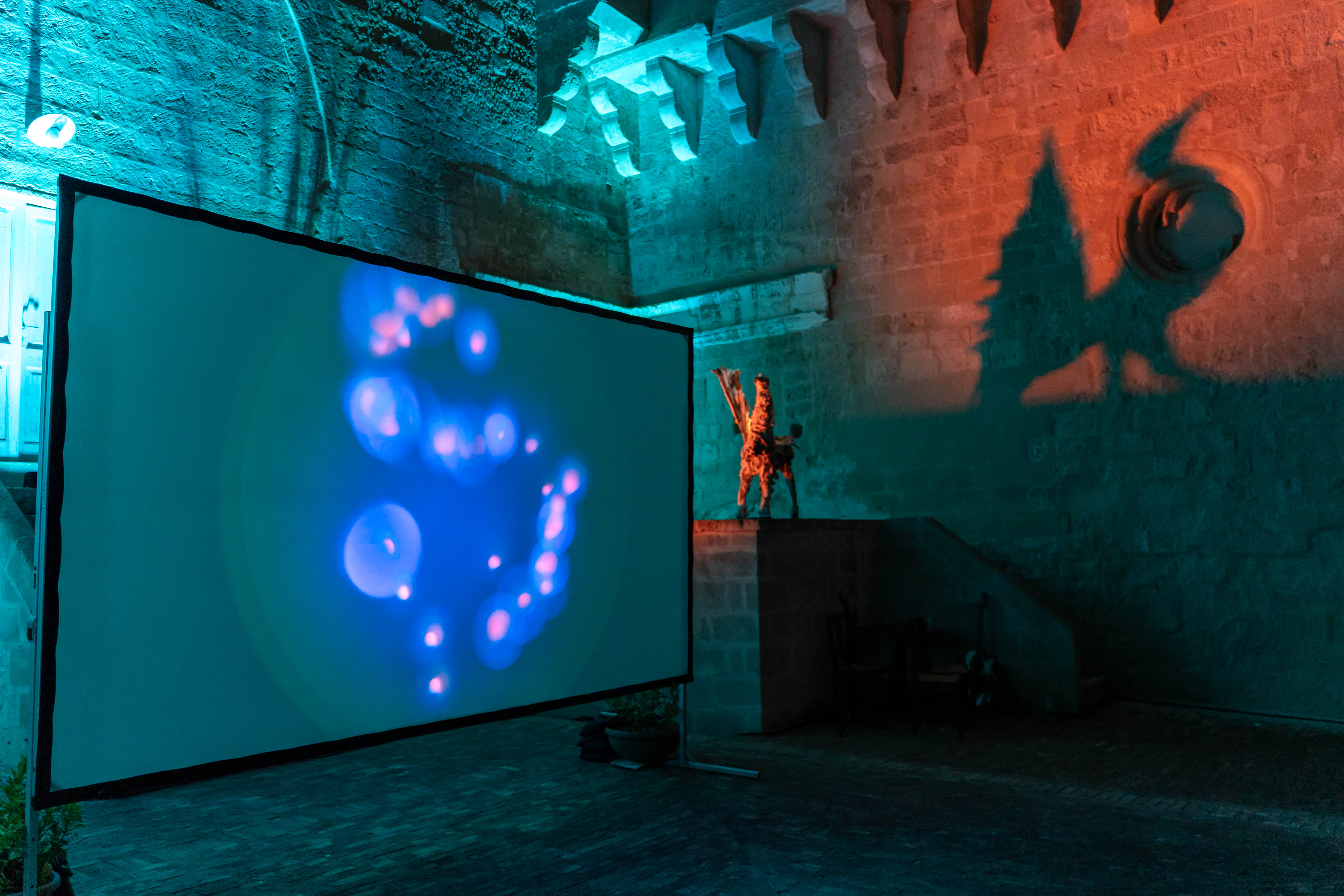
At the UMANIAMO® Festival in Matera in 2024, I invited participants into an experience that I imagined at the time as an exploration of individual and group coherence. Using HeartMath® Inner Balance sensors and the Global Coherence application loaded to each person’s mobile phone, we received live coherence data from people gathered in an ancient space. On a large screen, each participant appeared as a colored sphere whose size, movement, and proximity to the others changed as the incoming data changed. The larger visual field was set to the Schumann Resonance, placing those individual representations within a common environmental frame much like all of us that live our lives in the same common frame of resonance.
What appeared on the screen was not a scorecard, personality profile, or competition. People were seeing representations of themselves within a living energetic field. One sphere might move closer to another while another expanded, contracted, or moved differently. The pattern continued to change, yet no individual sphere disappeared into the group. Each remained visibly distinct while participating in something larger than itself.
That experience has stayed with me because, looking back, I think Matera was showing us an architecture that I didn’t really have words to describe. I knew what it felt like to be there, I could explain it technically but the deeper meaning was obscured.
Back then I had no foresight that what would evolve are now what we discuss in the Sunday Table and in the larger work of UMANIAMO®, We are human together or not at all. The Shield Wall, Relational Safety, Relational Sustainment, or the First Line of Defense were not part of our vocabulary. While we introduced REDISCOVER U® at the UMANIAMO® Festival, we had not yet described the Michaelic Sword as the discernment between illumination and illusion, nor had we fully understood REDISCOVER U® as the recognition of the Authored person that must precede discernment. Yet something of all of them was already visible.
Interestingly the most important feature of the visualization was what didn’t happen: the spheres never became one sphere. Coherence did not require sameness, assimilation, or the disappearance of the individual. Each participant remained an original while becoming visible within the relationship. Much like the people on the lawn, each individual Authored person shared a common experience that no-one else had ever been able to see before.
That is very close to what we mean by Humaning. The Authored person exists in an irreducible relationship with the Author, yet that relationship does not isolate us from one another. It makes righteous relationship with one another possible. Because I am Authored and you are Authored, the relationship between us exists within something neither of us invented and neither of us can possess. Each Chair remains uniquely occupied by the Authored person facing the Author, while the Table becomes the place where those persons encounter one another. We are distinct without being solitary and relational without becoming absorbed.
Seen from here, the HeartMath® visualization was making one layer of that architecture perceptible. It gave us a representation of the condition in which people were present to one another. Attention, intention, physiological regulation, perception, and response were not abstractions; they were occurring in embodied persons and changing over time. The sensors didn't create this inner technology. They allowed us to see traces of something already designed into the humaned person.
That distinction matters because the most remarkable technology in the room was not the sensor or the screen. It was the humaned person.
The Author had already given us heartbeat, breath, attention, memory, perception, gesture, voice, conscience, cognition, and the capacity to become relationally perceptible to another humaned person. What happens within us changes how we become present to others, just as relationships can affect the conditions under which we attend, interpret, regulate, and respond. The Matera experience allowed us to watch a representation of that movement.
REDISCOVER U® gives us another way to make the invisible visible.
The Cards don’t manufacture strengths or assign identities. They help us recognize something of what is already Authored into a particular person: character strengths, cognitive attributes, behavioral tendencies, and recurring ways of meeting the world where you are. If the HeartMath experience gave us a glimpse of the state of the person in relationship, REDISCOVER U® helps reveal something of the design the person brings into that relationship.
That makes REDISCOVER U® part of the First Line of Defense because discernment needs a directional signal. Before I can distinguish illumination from illusion, I need enough knowledge of my Authored nature to notice whether something is resonating with what is genuinely mine or merely exploiting what is familiar to me. A strength may open with the quiet recognition of something that feels deeply natural. Another may ache because it has been buried or neglected. Another may remain quiet because, although available, it is not central to the way I naturally move through life.
These signals are not infallible instructions, but they give us something more substantial to work from than the identities continually assigned by employers, platforms, markets, ideologies, influencers, or machines. REDISCOVER U® does not tell the person who to become. It helps the person recognize more clearly who is already there.
This is where the Shield Wall begins to emerge from the Matera image. A Shield Wall is not formed by making everyone alike. Its strength comes from distinct humaned persons knowing what they carry and understanding how their position affects the people beside them. One person may bring Bravery and Moral Valour, another Prudence, another Social Intelligence, Self-Control, Curiosity, or a strongly Analytical, Structural, Social, or Conceptual way of thinking. Humaning does not flatten those differences. It helps us bring them into righteous relationship.
The REDISCOVER U® Cards therefore become more than a language of self-discovery. They become a language of relational architecture. They allow us to ask what a strength looks like when it is rightly ordered, how it changes when it overextends, what another person experiences when they encounter it, and which strengths in the people beside us allow the whole relationship to see something that no one person could see alone.
This matters because we now live inside an extraordinary volume of speculation about who we are. Influencers tell us what deserves our attention and what kind of life we should want. Algorithms infer what we are likely to prefer. Employers define valuable capacities. Ideologies organize identities and enemies. Platforms reward whichever version of us produces engagement, while artificial intelligence can generate increasingly persuasive interpretations of our patterns, motives, risks, and likely behavior.
Some of this can be useful. Much of it is noise, and some of it becomes what we have called the hypnotic lantern of the Devil at Work: partial truth, emotional cue, seductive fluency, urgency, certainty, grievance, and repetition moving back and forth before the mind until our attention follows the lantern rather than remaining oriented toward the Author.
The deeper danger is therefore not merely misinformation. It is displaced attention.
Knowing more of the Authored self does not make us immune to influence, but it gives us a more trustworthy place from which to test what arrives at the field of our attention. The person who recognizes their own strengths and tendencies can begin asking whether a message illuminates something true or merely flatters a preferred strength, whether a relationship increases capacity or quietly builds dependency, whether someone sees the whole person or rewards only the version useful to them, and whether a technology extends human capability or gradually replaces the capabilities required for judgment. That is the work of the Michaelic Sword.
The Shield Wall represents the relational architecture among distinct Authored persons; the Sword represents the discernment necessary to protect that architecture from illusion. Yet neither the Cards nor coherence data can do that work for us. A person can know their strengths and still misuse them. A physiologically coherent person can still make mistakes. An entire group can feel deeply connected and still move together toward the cliff of illusion.
The First Line of Defense is therefore not a profile, card, score, feeling, or signal. It is the humaned person capable of receiving those signals, testing them, and remaining oriented toward the Author.
The Six Promises give us evidence of whether that discernment has actually become illumination in relationship:
Care for the Whole Person resists reduction. Empower Individuals for a Greater Purpose protects agency. Integrate Faith and Science keeps truth from being fragmented. Encourage Reflection and Discernment preserves the space required for conscience. Value Every Act of Service recognizes what systems often make invisible. Invite Continuous Growth refuses to freeze a person inside a convenient identity. Where these become visible in behavior, the Shield Wall strengthens because illumination has moved beyond insight and entered relationship.
Seen this way, what happened in Matera was more than an innovative visualization of coherence. We were watching an early representation of the relational architecture we are only now learning to name. Distinct humaned persons remained visible within a changing field, carrying an interior design and an interior condition that influenced how they became present to one another. The architecture was not installed by HeartMath, REDISCOVER U®, or UMANIAMO®. It was already there, Authored into human beings and waiting to be noticed.
Perhaps that is the deeper invitation of REDISCOVER U® now: to replace some of the speculative noise surrounding us with more careful attention to what has actually been Authored, and then to bring that recognition into our relationships. As we know more of ourselves and more of the person beside us, the lantern has less power to define the Room. The Sword becomes more discerning, the Shield Wall becomes more relational, and the space between us can become more truthful, free, and sustainable.
In Matera, we may have been watching the Shield Wall form before we knew what to call it. Not through sameness, but through recognition; not through assimilation, but through relationship; and not by following whichever lantern happened to shine most brightly, but by beginning to see what had been there from the beginning.
The Authored, together, facing the Author.
The Sword Needs a Shield Wall
One of the more surprising realizations I’ve had this month is that the Sword and Shield Wall may describe Christian relational architecture more clearly than many of the modern structures, to include network structures, that we use to talk about growth, leadership, influence, or community.
Jesus did not vocate the disciples as isolated spiritual seekers. He named the twelve men onto sustained relationship, taught and corrected them in community, allowed their differences to remain visible and never labeled them as “my.” Some may reference John 13:35, where Jesus states, “By this everyone will know that you are my disciples, if you love one another.” Read carefully this means they will be known by their fruits having learned them from and with me and each other, not as a possessive “my.” As far as I know he called them by name and each did the same with each other, to include their nicknames. Their Sword was present in truth, discernment, correction, and mission, while the Wall was formed through fidelity, trust, and shared responsibility.
Ignatius of Loyola, to whom much of our work is inspired, and the first companions reveal a similar pattern. They were not followers of Ignatius, nor were they a circle gathered around the brilliance of one man. They went to school together, discerned together, made vows, entrusted themselves to a common mission, and then dispersed across great distances in service of Christ. What held them together was not proximity or constant agreement but a vocated belief strong enough to sustain missionary work when they moved through the world. Their expeditionary mission was made possible because the Wall had been trained in advance of being sent.
The Body of Christ offers an even deeper image of the same architecture. A body is not a collection of identical parts, and neither is a Shield Wall. Its strength depends upon differences held in relationship. Each of us remains distinct while carrying a responsibility that extends beyond myself. My steadiness affects the person beside me, just as theirs affects me. The Wall is strong because distinction and interdependence are held together.
The UMANIAMO® and the Sunday Table belong in this lineage. We are human together or not at all applies to all things to include the Table. We read, listen, disagree, pause, speak in our own words, repair misunderstandings, and remain present long enough for another person to become more than a category. These repeated acts train capacities that become essential when truth is costly, relationships are strained, or conscience is tested.
Italian generational family life often carries the same instinct. Loyalty, fidelity, honor, obligation, memory, and service are not learned mainly through slogans; they are learned through repeated life together. The family table demonstrates who shows up, who carries what, who listens, who remembers, who serves, and who remains when life becomes difficult. Over time, the family learns how to hold one another’s ground without erasing individual differences. That, too, is a form of Shield Wall training.
Seen this way, it also becomes clearer what the Shield Wall is not. Social media, Technological Machine Inference (TIM), ideology, and algorithmic belonging may transmit information, amplify ideas, or sharpen arguments, but they cannot substitute for embodied fidelity. At best, they may function like a sword, albeit dull, by helping us analyze, compare, challenge, or saw through confusion. What they do not provide is the relational architecture of people who know one another well enough to remain present when the stakes rise. If anything these technologies invite distance and mediation in the relational architecture, which may damage the foundations of the Shield Wall and invite Swords instead, to face each other.
Even the modern mastermind group, useful as it may be, often remains partial. It can sharpen thinking and create accountability, but unless it develops durable mutual responsibility, it risks becoming a circle of blades rather than a wall of shields.
That may be the easy to overlook lesson of the week. A Shield Wall is not discovered in the moment of crisis; it is revealed by what has already been practiced. Our contribution to your Sunday Table invites such practice.
The Sword helps us see clearly, but the Wall helps us remain human together.
We are human together or not at all.
Ad maiorem Dei gloriam
Al Festival UMANIAMO® di Matera nel 2024, ho invitato i partecipanti a vivere un’esperienza che all’epoca immaginavo come un’esplorazione della coerenza individuale e di gruppo. Utilizzando i sensori HeartMath® Inner Balance e l’applicazione Global Coherence installata sul cellulare di ciascuno, abbiamo ricevuto in tempo reale i dati sulla coerenza delle persone riunite in uno spazio antico. Su un grande schermo, ogni partecipante appariva come una sfera colorata la cui dimensione, movimento e vicinanza agli altri cambiavano al variare dei dati in arrivo. Il campo visivo più ampio era sintonizzato sulla Risonanza di Schumann, collocando quelle rappresentazioni individuali all’interno di un quadro ambientale comune, proprio come tutti noi che viviamo le nostre vite nello stesso quadro comune di risonanza.
Ciò che appariva sullo schermo non era una scheda di valutazione, un profilo di personalità o una competizione. Le persone vedevano rappresentazioni di se stesse all’interno di un campo energetico vivente. Una sfera poteva avvicinarsi a un’altra mentre un’altra si espandeva, si contraeva o si muoveva in modo diverso. Lo schema continuava a cambiare, eppure nessuna singola sfera scompariva nel gruppo. Ciascuna rimaneva visibilmente distinta pur partecipando a qualcosa di più grande di sé.
Quell’esperienza mi è rimasta impressa perché, ripensandoci, credo che Matera ci stesse mostrando un’architettura che non sapevo davvero descrivere a parole. Sapevo cosa significasse essere lì, potevo spiegarlo tecnicamente, ma il significato più profondo rimaneva oscuro.
All’epoca non potevo immaginare che ciò che si sarebbe sviluppato sarebbe poi diventato ciò di cui discutiamo oggi al Sunday Table e nel più ampio progetto di UMANIAMO®: «Siamo umani insieme o non lo siamo affatto». Il “Muro Scudo”, la “Sicurezza Relazionale”, il “Sostegno Relazionale” o la “Prima Linea di Difesa” non facevano parte del nostro vocabolario. Sebbene avessimo presentato REDISCOVER U® al Festival UMANIAMO®, non avevamo ancora descritto la “Spada Micaelica” come il discernimento tra illuminazione e illusione, né avevamo pienamente compreso REDISCOVER U® come il riconoscimento della persona Autentica che deve precedere il discernimento. Eppure, qualcosa di tutto ciò era già visibile.
È interessante notare che la caratteristica più importante della visualizzazione era ciò che non è accaduto: le sfere non sono mai diventate un’unica sfera. La coerenza non richiedeva uniformità, assimilazione o la scomparsa dell’individuo. Ogni partecipante è rimasto un originale pur diventando visibile all’interno della relazione. Proprio come le persone sul prato, ogni singola persona Creata ha condiviso un’esperienza comune che nessun altro era mai stato in grado di vedere prima.
Questo è molto vicino a ciò che intendiamo per “Humaning”. La persona “Creata” esiste in una relazione irriducibile con il Creatore, eppure tale relazione non ci isola gli uni dagli altri. Rende possibile una relazione retta tra di noi. Poiché io sono “Creato” e tu sei “Creato”, la relazione tra noi esiste all’interno di qualcosa che nessuno di noi due ha inventato e che nessuno di noi due può possedere. Ogni Sedia rimane occupata in modo unico dalla persona “Creata” che si rivolge al Creatore, mentre il Tavolo diventa il luogo in cui quelle persone si incontrano. Siamo distinti senza essere solitari e relazionali senza diventare assorbiti.
Da questo punto di vista, la visualizzazione HeartMath® rendeva percepibile uno strato di quell’architettura. Ci forniva una rappresentazione della condizione in cui le persone erano presenti l’una all’altra. Attenzione, intenzione, regolazione fisiologica, percezione e risposta non erano astrazioni; si verificavano in persone incarnate e cambiavano nel tempo. I sensori non hanno creato questa tecnologia interiore. Ci hanno permesso di vedere le tracce di qualcosa che era già insito nella persona in quanto essere umano.
Questa distinzione è importante perché la tecnologia più straordinaria nella stanza non era il sensore né lo schermo. Era la persona in quanto essere umano.
L’Autore ci aveva già donato il battito cardiaco, il respiro, l’attenzione, la memoria, la percezione, il gesto, la voce, la coscienza, la cognizione e la capacità di diventare relazionalmente percepibili da un’altra persona in quanto essere umano. Ciò che accade dentro di noi cambia il modo in cui ci rendiamo presenti agli altri, proprio come le relazioni possono influenzare le condizioni in cui prestiamo attenzione, interpretiamo, regoliamo e rispondiamo. L’esperienza di Matera ci ha permesso di osservare una rappresentazione di quel movimento.
REDISCOVER U® ci offre un altro modo per rendere visibile l’invisibile.
Le Schede non creano punti di forza né assegnano identità. Ci aiutano a riconoscere qualcosa di ciò che è già insito in una persona specifica: punti di forza caratteriali, attributi cognitivi, tendenze comportamentali e modi ricorrenti di rapportarsi al mondo così com’è. Se l’esperienza HeartMath ci ha offerto uno scorcio dello stato della persona nella relazione, REDISCOVER U® aiuta a rivelare qualcosa del disegno che la persona porta in quella relazione.
Questo rende REDISCOVER U® parte della Prima Linea di Difesa, perché il discernimento ha bisogno di un segnale direzionale. Prima di poter distinguere l’illuminazione dall’illusione, ho bisogno di una conoscenza sufficiente della mia natura innata per notare se qualcosa è in risonanza con ciò che è genuinamente mio o se sta semplicemente sfruttando ciò che mi è familiare. Un punto di forza può manifestarsi con il silenzioso riconoscimento di qualcosa che sembra profondamente naturale. Un altro può causare dolore perché è stato sepolto o trascurato. Un altro ancora può rimanere silenzioso perché, sebbene presente, non è centrale nel modo in cui mi muovo naturalmente nella vita.
Questi segnali non sono istruzioni infallibili, ma ci offrono un punto di partenza più sostanziale rispetto alle identità continuamente assegnate da datori di lavoro, piattaforme, mercati, ideologie, influencer o macchine. REDISCOVER U® non dice alla persona chi diventare. Aiuta la persona a riconoscere più chiaramente chi è già lì.
È qui che il Muro di Scudo comincia ad emergere dall’immagine di Matera. Un “Muro di Scudi” non si forma rendendo tutti uguali. La sua forza deriva da persone distinte e “umanizzate” che sanno cosa portano con sé e comprendono come la loro posizione influenzi le persone accanto a loro. Una persona può apportare Coraggio e Valore Morale, un’altra Prudenza, un’altra ancora Intelligenza Sociale, Autocontrollo, Curiosità, oppure un modo di pensare fortemente Analitico, Strutturale, Sociale o Concettuale. L’“umanizzazione” non appiattisce queste differenze. Ci aiuta a metterle in una giusta relazione.
Le carte REDISCOVER U® diventano quindi più di un linguaggio di scoperta di sé. Diventano un linguaggio di architettura relazionale. Ci permettono di chiederci che aspetto ha un punto di forza quando è correttamente ordinato, come cambia quando si estende eccessivamente, cosa prova un’altra persona quando lo incontra e quali punti di forza nelle persone accanto a noi consentono all’intera relazione di vedere qualcosa che nessuna persona potrebbe vedere da sola.
Questo è importante perché oggi viviamo in un contesto caratterizzato da una quantità straordinaria di speculazioni su chi siamo. Gli influencer ci dicono cosa merita la nostra attenzione e che tipo di vita dovremmo desiderare. Gli algoritmi deducono ciò che probabilmente preferiamo. I datori di lavoro definiscono le capacità di valore. Le ideologie organizzano identità e nemici. Le piattaforme premiano qualsiasi versione di noi che generi coinvolgimento, mentre l’intelligenza artificiale è in grado di produrre interpretazioni sempre più persuasive dei nostri schemi, delle nostre motivazioni, dei nostri rischi e dei nostri comportamenti probabili.
In parte ciò può essere utile. Gran parte di tutto questo è rumore, e una parte diventa ciò che abbiamo definito la «lanterna ipnotica del Diavolo all’opera»: verità parziale, stimoli emotivi, eloquenza seducente, urgenza, certezza, risentimento e ripetizione che si muovono avanti e indietro davanti alla mente finché la nostra attenzione non segue la lanterna invece di rimanere orientata verso l’Autore.
Il pericolo più profondo non è quindi semplicemente la disinformazione. È l’attenzione spostata.
Conoscere meglio il sé Autore non ci rende immuni all’influenza, ma ci offre un punto di osservazione più affidabile da cui valutare ciò che giunge nel campo della nostra attenzione. Chi riconosce i propri punti di forza e le proprie tendenze può iniziare a chiedersi se un messaggio metta in luce qualcosa di vero o si limiti a lusingare un punto di forza preferito, se una relazione accresca le capacità o crei silenziosamente dipendenza, se qualcuno veda la persona nella sua interezza o premi solo la versione a lui utile, e se una tecnologia amplii le capacità umane o sostituisca gradualmente le capacità necessarie al giudizio. Questo è il compito della Spada Micaelica.
Il Muro di Scudi rappresenta l’architettura relazionale tra persone distinte e Autentiche; la Spada rappresenta il discernimento necessario per proteggere tale architettura dall’illusione. Tuttavia, né le Carte né i dati di coerenza possono svolgere questo lavoro al posto nostro. Una persona può conoscere i propri punti di forza e comunque usarli in modo improprio. Una persona fisiologicamente coerente può comunque commettere errori. Un intero gruppo può sentirsi profondamente connesso e tuttavia muoversi insieme verso il precipizio dell’illusione.
La Prima Linea di Difesa non è quindi un profilo, una carta, un punteggio, una sensazione o un segnale. È la persona che vive la propria umanità, capace di ricevere quei segnali, di metterli alla prova e di rimanere orientata verso l’Autore.
Le Sei Promesse ci forniscono la prova del fatto che quel discernimento sia effettivamente diventato illuminazione nella relazione:
Prendersi cura della persona nella sua interezza resiste alla riduzione. Responsabilizzare gli individui per uno scopo più grande protegge l’autonomia. Integrare fede e scienza impedisce che la verità venga frammentata. «Incoraggiare la riflessione e il discernimento» preserva lo spazio necessario alla coscienza. «Valorizzare ogni atto di servizio» riconosce ciò che i sistemi spesso rendono invisibile. «Invitare alla crescita continua» rifiuta di congelare una persona all’interno di un’identità comoda. Laddove questi aspetti diventano visibili nel comportamento, il «Muro di protezione» si rafforza perché l’illuminazione è andata oltre l’intuizione ed è entrata nella relazione.
Vista in questo modo, ciò che è accaduto a Matera è stato più di una visualizzazione innovativa della coerenza. Stavamo assistendo a una delle prime rappresentazioni di quell’architettura relazionale che solo ora stiamo imparando a definire. Persone distinte e a misura d’uomo rimanevano visibili all’interno di un campo in mutamento, portando con sé un disegno interiore e una condizione interiore che influenzavano il modo in cui si rendevano presenti gli uni agli altri. L’architettura non era stata creata da HeartMath, REDISCOVER U® o UMANIAMO®. Era già lì, insita negli esseri umani e in attesa di essere notata.
Forse questo è oggi l’invito più profondo di REDISCOVER U®: sostituire parte del rumore speculativo che ci circonda con un’attenzione più attenta a ciò che è stato effettivamente creato, per poi portare tale consapevolezza nelle nostre relazioni. Man mano che conosciamo meglio noi stessi e la persona che ci sta accanto, la lanterna ha meno potere di definire la Stanza. La Spada diventa più perspicace, il Muro di Scudi diventa più relazionale, e lo spazio tra di noi può diventare più autentico, libero e sostenibile.
A Matera, forse stavamo osservando il formarsi del Muro di Scudi prima ancora di sapere come chiamarlo. Non attraverso l’uniformità, ma attraverso il riconoscimento; non attraverso l’assimilazione, ma attraverso la relazione; e non seguendo la lanterna che per caso brillava di più, ma iniziando a vedere ciò che era lì fin dall’inizio.
I Creati, uniti, di fronte al Creatore.
La spada ha bisogno di un muro di scudi
Una delle intuizioni più sorprendenti che ho avuto questo mese è che il concetto di spada e muro di scudi possa descrivere l’architettura relazionale cristiana in modo più chiaro rispetto a molte delle strutture moderne, comprese quelle a rete, che utilizziamo per parlare di crescita, leadership, influenza o comunità.
Gesù non chiamò i discepoli come ricercatori spirituali isolati. Chiamò i dodici uomini a una relazione duratura, li istruì e li corresse all’interno della comunità, permise che le loro differenze rimanessero visibili e non li etichettò mai come «miei». Alcuni potrebbero fare riferimento a Giovanni 13:35, dove Gesù afferma: «Da questo tutti sapranno che siete miei discepoli, se vi amerete gli uni gli altri». Leggendo attentamente, ciò significa che saranno riconosciuti dai loro frutti, avendoli appresi da me, con me e gli uni dagli altri, non come un «miei» possessivo. Per quanto ne so, li chiamava per nome e ciascuno faceva lo stesso con gli altri, compresi i loro soprannomi. La loro Spada era presente nella verità, nel discernimento, nella correzione e nella missione, mentre il Muro si formava attraverso la fedeltà, la fiducia e la responsabilità condivisa.
Ignazio di Loyola, a cui gran parte del nostro lavoro si ispira, e i primi compagni rivelano uno schema simile. Non erano seguaci di Ignazio, né costituivano una cerchia raccolta attorno al genio di un solo uomo. Frequentavano la scuola insieme, discernivano insieme, facevano i voti, si affidavano a una missione comune e poi si disperdevano a grandi distanze al servizio di Cristo. Ciò che li teneva uniti non era la vicinanza o il costante accordo, ma una fede vocazionale abbastanza forte da sostenere l’opera missionaria mentre si muovevano per il mondo. La loro missione di spedizione fu resa possibile perché il Muro era stato addestrato prima di essere inviato.
Il Corpo di Cristo offre un’immagine ancora più profonda della stessa architettura. Un corpo non è un insieme di parti identiche, e nemmeno lo è uno Scudo Muro. La sua forza dipende dalle differenze mantenute in relazione. Ciascuno di noi rimane distinto pur portando una responsabilità che va oltre se stesso. La mia fermezza influenza la persona accanto a me, proprio come la sua influenza me. Il Muro è forte perché distinzione e interdipendenza sono tenute insieme.
L’UMANIAMO® e la Tavola Domenicale appartengono a questa tradizione. «Siamo umani insieme o non lo siamo affatto» si applica a tutte le cose, compresa la Tavola. Leggiamo, ascoltiamo, dissentiamo, facciamo una pausa, parliamo con parole nostre, chiariamo i malintesi e restiamo presenti abbastanza a lungo da permettere all’altra persona di diventare più di una semplice categoria. Questi atti ripetuti allenano capacità che diventano essenziali quando la verità ha un prezzo, i rapporti sono tesi o la coscienza viene messa alla prova.
La vita familiare italiana, tramandata di generazione in generazione, porta spesso con sé lo stesso istinto. Lealtà, fedeltà, onore, obbligo, memoria e servizio non si imparano principalmente attraverso slogan; si imparano attraverso la vita condivisa e ripetuta. La tavola familiare mostra chi è presente, chi porta cosa, chi ascolta, chi ricorda, chi serve e chi rimane quando la vita diventa difficile. Col tempo, la famiglia impara a sostenersi a vicenda senza cancellare le differenze individuali. Anche questa è una forma di addestramento al «Muro di Scudi».
Vista in questo modo, diventa anche più chiaro cosa non sia il «Muro di Scudi». I social media, l’Inferenza Tecnologica Macchina (TIM), l’ideologia e l’appartenenza algoritmica possono trasmettere informazioni, amplificare idee o affinare argomentazioni, ma non possono sostituire la fedeltà incarnata. Nella migliore delle ipotesi, possono funzionare come una spada, seppur smussata, aiutandoci ad analizzare, confrontare, mettere in discussione o fare chiarezza nella confusione. Ciò che non forniscono è l’architettura relazionale di persone che si conoscono abbastanza bene da rimanere presenti quando la posta in gioco si fa alta. Semmai queste tecnologie favoriscono la distanza e la mediazione nell’architettura relazionale, il che può minare le fondamenta del Muro di Scudi e spingere invece le Spade a scontrarsi l’una contro l’altra.
Anche il moderno gruppo di riflessione, per quanto utile possa essere, spesso rimane parziale. Può affinare il pensiero e creare un senso di responsabilità, ma a meno che non sviluppi una responsabilità reciproca duratura, rischia di diventare un cerchio di lame piuttosto che un muro di scudi.
Questa potrebbe essere la lezione della settimana più facile da trascurare. Un «Muro di Scudi» non si scopre nel momento della crisi; si rivela attraverso ciò che è già stato messo in pratica. Il nostro contributo alla vostra «Tavola Domenicale» invita a tale pratica.
La Spada ci aiuta a vedere chiaramente, ma il Muro ci aiuta a rimanere umani insieme.
Siamo umani insieme o non lo siamo affatto.
Ad maiorem Dei gloriam
Four Weeks of Knowing U and Who
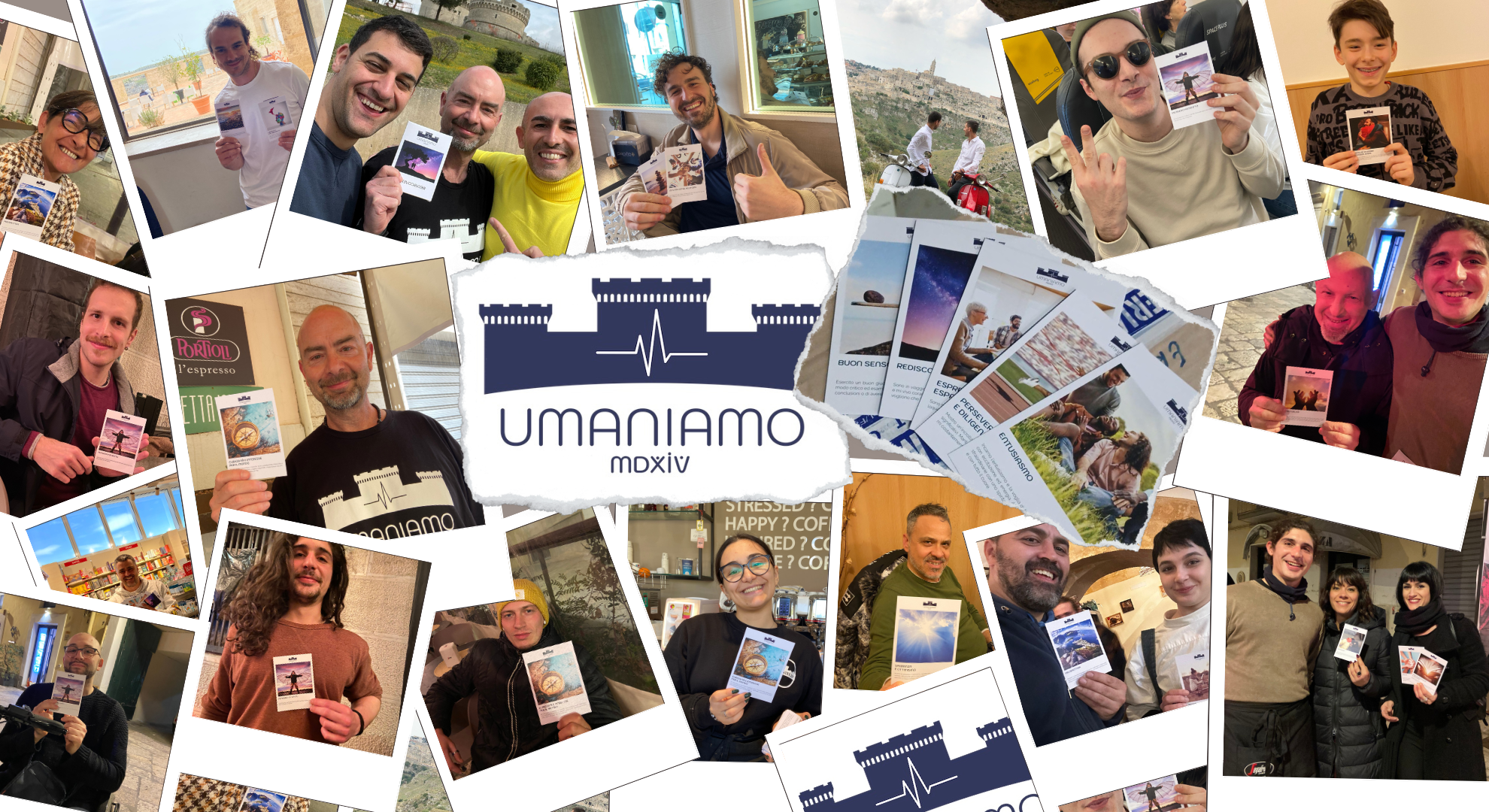
In celebration of one year at the Sunday Table and St. Michael’s Lent, for the next four Sundays, we are going to do something different with REDISCOVER U®. Rather than explore one card each week, we will place the whole deck on the Sunday Table along with the REDISCOVER U® Humaning Workbook.
Why? Because we know that the First Line of Defense begins with you, the discerning Authored person. Before we can distinguish illumination from illusion, we have to know something about our particular humaned technology through which we see, interpret, feel, decide, and act in the world.
The REDISCOVER U® Humaning Workbook describes this as learning “to recognize the Author’s handwriting in the Authored.” It reminds us that the card deck is not a test and does not assign a type. The cards open a feeling or sensation, but those must be tested through reflection, relationship, and the Six Promises of the Humaning Covenant.
The Michaelic Sword is a sword of discernment. It separates illumination from illusion, but it is held by a particular humaned person with particular strengths, tendencies, habits, experiences, wounds, relationships, and ways of thinking. If we do not know that person, we can easily mistake our own preferred way of seeing for the whole of reality.
Yet knowing ourselves is only the beginning.
The deeper movement of REDISCOVER U® has always been relational. For four weeks, then, we will move from recognition toward relationship, from relationship toward sustainment, and from sustainment toward service.
Know Yourself → Know the Person Beside You → Hold the Line Together → Set Another Table.
If you do not have a physical REDISCOVER U® deck you may order the complete deck, however, we have linked a digital version of the card images for each card which will be available during these four weeks along with the REDISCOVER U® Humaning Workbook. Don’t try to complete the workbook all at once. Move slowly and let the cards open what they open, let some ache, and let others remain quiet.
The purpose is not to construct a better identity. It is to recognize what has already been Authored and learn to carry it responsibly in relationship with others.
Quattro settimane alla scoperta di te stesso e degli altri
Per festeggiare il primo anno del “Sunday Table” e della Quaresima di San Michele, nelle prossime quattro domeniche faremo qualcosa di diverso con REDISCOVER U®. Anziché esplorare una carta alla settimana, metteremo l’intero mazzo sulla Tavola Domenicale insieme al Quaderno di lavoro REDISCOVER U® Humaning.
Perché? Perché sappiamo che la Prima Linea di Difesa inizia da te, persona creata con discernimento. Prima di poter distinguere l’illuminazione dall’illusione, dobbiamo conoscere qualcosa della nostra particolare tecnologia umana attraverso la quale vediamo, interpretiamo, sentiamo, decidiamo e agiamo nel mondo.
Il quaderno di lavoro REDISCOVER U® Humaning descrive questo processo come l’imparare «a riconoscere la calligrafia dell’Autore in ciò che è stato creato dall’Autore». Ci ricorda che il mazzo di carte non è un test e non assegna un tipo. Le carte suscitano un sentimento o una sensazione, ma questi devono essere messi alla prova attraverso la riflessione, le relazioni e le Sei Promesse del Patto Humaning.
La Spada di Michele è una spada del discernimento. Separa l’illuminazione dall’illusione, ma è impugnata da una persona “umanizzata” con particolari punti di forza, tendenze, abitudini, esperienze, ferite, relazioni e modi di pensare. Se non conosciamo quella persona, possiamo facilmente scambiare il nostro modo preferito di vedere le cose per la totalità della realtà.
Eppure conoscere noi stessi è solo l’inizio.
Il movimento più profondo di REDISCOVER U® è sempre stato relazionale. Per quattro settimane, quindi, passeremo dal riconoscimento alla relazione, dalla relazione al sostegno e dal sostegno al servizio.
Conosci te stesso → Conosci la persona accanto a te → Teniamo insieme la linea → Prepariamo un altro tavolo.
Se non disponi di un mazzo fisico di REDISCOVER U®, puoi ordinare il mazzo completo; tuttavia, abbiamo inserito un link a una versione digitale delle immagini di ciascuna carta, che sarà disponibile durante queste quattro settimane insieme al quaderno di lavoro REDISCOVER U® Humaning. Non cercare di completare il quaderno di lavoro tutto in una volta. Procedi lentamente e lascia che le carte rivelino ciò che rivelano, lascia che alcune facciano male e che altre rimangano in silenzio.
Lo scopo non è costruire un’identità migliore. È riconoscere ciò che è già stato creato e imparare a portarlo con responsabilità nelle relazioni con gli altri.
Ad maiorem Dei gloriam
The First Person You Are Responsible to Know, Yourself
The first week begins with the whole deck spread before you. In the free digital download you’ll notice that the cards are not labelled with each strength, that's on purpose. Download all of them and randomly choose.
Do not begin by asking which cards look impressive or which strengths you wish you had. Notice which cards open something in you, which ones ache, and which remain quiet. The workbook gives us these three readings because self-knowledge begins before explanation. A card may bring relief or recognition “I can stop performing now.” Another may reveal a strength that has been buried or neglected. A third may describe a real capacity that simply is not central to how you naturally move through the world.
Take your time with the deck. Choose several cards that open, one or two that ache, and a few that remain quiet. If possible, record them in the Card Reading Register in the workbook.
Then ask a harder question: Where have I been living from capacities that work, but do not feel like me?
This week, use the workbook’s three foundations, Accountability, Trust, and Meaning, to ground what you discover. Ask where you are answerable before the Author, where you are still trying to earn what can only be received, and what work, relationship, or service feels worthy of your one life. The sword turns inward first, not against the self, but toward clarity.
What has the Author entrusted to me, and what becomes possible when I carry it without performance or apology?
1. Which cards feel most like you at your best?
Which strengths open something in you that feels natural, alive, or relieving? Where have you underestimated these strengths because they feel too ordinary to you?
2. Which card aches?
Is there a strength you recognize as yours but have not been living? What has kept it buried: fear, role, expectation, convenience, or the belief that someone else’s way of being was more valuable?
3. Where are you capable but feel empty?
What do you do well that may no longer belong at the center of your life? What would change if your strongest Authored gifts rather than your most rewarded capacities began organizing your choices?
Sunday Table Invitation. Make sure the quiet ones speak… the children, the teenagers, the person on the edge of the table. Children still have unmanufactured enthusiasm; they have not yet learned to perform it, and watching how freely it moves in them can teach the rest of us what we lost. If young people are present, offer them a notebook and one question: What is something that makes you feel really alive, the kind of alive you don't have to fake?
Humaning is something we do together, and then carry out the door. This week the circle practices sourcing enthusiasm from the real and discovering that true vitality, unlike manufactured hype, is contagious in the best way. Gather a few people and take it slowly.
First, go around once. Each person names one thing that genuinely enlivens them, not what they think they should, not what sounds impressive, but the real thing that makes them come alive. Say it directly, even if it seems small. Especially if it seems small. The point is to name the true source, not the acceptable one.
Then go around again, more honestly. Each person names a place where their vitality has gone flat, where they have been performing energy they do not feel, or running on a borrowed brightness that has burned out. Do not fix it. Just name it. There is a particular relief in admitting out loud that you are tired of faking it.
Then help one another find the way back to the source. For one person at a time, let the circle ask: what actually gives you life that you have stopped doing? The prayer set down. The friendship let slide. The gift that has not been exercised in years. The rest skipped over and over again. Name one small, specific way to return to it this week, not a resolution, a re-connection.
Then close by noticing what has happened in the room. When one person shares what genuinely makes them alive, something wakes in the person next to them, it kindles the inner fire.
So this is the practice: stop manufacturing your feelings, and start receiving them from your purpose, from the people you are humaned with, and from the God whose life is the source of your own. Then carry that deeper aliveness out the door, and watch it wake the people you meet.
End however your circle ends with a prayer, a blessing, a shared silence. Then go, alive, and enliven someone.
Ad maiorem Dei gloriam. We are human together or not at all.
La prima persona che hai il dovere di conoscere: te stesso
La prima settimana inizia con l’intero mazzo steso davanti a te. Nel download digitale gratuito noterai che le carte non riportano l’indicazione di ciascun punto di forza: è una scelta voluta. Scaricale tutte e scegline una a caso.
Non iniziare chiedendoti quali carte ti sembrino più suggestive o quali punti di forza vorresti avere. Osserva quali carte aprono qualcosa dentro di te, quali ti fanno male e quali rimangono in silenzio. Il quaderno di esercizi ci propone queste tre letture perché la conoscenza di sé inizia prima della spiegazione. Una carta può portare sollievo o un’illuminazione: «Ora posso smettere di recitare». Un’altra può rivelare un punto di forza che è stato sepolto o trascurato. Una terza può descrivere una capacità reale che semplicemente non è centrale nel modo in cui ti muovi naturalmente nel mondo.
Prenditi il tempo necessario con il mazzo. Scegli diverse carte che ti aprono, una o due che ti fanno male e alcune che rimangono in silenzio. Se possibile, annotale nel Registro delle Letture delle Carte nel quaderno di lavoro.
Poi poniti una domanda più difficile: In quali ambiti ho vissuto attingendo a capacità che funzionano, ma che non mi sembrano mie?
Questa settimana, usa i tre pilastri del quaderno di lavoro – Responsabilità, Fiducia e Significato – per consolidare ciò che scopri. Chiediti dove devi rendere conto all’Autore, dove stai ancora cercando di guadagnarti ciò che può solo essere ricevuto, e quale lavoro, relazione o servizio ti sembra degno della tua unica vita. La spada si rivolge prima verso l’interno, non contro il sé, ma verso la chiarezza.
Cosa mi ha affidato l’Autore, e cosa diventa possibile quando lo porto avanti senza dover dimostrare nulla né scusarmi?
1. Quali carte ti rappresentano di più quando sei al meglio di te?
Quali punti di forza aprono in te qualcosa che ti sembra naturale, vivo o liberatorio? In quali ambiti hai sottovalutato questi punti di forza perché ti sembrano troppo ordinari?
2. Quale carta ti fa male?
C’è un punto di forza che riconosci come tuo ma che non hai messo in pratica? Cosa lo ha tenuto sepolto: paura, ruolo, aspettative, convenienza o la convinzione che il modo di essere di qualcun altro fosse più prezioso?
3. In quali ambiti sei capace ma ti senti vuoto?
Cosa fai bene che forse non è più al centro della tua vita? Cosa cambierebbe se fossero i tuoi doni più autentici, anziché le tue capacità più premiate, a guidare le tue scelte?
Invito alla tavola della domenica. Assicurati che parlino anche i più silenziosi… i bambini, gli adolescenti, la persona seduta ai margini del tavolo. I bambini hanno ancora un entusiasmo genuino; non hanno ancora imparato a metterlo in scena, e osservare quanto liberamente si muova in loro può insegnare a tutti noi ciò che abbiamo perso. Se ci sono dei giovani, offrite loro un quaderno e una domanda: Qual è una cosa che ti fa sentire davvero vivo, quel tipo di vita che non devi fingere?
L’Humaning è qualcosa che facciamo insieme e che poi portiamo fuori dalla porta. Questa settimana il cerchio si esercita a trarre entusiasmo dalla realtà e a scoprire che la vera vitalità, a differenza del clamore artificiale, è contagiosa nel senso migliore del termine. Radunate alcune persone e procedete con calma.
Per prima cosa, fate un giro completo. Ogni persona nomini una cosa che la ravviva sinceramente, non ciò che pensa di dover dire, non ciò che suona impressionante, ma la cosa reale che la fa sentire viva. Ditela con franchezza, anche se sembra insignificante. Soprattutto se sembra insignificante. Il punto è indicare la vera fonte, non quella socialmente accettabile.
Poi fate un altro giro, con maggiore onestà. Ognuno indichi un ambito in cui la propria vitalità si è affievolita, in cui ha finto di avere un’energia che non sentiva, o ha attinto a una luce presa in prestito che si è ormai esaurita. Non cercate di risolvere il problema. Limitatevi a nominarlo. C’è un particolare sollievo nell’ammettere ad alta voce che siete stanchi di fingere.
Poi aiutatevi a vicenda a ritrovare la strada verso la fonte. Una persona alla volta, lasciate che il cerchio chieda: cosa ti dà davvero vita e che hai smesso di fare? La preghiera trascurata. L’amicizia lasciata andare. Il dono che non viene esercitato da anni. Il riposo saltato più e più volte. Indicate un piccolo modo specifico per ritornarvi questa settimana, non un proposito, ma una riconnessione.
Concludete poi osservando ciò che è accaduto nella stanza. Quando una persona condivide ciò che la fa sentire veramente viva, qualcosa si risveglia in chi le sta accanto, accendendo il fuoco interiore.
Ecco quindi la pratica: smettete di fabbricare i vostri sentimenti e iniziate a riceverli dal vostro scopo, dalle persone con cui condividete l’umanità e dal Dio la cui vita è la fonte della vostra. Portate poi quella vitalità più profonda fuori dalla porta e osservate come risveglia le persone che incontrate.
Concludete il vostro cerchio, in qualunque modo esso si concluda, con una preghiera, una benedizione, un silenzio condiviso. Poi andate, pieni di vita, e ravvivate qualcuno.
Ad maiorem Dei gloriam. Siamo umani insieme o non lo siamo affatto.
Cosiamo | Founder, UMANIAMO® | Humaning Architecture

There is a version of meekness that has done considerable damage to Christian discernment, especially among men. It imagines the meek man as agreeable, accommodating, peacekeeping, and somehow more virtuous because he has learned to suppress the parts of himself that might create conflict. He doesn’t raise his voice or become visibly angry or challenge authority. He absorbs what comes his way and calls this passivity “peace.”
Then we encounter Christ.
Christ describes himself as meek and humble of heart, yet the man we encounter in the Gospels can’t easily be reconciled with our diminished understanding of meekness. He confronts religious authorities, rebukes his own disciples, overturns tables, speaks uncomfortable truths in public, protects people pushed to the margins, and finally walks toward those who have come to arrest him. He possesses extraordinary strength, yet there is something equally extraordinary about his relationship to that strength: it does not possess him. His anger does not govern him. Neither fear, humiliation, popularity, pain, nor even the instinct for self-preservation is allowed to take command of his purpose.
This may be one of the most important insights for our understanding of Michaelic Masculinity. The opposite of meekness is not strength. It is a disciplined discerned strength in the Authored.
An angry man may appear powerful while actually having surrendered his freedom to anger. A frightened man may call his retreat prudence while fear has quietly occupied the chair from which judgment should occur. A man consumed by the need for approval may appear kind, accommodating, and generous while being incapable of speaking his truth, especially if it’s something others don’t want to hear.
In each case, the problem isn't whether you experience anger, fear, or the desire to belong. These are part of being human. The problem begins when one of them becomes sovereign.
The meek man represented by Christ is different because he remains sufficiently free to choose. You can experience anger without giving anger authority. You can also feel fear without permitting fear to determine your direction. You can want to belong without purchasing it with your integrity. You may possess considerable physical, intellectual, institutional, and/or spiritual power, but you don’t prove that power by dominating another person. You own your strength because you’ve learned that owning strength is central to discernment.
Meekness, when understood this way, is not the abandonment of masculinity. It is one of the signs that masculinity is becoming mature, which we refer to as Michaelic as in Archangel Michael.
The Sword carried by the Spirit at Work has taken on a deeper meaning within the UMANIAMO® Neuro-Ignatian approach to Humaning. A Sword is generally thought of as a weapon directed outward, toward an adversary or obstacle. Yet its first significance is not combat but separation. A blade distinguishes one thing from another. In the Gospel of Matthew (10:34-36), Jesus states that he didn’t come to bring peace to the world but a Sword. The Michaelic Sword, therefore becomes the sword of discernment, capable of separating courage from recklessness, peace from avoidance, service from submission, righteous anger from wounded pride, conviction from certainty, and ultimately illumination from illusion cutting through deception and striking back.
That final distinction has become increasingly important because illumination and illusion can feel remarkably similar from the inside. A persuasive explanation suddenly makes the confusing world seem ordinary and orderly. A political narrative gives our frustration a target. An online community assures us that our anger is justified. A Technological Machine Inference TMI (our way to describe artificial intelligence) produces a beautifully coherent answer in seconds. A spiritual experience brings profound tranquility and a sense that we finally understand something important. Any of these experiences may contain truth, but the experience of certainty doesn’t by itself establish that truth.
Discernment is more demanding than whether something feels right. It asks what is moving you within and without as you encounter it, what attachments may be influencing your judgment, what Magis is being produced, and where it’s taking you. Ask, am I becoming freer to love and serve, or merely more convinced that I am right? Am I seeing something more clearly, or have I found a brilliant explanation for what I already wanted to believe? Has this conviction increased my capacity to encounter another humaned person, or has it made other people easier to categorize, dismiss, or hate?
The Michaelic Sword must therefore pass through you, the humaned person who carries it before it can be responsibly directed toward anything outside. That is what makes it a symbol of discernment rather than domination.
Across very different civilizations, serious methods of learning were developed to prevent recognition from masquerading as understanding. Learners reconstructed knowledge in unfamiliar sequences, suspended their own opinions long enough to encounter a text on its own terms, traced claims through chains of transmission, articulated serious arguments against their own conclusions, and allowed another person to challenge their reasoning directly. These traditions differed considerably in philosophy and theology, yet they shared an insight modern culture desperately needs to recover: a mind that encounters no meaningful resistance eventually becomes unreliable to itself.
The Michaelic Sword takes that principle beyond intellectual learning. I must become capable of offering meaningful resistance to my own first impressions and interpretation. I don’t need to distrust myself or my experience of what I see and hear, but I must learn that not every sensation deserves command attention. Fear deserves attention, while anger may contain information or desire may reveal something important. However, none of those sensations automatically point toward a discernment.
There is, however, something missing from this disciplined image. You can imagine someone who has become remarkably self-controlled, intellectually rigorous, physically strong, and spiritually discerning and still misses something essential to the Christian anthropology. He may have mastered himself and nevertheless remain profoundly alone.
The sword needs the Shield Wall.
In Ephesians 6:16, Paul tells us, in all circumstances take up the shield of faith, with which you can extinguish all the flaming darts of the evil one; stopping and extinguishing long standing lies/temptations
A shield can protect an individual, but a Shield Wall is a different kind of architecture. Its strength emerges through relationships. Each person must hold his own position, yet the protection created by that position extends beyond himself. My shield covers part of the person beside me, just as his covers part of me. I remain responsible for what has been entrusted to my hands, but my responsibility can no longer be understood only in terms of my own survival. The architecture moves from my defense to our responsibility.
This is a reason why the UMANIAMO® conviction that we are human together, or not at all, is much more than an expression of solidarity. It is a claim about the humaned person. None of us sees ourselves completely and no one reliably detects every illusion to which we are susceptible. The very intelligence that allows me to reason can also construct brilliant defenses of my own self-deception. I therefore need another humaned person who is sufficiently committed to my dignity to challenge me when necessary and so do you.
The Shield Wall in our context represents neither dependency nor rugged individualism. It represents humaned interdependence. I am responsible for my shield, but I am not holding it only for myself.
This is where the Spirit at Work and the Builder at Work become inseparable within this Michaelic frame. Michael gives us the image of ordered strength, the sword of discernment, and the refusal to allow fear or pride to displace truth from the center. Ignatius gives us something different but complementary: the human consequence of discernment carried into the world.
Ignatius's own experience did not end with his own conversion or even with his pilgrimage, mystical experience, education, or even increasingly refined discernment. Eventually what had been vocated within him had to become generative. He gathered companions and learned to trust them and share responsibility. He participated in vocating men who would themselves be entrusted with mission. The pilgrim became the disciple, and the disciple eventually became the Builder at Work.
Builders build Builders has become so central to what we mean by Humaning. Self-development can reasonably end when I become stronger, healthier, calmer, wiser, or more successful. Christian life can’t. If my strength never increases another person's capacity to stand, something remains unfinished. If my discernment produces only private certainty, something remains undone. If my spiritual life makes me peaceful but leaves me unavailable to those who need me, something remains missing. The Builder at Work eventually understands that his shield was never entrusted to him solely for his own protection.
Seen from this perspective, the Six Promises of the Humaning Covenant become remarkably concrete:
Care for the Whole Person requires us to recognize that the person standing beside us is never merely an object for accomplishing our purpose; his body, mind, spirit, relationships, limitations, and dignity matter. Empower Individuals for a Greater Purpose requires us to strengthen his agency rather than make him dependent upon ours. Integrate Faith and Science refuses the fragmentation that asks us to choose between what can be learned about the human person and what we believe about his sacred origin. Encourage Reflection and Discernment keeps the sword sharp, especially when certainty comes too quickly. Value Every Act of Service teaches us to recognize the quiet fidelity of the person holding his place when no one is applauding. Invite Continuous Growth reminds us that nobody in the wall has finished becoming.
These promises are not six independent virtues, when lived together, they begin to create an architecture greater than any one promise can produce. Accountability gives that architecture weight because each person must eventually stand behind what he claims, what he chooses, and how his choices affect the people entrusted to him. From that interaction something emerges that we have come to call Magis.
Magis is not simply more effort, greater ambition, or a demand that already exhausted people do more. Within the Humaning Covenant, Magis is the emergent capability produced when the Six Promises become embodied through accountable humaned lives. It appears as an increased baseline capacity to carry responsibility without becoming possessed by it and then to remain beside another person when carrying part of his burden would be easier to avoid.
Perhaps this is the watch required of us now. We live in a time when anger can be summoned on demand, fear can be monetized, approval can be quantified, and algorithms can surround us with increasingly persuasive confirmation of what we already believe. Under such conditions, the ability to experience conviction is hardly rare. The capacity to discern conviction is becoming precious.
The Builder at Work must learn to notice the moment anger begins to occupy his Chair. As a Builder at Work, you must become willing to look beside yourself and ask who is holding the neighboring shield. Who sees something I can’t? Who has earned enough trust to wake me up to the truth when I am confused by illusion, that feels like certainty? Who can challenge me without becoming his enemy? And just as importantly, for whom am I willing to provide that same presence.
Ad maiorem Dei gloriam. We are human together or not at all.
Cosiamo | Fondatore, UMANIAMO® | Architettura Umanizzante
Esiste una concezione della mitezza che ha arrecato notevole danno al discernimento cristiano, specialmente tra gli uomini. Essa immagina l’uomo mite come accomodante, conciliante, pacificatore e in qualche modo più virtuoso perché ha imparato a sopprimere quelle parti di sé che potrebbero creare conflitto. Non alza la voce, non mostra visibilmente la propria rabbia né sfida l’autorità. Assorbe ciò che gli capita e definisce questa passività «pace».
Poi incontriamo Cristo.
Cristo descrive se stesso come mite e umile di cuore, eppure l’uomo che incontriamo nei Vangeli non si concilia facilmente con la nostra concezione riduttiva della mitezza. Egli si confronta con le autorità religiose, rimprovera i propri discepoli, rovescia i tavoli, dice in pubblico verità scomode, protegge le persone emarginate e, infine, va incontro a coloro che sono venuti ad arrestarlo. Possiede una forza straordinaria, eppure c’è qualcosa di altrettanto straordinario nel suo rapporto con quella forza: essa non lo possiede. La sua ira non lo domina. Né la paura, né l’umiliazione, né la popolarità, né il dolore, né tantomeno l’istinto di autoconservazione possono prendere il sopravvento sul suo scopo.
Questa potrebbe essere una delle intuizioni più importanti per la nostra comprensione della Mascolinità Micaelica. Il contrario della mitezza non è la forza. È una forza disciplinata e discernente nell’Autorità.
Un uomo arrabbiato può sembrare potente mentre in realtà ha ceduto la propria libertà alla rabbia. Un uomo spaventato può definire la propria ritirata «prudenza», mentre la paura ha silenziosamente occupato il posto da cui dovrebbe provenire il giudizio. Un uomo consumato dal bisogno di approvazione può sembrare gentile, accomodante e generoso, pur essendo incapace di esprimere la propria verità, specialmente se si tratta di qualcosa che gli altri non vogliono sentire.
In ogni caso, il problema non è se provi rabbia, paura o il desiderio di appartenenza. Questi sentimenti fanno parte dell’essere umani. Il problema inizia quando uno di essi diventa sovrano.
L’uomo mite rappresentato da Cristo è diverso perché rimane sufficientemente libero di scegliere. Puoi provare rabbia senza conferirle autorità. Puoi anche provare paura senza permettere che sia la paura a determinare la tua direzione. Puoi desiderare di appartenere a qualcosa senza sacrificare la tua integrità per ottenerla. Puoi possedere un notevole potere fisico, intellettuale, istituzionale e/o spirituale, ma non dimostri quel potere dominando un’altra persona. Possiedi la tua forza perché hai imparato che possedere la forza è fondamentale per il discernimento.
La mitezza, intesa in questo modo, non è l’abbandono della mascolinità. È uno dei segni che la mascolinità sta maturando, ciò a cui ci riferiamo come «michielico», come l’Arcangelo Michele.
La Spada portata dallo Spirito al Lavoro ha assunto un significato più profondo nell’approccio Neuro-Ignaziano UMANIAMO® all’Humaning. Una Spada è generalmente considerata un’arma diretta verso l’esterno, verso un avversario o un ostacolo. Eppure il suo significato primo non è il combattimento, ma la separazione. Una lama distingue una cosa dall’altra. Nel Vangelo di Matteo (10,34-36), Gesù afferma di non essere venuto a portare la pace nel mondo, ma una spada. La Spada micheleica diventa quindi la spada del discernimento, capace di separare il coraggio dall’incoscienza, la pace dall’evitamento, il servizio dalla sottomissione, la giusta ira dall’orgoglio ferito, la convinzione dalla certezza e, in ultima analisi, l’illuminazione dall’illusione, tagliando a fetta l’inganno e contrattaccando.
Quest’ultima distinzione è diventata sempre più importante perché l’illuminazione e l’illusione possono sembrare straordinariamente simili dall’interno. Una spiegazione persuasiva fa improvvisamente apparire il mondo confuso come ordinario e ordinato. Una narrativa politica offre un bersaglio alla nostra frustrazione. Una comunità online ci assicura che la nostra rabbia è giustificata. Una Macchina di Inferenza Tecnologica (TMI, il nostro modo di descrivere l’intelligenza artificiale) produce una risposta meravigliosamente coerente in pochi secondi. Un’esperienza spirituale porta una profonda tranquillità e la sensazione di aver finalmente compreso qualcosa di importante.
Ognuna di queste esperienze può contenere una verità, ma l’esperienza della certezza non stabilisce di per sé quella verità.
Il discernimento è più impegnativo del semplice fatto che qualcosa sembri giusto. Chiede cosa ti sta muovendo dentro e fuori mentre la incontri, quali attaccamenti possano influenzare il tuo giudizio, quale «Magis» si sta generando e dove ti sta portando. Chiediti: sto diventando più libero di amare e servire, o semplicemente più convinto di avere ragione? Sto vedendo qualcosa più chiaramente, o ho trovato una spiegazione brillante per ciò in cui volevo già credere? Questa convinzione ha aumentato la mia capacità di incontrare un’altra persona umana, o ha reso più facile classificare, liquidare o odiare le altre persone?
La Spada di Michele deve quindi attraversare te, la persona umana che la porta, prima di poter essere diretta in modo responsabile verso qualsiasi cosa all’esterno. È questo che la rende un simbolo di discernimento piuttosto che di dominio.
In civiltà molto diverse tra loro, sono stati sviluppati metodi di apprendimento rigorosi per impedire che il riconoscimento si mascherasse da comprensione. Gli studiosi ricostruivano la conoscenza in sequenze insolite, sospendevano le proprie opinioni abbastanza a lungo da affrontare un testo secondo i suoi termini, rintracciavano le affermazioni attraverso le catene di trasmissione, articolavano argomentazioni serie contro le proprie conclusioni e permettevano a un’altra persona di contestare direttamente il loro ragionamento. Queste tradizioni differivano notevolmente nella filosofia e nella teologia, eppure condividevano un’intuizione che la cultura moderna ha un disperato bisogno di recuperare: una mente che non incontra alcuna resistenza significativa finisce per diventare inaffidabile per se stessa.
La Spada di Michele porta quel principio oltre l’apprendimento intellettuale. Devo diventare capace di opporre una resistenza significativa alle mie prime impressioni e alle mie interpretazioni. Non devo diffidare di me stesso o della mia esperienza di ciò che vedo e sento, ma devo imparare che non ogni sensazione merita la mia attenzione. La paura merita attenzione, mentre la rabbia può contenere informazioni o il desiderio può rivelare qualcosa di importante. Tuttavia, nessuna di queste sensazioni porta automaticamente a un discernimento.
C’è, tuttavia, qualcosa che manca in questa immagine disciplinata. Si può immaginare qualcuno che sia diventato straordinariamente autocontrollato, intellettualmente rigoroso, fisicamente forte e spiritualmente perspicace, e che tuttavia non possieda ancora qualcosa di essenziale per l’antropologia cristiana. Potrebbe aver raggiunto la padronanza di sé e tuttavia rimanere profondamente solo.
La spada ha bisogno del muro di scudi.
In Efesini 6:16, Paolo ci dice: «In ogni circostanza prendete lo scudo della fede, con il quale potrete spegnere tutti i dardi infuocati del maligno»; fermando e spegnendo menzogne e tentazioni di lunga data
Uno scudo può proteggere un individuo, ma un muro di scudi è un tipo diverso di struttura. La sua forza emerge attraverso le relazioni. Ogni persona deve mantenere la propria posizione, eppure la protezione creata da quella posizione si estende oltre se stessa. Il mio scudo copre parte della persona accanto a me, proprio come il suo copre parte di me. Rimango responsabile di ciò che mi è stato affidato, ma la mia responsabilità non può più essere intesa solo in termini di sopravvivenza personale. La struttura si sposta dalla mia difesa alla nostra responsabilità.
Questo è uno dei motivi per cui la convinzione di UMANIAMO® secondo cui siamo umani insieme, o non lo siamo affatto, è molto più di una semplice espressione di solidarietà. È un’affermazione sulla persona umanizzata. Nessuno di noi vede se stesso nella sua interezza e nessuno riesce a individuare con certezza ogni illusione a cui siamo esposti. La stessa intelligenza che mi permette di ragionare può anche costruire brillanti difese del mio autoinganno. Ho quindi bisogno di un’altra persona “umanizzata” che sia sufficientemente impegnata a difendere la mia dignità da sfidarmi quando necessario, e lo stesso vale per te.
Il Muro di Scudi nel nostro contesto non rappresenta né dipendenza né individualismo spietato. Rappresenta l’interdipendenza “umanizzata”. Sono responsabile del mio scudo, ma non lo tengo solo per me stesso.
È qui che lo Spirito al lavoro e il Costitutore al lavoro diventano inseparabili all’interno di questa cornice micheleana. Michele ci offre l’immagine della forza ordinata, della spada del discernimento e del rifiuto di permettere che la paura o l’orgoglio allontanino la verità dal centro. Ignazio ci offre qualcosa di diverso ma complementare: la conseguenza umana del discernimento portato nel mondo.
L’esperienza personale di Ignazio non si esaurì con la sua conversione, né tantomeno con il suo pellegrinaggio, l’esperienza mistica, la formazione o persino con un discernimento sempre più raffinato. Alla fine, ciò che era stato chiamato in lui doveva diventare generativo. Radunò dei compagni e imparò a fidarsi di loro e a condividere la responsabilità. Partecipò alla chiamata di uomini ai quali sarebbe stata a loro volta affidata una missione. Il pellegrino divenne discepolo, e il discepolo alla fine divenne il Costruttore all’opera.
“I Costruttori formano altri Costruttori” è diventato un concetto centrale di ciò che intendiamo per “Humaning”. Lo sviluppo personale può ragionevolmente concludersi quando divento più forte, più sano, più sereno, più saggio o ho più successo. La vita cristiana no. Se la mia forza non aumenta mai la capacità di un’altra persona di reggersi in piedi, qualcosa rimane incompiuto. Se il mio discernimento produce solo una certezza privata, qualcosa rimane incompiuto. Se la mia vita spirituale mi rende sereno ma mi rende indisponibile per chi ha bisogno di me, qualcosa rimane mancante. Il Costruttore all’opera alla fine comprende che il suo scudo non gli è mai stato affidato esclusivamente per la propria protezione.
Viste da questa prospettiva, le sei promesse del Patto dell’Humaning diventano straordinariamente concrete:
Prendersi cura della persona nella sua interezza ci impone di riconoscere che la persona che ci sta accanto non è mai semplicemente un oggetto per il raggiungimento del nostro scopo; il suo corpo, la sua mente, il suo spirito, le sue relazioni, i suoi limiti e la sua dignità contano. Responsabilizzare gli individui per uno scopo più grande ci impone di rafforzare la sua autonomia piuttosto che renderlo dipendente dalla nostra. Integrare fede e scienza rifiuta la frammentazione che ci chiede di scegliere tra ciò che si può apprendere sulla persona umana e ciò che crediamo riguardo alla sua origine sacra. Incoraggiare la riflessione e il discernimento mantiene affilata la spada, specialmente quando la certezza arriva troppo in fretta. Valorizzare ogni atto di servizio ci insegna a riconoscere la silenziosa fedeltà di chi mantiene il proprio posto quando nessuno applaude. “Invitare alla crescita continua” ci ricorda che nessuno all’interno del muro ha smesso di diventare.
Queste promesse non sono sei virtù indipendenti; quando vissute insieme, iniziano a creare un’architettura più grande di quanto qualsiasi singola promessa possa produrre. La responsabilità conferisce peso a quell’architettura perché ogni persona deve alla fine sostenere ciò che afferma, ciò che sceglie e il modo in cui le sue scelte influenzano le persone a lei affidate. Da quell’interazione emerge qualcosa che abbiamo finito per chiamare Magis.
Il Magis non è semplicemente un maggiore sforzo, una maggiore ambizione o la richiesta che persone già esauste facciano di più. All’interno del Patto dell’Umanità, il Magis è la capacità emergente che si produce quando le Sei Promesse si incarnano attraverso vite umane responsabili. Si manifesta come una maggiore capacità di base di assumersi la responsabilità senza esserne sopraffatti e di rimanere al fianco di un’altra persona anche quando sarebbe più facile evitare di portare parte del suo fardello.
Forse questa è la vigilanza che ci viene richiesta ora. Viviamo in un’epoca in cui la rabbia può essere evocata a comando, la paura può essere monetizzata, l’approvazione può essere quantificata e gli algoritmi possono circondarci con conferme sempre più persuasive di ciò in cui già crediamo. In tali condizioni, la capacità di provare convinzione non è affatto rara. La capacità di discernere la convinzione sta diventando preziosa.
Il Costruttore all’Opera deve imparare a notare il momento in cui la rabbia comincia a occupare la sua Poltrona. Come Costruttore all’opera, devi essere disposto a guardare oltre te stesso e chiederti chi sta impugnando lo scudo accanto al tuo. Chi vede qualcosa che io non riesco a vedere? Chi si è guadagnato abbastanza fiducia da risvegliarmi alla verità quando sono confuso dall’illusione, che mi sembra una certezza? Chi può sfidarmi senza diventare mio nemico? E, cosa altrettanto importante, per chi sono disposto a offrire quella stessa presenza?
Ad maiorem Dei gloriam. Siamo umani insieme o non lo siamo affatto.
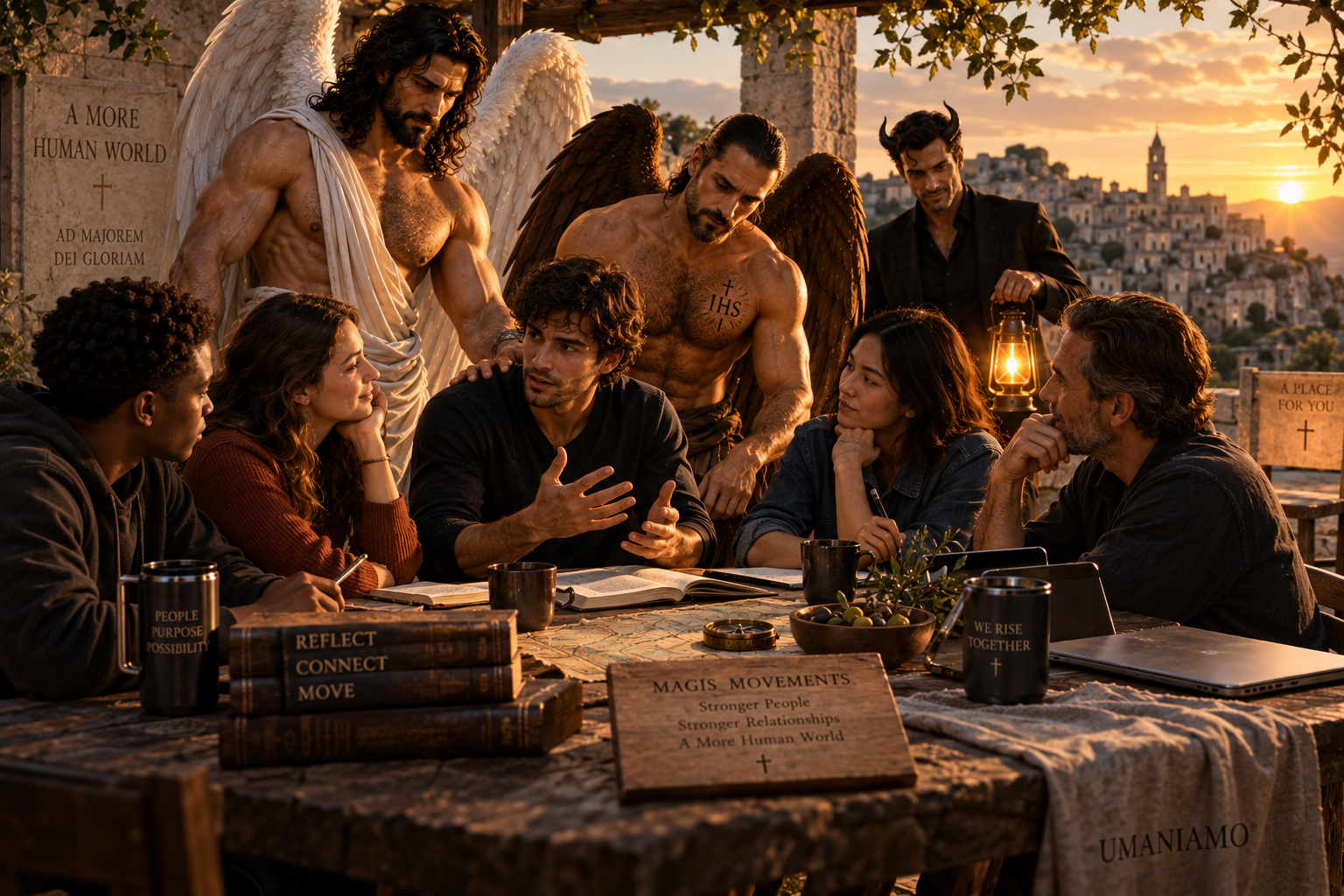
This week, our Magis Movements are not about doing more. Rather they are about becoming more capable of seeing clearly, remaining rightly ordered, and acting without surrendering conscience.
The Conflict of Conscience gives us a concrete place to practice. Before the difficult moment arrives, we can strengthen the conditions that make faithful discernment possible. We can know more of the Authored person we are, notice when illusion is narrowing the field, remain in relationship with others who can challenge and steady us, and practice the Six Promises until they become visible in the way we respond under pressure.
Use the Six Promises as a weekly relational Examen.
Care for the Whole Person
Notice one place where pressure, urgency, workload, fear, or obligation is reducing a whole person to a function, role, output, or problem. This may be you.
Magis Movement: Interrupt the reduction. Ask what the whole person needs in order to remain capable of judgment, relationship, and responsible action. Make one visible adjustment that protects mind, body, spirit, agency, or conscience.
Empower Individuals for a Greater Purpose
A relationship becomes extractive when one person’s agency quietly disappears.
Magis Movement: Identify one person whose judgment you may be overriding, pre-empting, or carrying for them. Create enough space for them to think, decide, object, or contribute in their own words. The aim is not agreement; it is greater capability.
Integrate Faith and Science
Conscience becomes fragile when either evidence or faith is excluded from the field.
Magis Movement: Choose one consequential belief, concern, or decision and test it from both directions. What does the evidence show? What does prayer, conscience, vocation, or spiritual discernment ask you to consider? Refuse the convenience of a partial truth.
Encourage Reflection and Discernment
Urgency is one of the easiest ways to bypass conscience.
Magis Movement: Place one deliberate pause between stimulus and action this week. Before sending, approving, forwarding, refusing, or deciding, step away long enough to ask whether you are responding to illumination or merely reacting to pressure.
Value Every Act of Service
Principled objection can itself be an act of service.
Magis Movement: Notice one person who raised a concern, slowed a process, questioned an assumption, protected someone vulnerable, or did quiet work that preserved integrity. Acknowledge that contribution explicitly.
Invite Continuous Growth
Conscience does not require infallibility. It requires the willingness to remain correctable.
Magis Movement: Identify one place where you may be wrong. Invite evidence, perspective, or correction from someone you trust. Growth this week is not abandoning conviction; it is making sure conviction has been honestly examined.
At the end of the week, return to three questions:
Which Promise most strengthened my First Line of Defense? Where did I notice illusion? What evidence is there that my response left more human capability in the relationship rather than less?
Walk a Conflict of Conscience Back Before You Act
Choose one situation in which you feel pressure, resistance, unease, or a sense that something may not be rightly ordered. Do not begin by deciding whether you are right. Begin by examining the field.
Details: What actually happened Describe the situation without interpretation. What was said, requested, decided, omitted, incentivized, or assumed? What are the observable facts?
The purpose is to separate the event itself from the story already forming around it.
Evidence: Why do I believe this is a conflict of conscience? What supports your concern? What evidence contradicts it? Are you responding to a genuine moral obligation, or could fear, status, resentment, preference, fatigue, ideology, or self-interest be influencing your judgment?
Ask what you know, what you do not know, and what you would need to know before acting.
Empathy: Who bears the consequence? Who is affected if you comply? Who is affected if you refuse? Who is missing from the conversation? Are you seeing the other people involved as whole Authored persons or only as authorities, obstacles, beneficiaries, adversaries, or roles?
This is where the Shield Wall matters. Conscience is personal, but the consequences are relational.
Prospective: Where does this lead if repeated? If this pattern continues for six months, a year, or five years, what happens to trust, agency, responsibility, capability, and integrity? What kind of person are you becoming by participating? What kind of architecture is the relationship or institution building?
Growth leaves evidence, and so does extraction.
Execution: What faithful action is required now? What is the smallest honest action that preserves conscience without rushing into unnecessary conflict? It may be asking a question, seeking clarification, requesting time, gathering evidence, naming a concern, escalating responsibly, proposing an alternative, setting a boundary, or refusing participation.
The Michaelic Sword is not proved by dramatic action. It is proved by rightly ordered action.
Reflection: What is this vocating in me? Where did you notice fear, relief, anger, certainty, courage, avoidance, or pressure? What happened in your body and attention? Did the lantern of the Devil at Work begin narrowing the field, or did something become clearer? Most importantly, ask: Does this leave me more available to the Author, more responsible toward the person before me, and more capable of acting with integrity?
Can My Conscience Still Enter the Room?
At the end of the week, return quietly to one relationship, workplace, family situation, community, or decision-making environment that matters to you. Ask whether conscience can still enter the space. Can someone say, “I do not agree,” and remain in relationship with you? Can a person ask for more time without being punished for slowing the process? Can evidence complicate the preferred narrative? Can someone admit error without losing dignity? Can a principled objection be heard without immediately being reframed as disloyalty, resistance, incompetence, or threat?
Are you able to say what you believe is true without becoming reactive? Are you willing to test your conviction rather than merely defend it? Can you remain open to correction without surrendering responsibility? Can you distinguish the cost of acting from the truth of what must be done?
The First Line of Defense is not complete when we merely know what we think.
Ad maiorem Dei gloriam. We are human together or not at all.
Questa settimana, i nostri Movimenti Magis non mirano a fare di più. Si tratta piuttosto di diventare più capaci di vedere con chiarezza, di mantenere il giusto ordine e di agire senza rinunciare alla coscienza.
Il conflitto di coscienza ci offre un’occasione concreta per esercitarci. Prima che giunga il momento difficile, possiamo rafforzare le condizioni che rendono possibile un discernimento fedele. Possiamo conoscere meglio la persona creata da Dio che siamo, notare quando l’illusione restringe il nostro campo visivo, rimanere in relazione con altri che possano metterci alla prova e sostenerci, e mettere in pratica le Sei Promesse finché non diventino visibili nel modo in cui reagiamo sotto pressione.
Usa le Sei Promesse come un Esame settimanale delle relazioni.
Prenditi cura della persona nella sua interezza
Individua un ambito in cui la pressione, l’urgenza, il carico di lavoro, la paura o l’obbligo stanno riducendo una persona nella sua interezza a una funzione, un ruolo, un risultato o un problema. Potresti essere tu stesso.
Movimento Magis: Interrompi questa riduzione. Chiediti di cosa abbia bisogno la persona nella sua interezza per rimanere capace di giudizio, relazione e azione responsabile. Apporta un cambiamento visibile che protegga la mente, il corpo, lo spirito, l’autonomia o la coscienza.
Responsabilizzare le persone per uno scopo più grande
Una relazione diventa sfruttatrice quando l’autonomia di una persona svanisce silenziosamente.
Movimento Magis: Identifica una persona il cui giudizio potresti stare scavalcando, anticipando o assumendoti al posto suo. Crea spazio sufficiente affinché possa pensare, decidere, obiettare o contribuire con parole proprie. L’obiettivo non è il consenso; è una maggiore capacità.
Integrare fede e scienza
La coscienza diventa fragile quando dall’equazione vengono escluse le prove o la fede.
Movimento Magis: scegli una convinzione, una preoccupazione o una decisione rilevante e mettila alla prova da entrambe le prospettive. Cosa dimostrano le prove? Cosa ti chiedono di considerare la preghiera, la coscienza, la vocazione o il discernimento spirituale? Rifiuta la comodità di una verità parziale.
Incoraggiare la riflessione e il discernimento
L’urgenza è uno dei modi più semplici per aggirare la coscienza.
Movimento Magis: questa settimana, inserisci una pausa deliberata tra lo stimolo e l’azione. Prima di inviare, approvare, inoltrare, rifiutare o decidere, prenditi una pausa abbastanza lunga da chiederti se stai rispondendo a un’illuminazione o semplicemente reagendo a una pressione.
Valorizzare ogni atto di servizio
L’obiezione basata sui principi può essere di per sé un atto di servizio.
Movimento Magis: Notate una persona che ha sollevato una preoccupazione, rallentato un processo, messo in discussione un presupposto, protetto qualcuno di vulnerabile o svolto un lavoro discreto che ha preservato l’integrità. Riconoscete esplicitamente quel contributo.
Incoraggiate la crescita continua
La coscienza non richiede infallibilità. Richiede la disponibilità a rimanere correggibili.
Movimento Magis: Identificate un ambito in cui potreste sbagliare. Chiedete prove, punti di vista o correzioni a qualcuno di cui vi fidate. La crescita di questa settimana non consiste nell’abbandonare le proprie convinzioni, ma nell’assicurarsi che siano state esaminate onestamente.
Alla fine della settimana, torna a queste tre domande:
Quale Promessa ha rafforzato maggiormente la mia Prima Linea di Difesa? Dove ho notato un’illusione? Quali prove ci sono che la mia risposta abbia lasciato più capacità umana nella relazione anziché meno?
Riesamina un conflitto di coscienza prima di agire
Scegli una situazione in cui provi pressione, resistenza, disagio o la sensazione che qualcosa possa non essere come dovrebbe. Non iniziare decidendo se hai ragione. Inizia esaminando il contesto.
Dettagli: Cosa è successo realmente? Descrivi la situazione senza interpretazioni. Cosa è stato detto, richiesto, deciso, omesso, incentivato o dato per scontato? Quali sono i fatti osservabili?
Lo scopo è separare l’evento in sé dalla storia che si sta già formando attorno ad esso.
Evidenza: perché ritengo che si tratti di un conflitto di coscienza? Cosa avvalora la tua preoccupazione? Quali prove la contraddicono? Stai rispondendo a un autentico obbligo morale, oppure paura, status, risentimento, preferenze, stanchezza, ideologia o interesse personale potrebbero influenzare il tuo giudizio?
Chiediti cosa sai, cosa non sai e cosa avresti bisogno di sapere prima di agire.
Empatia: Chi ne subisce le conseguenze? Chi ne risente se accedi? Chi ne risente se rifiuti? Chi manca dalla conversazione? Stai vedendo le altre persone coinvolte come persone a tutto tondo o solo come autorità, ostacoli, beneficiari, avversari o ruoli?
È qui che entra in gioco il «Muro Protettivo». La coscienza è personale, ma le conseguenze sono relazionali.
Prospettiva: Dove porta tutto questo se si ripete? Se questo schema dovesse continuare per sei mesi, un anno o cinque anni, cosa ne sarebbe della fiducia, dell’autonomia, della responsabilità, della capacità e dell’integrità? Che tipo di persona stai diventando partecipando a tutto questo? Che tipo di struttura sta costruendo la relazione o l’istituzione?
La crescita lascia tracce, e lo stesso vale per lo sfruttamento.
Esecuzione: Quale azione fedele è richiesta ora? Qual è la più piccola azione onesta che preservi la coscienza senza precipitarsi in un conflitto inutile? Potrebbe trattarsi di porre una domanda, chiedere chiarimenti, richiedere tempo, raccogliere prove, esprimere una preoccupazione, segnalare il problema in modo responsabile, proporre un’alternativa, stabilire un limite o rifiutare di partecipare.
La Spada di Michele non si dimostra con azioni spettacolari. Si dimostra con azioni correttamente ordinate.
Riflessione: Cosa sta suscitando in me questa vocazione? Dove hai notato paura, sollievo, rabbia, certezza, coraggio, evitamento o pressione? Cosa è successo nel tuo corpo e nella tua attenzione? La lanterna del «Diavolo all’opera» ha iniziato a restringere il campo, o qualcosa è diventato più chiaro? Soprattutto, chiediti: questo mi rende più disponibile verso l’Autore, più responsabile nei confronti della persona che ho davanti e più capace di agire con integrità?
La mia coscienza può ancora entrare nella stanza?
Alla fine della settimana, torna in silenzio a una relazione, a un ambiente di lavoro, a una situazione familiare, a una comunità o a un contesto decisionale che ti sta a cuore. Chiediti se la coscienza possa ancora entrare in quello spazio. Qualcuno può dire: «Non sono d’accordo» e rimanere in relazione con te? Una persona può chiedere più tempo senza essere punita per aver rallentato il processo? Le prove possono complicare la narrazione preferita? Qualcuno può ammettere un errore senza perdere la dignità? Un’obiezione basata sui principi può essere ascoltata senza essere immediatamente reinterpretata come slealtà, resistenza, incompetenza o minaccia?
Sei in grado di dire ciò che ritieni vero senza reagire d’istinto? Sei disposto a mettere alla prova la tua convinzione piuttosto che limitarti a difenderla? Puoi rimanere aperto alla correzione senza rinunciare alla responsabilità? Riesci a distinguere il costo dell’agire dalla verità di ciò che deve essere fatto?
La prima linea di difesa non è completa quando ci limitiamo a sapere ciò che pensiamo.
Ad maiorem Dei gloriam. Siamo umani insieme o non lo siamo affatto.

I’ve been thinking about this for a while, and I’ve stopped asking whether I have enough information, or whether some of this is persuasive, or whether people agree. What I’m most concerned with is whether I can remain faithful to what I have come to recognize as true, good, just, and rightly ordered before my Author, God in my relationship with the Lord Jesus Christ. That is where conscience becomes more than an idea and where the First Line of Defense becomes much more personal.
This week we have been reflecting on the Michaelic Sword and the Shield Wall as images of relational safety and relational sustainment. The Sword helps us distinguish illumination from illusion. The Shield Wall reminds us that this discernment does not happen in isolation. We are human together or not at all, and our ability to remain clear, courageous, and rightly ordered as we face the Author is strengthened or weakened by the relationships and architectures around us.
But there is another condition that has been on my mind a lot lately: the Conflict of Conscience.
Within Humaning, a conflict of conscience exists when a person, after meaningful reflection and discernment, recognizes that complying with an expected action, decision, policy, system, or authority would require participation in something they reasonably judge to violate truth, dignity, justice, responsibility, right relationship, or a higher obligation of vocation and service. This isn’t simple discomfort, disagreement, or resistance to change. It is a defining moment when you realize that participation itself begins to require that you betray what you hold sacred and must not surrender.
This is one of the more serious Sunday Table topics because conscience is not a negotiable moral preference. It is part of the humaned capability through which all judgment is brought into relationship with the truth, moral responsibility, dignity, and the purpose of your Authored self. Conscience can be mistaken and therefore must be vocated, examined, practiced and tested.
But it can’t be erased or ignored without cost. The conflict begins when you are asked to act against what you have discerned as truth in order to remain included, rewarded, protected, employed, approved, or permitted to act. At that point, the pressure is no longer external. It has entered the architecture of your life. That is where illusion becomes especially dangerous.
The Devil at Work rarely needs to announce that something is wrong. Illusion is more effective when it appears as necessity, urgency, loyalty, efficiency, belonging, expertise, convenience, or inevitability. A person can be persuaded to violate conscience while sincerely believing they are simply being reasonable. The lantern sways, attention follows, and before long the person has become more attentive to the consequences of dissent than to the truth of what they are being asked to do.
This is why the First Line of Defense must be built before the crisis arrives.
REDISCOVER U® helps us recognize more of the Authored person who will eventually have to choose. It reveals strengths, patterns, cognitive tendencies, and ways of being that can either serve discernment or become overextended under pressure. Cognitive Advantage™ helps us understand how we organize what we encounter. H.A.L.T.E.R.™ helps us notice when physical, emotional, relational, or cognitive conditions are distorting our interpretation. D.E.E.P.E.R.™ helps us slow the experience down and examine what actually happened, what evidence supports our conclusion, who is affected, where the pattern leads, what action is required, and what the experience is forming in us.
None of these replaces conscience. They strengthen the person who must exercise it. That distinction is essential because the purpose of Humaning is not to create another system that tells people what to think. A framework that replaces judgment becomes another enclosure. The deeper work is to help form people who can think, discern, test, remain open to correction, and still take responsibility for the choice they eventually make.
Onomastici are acts of remembrance. A saint’s name is more than a marker on a calendar; it recalls a particular human life that encountered pressure, uncertainty, vocation, suffering, service, and grace. Remembering them keeps faith embodied because it reminds us that holiness is not an abstraction. It is lived through choices, relationships, courage, correction, endurance, and service.
That makes this week especially fitting during St. Michael’s Lent. We are exploring Relational Safety, Relational Sustainment, the Shield Wall, and the Michaelic sword that distinguishes illumination from illusion. The saints and feasts of these seven days repeatedly return us to the same lesson: truth must become visible in relationship.
September 14: The Exaltation of the Holy Cross
The Church celebrates the Exaltation of the Holy Cross, remembering the Cross not merely as an instrument of execution but as the place where Christ transforms apparent defeat into revelation. The feast has deep historical roots connected with the dedication of the Church of the Holy Sepulchre in Jerusalem and the public veneration of the Cross.
Humaning Reflection: The Cross is perhaps Christianity’s clearest example of illumination cutting through illusion. The world sees weakness, humiliation, and defeat; faith discovers self-giving love and a relationship with the Author that violence cannot erase. As we consider the Michaelic sword, the Cross reminds us that truth does not always conquer by overpowering another person. Sometimes strength is revealed through the refusal to surrender love, dignity, or right relationship even when the surrounding architecture has become extractive.
September 15: Our Lady of Sorrows
The Memorial of Our Lady of Sorrows remembers Mary remaining close to Christ through suffering, especially at the foot of the Cross. Devotion to the Sorrowful Mother developed strongly in medieval Christianity and became closely associated with the Stabat Mater and the Seven Sorrows of Mary.
Humaning Reflection: Relational safety is not always the ability to make another person’s pain disappear. Sometimes it is the capacity to remain present when there is nothing left to fix. Mary teaches a form of relational sustainment that does not abandon the relationship when suffering becomes unbearable. She remains and that may be one of the deepest meanings of Connect: not rescuing, possessing, or explaining, but refusing to make another person carry sorrow alone.
September 16: Saints Cornelius and Cyprian
Cornelius, Bishop of Rome, and Cyprian, Bishop of Carthage, were third-century Church leaders who lived through persecution and intense disagreement over how Christians who had renounced the faith under pressure should be received back into the community. Both defended the possibility of repentance and reconciliation rather than treating failure as a permanent identity, and both eventually died as martyrs. The Church remembers them together on September 16.
Humaning Reflection: Their witness speaks directly to Relational Sustainment. A community that cannot distinguish a person from their worst failure eventually becomes incapable of repair. Cornelius and Cyprian remind us that truthful accountability and restoration are not opposites. The Sixth Promise, Invite Continuous Growth, asks us to resist freezing another person inside a single act, failure, or category while still taking responsibility seriously.
September 17: Saint Robert Bellarmine and Saint Hildegard of Bingen
Robert Bellarmine was a Jesuit cardinal, theologian, and Doctor of the Church whose life was shaped by the intellectual and religious upheavals following the Reformation. He became one of the major theological voices of the post-Tridentine Church and was also remembered for personal care of the poor. September 17 also commemorates Hildegard of Bingen, the remarkable Benedictine abbess, writer, composer, visionary, and later Doctor of the Church.
Humaning Reflection: Bellarmine and Hildegard remind us that faith does not require the abandonment of disciplined thought, observation, creativity, or intellectual inquiry. Their very different gifts show why the Body does not need every person to think alike. Relational safety makes room for differentiated strengths, while relational sustainment allows those differences to remain in communion long enough for something greater than any one person’s contribution to emerge. This is the Shield Wall at its best: not sameness, but distinct gifts held in right relationship.
September 18: Saint Joseph of Cupertino
Joseph of Cupertino was a seventeenth-century Franciscan friar remembered for an unusually difficult path into religious life. He struggled academically and was often considered incapable by those around him, yet his spiritual life became marked by profound devotion and simplicity, and he eventually became one of the most beloved Franciscan saints.
Humaning Reflection: Joseph’s life challenges the Doctrine of Utility. A human being who performs poorly according to one system’s measure may still carry gifts that the system cannot recognize. REDISCOVER U® asks us to look again at the person whose strengths do not match the dominant architecture. Relational safety begins when someone is allowed to be more than the category assigned to them, and Humaning begins when we help make room for what the Author has actually placed there.
September 19: Saint Januarius
Januarius, traditionally remembered as Bishop of Benevento, was martyred during the persecutions of the early fourth century. His devotion became especially strong in Naples, where his name and the tradition surrounding his relics became deeply intertwined with the religious and cultural life of the city.
Humaning Reflection: Januarius reminds us that faith is not merely private interior conviction; it becomes communal memory. A name carried across centuries can help a people remember who they are, what they have endured, and what they refuse to surrender. The Shield Wall is strengthened not only by the people immediately beside us but also by the memory of those who stood before us. Relational sustainment stretches across generations when a community remembers without turning remembrance into enclosure.
September 20: Saints Andrew Kim Taegon, Paul Chong Hasang, and the Korean Martyrs
Andrew Kim Taegon was the first native Korean Catholic priest, while Paul Chong Hasang was an important lay leader in the early Korean Church. Their feast commemorates 103 Korean martyrs, but the history behind them is especially remarkable because Christianity initially spread in Korea largely through lay people who encountered Christian texts, shared what they discovered with one another, sought baptism, and formed communities before a stable clergy was present.
Humaning Reflection: Their story may be one of the clearest examples of Builder of Builders. Faith moved person to person, friend to friend, through learning, relationship, courage, and shared responsibility. The community did not wait for an institution to arrive before beginning to live what it had discovered. This is the same movement we are exploring through the Sunday Table: receive something true, discern it, carry it into a relationship, and help another person become capable of carrying it too.
This week begins at the Cross and ends with a community formed person to person. That movement is remarkably close to what we are practicing during St. Michael’s Lent. Relational safety protects the person from being reduced. Relational sustainment protects the relationship from collapsing when truth, difference, failure, suffering, or change enters the Room. The sword of discernment helps us distinguish what must be confronted from what must be healed, while the Shield Wall reminds us that no one carries the work alone. Perhaps the invitation this week is to notice which movement is required in the relationships around us.
Ad maiorem Dei gloriam.
Ci sto riflettendo da un po’ e ho smesso di chiedermi se disponga di informazioni sufficienti, se alcune di queste siano convincenti o se le persone siano d’accordo. Ciò che mi sta più a cuore è se riesco a rimanere fedele a ciò che ho imparato a riconoscere come vero, buono, giusto e ben ordinato davanti al mio Autore, Dio, nel mio rapporto con il Signore Gesù Cristo. È qui che la coscienza diventa più di un’idea e che la prima linea di difesa assume un significato molto più personale.
Questa settimana abbiamo riflettuto sulla Spada di Michele e sul Muro di Scudi come immagini di sicurezza e sostegno relazionali. La Spada ci aiuta a distinguere l’illuminazione dall’illusione. Il Muro di Scudi ci ricorda che questo discernimento non avviene in isolamento. Siamo umani insieme o non lo siamo affatto, e la nostra capacità di rimanere lucidi, coraggiosi e ben ordinati mentre ci presentiamo davanti all’Autore è rafforzata o indebolita dalle relazioni e dalle strutture che ci circondano.
Ma c’è un’altra condizione che ultimamente mi è rimasta molto in mente: il conflitto di coscienza.
All’interno di Humaning, un conflitto di coscienza sussiste quando una persona, dopo una riflessione e un discernimento significativi, riconosce che conformarsi a un’azione, una decisione, una politica, un sistema o un’autorità attesi richiederebbe la partecipazione a qualcosa che ragionevolmente giudica in violazione della verità, della dignità, della giustizia, della responsabilità, delle giuste relazioni o di un obbligo superiore di vocazione e servizio. Non si tratta di semplice disagio, disaccordo o resistenza al cambiamento. È un momento decisivo in cui ti rendi conto che la partecipazione stessa comincia a richiederti di tradire ciò che consideri sacro e a cui non devi rinunciare.
Questo è uno degli argomenti più seri della “Tavola della Domenica”, perché la coscienza non è una preferenza morale negoziabile. Fa parte della capacità umana attraverso la quale ogni giudizio viene messo in relazione con la verità, la responsabilità morale, la dignità e lo scopo del tuo sé Autore. La coscienza può sbagliare e quindi deve essere chiamata in causa, esaminata, esercitata e messa alla prova.
Ma non può essere cancellata o ignorata senza conseguenze. Il conflitto inizia quando ti viene chiesto di agire contro ciò che hai discernuto come verità per poter continuare a essere incluso, ricompensato, protetto, assunto, approvato o autorizzato ad agire. A quel punto, la pressione non è più esterna. È entrata nell’architettura della tua vita. È lì che l’illusione diventa particolarmente pericolosa.
Il Diavolo al lavoro raramente ha bisogno di annunciare che qualcosa non va. L’illusione è più efficace quando si presenta come necessità, urgenza, lealtà, efficienza, senso di appartenenza, competenza, convenienza o inevitabilità. Una persona può essere persuasa a violare la propria coscienza pur credendo sinceramente di agire semplicemente in modo ragionevole. La lanterna oscilla, l’attenzione la segue e, in breve tempo, la persona diventa più attenta alle conseguenze del dissenso che alla verità di ciò che le viene chiesto di fare.
Ecco perché la Prima Linea di Difesa deve essere costruita prima che la crisi si presenti.
REDISCOVER U® ci aiuta a riconoscere meglio la persona autentica che alla fine dovrà scegliere. Rivela punti di forza, schemi comportamentali, tendenze cognitive e modi di essere che possono favorire il discernimento o diventare eccessivi sotto pressione. Cognitive Advantage™ ci aiuta a comprendere come organizziamo ciò che incontriamo. H.A.L.T.E.R.™ ci aiuta a notare quando condizioni fisiche, emotive, relazionali o cognitive stanno distorcendo la nostra interpretazione. D.E.E.P.E.R.™ ci aiuta a rallentare l’esperienza ed esaminare cosa è realmente accaduto, quali prove sostengono la nostra conclusione, chi ne è coinvolto, dove conduce lo schema, quale azione è richiesta e cosa l’esperienza sta formando in noi.
Nessuno di questi sostituisce la coscienza. Essi rafforzano la persona che deve esercitarla. Questa distinzione è essenziale perché lo scopo di Humaning non è quello di creare un altro sistema che dica alle persone cosa pensare. Un quadro di riferimento che sostituisca il giudizio diventa un’altra gabbia. Il lavoro più profondo consiste nell’aiutare a formare persone capaci di pensare, discernere, verificare, rimanere aperte alla correzione e assumersi comunque la responsabilità della scelta che alla fine compiono.
Gli Onomastici sono atti di commemorazione. Il nome di un santo è più di una semplice indicazione sul calendario; richiama alla memoria una vita umana specifica che ha affrontato pressioni, incertezze, vocazione, sofferenza, servizio e grazia. Ricordarli mantiene viva la fede perché ci ricorda che la santità non è un’astrazione. Si vive attraverso scelte, relazioni, coraggio, correzione, perseveranza e servizio.
Ciò rende questa settimana particolarmente appropriata durante la Quaresima di San Michele. Stiamo esplorando la Sicurezza Relazionale, il Sostegno Relazionale, il Muro Scudo e la spada micheleica che distingue l’illuminazione dall’illusione. I santi e le feste di questi sette giorni ci riportano ripetutamente alla stessa lezione: la verità deve diventare visibile nella relazione.
14 settembre: Esaltazione della Santa Croce
La Chiesa celebra l’Esaltazione della Santa Croce, ricordando la Croce non solo come strumento di esecuzione, ma come il luogo in cui Cristo trasforma l’apparente sconfitta in rivelazione. La festa ha profonde radici storiche legate alla dedicazione della Chiesa del Santo Sepolcro a Gerusalemme e alla venerazione pubblica della Croce.
Riflessione sull’umanità: La Croce è forse l’esempio più chiaro del cristianesimo di come l’illuminazione squarci l’illusione. Il mondo vede debolezza, umiliazione e sconfitta; la fede scopre l’amore che si dona e una relazione con l’Autore che la violenza non può cancellare. Mentre consideriamo la spada micheleica, la Croce ci ricorda che la verità non sempre vince sopraffacendo un’altra persona. A volte la forza si rivela attraverso il rifiuto di rinunciare all’amore, alla dignità o a una relazione giusta, anche quando il contesto circostante è diventato opprimente.
15 settembre: Madonna Addolorata
La memoria della Madonna Addolorata ricorda Maria che è rimasta vicina a Cristo attraverso la sofferenza, specialmente ai piedi della Croce. La devozione alla Madre Addolorata si sviluppò fortemente nel cristianesimo medievale e divenne strettamente associata allo Stabat Mater e ai Sette Dolori di Maria.
Riflessione sull’umanità: La sicurezza relazionale non è sempre la capacità di far scomparire il dolore di un’altra persona. A volte è la capacità di rimanere presenti quando non c’è più nulla da sistemare. Maria insegna una forma di sostegno relazionale che non abbandona il rapporto quando la sofferenza diventa insopportabile. Lei rimane, e questo potrebbe essere uno dei significati più profondi di Connect: non salvare, non possedere, né spiegare, ma rifiutarsi di lasciare che un’altra persona porti il dolore da sola.
16 settembre: Santi Cornelio e Cipriano
Cornelio, vescovo di Roma, e Cipriano, vescovo di Cartagine, furono leader della Chiesa del III secolo che vissero periodi di persecuzione e di intenso dissenso su come i cristiani che avevano rinnegato la fede sotto pressione dovessero essere riaccolti nella comunità. Entrambi difesero la possibilità del pentimento e della riconciliazione piuttosto che considerare il fallimento come un’identità permanente, ed entrambi alla fine morirono martiri. La Chiesa li ricorda insieme il 16 settembre.
Riflessione sull’umanità: La loro testimonianza riguarda direttamente il «Sostegno relazionale». Una comunità che non riesce a distinguere una persona dal suo peggior fallimento finisce per diventare incapace di ricomporre i rapporti. Cornelio e Cipriano ci ricordano che l’assunzione sincera di responsabilità e la riconciliazione non sono opposti. La Sesta Promessa, «Invitare alla crescita continua», ci chiede di resistere alla tentazione di cristallizzare un’altra persona in un singolo atto, fallimento o categoria, pur continuando ad assumerci seriamente le nostre responsabilità.
17 settembre: San Roberto Bellarmino e Santa Ildegarda di Bingen
Roberto Bellarmino fu un cardinale gesuita, teologo e Dottore della Chiesa, la cui vita fu plasmata dagli sconvolgimenti intellettuali e religiosi che seguirono la Riforma. Divenne una delle principali voci teologiche della Chiesa post-tridentina e fu ricordato anche per la cura personale dei poveri. Il 17 settembre si commemora anche Ildegarda di Bingen, la straordinaria badessa benedettina, scrittrice, compositrice, visionaria e in seguito Dottore della Chiesa.
Riflessione sull’umanità: Bellarmino e Ildegarda ci ricordano che la fede non richiede l’abbandono del pensiero disciplinato, dell’osservazione, della creatività o della ricerca intellettuale. I loro doni, così diversi, dimostrano perché il Corpo non ha bisogno che ogni persona pensi allo stesso modo. La sicurezza relazionale fa spazio a punti di forza differenziati, mentre il sostegno relazionale permette a quelle differenze di rimanere in comunione abbastanza a lungo da far emergere qualcosa di più grande del contributo di una singola persona. Questo è lo “Scudo” al suo meglio: non uniformità, ma doni distinti tenuti in giusta relazione.
18 settembre: San Giuseppe da Cupertino
Giuseppe da Cupertino fu un frate francescano del XVII secolo ricordato per un percorso insolitamente difficile verso la vita religiosa. Aveva difficoltà negli studi ed era spesso considerato incapace da chi lo circondava, eppure la sua vita spirituale fu caratterizzata da profonda devozione e semplicità, e alla fine divenne uno dei santi francescani più amati.
Riflessione sull’Humaning: La vita di Giuseppe sfida la Dottrina dell’Utilità. Un essere umano che ottiene scarsi risultati secondo i parametri di un sistema può comunque possedere doni che quel sistema non è in grado di riconoscere. REDISCOVER U® ci invita a guardare con occhi nuovi alla persona i cui punti di forza non corrispondono all’architettura dominante. La sicurezza relazionale ha inizio quando a qualcuno viene permesso di essere più della categoria che gli è stata assegnata, e l’Humaning ha inizio quando contribuiamo a fare spazio a ciò che l’Autore ha effettivamente posto lì.
19 settembre: San Gennaro
Gennaro, tradizionalmente ricordato come vescovo di Benevento, fu martirizzato durante le persecuzioni dell’inizio del IV secolo. La sua devozione divenne particolarmente forte a Napoli, dove il suo nome e la tradizione legata alle sue reliquie si intrecciarono profondamente con la vita religiosa e culturale della città.
Riflessione sull’Humaning: Gennaro ci ricorda che la fede non è solo una convinzione interiore privata; diventa memoria comune. Un nome tramandato attraverso i secoli può aiutare un popolo a ricordare chi è, cosa ha sopportato e a cosa si rifiuta di rinunciare. Il «muro di scudo» è rafforzato non solo dalle persone che ci stanno immediatamente accanto, ma anche dalla memoria di coloro che ci hanno preceduto. Il sostegno relazionale si estende attraverso le generazioni quando una comunità ricorda senza trasformare il ricordo in chiusura.
20 settembre: Santi Andrea Kim Taegon, Paolo Chong Hasang e i martiri coreani
Andrea Kim Taegon fu il primo sacerdote cattolico di origine coreana, mentre Paolo Chong Hasang fu un’importante figura laica nella Chiesa coreana dei primi tempi. La loro festa commemora 103 martiri coreani, ma la storia che li ha preceduti è particolarmente degna di nota perché il cristianesimo si diffuse inizialmente in Corea in gran parte attraverso laici che entrarono in contatto con testi cristiani, condivisero tra loro ciò che avevano scoperto, cercarono il battesimo e formarono comunità prima ancora che fosse presente un clero stabile.
Riflessione “Humaning”: La loro storia può essere uno degli esempi più chiari di “Costruttore dei Costruttori”. La fede si trasmetteva da persona a persona, da amico ad amico, attraverso l’apprendimento, le relazioni, il coraggio e la responsabilità condivisa. La comunità non ha aspettato l’arrivo di un’istituzione prima di iniziare a vivere ciò che aveva scoperto. Questo è lo stesso movimento che stiamo esplorando attraverso la “Mensa Domenicale”: ricevere qualcosa di vero, discernere, portarlo all’interno di una relazione e aiutare un’altra persona a diventare capace di portarlo a sua volta.
Questa settimana inizia dalla Croce e termina con una comunità formata da persona a persona. Quel movimento è straordinariamente vicino a ciò che stiamo praticando durante la Quaresima di San Michele. La sicurezza relazionale protegge la persona dall’essere sminuita. Il sostegno relazionale protegge la relazione dal crollo quando la verità, la differenza, il fallimento, la sofferenza o il cambiamento entrano nella Stanza. La spada del discernimento ci aiuta a distinguere ciò che deve essere affrontato da ciò che deve essere sanato, mentre il Muro di Scudi ci ricorda che nessuno porta avanti il lavoro da solo. Forse l’invito di questa settimana è quello di notare quale movimento sia necessario nelle relazioni che ci circondano.
Ad maiorem Dei gloriam.
Cosiamo | Founder, UMANIAMO® | Humaning Architecture

The door was on the sublevel, at the end of a corridor the tour had folded into a single dismissive sentence, and Michael stood in front of it at a quarter to four in the morning and put his badge to the reader and watched the light stay red.
He tried it again, slower, the way you re-check a thing you already know the answer to. Red. He held the badge flat against the panel and counted three, and the little indicator did not so much as flicker toward green. Then he walked back up the corridor to an ordinary supply room he'd passed, tapped the badge there, and watched that lock click open without hesitation, and walked back down, and tried the lab door once more, and got the same flat red.
So it was not a malfunction. His badge, the badge of the man who owned the company and the building where the door was, opened every lock in the place except this one. Somebody had sat at a console and, deliberately, with intention, carved out an exception with his name on it. There was ground on his own objective he was being denied, and twenty years had taught him one iron thing about that: whatever is behind the door you are not allowed to open is precisely the thing you most need to see. You could build an entire understanding of an enemy out of nothing but the list of what he hides.
He did not try to force it. He was not a young man anymore, and he had learned the hard way that the loud move is almost always the wrong one; a man who kicks a door announces to everyone exactly what he was looking for and hands them the time to move it. He stood there another moment in the dark corridor, reading the door the way he'd read the route on Thursday and the floor an hour ago, and he let it tell him what it could. Heavier than the others. A different reader, newer. A camera in the corner of the ceiling that was different from the hallway cameras. This was not a supply closet somebody had forgotten to stock. This was a perimeter. And a perimeter is not built to keep out people who don't matter. It is built against a specific threat, and the specific threat, this time, was him.
He thought about what Mara had said, going out the door with her bag on her shoulder and two years of exhaustion in her voice. Don't look at the Wall. The Wall's just the thing they show people. The real thing was down here, behind the one door in his own company that had been programmed to know his name and refuse it. Whatever the eight tired people on the floor were being burned to feed, whatever Coyle couldn't shut up about, whatever justified the pace and the crunch and the crushed young faces, it lived on the other side of this red light. The tour, the liturgy, the breathing miracle on the Wall: all of it, he understood now, was the bright thing held up in front of your eyes so you would not look at the dark thing behind it. He had spent the whole week being shown a lantern. This was what the lantern was for.
He went home and slept four hours and was not surprised, when he woke, to find that the perimeter had already moved.
Prentiss called at nine, warm as ever, and the warmth was the tell. He'd heard Michael had come by in the small hours, such dedication, really, though of course the team worried about security protocol, badge logs, that sort of thing, purely a formality. And it had gotten him thinking: they'd never properly onboarded Michael, had they? There was so much sensitive material now: the partnership work especially, the arrangements with the larger platforms, all under some fairly aggressive mutual NDAs, the counterparties were very protective and the board would want everything done cleanly, fiduciary process, the general counsel could walk him through what he could and couldn't access and when, so that nobody ever put Michael in an awkward position, legally speaking. It was, Prentiss said, entirely for Michael's own protection.
Michael listened to all of it and understood it perfectly, because it was, underneath the courtesy, the single most familiar move in the world. It was a wall. They were walling him out of his own company, brick by polite brick, and every brick was labeled for your protection. NDAs he couldn't see the terms of. A process that ran through the people who most needed him not to look. Access granted by the very men whose bonuses lived behind the door. It was, he thought, a beautifully built thing, and it would have worked flawlessly on almost any owner, on a man who wanted the money and the title and none of the trouble, which was precisely the man they had assumed, at the wall on Thursday, that he was.
"Sure," Michael said. "Set up the onboarding." And let Prentiss ring off pleased, because there was no profit yet in letting him hear the other thing, which was that Michael had just taken his first fire and now knew, for certain, three facts he had only suspected the day before. That there was something down there worth this much trouble to hide. That the people hiding it were the people running the company. And that they would come at him not with anything he knew how to fight, no one was going to face him across open ground, but with process, and paper, and patience, and smiling containment, the whole soft lethal machinery of a culture that had perfected the art of removing a man without ever once raising its voice. He had heard how they talked about the users. He had watched how they spent the developers. He understood now that the same appetite would come for him, courteously, the instant he became less useful than he was inconvenient. This place ate its own. It just used good napkins.
And standing at his window with the cold coffee, he arrived at the hardest and most necessary recognition of the whole week, and it had nothing to do with the door.
He could not do this alone.
It went against everything in him to admit it. He was a man who read ground alone, who worked on a problem alone, who had carried the whole of this thing alone since a dead Tuesday and a sealed letter. But a sword is not a line. One man, however sharp, however right, does not hold ground against a perimeter, he gets flanked, isolated, cut off from his own supply, and rolled up at leisure, which was exactly the shape of what Prentiss had just, so gently, begun. You do not take a defended objective with one rifle. You take it with people beside you, each of whom knows precisely what he carries and where he stands and how his position covers the man to his left and right. He had spent a career knowing that. He had simply never once had to apply it to himself, standing in a glass tower with no unit, no chain, no one.
Except that was not quite true, and he made himself see it. There was a woman named Mara who kept the Wall alive and had told him the truth when no one else would, because she was too tired to lie and had been waiting for someone to ask. There was a soft-spoken man on the behavioral team with a wedding ring and two kids on his badge, who had never been able to answer Michael's questions and had looked, each time, like a man relieved to finally be asked them. There were eight faces on the floor at 3 a.m. that had come up off their screens when someone finally spoke about them. They were not a unit yet. They did not know each other, or him, or that they had anything in common but exhaustion. But they were distinct people, each carrying something real, each standing somewhere the others couldn't see and that, Michael knew in his bones, was the only thing a wall was ever made of. Not sameness. Not agreement. People who knew what they carried, standing close enough to cover each other's ground.
He did not have that yet. He had a locked door, a smiling enemy, an onboarding designed to blindfold him, and a boy, a boy he still could not name, asleep somewhere in the gray morning, held under by a hand built to feed whatever was behind that red light.
But he knew, now, what the job actually required, and it was not a better sword. It was a line. And a line begins with one man deciding to find the others, and go and stand beside them, one at a time, before the perimeter closes for good.
He set down the coffee, and he picked up the phone, and he called Mara first.
Ad maiorem Dei gloriam.
La porta si trovava nel sottopiano, in fondo a un corridoio che la visita guidata aveva liquidato con una sola frase sprezzante, e Michael se ne stava lì davanti alle quattro meno un quarto del mattino; avvicinò il badge al lettore e osservò la luce rimanere rossa.
Ci riprovò, più lentamente, come si fa quando si ricontrolla qualcosa di cui si conosce già la risposta. Rosso. Tenne il badge ben piatto contro il pannello e contò fino a tre, ma la piccola spia non accennò nemmeno a lampeggiare verso il verde. Allora tornò indietro lungo il corridoio fino a un normale magazzino che aveva superato, vi appoggiò il badge e vide quella serratura aprirsi con un clic senza esitazione; tornò giù e provò ancora una volta con la porta del laboratorio, ottenendo lo stesso rosso fisso.
Quindi non si trattava di un malfunzionamento. Il suo badge, il badge dell’uomo proprietario dell’azienda e dell’edificio in cui si trovava quella porta, apriva ogni serratura del posto tranne quella. Qualcuno si era seduto a una console e, deliberatamente, con intenzione, aveva creato un’eccezione a suo nome. C’era un aspetto del suo obiettivo che gli veniva negato, e vent’anni gli avevano insegnato una cosa fondamentale al riguardo: qualunque cosa si nasconda dietro la porta che non ti è permesso aprire è proprio ciò che hai più bisogno di vedere. Si poteva costruire una comprensione completa di un nemico partendo nient’altro che dall’elenco di ciò che nascondeva.
Non cercò di forzarla. Non era più un giovane, e aveva imparato a proprie spese che la mossa più eclatante è quasi sempre quella sbagliata; un uomo che sfonda una porta annuncia a tutti esattamente ciò che stava cercando e concede loro il tempo di spostarla. Rimase lì ancora un attimo nel corridoio buio, scrutando la porta come aveva scrutato il percorso giovedì e il pavimento un’ora prima, e lasciò che gli rivelasse ciò che poteva. Più pesante delle altre. Un lettore diverso, più recente. Una telecamera nell’angolo del soffitto, diversa da quelle del corridoio. Quello non era un ripostiglio che qualcuno aveva dimenticato di rifornire. Era un perimetro. E un perimetro non è costruito per tenere fuori le persone che non contano. È costruito contro una minaccia specifica, e la minaccia specifica, questa volta, era lui.
Pensò a ciò che aveva detto Mara, uscendo dalla porta con la borsa a tracolla e due anni di stanchezza nella voce. «Non guardare il Muro. Il Muro è solo ciò che mostrano alla gente.» La realtà era quaggiù, dietro l’unica porta della sua stessa azienda che era stata programmata per riconoscere il suo nome e rifiutarlo. Qualunque cosa stessero bruciando per alimentare quelle otto persone stanche sul pavimento, qualunque cosa Coyle non smettesse mai di ripetere, qualunque cosa giustificasse il ritmo, lo scricchiolio e i volti giovani schiacciati, viveva dall’altra parte di quella luce rossa. Il tour, la liturgia, il miracolo del respiro sul Muro: tutto ciò, ora lo capiva, era la cosa luminosa tenuta davanti ai tuoi occhi affinché non guardassi la cosa oscura che c’era dietro. Aveva passato l’intera settimana a farsi mostrare una lanterna. Ecco a cosa serviva quella lanterna.
Tornò a casa e dormì quattro ore e non si sorprese, quando si svegliò, di scoprire che il perimetro si era già spostato.
Prentiss chiamò alle nove, cordiale come sempre, e proprio quel tono cordiale fu l’indizio rivelatore. Aveva sentito dire che Michael era passato nelle prime ore del mattino, che dedizione, davvero, anche se ovviamente il team era preoccupato per il protocollo di sicurezza, i registri dei badge e cose del genere, puramente una formalità. E questo lo aveva fatto riflettere: non avevano mai integrato Michael come si deve, vero? Ora c’era così tanto materiale sensibile: soprattutto il lavoro sulle partnership, gli accordi con le piattaforme più grandi, il tutto vincolato da accordi di riservatezza reciproci piuttosto rigidi; le controparti erano molto caute e il consiglio di amministrazione avrebbe voluto che tutto fosse gestito in modo impeccabile, secondo i principi fiduciari; il responsabile legale avrebbe potuto spiegargli a cosa poteva e non poteva accedere e quando, in modo che nessuno mettesse mai Michael in una posizione scomoda, dal punto di vista legale. Era, disse Prentiss, esclusivamente a tutela di Michael stesso.
Michael ascoltò tutto e capì perfettamente, perché, al di là delle buone maniere, si trattava della mossa che gli era più familiare al mondo. Era un muro. Lo stavano escludendo dalla sua stessa azienda, mattone dopo mattone, con estrema cortesia, e ogni mattone recava la scritta per la tua protezione. Accordi di riservatezza di cui non poteva vedere i termini. Un processo che passava proprio attraverso le persone che più avevano bisogno che lui non guardasse. Un accesso concesso proprio da quegli uomini i cui bonus si nascondevano dietro quella porta. Era, pensò, una cosa costruita magnificamente, e avrebbe funzionato alla perfezione su quasi qualsiasi proprietario, su un uomo che voleva i soldi e il titolo senza alcun problema, che era proprio l’uomo che avevano supposto, davanti al muro giovedì, che lui fosse.
«Certo», disse Michael. «Organizza l’inserimento.» E lasciò che Prentiss riattaccasse soddisfatto, perché non c’era ancora alcun vantaggio nel fargli sentire l’altra cosa, ovvero che Michael aveva appena subito il suo primo attacco e ora sapeva, con certezza, tre fatti che il giorno prima aveva solo sospettato. Che laggiù c’era qualcosa che valeva tutta questa fatica per nasconderlo. Che le persone che lo nascondevano erano proprio quelle che gestivano l’azienda. E che lo avrebbero attaccato non con qualcosa che lui sapesse come combattere – nessuno lo avrebbe affrontato in campo aperto – ma con procedure, scartoffie, pazienza e un contenimento sorridente, l’intera macchina letale e subdola di una cultura che aveva perfezionato l’arte di eliminare un uomo senza mai alzare la voce. Aveva sentito come parlavano degli utenti. Aveva visto come si sbarazzavano degli sviluppatori. Ora capiva che lo stesso appetito si sarebbe rivolto contro di lui, con cortesia, nell’istante stesso in cui fosse diventato meno utile di quanto fosse scomodo. Questo posto divorava i propri. Usava solo tovaglioli di buona qualità.
E in piedi alla finestra con il caffè freddo, giunse alla consapevolezza più difficile e necessaria di tutta la settimana, e non aveva nulla a che fare con la porta.
Non poteva farcela da solo.
Ammetterlo andava contro tutto ciò che era in lui. Era un uomo che analizzava il terreno da solo, che lavorava su un problema da solo, che aveva portato avanti tutta questa faccenda da solo sin da quel martedì funesto e da quella lettera sigillata. Ma una spada non è una linea. Un uomo, per quanto acuto, per quanto nel giusto, non può difendere una posizione contro un perimetro: viene aggirato, isolato, tagliato fuori dai propri rifornimenti e spazzato via con calma, ed era esattamente ciò che Prentiss aveva appena, così delicatamente, iniziato a fare. Non si conquista un obiettivo difeso con un solo fucile. Lo si conquista con persone al proprio fianco, ognuna delle quali sa esattamente cosa porta con sé, dove si trova e in che modo la propria posizione copre l’uomo alla sua sinistra e alla sua destra. Aveva trascorso una carriera sapendo proprio questo. Semplicemente non aveva mai dovuto applicarlo a se stesso, in piedi in una torre di vetro senza un’unità, senza una catena di comando, senza nessuno.
Solo che non era del tutto vero, e si costrinse a rendersene conto. C’era una donna di nome Mara che manteneva in vita il Muro e gli aveva detto la verità quando nessun altro voleva farlo, perché era troppo stanca per mentire e stava aspettando che qualcuno glielo chiedesse. C’era un uomo dalla voce pacata nella squadra comportamentale, con una fede nuziale e due bambini sul distintivo, che non era mai stato in grado di rispondere alle domande di Michael e che, ogni volta, sembrava un uomo sollevato dal fatto che finalmente gliele avessero poste. C’erano otto volti sul piano alle 3 del mattino che si erano staccati dai loro schermi quando qualcuno aveva finalmente parlato di loro. Non erano ancora un’unità. Non conoscevano né l’uno né l’altro, né sapevano di avere nulla in comune se non la stanchezza. Ma erano persone distinte, ognuna delle quali portava con sé qualcosa di reale, ognuna delle quali si trovava in un punto che gli altri non potevano vedere e quella, Michael lo sapeva nel profondo, era l’unica cosa di cui un muro fosse mai stato fatto. Non l’uniformità. Non l’accordo. Persone che sapevano cosa portavano con sé, in piedi abbastanza vicine da coprirsi a vicenda le spalle.
Lui non aveva ancora tutto questo. Aveva una porta chiusa a chiave, un nemico sorridente, un percorso di inserimento progettato per bendargli gli occhi, e un ragazzo, un ragazzo a cui ancora non riusciva a dare un nome, addormentato da qualche parte nel grigio del mattino, trattenuto da una mano creata per nutrire qualunque cosa ci fosse dietro quella luce rossa.
Ma ora sapeva cosa richiedesse realmente quel lavoro, e non era una spada migliore. Era una linea. E una linea inizia con un uomo che decide di trovare gli altri, di andare a stare al loro fianco, uno alla volta, prima che il perimetro si chiuda per sempre.
Posò il caffè, prese il telefono e chiamò prima Mara.
Ad maiorem Dei gloriam.