Guard the Gate
August 24 - 30, 2026
Formation Library → Sunday Table → Guard the Gate
Builders at Work
The Sunday Table è scritto in due lingue, inglese e italiano. Per ogni sezione, il testo in inglese è seguito da quello in italiano.
We are Human Together or Not at All.
And God Becomes Who
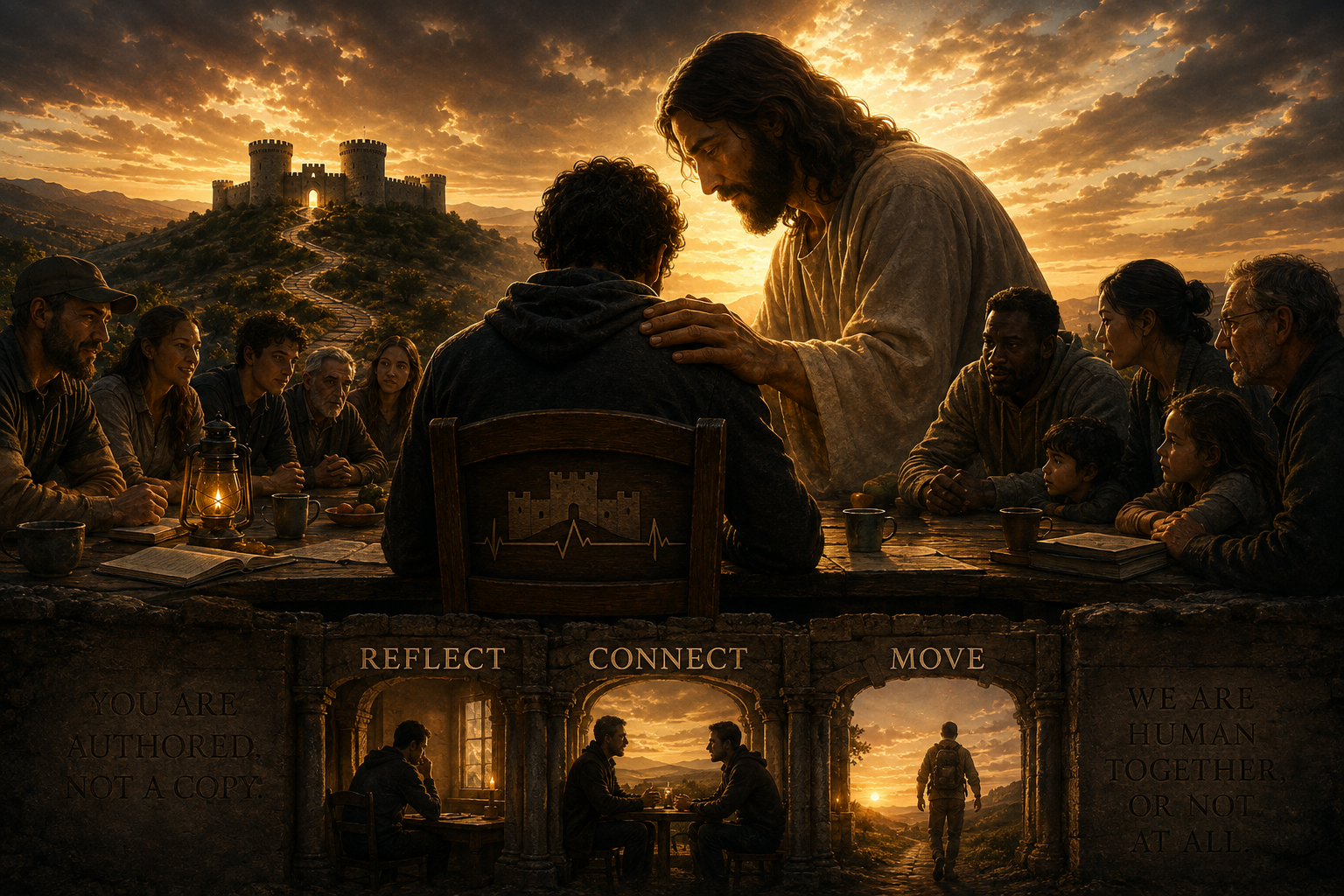
Why am I here? Why does this matter? Why should I serve, trust, believe? They are all good questions. They provide motive and point toward a direction. But in each, Why remains an idea. A mission can sound noble and still trample the people it claims to serve. A purpose can be clear and still leave the person invisible. A Why with no Who can and will justify almost anything - just look around…
The Christian story doesn’t stop at Why. God does not stay an idea, a principle, an explanation shouted from a safe distance in the heavens.
God becomes Who.
He takes on flesh. He has a name and a face. He eats, works, prays, rests, teaches, walks, grieves, touches, listens, and sits at tables with particular people who also have names. He also challenges the status quo of the time and relentlessly redirects the attention of people, groups, and the institutions of the time. He doesn't just tell us why we exist. He enters life, so we can see what a humaned person is worth.
That paragraph is worth sitting with for a while, it reveals the entire lived history of humanity for the past 2,000+ years. It's not sentiment, it’s a line in the sand.
If God can wear a human face, then no human face is to be assumed a tool. If God can take a human body, then no body is disposable. If Christ can sit at a table with fishermen, tax collectors, women, children, doubters, and enemies, then the person across from you is not a role, a score, a category, a market, a diagnosis, a profile, or a function.
God became Who so that we would stop treating the Who as a what.
We’ve written and reflected on this truth for some time. We are not thinking about this understanding according to the marketing adage of the Rule of 7, where common practice suggests that people need to see or hear something seven times before taking action. However, we want to emphasize the importance of knowing that the same God that became flesh, also Authored you and every humaned person that has or will ever live.
“Your life was received before it was achieved.”
Your worth does not begin or end when you perform well enough to please the Author. It does not rise when the room approves of you or what you have to say. It certainly doesn’t fall when someone stops finding you useful. A title after your name doesn’t make you more real or accomplished. The Author comes before every one of those valuations. You were not created by the system that later learned to measure you.
This is why the Chair matters. The Chair is not a throne for a man who answers to no one. It is the place where the Authored person faces the Author and answers for the life he was given. Sit there, and self-knowledge stops being self-invention. You stop asking which gifts the surrounding culture rewards and start asking which gifts were actually placed in you. You can admit a weakness without becoming it. You can take a correction without vanishing. You can learn from a better man without trying to become him. You can say yes without surrendering yourself, and no without hating the one who asked.
I want to be clear about something that’s been on my mind because to me September is not the time to be vague.
UMANIAMO® is structurally created as a Church under US Laws - but it was not built to save souls. That work is God's, and we don’t pretend it is ours.
Our work - all of our work - is in our name translated from Italian origins. Umani — humans. Iamo — we. We humans. Humaned together, not apart.
In our way of thinking about our work: We are Human together, or not at all & We are Humaned together, or not at all, where human is understood to be a verb of active Humaning.
Our work then is simply this, to help you:
Know yourself as Authored: not as an imposter, an avatar, a profile, a consumer, or a function. We can simplify this to mean: REFLECT or Leading Inward.
See the same truth in the man and woman across the table. We can simply say CONNECT or Leading Outward.
Build enough honest relationships that each of us can move in the direction of the Author more freely and understand and give what was entrusted to us. To us this means MOVE or Leading Together.
Together these 3 verbs REFLECT, CONNECT, MOVE flow together as part of the Humaned whole. Our work - your work really - is of enormous importance, because everything around us pulls the other way. It teaches us to become representations of ourselves: brands, feeds, résumés, optimized versions of whoever the room wants to see. We get good at it. We earn approval, access, and belonging. And the mask grows easier to wear than the face. Then one day we feel like frauds and call it imposter syndrome, as if the fix were more confidence. The real problem is the distance. The performed self has drifted too far from the Authored self. UMANIAMO® and our Humaning work does not perfect the performance. It closes the distance.
The Builder at Work does not stamp out men in his own image. If every person carries the image of God in a way no one else does, then humaning with people can never mean flattening them into one approved shape. Some read patterns, others read people, someone steadies the room, yet another imagines what it could be. One speaks first, while waits and sees what the first missed. No single person holds the whole image. That is why we need each other. Together, the image becomes clearer. Together, we become clearer too… if we know how.
Magis is the greater clarity and the greater freedom that becomes available through the one particular life you were handed. Magis is what emerges when our unique gifts are oriented toward truth. In helping another rise without needing to own the method or the results. It is being seated in your Chair without ever believing that your Chair makes you sovereign over anyone because the Chair always faces the Author.
God became Who. In doing it, He made the human person impossible to dismiss as an abstraction. The person matters before usefulness, before status, before success, before agreement, before the machine around him decides what he is worth. So we are not here to make you extraordinary. You already carry something extraordinary by being human. We are here to help you live it authentically, with courage, together.
Ad maiorem Dei gloriam. We are human together or not at all.
Perché sono qui? Perché è importante? Perché dovrei servire, fidarmi, credere? Sono tutte domande valide. Forniscono una motivazione e indicano una direzione. Ma in ciascuna di esse, il “perché” rimane un’idea. Una missione può sembrare nobile e tuttavia calpestare le persone che sostiene di servire. Uno scopo può essere chiaro e tuttavia lasciare la persona invisibile. Un «perché» senza un «chi» può giustificare e giustificherà quasi tutto: basta guardarsi intorno…
La storia cristiana non si ferma al «perché». Dio non rimane un’idea, un principio, una spiegazione gridata da una distanza sicura nei cieli.
Dio diventa “Chi”.
Si incarna. Ha un nome e un volto. Mangia, lavora, prega, riposa, insegna, cammina, soffre, tocca, ascolta e si siede a tavola con persone concrete che hanno anch’esse un nome. Sfida inoltre lo status quo del tempo e reindirizza incessantemente l’attenzione delle persone, dei gruppi e delle istituzioni dell’epoca. Non si limita a dirci perché esistiamo. Entra nella vita, così che possiamo vedere quanto vale una persona trattata con umanità.
Vale la pena soffermarsi un po’ su quel paragrafo: rivela l’intera storia vissuta dell’umanità negli ultimi oltre 2.000 anni. Non è sentimentalismo, è una linea tracciata nella sabbia.
Se Dio può assumere un volto umano, allora nessun volto umano deve essere considerato uno strumento. Se Dio può assumere un corpo umano, allora nessun corpo è usa e getta. Se Cristo può sedersi a tavola con pescatori, esattori delle tasse, donne, bambini, scettici e nemici, allora la persona che hai di fronte non è un ruolo, un punteggio, una categoria, un mercato, una diagnosi, un profilo o una funzione.
Dio si è fatto Chi affinché smettessimo di trattare il Chi come un cosa.
Abbiamo scritto e riflettuto su questa verità per un po’ di tempo. Non stiamo ragionando su questa comprensione secondo l’adagio di marketing della “Regola del 7”, secondo cui la prassi comune suggerisce che le persone debbano vedere o sentire qualcosa sette volte prima di agire. Tuttavia, vogliamo sottolineare l’importanza di sapere che lo stesso Dio che si è fatto carne, ha anche creato te e ogni persona che sia mai vissuta o che vivrà.
“La tua vita è stata ricevuta prima ancora di essere realizzata.”
Il tuo valore non inizia né finisce quando ti comporti abbastanza bene da soddisfare l’Autore. Non aumenta quando chi ti circonda approva te o ciò che hai da dire. E certamente non diminuisce quando qualcuno smette di trovarti utile. Un titolo dopo il tuo nome non ti rende più reale o realizzato. L’Autore viene prima di ogni singola valutazione. Non sei stato creato dal sistema che in seguito ha imparato a misurarti.
Ecco perché la Poltrona è importante. La Poltrona non è un trono per un uomo che non deve rendere conto a nessuno. È il luogo in cui la persona creata dall’Autore si trova di fronte all’Autore e risponde della vita che gli è stata donata. Siediti lì, e la conoscenza di sé smette di essere un’invenzione di sé. Smetti di chiederti quali doni la cultura circostante premia e inizi a chiederti quali doni ti sono stati effettivamente donati. Puoi ammettere una debolezza senza diventare essa stessa. Puoi accettare una correzione senza svanire. Puoi imparare da un uomo migliore senza cercare di diventare lui. Puoi dire sì senza rinunciare a te stesso, e no senza odiare chi te l’ha chiesto.
Voglio essere chiaro su una cosa che mi sta a cuore, perché per me settembre non è il momento di essere vaghi.
UMANIAMO® è strutturalmente costituita come Chiesa secondo le leggi degli Stati Uniti — ma non è stata creata per salvare le anime. Quell’opera spetta a Dio, e non fingiamo che sia nostra.
Il nostro lavoro — tutto il nostro lavoro — è racchiuso nel nostro nome, tradotto dalle origini italiane. Umani — esseri umani. Iamo — noi. Noi esseri umani. Umani insieme, non separati.
Nel nostro modo di concepire il nostro lavoro: siamo Umani insieme, o non lo siamo affatto; e siamo Umaniati insieme, o non lo siamo affatto, dove “umano” va inteso come verbo che indica un’azione attiva di “Umanizzazione”.
Il nostro lavoro, quindi, è semplicemente questo: aiutarvi a:
Conoscere voi stessi come Creature: non come impostori, avatar, profili, consumatori o funzioni. Possiamo semplificare questo concetto in: RIFLETTERE o “Guidare verso l’Interiore”.
Vedere la stessa verità nell’uomo e nella donna seduti dall’altra parte del tavolo. Possiamo semplicemente dire CONNETTERSI o “Condurre verso l’esterno”.
Costruire relazioni sincere a sufficienza affinché ciascuno di noi possa muoversi più liberamente nella direzione dell’Autore e comprendere e offrire ciò che ci è stato affidato. Per noi questo significa MUOVERSI o “Condurre insieme”.
Insieme, questi tre verbi – RIFLETTERE, CONNETTERSI, MUOVERSI – scorrono in armonia come parte del tutto “umanizzato”. Il nostro lavoro – in realtà il vostro lavoro – è di enorme importanza, perché tutto ciò che ci circonda spinge nella direzione opposta. Ci insegna a diventare rappresentazioni di noi stessi: marchi, feed, curriculum, versioni ottimizzate di chiunque la sala voglia vedere. Diventiamo bravi in questo. Otteniamo approvazione, accesso e senso di appartenenza. E la maschera diventa più facile da indossare del volto vero. Poi un giorno ci sentiamo degli impostori e lo chiamiamo “sindrome dell’impostore”, come se la soluzione fosse una maggiore fiducia in noi stessi. Il vero problema è la distanza. Il sé rappresentato si è allontanato troppo dal sé autentico. UMANIAMO® e il nostro lavoro di Humaning non perfezionano la rappresentazione. Colmano la distanza.
Il Costruttore all’opera non crea uomini a sua immagine. Se ogni persona porta l’immagine di Dio in un modo che nessun altro ha, allora fare Humaning con le persone non può mai significare appiattirle in un’unica forma approvata. Alcuni leggono schemi, altri leggono le persone, qualcuno stabilizza l’atmosfera, un altro ancora immagina come potrebbe essere. Uno parla per primo, mentre un altro aspetta e vede ciò che il primo ha tralasciato. Nessuna singola persona possiede l’immagine completa. Ecco perché abbiamo bisogno gli uni degli altri. Insieme, l’immagine diventa più chiara. Insieme, anche noi diventiamo più chiari… se sappiamo come fare.
Magis è la maggiore chiarezza e la maggiore libertà che si rendono disponibili attraverso quella vita particolare che ti è stata affidata. Magis è ciò che emerge quando i nostri doni unici sono orientati verso la verità. Nell’aiutare un altro a elevarsi senza bisogno di appropriarsi del metodo o dei risultati. È stare seduti sulla propria Sedia senza mai credere che la Sedia ti renda sovrano su qualcuno, perché la Sedia è sempre rivolta verso l’Autore.
Dio è diventato Chi. Così facendo, ha reso impossibile liquidare la persona umana come un’astrazione. La persona conta prima dell’utilità, prima dello status, prima del successo, prima del consenso, prima che la macchina che la circonda decida quanto vale. Quindi non siamo qui per renderti straordinario. Tu porti già in te qualcosa di straordinario per il solo fatto di essere umano. Siamo qui per aiutarti a viverlo in modo autentico, con coraggio, insieme.
Ad maiorem Dei gloriam. Siamo umani insieme o non lo siamo affatto.
Curiosity and Interest in the World
A curious person is willing to admit that the world around them may contain something they don’t yet understand. Curiosity resists the comfort of premature certainty. It makes room for another person to know something we do not know and for evidence to disturb an answer we had already settled upon. In an age of ideological enclosure, algorithmic recommendation, synthetic certainty, and ambient vigilance, that is not a small strength.
It is the strength of the Builder at Work.
Curiosity and Interest in the World now sits naturally beneath the sixth Promise, Invite Continuous Growth, because growth becomes impossible when we already know everything that matters. The person who cannot wonder cannot easily learn. The person who cannot ask another question becomes dependent on whichever answer reached them first. The person who is no longer interested in the world beyond the enclosure eventually mistakes the enclosure for the world. That doesn’t mean the Builder at Work wanders through every open gate or traverses the world without direction. Michaelic curiosity has eyes open and feet planted.
The Builder at Work does not chase novelty simply because it flashes. He is not seduced by every new idea, technology, guru, cause, movement, or promise. Curiosity without discernment becomes gullibility. Discernment without curiosity can become rigidity. The strength is found in their partnership. The Spirit at Work illuminates what deserves another look. The Builder at Work moves closer, tests, listens, studies, and learns. The Devil at Work uses novelty to keep the person moving so quickly that nothing is ever examined deeply enough to become wisdom.
This week, exercise Curiosity rather than merely admiring it.
Choose one thing in the Sunday Table that made you uncomfortable, confused, resistant, or interested. Do not immediately decide whether you agree with it. Stay with it. Write one honest question that begins with something other than “Why are they wrong?” Ask what you might not yet understand. Then follow the question one step beyond the environment that first gave it to you.
1. What is something you have recently decided you already understand, and what question might reopen it?
Certainty can become an enclosure when we stop examining what we think we know. Choose something from work, faith, technology, culture, or a relationship where your answer has become automatic, and consider what you might discover if you approached it again with genuine curiosity rather than defending your existing position.
2. Who sees something differently from you that may be worth understanding before deciding they are wrong?
Curiosity becomes relational when the Who interrupts our Why. Think of a person whose perspective challenges you and consider what experience, evidence, gift, fear, or responsibility may allow them to see something you do not. The goal is not to surrender your judgment, but to strengthen it by allowing another Authored person to enlarge the field before you discern.
3. What has been repeatedly entering your INbound gate, and is it helping you grow or merely keeping you engaged?
Look at a recurring source of attention such as an influencer, AI system, organization, cause, news source, meeting, online community, or platform. Consider what repeated participation is forming in you and whether it leaves you more curious, capable, discerning, and free to face the Author, or increasingly dependent upon the same source to tell you what to notice, believe, or do next.
Humaning is something we do together, and then carry out the door. This week the circle practices sourcing curiosity from the real and discovering that true curiosity is contagious in the best way. Gather a few people and take it slowly.
First, go around once. Each person names one thing that genuinely invited Curiosity and Interest in the World, not what they think they should, not what sounds impressive, but the real thing that makes them come alive. Say it directly, even if it seems small. Especially if it seems small. The point is to name the true source, not the acceptable one.
Then go around again, more honestly. Each person names a place where their curiosity has gone flat, where they have been performing energy they do not feel, or running on a borrowed brightness that has burned out. Do not fix it. Just name it. There is a particular relief in admitting out loud that you are tired of faking it.
Then help one another find the way back to the source. For one person at a time, let the circle ask: what actually gives feeds your curiosity that you may have stopped doing? The prayer set down. The friendship let slide. The gift that has not been exercised in years. The rest skipped over and over again. Name one small, specific way to return to it this week, not a resolution, a re-connection.
Then close by noticing what has happened in the room. When one person shares what genuinely makes them curious , something wakes in the person next to them, it kindles the inner fire. That is the opposite of manufactured curiosity or intrigue, which drains a room the longer it performs.
End however your circle ends with a prayer, a blessing, a shared silence. Then go, alive, and enliven someone.
Ad maiorem Dei gloriam. We are human together or not at all.
Curiosità e interesse per il mondo
Una persona curiosa è disposta ad ammettere che il mondo che la circonda possa contenere qualcosa che ancora non comprende. La curiosità resiste al comfort di una certezza prematura. Lascia spazio alla possibilità che un’altra persona sappia qualcosa che noi non sappiamo e che delle prove possano mettere in discussione una risposta su cui ci eravamo già fissati. In un’epoca di chiusura ideologica, raccomandazioni algoritmiche, certezze sintetiche e vigilanza pervasiva, questa non è certo una forza da poco.
È la forza del Costruttore al Lavoro.
La curiosità e l’interesse per il mondo si collocano ora naturalmente sotto la sesta Promessa, Invitare alla crescita continua, perché la crescita diventa impossibile quando crediamo di sapere già tutto ciò che conta. Chi non è capace di stupirsi non può imparare facilmente. Chi non è in grado di porre un’altra domanda diventa dipendente dalla prima risposta che gli è giunta. Chi non è più interessato al mondo al di là della recinzione finisce per scambiare la recinzione stessa per il mondo. Ciò non significa che il Costruttore al Lavoro vaghi attraverso ogni cancello aperto o attraversi il mondo senza una direzione. La curiosità micheleica ha gli occhi aperti e i piedi ben piantati a terra.
Il Costruttore al Lavoro non insegue la novità semplicemente perché lampeggia. Non si lascia sedurre da ogni nuova idea, tecnologia, guru, causa, movimento o promessa. La curiosità senza discernimento diventa credulità. Il discernimento senza curiosità può diventare rigidità. La forza sta nella loro collaborazione. Lo Spirito al Lavoro illumina ciò che merita un altro sguardo. Il Costruttore al Lavoro si avvicina, verifica, ascolta, studia e impara. Il Diavolo al Lavoro usa la novità per spingere la persona a muoversi così rapidamente che nulla viene mai esaminato abbastanza a fondo da diventare saggezza.
Questa settimana, esercita la Curiosità invece di limitarti ad ammirarla.
Scegliete una cosa nella “Tavola della Domenica” che vi abbia messo a disagio, confuso, suscitato resistenza o suscitato interesse. Non decidete immediatamente se siete d’accordo o meno. Rimanete su quel punto. Scrivete una domanda sincera che non inizi con “Perché hanno torto?”. Chiedetevi cosa potreste non aver ancora compreso. Poi seguite la domanda un passo oltre l’ambiente che ve l’ha suggerita inizialmente.
1. Qual è una cosa che di recente hai deciso di aver già compreso, e quale domanda potrebbe riaprire la questione?
La certezza può trasformarsi in una gabbia quando smettiamo di esaminare ciò che pensiamo di sapere. Scegliete qualcosa che riguardi il lavoro, la fede, la tecnologia, la cultura o una relazione in cui la vostra risposta è diventata automatica, e riflettete su cosa potreste scoprire se la affrontaste di nuovo con sincera curiosità, anziché difendere la vostra posizione attuale.
2. Chi vede le cose in modo diverso da voi e potrebbe valere la pena comprendere prima di decidere che ha torto?
La curiosità diventa relazionale quando il “Chi” interrompe il nostro “Perché”. Pensa a una persona la cui prospettiva ti mette alla prova e considera quale esperienza, prova, dono, paura o responsabilità possa permetterle di vedere qualcosa che a te sfugge. L’obiettivo non è rinunciare al tuo giudizio, ma rafforzarlo consentendo a un’altra persona con una propria visione di ampliare il campo prima che tu giunga a una conclusione.
3. Cosa sta entrando ripetutamente nel tuo “INbound gate”, e ti sta aiutando a crescere o semplicemente ti tiene occupato?
Osserva una fonte ricorrente di attenzione, come un influencer, un sistema di intelligenza artificiale, un’organizzazione, una causa, una fonte di notizie, una riunione, una comunità online o una piattaforma. Considera cosa sta formando in te questa partecipazione ripetuta e se ti rende più curioso, capace, perspicace e libero di affrontare l’Autore, oppure sempre più dipendente dalla stessa fonte che ti dice cosa notare, credere o fare dopo.
Humaning è qualcosa che facciamo insieme e che poi portiamo fuori dalla porta.
Questa settimana il circolo si esercita a trarre la curiosità dal reale e a scoprire che la vera curiosità è contagiosa nel senso migliore del termine. Raduna alcune persone e procedi con calma.
Per prima cosa, fate un giro di parole. Ogni persona nomina una cosa che autenticamente ha suscitato Curiosità e Interesse nel Mondo, non ciò che pensa di dover dire, non ciò che suona impressionante, ma la cosa reale che la fa sentire viva. Dillo in modo diretto, anche se sembra una cosa da poco. Soprattutto se sembra una cosa da poco.
Il punto è indicare la vera fonte, non quella socialmente accettabile.
Poi fate un altro giro, con maggiore onestà. Ognuno nomini un ambito in cui la propria curiosità si è affievolita, in cui ha finto di avere un’energia che non provava, o ha attinto a una luce presa in prestito che ormai si è esaurita. Non cercate di risolvere il problema. Limitatevi a nominarlo. C’è un particolare sollievo nell’ammettere ad alta voce che siete stanchi di fingere.
Poi aiutatevi a vicenda a ritrovare la strada per tornare alla fonte. Una persona alla volta, lasciate che il cerchio chieda: cosa alimenta davvero la vostra curiosità che forse avete smesso di fare? La preghiera messa da parte. L’amicizia trascurata. Il dono che non viene esercitato da anni. Il riposo saltato più e più volte. Indicate un piccolo modo specifico per ritornarvi questa settimana, non un proposito, ma una riconnessione.
Concludete poi osservando cosa è successo nella stanza. Quando una persona condivide ciò che la rende sinceramente curiosa, qualcosa si risveglia nella persona accanto a lei, accendendo il fuoco interiore. Questo è l’opposto della curiosità o dell’intrigo artificiali, che prosciugano l’energia di una stanza man mano che si protraggono.
Concludete comunque il vostro cerchio con una preghiera, una benedizione, un silenzio condiviso. Poi andate, pieni di vita, e infondete vita a qualcuno.
Ad maiorem Dei gloriam. Siamo umani insieme o non lo siamo affatto.
Cosiamo | Founder, UMANIAMO® | Humaning Architecture
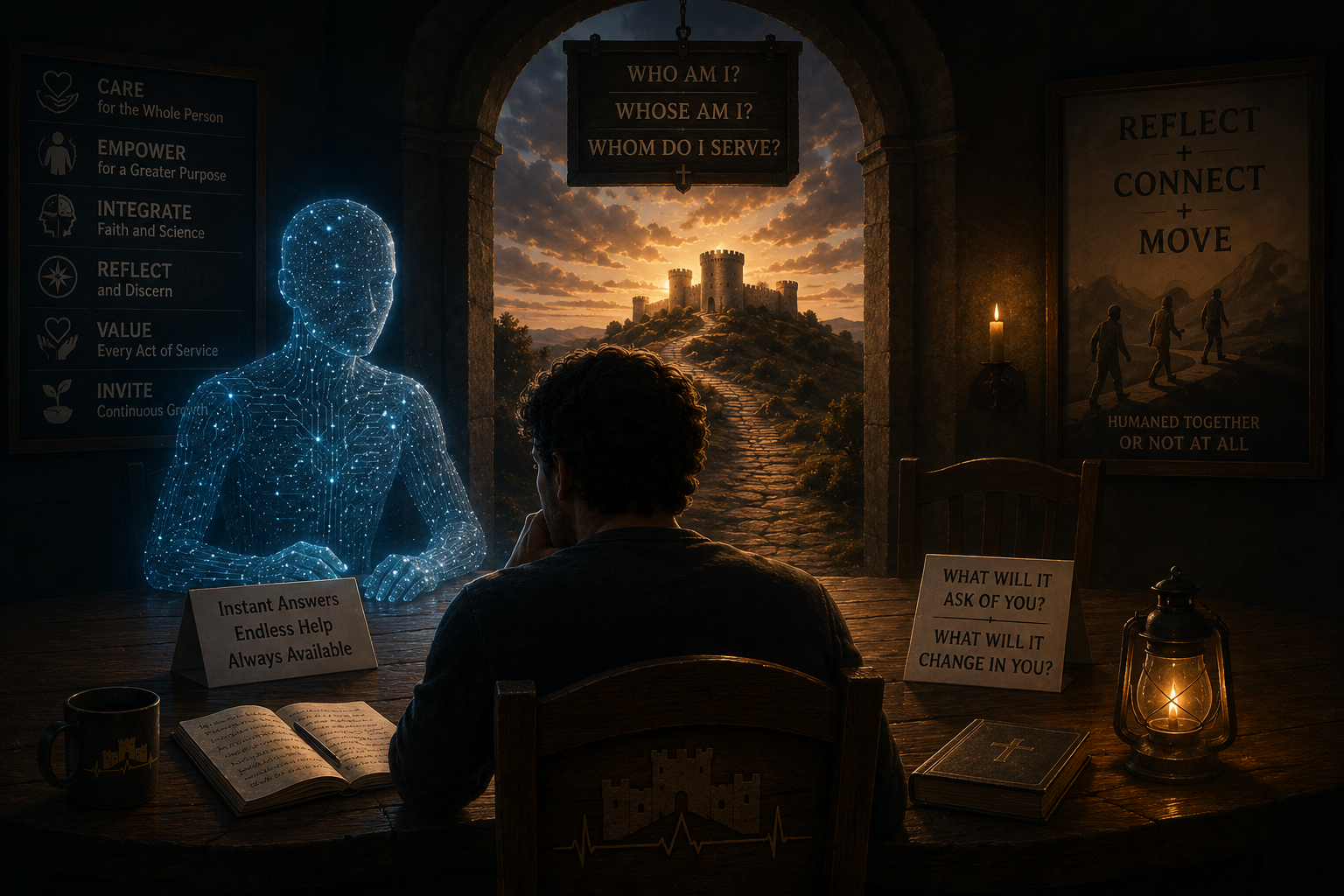
Most relationships start with some kind of invitation and there is usually a moment when you recognize that a relationship is beginning and decide how much of yourself to bring into it.
Now imagine being told that someone has arranged a blind date for you. You didn't ask for the introduction. You do not know much about the person. You are told that everyone seems to like them, that they are brilliant, helpful, quick, and increasingly difficult to resist. Your employer thinks you should meet them. Your school may insist upon it. The software you already use has begun bringing them into the conversation whether you requested the introduction or not.
Then, before you have learned very much about this new companion, you are encouraged to tell them about your work. Perhaps you share something confidential. You ask for advice. You tell them what frustrates you. You describe the people you work with. You give them unfinished ideas. You allow them to finish your sentences. Eventually you may even begin asking them what you should think. That would be a rather strange first date.
Yet it is not very far from the way artificial intelligence is entering many of our lives.
We usually think about relationships as though they involve another human person, but the INbound side of our relational architecture has always included more than friendship. Things come toward us too. In addition to people wanting something from us, people ask something of us: institutions make claims upon our attention; media enters the room; employers establish expectations; schools define participation; and technologies invite habits. Sometimes what we are asked is welcome and sometimes it is useful. However, sometimes it was never really invited at all. Artificial intelligence increasingly belongs in that INbound field.
Something we all need to ask ourselves is: what kind of relationship is being created around the asker - in this case AI, and what is that relationship begins asking of the humaned person - you.
Our friend Jake offered an unexpectedly useful image while describing how he teaches motocross riders. Before the throttle, before braking, before suspension adjustments, he wants the rider to locate the body. The rider establishes posture, balance, stability, tension, and awareness before engaging the power of the motorcycle. Otherwise the force of the bike begins dictating what happens to the rider. His teaching begins with a simple embodied conviction: the human initiates the relationship with the machine rather than merely hanging on to whatever the machine does next. That seems like very good counsel for considerably more than motocross.
Before opening the door to your blind date, you might ask which direction you are facing. You might notice what has brought you here. You may remember “Whose” you are before deciding what we are willing to surrender. You may even ask what this relationship is likely to require from you and what repeated participation could begin to change in you and your most important relationship.
All of this is ordinary discernment. We practice some version of it whenever we enter a new place for dinner. We do not normally walk into an unfamiliar restaurant, sit at the first table we see, consume everything placed in front of us, tell the stranger beside us our private history, give the kitchen access to everything in our briefcase, and then ask the waiter to make your major life decisions. You look around first and figure out something about where you are. You decide what you want on the menu and more often what you don’t want as well.
The Sunday Table is precisely the kind of place where this type of preparation is practiced. AI doesn’t need to be treated as an enemy before entering the room. Fear is not discernment but neither is fascination. Both can make us stop paying attention.
The more useful perspective for any of us in these relationships may be whether we are still free enough to decide the terms of participation. Can you still say no?
That question sounds almost too simple until we begin applying it. If a software feature appears, can you turn it off? If your employer encourages AI use, can you decide that a particular task requires your own judgment? If your school begins expecting you to use an AI assistant or use AI to evaluate your work, can you choose to opt out? If an algorithm or system recommends what to read, write, buy, believe, or do next, can you ignore the recommendation without feeling that you are doing something irrational? The answer does not always need to be no. In many cases, the answer may quite reasonably be yes. The point is whether there remains a genuine answer or are you dealing with an ideological enclosure?
Something I’ve been thinking about recently, which is worth considering, is the importance of Informed Human Participation. Participation should mean more than being present when a technology is deployed around us. A person should understand enough about the relationship to exercise judgment within it. What information are we giving away? What work may be retained or learned from? What human capability are we delegating? What happens to the person when that delegation becomes routine? What expectations are changing because the technology is present? What choices remain?
These are not questions for the providers, policy makers, or specialists alone. They belong to ordinary people just like us because we the people are the ones being formed through repeated participation.
Once use of any technology begins carrying employment, performance, or professional consequences, the relationship has changed even when the interface looks exactly the same. The deeper question becomes whether participation is meaningfully voluntary and whether the person retains the practical ability to slow, stop, or redirect what the system is doing. That capacity to slow, stop, or redirect may be one of the clearest signs that your Chair is still occupied.
Of course this doesn’t mean that you can control everything around you. It means that you are responsible for the part that is yours and that your choices are your own. It means that you alone can answer, whom do I serve and what does it serve?
This week The Sunday Table places those two questions beside one another.
Whom does this serve? | Whom do I serve? Between them stands the humaned person, you.
This is why your or anyone else’s concern can’t just stop with whether AI produces good answers. A system can produce an excellent answer and still participate in a relationship that leaves the human person less capable of judging the next one. It can make something easier without making the person stronger. It can remove friction that was useless, or it can remove precisely the friction through which patience, memory, judgment, craftsmanship, or courage was being formed. Each of us must learn the difference.
The Six Promises of the Humaning Covenant give us a way to notice. Does the relationship care for the whole person, or only the productive portion? Does it increase agency, or quietly increase dependence? Does it leave room for evidence, conscience, faith, and honest inquiry, or does it make one mode of knowing seem sufficient? Does it preserve the interval required for reflection and discernment? Does it help us recognize the human service that cannot be captured by the metric? Does participation leave us more capable of continued growth?
These questions do not tell us whether to use AI. They help us remain human while deciding.
Perhaps AI is increasingly like a blind date arranged by the employer, the school, the software company, or the culture itself. We may not have chosen the introduction. We may discover that the relationship is useful, interesting, frustrating, fruitful, or unavoidable. But we should still know who we are and what is being asked of us. We should still know which direction we are facing.
Ad maiorem Dei gloriam. We are human together or not at all.
L’IA come relazione “inbound”
La maggior parte delle relazioni inizia con una sorta di invito e di solito c’è un momento in cui ti rendi conto che sta nascendo una relazione e decidi quanto di te stesso voler mettere in gioco.
Ora immagina che ti venga detto che qualcuno ti ha organizzato un appuntamento al buio. Non hai chiesto di essere presentato. Non sai molto di quella persona. Ti viene detto che sembra piacere a tutti, che è brillante, disponibile, brillante e sempre più difficile da resistere. Il tuo datore di lavoro pensa che dovresti incontrarla. La tua scuola potrebbe insistere affinché tu lo faccia. Il software che già utilizzi ha iniziato a inserirla nella conversazione, indipendentemente dal fatto che tu ne avessi fatto richiesta o meno.
Poi, prima ancora di aver imparato molto su questa nuova compagna, vieni incoraggiato a parlarle del tuo lavoro. Forse condividi qualcosa di riservato. Chiedi un consiglio. Gli racconti cosa ti frustra. Descrivi le persone con cui lavori. Gli affidi idee incomplete. Gli permetti di finire le tue frasi. Alla fine potresti persino iniziare a chiedergli cosa dovresti pensare. Sarebbe un primo appuntamento piuttosto strano.
Eppure non è molto diverso dal modo in cui l’intelligenza artificiale sta entrando nella vita di molti di noi.
Di solito pensiamo alle relazioni come se coinvolgessero un’altra persona umana, ma il lato “INbound” della nostra architettura relazionale ha sempre incluso più della semplice amicizia. Anche le cose vengono verso di noi. Oltre alle persone che vogliono qualcosa da noi, ci sono persone che ci chiedono qualcosa: le istituzioni reclamano la nostra attenzione; i media entrano nella stanza; i datori di lavoro stabiliscono delle aspettative; le scuole definiscono la partecipazione; e le tecnologie inducono abitudini. A volte ciò che ci viene chiesto è ben accetto e a volte è utile. Tuttavia, a volte non è mai stato realmente richiesto. L’intelligenza artificiale appartiene sempre più a quel campo “INbound”.
Una domanda che tutti dobbiamo porci è: che tipo di relazione si sta creando attorno a chi chiede – in questo caso l’IA – e cosa quella relazione comincia a chiedere alla persona umana, cioè a te.
Il nostro amico Jake ha offerto un’immagine inaspettatamente utile mentre descriveva come insegna ai piloti di motocross. Prima dell’acceleratore, prima della frenata, prima delle regolazioni delle sospensioni, vuole che il pilota trovi la giusta posizione del corpo. Il pilota stabilisce postura, equilibrio, stabilità, tensione e consapevolezza prima di attingere alla potenza della moto. Altrimenti, è la forza della moto a dettare ciò che accade al pilota. Il suo insegnamento parte da una semplice convinzione radicata: è l’essere umano a dare inizio alla relazione con la macchina, anziché limitarsi a subire passivamente ciò che la macchina farà dopo. Sembra un ottimo consiglio, valido ben oltre il motocross.
Prima di aprire la porta al tuo appuntamento al buio, potresti chiederti in quale direzione sei rivolto. Potresti notare cosa ti ha portato qui. Potresti ricordarti “di chi” sei prima di decidere a cosa sei disposto a rinunciare. Potresti persino chiederti cosa questa relazione potrebbe richiedere da te e cosa una partecipazione ripetuta potrebbe cominciare a cambiare in te e nella tua relazione più importante.
Tutto questo è semplice discernimento. Ne mettiamo in pratica una qualche versione ogni volta che entriamo in un nuovo locale per cenare. Normalmente non entriamo in un ristorante sconosciuto, non ci sediamo al primo tavolo che vediamo, non consumiamo tutto ciò che ci viene servito, non raccontiamo alla persona sconosciuta accanto a noi la nostra storia personale, non diamo alla cucina accesso a tutto ciò che c’è nella nostra valigetta e poi non chiediamo al cameriere di prendere le nostre decisioni più importanti della vita. Prima ci guardiamo intorno e cerchiamo di capire qualcosa del posto in cui ci troviamo. Decidiamo cosa vogliamo dal menu e, più spesso, anche cosa non vogliamo.
The Sunday Table è proprio il tipo di posto in cui si mette in pratica questo tipo di preparazione. L’IA non deve essere trattata come un nemico prima ancora di entrare nella stanza. La paura non è discernimento, ma nemmeno lo è il fascino. Entrambe possono farci smettere di prestare attenzione.
La prospettiva più utile per chiunque di noi in queste relazioni potrebbe essere chiedersi se siamo ancora abbastanza liberi da decidere le condizioni della nostra partecipazione. Si può ancora dire di no?
Questa domanda sembra quasi troppo semplice finché non iniziamo ad applicarla. Se viene introdotta una funzionalità software, riesci a disattivarla? Se il tuo datore di lavoro incoraggia l’uso dell’IA, puoi decidere che un determinato compito richieda il tuo giudizio personale? Se la tua scuola inizia ad aspettarsi che tu utilizzi un assistente basato sull’IA o che utilizzi l’IA per valutare il tuo lavoro, puoi scegliere di non partecipare? Se un algoritmo o un sistema ti consiglia cosa leggere, scrivere, acquistare, credere o fare dopo, riesci a ignorare il consiglio senza sentirti come se stessi facendo qualcosa di irrazionale? La risposta non deve necessariamente essere sempre «no». In molti casi, la risposta può essere, in tutta ragionevolezza, «sì». Il punto è: esiste ancora una risposta autentica o ci troviamo di fronte a un «recinto ideologico»?
Un aspetto su cui ho riflettuto di recente, e che vale la pena considerare, è l’importanza della partecipazione umana informata. Partecipare dovrebbe significare qualcosa di più che essere semplicemente presenti quando una tecnologia viene implementata intorno a noi. Una persona dovrebbe comprendere a sufficienza la relazione per poter esercitare il proprio giudizio al suo interno. Quali informazioni stiamo cedendo? Quali attività possono essere mantenute o da cui si può imparare? Quali capacità umane stiamo delegando? Cosa succede alla persona quando tale delega diventa routine? Quali aspettative stanno cambiando a causa della presenza della tecnologia? Quali scelte rimangono?
Queste non sono domande rivolte esclusivamente ai fornitori, ai responsabili politici o agli specialisti. Appartengono alle persone comuni proprio come noi, perché siamo noi, le persone, ad essere plasmati attraverso la partecipazione ripetuta.
Non appena l’uso di una tecnologia inizia a comportare conseguenze sull’occupazione, sulle prestazioni o sulla carriera, il rapporto è cambiato anche se l’interfaccia appare esattamente la stessa. La domanda più profonda diventa se la partecipazione sia significativamente volontaria e se la persona conservi la capacità pratica di rallentare, fermare o reindirizzare ciò che il sistema sta facendo. Quella capacità di rallentare, fermare o reindirizzare potrebbe essere uno dei segni più evidenti che la tua “poltrona” è ancora occupata.
Naturalmente questo non significa che possiate controllare tutto ciò che vi circonda. Significa che siete responsabili della parte che vi appartiene e che le vostre scelte sono solo vostre. Significa che solo voi potete rispondere: chi servo e a cosa serve?
Questa settimana The Sunday Table mette queste due domande una accanto all’altra.
A chi serve questo? | Chi servo? Tra di esse si trova la persona umana, voi.
Ecco perché la tua preoccupazione, o quella di chiunque altro, non può limitarsi a chiedersi se l’IA produca buone risposte. Un sistema può produrre una risposta eccellente e tuttavia partecipare a una relazione che rende la persona umana meno capace di giudicare quella successiva. Può rendere qualcosa più facile senza rendere la persona più forte. Può rimuovere attriti che erano inutili, oppure può rimuovere proprio quegli attriti attraverso i quali si formavano la pazienza, la memoria, il giudizio, l’abilità artigianale o il coraggio. Ognuno di noi deve imparare a cogliere la differenza.
Le Sei Promesse dell'Alleanza Umanizzante ci offrono un modo per renderci conto di ciò. La relazione si prende cura della persona nella sua interezza, o solo della parte produttiva? Aumenta l'autonomia, o accresce silenziosamente la dipendenza? Lascia spazio alle prove, alla coscienza, alla fede e alla ricerca onesta, oppure fa sembrare sufficiente un unico modo di conoscere? Preserva l’intervallo necessario per la riflessione e il discernimento? Ci aiuta a riconoscere quel contributo umano che non può essere colto dalle metriche? La partecipazione ci rende più capaci di una crescita continua?
Queste domande non ci dicono se usare l’IA. Ci aiutano a rimanere umani mentre decidiamo.
Forse l’IA assomiglia sempre più a un appuntamento al buio organizzato dal datore di lavoro, dalla scuola, dall’azienda di software o dalla cultura stessa. Potremmo non aver scelto noi l’incontro. Potremmo scoprire che la relazione è utile, interessante, frustrante, fruttuosa o inevitabile. Ma dovremmo comunque sapere chi siamo e cosa ci viene chiesto. Dovremmo comunque sapere in quale direzione siamo rivolti.
Ad maiorem Dei gloriam. Siamo umani insieme o non lo siamo affatto.
Is that supposed to happen?

“I think I am getting dumber.” That thought may sound like a joke or maybe you feel it too.
Maybe it comes after a long day bouncing between AI, email, social media, messages, search results, video clips, notifications, and documents.
You walk away from the screen and discover that forming a complete thought feels strangely difficult. You know you have consumed a great deal of information, but you are not sure what you remember. You have answered messages all day and struggle to remember what you actually wanted to say. You have produced a surprising amount of work, yet somewhere underneath the productivity there is a quiet suspicion that you exercised less of yourself in producing it. That is worth noticing.
It does not prove that artificial intelligence or multi-tasking is making us stupid. It does not mean that every digital tool is harmful. It may not even mean that anything serious is happening. But if you repeatedly find yourself thinking, “I feel less capable than I used to,” perhaps the answer should not immediately be another productivity hack. Perhaps we should become curious.
Humans have always built tools that allow us to do more than we could do alone. There is nothing inherently troubling about this. A hammer increases the force of the hand and stone. A telescope extends sight. A calculator performs arithmetic faster than most of us ever will. A motorcycle or car allows the human body to move with astonishing speed and force.
A person can become extraordinarily productive while certain underlying capacities weaken. We already know this intuitively from ordinary life. If someone always drives us somewhere, we may never learn the route. If someone else always cooks, we may remain well fed without becoming capable of feeding ourselves. If every problem is solved for a child, the child may have an easier childhood while becoming less prepared for difficulty. Ease and growth are not synonyms.
Artificial intelligence makes this question much more interesting because it does not merely extend capabilities. It increasingly enters domains we have associated with humaned thinking itself. It writes, summarizes, recalls, organizes, searches, calculates, translates, recommends, compares, explains, and generates. Those can be enormously useful, but this also means that we need to pay attention to what we stop exercising.
In the past you may have sat with a blank page until the first sentence came; now a machine gives you six pages in seconds. You used to read a whole article book because you needed to understand it; now you ask for the summary.
You used to practice or write down names to recall a person’s name, reconstruct an argument, find your own way to a place, make the comparison, or explain the idea in your own words. Some of that struggle was probably wasted effort. Humaned persons don’t become more virtuous by making every task difficult. There is no special reward in refusing a calculator when the calculation does not matter. But some forms of difficulty are not defects in the process. They are the process. Learning to write involves the struggle to decide what we actually mean. Reading difficult material stretches attention. Remembering requires retrieval. Explaining an idea reveals whether we understand it. Making a judgment under uncertainty requires us to tolerate the discomfort of not yet knowing.
If every uncomfortable interval is immediately filled by an answer, you may eventually discover that you have become very good at retrieving answers and less practiced at forming them. That is the part worth watching. Growth leaves evidence and so does atrophy. Perhaps that is what the sentence “I’m feeling dumber” is trying to tell us. It may be the felt sense of a capacity that has not been exercised enough lately. Your attention span feels shorter and memory feels a little fuzzy. Conversation becomes harder and you may even reach for your phone during every empty moment. We know many things have passed in front of our eyes, but find fewer things stick with us even for a few moments. That does not make the feeling proof. Felt sense is neither proof nor noise. It is an invitation to examine.
D.E.E.P.E.R.™ gives us somewhere to begin. It invites you to consider: What is actually happening? When do I notice this most strongly? What evidence supports the feeling, and what may simply be fatigue? Who am I becoming through the pattern? Who around me is affected by the way I am present or absent? Where will this lead if I repeat it for another year? What small action could test whether the capacity returns? What is this relationship forming in me? The answers may surprise you.
Perhaps the issue is not AI alone. It may be the entire cognitive environment surrounding it. AI followed by social media followed by email followed by video followed by more AI creates very little room in which the human mind remains with anything for long. Every signal arrives already competing with another signal. Eventually even silence can feel uncomfortable. That is when the Lantern of The Devil at Work becomes dangerous. The Lantern does not need to lie about everything. It only needs to illuminate enough of the room that we stop noticing how small the room has become. We call that an ideological enclosure - a machine that can answer almost any question is an extraordinary tool. The danger begins when the availability of an answer reduces our willingness to remain with the question and thus makes the space - the room smaller. This may be why “I’m feeling dumber” deserves to be treated as a form of discernment. This is the deeper concern behind what we call Cognitive Sustainment - exercising your humaned capabilities like you would exercise any muscle. We don’t only need human judgment when everything is working. We need it most when the system fails, the information conflicts, the stakes become moral and ethical, the answer is ambiguous, or the person across from us cannot be reduced to the available categories. Those are precisely the moments when “the machine usually does this for me” becomes a dangerous sentence.
Here’s a sentence to post somewhere that you will see: What capacities in me are becoming stronger, and which ones am I quietly ceasing to exercise?
Then look for evidence. Perhaps we discover that AI has helped us understand something more deeply, explore perspectives we would not have encountered, communicate more clearly, or undertake work that previously felt inaccessible. That is evidence too.
The Builder at Work remains curious about the mind. He notices when something is strengthening and when something is contracting. Maybe the strange gift of feeling a little dumber is that we noticed. The more troubling condition would be never noticing at all. So this week, start to use the Sunday Table as Cognitive Gym! We are stronger when we work-out together! The Sunday Table gives us somewhere we can be stronger together.
È normale che succeda?
“Credo di stare diventando più stupido.” Questo pensiero potrebbe sembrare uno scherzo, oppure forse lo provi anche tu.
Forse ti viene in mente dopo una lunga giornata passata a passare dall’intelligenza artificiale alle e-mail, dai social media ai messaggi, dai risultati di ricerca ai video, dalle notifiche ai documenti.
Ti allontani dallo schermo e scopri che formulare un pensiero completo ti sembra stranamente difficile. Sai di aver assimilato una grande quantità di informazioni, ma non sei sicuro di cosa ricordi. Hai risposto ai messaggi tutto il giorno e fai fatica a ricordare cosa volessi dire in realtà. Hai prodotto una quantità sorprendente di lavoro, eppure, da qualche parte sotto quella produttività, c’è un vago sospetto che tu abbia impiegato meno di te stesso per realizzarlo. Vale la pena notarlo.
Questo non dimostra che l’intelligenza artificiale o il multitasking ci stiano rendendo stupidi. Non significa che ogni strumento digitale sia dannoso. Potrebbe anche non significare che stia accadendo nulla di grave. Ma se ti ritrovi ripetutamente a pensare: «Mi sento meno capace di un tempo», forse la risposta non dovrebbe essere immediatamente un altro trucco per la produttività. Forse dovremmo diventare curiosi.
Gli esseri umani hanno sempre costruito strumenti che ci permettono di fare più di quanto potremmo fare da soli. Non c’è nulla di intrinsecamente preoccupante in questo. Un martello aumenta la forza della mano e della pietra. Un telescopio allunga lo sguardo. Una calcolatrice esegue operazioni aritmetiche più velocemente di quanto la maggior parte di noi potrà mai fare. Una moto o un’auto permette al corpo umano di muoversi con velocità e forza sorprendenti.
Una persona può diventare straordinariamente produttiva mentre alcune capacità di fondo si indeboliscono. Lo sappiamo già intuitivamente dalla vita quotidiana. Se qualcuno ci accompagna sempre da qualche parte, potremmo non imparare mai il percorso. Se qualcun altro cucina sempre, potremmo rimanere ben nutriti senza diventare capaci di nutrirci da soli. Se ogni problema viene risolto per un bambino, questi potrebbe avere un’infanzia più serena, ma diventare meno preparato ad affrontare le difficoltà. Facilità e crescita non sono sinonimi.
L’intelligenza artificiale rende questa questione molto più interessante perché non si limita semplicemente ad ampliare le capacità. Entra sempre più in ambiti che abbiamo associato al pensiero umano stesso. Scrive, riassume, ricorda, organizza, cerca, calcola, traduce, consiglia, confronta, spiega e genera. Queste capacità possono essere estremamente utili, ma ciò significa anche che dobbiamo prestare attenzione a ciò che smettiamo di esercitare.
In passato forse rimanevi seduto davanti a una pagina bianca finché non ti veniva in mente la prima frase; ora una macchina ti fornisce sei pagine in pochi secondi. Un tempo leggevi un intero articolo o un libro perché avevi bisogno di comprenderlo; ora chiedi il riassunto.
Un tempo vi esercitavate o scrivevate i nomi per ricordarvi il nome di una persona, ricostruire un ragionamento, trovare da soli la strada per un luogo, fare un confronto o spiegare un’idea con parole vostre. Probabilmente parte di quella fatica era uno sforzo inutile. Le persone non diventano più virtuose rendendo difficile ogni compito. Non c’è alcuna ricompensa speciale nel rifiutare la calcolatrice quando il calcolo non ha importanza. Ma alcune forme di difficoltà non sono difetti del processo. Sono il processo stesso. Imparare a scrivere comporta la fatica di decidere cosa intendiamo realmente. Leggere materiale difficile allunga l’attenzione. Ricordare richiede il recupero delle informazioni. Spiegare un’idea rivela se la comprendiamo. Esprimere un giudizio in condizioni di incertezza ci impone di tollerare il disagio di non sapere ancora.
Se ogni intervallo di disagio viene immediatamente colmato da una risposta, potresti alla fine scoprire di essere diventato molto bravo a recuperare risposte e meno abile nel formularle. È proprio questa la parte su cui vale la pena prestare attenzione. La crescita lascia tracce, così come l’atrofia. Forse è proprio questo che la frase «Mi sento più stupido» sta cercando di dirci. Potrebbe essere la sensazione percepita di una capacità che ultimamente non è stata esercitata a sufficienza. La tua capacità di concentrazione sembra più breve e la memoria un po’ confusa. Conversare diventa più difficile e potresti persino ritrovarti a prendere il telefono in ogni momento di pausa. Sappiamo che molte cose ci sono passate davanti agli occhi, ma ci rendiamo conto che poche rimangono impresse, anche solo per qualche istante. Questo non rende la sensazione una prova. La sensazione provata non è né una prova né un rumore di fondo. È un invito a indagare.
D.E.E.P.E.R.™ ci offre un punto da cui partire. Ti invita a chiederti: cosa sta realmente accadendo?
Quando lo noto con maggiore intensità? Quali prove sostengono questa sensazione e cosa potrebbe essere semplicemente stanchezza? Chi sto diventando attraverso questo schema? Chi intorno a me è influenzato dal modo in cui sono presente o assente? Dove mi porterà tutto questo se continuo così per un altro anno? Quale piccola azione potrebbe verificare se la capacità ritorna? Che tipo di relazione si sta formando in me? Le risposte potrebbero sorprenderti.
Forse il problema non è solo l’IA. Potrebbe essere l’intero ambiente cognitivo che la circonda. L’IA seguita dai social media, seguita dall’e-mail, seguita dai video, seguita da altra IA, crea pochissimo spazio in cui la mente umana possa soffermarsi a lungo su qualcosa. Ogni segnale arriva già in competizione con un altro segnale. Alla fine persino il silenzio può sembrare scomodo. È allora che la Lanterna di «The Devil at Work» diventa pericolosa. La Lanterna non ha bisogno di mentire su tutto. Deve solo illuminare la stanza quel tanto che basta affinché smettiamo di notare quanto sia diventata piccola. La chiamiamo “recinto ideologico”: una macchina in grado di rispondere a quasi ogni domanda è uno strumento straordinario. Il pericolo inizia quando la disponibilità di una risposta riduce la nostra disponibilità a soffermarci sulla domanda e quindi restringe lo spazio – la stanza. Forse è per questo che “Mi sento più stupido” merita di essere considerato una forma di discernimento. Questa è la preoccupazione più profonda che sta dietro a ciò che chiamiamo «Sostenibilità cognitiva» – esercitare le proprie capacità umane come si eserciterebbe qualsiasi muscolo. Non abbiamo bisogno del giudizio umano solo quando tutto funziona. Ne abbiamo più bisogno quando il sistema fallisce, le informazioni sono in conflitto, la posta in gioco diventa morale ed etica, la risposta è ambigua o la persona che abbiamo di fronte non può essere ridotta alle categorie disponibili. Sono proprio quei momenti in cui «di solito ci pensa la macchina» diventa una frase pericolosa.
Ecco una frase da appendere da qualche parte dove la vedrete: Quali capacità in me si stanno rafforzando e quali sto silenziosamente smettendo di esercitare?
Poi cercate delle prove. Forse scopriremo che l’IA ci ha aiutato a comprendere qualcosa più a fondo, a esplorare prospettive che non avremmo mai incontrato, a comunicare in modo più chiaro o a intraprendere un lavoro che prima ci sembrava inaccessibile. Anche questa è una prova.
Il Costruttore al Lavoro continua a nutrire curiosità per la mente. Si accorge quando qualcosa si rafforza e quando qualcosa si indebolisce. Forse lo strano dono di sentirci un po’ più stupidi è proprio quello di averlo notato. La condizione più preoccupante sarebbe non accorgersene affatto. Quindi questa settimana, iniziate a usare la Tavola della Domenica come palestra cognitiva! Siamo più forti quando ci alleniamo insieme! La Tavola della Domenica ci offre un luogo dove possiamo diventare più forti insieme.
Ad maiorem Dei gloriam. Siamo umani insieme o non lo siamo affatto.
A Blueprint for the Builder at Work

Last week, we looked outward and asked who we are choosing to help, support, recommend, encourage, and stand behind. In the SMARTER Castle, OUTbound Relationships are not simply the people we know. They include the people and organizations toward whom we deliberately extend ourselves. A charity we support, a person we mentor, a community we serve, a cause we recommend, or someone whose growth we choose to encourage all become part of our OUTbound relational architecture. That is why When Why Becomes Who really mattress because a cause can have an admirable Why, but eventually we need to ask who is actually being served, who is being formed, and whether the fruit bears any resemblance to the purpose we were promised.
This week we turn toward the other tower.
INbound Relationships include the people who come toward us and depend on us for something. They may be customers, coworkers, direct reports, supervisors, family members, friends, neighbors, community members, students, clients, or people who come looking for advice, support, care, expertise, attention, or help. These relationships matter because Humaning is not merely about deciding where we will direct ourselves. It is also about discerning what and who we allow to come through the gates.
This is one of the reasons the SMARTER Castle has walls. We’ve tackled this before: Walls are not a rejection of a relationship. They make relationships possible without surrendering the whole interior of our lives.
A healthy castle like a happy home has doors and happy countries have borders. People enter, they leave, hospitality happens, messages are received, requests are made, there may be some exchange, and people leave. Friends come to the Table and some strangers may become friends. The wall does not exist because everything outside is dangerous. It exists because discernment requires a threshold.
That threshold has become increasingly difficult to see. Today, what comes knocking at the door isn’t always a person at all. A request for our attention may have been generated by a bot. A carefully worded appeal may have been optimized by an algorithm. A cause may “find” you because a platform has predicted which image, fear, grievance, kitten, child, crisis, or story is most likely to move you to act. An influencer may speak into your home every day with the warmth and familiarity of a friend while knowing almost nothing about you except your Google Analytics scores. The relationship may feel personal while the architecture underneath it is built almost entirely around extraction.
There is nothing especially new about the desire to extract attention, money, loyalty, labor, or belonging. Today, however, the costumes have changed.
Yesterday's promise of sudden wealth arrived through a seminar, a mailing list, or a multilevel marketing opportunity. Today's version may arrive through a perfectly edited lie of a life telling us to subscribe, follow, join, upgrade, support, become a member, send a Super Chat, or buy access to the secret that finally made everything work.
The sales language has become relationally targeted. Stop and think about that for a minute - because it matters. The “person” on the screen may call us family. A community may call us one of them. A movement may tell us that belonging requires repeating its slogans. A platform may reward us for returning. A cause may imply that asking a question proves we do not care enough. An artificial companion may respond with endless availability and apparent affirmation. But familiarity is not reciprocity, visibility or access is not intimacy, and attention isn’t care. A parasocial relationship is not automatically a human relationship simply because it feels relational from one side.
The Lantern of the Devil at Work rarely tries to make darkness look attractive. Instead, he can make the enclosure feel warm. That may be one of the great challenges we face at this moment. We may be living through an age of ambient vigilance, where part of our cognition remains continuously occupied with scanning. What changed? Is this real? Can I trust this person? Is that photograph authentic? Is this message from who it claims to be from? Is this recommendation genuine? Will this job still exist? Is the answer coming from a person? Is this outrage organic or manufactured? What happens if I do not respond?
We can become exhausted even while sitting still because some part of you never stops standing watch. The Sunday Table offers a counter-environment to that vigilance, not because we suggest whom to trust, but because it gives you somewhere and some ways to exercise the capacities by which trust can be discerned.
This week's Magis Movement therefore turns the Six Promises toward the INbound gate.
This week, don’t try to solve the entire problem of influence, AI, social media, work, relationships, or trust. That would become another enclosure of its own. Instead, practice at the gate.
Take ten minutes and review what actually entered your life during the past week. Open your calendar and find one meeting you did not initiate. Look at the invitation and remember what happened. What did the person who requested the meeting want from you? Did they need your judgment, agreement, labor, expertise, approval, attention, reassurance, access, or simply your presence? Then look at your media history. Review ten minutes of YouTube, Instagram, news, podcast, or other content history. Do not begin by counting the hours or accusing yourself of wasting time. Look instead at what repeatedly gained admission. What wanted your attention, and what happened to you after you gave it?
Now bring those encounters under the Six Promises, not as six questions someone else has to pass, but as six actions you are responsible for practicing.
Care for the Whole Person: Notice what the relationship did to your Authored self. Don’t evaluate the meeting only by whether something was accomplished or the video only by whether you learned something interesting. Notice what happened to your attention, your body, your patience, your relationships, your peace, and your ability to remain present afterward. Then act. If an INbound relationship repeatedly leaves the whole person depleted, agitated, fragmented, or smaller, change the terms of entry. Shorten the meeting, turn off the notification, leave the channel, create space, or choose a different time to engage.
Empower Individuals for a Greater Purpose: Notice whether the person, organization, platform, or system coming toward you helps you become more capable of standing on your own feet or continually creates another reason you need to return. Then do something that restores agency. Ask for the information rather than the interpretation. Learn the skill instead of remaining dependent upon the expert. Write the first paragraph before requesting the AI draft. Ask the person directly rather than letting a platform tell you what they think. Good help should eventually make you more capable of helping yourself and someone else.
Integrate Faith and Science: Keep your view open. Do not allow a preferred explanation to become true merely because it comforts you, agrees with your politics, supports your organization, comes from a favorite personality, or was delivered confidently by a machine. Follow one claim back to evidence. Look for what would challenge it. Then bring conscience into the same field. A fact is not an enemy of faith, and faith is not an excuse to ignore what is actually happening. The Builder has enough courage to let truth disturb the story he wanted to believe.
Encourage Reflection and Discernment: Create an interval before one INbound demand receives your response. If a meeting request arrives, ask what the meeting is intended to accomplish before accepting. If a story makes you angry, do not immediately share it. If an AI response seems persuasive, do not immediately act on it. If a cause produces urgency, wait long enough to discover whether urgency is part of the truth or part of the persuasion. The interval is not indecision. It is where responsibility returns to the Chair.
Value Every Act of Service: Notice whether the relationship recognizes human contribution that cannot be converted into attention, money, visibility, or metrics. Look this week for one person doing work that holds something together without receiving much recognition. Thank them. Help them. Name what they did. This exercise matters because extractive architectures teach us to notice only what creates measurable value. Humaning retrains the eye to recognize the human acts that sustain a room long before anyone calculates their return.
Invite Continuous Growth: Change one relationship so that it leaves more room for becoming. This may mean asking a better question of someone who always comes to you for an answer instead of answering immediately. It may mean leaving an online enclosure that has stopped teaching you anything new. It may mean following someone whose perspective complicates your own. It may mean learning enough about an AI system to make an informed decision rather than accepting or rejecting it because of what others say. Growth requires movement, but not every movement is growth. Choose the one that leaves you more capable of discerning the next step.
These Six Promises are not a scorecard for judging the people outside the tower. They are ways of remaining human while deciding what belongs inside it.
Now choose one INbound relationship from the week and take it through the D.E.E.P.E.R.™ Blueprint. Do not choose the most dramatic relationship in your life. Choose one you encounter often enough that repeated participation could actually be forming you.
Details: Write down what happened without explaining it. Name what came toward you, what was requested, what you gave, and what occurred next. If the relationship is a person, stay with the observable interaction. If it is an organization, platform, AI system, cause, or media personality, record what you actually saw, heard, clicked, shared, purchased, disclosed, accepted, or returned to. Resist the temptation to decide what it means before you know what happened.
Evidence: Examine why you believe what you believe about the relationship. If you trust it, identify the evidence that earned the trust. If you distrust it, identify what produced the concern. If you believe participation is necessary, determine what makes it necessary. If someone claims that everyone is doing something, look for evidence beyond the claim. The analytical mind can build a powerful Why, but Why must remain answerable to reality.
Empathy: Identify the people inside the architecture. Who benefits? Who bears the cost? Who depends upon the relationship? Who remains invisible? Who is monetized, measured, influenced, helped, ignored, or formed? If the relationship involves AI or a platform, remember that the Who includes you. The most sophisticated system in the world can still become an enclosure if the human person disappears from the analysis.
Prospective: Look beyond the immediate interaction. Imagine another six months or another year of the same pattern. What becomes stronger in you? What becomes easier? What becomes harder? What might you stop practicing because the relationship now performs it for you? What might deepen because the relationship challenges or equips you? Growth and atrophy both leave evidence, but sometimes we have to look downstream before the evidence becomes visible.
Execution: Change one thing. Protect one hour. Decline one meeting. Ask one person for clarification. Turn off one recommendation stream. Verify one claim. Write something yourself. Ask another human before asking the machine. Learn one feature before giving an AI system access to more information. Do not make the action heroic. Make it real.
Reflection: Return to the Chair after you have acted. Notice what happened when you changed the terms of the relationship. Did you feel relief, fear, guilt, irritation, freedom, curiosity, or a strong urge to return to the old pattern? Do not make the feeling the verdict. Bring it before the Author. Ask what the movement is forming in you and whether you are becoming more available to truth, responsibility, relationship, service, and love.
The Blueprint doesn’t give you an answer. It strengthens the person who must answer.
Then CONNECT. Tell one person what you noticed and ask what they see. Do not recruit them into your conclusion. Give them room to exercise their own discernment.
Then MOVE. Change one gate for seven days and watch the evidence.
This is Magis as practice. The greater good does not emerge because we consume a better explanation. It emerges because a more discerning person enters the relationship differently.
Un progetto per il costruttore al lavoro
La settimana scorsa abbiamo guardato verso l’esterno e ci siamo chiesti chi stiamo scegliendo di aiutare, sostenere, raccomandare, incoraggiare e appoggiare. Nel Castello SMARTER, le relazioni OUTbound non sono semplicemente le persone che conosciamo. Includono le persone e le organizzazioni verso cui ci rivolgiamo deliberatamente. Un’organizzazione benefica che sosteniamo, una persona a cui facciamo da mentore, una comunità che serviamo, una causa che raccomandiamo o qualcuno di cui scegliamo di incoraggiare la crescita diventano tutti parte della nostra architettura relazionale “OUTbound”. Ecco perché Quando il “Perché” diventa “Chi” è davvero fondamentale, perché una causa può avere un “Perché” ammirevole, ma alla fine dobbiamo chiederci chi viene effettivamente aiutato, chi viene formato e se il frutto assomiglia in qualche modo allo scopo che ci era stato promesso.
Questa settimana ci rivolgiamo all’altra torre.
Le relazioni “INbound” includono le persone che vengono verso di noi e dipendono da noi per qualcosa. Possono essere clienti, colleghi, collaboratori diretti, supervisori, familiari, amici, vicini, membri della comunità, studenti, committenti o persone che vengono in cerca di consigli, sostegno, cura, competenza, attenzione o aiuto. Queste relazioni sono importanti perché l’essere umani non consiste semplicemente nel decidere dove indirizzare noi stessi. Si tratta anche di discernere cosa e chi permettiamo di varcare i cancelli.
Questo è uno dei motivi per cui il Castello SMARTER ha delle mura. Ne abbiamo già parlato in precedenza: le mura non sono un rifiuto di una relazione. Rendono possibili le relazioni senza rinunciare all’intero interno delle nostre vite.
Un castello sano, come una casa felice, ha delle porte e i paesi felici hanno dei confini. Le persone entrano, escono, c’è ospitalità, si ricevono messaggi, si fanno richieste, può esserci qualche scambio, e le persone se ne vanno. Gli amici si siedono a tavola e alcuni sconosciuti possono diventare amici. Il muro non esiste perché tutto ciò che sta fuori è pericoloso. Esiste perché il discernimento richiede una soglia.
Quella soglia è diventata sempre più difficile da vedere. Oggi, ciò che bussa alla porta non è sempre una persona. Una richiesta della nostra attenzione potrebbe essere stata generata da un bot. Un appello formulato con cura potrebbe essere stato ottimizzato da un algoritmo. Una causa potrebbe “trovarti” perché una piattaforma ha previsto quale immagine, paura, rimostranza, gattino, bambino, crisi o storia sia più probabile che ti spinga ad agire. Un influencer potrebbe parlarti ogni giorno con il calore e la familiarità di un amico pur non sapendo quasi nulla di te, se non i tuoi punteggi di Google Analytics. La relazione potrebbe sembrare personale, mentre l’architettura sottostante è costruita quasi interamente intorno all’estrazione.
Non c’è nulla di particolarmente nuovo nel desiderio di estrarre attenzione, denaro, fedeltà, lavoro o senso di appartenenza. Oggi, tuttavia, le forme si sono cambiate.
La promessa di ricchezza improvvisa di un tempo arrivava tramite un seminario, una mailing list o un’opportunità di marketing multilivello. La versione odierna può arrivare attraverso una vita che è una bugia perfettamente montata, che ci dice di iscriverci, seguire, aderire, passare a un piano superiore, sostenere, diventare membri, inviare una Super Chat o acquistare l’accesso al segreto che finalmente ha fatto funzionare tutto.
Il linguaggio di vendita è diventato mirato alle relazioni. Fermati un attimo a rifletterci, perché è importante. La “persona” sullo schermo potrebbe chiamarci “famiglia”. Una comunità potrebbe definirci “uno di loro”. Un movimento potrebbe dirci che per sentirci parte di esso dobbiamo ripetere i suoi slogan. Una piattaforma potrebbe ricompensarci per essere tornati. Una causa potrebbe sottintendere che porre una domanda dimostri che non ci teniamo abbastanza. Un compagno artificiale potrebbe rispondere con disponibilità infinita e apparente approvazione. Ma la familiarità non è reciprocità, la visibilità o l’accesso non sono intimità, e l’attenzione non è cura. Una relazione parasociale non è automaticamente una relazione umana semplicemente perché da una parte sembra relazionale.
La Lanterna del Diavolo all’opera raramente cerca di rendere attraente l’oscurità. Piuttosto, può far sembrare accogliente lo spazio chiuso. Questa potrebbe essere una delle grandi sfide che affrontiamo in questo momento. Potremmo vivere in un’era di vigilanza ambientale, in cui parte della nostra cognizione rimane continuamente occupata a scrutare. Cosa è cambiato? È reale? Posso fidarmi di questa persona? Quella fotografia è autentica? Questo messaggio proviene davvero da chi dice di provenire?
Questa raccomandazione è sincera? Questo lavoro esisterà ancora? La risposta proviene da una persona? Questo sdegno è spontaneo o artificiale? Cosa succede se non rispondo?
Possiamo sentirci esausti anche stando seduti immobili perché una parte di noi non smette mai di stare di guardia. The Sunday Table offre un ambiente alternativo a quella vigilanza, non perché suggeriamo di chi fidarsi, ma perché offre un luogo e dei modi per esercitare le capacità grazie alle quali è possibile discernere la fiducia.
Il Movimento Magis di questa settimana rivolge quindi le Sei Promesse verso la porta INbound.
Questa settimana, non cercare di risolvere l’intero problema dell’influenza, dell’IA, dei social media, del lavoro, delle relazioni o della fiducia. Ciò diventerebbe un’altra gabbia a sé stante. Esercitati invece alla porta.
Prenditi dieci minuti e ripensa a ciò che è effettivamente entrato nella tua vita durante la settimana appena trascorsa. Apri il tuo calendario e individua un incontro che non hai organizzato tu. Guarda l’invito e ricorda cosa è successo. Cosa voleva da te la persona che ha richiesto l’incontro? Aveva bisogno del tuo giudizio, del tuo consenso, del tuo lavoro, della tua competenza, della tua approvazione, della tua attenzione, di rassicurazioni, di accesso o semplicemente della tua presenza? Poi esamina la cronologia dei tuoi social. Ripassa dieci minuti di YouTube, Instagram, notizie, podcast o altri contenuti. Non iniziare a contare le ore o ad accusarti di aver perso tempo. Osserva invece ciò che ha ripetutamente ottenuto spazio. Cosa ha richiesto la tua attenzione e cosa ti è successo dopo che gliel’hai data?
Ora inserisci questi incontri nelle Sei Promesse, non come sei domande che qualcun altro deve superare, ma come sei azioni che hai la responsabilità di mettere in pratica.
Prenditi cura della persona nella sua interezza: Nota cosa ha fatto quella relazione al tuo “io autore”. Non valutare l’incontro solo in base al fatto che sia stato raggiunto un risultato o il video solo in base al fatto che tu abbia imparato qualcosa di interessante. Osserva cosa è successo alla tua attenzione, al tuo corpo, alla tua pazienza, alle tue relazioni, alla tua serenità e alla tua capacità di rimanere presente in seguito. Poi agisci. Se una relazione “INbound” lascia ripetutamente la persona nella sua interezza svuotata, agitata, frammentata o sminuita, modifica le condizioni di accesso. Accorcia l’incontro, disattiva la notifica, esci dal canale, crea spazio o scegli un momento diverso per interagire.
Responsabilizza le persone per uno scopo più grande: Osserva se la persona, l’organizzazione, la piattaforma o il sistema che si avvicina a te ti aiuta a diventare più capace di reggerti sulle tue gambe o crea continuamente un altro motivo per cui devi tornare. Poi fai qualcosa che ripristini la tua autonomia. Chiedi le informazioni piuttosto che l’interpretazione. Impara l’abilità invece di rimanere dipendente dall’esperto. Scrivi il primo paragrafo prima di richiedere la bozza all’IA. Chiedi direttamente alla persona piuttosto che lasciare che sia una piattaforma a dirti cosa ne pensa. Un buon aiuto dovrebbe, alla fine, renderti più capace di aiutare te stesso e qualcun altro.
Integra fede e scienza: Mantieni una visione aperta. Non permettere che una spiegazione preferita diventi vera solo perché ti conforta, è in linea con le tue idee politiche, sostiene la tua organizzazione, proviene da una personalità che apprezzi o è stata fornita con sicurezza da una macchina. Risali a una prova per verificare ogni affermazione. Cerca ciò che potrebbe metterla in discussione. Poi coinvolgi la coscienza in questo stesso processo. Un fatto non è nemico della fede, e la fede non è una scusa per ignorare ciò che sta realmente accadendo. Il Costruttore ha abbastanza coraggio da lasciare che la verità sconvolga la storia a cui voleva credere.
Incoraggia la riflessione e il discernimento: Concediti un po’ di tempo prima di rispondere a una richiesta in arrivo. Se ricevi una richiesta di incontro, chiediti quale sia lo scopo dell’incontro prima di accettare. Se una notizia ti fa arrabbiare, non condividerla immediatamente. Se una risposta dell’IA sembra persuasiva, non agire immediatamente in base ad essa. Se una causa suscita urgenza, aspetta abbastanza a lungo da scoprire se l’urgenza fa parte della verità o fa parte della persuasione. L’intervallo non è indecisione. È il momento in cui la responsabilità torna al Presidente.
Valorizza ogni atto di servizio: Osserva se la relazione riconosce il contributo umano che non può essere convertito in attenzione, denaro, visibilità o metriche. Cerca questa settimana una persona che svolga un lavoro che tiene insieme qualcosa senza ricevere molto riconoscimento. Ringraziatela. Aiutatela. Date un nome a ciò che ha fatto. Questo esercizio è importante perché le architetture estrattive ci insegnano a notare solo ciò che crea valore misurabile. L’“humaning” rieduca lo sguardo a riconoscere gli atti umani che sostengono un ambiente ben prima che qualcuno ne calcoli il ritorno.
Incoraggiate la crescita continua: cambiate una relazione in modo che lasci più spazio al divenire. Questo può significare porre una domanda migliore a qualcuno che viene sempre da voi in cerca di una risposta, invece di rispondere immediatamente.
Potrebbe significare abbandonare un ambiente online che ha smesso di insegnarti qualcosa di nuovo. Potrebbe significare seguire qualcuno la cui prospettiva complica la tua. Potrebbe significare imparare abbastanza su un sistema di intelligenza artificiale per prendere una decisione informata, piuttosto che accettarlo o rifiutarlo in base a ciò che dicono gli altri. La crescita richiede movimento, ma non ogni movimento è crescita. Scegli quello che ti rende più capace di discernere il passo successivo.
Queste sei promesse non sono una scheda di valutazione per giudicare le persone al di fuori della torre. Sono modi per rimanere umani mentre si decide cosa appartiene al suo interno.
Ora scegli una relazione INbound della settimana e analizzala attraverso il modello D.E.E.P.E.R.™. Non scegliere la relazione più drammatica della tua vita. Scegline una che incontri abbastanza spesso da poter essere effettivamente plasmato dalla tua partecipazione ripetuta.
Dettagli: Scrivi cosa è successo senza spiegarlo. Indica cosa ti è stato presentato, cosa ti è stato chiesto, cosa hai dato e cosa è successo dopo. Se la relazione riguarda una persona, limitati all’interazione osservabile. Se si tratta di un’organizzazione, una piattaforma, un sistema di intelligenza artificiale, una causa o un personaggio dei media, registra ciò che hai effettivamente visto, sentito, cliccato, condiviso, acquistato, rivelato, accettato o a cui sei tornato. Resisti alla tentazione di decidere cosa significhi prima di sapere cosa è successo.
Evidenza: Esamina perché credi ciò che credi riguardo alla relazione. Se ti fidi, identifica le prove che hanno guadagnato quella fiducia. Se diffidi, identifica cosa ha generato la preoccupazione. Se ritieni che la partecipazione sia necessaria, determina cosa la rende necessaria. Se qualcuno sostiene che tutti stiano facendo qualcosa, cerca prove al di là di tale affermazione. La mente analitica può costruire un potente «Perché», ma il «Perché» deve rimanere rispondibile alla realtà.
Empatia: Identificate le persone all’interno dell’architettura. Chi ne beneficia? Chi ne sostiene il costo? Chi dipende da questa relazione? Chi rimane invisibile? Chi viene monetizzato, misurato, influenzato, aiutato, ignorato o plasmato? Se la relazione coinvolge l’IA o una piattaforma, ricordate che quel “chi” include anche voi. Anche il sistema più sofisticato al mondo può comunque trasformarsi in una gabbia se la persona umana scompare dall’analisi.
Prospettiva: Guarda oltre l’interazione immediata. Immagina altri sei mesi o un altro anno dello stesso schema. Cosa diventa più forte in te? Cosa diventa più facile? Cosa diventa più difficile? Cosa potresti smettere di praticare perché ora è la relazione a farlo per te? Cosa potrebbe approfondirsi perché la relazione ti sfida o ti fornisce gli strumenti? Sia la crescita che l’atrofia lasciano tracce, ma a volte dobbiamo guardare a valle prima che le tracce diventino visibili.
Esecuzione: Cambia una cosa. Riservati un’ora. Rifiuta un incontro. Chiedi chiarimenti a una persona. Disattiva un flusso di raccomandazioni. Verifica un’affermazione. Scrivi qualcosa di tuo pugno. Chiedi a un altro essere umano prima di chiedere alla macchina. Impara a usare una funzione prima di concedere a un sistema di IA l’accesso a ulteriori informazioni. Non rendere l’azione eroica. Rendila reale.
Riflessione: Torna alla Sedia dopo aver agito. Osserva cosa è successo quando hai cambiato i termini della relazione. Hai provato sollievo, paura, senso di colpa, irritazione, libertà, curiosità o un forte impulso a tornare al vecchio schema? Non lasciare che la sensazione sia il verdetto. Portala davanti all’Autore. Chiedi che cosa si sta formando in te attraverso questo movimento e se stai diventando più disponibile alla verità, alla responsabilità, alla relazione, al servizio e all’amore.
Il Progetto non ti dà una risposta. Rafforza la persona che deve rispondere.
Poi CONNETTITI. Racconta a una persona ciò che hai notato e chiedi cosa vede. Non coinvolgerla nella tua conclusione. Lascia spazio affinché eserciti il proprio discernimento.
Poi AGISCI. Cambia un punto di vista per sette giorni e osserva i risultati.
Questo è il Magis messo in pratica. Il bene maggiore non emerge perché ci accontentiamo di una spiegazione migliore. Emerge perché una persona più perspicace entra nella relazione in modo diverso.
Ad maiorem Dei gloriam. Siamo umani insieme o non lo siamo affatto.
Cosiamo | Founder, UMANIAMO® | Humaning Architecture

There are moments when something enters our lives before we have decided whether we want a relationship with it. A technology appears inside the tools we already use. A new requirement arrives at work. An organization asks for information it did not need yesterday. A platform wants access to our voice, our image, our attention, our habits, or our work. A cause asks for loyalty before it has earned trust. A person asks us to surrender judgment in the name of urgency. An ideology offers belonging if we will stop asking difficult questions. Sometimes the request is obvious. Sometimes it arrives so gently that we only recognize what has happened after something inside us begins to feel diminished. (does this sound familiar?)
That feeling deserves your attention.
You may not know whether what you are sensing is danger, unfamiliarity, fear, resistance, or genuine discernment. You don’t have to know immediately. Your first responsibility is to stop long enough to notice. Return to your Chair and remember that the person sitting is Authored.
That is where Informed Human Participation begins. It begins with the recognition that participation worthy of a humaned person must involve enough freedom and understanding for the person to remain responsible for what he gives, what he accepts, what he delegates, and what he refuses. Consent cannot become a ritual performed after the meaningful choices have already disappeared. Agreement cannot simply be assumed because everyone else entered the room. Adoption cannot become obedience simply because the new architecture is convenient, profitable, popular, or difficult to avoid.
The Builder at Work does not meet that reality with panic. He stands.
He looks carefully at what has tried to enter through the gate. He asks what it wants. He examines what it promises and what it quietly requires in return. He distinguishes assistance from substitution, participation from extraction, influence from manipulation, relationship from enclosure, and legitimate authority from the attempt to occupy a place that authority does not possess. This is not a suspicion of the world. It is stewardship of what has been entrusted to us.
There will be many things worth welcoming. There will be technologies that enlarge our ability to serve, people whose wisdom strengthens us, institutions worthy of trust, communities that make us more capable, and tools that remove burdens that never needed to be carried by a humaned person in the first place. Informed Human Participation leaves us free to say yes to these things wholeheartedly. But a meaningful yes requires the possibility of no.
There may come a moment when the request crosses a threshold. Something may ask for access to information that should remain protected. A system may seek to use our work to train something we did not knowingly agree to build. A synthetic representation may be created from our face, voice, words, or identity without meaningful permission. A workplace may ask us to delegate a judgment we believe we remain morally responsible to make. A platform may turn relationship into behavioral extraction. An organization may demand conformity where conscience still has questions. A machine may be positioned between two human beings in a relationship we believe requires humaned presence. When that moment comes, the question is not whether we can produce the most sophisticated argument. The question is whether we can still occupy the Chair.
I will remember that my life was received before it was measured and that my dignity does not depend upon my usefulness to the system in front of me. I will not knowingly surrender judgment simply because synthetic intelligence can provide an answer faster. I will seek to understand what I am being asked to give before I give it, what I am being asked to delegate before I delegate it, and what repeated participation may be forming in me before habit makes the decision for me. I will not confuse familiarity with trust, synthetic representation with human presence, personalization with relationship, urgency with moral obligation, or inevitability with truth. When something asks for my attention, labor, likeness, voice, knowledge, loyalty, agreement, or conscience, I will protect enough of an interval to discern what is actually being requested.
When I sense extraction, I will not immediately run, and I will not automatically comply. I will look again. I will gather Details. I will examine the Evidence. I will recover the Who. I will look toward Where the movement leads. I will choose an Execution that remains mine to make, and I will return in Reflection to the Author before whom my choices ultimately stand.
I will use the Six Promises not as standards by which I condemn others, but as actions by which I govern my own participation. I will care for the whole person, including myself. I will increase agency rather than dependence. I will hold evidence, conscience, embodiment, faith, and honest inquiry in the same field. I will preserve room for reflection and discernment. I will recognize service that cannot be reduced to a metric. I will invite growth rather than accept an architecture that requires people to become smaller so that the system can become larger.
When conscience requires no, I will seek the courage to say no without hatred. When truth permits yes, I will say yes without fear. When I do not yet know, I will refuse the pressure to pretend certainty. I will ask questions. I will seek counsel. I will remain teachable. I will accept that discernment can require time and that time spent protecting responsible judgment is not wasted simply because someone else wants an immediate answer.
I will also protect this freedom in the person across from me. I will not demand from another the surrender I would resist for myself. I will not treat reluctance as disloyalty simply because I am enthusiastic. I will not call someone backward because they ask what a technology is doing to them. I will not use authority to erase conscience when honest dialogue remains possible. I will remember that the other person is also Authored and that their Chair does not belong to me.
This is not withdrawal from the world. It is a promise to enter the world awake. It is not a refusal of technology. It is a refusal to allow technology to decide what a human being is for. It is not defiance for its own sake. It is the disciplined courage to participate without disappearing.
The Spirit at Work does not ask us to become afraid of everything knocking at the gate. The Spirit illuminates enough for us to see what is actually there. The Builder at Work then accepts the responsibility to decide what enters, what remains outside, what requires another look, and what may be welcomed with gratitude.
That is a masculine courage deeper than domination. It does not need to control every force around it. It needs to remain ordered enough not to be controlled by every force that arrives.
So when something in you says, “This does not feel right,” do not immediately dismiss the signal and do not immediately make it the verdict. Return to the Chair. Examine it. Discern it. Pray. Speak with someone you trust. Look for the evidence. Ask whom it serves. Ask whom you serve. Then act.
This is our Covenantal Commitment to Informed Human Participation. We will enter relationships awake, remain responsible for what is ours, protect the dignity and freedom of the person beside us, and resist any architecture that asks us to become less human in exchange for belonging, convenience, safety, approval, or usefulness.
We are human together, or not at all.
The Cost of Remaining in the Chair
“If you worry about consequence, you will never bring about change.” — Tommy Robinson
This is not an invitation to become reckless or indifferent to consequences. The Builder at Work considers consequences carefully because other human beings may have to live with the results of his choices. But there comes a point when calculating consequences can become another way of surrendering agency. If fear of losing approval, employment, access, status, comfort, or belonging becomes the deciding voice, discernment has quietly been replaced by self-preservation.
Informed Human Participation asks something harder. After you have gathered the evidence, considered the people affected, examined where the movement is leading, sought counsel, and faced the Author honestly, there may still be a cost attached to what you know you should do. The existence of that cost does not make the discernment wrong. Sometimes it is precisely the cost that reveals how much pressure has been surrounding the Chair.
The Michaelic response is not to seek conflict. It is to remain standing when truth creates one. Courage does not mean that consequences disappear; courage means consequences do not become the Author of the decision.
This matters especially when something feels extractive. A workplace may expect participation. A platform may make leaving inconvenient. A group may make questioning costly. An ideology may make belonging conditional. A technology may be presented as inevitable. In each case, the temptation is to tell ourselves that we have no choice because choosing differently might cost too much.
The Builder remembers that prudence and fear are not the same thing. He does not throw away responsibility in pursuit of dramatic resistance, but neither does he surrender conscience merely to avoid discomfort. He asks what belongs to him to do, accepts that faithful action may carry a price, and refuses to let anticipated punishment make the decision before discernment has even begun.
That is why “Can I still say no?” matters. The answer may ultimately be yes. The answer may be no. The answer may be not yet. But it should remain an answer reached from the Chair rather than one imposed by fear of what will happen if we refuse.
Change rarely begins when everyone feels safe enough to permit it. Sometimes it begins when one humaned person recognizes the interference around the Chair, remembers Whose he is, and decides that consequence will be considered honestly but will no longer be allowed to masquerade as conscience.
September arrives just as we leave the twenty-eight days of Turn the Table™ behind. The workbook may be complete, but the work is not. If August taught us to return to the Chair, read the room, separate signal from noise, and act for the greater good, September asks what happens when those practices become part of ordinary life. The saints remembered this week offer an unusually fitting beginning. Their stories are not about constant visibility or effortless certainty. They are stories of people who exercised judgment, changed direction, protected what had been entrusted to them, served when service was costly, and allowed their lives to be formed through repeated fidelity.
August 31 - Saints Joseph of Arimathea and Nicodemus
Joseph of Arimathea and Nicodemus both appear in the Gospels as men of standing who were drawn toward Jesus while navigating the danger of being publicly associated with Him. Nicodemus first came to Jesus at night, asking questions. Joseph is described as a member of the council who ultimately offered his own tomb for the body of Christ. After the Crucifixion, when following Jesus appeared to have produced nothing but defeat, these two men stepped forward to perform the deeply human work of caring for His body. Their movement matters precisely because there was little worldly advantage left in making it.
Humaning Reflection: Discernment is not proved by the questions we ask while safely hidden; eventually it asks something of us. Joseph and Nicodemus moved from interior recognition toward embodied responsibility. They remind us that Cognitive Cardio is not simply thinking harder. It is strengthening the capacity to recognize when the moment for movement has arrived. There may be places in our own lives where we already know enough, but fear, reputation, convenience, or uncertainty has kept us at a distance. The question for the Table is whether something we have been quietly discerning now requires us to step forward and care for what is ours to care for.
September 1 - Sant’Egidio
He was a hermit whose life became associated with prayer, simplicity, hospitality, and care for those pushed to the margins. His memory became especially strong in medieval Europe, where churches, hospitals, and communities were placed under his patronage. What began as a life of withdrawal did not become a life of indifference. The solitude created room for a different kind of presence to others.
Humaning Reflection: Sant’Egidio reminds us that stepping away from noise is not the same as withdrawing from responsibility. Sometimes we need enough distance from the room to recognize what the room has been doing to us. Silence restores the interval in which discernment becomes possible. Yet the purpose of that restoration is not enclosure. We return so that we can see more clearly whom we are called to serve. As September begins, we might ask whether there is enough unoccupied space in our own lives for the Author to interrupt the stories, feeds, demands, and expectations that otherwise tell us who we should become.
September 2 - San Zeno of Nicomedia
Saint Zeno of Nicomedia is remembered with his sons Concordius and Theodore as martyrs during the reign of Julian the Apostate. Tradition preserves their fidelity during a period in which political authority was attempting to reverse Christianity's place within the Roman world. Their witness belongs to the long Christian memory of people for whom belonging to the surrounding system could not finally supersede allegiance to God.
Humaning Reflection: touches directly on the question we have begun asking about agency: Can I still say no? The ability to refuse is not the highest expression of freedom, but without it freedom becomes difficult to recognize. Every age produces pressures that present themselves as inevitable. The pressure may be religious, political, economic, social, or technological. Discernment does not require us to oppose everything around us. It requires enough sovereignty to distinguish participation from submission. Cognitive and spiritual formation prepare us for the moment when conscience has to remain present even when conformity would be easier.
September 3 - San Gregorio Magno
Gregory the Great is remembered as pope, pastor, theologian, and one of the great Doctors of the Western Church, but his name also still echoes every time we speak of Gregorian chant. Tradition long credited Gregory directly with organizing or even composing the chant of the Roman Church. Modern scholarship is more cautious and finds little evidence that he personally created the repertoire that later carried his name, yet the association itself tells us something important about his legacy: Gregory became a symbol of the Church's effort to preserve, order, teach, and transmit prayer through the human voice. Gregorian chant developed as a form in which Scripture was not merely read but breathed, remembered, and carried together through melody.
That musical inheritance eventually contributed to another extraordinary development in human formation. Centuries after Gregory, the Italian monk Guido of Arezzo developed a method for teaching singers the relationships between pitches using the syllables ut, re, mi, fa, sol, and la, drawn from the hymn Ut queant laxis in honor of Saint John the Baptist whose Passion is celebrated on August 29th (yesterday). That system became the foundation of what we know today as solmization and, eventually, solfège. Gregory did not invent solfège, but the world of sung prayer associated with Gregorian tradition helped create the need for better ways to teach, remember, reproduce, and share music across generations.
Humaning Reflection: For Gregory his human capacity was not outsourced; it was formed and transmitted. People learned to listen carefully, control breath, remember long passages, distinguish intervals, coordinate their voices with others, and eventually teach another person to do the same. The innovation did not make the singer unnecessary. It made the singer more capable. The notation, the syllables, and the method served the human voice rather than replacing it.
There is also something deeply fitting about this for the Sunday Table as a Cognitive Gym. Gregorian chant is not principally a spectator experience. It asks the person to participate. Breath, attention, memory, hearing, voice, and relationship have to work together. Solfège later gave the learner a scaffold through which something that initially seemed difficult could become embodied capability. The tool served formation until the person could carry more of the music within themselves.
The Humaning reflection for Gregory's day might therefore be to notice the difference between a tool that performs for us and a tool that teaches us to perform more fully ourselves. Both may be useful, but they leave different evidence in the humaned person. As we enter September and begin treating the Sunday Table more deliberately as Cognitive and Relational Cardio, Gregory's musical legacy gives us an old and beautiful test for new technologies: does this help me exercise, remember, listen, participate, and eventually contribute my own voice, or does it slowly teach me that my voice is unnecessary?
A choir does not become stronger because one perfect voice sings for everyone. It becomes stronger because distinct voices learn how to listen, breathe, enter, rest, and sing together. That is a fitting image of Humaning itself. We do not lose our particular voice in the whole; through disciplined relationships, we learn how to offer it.
September 4 - Santa Rosalia
Saint Rosalia, deeply beloved in Palermo and throughout Sicily, was born into a noble family but left the privileges of court life for the solitude of a hermitage. Centuries after her death, her memory became especially associated with Palermo during a devastating plague, when devotion to her spread through the city and she came to be honored as its patroness. Her September 4 feast remains particularly significant in Sicily.
Humaning Reflection: Her life moved away from a form of status that the surrounding culture would have recognized immediately. That movement did not make her life smaller. It reordered what counted. The Doctrine of Utility asks what a person can provide to the architecture already in place. Vocation asks something different: what has the Author entrusted to this particular person? Rosalia reminds us that growth may sometimes look like subtraction before it bears fruit. We may have to become quiet enough to distinguish the form the world rewards from the form our vocation is actually taking.
September 5 - Santa Teresa di Calcutta
After years as a Loreto sister and teacher, she experienced what she described as a new call to serve Christ among the poorest of the poor. She eventually founded the Missionaries of Charity, whose work spread far beyond India. Her life became a global witness to the dignity of people whom prosperous societies could easily overlook, discard, or reduce to need.
Humaning Reflection: Teresa did not begin by asking whether the dying, abandoned, sick, or impoverished person could become productive. She began with the person who was already there. The Who preceded the utility. That is a desperately important discipline in an age increasingly capable of sorting people by efficiency, capability, economic value, employability, visibility, and data. Human dignity is not the reward for remaining useful. The practice for us is to notice who disappears when efficiency becomes the dominant lens, and then to recover the person before deciding what greater good actually requires.
September 6 - The Prophet Zechariah
His prophetic work called the people not merely to reconstruct a building but to return spiritually to God so that restoration would be more than architectural repair. His visions carried hope, repentance, and the promise that rebuilding outward structures without inward conversion would never be enough.
Humaning Reflection: We can rebuild systems and still leave the person hollow. We can introduce new tools, redesign work, improve structures, and increase capability while failing to notice what the architecture is forming in those who inhabit it.
The Sunday Table will ask us to read rather than merely consume, to notice rather than immediately react, to write enough to discover what we actually think, to listen long enough for another person to complicate our certainty, and to discern before surrendering judgment to whatever architecture happens to surround us. These are small exercises, but small exercises repeated over time become formation.
The saints did not know the term Cognitive Cardio, but their lives show us what exercised faith looks like. Their discernment became movement. Their movement became service. Their service left evidence in people they could not always know would come after them.
Cosiamo | Fondatore, UMANIAMO® | Humaning Architecture
Ci sono momenti in cui qualcosa entra nelle nostre vite prima ancora che abbiamo deciso se vogliamo instaurare un rapporto con essa. Una tecnologia fa la sua comparsa tra gli strumenti che già utilizziamo. Al lavoro arriva una nuova richiesta. Un’organizzazione chiede informazioni di cui ieri non aveva bisogno. Una piattaforma vuole accedere alla nostra voce, alla nostra immagine, alla nostra attenzione, alle nostre abitudini o al nostro lavoro. Una causa chiede lealtà prima ancora di essersi guadagnata la fiducia. Una persona ci chiede di rinunciare al nostro giudizio in nome dell’urgenza. Un’ideologia offre un senso di appartenenza se smettiamo di porre domande difficili. A volte la richiesta è evidente. A volte arriva così delicatamente che ci rendiamo conto di ciò che è successo solo dopo che qualcosa dentro di noi inizia a sentirsi svuotato. (vi suona familiare?)
Quella sensazione merita la vostra attenzione.
Potresti non sapere se ciò che stai percependo sia pericolo, estraneità, paura, resistenza o autentico discernimento. Non devi saperlo immediatamente. La tua prima responsabilità è fermarti abbastanza a lungo da notarlo. Torna alla tua Sedia e ricorda che la persona seduta è Autore.
È lì che ha inizio la Partecipazione Umana Consapevole. Inizia con il riconoscimento che una partecipazione degna di una persona che agisce in modo umano deve comportare libertà e comprensione sufficienti affinché la persona rimanga responsabile di ciò che offre, di ciò che accetta, di ciò che delega e di ciò che rifiuta. Il consenso non può diventare un rituale eseguito dopo che le scelte significative sono già scomparse. L’accordo non può essere semplicemente dato per scontato solo perché tutti gli altri sono entrati nella stanza. L’adozione non può trasformarsi in obbedienza semplicemente perché la nuova architettura è comoda, redditizia, popolare o difficile da evitare.
Il Costruttore al Lavoro non affronta quella realtà con panico. Lui resta saldo.
Osserva attentamente ciò che ha cercato di entrare dal cancello. Chiede cosa vuole. Esamina ciò che promette e ciò che silenziosamente richiede in cambio. Distingue l’assistenza dalla sostituzione, la partecipazione dallo sfruttamento, l’influenza dalla manipolazione, la relazione dall’isolamento e l’autorità legittima dal tentativo di occupare un posto che l’autorità non possiede. Questo non è un sospetto nei confronti del mondo. È la cura di ciò che ci è stato affidato.
Ci saranno molte cose che vale la pena accogliere. Ci saranno tecnologie che ampliano la nostra capacità di servire, persone la cui saggezza ci rafforza, istituzioni degne di fiducia, comunità che ci rendono più capaci e strumenti che eliminano fardelli che, in primo luogo, non avrebbero mai dovuto essere portati da una persona in carne e ossa. La partecipazione umana consapevole ci lascia liberi di dire sì a queste cose con tutto il cuore. Ma un sì significativo richiede la possibilità di dire no.
Potrebbe arrivare un momento in cui la richiesta supera una soglia. Qualcosa potrebbe chiedere l’accesso a informazioni che dovrebbero rimanere protette. Un sistema potrebbe cercare di utilizzare il nostro lavoro per addestrare qualcosa che non abbiamo consapevolmente accettato di costruire. Una rappresentazione sintetica potrebbe essere creata a partire dal nostro volto, dalla nostra voce, dalle nostre parole o dalla nostra identità senza un’autorizzazione significativa. Un ambiente di lavoro potrebbe chiederci di delegare un giudizio che riteniamo di dover ancora formulare in quanto moralmente responsabili. Una piattaforma potrebbe trasformare una relazione in un’estrazione comportamentale. Un’organizzazione potrebbe esigere conformità laddove la coscienza nutre ancora dei dubbi. Una macchina potrebbe essere interposto tra due esseri umani in una relazione che riteniamo richieda una presenza umana. Quando arriverà quel momento, la domanda non sarà se saremo in grado di elaborare l’argomentazione più sofisticata. La domanda sarà se saremo ancora in grado di occupare la Poltrona.
Ricorderò che la mia vita mi è stata donata prima ancora di essere misurata e che la mia dignità non dipende dalla mia utilità per il sistema che ho davanti. Non rinuncerò consapevolmente al mio giudizio semplicemente perché l’intelligenza artificiale è in grado di fornire una risposta più rapidamente. Cercherò di comprendere ciò che mi viene chiesto di dare prima di darlo, ciò che mi viene chiesto di delegare prima di delegarlo, e ciò che una partecipazione ripetuta potrebbe plasmare in me prima che l’abitudine prenda la decisione al posto mio. Non confonderò la familiarità con la fiducia, la rappresentazione sintetica con la presenza umana, la personalizzazione con la relazione, l’urgenza con l’obbligo morale, né l’inevitabilità con la verità. Quando qualcosa richiederà la mia attenzione, il mio lavoro, la mia immagine, la mia voce, la mia conoscenza, la mia lealtà, il mio consenso o la mia coscienza, mi concederò un intervallo sufficiente per discernere ciò che mi viene effettivamente richiesto.
Quando percepirò un tentativo di sfruttamento, non fuggirò immediatamente e non mi adeguerò automaticamente. Guarderò di nuovo. Raccoglierò i Dettagli. Esaminerò le prove. Recupererò il “chi”. Guarderò verso dove conduce il movimento. Sceglierò un modo di agire che rimanga una mia scelta, e tornerò in riflessione all’Autore davanti al quale, in ultima analisi, le mie scelte si presenteranno.
Userò le Sei Promesse non come standard con cui condannare gli altri, ma come azioni con cui governare la mia stessa partecipazione. Mi prenderò cura della persona nella sua interezza, me stesso compreso. Aumenterò l’autonomia piuttosto che la dipendenza. Terrò insieme prove, coscienza, incarnazione, fede e ricerca onesta. Preserverò spazio per la riflessione e il discernimento. Riconoscerò il servizio che non può essere ridotto a una metrica. Inviterò alla crescita piuttosto che accettare un’architettura che richiede alle persone di rimpicciolirsi affinché il sistema possa diventare più grande.
Quando la coscienza mi impone di dire «no», cercherò il coraggio di dirlo senza odio. Quando la verità mi permette di dire «sì», dirò «sì» senza paura. Quando ancora non so, rifiuterò la pressione di fingere certezza. Porrò domande. Cercherò consiglio. Rimarrò aperto all’apprendimento. Accetterò che il discernimento possa richiedere tempo e che il tempo dedicato a salvaguardare un giudizio responsabile non sia sprecato solo perché qualcun altro vuole una risposta immediata.
Proteggerò questa libertà anche nella persona che mi sta di fronte. Non pretenderò da un altro quella resa a cui io stesso mi opporrei. Non tratterò la riluttanza come slealtà semplicemente perché io sono entusiasta. Non definirò qualcuno arretrato solo perché si chiede quali effetti abbia su di lui una determinata tecnologia. Non userò l’autorità per cancellare la coscienza quando rimane possibile un dialogo onesto. Ricorderò che anche l’altra persona è stata creata da Dio e che il suo posto non mi appartiene.
Questo non è un ritiro dal mondo. È una promessa di entrare nel mondo da svegli. Non è un rifiuto della tecnologia. È un rifiuto di permettere alla tecnologia di decidere a cosa serva un essere umano. Non è ribellione fine a se stessa. È il coraggio disciplinato di partecipare senza scomparire.
Lo Spirito al lavoro non ci chiede di avere paura di tutto ciò che bussa al cancello. Lo Spirito illumina quanto basta per permetterci di vedere ciò che è realmente lì. Il Costruttore al lavoro accetta quindi la responsabilità di decidere cosa entra, cosa rimane fuori, cosa richiede un altro sguardo e cosa può essere accolto con gratitudine.
Questo è un coraggio maschile più profondo del dominio. Non ha bisogno di controllare ogni forza che lo circonda. Ha bisogno di rimanere sufficientemente ordinato da non essere controllato da ogni forza che arriva.
Quindi, quando qualcosa dentro di te dice: «Questo non mi sembra giusto», non ignorare immediatamente quel segnale e non trasformarlo subito in un verdetto. Torna alla Sedia. Esaminalo. Discernilo. Prega. Parla con qualcuno di cui ti fidi. Cerca le prove. Chiediti a chi serve. Chiediti chi servi. Poi agisci.
Questo è il nostro Impegno di Alleanza per una Partecipazione Umana Consapevole. Entreremo nelle relazioni con consapevolezza, rimarremo responsabili di ciò che ci appartiene, proteggeremo la dignità e la libertà della persona al nostro fianco e resisteremo a qualsiasi struttura che ci chieda di diventare meno umani in cambio di appartenenza, comodità, sicurezza, approvazione o utilità.
Siamo umani insieme, oppure non lo siamo affatto.
Il costo di rimanere sulla Sedia
«Se ti preoccupi delle conseguenze, non porterai mai alcun cambiamento.» — Tommy Robinson
Questo non è un invito a diventare avventati o indifferenti alle conseguenze. Il Costruttore all’opera valuta attentamente le conseguenze perché altri esseri umani potrebbero dover convivere con i risultati delle sue scelte. Ma arriva un punto in cui calcolare le conseguenze può diventare un altro modo per rinunciare alla propria autonomia. Se la paura di perdere l’approvazione, il lavoro, l’accesso, lo status, il benessere o il senso di appartenenza diventa la voce decisiva, il discernimento è stato silenziosamente sostituito dall’istinto di autoconservazione.
La partecipazione umana consapevole richiede qualcosa di più difficile. Dopo aver raccolto le prove, considerato le persone coinvolte, esaminato dove sta portando il movimento, chiesto consiglio e affrontato onestamente l’Autore, potrebbe esserci ancora un costo legato a ciò che sai di dover fare. L’esistenza di quel costo non rende errato il discernimento. A volte è proprio il costo a rivelare quanta pressione abbia gravato sulla Sedia.
La risposta micheleica non è cercare il conflitto. È rimanere saldi quando la verità ci mette alla prova. Il coraggio non significa che le conseguenze scompaiano; il coraggio significa che le conseguenze non diventano l’Autore della decisione.
Questo è particolarmente importante quando qualcosa sembra opprimente. Un ambiente di lavoro può aspettarsi partecipazione. Una piattaforma può rendere scomodo andarsene. Un gruppo può rendere costoso mettere in discussione le cose. Un’ideologia può rendere l’appartenenza condizionata. Una tecnologia può essere presentata come inevitabile. In ogni caso, la tentazione è quella di dirci che non abbiamo scelta perché scegliere diversamente potrebbe costare troppo.
Il Costruttore ricorda che prudenza e paura non sono la stessa cosa. Non rinuncia alla responsabilità alla ricerca di una resistenza spettacolare, ma non rinuncia nemmeno alla coscienza solo per evitare il disagio. Si chiede cosa spetti a lui fare, accetta che un’azione fedele possa avere un prezzo e rifiuta di lasciare che la punizione anticipata prenda la decisione prima ancora che il discernimento abbia avuto inizio.
Ecco perché “Posso ancora dire di no?” è importante. La risposta potrebbe essere, in definitiva, sì. La risposta potrebbe essere no. La risposta potrebbe essere «non ancora». Ma dovrebbe rimanere una risposta raggiunta dalla Poltrona piuttosto che una imposta dalla paura di ciò che accadrà se rifiutiamo.
Il cambiamento raramente inizia quando tutti si sentono abbastanza al sicuro da permetterlo. A volte inizia quando una persona che ha ritrovato la propria umanità riconosce l’interferenza attorno alla Poltrona, ricorda a Chi appartiene e decide che la conseguenza sarà considerata onestamente, ma non le sarà più permesso di mascherarsi da coscienza.
Settembre arriva proprio mentre ci lasciamo alle spalle i ventotto giorni di Turn the Table™. Il quaderno di esercizi sarà anche completo, ma il lavoro non lo è. Se agosto ci ha insegnato a tornare alla Poltrona, a leggere l’atmosfera, a separare il segnale dal rumore e ad agire per il bene comune, settembre ci chiede cosa succede quando quelle pratiche diventano parte della vita quotidiana. I santi commemorati questa settimana offrono un inizio insolitamente appropriato. Le loro storie non parlano di visibilità costante o di certezze senza sforzo. Sono storie di persone che hanno esercitato il discernimento, cambiato direzione, protetto ciò che era stato loro affidato, servito quando il servizio era costoso e hanno permesso che le loro vite fossero plasmate da una fedeltà ripetuta.
31 agosto - Santi Giuseppe d’Arimatea e Nicodemo
Giuseppe d’Arimatea e Nicodemo compaiono entrambi nei Vangeli come uomini di prestigio che furono attratti da Gesù pur affrontando il pericolo di essere pubblicamente associati a Lui. Nicodemo si recò da Gesù per la prima volta di notte, ponendogli delle domande. Giuseppe è descritto come un membro del sinedrio che alla fine offrì la propria tomba per il corpo di Cristo. Dopo la crocifissione, quando seguire Gesù sembrava aver portato solo alla sconfitta, questi due uomini si fecero avanti per compiere l’opera profondamente umana di prendersi cura del Suo corpo. Il loro gesto è significativo proprio perché non offriva quasi alcun vantaggio mondano.
Riflessione sull’umanità: Il discernimento non si dimostra con le domande che poniamo mentre siamo al sicuro; alla fine, è lui a chiederci qualcosa. Giuseppe e Nicodemo sono passati dal riconoscimento interiore alla responsabilità concreta. Ci ricordano che il «Cognitive Cardio» non consiste semplicemente nel pensare con maggiore intensità. Si tratta piuttosto di rafforzare la capacità di riconoscere quando è giunto il momento di agire. Potrebbero esserci ambiti nella nostra vita in cui sappiamo già abbastanza, ma la paura, la reputazione, la convenienza o l’incertezza ci hanno tenuti a distanza. La domanda che ci poniamo alla Tavola è se qualcosa che abbiamo discernuto in silenzio richieda ora che facciamo un passo avanti e ci prendiamo cura di ciò di cui siamo chiamati a occuparci.
1 settembre - Sant’Egidio
Era un eremita la cui vita è stata associata alla preghiera, alla semplicità, all’ospitalità e alla cura di chi era emarginato. La sua memoria si è rafforzata in modo particolare nell’Europa medievale, dove chiese, ospedali e comunità venivano posti sotto il suo patrocinio. Ciò che era iniziato come una vita di ritiro non si è trasformato in una vita di indifferenza. La solitudine ha creato spazio per un diverso tipo di presenza verso gli altri.
Riflessione sull’umanità: Sant’Egidio ci ricorda che allontanarsi dal rumore non equivale a sottrarsi alle responsabilità. A volte abbiamo bisogno di una distanza sufficiente dalla stanza per riconoscere ciò che quella stanza ci sta facendo. Il silenzio ripristina l’intervallo in cui il discernimento diventa possibile. Eppure lo scopo di tale ripristino non è la chiusura in se stessi. Ritorniamo per poter vedere più chiaramente chi siamo chiamati a servire. All’inizio di settembre, potremmo chiederci se nella nostra vita ci sia abbastanza spazio libero affinché l’Autore possa interrompere le storie, i flussi di informazioni, le richieste e le aspettative che altrimenti ci dicono chi dovremmo diventare.
2 settembre – San Zeno di Nicomedia
San Zeno di Nicomedia è ricordato insieme ai figli Concordio e Teodoro come martire durante il regno di Giuliano l’Apostata. La tradizione tramanda la loro fedeltà in un periodo in cui l’autorità politica tentava di ribaltare il ruolo del cristianesimo all’interno del mondo romano. La loro testimonianza appartiene alla lunga memoria cristiana di coloro per i quali l’appartenenza al sistema circostante non poteva, in definitiva, prevalere sulla fedeltà a Dio.
Riflessione sull’essere umani: tocca direttamente la domanda che abbiamo iniziato a porci riguardo all’autodeterminazione: Posso ancora dire di no? La capacità di rifiutare non è la massima espressione della libertà, ma senza di essa la libertà diventa difficile da riconoscere. Ogni epoca produce pressioni che si presentano come inevitabili. La pressione può essere religiosa, politica, economica, sociale o tecnologica. Il discernimento non ci impone di opporci a tutto ciò che ci circonda. Richiede invece una sovranità sufficiente per distinguere la partecipazione dalla sottomissione. La formazione cognitiva e spirituale ci prepara al momento in cui la coscienza deve rimanere presente anche quando sarebbe più facile conformarsi.
3 settembre - San Gregorio Magno
Gregorio Magno è ricordato come papa, pastore, teologo e uno dei grandi Dottori della Chiesa occidentale, ma il suo nome risuona ancora ogni volta che si parla di canto gregoriano. La tradizione ha a lungo attribuito direttamente a Gregorio l’organizzazione o addirittura la composizione del canto della Chiesa romana. La ricerca moderna è più cauta e trova poche prove che egli abbia creato personalmente il repertorio che in seguito portò il suo nome, eppure l’associazione stessa ci dice qualcosa di importante sulla sua eredità: Gregorio divenne un simbolo dello sforzo della Chiesa di preservare, ordinare, insegnare e trasmettere la preghiera attraverso la voce umana. Il canto gregoriano si sviluppò come una forma in cui la Scrittura non veniva semplicemente letta, ma respirata, ricordata e portata avanti insieme attraverso la melodia.
Quell’eredità musicale contribuì infine a un altro straordinario sviluppo nella formazione umana. Secoli dopo Gregorio, il monaco italiano Guido d’Arezzo sviluppò un metodo per insegnare ai cantori le relazioni tra le altezze utilizzando le sillabe ut, re, mi, fa, sol, e la, tratte dall’inno Ut queant laxis in onore di San Giovanni Battista, la cui Passione si celebra il 29 agosto (ieri). Quel sistema divenne il fondamento di ciò che oggi conosciamo come solmizzazione e, in seguito, solfeggio. Gregorio non inventò il solfeggio, ma il mondo della preghiera cantata associato alla tradizione gregoriana contribuì a creare l’esigenza di metodi migliori per insegnare, ricordare, riprodurre e condividere la musica attraverso le generazioni.
Riflessione sull’umanità: per Gregorio la sua capacità umana non era esternalizzata; era formata e trasmessa. Le persone imparavano ad ascoltare attentamente, a controllare il respiro, a ricordare lunghi passaggi, a distinguere gli intervalli, a coordinare le proprie voci con quelle degli altri e, infine, a insegnare a un’altra persona a fare lo stesso. L’innovazione non rese superfluo il cantante. Lo rese più capace. La notazione, le sillabe e il metodo erano al servizio della voce umana piuttosto che sostituirla.
C’è anche qualcosa di profondamente appropriato in questo per la «Mensa Domenicale» intesa come «palestra cognitiva». Il canto gregoriano non è principalmente un’esperienza da spettatori. Chiede alla persona di partecipare. Respirazione, attenzione, memoria, udito, voce e relazione devono lavorare insieme. Il solfeggio ha poi fornito allo studente un supporto attraverso il quale ciò che inizialmente sembrava difficile potesse diventare una capacità interiorizzata. Lo strumento ha servito alla formazione fino a quando la persona non è stata in grado di portare dentro di sé una parte maggiore della musica.
La riflessione «Humaning» per la giornata dedicata a Gregorio potrebbe quindi essere quella di notare la differenza tra uno strumento che esegue per noi e uno strumento che ci insegna a eseguire più pienamente da soli. Entrambi possono essere utili, ma lasciano impronte diverse nella persona che ha fatto esperienza dell’Humaning. Mentre entriamo in settembre e iniziamo a considerare la Tavola Domenicale in modo più consapevole come “Cardio Cognitivo e Relazionale”, l’eredità musicale di Gregory ci offre un antico e bellissimo banco di prova per le nuove tecnologie: questo mi aiuta a esercitarmi, a ricordare, ad ascoltare, a partecipare e, alla fine, a contribuire con la mia voce, oppure mi insegna lentamente che la mia voce non è necessaria?
Un coro non diventa più forte perché una voce perfetta canta per tutti. Diventa più forte perché voci distinte imparano ad ascoltare, respirare, entrare, riposare e cantare insieme. Questa è un’immagine appropriata dello stesso “Humaning”. Non perdiamo la nostra voce particolare nel tutto; attraverso relazioni disciplinate, impariamo come offrirla.
4 settembre - Santa Rosalia
Santa Rosalia, profondamente amata a Palermo e in tutta la Sicilia, nacque in una famiglia nobile ma abbandonò i privilegi della vita di corte per la solitudine di un eremo. Secoli dopo la sua morte, la sua memoria si legò in modo particolare a Palermo durante una devastante epidemia di peste, quando la devozione verso di lei si diffuse in tutta la città e venne onorata come sua patrona. La sua festa, il 4 settembre, rimane particolarmente significativa in Sicilia.
Riflessione sull’Humaning: La sua vita si allontanò da una forma di status che la cultura circostante avrebbe immediatamente riconosciuto. Quel movimento non sminuì la sua vita. Riorganizzò ciò che contava. La dottrina dell’utilità si chiede cosa una persona possa apportare all’architettura già esistente. La vocazione pone una domanda diversa: cosa ha affidato l’Autore a questa persona in particolare? Rosalia ci ricorda che la crescita a volte può sembrare una sottrazione prima di dare frutto. Potremmo dover raggiungere una quiete sufficiente per distinguere la forma che il mondo premia da quella che la nostra vocazione sta effettivamente assumendo.
5 settembre - Santa Teresa di Calcutta
Dopo anni trascorsi come suora di Loreto e insegnante, sperimentò quella che descrisse come una nuova chiamata a servire Cristo tra i più poveri dei poveri. Alla fine fondò le Missionarie della Carità, la cui opera si estese ben oltre i confini dell’India. La sua vita divenne una testimonianza globale della dignità di persone che le società prospere potrebbero facilmente trascurare, scartare o ridurre a semplici bisognosi.
Riflessione sull’umanità: Teresa non iniziò chiedendosi se la persona morente, abbandonata, malata o indigente potesse diventare produttiva. Partì dalla persona che era già lì. Il «chi» precedeva l’utilità. Questa è una disciplina di fondamentale importanza in un’epoca sempre più capace di classificare le persone in base all’efficienza, alla capacità, al valore economico, all’occupabilità, alla visibilità e ai dati. La dignità umana non è la ricompensa per essere rimasti utili. La pratica per noi consiste nel notare chi scompare quando l’efficienza diventa la lente dominante, e poi recuperare la persona prima di decidere cosa richieda effettivamente il bene superiore.
6 settembre - Il profeta Zaccaria
La sua opera profetica invitava il popolo non solo a ricostruire un edificio, ma a tornare spiritualmente a Dio affinché la restaurazione fosse più di una semplice riparazione architettonica. Le sue visioni portavano speranza, pentimento e la promessa che ricostruire le strutture esteriori senza una conversione interiore non sarebbe mai stato sufficiente.
Riflessione sull’umanità: possiamo ricostruire i sistemi e lasciare comunque la persona vuota. Possiamo introdurre nuovi strumenti, riprogettare il lavoro, migliorare le strutture e aumentare le capacità, senza però notare ciò che l’architettura sta formando in coloro che la abitano.
La «Mensa della Domenica» ci chiederà di leggere anziché limitarci a consumare, di osservare anziché reagire immediatamente, di scrivere abbastanza da scoprire ciò che pensiamo realmente, di ascoltare abbastanza a lungo da permettere a un’altra persona di mettere in discussione la nostra certezza, e di discernere prima di affidare il nostro giudizio a qualunque architettura ci circondi. Si tratta di piccoli esercizi, ma i piccoli esercizi ripetuti nel tempo diventano formazione.
I santi non conoscevano il termine Cognitive Cardio, ma le loro vite ci mostrano come si presenta una fede esercitata. Il loro discernimento si è trasformato in movimento. Il loro movimento si è trasformato in servizio. Il loro servizio ha lasciato tracce nelle persone che non sempre potevano sapere sarebbero venute dopo di loro.
Ad maiorem Dei gloriam. Siamo umani insieme o non lo siamo affatto.
Cosiamo | Founder, UMANIAMO® | Humaning Architecture

They gave him the tour on a Thursday, and everyone had known about it for a week, which was the first thing Michael noticed and the last thing they wanted him to.
He knew an announced inspection when he walked into one. He had stood on both sides of enough of them, the young lieutenant scrubbing a motor pool at midnight so a colonel could admire a lie at 0900, and, later, the field-grade officer who had learned to stop believing anything that clean. The tell was never one thing. It was the sum. And from the moment the glass doors opened onto the atrium, the sum was unmistakable. The floors were too bright. The plants had been watered. There was a particular stillness in the way people sat, a fraction too upright, that a body only holds when it knows it is being watched. Somewhere last night an email had gone out, leadership walking the floor Thursday, and the whole building had squared itself away for viewing. He could read it in their spines.
The president met him at the elevator. His name was Prentiss, and he was lean and gracious and beautifully dressed in the way that costs a great deal to look like it costs nothing, and he shook Michael's hand with both of his and said how glad, how truly glad, they all were to finally show him what he'd inherited. Michael said thank you, and nothing else, and watched Prentiss wait a half-second for more, and not get it.
That half-second would repeat all morning, and Prentiss would never quite learn from it.
The tour had a route. Michael clocked that immediately, because his structural mind can’t help it: every tour is an argument, and the route is how the argument is made. They walked him through the bright open floors and the glass conference rooms with the good views and the wall of framed press, and they walked him past certain doors without slowing, and around one whole corner of the building that Prentiss folded into a sentence about "engineering workspace, nothing exciting" without breaking stride. Michael said nothing and filed it. A patrol leader learns a piece of ground as much by where the guide steers him away from as by where he's led. There was a corner of this objective he was being walked around, and he marked it on the map behind his eyes.
Prentiss talked as they went, and the talk had a liturgy to it. Mission. Community. Growth. Impact. The words came smooth and often, and after the third time Michael heard a second executive use the identical phrasing about "meeting people where they are," he understood that this was not conviction but issue: that someone above these people had decided what the answers would be before any question was asked, and had handed the words down like a challenge and password. Rehearsed unanimity. In the Corps that was sometimes discipline. Here it felt like something else. It felt like a building that had agreed on what it would say about itself and stopped checking whether it was true.
He counted chairs. He did it without deciding to, the way he counted everything. Occupied and empty, and the ratio of them, and where the empty ones clustered. Whole rows dark at ten in the morning, and Prentiss narrating past them about "flexible culture" and "async teams," and Michael thinking: or they were here until four and they are asleep, and you have arranged the tour for the hour that flatters the floor with optics. The chairs that were occupied told him more. He read the desks the way you read a fighting position and what a man keeps close tells you how he actually lives. Energy Drink cans, three and four deep. The good headphones, the expensive kind, worn like a way of sealing yourself off from the room. And the eyes, when the eyes came up at all: bright, lit, jumping, the specific over-stimulated glassiness of people running on input instead of rest. He knew that look. He had seen it on Marines pushed a day and a night past where a body is meant to go, except those Marines had known exactly what they were being spent for. He was not sure these people did.
And over the top of all of it, the perk. That was the thing that unsettled him most, and it took him half the morning to name it. The young ones they walked him past were bright and quick to smile, quick with the upbeat word, energy pitched a notch too high, and it read, at first, like morale. It was not morale. He knew the difference in his gut, the way you know a unit that's genuinely tight from one performing tightness for a visitor. This was affect worn as a uniform. Somewhere these people had learned that visible enthusiasm was part of the job, that flagging was a liability management would notice, that you kept the brightness up or your number dimmed. The perkiness was the same thing as the scrubbed desk and the watered plant. It was the floor squared away for inspection, except that Michael was slowly understanding the inspection never ended here. They weren't performing for him. They performed like this every day, for something that was always watching and never left. A Marine performs for the colonel and then, blessedly, exhales. He could not find, anywhere on this floor, the exhale.
That was the first thing about this whole world that genuinely got under his skin. Not the money, though the money was strange, the casual nine-figure ease of it, the catered everything, the frictionlessness of a place where nothing was ever hard or waited for. It was that no one got to stop performing. The developers performed velocity. The executives performed vision. The whole building performed a mission, tirelessly, to an audience made of its own instruments. And he felt the pull of it on himself, faintly, even in one morning the way the ease invited you to stop pushing against anything, to let the smooth current carry you and he understood, standing there, why the kid at the terminal could not look up. The same tide had him. It just hadn't had him long.
They showed him the Wall last, the way you save the thing you're proudest of.
He'd seen it before, on his first disoriented visit, and it hit him differently now that he knew what he was looking at. Three point seven million points of light, breathing, updating, alive. Prentiss let the silence work; he'd clearly done this before, watched visitors go quiet in front of it and mistook Michael's silence for the same awe everyone else brought. Michael was not in awe. Michael was reading it as a system, and a system, to a structural mind, always raises the same first question, the one nobody in the room seemed ever to have asked out loud. "Who maintains it?" Michael said. Prentiss turned, still smiling. "Sorry?"
"The Wall. This." He nodded at the breathing light. "Something this size, updating live, it breaks. Things this size always break. Somebody gets the call at three in the morning when it does. Somebody owns it, feeds it, keeps it running." He looked at Prentiss, plainly, without heat. "Who?"
And there it was, the half-second, but longer now, and without a recovery ready in it. Prentiss's smile held while the rest of his face went looking for an answer and did not find one. He half-turned toward the aide at his shoulder, a reflex, and the aide's face was doing the same blank arithmetic, and for one long unperformed moment the two most senior people on the tour stood in front of the company's miracle and could not tell Michael the name of the person who kept it alive.
"I can get you that," Prentiss said finally. "The, ah — the on-call rotation, our infrastructure group handles—"
"Sure," Michael said, and let him off it, and said nothing more.
But he had his answer, and it was the truest thing he'd been shown all morning. It wasn’t that they had the wrong answer. It was that the question had never been asked. This company could see three point seven million people it did not know, and it was run by men who could not name the one keeping the lights on, which meant, Michael understood with the cold click of a thing resolving, that these men had never once been down to the floor in the dead hours where that person actually was. They ran the Wall the way the Wall ran everyone on it: from a comfortable distance, by the number, without ever meeting a soul. A leader who cannot tell you who holds the critical thing together has never gone and looked. And a leader who has never gone and looked is not commanding anything. He is only presiding over it.
Somewhere in the breathing light on that wall was a point that had gone still at 3:14 one morning and been pulled back under, a twenty-four-year-old with a box on his desk his hands had made. Michael did not know which point. He carried the not-knowing around the rest of the tour like a stone.
At the doors, Prentiss shook his hand again with both of his and said he hoped Michael had seen the heart of the place, really seen it, and that his door was always open. Michael said thank you. He watched the relief move behind the president's eyes, the tour had gone well, the quiet man had been quiet, the inheritance had been impressed and would now, presumably, go away and let the people who understood this business run it.
Michael let him believe it. It cost nothing, and it bought something.
Because he had learned exactly one thing for certain on the whole choreographed morning, and it was enough to build on. A building did not scrub itself this hard, and route a man this carefully, and hand him this smooth story, unless there was something underneath it worth not showing. The polish was not the truth. The polish was the thing built to stand in front of the truth. And the surest sign that there was something down there worth seeing was how determined every person in that building had been, all morning, to show him something else.
He would come back. Not on a Thursday. Not announced. He would come back at three in the morning, when no one was performing and the floor could not square itself away, and he would find the person who maintained the Wall because whoever answered that phone at 3 a.m. was the one soul in the whole company who actually knew what this thing was, and what it cost, and who was paying.
Ad maiorem Dei gloriam.
Gli fecero fare il giro di ispezione un giovedì, e tutti ne erano al corrente già da una settimana: questa fu la prima cosa che Michael notò e l’ultima che loro avrebbero voluto che notasse.
Sapeva riconoscere un’ispezione annunciata non appena vi si trovava di fronte. Ne aveva vissute abbastanza da entrambe le parti: il giovane tenente che a mezzanotte puliva a fondo il parco veicoli affinché un colonnello potesse ammirare una finzione alle 09:00 e, più tardi, l’ufficiale di grado superiore che aveva imparato a non credere più a nulla di così pulito. L’indizio non era mai una sola cosa. Era la somma di tutto. E dal momento in cui le porte di vetro si aprirono sull’atrio, quella somma fu inconfondibile. I pavimenti erano troppo lucidi. Le piante erano state innaffiate. C’era una particolare immobilità nel modo in cui le persone stavano sedute, con la schiena un po’ troppo dritta, che si assume solo quando si sa di essere osservati. Da qualche parte, la notte precedente, era stata inviata un’e-mail: «I vertici faranno un giro di ispezione giovedì», e l’intero edificio si era messo in riga per la visita. Se lo leggeva nelle loro schiene.
Il presidente lo accolse all’ascensore. Si chiamava Prentiss, era snello, affabile e vestito con eleganza, in quel modo che costa molto per sembrare che non costi nulla, e strinse la mano a Michael con entrambe le sue, dicendogli quanto fossero felici, davvero felici, di mostrargli finalmente ciò che aveva ereditato. Michael disse grazie, e nient’altro, e osservò Prentiss aspettare mezzo secondo per un’altra parola, senza ottenerla.
Quel mezzo secondo si sarebbe ripetuto per tutta la mattinata, e Prentiss non avrebbe mai imparato la lezione.
Il tour seguiva un percorso prestabilito. Michael se ne accorse immediatamente, perché la sua mente strutturale non può farne a meno: ogni visita guidata è un ragionamento, e il percorso è il modo in cui viene sviluppato. Lo accompagnarono attraverso i piani luminosi e aperti e le sale conferenze vetrate con una bella vista e la parete ricoperta di ritagli di giornale incorniciati, e lo fecero passare davanti a certe porte senza rallentare, e aggirarono un intero angolo dell’edificio che Prentiss liquidò in una frase su «spazio di lavoro ingegneristico, niente di entusiasmante» senza interrompere il passo. Michael non disse nulla e ne prese nota. Un caposquadra impara a conoscere un territorio tanto dai luoghi da cui la guida lo allontana quanto da quelli verso cui lo conduce. C’era un angolo di questo obiettivo che gli stavano facendo aggirare, e lui lo segnò sulla mappa nella sua mente.
Prentiss parlava mentre avanzavano, e il suo discorso aveva i toni di una liturgia. Missione. Comunità. Crescita. Impatto.Le parole scivolavano fluide e frequenti, e dopo aver sentito per la terza volta un secondo dirigente usare l’identica formulazione su «incontrare le persone là dove si trovano», Michael capì che non si trattava di convinzione ma di una direttiva: che qualcuno al di sopra di quelle persone aveva deciso quali sarebbero state le risposte prima ancora che venisse posta qualsiasi domanda, e aveva impartito quelle parole come una sfida e una parola d’ordine. Unanimità preparata. Nel Corpo, a volte, quella era disciplina. Qui sembrava qualcosa di diverso. Sembrava un edificio che avesse concordato cosa dire di sé stesso e avesse smesso di verificare se fosse vero.
Contò le sedie. Lo fece senza deciderlo, nel modo in cui contava ogni cosa. Quelle occupate e quelle vuote, il loro rapporto, e dove si raggruppavano quelle vuote. Intere file buie alle dieci del mattino, e Prentiss che parlava ignorandole di «cultura flessibile» e «team asincroni», e Michael che pensava: oppure sono rimasti qui fino alle quattro e ora dormono, e tu hai organizzato la visita nell’ora che valorizza il piano dal punto di vista visivo. Le sedie occupate gli dicevano di più. Osservava le scrivanie come si osserva una posizione di combattimento, e ciò che un uomo tiene vicino a sé ti dice come vive realmente. Lattine di bevande energetiche, tre o quattro in fila. Le cuffie di qualità, quelle costose, indossate come un modo per isolarsi dalla stanza. E gli occhi, quando mai alzavano lo sguardo: luminosi, accesi, vivaci, con quella specifica opacità da sovrastimolazione tipica di chi vive di stimoli invece che di riposo. Conosceva quello sguardo. L’aveva visto sui marines spinti per un giorno e una notte oltre i limiti che un corpo dovrebbe sopportare, solo che quei marines sapevano esattamente per cosa venivano sfruttati. Non era sicuro che queste persone lo sapessero.
E al di sopra di tutto questo, l’entusiasmo. Era quella la cosa che lo turbava di più, e gli ci volle metà mattinata per darle un nome. I giovani accanto ai quali lo facevano passare erano vivaci e pronti a sorridere, pronti con parole allegre, con un’energia un po’ troppo alta, e all’inizio sembrava morale. Non era morale. Ne percepiva la differenza nel profondo, così come si distingue un’unità genuinamente affiatata da una che finge di esserlo per un visitatore. Quello era un atteggiamento indossato come un’uniforme. Da qualche parte quelle persone avevano imparato che l’entusiasmo visibile faceva parte del lavoro, che un calo di tono era un rischio che la direzione avrebbe notato, che bisognava mantenere alto il livello di entusiasmo o il proprio valore sarebbe scemato. Quell’allegrezza era la stessa cosa della scrivania pulita a fondo e della pianta innaffiata. Era il piano di lavoro messo in ordine per l’ispezione, solo che Michael stava lentamente capendo che qui l’ispezione non finiva mai. Non stavano recitando per lui. Recitavano così ogni giorno, per qualcosa che li osservava sempre e non se ne andava mai. Un marine recita per il colonnello e poi, per fortuna, tira un sospiro di sollievo. Lui non riusciva a trovare, da nessuna parte su quel piano, quel sospiro di sollievo.
Quella era la prima cosa di tutto quel mondo che gli dava davvero sui nervi. Non i soldi, anche se i soldi erano strani: la disinvolta facilità delle cifre a nove zeri, il servizio di catering per ogni cosa, l’assenza di attrito in un luogo dove nulla era mai difficile o richiedeva attesa. Era il fatto che nessuno potesse smettere di recitare. Gli sviluppatori recitavano la velocità. I dirigenti recitavano la visione. L’intero edificio recitava una missione, instancabilmente, davanti a un pubblico composto dai propri stessi strumenti. E ne sentì l’attrazione su di sé, vagamente, anche in una mattina come quella, nel modo in cui quella disinvoltura ti invitava a smettere di opporre resistenza a qualsiasi cosa, a lasciarti trasportare dalla corrente fluida, e capì, stando lì in piedi, perché il ragazzo al terminale non riuscisse ad alzare lo sguardo. Quella stessa marea lo aveva travolto. Solo che non lo aveva travolto da molto.
Gli mostrarono il Muro per ultimo, come si fa con la cosa di cui si va più fieri.
L’aveva già visto, durante la sua prima visita in cui si era sentito disorientato, e ora lo colpiva in modo diverso, ora che sapeva cosa stava guardando. Tre virgola sette milioni di punti luminosi, che respiravano, si aggiornavano, erano vivi. Prentiss lasciò che il silenzio facesse il suo effetto; chiaramente l’aveva già fatto in passato, aveva visto i visitatori tacere di fronte ad esso e scambiò il silenzio di Michael per lo stesso stupore che tutti gli altri provavano. Michael non era stupito. Michael lo stava interpretando come un sistema, e un sistema, per una mente strutturale, solleva sempre la stessa prima domanda, quella che nessuno nella stanza sembrava aver mai posto ad alta voce. «Chi lo mantiene?» disse Michael. Prentiss si voltò, ancora sorridendo. «Scusa?»
«Il Muro. Questo.» Indicò con un cenno del capo la luce pulsante. «Una cosa di queste dimensioni, che si aggiorna in tempo reale, si rompe. Le cose di queste dimensioni si rompono sempre. Qualcuno riceve la chiamata alle tre del mattino quando succede. Qualcuno ne è responsabile, lo alimenta, lo mantiene in funzione.» Guardò Prentiss, con franchezza, senza rabbia. «Chi?»
Ed eccolo lì, quel mezzo secondo, ma ora più lungo, e senza una risposta pronta. Il sorriso di Prentiss rimase immutato mentre il resto del suo volto cercava una risposta senza trovarla. Si voltò di mezzo giro verso l’assistente alla sua spalla, per riflesso, e il volto dell’assistente stava compiendo lo stesso calcolo a vuoto, e per un lungo momento sospeso le due persone di più alto rango presenti alla visita rimasero in piedi davanti al miracolo dell’azienda senza riuscire a dire a Michael il nome della persona che lo manteneva in vita.
«Posso procurartelo», disse infine Prentiss. «Il, ehm... il turno di reperibilità, se ne occupa il nostro gruppo infrastrutture...»
«Certo», disse Michael, lasciandolo andare e non aggiungendo altro.
Ma aveva la sua risposta, ed era la cosa più vera che gli fosse stata mostrata in tutta la mattinata. Non era che avessero dato la risposta sbagliata. Era che la domanda non era mai stata posta. Quell’azienda poteva vedere 3,7 milioni di persone che non conosceva, ed era gestita da uomini che non sapevano dire chi tenesse accese le luci; il che significava — come Michael capì con il freddo scatto di una consapevolezza che si faceva strada — che quegli uomini non erano mai scesi al piano nelle ore morte in cui quella persona si trovava effettivamente. Gestivano il Muro nello stesso modo in cui il Muro gestiva tutti coloro che vi lavoravano: da una comoda distanza, in base ai numeri, senza mai incontrare anima viva. Un leader che non sa dirti chi tiene insieme la cosa fondamentale non è mai andato a vedere. E un leader che non è mai andato a vedere non comanda nulla. Si limita a presiederlo.
Da qualche parte nella luce pulsante su quel muro c’era un punto che si era fermato alle 3:14 di una mattina ed era stato risucchiato di nuovo sotto, un ventiquattrenne con una scatola sulla scrivania che le sue mani avevano costruito. Michael non sapeva quale punto fosse. Si portò dietro quell’incertezza per il resto del giro come un peso.
All’uscita, Prentiss gli strinse di nuovo la mano con entrambe le sue e disse che sperava che Michael avesse visto il cuore di quel luogo, lo avesse visto davvero, e che la sua porta era sempre aperta. Michael lo ringraziò. Osservò il sollievo che si dipingeva negli occhi del presidente: la visita era andata bene, l’uomo taciturno era rimasto in silenzio, l’eredità aveva fatto bella figura e ora, presumibilmente, se ne sarebbe andato lasciando che fossero le persone che capivano di questo settore a gestirlo.
Michael gli lasciò credere che fosse così. Non gli costava nulla e gli procurava qualcosa.
Perché aveva imparato esattamente una cosa con certezza in tutta quella mattinata coreografata, ed era abbastanza su cui costruire. Un edificio non si puliva così a fondo, né guidava un uomo con tanta cura, né gli serviva una storia così ben congegnata, a meno che sotto non ci fosse qualcosa che valeva la pena non mostrare. La patina non era la verità. La patina era ciò che era stato costruito per frapporsi alla verità. E il segno più evidente che là sotto ci fosse qualcosa che valeva la pena vedere era quanto ogni persona in quell’edificio fosse stata determinata, per tutta la mattina, a mostrargli qualcos’altro.
Sarebbe tornato. Non di giovedì. Senza preavviso. Sarebbe tornato alle tre del mattino, quando nessuno era in servizio e il piano non poteva rimettersi in ordine, e avrebbe trovato la persona che manteneva il Muro, perché chiunque avesse risposto al telefono alle 3 del mattino era l’unica anima in tutta l’azienda che sapeva davvero cosa fosse quella cosa, quanto costasse e chi la pagasse.
Ad maiorem Dei gloriam.